
Temporal Smoothness Doubly Robust Learning for Debiased Knowledge Tracing
Proceedings of the Thirty-Fifth International Joint Conference on Artificial Intelligence. Main Track. Pages 3728-3736.
https://doi.org/10.24963/ijcai.2026/415
© 2026 International Joint Conferences on Artificial Intelligence
Keywords
- Humans and AI: Computer-aided education
- Machine Learning: Learning theory
- Multidisciplinary Topics and Applications: Education
- Machine Learning: Applications
Abstract
Knowledge Tracing (KT) is fundamental to intelligent education systems, yet relies on educational logs that are selectively observed. The non-random nature of exercise recommendations and student choices inevitably induces severe selection bias. Most existing KT methods neglect this issue, training on observed logs using standard empirical risk, which yields biased mastery estimates and accumulates errors in subsequent recommendations. To address this, we introduce a doubly robust (DR) formulation for KT that integrates a propensity model with an error imputation model, theoretically guaranteeing unbiasedness if either model is accurate. Beyond unbiasedness, in the sequential setting of KT, we identify that the estimator's performance is compromised by variance-dependent stochastic deviations that accumulate over time, thereby causing training instability and limiting performance. To mitigate this, we derive a generalization bound that explicitly characterizes the impact of estimator variance and identifies temporal smoothness as a key factor in controlling it. Building on these theoretical insights, we propose the Temporal Smoothness Doubly Robust (TSDR) framework. TSDR jointly optimizes the KT predictor and the imputation model with a smoothness regularizer, effectively reducing variance while preserving the unbiasedness guarantee of DR. Experiments on multiple real-world benchmarks demonstrate that TSDR consistently enhances various state-of-the-art KT backbones, underscoring the vital role of principled bias correction in KT.
- [Anderson et al., 1985] John R Anderson, C Franklin Boyle, and Brian J Reiser. Intelligent tutoring systems. Science, 228(4698):456-462, 1985.
- [Azuma, 1967] Kazuoki Azuma. Weighted sums of certain dependent random variables. Tohoku Mathematical Jour- nal, Second Series, 19(3):357-367, 1967.
- [Baker et al., 2008a] Ryan SJ d Baker, Albert T Corbett, and Vincent Aleven. More accurate student modeling through contextual estimation of slip and guess probabilities in bayesian knowledge tracing. In International conference on intelligent tutoring systems, pages 406-415. Springer, 2008.
- [Baker et al., 2008b] Ryan SJd Baker, Albert T Corbett, and Vincent Aleven. Improving contextual models of guess- ing and slipping with a truncated training set. Educational Data Mining, page 67, 2008.
- [Baker, 2001] Frank B Baker. The basics of item response theory. ERIC, 2001.
- [Barrett et al., 2024] Jake Barrett, Alasdair Day, and Kobi Gal. Improving model fairness with time-augmented bayesian knowledge tracing. In Proceedings of the 14th Learning Analytics and Knowledge Conference, pages 46- 54, 2024.
- [Cai et al., 2025] Ruichu Cai, Kaitao Zheng, Junxian Huang, Zijian Li, Zhengming Chen, Boyan Xu, and Zhifeng Hao. Causal view of time series imputation: Some identification results on missing mechanism. International Joint Confer- ences on Artificial Intelligence, 2025. IJCAI
- [Carless, 2019] David Carless. Feedback loops and the longer-term: towards feedback spirals. Assessment & Evaluation in Higher Education, 44(5):705-714, 2019.
- [Chen et al., 2024] Weilin Chen, Ruichu Cai, Zeqin Yang, Jie Qiao, Yuguang Yan, Zijian Li, and Zhifeng Hao. Dou- bly robust causal effect estimation under networked inter- ference via targeted learning. In International Conference on Machine Learning, pages 6457-6485. PMLR, 2024.
- [Choi et al., 2020] Youngduck Choi, Youngnam Lee, Dong- min Shin, Junghyun Cho, Seoyon Park, Seewoo Lee, Ji- neon Baek, Chan Bae, Byungsoo Kim, and Jaewe Heo. Ednet: A large-scale hierarchical dataset in education. In Ig Ibert Bittencourt, Mutlu Cukurova, Kasia Muldner, Rose Luckin, and Eva Millán, editors, Artificial Intelli- gence in Education, pages 69-73, Cham, 2020. Springer International Publishing.
- [Corbett and Anderson, 1994] Albert T Corbett and John R Anderson. Knowledge tracing: Modeling the acquisi- tion of procedural knowledge. User modeling and user- adapted interaction, 4(4):253-278, 1994.
- [Cui et al., 2023] Chaoran Cui, Hebo Ma, Chen Zhang, Chunyun Zhang, Yumo Yao, Meng Chen, and Yuling Ma. Do we fully understand students' knowledge states? iden- tifying and mitigating answer bias in knowledge tracing. arXiv preprint arXiv:2308.07779, 2023.
- [Cui et al., 2025] Jiajun Cui, Hong Qian, Chanjin Zheng, Lu Wang, Mo Yu, and Wei Zhang. Rebalancing discrim- inative responses for knowledge tracing. ACM Transac- tions on Information Systems, 43(3):1-25, 2025.
- [de Haan et al., 2019] Pim de Haan, Dinesh Jayaraman, and Sergey Levine. Causal confusion in imitation learning. NeurIPS, 2019.
- [Dudík et al., 2011] Miroslav Dudík, John Langford, and Li- hong Li. Doubly robust policy evaluation and learning. In Lise Getoor and Tobias Scheffer, editors, Proceedings of the 28th International Conference on Machine Learning, ICML 2011, Bellevue, Washington, USA, June 28 -July 2, 2011, pages 1097-1104. Omnipress, 2011.
- [Ghosh et al., 2020] Aritra Ghosh, Neil Heffernan, and An- drew S Lan. Context-aware attentive knowledge tracing. In Proceedings of the 26th ACM SIGKDD international conference on knowledge discovery & data mining, pages 2330-2339, 2020.
- [Gorgun and Bulut, 2022] Guher Gorgun and Okan Bulut. Identifying aberrant responses in intelligent tutoring sys- tems: an application of anomaly detection methods. Psy- chological Test and Assessment Modeling, 64(4):359-384, 2022.
- [Guo et al., 2021] Xiaopeng Guo, Zhijie Huang, Jie Gao, Mingyu Shang, Maojing Shu, and Jun Sun. Enhancing knowledge tracing via adversarial training. In Proceedings of the 29th ACM international conference on multimedia, pages 367-375, 2021.
- [Huang et al., 2023] Shuyan Huang, Zitao Liu, Xiangyu Zhao, Weiqi Luo, and Jian Weng. Towards robust knowl- edge tracing models via k-sparse attention. In Proceed- ings of the 46th International ACM SIGIR Conference on Research and Development in Information Retrieval, page 2441-2445, 2023.
- [Huang et al., 2024] Changqin Huang, Hangjie Wei, Qiong- hao Huang, Fan Jiang, Zhongmei Han, and Xiaodi Huang. Learning consistent representations with temporal and causal enhancement for knowledge tracing. Expert Sys- tems with Applications, 245:123128, 2024.
- [Im et al., 2023] Yoonjin Im, Eunseong Choi, Heejin Kook, and Jongwuk Lee. Forgetting-aware linear bias for atten- tive knowledge tracing. In Proceedings of the 32nd ACM international conference on information and knowledge management, pages 3958-3962, 2023.
- [Li et al., 2024] Xueyi Li, Youheng Bai, Teng Guo, Zitao Liu, Yaying Huang, Xiangyu Zhao, Feng Xia, Weiqi Luo, and Jian Weng. Enhancing length generalization for atten- tion based knowledge tracing models with linear biases. In Proceedings of the thirty-third international joint con- ference on artificial intelligence (IJCAI-24), pages 5918- 5926, 2024. IJCAI
- [Liu et al., 2023] Zitao Liu, Qiongqiong Liu, Jiahao Chen, Shuyan Huang, and Weiqi Luo. simplekt: A simple but tough-to-beat baseline for knowledge tracing. In The Eleventh International Conference on Learning Repre- sentations, ICLR 2023, Kigali, Rwanda, May 1-5, 2023. OpenReview.net, 2023.
- [Liu et al., 2025] Jie Liu, Zhifeng Li, Jiawang Yang, Hao He, and Fang Cui. The neurocognitive mechanism underlying math avoidance among math anxious people. npj Science of Learning, 10(1):50, 2025.
- [Lv et al., 2025] Xiangwei Lv, Guifeng Wang, Jingyuan Chen, Hejian Su, Zhiang Dong, Yumeng Zhu, Beishui Liao, and Fei Wu. Debiased cognition representation learning for knowledge tracing. ACM Transactions on In- formation Systems, 2025.
- [Ma et al., 2024] Haiping Ma, Yong Yang, Chuan Qin, Xi- aoshan Yu, Shangshang Yang, Xingyi Zhang, and Heng- shu Zhu. Hd-kt: Advancing robust knowledge tracing via anomalous learning interaction detection. In Proceed- ings of the ACM Web Conference 2024, pages 4479-4488, 2024.
- [Mao et al., 2025] Shun Mao, Jieyu Zhan, Yuanfei Deng, Yixiu Qin, and Yuncheng Jiang. Improving exercise-level knowledge tracing via knowledge concept-based memory network. Expert Systems with Applications, page 127825, 2025.
- [Nakagawa et al., 2019] Hiromi Nakagawa, Yusuke Iwa- sawa, and Yutaka Matsuo. Graph-based knowledge trac- ing: modeling student proficiency using graph neural net- work. In IEEE/WIC/aCM international conference on web intelligence, pages 156-163, 2019.
- [Newell and Rosenbloom, 2013] Allen Newell and Paul S Rosenbloom. Mechanisms of skill acquisition and the law of practice. In Cognitive skills and their acquisition, pages 1-55. Psychology Press, 2013.
- [Pandey and Karypis, 2019] Shalini Pandey and George Karypis. A self-attentive model for knowledge tracing. In- ternational Educational Data Mining Society, 2019.
- [Pearl et al., 2016] J. Pearl, M. Glymour, and N.P. Jewell. Causal Inference in Statistics: A Primer. Wiley, 2016.
- [Piech et al., 2015] Chris Piech, Jonathan Bassen, Jonathan Huang, Surya Ganguli, Mehran Sahami, Leonidas J Guibas, and Jascha Sohl-Dickstein. Deep knowledge trac- ing. Advances in neural information processing systems, 28, 2015.
- [Schnabel et al., 2016] Tobias Schnabel, Adith Swami- nathan, Ashudeep Singh, Navin Chandak, and Thorsten Joachims. Recommendations as treatments: Debiasing learning and evaluation. In international conference on machine learning, pages 1670-1679. PMLR, 2016.
- [Shen et al., 2021] Shuanghong Shen, Qi Liu, Enhong Chen, Zhenya Huang, Wei Huang, Yu Yin, Yu Su, and Shijin Wang. Learning process-consistent knowledge tracing. In Proceedings of the 27th ACM SIGKDD conference on knowledge discovery & data mining, pages 1452-1460, 2021.
- [Steck, 2013] Harald Steck. Evaluation of recommenda- tions: rating-prediction and ranking. In Proceedings of the 7th ACM conference on Recommender systems, pages 213-220, 2013.
- [Thomas and Brunskill, 2016] Philip Thomas and Emma Brunskill. Data-efficient off-policy policy evaluation for reinforcement learning. In International conference on machine learning, pages 2139-2148. PMLR, 2016.
- [Vaswani et al., 2017] Ashish Vaswani, Noam Shazeer, Niki Parmar, Jakob Uszkoreit, Llion Jones, Aidan N Gomez, Łukasz Kaiser, and Illia Polosukhin. Attention is all you need. Advances in neural information processing systems, 30, 2017.
- [Villegas-Ch et al., 2025] William Villegas-Ch, Diego Buenano-Fernandez, Alexandra Maldonado Navarro, and Aracely Mera-Navarrete. Adaptive intelligent tutoring systems for stem education: analysis of the learning impact and effectiveness of personalized feedback. Smart Learning Environments, 12(1):1-31, 2025.
- [Vygotsky et al., 1978] Lev S Vygotsky, Michael Cole, Vera John-Steiner, S Scribner, and Ellen Souberman. The de- velopment of higher psychological processes, 1978.
- [Wang et al., 2019] Xiaojie Wang, Rui Zhang, Yu Sun, and Jianzhong Qi. Doubly robust joint learning for recom- mendation on data missing not at random. In Interna- tional Conference on Machine Learning, pages 6638- 6647. PMLR, 2019.
- [Wise, 2017] Steven L Wise. Rapid-guessing behavior: Its identification, interpretation, and implications. Educa- tional Measurement: Issues and Practice, 36(4):52-61, 2017.
- [Zambrano et al., 2024] Andres Felipe Zambrano, Jiayi Zhang, and Ryan S Baker. Investigating algorithmic bias on bayesian knowledge tracing and carelessness detectors. In Proceedings of the 14th Learning Analytics and Knowl- edge Conference, pages 349-359, 2024.
- [Zhou et al., 2025] Yiyun Zhou, Zheqi Lv, Shengyu Zhang, and Jingyuan Chen. Disentangled knowledge tracing for alleviating cognitive bias. In Proceedings of the ACM on Web Conference 2025, pages 2633-2645, 2025.
References were extracted automatically from the PDF and may contain errors.
Full text extracted automatically from the PDF; figures, tables and equations may differ. The PDF is the version of record.
1 Introduction
In intelligent education, tracing what students know is of great importance for adaptive learning [Anderson et al., 1985; Villegas-Ch et al., 2025]. Knowledge Tracing (KT) serves this role by modeling students' dynamic knowledge states based on their historical learning interactions, aiming to predict how well they will master future questions.
∗Corresponding author.
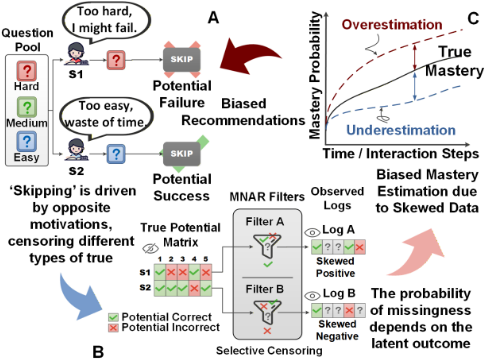
However, despite the rapid progress of deep learning-based KT models [Piech et al., 2015; Pandey and Karypis, 2019; Ghosh et al., 2020; Huang et al., 2023; Cui et al., 2025], their predictions often exhibit systematic deviation from students' actual knowledge. This discrepancy raises a fundamental question: are current KT models truly tracing students' knowledge, or just fitting their observed behaviors?
The reason for this discrepancy lies in the nature of the data on which current KT models are trained. The recorded data exhibit bias since whether student-question interactions are observed may depend on the students' ability and the questions' difficulty, a phenomenon known as the Missing Not At Random (MNAR) property. Taking Fig. 1 as an example, in online learning scenarios, students often strategically skip questions they deem "too difficult" or "boring" [Liu et al., 2025]. This behavior causes a lack of specific question types in the data. Ignoring this missingness mechanism leads standard KT models to confound genuine knowledge states with interaction patterns, thereby introducing severe selection bias. This results in skewed proficiency estimates and diminished generalization capabilities. The issue is further compounded in adaptive systems, since recommendations are tailored to the student's estimated level via the Zone of Proximal Development (ZPD) [Vygotsky et al., 1978]: biased estimates trigger biased recommendations, creating a feedback loop that exacerbates the bias [Carless, 2019].
Addressing such a selection bias necessitates disentangling a student's actual performance from the observation probability. This requires modeling two factors: which interactions are logged and what the responses would have been for unlogged interactions. Accordingly, we adopt a Doubly Robust (DR) risk estimator that integrates selection correction via Inverse Propensity Weighting (IPW) [Schnabel et al., 2016; Thomas and Brunskill, 2016] and potential performance estimation via Error Imputation (EIB) [Steck, 2013]. This construction enjoys the double robustness property: the resulting risk estimate is unbiased as long as either the propensity model or the imputation model is accurate. Nevertheless, directly applying DR in KT can be unstable: the training loss is prone to oscillation if imputation models are inaccurate [Wang et al., 2019]. This issue is particularly critical in educational logs where responses are inherently noisy due to guessing and slipping [Ma et al., 2024; Baker et al., 2008b; Wise, 2017], and such noise triggers error propagation and accumulation throughout deep sequential models, leading to significant error amplification.
To bridge this gap, we propose a Temporal Smoothness Doubly Robust (TSDR) learning framework for knowledge tracing. 1 Rather than treating the instability as an inevitable side effect, we derive a generalization bound specifically for the KT context. This theoretical analysis reveals that the estimation risk is dominated by the instability of imputation errors. Guided by this insight, we design a joint learning paradigm where the KT predictor and the imputation model are co-optimized. Crucially, we introduce a temporal smoothness constraint to regularize the latent trajectory, which effectively tightens the generalization bound and suppresses variance, thereby preserving the unbiased nature of the DR estimator while ensuring training stability. Overall, the main contributions of this paper are summarized as follows:
- We tackle the selection bias in KT induced by the nonrandom nature of exercise recommendations and student engagement choices. By adopting a causal inference perspective, we model the data generation process and propose a DR estimator to obtain unbiased mastery estimates.
- We propose TSDR, a model-agnostic DR framework for bias correction that incorporates temporal smoothing to mitigate variance-related stochastic deviations. Supported by the proposed generalization bound, we employ a joint learning paradigm to co-optimize the KT and imputation models, ensuring robust performance.
- We conduct extensive experiments on 9 real-world benchmark datasets. The empirical results validate the efficacy of our framework, showing that TSDR improves the performance of various state-of-the-art KT baselines.
1 The extended version is available at https://arxiv.org/pdf/2605. 05958
These findings highlight the practical value of addressing selection bias in knowledge tracing.
2 RelatedWork
2.1 Classic Knowledge TracingModels
Early research in knowledge tracing is based on probabilistic graphical models, such as BKT [Corbett and Anderson, 1994]. BKT leverages Hidden Markov Models to characterize knowledge state transitions, and Item Response Theory (IRT) [Baker, 2001], which focuses on modeling item difficulty and student ability. After that, the advent of deep learning catalyzed a profound paradigm shift. DKT [Piech et al., 2015] pioneered the use of Recurrent Neural Networks to capture the hidden dynamics of knowledge acquisition within student interaction sequences, demonstrating strong adaptability in handling the complexities of realworld scenarios. Subsequently, the research paradigm gravitated towards Transformer-based architectures [Vaswani et al., 2017] for their superior ability to capture long-range dependencies. For instance, Self-Attentive Knowledge Tracing (SAKT) [Pandey and Karypis, 2019] first applied selfattention mechanisms to a student's historical interaction sequence to dynamically weigh the relevance of past exercises. AKT [Ghosh et al., 2020] further refined this by incorporating contextual information from the items themselves to mitigate interference from irrelevant exercises. More recent work has been dedicated to augmenting attention mechanisms to overcome their native inability to capture the dynamics of human forgetting or to robustly handle sequences of long lengths [Li et al., 2024; Im et al., 2023]. While their approaches differ, a significant body of work increasingly seeks to enhance model predictive performance from the perspective of learning high-quality representations for knowledge concepts or exercises. For instance, some studies have introduced Graph Neural Networks to model relationships among knowledge concepts [Nakagawa et al., 2019], while others have considered relations between knowledge concepts and exercises [Mao et al., 2025], among other complex relationships.
However, these methods largely overlook systematic selection bias from non-random assignments, limiting their ability to generalize to counterfactual scenarios.
2.2 Bias and Debiasing in Knowledge Tracing
A central challenge in the development of robust Knowledge Tracing (KT) models is the mitigation of various biases that can compromise their validity. Existing research has predominantly focused on two key areas: first, addressing the inherent noise present within student interaction data; and second, preventing the model from learning spurious correlations during the training process.
Debiasing from Noise in Student Responses. The first major line of research targets the inherent noise in student response data, which can distort the model's inference of a student's true knowledge state. This noise often stems from aberrant student behaviors. Early models explicitly incorporated parameters for guessing and slipping to account for such behaviors [Baker et al., 2008b; Baker et al., 2008a;
Zambrano et al., 2024; Barrett et al., 2024]. More recent work has explored nuanced modeling of factors like student disengagement [Gorgun and Bulut, 2022] and added small perturbations to input embeddings [Guo et al., 2021] to improve robustness. State-of-the-art approaches now employ adversarial training and contrastive learning to generate debiased knowledge representations that are resilient to abnormal responses, thereby isolating the most reliable signals for prediction [Lv et al., 2025; Ma et al., 2024], also acknowledging that student actions do not always directly reflect their knowledge [Lv et al., 2025]. While mitigating response noise, they focus on denoising rather than data recovery, failing to account for selection bias from non-random missingness.
Addressing Spurious Correlations and Causal Confusion. The second major area of research addresses the risk of the model learning spurious correlations from confounding factors, which is often termed "causal confusion" [de Haan et al., 2019]. This occurs when a model learns shortcuts from data artifacts instead of isolating the student's true knowledge. These confounders can stem from various sources, including the model's own architectural limitations. To counteract confounding more comprehensively, researchers have utilized a spectrum of techniques, many of which are predicated on the principles of causal inference. For instance, to address confounding from the imbalanced informativeness of historical responses, DR4KT introduces a reweighting framework [Cui et al., 2025]. Other approaches use formal causal modeling to disentangle effects. The CORE framework mitigates answer bias by modeling and subtracting the direct causal effect of the question on the response [Cui et al., 2023]. Similarly, DisKT uses a disentangled modeling approach and a causal subtraction mechanism to remove confounding from uneven performance distributions across concepts [Zhou et al., 2025]. For more complex scenarios involving unobserved confounders, recent work has leveraged the front-door criterion from causal inference, implementing it through causal self-attention mechanisms to identify the true, unconfounded pathway from knowledge to performance [Huang et al., 2024]. While recent causal-aware approaches attempt to mitigate specific confounders, they primarily focus on feature-level disentanglement rather than correcting the systemic selection bias in the data generation process.
2.3 MNAR and DRDebiasing
While existing KT approaches address biases regarding what is recorded and how it is modeled, they largely overlook a fundamental bias rooted in why interactions are recorded: selection bias. This challenge is closely related to the MNAR problem in Recommender Systems (RS), where doubly robust learning mitigates selection bias by combining propensity weighting with error imputation [Dud´ık et al., 2011; Wang et al., 2019]. Beyond RS, DR has also been explored in structured observational settings such as networked interference [Chen et al., 2024]. Similar concerns arise in timeseries imputation, where causal perspectives emphasize missing mechanisms in temporal data [Cai et al., 2025]. However, KT differs from these settings by modeling evolving knowledge states rather than static preferences, networked effects, or imputed values. Directly applying existing DR estimators to KT may therefore cause high-variance corrections and error accumulation along the learning sequence. We thus adapt DR to KT and introduce temporal smoothness to stabilize sequential training.
3 ProblemFormulation
The objective of KT is to predict a student's performance on an upcoming question by modeling their knowledge state from past interactions. Without loss of generality, we define a student's historical interaction sequence as Seqt := {(c1, r1), (c2, r2), . . . , (ct, rt)}, where ct and rt denote the concept from the concept set C and the binary response correctness (rt ∈ {0, 1}) at time step t respectively. Given the next concept ct+1, the KT model aims to first estimate the student's latent knowledge state ˆht = fθ(Seqt), and then use this state to predict the probability of a correct answer, ˆ rt+1 = gϕ(ˆht, ct+1). The model parameters θ and ϕ are typically optimized by minimizing the prediction error, e.g., binary cross-entropy (BCE), on the observed data.
Since interactions are selectively acquired (MNAR) rather than random based on recommendation policies or student preferences, minimizing error on observed data results in a biased estimator. We typically analyze this bias and derive a causal-aware solution to mitigate it, given the students' historical interaction sequences data.
4 Theoretical Analysis
To address the selection bias identified in the problem formulation, we reframe the KT task from the perspective of counterfactual estimation [Pearl et al., 2016] for model performance. We formalize the discrepancy between the ideal true risk and the naive empirical risk, and then derive the DR estimator as a principled solution.
4.1 Revisiting Estimation Problem
Let data Dfull = {(t, c) | 1 ≤ t ≤ T, c ∈ C} with T being the maximum length of the interaction sequence denote the ideal full set of potential interactions for a student sequence. We define the true risk Rtrue as the average prediction error over this full distribution of data:
where N = (T - 1) × |C| represents the total number of prediction targets, and et+1,c = -(rt+1,c log(ˆ rt+1,c) + (1 - rt+1,c) log(1 - ˆ rt+1,c)) is the BCE loss for skill c at time t.
In practice, we only observe a subset of interactions where the observation indicator ot+1,c = 1. The Naive Estimator, which corresponds to the standard KT objective, calculates the risk solely on observed data:
Since the observation probability, i.e., propensity pt+1,c = P (ot+1,c = 1|ht, c), is non-uniform due to the MNAR mechanism, E[ ˆRnaive] ̸= Rtrue. This estimation bias misguides the optimization, causing the model to overfit to the specific selection policy rather than learning the true knowledge dynamics.
4.2 Constructing DR Estimator
To obtain an unbiased estimate of Rtrue, we combine two distinct approaches: the imputation-based method modeling ˆ et+1,c and the propensity-based method modeling ˆ pt+1,c.
We introduce the DR estimator, denoted as ˆRDR. Instead of viewing it merely as a loss function, we define it as a statistical estimator for the unobserved true risk:
where N represents the total number of entries, T is the maximum sequence length, and C denotes the set of knowledge concepts. The intuition behind this formulation is to leverage the imputed error ˆ et+1,c as a baseline estimate for the risk on the full distribution. Since the imputation model alone may be biased, the second term, ot+1,c ˆ pt+1,c (et+1,c - ˆ et+1,c), acts as a bias correction. It adjusts the baseline using the residual between the true error et+1,c and the imputed error ˆ et+1,c for observed interactions, weighted by the inverse propensity. This structure explicitly demonstrates the "double robustness" property: if the imputation is accurate (i.e., ˆ e ≈ e), the correction term vanishes, effectively minimizing variance; conversely, if the propensity model is accurate, the correction term ensures the estimator remains unbiased even if the baseline imputation is poor.
4.3 Theoretical Guarantee fromBias Analysis
To show why this estimator is preferred, we analyze its bias with respect to the true risk. The bias is defined as the difference between the expected value of the estimator over the observation distribution O and the true target. The complete theoretical framework and main results are presented in Appendix E, with detailed proofs provided in Appendix F.
For clearly, we define the imputation error as δt,c := et,c - ˆ et,c and the propensity error as ∆t,c := 1 - pt,c ˆ pt,c .
Lemma 1 (Bias of the DR Estimator). The bias of the DR estimator is bounded by the product of the errors of the two auxiliary models:
Proof. (Sketch) By linearity of expectation, EO[ot,c] = pt,c. Substituting this into the expectation of ˆRDR:
Subtracting Rtrue = 1N ∑ et+1,c from this expectation yields the bias term proportional to δt+1,c · ∆t+1,c.
Lemma 1 confirms the Double Robustness property: the estimation is unbiased if either the propensity model or the imputation model is accurate. More attractively, the bias depends on a product of the two model errors. When both models are learned with sufficiently expressive estimators (e.g., neural networks) and their estimation errors can be controlled, the DR estimator achieves a second-order error decay, resulting in an error that is smaller than that of estimators typically dominated by a single estimation error.
4.4 Generalization Bound and Variance Control
While the DR estimator theoretically guarantees unbiasedness under mild conditions, its practical application on finite interaction sequences is often hindered by stochastic fluctuations. To rigorously quantify this risk, we derive a generalization bound that accounts for both the bias and the concentration properties of the estimator.
Theorem 1 (Generalization Bound). For any finite hypothesis space H, with probability at least 1 - η, the true risk of the optimal prediction is bounded by:
Proof. (Sketch) The bound is derived by decomposing the risk into bias and variance components. The bias term follows from Lemma 1. The variance term is bounded using the Azuma-Hoeffding inequality [Azuma, 1967], accounting for the sequential nature of student interactions, combined with a union bound over H.
Theorem 1 reveals a critical insight: the total generalization error is dominated not just by the bias product but also by the Variance Term, which scales with the squared imputation error δ2 t,c . Inaccuracy in the imputation model results in large error deviations δu,i, which loosens the generalization bound and in turn leads to unstable training. To minimize δt,c and tighten the generalization bound, we introduce a temporal smoothness constraint (Section 5.1). This constraint works by regularizing the latent trajectory. Furthermore, we adopt a joint learning approach to couple the optimization processes (Section 5.2).
5 Method
We re-conceptualize the challenge of debiasing a temporal learning process, treating the knowledge state at each distinct time step as a temporal "user" and operating under the principle that each momentary state possesses its own distinct learning preferences and biases. Adopting this perspective allows us to apply a DR strategy to learn from these statespecific interactions in a robust manner.
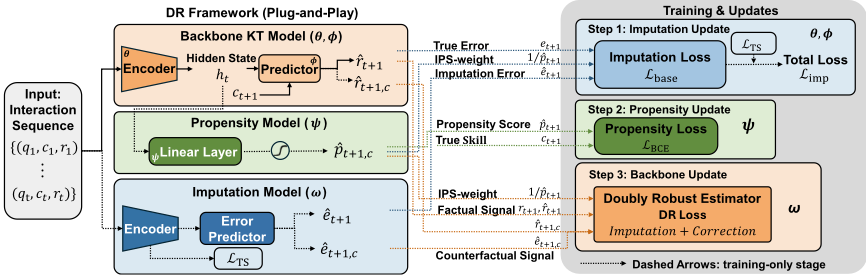
Temporal Smoothness constraint on the latent states himp t . This aligns with the Power Law of Practice [Newell and Rosenbloom, 2013], which characterizes skill acquisition as a smooth, continuous power-function trajectory rather than a series of abrupt changes. By explicitly restricting the path length of Himp , this constraint reduces the Rademacher complexity and tightens the generalization bound. The total loss function is formulated as:
where λ is the coefficient controlling the strength of the smoothness regularization.
KT Model with Doubly Robust Estimator
As defined in our problem formulation, the core of our approach is the KT model, which consists of an encoder fθ and a predictor gϕ. The encoder fθ(Seqt) processes the interaction history to produce the knowledge state ˆht. The predictor gϕ(ˆht, ct+1) then outputs the probability of a correct answer ˆ rt+1,c. Our ultimate goal is to learn the parameters θ and ϕ in an unbiased manner. The vanilla prediction loss for a single step is given by the BCE:
Doubly Robust Estimator. Adhering to the principle of double robustness, we train the KT model by minimizing the doubly robust loss instead of the naive BCE loss. As restated in Eq. (3), the loss is given by:
where wt+1,c = ot+1,c/ˆ pt+1,c and ∆et+1,c = et+1,c-ˆ et+1,c.
5.2 Joint Learning Approach
To mitigate the impact of imputation errors on prediction, we derive a generalization bound (Appendix F) following [Wang et al., 2019]. Motivated by this theoretical insight, we cooptimize the parameters (θ, ϕ, ψ, ω) via an alternating strategy, as detailed in Algorithm 1. This joint procedure allows the models to mutually regularize each other, leading to a more robust estimation of the true prediction inaccuracy and ultimately, a more effective and unbiased KT model.
5.1 Model Architecture
We propose a Temporal-Smooth Doubly Robust (TSDR) learning framework that jointly learns a propensity model, an error imputation model, and a KT model. The overall architecture of our framework is presented in Figure 2.
Propensity Model for Interaction Selection
We learn the propensity score to model the interaction probability as:
We model this as a Multivariate Bernoulli distribution for all concepts using a sigmoid output layer. The model is trained via BCE loss, treating unobserved concepts as implicit negatives.
Error Imputation Model for Counterfactual Prediction
The second component is the error imputation model, parameterized by ω. Unlike the prediction model that focuses on knowledge mastery, this module aims to capture the dynamics of prediction residuals. To decouple these distinct objectives, we employ a separate encoder for the imputation task. Let himp t denote the imputation-specific latent state derived from the interaction sequence Seqt:
where Encω denotes the internal knowledge state extractor of the imputation model, similar to the KT backbone. The imputed error ˆ et+1 is then predicted based on this state and a potential next concept:
Optimization Objective. The training of the imputation model consists of two components. First, the model aims to regress the true prediction errors et+1 based on the observed data. To address the distribution shift, we adopt an Inverse Propensity Score (IPS) weighted Mean Squared Error (MSE) as the base objective:
where we focus solely on observation loss. Then, guided by the theoretical analysis in Theorem 1, we incorporate a
Algorithm 1 Joint Learning with TSDR
Input: Observed interaction data Dobs, Concept set C.
Parameters: Learning rates α.
Output: Trained KT model parameters θ, ϕ
- 1: Initialize parameters θ, ϕ, ψ, ω.
- 2: while stopping criteria not met do
- 3: Sample a mini-batch B fromDobs.
- 4: /* Phase 1: Update Auxiliary Models */
- 5: Update imputation model: ω ←ω -α∇ωLimp(ω)
- 6: Update propensity model: ψ ←ψ -α∇ψLprop(ψ)
- 7: /* Phase 2: Update the KT Model */
- 8: Based on observed history in B, compute counterfactual errors ˆ et+1,c for all concepts c ∈ C.
- 9: Calculate LDR(θ, ϕ) by summing errors over C.
- 10: θ, ϕ← (θ, ϕ) -α∇θ,ϕLDR(θ, ϕ)
- 11: end while
- 12: return Optimized KT parameters θ, ϕ.
6 Experiment
In this section, our evaluation aims to answer the following research questions:
- RQ1: Does TSDR consistently enhance the performance of SOTA baselines on real-world datasets?
- RQ2: Can TSDR mitigate performance degradation under varying MNAR levels in controlled simulations?
- RQ3: How sensitive is the model to the intensity of the temporal smoothness constraint?
6.1 Experimental Setup
BenchmarkDataset. We evaluate the proposed framework on 9 publicly available benchmark datasets covering diverse domains: Spanish 2 , ASSISTments17 3 , Slepemapy 4 , Algebra05 5 , [Prob, Linux, Database, Comp] 6 and EdNet 7 . These datasets vary significantly in scale and density, offering a comprehensive testbed for robustness. Details are available in Appendix A.
Synthetic Dataset. To evaluate robustness against the bias, we generated 6 synthetic datasets using a controllable MNAR mechanism with bias degrees γ ∈ [0, 0.999]. Generation details and statistics are provided in Appendix B.
Baselines. To validate TSDR as a generic strategy, we apply it to 6 SOTA baselines (DKT [Piech et al., 2015], AKT [Ghosh et al., 2020], simpleKT [Liu et al., 2023], FoLiBiKT [Im et al., 2023], SparseKT [Huang et al., 2023], and DisKT [Zhou et al., 2025]) and compare them against their original versions. Details of baselines are provided in Appendix C.
2 https://github.com/robert-lindsey/WCRP
3 https://sites.google.com/view/assistmentsdatamining/dataset
4 ttps://www.fi.muni.cz/adaptivelearning/?a=data
5 https://pslcdatashop.web.cmu.edu/KDDCup/
6 https://github.com/wahr0411/PTADisc Implementation Details. We adopt the pipeline from the work in [Zhou et al., 2025] using student-stratified 5-fold cross-validation. A 10% validation set determines early stopping after 15 epochs of non-improvement. We truncate sequences to the latest 50 interactions and train models using Adam with a learning rate of 0.001, a batch size of 64, and an embedding dimension of 64. The random seed and dropout rate are set to 42 and 0.05, respectively. Furthermore, we tune the hyperparameter λ that controls loss strength within [0.1, 0.3, 0.5, 0.7, 1, 2]. All experiments run on an NVIDIA RTX 4090 GPU and are evaluated via AUC, ACC, and RMSE following [Shen et al., 2021; Im et al., 2023; Zhou et al., 2025]. The source code and supplementary material are available at https://github.com/plzhan/TSDR.
7 https://github.com/riiid/ednet
6.2 Results
Empirical Study (RQ1)
Table 1 summarizes the performance of TSDR applied to six baseline models across nine datasets. Comparing the original performance with the TSDR-enhanced results, we have the following observations: 1) Regarding the primary evaluation metric of AUC, TSDR yields improvements across diverse model architectures. These gains are particularly notable on datasets characterized by high sparsity or strong student autonomy. For instance, TSDR improves AKT by 5.06% on the Prob dataset and SparseKT by 4.76% on Assist17. These results suggest that our framework helps recover mastery patterns by mitigating bias in MNAR data. 2) The magnitude of improvement appears to correlate with the data collection mechanism. While TSDR provides substantial gains on openended platforms, the improvements on EdNet and Linux are relatively limited, as exemplified by an AUC gain of approximately 1% on EdNet. This behavior is likely attributable to EdNet's specific design, which enforces a mandatory "bundle" completion policy [Choi et al., 2020]. Such structural constraints tend to limit selection bias, rendering the missing data mechanism closer to random compared to other datasets, thereby reducing the potential scope for bias correction. 3) Regarding secondary metrics such as ACC and RMSE, TSDR consistently improves calibration. Even on datasets where AUC gains plateau, such as Linux and Database, TSDR frequently reduces RMSE and improves ACC. A specific example is the 1.70% reduction for SparseKT on Linux. This indicates that counterfactual imputation may contribute to bettercalibrated probability estimates, even when the ranking performance remains stable.
Experiments on Synthetic Data (RQ2)
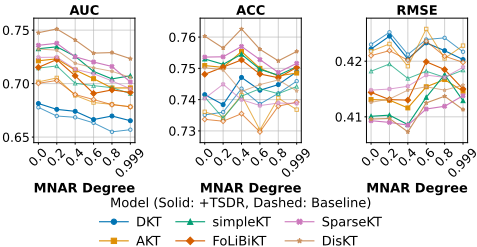
To evaluate robustness, we tested TSDR on synthetic datasets with MNAR degrees (γ) ranging from 0.0 to 0.999. As shown in Figure 3, we observe varying degrees of performance degradation across all baselines as the bias severity increases, particularly visible in AUC. However, equipping SOTA models with TSDR consistently yields improvements across the entire spectrum. Specifically for RMSE, with the exception of DKT, TSDR is highly effective at reducing error when MNAR is low, although this advantage diminishes slightly beyond γ > 0.8. Since TSDR is a model-agnostic strategy, it relies on the backbone's modeling capacity to maximize efficacy: we observe the most significant relative lift in AKT, while DisKT achieves the best overall performance, likely attributed to its disentangled modeling and causal subtraction mechanism [Zhou et al., 2025]. Furthermore, the positive results at γ = 0.0 indicate that our framework is "safe", avoiding performance degradation even when selection bias is minimal, likely due to the regularization effect of the counterfactual imputation (see Appendix B for numerical results).
| Dataset | Metric | DKT AKT | simpleKT | FoLiBiKT | SparseKT | DisKT |
|---|---|---|---|---|---|---|
| Spanish AUC ACC RMSE | ↑ 0.7798 / 0.8018 (↑ 2.82%) ↑ 0.7250 / 0.7362 (↑ 1.54%) ↓ 0.4301 / 0.4195 (↓ 2.46%) | 0.7967 / 0.8034 (↑ 0.84%) 0.7386 / 0.7420 (↑ 0.46%) 0.4294 / 0.4241 (↓ 1.23%) | 0.8098 / 0.8188 (↑ 1.11%) 0.7992 / 0.8067 (↑ 0.94%) 0.7405 / 0.7494 (↑ 1.20%) 0.7332 / 0.7388 (↑ 0.76%) 0.4214 / 0.4186 (↓ 0.66%) 0.4292 / 0.4264 (↓ 0.65%) | 0.8019 / 0.8197 (↑ 2.22%) 0.7324 / 0.7510 (↑ 2.54%) 0.4319 / 0.4204 (↓ | 0.8243 / 0.8259 (↑ 0.7520 / 0.7582 (↑ 2.66%) | 0.19%) 0.82%) 0.4199 / 0.4096 (↓ 2.45%) |
| ASSISTments17 AUC ACC RMSE | 0.6358 / 0.6472 (↑ 1.79%) 0.6172 / 0.6249 (↑ 1.25%) 0.4807 / 0.4774 (↓ 0.69%) | 0.6843 / 0.7012 (↑ 2.47%) 0.6525 / 0.6617 (↑ 1.41%) 0.4762 / 0.4651 (↓ 2.33%) | 0.6692 / 0.6905 (↑ 3.18%) 0.6430 / 0.6590 (↑ 2.49%) 0.4791 / 0.4682 (↓ 2.28%) | 0.6826 / 0.6994 (↑ 2.46%) 0.6538 / 0.6619 (↑ 1.24%) 0.4750 / 0.4659 (↓ 1.92%) | 0.6800 / 0.7124 (↑ 4.76%) 0.6442 / 0.6693 (↑ 3.90%) 0.4767 / 0.4624 (↓ 3.00%) | 0.7223 / 0.7324 (↑ 1.40%) 0.6621 / 0.6784 (↑ 2.46%) 0.4740 / 0.4641 (↓ 2.09%) |
| Slepemapy AUC ACC RMSE | 0.6806 / 0.6937 (↑ 0.7740 / 0.7795 (↑ 0.4021 / 0.3977 (↓ | 1.92%) 0.7127 / 0.7208 (↑ 1.14%) 0.71%) 0.7796 / 0.7833 (↑ 0.47%) 1.09%) 0.3948 / 0.3915 (↓ 0.84%) | 0.7108 / 0.7143 (↑ 0.49%) 0.7743 / 0.7830 (↑ 1.12%) 0.3969 / 0.3927 (↓ 1.06%) | 0.7120 / 0.7199 (↑ 1.11%) 0.7799 / 0.7843 (↑ 0.56%) 0.3962 / 0.3915 (↓ 1.19%) | 0.7478 / 0.7758 (↑ 3.74%) 0.7845 / 0.7944 (↑ 1.26%) 0.3866 / 0.3768 (↓ 2.53%) | 0.7283 / 0.7345 (↑ 0.85%) 0.7805 / 0.7861 (↑ 0.72%) 0.3901 / 0.3886 (↓ 0.38%) |
| Algebra05 AUC ACC RMSE | 0.7538 / 0.7669 (↑ 1.74%) 0.7748 / 0.7852 (↑ 1.34%) 0.4013 / 0.3895 (↓ 2.94%) | 0.7698 / 0.7797 (↑ 1.29%) 0.7794 / 0.7825 (↑ 0.40%) 0.3955 / 0.3937 (↓ 0.46%) | 0.7677 / 0.7809 (↑ 1.71%) 0.7734 / 0.7834 (↑ 1.29%) 0.3980 / 0.3901 (↓ 1.98%) | 0.7718 / 0.7781 (↑ 0.82%) 0.7813 / 0.7857 (↑ 0.56%) 0.3911 / 0.3904 (↓ 0.18%) | 0.7677 / 0.7772 (↑ 1.24%) 0.7694 / 0.7876 (↑ 2.37%) 0.3954 / 0.3891 (↓ 1.59%) | 0.7769 / 0.7862 (↑ 1.20%) 0.7817 / 0.7912 (↑ 1.22%) 0.3958 / 0.3886 (↓ 1.82%) |
| Prob AUC ACC RMSE | 0.7278 / 0.7319 (↑ 0.56%) 0.6770 / 0.6822 (↑ 0.77%) 0.4527 / 0.4510 (↓ 0.38%) | 0.7347 / 0.7719 (↑ 5.06%) 0.6916 / 0.7136 (↑ 3.18%) 0.4527 / 0.4407 (↓ 2.65%) | 0.7447 / 0.7716 (↑ 3.61%) 0.6956 / 0.7110 (↑ 2.21%) 0.4556 / 0.4466 (↓ 1.98%) | 0.7409 / 0.7703 (↑ 3.97%) 0.6956 / 0.7126 (↑ 2.44%) 0.4501 / 0.4403 (↓ 2.18%) | 0.7597 / 0.7775 (↑ 2.34%) 0.7062 / 0.7197 (↑ 1.91%) 0.4475 / 0.4441 (↓ 0.76%) | 0.7617 / 0.7870 (↑ 3.32%) 0.7023 / 0.7262 (↑ 3.40%) 0.4460 / 0.4364 (↓ 2.15%) |
| Linux AUC ACC RMSE | 0.7477 / 0.7521 (↑ 0.59%) 0.7690 / 0.7708 (↑ 0.23%) 0.4009 / 0.3996 (↓ 0.32%) | 0.8164 / 0.8162 (↓ 0.02%) 0.7975 / 0.7979 (↑ 0.05%) 0.3760 / 0.3750 (↓ 0.27%) | 0.8151 / 0.8162 (↑ 0.13%) 0.7963 / 0.7980 (↑ 0.21%) 0.3763 / 0.3751 (↓ 0.32%) | 0.8162 / 0.8163 (↑ 0.01%) 0.7970 / 0.7976 (↑ 0.08%) 0.3759 / 0.3750 (↓ 0.24%) | 0.8315 / 0.8413 (↑ 1.18%) 0.8039 / 0.8084 (↑ 0.56%) 0.3702 / 0.3639 (↓ 1.70%) | 0.8269 / 0.8278 (↑ 0.11%) 0.8045 / 0.8070 (↑ 0.31%) 0.3705 / 0.3692 (↓ 0.35%) |
| Database AUC ACC RMSE | 0.7467 / 0.7493 (↑ 0.35%) 0.8294 / 0.8285 (↓ 0.11%) 0.3562 / 0.3561 (↓ 0.03%) | 0.8064 / 0.8079 (↑ 0.19%) 0.8383 / 0.8432 (↑ 0.58%) 0.3415 / 0.3380 (↓ 1.02%) | 0.8060 / 0.8067 (↑ 0.09%) 0.8395 / 0.8435 (↑ 0.48%) 0.3408 / 0.3382 (↓ 0.76%) | 0.8067 / 0.8071 (↑ 0.05%) 0.8392 / 0.8438 (↑ 0.55%) 0.3410 / 0.3381 (↓ 0.85%) | 0.8359 / 0.8422 (↑ 0.75%) 0.8478 / 0.8498 (↑ 0.24%) 0.3302 / 0.3274 (↓ 0.85%) | 0.8133 / 0.8156 (↑ 0.28%) 0.8460 / 0.8483 (↑ 0.27%) 0.3360 / 0.3343 (↓ 0.51%) |
| Comp AUC ACC RMSE | 0.7073 / 0.7157 (↑ 1.19%) 0.8056 / 0.8077 (↑ 0.26%) 0.3794 / 0.3773 (↓ 0.55%) | 0.7912 / 0.7958 (↑ 0.58%) 0.8201 / 0.8232 (↑ 0.38%) 0.3591 / 0.3558 (↓ 0.92%) | 0.7929 / 0.7958 (↑ 0.37%) 0.8195 / 0.8243 (↑ 0.59%) 0.3585 / 0.3558 (↓ 0.75%) | 0.7914 / 0.7960 (↑ 0.58%) 0.8207 / 0.8245 (↑ 0.46%) 0.3587 / 0.3552 (↓ 0.98%) | 0.8142 / 0.8263 (↑ 1.49%) 0.8266 / 0.8314 (↑ 0.58%) 0.3520 / 0.3454 (↓ 1.87%) | 0.7986 / 0.8037 (↑ 0.64%) 0.8111 / 0.8298 (↑ 2.31%) 0.3656 / 0.3529 (↓ 3.47%) |
| EdNet AUC ACC RMSE | 0.6602 / 0.6678 (↑ 1.15%) 0.6189 / 0.6270 (↑ 1.31%) 0.4792 / 0.4769 (↓ 0.48%) | 0.6868 / 0.6936 (↑ 0.99%) 0.6288 / 0.6351 (↑ 1.00%) 0.4848 / 0.4822 (↓ 0.54%) | 0.6924 / 0.6977 (↑ 0.77%) 0.6324 / 0.6451 (↑ 2.01%) 0.4872 / 0.4864 (↓ 0.16%) | 0.6885 / 0.6934 (↑ 0.71%) 0.6337 / 0.6402 (↑ 1.03%) 0.4813 / 0.4783 (↓ 0.62%) | 0.7282 / 0.7365 (↑ 1.14%) 0.6698 / 0.6800 (↑ 1.52%) 0.4744 / 0.4672 (↓ 1.52%) | 0.7273 / 0.7239 (↓ 0.47%) 0.6614 / 0.6698 (↑ 1.27%) 0.4846 / 0.4786 (↓ 1.24%) |
Sensitivity Analysis (RQ3)
We focus on the prob dataset, where our model achieves superior performance, to highlight the experimental results. Figure 4 shows the impact of the hyperparameter λ on TSDR. We observe that incorporating the temporal smoothness constraint yields superior performance compared to the vanilla DR (λ = 0) within an appropriate range, while outperforming the original baselines. The method exhibits strong robustness, achieving a stable "sweet spot" generally in λ ∈ [0.3, 1.0]. Despite minor fluctuations in the case, e.g., DKT at λ = 0.7, the overall performance remains high, indicating that TSDR
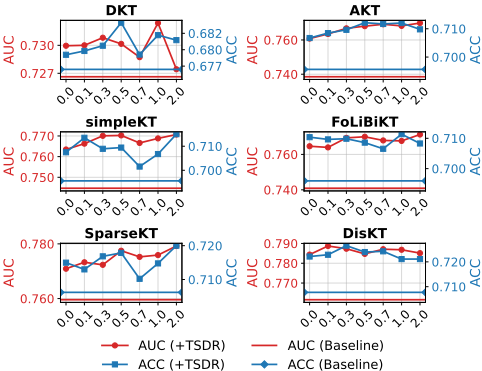
is effective without requiring meticulous tuning.
7 Conclusion
This paper introduces TSDR, a framework that addresses selection bias in knowledge tracing by integrating a doubly robust estimator with a theoretically-guided temporal smoothness constraint. Experiments on multiple benchmarks demonstrate its superior accuracy and stability over state-ofthe-art methods. We acknowledge that the joint optimization of auxiliary modules introduces training overhead; however, this cost is confined to the offline phase and does not compromise online inference efficiency. Overall, TSDR offers a principled paradigm for learning from observational data, paving the way for more reliable intelligent tutoring systems.
Acknowledgments
This research was supported in part by National Science and Technology Major Project (2021ZD0111501), Natural Science Foundation of China (U24A20233, 62206064, 62206061, 62476163, 62406078, 62406080), the Guangdong Basic and Applied Basic Research Foundation (2025A1515010172, 2023B1515120020), the Guangzhou Basic and Applied Basic Research Foundation (2024A04J4384), and CCF-DiDi GAIA Collaborative Research Funds (CCF-DiDi GAIA 202521).
Contribution Statement
Peilin Zhan, Wei Chen, and Weilin Chen contributed equally to this work and should be regarded as co-first authors. They jointly contributed to the conceptualization, methodology design, implementation, experimental analysis, and manuscript writing. All authors discussed the results and approved the final manuscript.
@inproceedings{ijcai2026p415,
  title     = {Temporal Smoothness Doubly Robust Learning for Debiased Knowledge Tracing},
  author    = {Zhan, Peilin and Chen, Wei and Chen, Weilin and Pan, Shuyi and Cai, Ruichu},
  booktitle = {Proceedings of the Thirty-Fifth International Joint Conference on
               Artificial Intelligence, {IJCAI-26}},
  publisher = {International Joint Conferences on Artificial Intelligence Organization},
  editor    = {Diego Calvanese},
  pages     = {3728--3736},
  year      = {2026},
  month     = {8},
  note      = {Main Track},
  doi       = {10.24963/ijcai.2026/415},
  url       = {https://doi.org/10.24963/ijcai.2026/415},
}
TY - CPAPER TI - Temporal Smoothness Doubly Robust Learning for Debiased Knowledge Tracing AU - Zhan, Peilin AU - Chen, Wei AU - Chen, Weilin AU - Pan, Shuyi AU - Cai, Ruichu T2 - Proceedings of the Thirty-Fifth International Joint Conference on Artificial Intelligence, IJCAI-26 PB - International Joint Conferences on Artificial Intelligence Organization PY - 2026 SP - 3728 EP - 3736 DO - 10.24963/ijcai.2026/415 UR - https://doi.org/10.24963/ijcai.2026/415 ER -Copied
Machine-readable versions of this paper, for tools and AI agents:





