
Geodesic Expert Routing for Unbiased Knowledge Distillation in Recommendation
Proceedings of the Thirty-Fifth International Joint Conference on Artificial Intelligence. Main Track. Pages 3250-3258.
https://doi.org/10.24963/ijcai.2026/361
Keywords
- Data Mining: Recommender systems
- Machine Learning: Deep learning architectures
Abstract
Knowledge distillation has become a prevalent technique for deploying efficient recommender systems, enabling lightweight student models to approximate the performance of larger teachers. However, we identify a critical issue: distillation systematically amplifies popularity bias, as student models inherit and intensify the popularity-driven shortcuts encoded in teachers trained on interaction data dominated by popular items. To address this limitation, we propose GUIDE (Geodesic aware Unbiased Instructive Distillation with Experts), a collaborative distillation framework that incorporates domain-specific debiasing experts alongside the global teacher. GUIDE tackles two key challenges in this paradigm. First, for expert routing, we introduce Spherical Expert Alignment, which conducts expert-student matching on the spherical manifold with geodesic distance optimization, eliminating magnitude-induced bias and ensuring stable gradient flow. Second, for context fusion, we design a Meta-Debiasing Gate that dynamically arbitrates teacher-expert influence based on real-time user-item context through end-to-end meta-learning. Extensive experiments on multiple real-world datasets demonstrate that GUIDE significantly mitigates popularity bias while preserving recommendation accuracy, with state-of-the-art trade-offs among efficiency, accuracy, and fairness. The code and data are available at:https://github.29com/zx19971219/GUIDE.
- [Abdollahpouri et al., 2019] Himan Abdollahpouri, Robin Burke, and Bamshad Mobasher. Managing popularity bias in recommender systems with personalized re-ranking. In Roman Barták and Keith W. Brawner, editors, Proceedings of the Thirty-Second International Florida Artificial Intel- ligence Research Society Conference, Sarasota, Florida, USA, May 19-22 2019, pages 413-418. AAAI Press, 2019.
- [Abdollahpouri et al., 2021] Himan Abdollahpouri, Masoud Mansoury, Robin Burke, Bamshad Mobasher, and Ed- ward C. Malthouse. User-centered evaluation of popu- larity bias in recommender systems. In Judith Masthoff, Eelco Herder, Nava Tintarev, and Marko Tkalcic, edi- tors, Proceedings of the 29th ACM Conference on User Modeling, Adaptation and Personalization, UMAP 2021, Utrecht, The Netherlands, June, 21-25, 2021, pages 119- 129. ACM, 2021.
- [Chen et al., 2021] Jiawei Chen, Hande Dong, Yang Qiu, Xi- angnan He, Xin Xin, Liang Chen, Guli Lin, and Keping Yang. Autodebias: Learning to debias for recommenda- tion. In SIGIR, pages 21-30. ACM, 2021.
- [Chen et al., 2023a] Gang Chen, Jiawei Chen, Fuli Feng, Sheng Zhou, and Xiangnan He. Unbiased knowledge dis- tillation for recommendation. In WSDM, pages 976-984. ACM, 2023.
- [Chen et al., 2023b] Jiawei Chen, Hande Dong, Xiang Wang, Fuli Feng, Meng Wang, and Xiangnan He. Bias and debias in recommender system: A survey and future directions. ACM Trans. Inf. Syst., 41(3):67:1-67:39, 2023.
- [Deldjoo et al., 2024] Yashar Deldjoo, Zhankui He, Ju- lian J. McAuley, Anton Korikov, Scott Sanner, Arnau Ramisa, René Vidal, Maheswaran Sathiamoorthy, Atoosa Kasirzadeh, and Silvia Milano. A review of modern rec- ommender systems using generative models (gen-recsys). In Ricardo Baeza-Yates and Francesco Bonchi, editors, Proceedings of the 30th ACM SIGKDD Conference on Knowledge Discovery and Data Mining, KDD 2024, Barcelona, Spain, August 25-29, 2024, pages 6448-6458. ACM, 2024.
- [Ding et al., 2022] Sihao Ding, Fuli Feng, Xiangnan He, Jin- qiu Jin, Wenjie Wang, Yong Liao, and Yongdong Zhang. Interpolative distillation for unifying biased and debiased recommendation. In Enrique Amigó, Pablo Castells, Julio Gonzalo, Ben Carterette, J. Shane Culpepper, and Gabriella Kazai, editors, SIGIR '22: The 45th Interna- tional ACM SIGIR Conference on Research and Develop- ment in Information Retrieval, Madrid, Spain, July 11 - 15, 2022, pages 40-49. ACM, 2022.
- [Gao et al., 2023] Chen Gao, Yu Zheng, Nian Li, Yinfeng Li, Yingrong Qin, Jinghua Piao, Yuhan Quan, Jianxin Chang, Depeng Jin, Xiangnan He, and Yong Li. A survey of graph neural networks for recommender systems: Challenges, methods, and directions. Trans. Recomm. Syst., 1(1):1-51, 2023.
- [Gou et al., 2024] Jianping Gou, Liyuan Sun, Baosheng Yu, Lan Du, Kotagiri Ramamohanarao, and Dacheng Tao. Collaborative knowledge distillation via multiknowledge transfer. IEEE Trans. Neural Networks Learn. Syst., 35(5):6718-6730, 2024.
- [Han et al., 2024] Yishan Han, Biao Xu, Yao Wang, and Shanxing Gao. Towards popularity-aware recommenda- tion: A multi-behavior enhanced framework with orthog- onality constraint. CoRR, abs/2412.19172, 2024.
- [He et al., 2022] Ming He, Xinlei Hu, Changshu Li, Xin Chen, and Jiwen Wang. Mitigating confounding bias for recommendation via counterfactual inference. In ECML/PKDD (1), volume 13713 of Lecture Notes in Com- puter Science, pages 524-540. Springer, 2022.
- [Joachims et al., 2018] Thorsten Joachims, Adith Swami- nathan, and Tobias Schnabel. Unbiased learning-to-rank with biased feedback. In Jérôme Lang, editor, Proceed- ings of the Twenty-Seventh International Joint Conference on Artificial Intelligence, IJCAI 2018, July 13-19, 2018, Stockholm, Sweden, pages 5284-5288. ijcai.org, 2018. IJCAI
- [Kang et al., 2020] SeongKu Kang, Junyoung Hwang, Won- bin Kweon, and Hwanjo Yu. DE-RRD: A knowledge dis- tillation framework for recommender system. In CIKM, pages 605-614. ACM, 2020.
- [Kang et al., 2021] SeongKu Kang, Junyoung Hwang, Won- bin Kweon, and Hwanjo Yu. Topology distillation for rec- ommender system. In KDD, pages 829-839. ACM, 2021.
- [Koren et al., 2009] Yehuda Koren, Robert M. Bell, and Chris Volinsky. Matrix factorization techniques for rec- ommender systems. Computer, 42(8):30-37, 2009.
- [Kweon et al., 2021] Wonbin Kweon, SeongKu Kang, and Hwanjo Yu. Bidirectional distillation for top-k recom- mender system. In Jure Leskovec, Marko Grobelnik, Marc Najork, Jie Tang, and Leila Zia, editors, WWW '21: The Web Conference 2021, Virtual Event / Ljubljana, Slove- nia, April 19-23, 2021, pages 3861-3871. ACM / IW3C2, 2021.
- [Lee et al., 2019] Jae-woong Lee, Minjin Choi, Jongwuk Lee, and Hyunjung Shim. Collaborative distillation for top-n recommendation. In ICDM, pages 369-378. IEEE, 2019.
- [Li et al., 2023] Haoxuan Li, Yanghao Xiao, Chunyuan Zheng, and Peng Wu. Balancing unobserved confounding with a few unbiased ratings in debiased recommendations. In WWW, pages 1305-1313. ACM, 2023.
- [Lin et al., 2019] Kun Lin, Nasim Sonboli, Bamshad Mobasher, and Robin Burke. Crank up the volume: Preference bias amplification in collaborative recom- mendation. In RMSE@RecSys, volume 2440 of CEUR Workshop Proceedings. CEUR-WS.org, 2019.
- [Liu et al., 2020] Dugang Liu, Pengxiang Cheng, Zhenhua Dong, Xiuqiang He, Weike Pan, and Zhong Ming. A gen- eral knowledge distillation framework for counterfactual recommendation via uniform data. In SIGIR, pages 831- 840. ACM, 2020.
- [Liu et al., 2021] Dugang Liu, Pengxiang Cheng, Hong Zhu, Zhenhua Dong, Xiuqiang He, Weike Pan, and Zhong Ming. Mitigating confounding bias in recommendation via information bottleneck. In RecSys, pages 351-360. ACM, 2021.
- [Liu et al., 2023] Dugang Liu, Pengxiang Cheng, Hong Zhu, Zhenhua Dong, Xiuqiang He, Weike Pan, and Zhong Ming. Debiased representation learning in recommenda- tion via information bottleneck. Trans. Recomm. Syst., 1(1):1-27, 2023.
- [Ning et al., 2024] Wentao Ning, Reynold Cheng, Xiao Yan, Ben Kao, Nan Huo, Nur Al Hasan Haldar, and Bo Tang. Debiasing recommendation with personal popularity. In WWW, pages 3400-3409. ACM, 2024.
- [Oestreicher-Singer and Sundararajan, 2012] Gal Oestreicher-Singer and Arun Sundararajan. Recom- mendation networks and the long tail of electronic commerce. MIS Q., 36(1):65-83, 2012.
- [Park et al., 2026] Jongwon Park, Minku Kang, Wooseok Sim, Soyoung Lee, and Hogun Park. Federated recom- mender system with data valuation for e-commerce plat- form. Expert Syst. Appl., 298:129695, 2026.
- [Romero et al., 2015] Adriana Romero, Nicolas Ballas, Samira Ebrahimi Kahou, Antoine Chassang, Carlo Gatta, and Yoshua Bengio. Fitnets: Hints for thin deep nets. In ICLR (Poster), 2015.
- [Sarwar et al., 2001] Badrul Munir Sarwar, George Karypis, Joseph A. Konstan, and John Riedl. Item-based collabora- tive filtering recommendation algorithms. In Vincent Y. Shen, Nobuo Saito, Michael R. Lyu, and Mary Ellen Zurko, editors, Proceedings of the Tenth International World Wide Web Conference, WWW 10, Hong Kong, China, May 1-5, 2001, pages 285-295. ACM, 2001.
- [Schnabel et al., 2016] Tobias Schnabel, Adith Swami- nathan, Ashudeep Singh, Navin Chandak, and Thorsten Joachims. Recommendations as treatments: Debias- ing learning and evaluation. In ICML, volume 48 of JMLR Workshop and Conference Proceedings, pages 1670-1679. JMLR.org, 2016.
- [Song et al., 2023] Zijie Song, Jiawei Chen, Sheng Zhou, Qihao Shi, Yan Feng, Chun Chen, and Can Wang. CDR: conservative doubly robust learning for debiased recom- mendation. In CIKM, pages 2321-2330. ACM, 2023.
- [Tang and Wang, 2018] Jiaxi Tang and Ke Wang. Rank- ing distillation: Learning compact ranking models with high performance for recommender system. In Yike Guo and Faisal Farooq, editors, Proceedings of the 24th ACM SIGKDD International Conference on Knowledge Discov- ery & Data Mining, KDD 2018, London, UK, August 19- 23, 2018, pages 2289-2298. ACM, 2018.
- [Tang et al., 2020] Kaihua Tang, Jianqiang Huang, and Han- wang Zhang. Long-tailed classification by keeping the good and removing the bad momentum causal effect. In NeurIPS, 2020. [Tao et al., 2022] Ye Tao, Ying Li, Su Zhang, Zhirong Hou, and Zhonghai Wu. Revisiting graph based social recom- mendation: A distillation enhanced social graph network. In WWW, pages 2830-2838. ACM, 2022.
- [Wang et al., 2017] Feng Wang, Xiang Xiang, Jian Cheng, and Alan Loddon Yuille. Normface: L 2 hypersphere em- bedding for face verification. In Qiong Liu, Rainer Lien- hart, Haohong Wang, Sheng-Wei "Kuan-Ta" Chen, Su- sanne Boll, Yi-Ping Phoebe Chen, Gerald Friedland, Jia Li, and Shuicheng Yan, editors, Proceedings of the 2017 ACM on Multimedia Conference, MM 2017, Mountain View, CA, USA, October 23-27, 2017, pages 1041-1049. ACM, 2017.
- [Wang et al., 2021] Shuai Wang, Kun Zhang, Le Wu, Haip- ing Ma, Richang Hong, and Meng Wang. Privileged graph distillation for cold start recommendation. In Fer- nando Diaz, Chirag Shah, Torsten Suel, Pablo Castells, Rosie Jones, and Tetsuya Sakai, editors, SIGIR '21: The 44th International ACM SIGIR Conference on Research and Development in Information Retrieval, Virtual Event, Canada, July 11-15, 2021, pages 1187-1196. ACM, 2021.
- [Xu et al., 2020] Chen Xu, Quan Li, Junfeng Ge, Jinyang Gao, Xiaoyong Yang, Changhua Pei, Fei Sun, Jian Wu, Hanxiao Sun, and Wenwu Ou. Privileged features distil- lation at taobao recommendations. In KDD, pages 2590- 2598. ACM, 2020.
- [Yang et al., 2025] Xinxin Yang, Xinwei Li, Zhen Liu, Yafan Yuan, and Yannan Wang. Multi-teacher knowledge distil- lation for debiasing recommendation with uniform data. Expert Syst. Appl., 273:126808, 2025.
- [Zhang and Shen, 2023] Fan Zhang and Qijie Shen. A model-agnostic popularity debias training framework for click-through rate prediction in recommender system. In SIGIR, pages 1760-1764. ACM, 2023.
- [Zhang et al., 2019] Shuai Zhang, Lina Yao, Aixin Sun, and Yi Tay. Deep learning based recommender system: A sur- vey and new perspectives. ACM Comput. Surv., 52(1):5:1- 5:38, 2019.
- [Zhang et al., 2020] Yuan Zhang, Xiaoran Xu, Hanning Zhou, and Yan Zhang. Distilling structured knowledge into embeddings for explainable and accurate recommen- dation. In WSDM, pages 735-743. ACM, 2020.
- [Zhu et al., 2020] Jieming Zhu, Jinyang Liu, Weiqi Li, Jincai Lai, Xiuqiang He, Liang Chen, and Zibin Zheng. Ensem- bled CTR prediction via knowledge distillation. In CIKM, pages 2941-2958. ACM, 2020.
- [Zhu et al., 2021] Ziwei Zhu, Yun He, Xing Zhao, Yin Zhang, Jianling Wang, and James Caverlee. Popularity- opportunity bias in collaborative filtering. In WSDM '21, The Fourteenth ACM International Conference on Web Search and Data Mining, Virtual Event, Israel, March 8- 12, 2021, pages 85-93. ACM, 2021.
References were extracted automatically from the PDF and may contain errors.
Full text extracted automatically from the PDF; figures, tables and equations may differ. The PDF is the version of record.
1 Introduction
Recommender systems have become indispensable infrastructure for modern online platforms, serving as the primary mechanism through which users discover products, content, and services aligned with their preferences [Deldjoo et al., 2024]. By filtering the overwhelming volume of available options into personalized suggestions, these systems significantly enhance user experience across diverse domains such as e-commerce, streaming media, and social networks [Park et al., 2026; Gao et al., 2023]. As data volume and item diversity continue to scale exponentially, system designers face an increasingly critical trade-off between recommendation accuracy and computational efficiency [Zhang et al., 2019].
∗Corresponding author
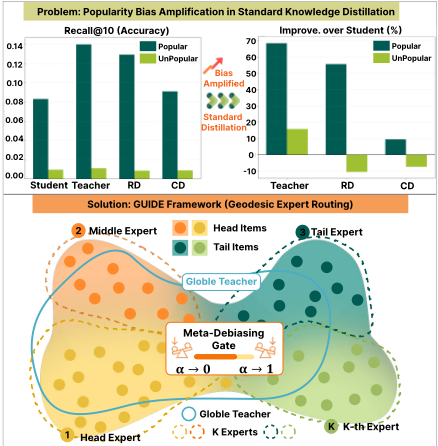
Knowledge Distillation (KD) has emerged as a widely adopted paradigm to address this efficiency challenge [Kang et al., 2020]. By transferring knowledge from a computationally expensive teacher model to a lightweight student model, KD enables the deployment of compact recommenders that retain much of the predictive capability of their larger counterparts while satisfying stringent latency requirements [Lee et al., 2019; Kweon et al., 2021]. This approach has demonstrated remarkable success across various recommendation architectures, from collaborative filtering to sequential models [Sarwar et al., 2001; Kang et al., 2021]. However, we identify a critical yet underexplored issue: knowledge distillation systematically amplifies popularity bias in the student model. Popularity bias, where models disproportionately favor frequently-interacted items at the expense of longtail content, is already pervasive in recommender systems trained on implicit feedback [Oestreicher-Singer and Sundararajan, 2012; Abdollahpouri et al., 2019]. Our empirical investigation reveals that this bias is not merely preserved but substantially magnified during the distillation process. We argue that the root cause lies in the reliance on a single global teacher trained on complete interaction data that is inherently dominated by popularity patterns. Figure 1 shows KD improvements are driven by popular items at the expense of unpopular ones. By mimicking such a teacher, the student internalizes and amplifies these popularity-driven shortcuts, resulting in reduced exposure diversity and exacerbated unfairness toward niche items [Lee et al., 2019; Tang and Wang, 2018].
To address this limitation, we propose GUIDE (Geodesicaware Unbiased Instructive Distillation with Experts), a novel framework that augments conventional single-teacher distillation with collaborative guidance from domain-specific debiasing experts. Our key insight is that while the global teacher provides comprehensive knowledge essential for accuracy, targeted experts trained on strategically partitioned data subsets can serve as corrective signals that counteract popularity bias. Specifically, we partition the original interaction data into multiple subsets based on item popularity strata and train specialized expert models in parallel. During distillation, the student model learns not only from the global teacher but also from these experts, enabling balanced knowledge acquisition that promotes both accuracy and fairness. However, transitioning from single-teacher distillation to this collaborative teacher-expert paradigm introduces two fundamental challenges:
- Expert Routing: How to select the most appropriate expert for each prediction context? A natural approach measures expert-student similarity via cosine or inner product in Euclidean space [Koren et al., 2009]. However, embedding norms encode popularity-correlated intensity information, as popular items naturally exhibit larger magnitudes due to more frequent gradient updates [Zhu et al., 2021; Wang et al., 2017]. This causes the student to be attracted to high-norm experts rather than semantically aligned ones. While post-hoc ℓ2 normalization offers an implicit remedy, it remains geometrically imprecise and optimization-unfriendly.
- Context Fusion: How to dynamically balance knowledge from the teacher and experts based on varying useritem characteristics? Static fusion weights are fundamentally inadequate, since susceptibility to popularity bias varies substantially across user-item contexts depending on user engagement diversity, item popularity characteristics, and interaction patterns [Han et al., 2024; Abdollahpouri et al., 2021]. Determining appropriate debiasing intensity requires real-time contextual reasoning rather than a fixed arbitration strategy.
To tackle Expert Routing, we propose Spherical Expert Alignment, which conducts expert-student matching directly on the spherical manifold S d-1 , ensuring that all comparisons reflect pure directional similarity free from magnitude contamination. Crucially, we optimize geodesic distance rather than cosine angle: cosine-based gradients scale with sin(θ) and vanish as θ → 0, whereas geodesic gradients remain linear in θ, enabling stable optimization even when student and expert representations are closely aligned.
To address Context Fusion, we design a Meta-Debiasing Gate, a lightweight gating network that ingests contextual features such as user history diversity, item popularity percentile, and interaction density. The gate outputs a dynamic fusion weight α ∈ [0, 1] that arbitrates the balance between teacher and expert influence. It is trained end-to-end via amortized meta-learning to explicitly optimize for both accuracy and debiasing effectiveness.
Our main contributions are summarized as follows:
- We identify the phenomenon of popularity bias amplification in knowledge distillation and propose GUIDE, a collaborative distillation framework that integrates domainspecific debiasing experts alongside the global teacher to enable accuracy-fairness balanced knowledge transfer.
- We introduce Spherical Expert Alignment for geometryaware expert routing and Meta-Debiasing Gate for contextaware dynamic fusion, addressing the challenges of expert selection and adaptive knowledge arbitration respectively.
- Extensive experiments on real-world datasets demonstrate that GUIDE significantly mitigates popularity bias while maintaining competitive accuracy, achieving state-of-theart trade-offs among efficiency, accuracy, and fairness.
2 RelatedWork
2.1 Knowledge Distillation for Recommendation
Knowledge Distillation (KD) enhances recommender systems by transferring knowledge from intermediate layers [Romero et al., 2015], privileged features [Xu et al., 2020], or structured graphs [Zhang et al., 2020]. Beyond efficiency [Zhu et al., 2020] and collaborative learning [Gou et al., 2024], KD is widely applied to mitigate biases. For instance, [Liu et al., 2020] and UKDRec [Yang et al., 2025] leverage counterfactual data and multi-teacher frameworks for debiasing. UNKD [Chen et al., 2023a] and [Ding et al., 2022] address popularity bias and model fusion, respectively. Research also optimizes distillation losses, ranging from ranking-based top-N selection [Tang and Wang, 2018] and instance construction [Lee et al., 2019] to list-level losses [Kang et al., 2020], extending to heterogeneous graph integration [Tao et al., 2022; Wang et al., 2021].
2.2 Bias in Recommendation
Recommendation bias arises from user behavior and feedback loops [Chen et al., 2023b]. Mitigation strategies typically employ IPS [Joachims et al., 2018; Li et al., 2023; Schnabel et al., 2016], Doubly Robust methods [Song et al., 2023], or causal graphs [Liu et al., 2021; Liu et al., 2023; He et al., 2022] on biased data [Ning et al., 2024; Zhang and Shen, 2023], or leverage unbiased data via meta-learning [Chen et al., 2021] and distillation [Liu et al., 2020]. Beyond data, architectures [Lin et al., 2019] and optimizers [Tang et al., 2020] contribute to bias. Notably, KD itself can aggravate popularity bias [Chen et al., 2023a]: a teacher model trained on skewed data transfers inherent biases to the student, undermining debiasing efforts [Yang et al., 2025].
3 Preliminaries
3.1 ProblemFormulation
Let U = {u1, u2, . . . , uM} denote the set of M users and I = {i1, i2, . . . , iN} denote the set of N items. The useritem interaction matrix R ∈ {0, 1}M×N encodes implicit feedback, where rui = 1 indicates that user u has interacted with item i, and rui = 0 otherwise. For each user u, we denote the set of interacted items as I + u = {i ∈ I | rui = 1}. The primary objective of a recommender system is to learn a scoring function f : U×I → R that predicts user preferences over unobserved items.
3.2 Knowledge Distillation in Recommendation
Knowledge Distillation (KD) aims to transfer knowledge from a high-capacity teacher model T to a lightweight student model S. Given a user-item pair (u, i), the teacher produces a soft prediction ˆ yT ui that encodes rich relational knowledge beyond binary labels. The student is trained to mimic these soft targets while maintaining computational efficiency. The distillation objective typically minimizes the divergence between teacher and student outputs:
where ℓ(·, ·) denotes a divergence measure such as Mean Squared Error or KL divergence, and D is the training set.
3.3 Spherical Manifold
The (d-1)-dimensional unit spherical manifold S d-1 is defined as the set of all d-dimensional vectors with unit ℓ2 norm:
The spherical manifold provides an embedding space where vector magnitudes are normalized, enabling the model to focus purely on directional relationships. For any vector x ∈ Rd \ {0}, the projection onto S d-1 is given by:
The intrinsic distance on the spherical manifold is the geodesic distance, representing the length of the shortest arc connecting two points. For x, y ∈ S d-1 , the distance is:
4 Methodology
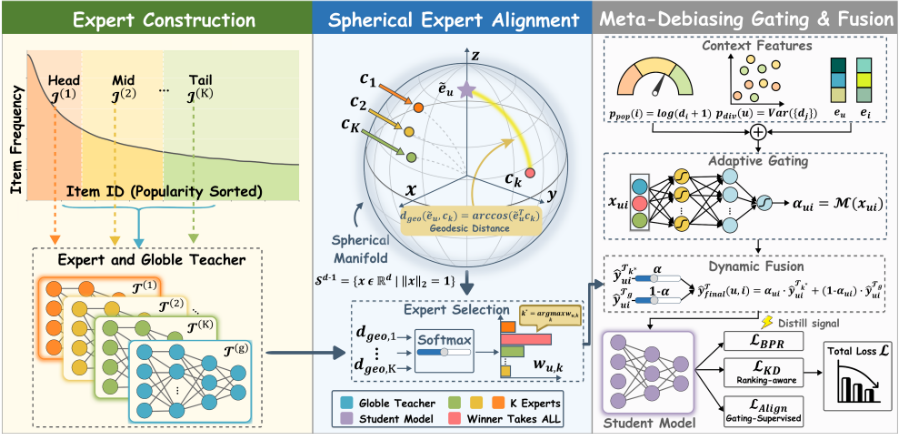
Figure 2 illustrates the overall framework of GUIDE. Given user-item interaction data, GUIDE first partitions the item set into K popularity-based subsets to construct domain-specific expert teachers. To address the Expert Routing challenge, we project both users and expert centroids onto a spherical manifold, where expert relevance is quantified via geodesic distance. To address the Context Fusion challenge, a MetaDebiasing Gate dynamically arbitrates between expert and global teacher knowledge based on real-time contextual features. The final distillation signal is derived as a contextaware ensemble tailored to each user-item interaction. We detail each component in the following subsections.
4.1 Domain-Specific Expert Construction
Relying on a single global teacher causes popularity bias amplification in knowledge distillation. A global teacher trained on the complete interaction data inevitably inherits the longtail distribution, leading to overfitting on popular items while under-representing niche content. To mitigate this limitation, we construct multiple domain-specific experts, each specializing in a distinct popularity stratum.
Popularity-Based Data Partitioning
We quantify the popularity of each item i by its interaction frequency di = |{u ∈ U | rui = 1}|. Based on these frequency values, we partition the item set I into K disjoint subsets {I (1) , I (2) , . . . , I (K) }, where each subset corresponds to a distinct popularity tier. Specifically, we sort all items by di in descending order and divide them into K groups of approximately equal size, yielding a spectrum from head (highpopularity) to tail (low-popularity) items. Each item subset I (k) induces a corresponding interaction subset:
This partitioning creates isolated training environments that shield tail item learning from head item interference.
Expert Teacher Training
For each partition D(k) , we train a dedicated expert teacher T (k) exclusively on interactions within I (k) . This constraint ensures that each expert captures the intrinsic collaborative patterns specific to its popularity domain without being dominated by global popularity shortcuts. Formally, the expert T (k) is optimized via:
where j denotes a negative sample drawn from I (k) . In parallel, we train a global teacher T (g) on the complete interaction data D to preserve comprehensive collaborative signals.
Remark. The expert construction procedure is modelagnostic: any recommendation architecture (e.g., matrix factorization, neural collaborative filtering, or sequential models) can serve as the backbone for both expert and student models. This flexibility ensures broad applicability across diverse recommendation scenarios.
4.2 Spherical Expert Alignment
With K expert teachers constructed, the next challenge lies in dynamically routing each user to the most semantically aligned expert. Conventional approaches measure expertstudent similarity via cosine or inner product in Euclidean space. However, as discussed in Section 1, embedding magnitudes encode popularity-correlated intensity information that confounds directional similarity. We address this challenge through Spherical Expert Alignment, which conducts matching directly on the spherical manifold S d-1 .
Expert Centroid Representation
To enable efficient expert routing, we represent each expert T (k) by a semantic centroid that summarizes its domain knowledge. Let E(k) = {ei | i ∈ I (k) } denote the set of item embeddings learned by expert T (k) . We compute the expert centroid ck by aggregating these embeddings and projecting onto the spherical manifold:
where ck ∈ S d-1 serves as the representative prototype for the k-th expert domain.
User Projection and Geodesic Matching
For any user u with embedding eu learned by the student model, we project it onto the same spherical manifold:
The affinity between user u and expert k is then quantified by the geodesic distance on S d-1 :
This geodesic formulation offers two key advantages over cosine similarity. First, constraining representations to the unit sphere strictly decouples embedding magnitude-often correlated with item popularity-from semantic direction, ensuring pure content-based routing. Second, unlike cosine gradients which scale with sin(θ) and vanish as θ → 0, the geodesic gradient ∇vLgeo ∝ ∂θ2 ∂θ ∂θ ∂ cos θ ∇v cos θ introduces a 1/ sin(θ) term that perfectly cancels the projection-induced sin(θ) decay. This yields stable gradients linear in θ (i.e., ∇L ∝ 2θ) even for closely aligned representations.
Expert Selection via Soft Routing
Based on geodesic distances, we compute a probability distribution over experts for each user u:
where τ > 0 is a temperature parameter controlling the sharpness of the distribution. To minimize noise from less relevant experts, we adopt a winner-takes-all strategy that selects the expert with the highest probability:
The selected expert T (k∗ ) provides the specialized soft label ˆ yTk∗ ui for the current user-item pair.
4.3 Meta-Debiasing Gate
While Spherical Expert Alignment identifies the optimal domain-specific expert for each user, relying solely on expert knowledge may be suboptimal. Expert teachers, trained on isolated popularity strata, may lack the broader collaborative signals captured by the global teacher. Conversely, the global teacher provides robust general knowledge but inherits popularity bias. To dynamically balance these complementary knowledge sources, we design a Meta-Debiasing Gate that adaptively arbitrates their influence based on real-time contextual features.
Context Feature Extraction
The optimal balance between expert and global teacher knowledge depends on the specific characteristics of each user-item interaction. We extract a context feature vector xui that captures two key factors:
Item Popularity. We quantify the global exposure of candidate item i using its log-normalized interaction frequency:
This feature informs the gate about the item's position in the popularity spectrum.
User Diversity. We measure the diversity of user u's historical interactions by computing the variance of popularity values across interacted items:
This feature indicates the user's tendency to explore across different popularity tiers. The context vector concatenates these features with learned user and item embeddings, where ⊕ denotes concatenation:
Adaptive Gating Mechanism
The Meta-Debiasing Gate M uses a lightweight multi-layer perceptron (MLP) with sigmoid activation, mapping the context vector to a scalar fusion coefficient αui ∈ (0, 1):
where W1,W2, b1, b2 are learnable parameters, and σ(·) denotes the sigmoid function.
The coefficient αui quantifies the necessity of debiasing for the current context: higher values indicate that the model should prioritize expert knowledge (e.g., for long-tail items or users with diverse histories), while lower values suggest relying on the global teacher for stability.
Dynamic Knowledge Fusion
The final distillation target is synthesized as a convex combination of soft labels from the selected expert T (k∗ ) and the global teacher T (g) :
This dynamic fusion ensures that the distillation signal is adaptively tailored to each user-item interaction, effectively resolving the trade-off between accuracy and fairness.
4.4 Optimization
We formulate a multi-objective loss function that jointly optimizes recommendation accuracy, knowledge transfer, and gate calibration:
where λKD, λAlign, and λReg are hyperparameters balancing each component.
Recommendation Loss. We employ the BPR loss to ensure the student captures fundamental collaborative signals:
where (u, i, j) denotes a triplet with positive item i ∈ I + u and negative item j /∈ I + u .
Ranking-Aware Distillation Loss. Standard pointwise distillation may fail to preserve the nuanced ranking relationships essential for recommendation. We propose a rankingaware objective that aligns the preference margins between student and teacher:
where ∆pSuij = σ(ˆ yS ui ) - σ(ˆ yS uj ) and ∆pTuij = σ(ˆ yT final (u, i)) - σ(ˆ yT final (u, j)) represent the preference margins from the student and fused teacher, respectively.
Gate Alignment Loss. To prevent the gate coefficient αui from collapsing to trivial solutions, we introduce an explicit supervisory signal. Let ti = I(i ∈ Itail) be an indicator for tail items. We employ binary cross-entropy to guide the gate:
This objective encourages the gate to prioritize expert knowledge (αui → 1) for tail items while retaining global knowledge (αui → 0) for popular items.
4.5 Complexity Analysis
Training Complexity. Given batch size B, embedding dimension d, and K experts, the primary computational costs include: (1) student forward pass: O(Bd); (2) geodesic distance computation: O(BKd); and (3) Meta-Debiasing Gate: O(Bd2 ). Since K is typically small (e.g., K ≤ 5), and the winner-takes-all strategy activates only the selected expert and global teacher, the overall training complexity remains linear in batch size.
Inference Complexity. During inference, all auxiliary components (expert teachers, spherical projection, MetaDebiasing Gate) are discarded. Only the lightweight student model is deployed, yielding inference complexity identical to the base architecture with no additional latency.
5 Experiments
We conduct comprehensive experiments to evaluate GUIDE, aiming to answer the following research questions:
- RQ1: How does GUIDE perform compared to state-of-theart knowledge distillation methods for recommendation?
- RQ2: What are the individual contributions of each proposed component?
- RQ3: How sensitive is GUIDE to key hyperparameters?
- RQ4: How effective is GUIDE in handling popularity bias and enhancing item fairness?
5.1 Experimental Setup
Datasets. We evaluate our model on three public benchmarks: CiteULike (scholarly articles), Amazon-Movie, and Amazon-Game (e-commerce). Following standard preprocessing, we retain users with at least 20 interactions and split the data into training, validation, and test sets using an 8:1:1 ratio. Detailed statistics are reported in Table 1.
| Statistic | CiteULike | Amazon-Movie | Amazon-Game |
|---|---|---|---|
| #Users | 5,219 | 123,960 | 24,303 |
| #Items | 25,181 | 50,052 | 10,672 |
| #Interactions | 125,580 | 1,697,533 | 231,780 |
| Sparsity | 99.90% | 99.97% | 99.91% |
Baselines. We compare GUIDE against five state-of-theart distillation methods: (1) Ranking-based: RD [Tang and Wang, 2018] and CD [Lee et al., 2019] transfer ranking knowledge via position-aware weighting and rank-aware sampling; (2) Structure-aware: DE-RRD [Kang et al., 2020] and HTD [Kang et al., 2021] distill latent knowledge and topological structures; and (3) Bias-aware: UNKD [Chen et al., 2023a] mitigates popularity bias via stratified distillation. Evaluation Metrics. We adopt two widely-used top-K metrics: Recall@K (R@K), which measures the proportion of relevant items retrieved, and NDCG@K (N@K), which accounts for ranking position via discounted cumulative gain. We report results for K ∈ {10, 20}.
Implementation Details. All hyperparameters are tuned based on NDCG@20 on the validation set. The teacher uses 3-layer LightGCN, for students, we evaluate 2-layer GCN and BPRMF. The learning rate is searched over {0.0002, 0.001, 0.005, 0.01}. The distillation coefficient λKD is selected from {0.01, 0.02, ..., 0.9, 0.99}, and the alignment coefficient λAlign from {0.0005, 0.001, ..., 0.9, 0.99}. The number of experts K is set to 5 by default. All experiments are repeated 5 times with different random seeds, and we report the mean and standard deviation.
5.2 Overall Performance (RQ1)
Table 2 presents the overall performance comparison. From these results, we draw the following observations:
GUIDE Consistently Outperforms All Baselines Across Datasets and Metrics. The improvements are particularly pronounced on the sparser Amazon-Game dataset, demonstrating GUIDE's robustness in challenging scenarios where popularity bias is most detrimental. Remarkably, GUIDE surpasses the teacher on several metrics, indicating that filtering popularity noise yields superior generalization.
Ranking-Based Methods Exhibit Limited Effectiveness. RD yields the poorest performance among all methods, as simple ranking alignment neglects the rich semantic relationships essential for recommendation. This highlights the need for superior knowledge transfer mechanisms.
Structure-Aware Methods Provide Substantial Improvements Over Ranking-Based Approaches. CD, HTD, and UNKD significantly outperform RD by incorporating structural knowledge. Notably, CD achieves competitive results by distilling collaborative similarity distributions, while UNKD leverages unobserved feedback for enhanced supervision.
The Advantages of GUIDE Stem From Its Two Core Innovations. Spherical Expert Alignment eliminates magnitudeinduced bias in expert routing, enabling semantically meaningful knowledge selection. The Meta-Debiasing Gate further adapts the fusion strategy to each context, ensuring debiasing preserves accuracy on well-represented items.
5.3 Ablation Study (RQ2)
To validate the contribution of each component, we compare GUIDE against four ablated variants on Amazon-Game:
- w/o Spherical: Replaces spherical manifold matching with Euclidean distance-based expert selection.
- w/o Meta-Gate: Substitutes the adaptive gate with a fixed fusion weight (α = 0.5).
- w/o Ranking KD: Replaces the ranking-aware distillation loss with standard pointwise MSE.
- w/o Alignment: Removes the gate alignment loss LAlign.
As shown in Table 3, the full GUIDE model consistently outperforms all variants, confirming the necessity of each component: (i) w/o Spherical shows that Euclidean embeddings are prone to magnitude-induced bias, emphasizing the need for directional alignment; (ii) w/o Meta-Gate confirms that static fusion is insufficient for handling user-item heterogeneity; (iii) w/o Ranking KD proves that pointwise distillation fails to capture nuanced preference margins; and (iv) w/o Alignment indicates that explicit gate supervision is vital to avoid trivial solutions.
5.4 Hyperparameter Sensitivity (RQ3)
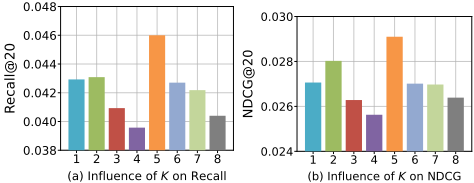
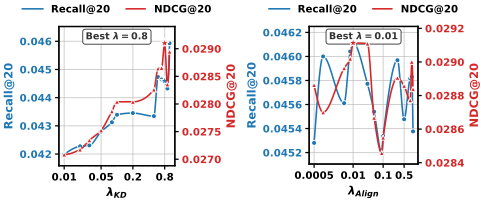
We examine three key hyperparameters: (1) Number of experts K: As shown in Figure 3, performance peaks around K = 5; too few experts fail to capture popularity diversity, while excessive K introduces noise due to data sparsity. (2) Distillation coefficient λKD: Figure 4 (Left) shows optimal result at 0.8, balancing knowledge transfer and student adaptation. (3) Alignment coefficient λAlign: Figure 4 (Right) indicates that λAlign = 0.01 is optimal, while larger values may conflict with the primary ranking objective.
5.5 Debiasing Effectiveness (RQ4)
To evaluate the effectiveness of GUIDE in addressing popularity bias and enhancing fairness, we conduct three complementary analyses.
Addressing Popularity Bias and Fairness. We evaluate GUIDE on Amazon-Game (stratified into Head/Tail groups) and CiteULike (fairness metrics). Table 4 presents the results. GUIDE achieves substantial improvements on Tail items (+6.21%) while simultaneously improving Head performance (+2.75%). On CiteULike, GUIDE significantly lowers the Gini index and doubles Item Coverage. These results across datasets prove that GUIDE effectively handles popularity bias and improves fairness while maintaining superior overall accuracy.
| Dataset | Metric | Teacher | RD | CD | DE-RRD | HTD | UNKD | GUIDE | Improv. |
|---|---|---|---|---|---|---|---|---|---|
| CiteULike | R@10 R@20 N@10 N@20 | 0.0964 0.062±.006 0.085±.009 0.051±.005 | 0.086±.005 0.075±.002 | 0.062±.001 0.050±.002 | 0.089±.002 0.140±.001 0.076±.001 0.091±.001 | 0.093±.001 0.132±.004 0.078±.000 0.089±.002 | 0.097±.001 0.145±.002 0.079±.000 0.094±.001 | +4.3% +1.3% | |
| 0.1456 | 0.129±.006 | 0.092±.003 | +3.6% | ||||||
| 0.0788 | 0.060±.001 | +3.3% | |||||||
| 0.0937 | 0.058±.006 | 0.087±.003 | |||||||
| R@10 | 0.0284 | 0.020±.001 | 0.025±.003 0.044±.004 | 0.022±.001 0.037±.001 | 0.027±.002 | 0.027±.001 0.046±.001 | 0.029±.001 0.049±.000 | +7.4% +6.5% | |
| Amazon-Movie | R@20 N@10 | 0.0487 0.0313 | 0.033±.003 0.023±.002 | 0.028±.002 | 0.024±.001 | 0.045±.002 0.030±.001 | 0.030±.001 | 0.031±.002 | +3.3% |
| N@20 | 0.036±.003 | 0.030±.000 | |||||||
| 0.0394 | 0.028±.005 | 0.037±.001 | 0.037±.002 | 0.039±.001 | +5.4% | ||||
| Amazon-Game | R@10 | 0.0282 | 0.018±.001 | 0.025±.002 | 0.020±.002 | 0.026±.001 | 0.025±.001 | 0.029±.001 | +11.5% |
| R@20 | 0.0460 | 0.028±.003 | 0.043±.003 | 0.028±.001 | 0.040±.002 | 0.041±.002 | 0.046±.002 | +6.9% | |
| N@10 | 0.0232 | 0.016±.001 | 0.020±.002 | 0.017±.000 | 0.021±.001 | 0.021±.001 | 0.023±.000 | +9.5% | |
| N@20 | 0.0299 | 0.020±.001 | 0.027±.002 | 0.022±.000 | 0.026±.001 | 0.027±.001 | 0.029±.002 | +7.4% |
| Variant | R@10 | R@20 | N@10 | N@20 |
|---|---|---|---|---|
| w/o Spherical | 0.0259 | 0.0422 | 0.0206 | 0.0266 |
| w/o Meta-Gate | 0.0259 | 0.0419 | 0.0209 | 0.0270 |
| w/o Ranking KD | 0.0258 | 0.0420 | 0.0206 | 0.0267 |
| w/o Alignment | 0.0261 | 0.0419 | 0.0210 | 0.0270 |
| GUIDE (Full) | 0.0288 | 0.0465 | 0.0230 | 0.0299 |
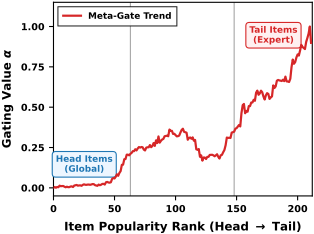
Visualization of Adaptive Gating. To verify that the MetaDebiasing Gate learns meaningful context-aware strategies, we visualize the distribution of gating coefficients αui across item popularity on the Amazon-Game test set. As shown in Figure 5, a clear trend emerges: α ≈ 0 for popular (Head) items, indicating reliance on the global teacher, while α ≈ 1 for long-tail (Tail) items, shifting toward expert knowledge. This confirms that the gate learns a principled popularityaware arbitration strategy rather than random assignment, validating the effectiveness of the alignment loss LAlign.
Case Study: Cold-Start Item Recommendation. To evaluate performance under extreme sparsity, we analyze a coldstart interaction (User #8137, Item #10872) in Amazon- Game. While the LightGCN teacher fails to recommend the item (Rank > 200) due to absent collaborative signals, GUIDE achieves Rank 1 with a high gating coefficient (αui = 0.84). This confirms that GUIDE adaptively prioritizes specialized expert knowledge to compensate for data scarcity, effectively enabling zero-shot cold-start recommendations.
| Amazon-Game | CiteULike | ||||||
|---|---|---|---|---|---|---|---|
| Model | Head | Tail | ∆Tail | Gini ↓ | Coverage ↑ | Tail Ratio ↑ | R@20 |
| UNKD | 0.0509 | 0.00177 | - | 0.9679 | 0.1234 | 0.0845 | 0.1331 |
| GUIDE | 0.0523 | 0.00188 | +6.21% | 0.9239 | 0.2521 | 0.0876 | 0.1447 |
6 Conclusion
Existing KD approaches, using standard Euclidean teachers, often suffer from bias amplification. We propose GUIDE, projecting diverse expert knowledge onto a Spherical Manifold. This design eliminates magnitude-induced noise via distinct subspace experts, while our Meta-Debiasing Gate intelligently arbitrates between global and specialized supervision to adapt to dynamic user preferences. Experiments confirm that GUIDE consistently outperforms competing methods in both recommendation accuracy and bias mitigation.
Acknowledgments
This work was supported by the National Natural Science Foundation of China (No.62173199 and No.62506366).
@inproceedings{ijcai2026p361,
  title     = {Geodesic Expert Routing for Unbiased Knowledge Distillation in Recommendation},
  author    = {Zhang, Xuan and Wei, Rongchuan and Wei, Chunyu and Yuan, Hongxing and Fan, Yushun},
  booktitle = {Proceedings of the Thirty-Fifth International Joint Conference on
               Artificial Intelligence, {IJCAI-26}},
  publisher = {International Joint Conferences on Artificial Intelligence Organization},
  editor    = {Diego Calvanese},
  pages     = {3250--3258},
  year      = {2026},
  month     = {8},
  note      = {Main Track},
  doi       = {10.24963/ijcai.2026/361},
  url       = {https://doi.org/10.24963/ijcai.2026/361},
}
TY - CPAPER TI - Geodesic Expert Routing for Unbiased Knowledge Distillation in Recommendation AU - Zhang, Xuan AU - Wei, Rongchuan AU - Wei, Chunyu AU - Yuan, Hongxing AU - Fan, Yushun T2 - Proceedings of the Thirty-Fifth International Joint Conference on Artificial Intelligence, IJCAI-26 PB - International Joint Conferences on Artificial Intelligence Organization PY - 2026 SP - 3250 EP - 3258 DO - 10.24963/ijcai.2026/361 UR - https://doi.org/10.24963/ijcai.2026/361 ER -Copied
Machine-readable versions of this paper, for tools and AI agents:





