
Two-Stage Fine-Grained Trajectory Generation Constrained by Road Networks
Proceedings of the Thirty-Fifth International Joint Conference on Artificial Intelligence. Main Track. Pages 2915-2923.
https://doi.org/10.24963/ijcai.2026/324
Keywords
- Data Mining: Mining spatial and/or temporal data
- Machine Learning: Sequence and graph learning
- Machine Learning: Representation learning
Abstract
Trajectory generation is a pivotal technique for mitigating data sparsity, but existing methods struggle to simultaneously achieve strict road network alignment and capture realistic movement characteristics. To bridge this gap, we propose RNTrajGen, a two-stage fine-grained trajectory generation framework constrained by road networks. Specifically, we first develop a Road Network Knowledge-Enhanced Encoder (RNKEE) to provide semantically rich representations for trajectory generation. By leveraging graph attention networks, RNKEE encodes static prior knowledge of the road network while integrating self-supervised learning to extract latent movement patterns from real-world trajectories. Subsequently, RNTrajGen follows a two-stage generation strategy: it first generates a sequence of road segments to ensure strict topological alignment, and then infers the moving ratios of trajectory points along road segments to capture fine-grained movement characteristics. Extensive experiments on two real-world datasets demonstrate that RNTrajGen significantly outperforms state-of-the-art baselines, and the generated trajectories exhibit high utility in downstream prediction tasks. Our code is available at https://github.com/jkzh986/RNTrajGen.
- [Devlin et al., 2019] Jacob Devlin, Ming-Wei Chang, Ken- ton Lee, and Kristina Toutanova. Bert: Pre-training of deep bidirectional transformers for language understand- ing. In Proceedings of the 2019 conference of the North American chapter of the association for computational lin- guistics: human language technologies, volume 1 (long and short papers), pages 4171-4186, 2019.
- [Feng et al., 2020] Jie Feng, Zeyu Yang, Fengli Xu, Haisu Yu, Mudan Wang, and Yong Li. Learning to simulate hu- man mobility. In Proceedings of the 26th ACM SIGKDD international conference on knowledge discovery & data mining, pages 3426-3433, 2020.
- [Guo et al., 2025] Baoshen Guo, Zhiqing Hong, Junyi Li, Shenhao Wang, and Jinhua Zhao. Leveraging the spa- tial hierarchy: Coarse-to-fine trajectory generation via cas- caded hybrid diffusion. arXiv preprint arXiv:2507.13366, 2025.
- [Hadsell et al., 2006] Raia Hadsell, Sumit Chopra, and Yann LeCun. Dimensionality reduction by learning an invariant mapping. In 2006 IEEE computer society conference on computer vision and pattern recognition (CVPR'06), vol- ume 2, pages 1735-1742. IEEE, 2006.
- [He et al., 2016] Kaiming He, Xiangyu Zhang, Shaoqing Ren, and Jian Sun. Deep residual learning for image recog- nition. In Proceedings of the IEEE conference on computer vision and pattern recognition, pages 770-778, 2016.
- [Hu et al., 2024] Yujia Hu, Yuntao Du, Zhikun Zhang, Zi- quan Fang, Lu Chen, Kai Zheng, and Yunjun Gao. Real- time trajectory synthesis with local differential privacy. In 2024 IEEE 40th International Conference on Data Engi- neering (ICDE), pages 1685-1698. IEEE, 2024.
- [Huang et al., 2019] Dou Huang, Xuan Song, Zipei Fan, Renhe Jiang, Ryosuke Shibasaki, Yu Zhang, Haizhong Wang, and Yugo Kato. A variational autoencoder based generative model of urban human mobility. In 2019 IEEE conference on multimedia information processing and re- trieval (MIPR), pages 425-430. IEEE, 2019.
- [Kapp et al., 2023] Alexandra Kapp, Julia Hansmeyer, and Helena Mihaljević. Generative models for synthetic urban mobility data: A systematic literature review. ACM Com- puting Surveys, 56(4):1-37, 2023.
- [Kim et al., 2006] Minkyong Kim, David Kotz, and Songkuk Kim. Extracting a mobility model from real user traces. In Proceedings IEEE INFOCOM 2006. 25TH IEEE International Conference on Computer Communications, pages 1-13, 2006.
- [Li et al., 2018] Qimai Li, Zhichao Han, and Xiao-Ming Wu. Deeper insights into graph convolutional networks for semi-supervised learning. In Proceedings of the AAAI con- ference on artificial intelligence, volume 32, 2018.
- [Long et al., 2023] Qingyue Long, Huandong Wang, Tong Li, Lisi Huang, Kun Wang, Qiong Wu, Guangyu Li, Yan- ping Liang, Li Yu, and Yong Li. Practical synthetic hu- man trajectories generation based on variational point pro- cesses. In Proceedings of the 29th ACM SIGKDD con- ference on knowledge discovery and data mining, pages 4561-4571, 2023.
- [Ouyang et al., 2018] Kun Ouyang, Reza Shokri, David S Rosenblum, and Wenzhuo Yang. A non-parametric gener- ative model for human trajectories. In IJCAI, volume 18, pages 3812-3817, 2018. IJCAI
- [Rao et al., 2025] Xuan Rao, Shuo Shang, Renhe Jiang, Peng Han, and Lisi Chen. Seed: Bridging sequence and diffusion models for road trajectory generation. In Pro- ceedings of the ACM on Web Conference 2025, pages 2007-2017, 2025.
- [Ren et al., 2021] Huimin Ren, Sijie Ruan, Yanhua Li, Jie Bao, Chuishi Meng, Ruiyuan Li, and Yu Zheng. Mtrajrec: Map-constrained trajectory recovery via seq2seq multi- task learning. In Proceedings of the 27th ACM SIGKDD Conference on Knowledge Discovery & Data Mining, pages 1410-1419, 2021.
- [Ronneberger et al., 2015] Olaf Ronneberger, Philipp Fis- cher, and Thomas Brox. U-net: Convolutional networks for biomedical image segmentation. In International Conference on Medical image computing and computer- assisted intervention, pages 234-241. Springer, 2015.
- [Shi et al., 2024] Dingyuan Shi, Yongxin Tong, Zimu Zhou, Ke Xu, Zheng Wang, and Jieping Ye. Graph-constrained diffusion for end-to-end path planning. In The Twelfth International Conference on Learning Representations, 2024.
- [Vaswani et al., 2017] Ashish Vaswani, Noam Shazeer, Niki Parmar, Jakob Uszkoreit, Llion Jones, Aidan N Gomez, Łukasz Kaiser, and Illia Polosukhin. Attention is all you need. Advances in neural information processing systems, 30, 2017.
- [Veličković et al., 2018] Petar Veličković, Guillem Cucurull, Arantxa Casanova, Adriana Romero, Pietro Liò, and Yoshua Bengio. Graph attention networks. In Interna- tional Conference on Learning Representations, 2018.
- [Wang et al., 2021] Xingrui Wang, Xinyu Liu, Ziteng Lu, and Hanfang Yang. Large scale gps trajectory generation using map based on two stage gan. Journal of Data Sci- ence, 19(1):126-141, 2021.
- [Wei et al., 2024] Tonglong Wei, Youfang Lin, Shengnan Guo, Yan Lin, Yiheng Huang, Chenyang Xiang, Yuqing Bai, and Huaiyu Wan. Diff-rntraj: A structure-aware dif- fusion model for road network-constrained trajectory gen- eration. IEEE Transactions on Knowledge and Data Engi- neering, 2024.
- [Wen et al., 2021] Haomin Wen, Youfang Lin, Fan Wu, Huaiyu Wan, Shengnan Guo, Lixia Wu, Chao Song, and Yinghui Xu. Package pick-up route prediction via modeling couriers' spatial-temporal behaviors. In 2021 IEEE 37th International Conference on Data Engineering (ICDE), pages 2141-2146. IEEE, 2021.
- [Wen et al., 2022] Haomin Wen, Youfang Lin, Xiaowei Mao, Fan Wu, Yiji Zhao, Haochen Wang, Jianbin Zheng, Lixia Wu, Haoyuan Hu, and Huaiyu Wan. Graph2route: A dynamic spatial-temporal graph neural network for pick- up and delivery route prediction. In Proceedings of the 28th ACM SIGKDD conference on knowledge discovery and data mining, pages 4143-4152, 2022.
- [Williams and Zipser, 1989] Ronald J Williams and David Zipser. A learning algorithm for continually running fully recurrent neural networks. Neural computation, 1(2):270- 280, 1989.
- [Yang et al., 2018] Zhou Yang, Heli Sun, Jianbin Huang, Zhongbin Sun, Hui Xiong, Shaojie Qiao, Ziyu Guan, and Xiaolin Jia. An efficient destination prediction approach based on future trajectory prediction and transition matrix optimization. IEEE transactions on knowledge and data engineering, 32(2):203-217, 2018.
- [Yuan et al., 2022] Yuan Yuan, Jingtao Ding, Huandong Wang, Depeng Jin, and Yong Li. Activity trajectory gener- ation via modeling spatiotemporal dynamics. In Proceed- ings of the 28th ACM SIGKDD Conference on Knowledge Discovery and Data Mining, pages 4752-4762, 2022.
- [Zhu et al., 2023] Yuanshao Zhu, Yongchao Ye, Shiyao Zhang, Xiangyu Zhao, and James Yu. Difftraj: Gen- erating gps trajectory with diffusion probabilistic model. Advances in Neural Information Processing Systems, 36:65168-65188, 2023.
- [Zhu et al., 2024] Yuanshao Zhu, James Jianqiao Yu, Xi- angyu Zhao, Qidong Liu, Yongchao Ye, Wei Chen, Zijian Zhang, Xuetao Wei, and Yuxuan Liang. Controltraj: Con- trollable trajectory generation with topology-constrained diffusion model. In Proceedings of the 30th ACM SIGKDD Conference on Knowledge Discovery and Data Mining, pages 4676-4687, 2024.
References were extracted automatically from the PDF and may contain errors.
Full text extracted automatically from the PDF; figures, tables and equations may differ. The PDF is the version of record.
1 Introduction
With the widespread adoption of GPS-enabled devices in Intelligent Transportation Systems (ITS), recording vehicle trajectories has become highly convenient. Mining this trajectory data plays a crucial role in supporting various downstream intelligent navigation applications, such as path prediction [Yang et al., 2018; Wen et al., 2021; Wen et al., 2022]. However, due to the sensitivity of such data and associated privacy concerns [Hu et al., 2024; Kapp et al., 2023], publicly available trajectory datasets are typically limited in scale. To address these challenges, trajectory data generation has emerged as a significant research direction. Its goal is to produce trajectory data that closely aligns with realworld distributions, thereby resolving the difficulty of acquiring large-scale trajectory datasets.
†Corresponding author.
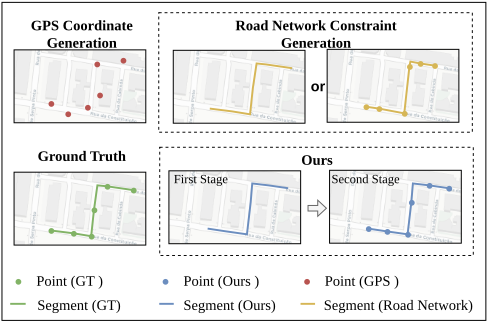
In recent years, trajectory generation methods have been extensively studied. However, existing approaches still face challenges in generating fine-grained trajectories that align with road networks while preserving realistic movement characteristics. Specifically, as illustrated in Fig. 1, some studies [Zhu et al., 2023; Zhu et al., 2024] attempt to represent trajectories using sequences of GPS points in a generated geographic coordinate system (i.e., latitude and longitude). However, trajectories generated by such methods often suffer from poor alignment with road networks. Other studies [Shi et al., 2024; Rao et al., 2025] generate trajectories directly on road networks, resolving the alignment issue. However, most methods remain limited to coarse-grained road segment-level trajectories. Although existing research [Wei et al., 2024] attempts to generate fine-grained trajectories constrained by road networks, it still fails to accurately capture the movement characteristics of trajectory points along road segments. Furthermore, existing approaches [Rao et al., 2025] typically employ data-driven graph representation techniques to learn road network representations, enabling trajectory generation over road networks. This approach neglects prior knowledge about the road network, such as static road segment attributes and road network topology, leading to semantically weak road segment embeddings. In summary, existing trajectory generation tasks face two core challenges: (i) How to ensure generated trajectories align with road networks while preserving realistic movement characteristics; and (ii) How to learn representations of road networks to provide semantically rich road segment embeddings for trajectory generation.
To address these challenges, we propose a two-stage finegrained trajectory generation framework constrained by road networks, named RNTrajGen. It not only resolves the misalignment between trajectories and road networks but also generates fine-grained trajectories with realistic movement characteristics. Specifically, (i) To provide semantically rich road segment embeddings for trajectory generation, we design a road network knowledge-enhanced encoder. This encoder innovatively combines a graph attention network with self-supervised learning to capture rich road network features from both road network prior knowledge and the movement patterns of real trajectories. (ii) To ensure generated trajectories align with the road network while preserving realistic movement characteristics, we adopt a two-stage generation strategy. The first stage generates a sequence of road segments, ensuring the trajectories align with the road network. In the second stage, the obtained road segment sequence and its static attributes serve as semantic conditions to further infer the moving ratio of trajectory points along the road segments, thereby capturing the realistic movement characteristics of the trajectories. In summary, the main contributions of our work are as follows:
- We propose RNTrajGen, a framework for two-stage finegrained trajectory generation constrained by road networks. This staged modeling approach effectively generates finegrained trajectories that align with road networks while exhibiting realistic movement characteristics.
- We designed a Road Network Knowledge-Enhanced Encoder (RNKEE) that integrates graph attention networks with self-supervised learning. By leveraging both static prior knowledge from road networks and movement patterns from real-world trajectories, it provides semantically rich road segment embeddings for trajectory generation tasks.
- We conducted extensive experiments on two real-world trajectory datasets. Experimental results demonstrate that the proposed RNTrajGen consistently outperforms state-ofthe-art methods across all trajectory quality metrics while exhibiting strong utility in downstream tasks.
2 RelatedWork
Trajectory generation techniques have been extensively studied for producing large-scale realistic movement data. Existing approaches can be broadly categorized into model-based and learning-based methods.
Model-based Methods. Early research primarily relied on predefined physical rules or probabilistic models to simulate human movement. For instance, [Kim et al., 2006] extracted statistical features such as transition matrices and velocity distributions to construct generative models. While these approaches offer interpretability, they often oversimplify the inherent randomness and complexity of human mobility, limiting their practical utility.
Learning-Based Methods. With the advancement of Variational Autoencoders (VAEs) and Generative Adversarial Networks (GANs), data-driven generative models have been integrated into trajectory generation. [Huang et al., 2019] combined the VAE with a Seq2Seq model to learn the latent distribution of trajectories, while [Long et al., 2023] employed a hierarchical VAE structure within a variational temporal point process framework to process user trajectory data. Additionally, grid-based or image-based GANs [Wang et al., 2021; Yuan et al., 2022; Ouyang et al., 2018; Feng et al., 2020] have been employed for trajectory generation. However, these methods trade off spatial resolution for computational complexity, only generating coarse-grained trajectory data. Recent research has begun applying diffusion models to trajectory generation, aiming to generate more fine-grained trajectories. [Zhu et al., 2023] guided diffusion models to generate trajectories by incorporating trajectory attributes as additional constraints. [Zhu et al., 2024] extracted road segment information traversed by trajectories as topological constraints to enhance fine-grained control over generated trajectories. [Wei et al., 2024] attempted to jointly represent trajectory points using road segments and moving ratios, enabling end-to-end generation of trajectories constrained by road networks. [Guo et al., 2025] introduced a coarse-to-fine cascaded framework, guiding GPS trajectory generation through road segment-level trajectory representations.
3 ProblemDefinition
Definition 1 (Road Network). A road network is modeled as a directed graph G = (V, E), where V = {v1, v2, . . . , v|V |} is the set of vertices representing road segments, and E ⊆ V ×V is the set of directed edges representing the topological connectivity between adjacent road segments.
Definition 2 (Road Network-Constrained Trajectory). A road network-constrained trajectory is defined as τRN = [q1, q2, . . . , qn], where each trajectory point qi = (si, ri) consists of a road segment si and a moving ratio ri. Specifically, if qi is the first point on si, then ri = di li , where di denotes the traveled distance from the start of si to qi, and li is the length of si. Otherwise, ri = di li-di-1 , where di denotes the distance traveled from qi-1 to qi, and di-1 is the traveled distance from the start of si to qi-1.
Definition 3 (Trajectory Generation). Given a real-world trajectory dataset, the objective of this problem is to train a deep learning model to generate a dataset that follows the distribution of the real trajectory data.
4 Methodology
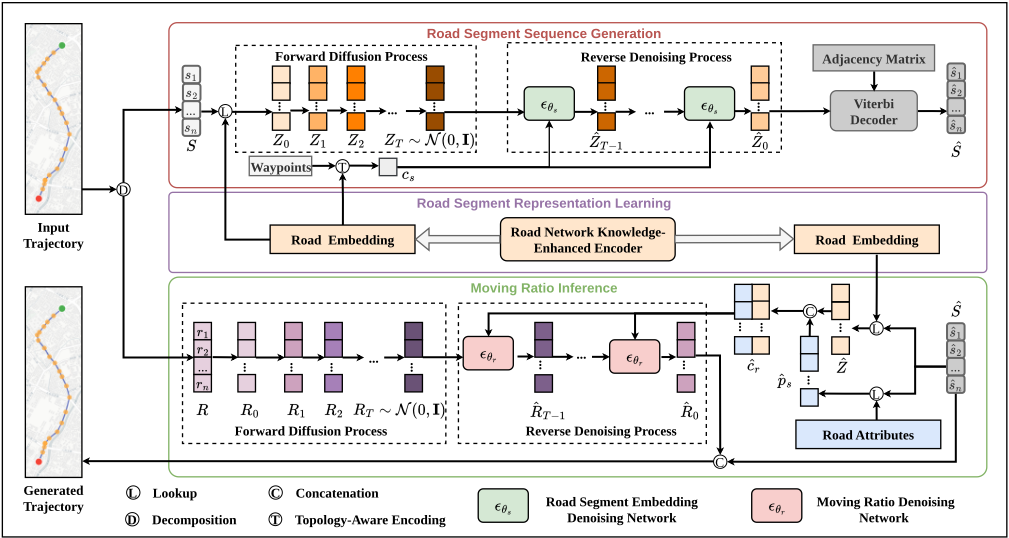
To address the dual challenges of road network alignment and realistic movement characteristics, we propose RNTrajGen, a two-stage fine-grained trajectory generation framework constrained by road networks. As shown in Fig. 2, this framework consists of a road segment representation learning module, a road segment sequence generation module, and a moving ratio inference module. The following subsections will introduce these modules in turn.
4.1 Road Representation Learning
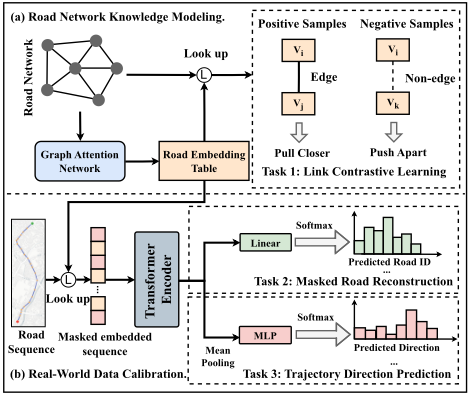
Existing trajectory generation studies predominantly employ purely data-driven graph representation learning for encoding road segments, neglecting explicit prior knowledge such as road segment attributes (e.g., level, length and direction) and topological structure. To address this, we propose the Road Network Knowledge-Enhanced Encoder (RN- KEE). As illustrated in Fig. 3, RNKEE first employs a GNN [Veliˇckovi´c et al., 2018] to encode road segment attributes and topological constraints, establishing a prior baseline. Subsequently, it extracts movement patterns from trajectory sequences through a self-supervised learning framework [Devlin et al., 2019]. This dual-drive mechanism enables the generated road embeddings to integrate both prior knowledge of road networks and real-world movement patterns.
Road Network Knowledge Modeling
In this stage, we first employ a graph attention network (GAT) to encode the static attributes of road segments, establishing a preliminary local spatial context. To further enhance the discriminative perception of embedded representations toward road network topology and mitigate the over-smoothing issue [Li et al., 2018] in deep graph neural networks, we designed a link contrastive learning task [Hadsell et al., 2006]. This task explicitly models the connectivity between road segments, forcing topologically related segment embeddings to cluster closer together in vector space while pushing disconnected segments apart. Specifically, we use the binary cross-entropy (BCE) loss function based on dot product similarity as the optimization objective:
where S denotes the set of segment pairs containing positive and negative samples, and yij ∈ {0, 1} indicates whether a real physical connection exists between road segments.
Real-World Data Calibration
While road network knowledge provides a structural foundation, it often fails to capture real-world movement patterns (e.g., traffic flow). We thus introduce a self-supervised calibration framework via masked road segment reconstruction. Specifically, given a sequence S = [s1, . . . , sn] of discrete road segments, we first obtain its initial embedding sequence via the GAT-learned node embedding table, and then apply a BERT-style masking strategy on the embeddings (80% mask, 10% random, 10% unchanged) to produce a corrupted embedding sequence ˆS ∈ Rn×d . This sequence is passed through a Transformer Encoder [Vaswani et al., 2017] to compute hidden states H ∈ Rn×d , and a linear layer finally predicts the actual segment IDs for all masked positions M. The reconstruction loss is defined as:
Here, si represents the actual road segment ID at position i, and θe denotes the set of learnable parameters of the model.
To further enhance spatial structural awareness, we incorporate trajectory direction prediction as an auxiliary task. We discretize geographic orientations into D equal intervals. A global representation ¯h ∈ Rd is obtained via mean pooling over H and fed into an MLP to predict the probability distribution of the destination's relative orientation from the origin. The loss function Ldir is defined as:
Here, yk ∈ {0, 1} is the k-th component of the one-hot encoded target direction vector, and Pθe (d = k | ˆS) is the predicted probability that the trajectory direction d belongs to the k-th class.
Multi-Task Joint Optimization
To embed static knowledge of the road network while capturing real-world movement patterns, we jointly optimize three tasks: link contrastive learning, masked road segment reconstruction, and trajectory direction prediction. The final total loss function Ltotal is defined as follows:
Where λ1 and λ2 are hyperparameters that adjust the contribution ratios of each task.
4.2 Road Sequence Generation
To train the diffusion model to learn road segment transition patterns within trajectories, we first derive road segmentlevel trajectories from the road network-constrained trajectory τRN, obtaining the discrete road segment sequence S = [s1, . . . , sn]. Different from direct modeling in discrete space, we utilize pre-trained road segment embeddings to map the discrete sequence S into a continuous latent representation Z0 ∈ Rn×d . Following the standard diffusion paradigm, RNTrajGen recovers the clean representation Z0 from the noisy sequence Zt by predicting the added noise ϵ ∈ Rn×d at each diffusion step t. The denoising network follows the Traj-UNet architecture [Zhu et al., 2023], which comprises downsampling, intermediate, and upsampling stages. To effectively capture both local and global dependencies, each stage integrates 1D-CNN-based residual modules [He et al., 2016] with Transformer Encoders, ensuring robust modeling of long-range trajectory patterns.
To ensure the generated results align with the real distribution, we propose a topology-aware conditional encoding method. In contrast to traditional GPS generation methods that employ grid IDs with granularity trade-offs, we refine the condition to the road segment level, inspired by MTrajRec [Ren et al., 2021]. Specifically, for key points pi such as origin and destination, we model their association with surrounding road segments using an exponential function:
Here, dj,pi denotes the geodesic distance between point pi and its projection onto road segment j, while β is a hyperparameter related to the road network. Clearly, the function f(dj,pi ) only considers road segments j whose distance to point pi falls below the threshold δ. Subsequently, we utilize the pre-trained road segment embedding representation ej ∈ Rd to obtain the road segment-level representation hi ∈ Rd for point pi through weighted summation:
Here, R denotes the set of candidate road segments. Furthermore, to capture the temporal dependencies between trajectory point locations, we model the sequence of waypoints using a GRU. The final hidden state is utilized as a contextual condition vector cs ∈ Rd to guide the denoising network in the road segment generation task. The loss function for noise prediction is defined as follows
Here, θs denotes the learnable parameters of the denoising network in the road segment generation task, and ¯αt = ∏ti=1 (1 - βi) represents the predefined cumulative noise coefficient. However, the noise prediction loss does not account for the structure of the road segment embeddings, leading to invalid recovered road segment representations. Therefore, we simultaneously compute the estimated road segment embedding ˜Z0 ∈ Rn×d and optimize the road segment embedding loss Le:
Thus, the total loss function for the sequence generation stage is defined as follows:Lsegment = Ln + Le (10)
For the latent representation ˆZ0 ∈ Rn×d obtained via the reverse denoising process of the diffusion model, directly mapping it back to discrete IDs via nearest-neighbor search cannot guarantee the topological connectivity of the generated road segment sequences. Here, we combine the road segment adjacency matrix with the Viterbi algorithm to search for globally optimal discrete sequences ˆ S that conform to the road network topology.
4.3 Moving Ratio Inference
As the second stage of RNTrajGen, we employ a Teacher Forcing strategy [Williams and Zipser, 1989] to train the diffusion model. Specifically, during training, we first decompose the real trajectory data τRN into a discrete road segment sequence S = [s1, . . . , sn] and a moving ratio sequence R0 = [r1, . . . , rn]. Subsequently, using pre-trained road segment embeddings and static attributes (e.g., length, level), we map S to a semantically rich embedding sequence Z ∈ Rn×d and a static attribute sequence ps ∈ Rn×dp . During the forward diffusion process, Gaussian noise ϵ ∈ Rn×1 is added to the original moving ratio sequence R0 ∈ Rn×1 at time step t to generate the noisy sequence Rt. During the reverse denoising process, the semantic feature embedding sequence Z is concatenated with the static attribute sequence ps to form the conditional input cr ∈ Rn×(d+dp) . We then optimize the denoising network parameters θr by minimizing the predicted noise loss, defined as follows:
Given that the inference of moving ratios exhibits local temporal correlations, the denoising network ϵθr adopts a UNet architecture [Ronneberger et al., 2015] based on 1D CNNs. During inference, the model no longer relies on the real road segment sequence S, but instead uses the discrete sequence ˆ S generated in the first stage. ˆ S is first mapped into an embedding sequence ˆZ, which is then concatenated with the corresponding static attribute sequence ˆps of road segments to construct the condition ˆcr. Subsequently, the denoising network ϵθr performs the reverse diffusion process conditioned on ˆcr. After T steps, it generates a moving ratio sequence ˆR0 fromGaussian noise. Finally, combining ˆ S with ˆR0 yields the fine-grained trajectory ˆ τRN = [ ˆ S, ˆR0], which aligns with the road network topology and exhibits realistic movement patterns.
4.4 Training and Sampling
For training, the RNTrajGen model employs parallel training to optimize the diffusion denoising networks for both stages. For the road segment sequence generation stage, the denoising network ϵθs is optimized by minimizing the sum of estimated losses between noise and road segment embeddings, as defined in Eq. 10. For the moving ratio inference stage, the denoising network ϵθr is optimized by minimizing the estimated noise loss, as defined in Eq. 11. For sampling, the RNTrajGen model employs a two-stage cascaded generation approach. It first generates road segment sequences, then infers the moving ratio of trajectory points along these segments by using the sequences and their static attributes as semantic conditions.
5 Experiment
This section first details the experimental setup, including datasets, baseline methods, evaluation metrics, and implementation details. Subsequently, we conduct extensive experiments to investigate the following research questions:
- RQ1 (Main Performance): How does the proposed RNTrajGen perform compared with the state-of-the-art trajectory generation baselines?
- RQ2 (Ablation Study): What are the individual contributions of the key technical components in RNTrajGen to the overall performance?
- RQ3 (Embedding Effectiveness): Can the Road Network Knowledge-Enhanced Encoder provide semantically rich road segment embeddings?
- RQ4 (Generation Fidelity): Can RNTrajGen generate fine-grained trajectories aligned with the road network?
- RQ5 (Downstream Task Performance): How does RNTrajGen perform on downstream tasks?
5.1 Experimental Setups
Datasets. We evaluate the performance of RNTrajGen on two publicly available real-world taxi trajectory datasets: Porto and Chengdu. To incorporate road network constraints, we utilize the OSMnx tool to download the road network from OpenStreetMap. We then project the raw GPS trajectories onto the road network via a map matching algorithm.
Baselines. We compared RNTrajGen with several representative methods, including traditional approaches such as Node2Vec and advanced generative methods like SVAE, Diff-RNTraj, DiffTraj, and ControlTraj. Since SVAE, DiffTraj, and ControlTraj only produce GPS trajectories, we subsequently employed a map matching algorithm to project their GPS trajectories onto the road network in order to obtain trajectories constrained by the road network.
EvaluationMetrics. We employ the Johnson-Shannon Divergence (JSD) to assess the distributional similarity between generated trajectories and real trajectories: total distance (JSD-TD), step distance (JSD-SD), grid point frequency (JSD-GPD), and road segment frequency (JSD-RS). Additionally, we define Trajectory Adjacency Connectivity (TAC) and Trajectory Complete Connectivity (TCC) to quantify the proportion of adjacent points conforming to road network topology connectivity and the proportion of trajectories where all points meet topology connectivity, respectively. Lower JSD values and higher TAC or TCC values indicate superior generation quality.
5.2 Experimental Results
Main Performance(RQ1)
Table 1 summarizes the performance of baseline methods on real-world datasets. Results demonstrate that RNTrajGen comprehensively outperforms baseline methods on both the Porto and Chengdu datasets, achieving particularly significant improvements on the complex Porto dataset, highlighting its robustness to intricate topological structures. Additionally, we observe the following findings: (i) Learningbased methods outperform traditional approaches on distributed metrics, while Node2Vec maintains an advantage in topological connectivity through its random walk mechanism. Among learning-based methods, diffusion models outperform VAE due to their superior distributed learning capabilities. (ii) ControlTraj, an enhanced version of DiffTraj incorporating road network constraints, outperforms DiffTraj, confirming the critical role of road network constraints in trajectory generation.
| Model | Porto | Chengdu | ||||||||||
|---|---|---|---|---|---|---|---|---|---|---|---|---|
| JSD-TD(↓) | JSD-SD(↓) | JSD-GPD(↓) | JSD-RS(↓) | TAC(↑) | TCC(↑) | JSD-TD(↓) | JSD-SD(↓) | JSD-GPD(↓) | JSD-RS(↓) | TAC(↑) | TCC(↑) | |
| Node2vec | 0.328315 | 0.067598 | 0.284082 | 0.099659 | 100.00 | 100.00 | 0.447927 | 0.144982 | 0.354370 | 0.088788 | 100.00 | 100.00 |
| SVAE | 0.327810 | 0.076996 | 0.189638 | 0.202988 | 56.10 | 0.03 | 0.010489 | 0.008478 | 0.202559 | 0.218843 | 89.51 | 15.02 |
| Diff-RNTraj | 0.043753 | 0.023707 | 0.036073 | 0.037146 | 88.93 | 14.12 | 0.078314 | 0.046964 | 0.026099 | 0.028477 | 88.70 | 20.44 |
| DiffTraj | 0.000952 | 0.003434 | 0.029100 | 0.030676 | 94.50 | 49.77 | 0.000337 | 0.002923 | 0.051434 | 0.061067 | 95.51 | 48.72 |
| ControlTraj | 0.000850 | 0.002376 | 0.011857 | 0.011033 | 98.05 | 73.21 | 0.000349 | 0.001874 | 0.015184 | 0.022753 | 98.29 | 74.47 |
| RNTrajGen | 0.000448 | 0.001043 | 0.005352 | 0.008274 | 100.00 | 100.00 | 0.000285 | 0.001646 | 0.006246 | 0.006921 | 100.00 | 100.00 |
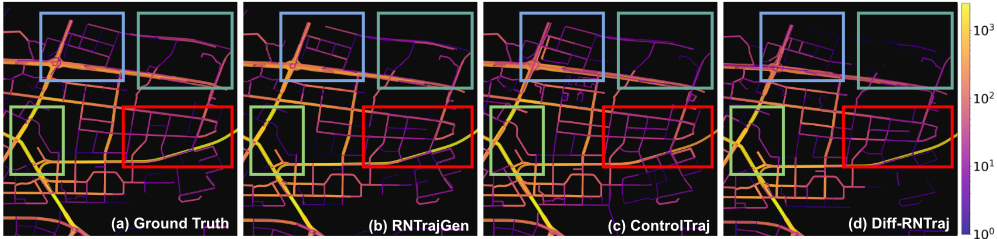
Fig. 4 compares heatmaps of trajectory point distributions across road segments for various models in the Chengdu region. Results show that ControlTraj exhibits flow deviations on certain segments, indicating that its generated trajectories deviate from the road network during map matching. DiffRNTraj performs worse than ControlTraj, probably due to its lack of conditional guidance. In contrast, RNTrajGen exhibits a distribution highly consistent with ground truth. This is attributable to the rich geosemantic embeddings provided by RNKEE and the precise constraints imposed on the generation process by its topology-aware guidance mechanism at the road segment level.
Ablation Study (RQ2)
The RNTrajGen framework comprises four key technical modules. To evaluate the independent contributions of each component, we constructed the following four variants:
- w/o C: This variant removes the topology-aware conditional guidance mechanism, degenerating into an unconditional trajectory generation model.
- w/o RNKEE: This variant replaces the Road Network Knowledge-Enhanced Encoder with the Node2Vec algorithm to learn road segment representations.
- w/o Viterbi: This variant employs a decoding method based on maximum cosine similarity instead of the Viterbi algorithm.
- w/o Two Stage: This variant abandons the two-stage generation strategy and adopts the generation approach of the Diff-RNTraj model, directly modeling the joint distribution of road segment embeddings and moving ratios within a single stage.
According to the results in Table 2, we draw the following conclusions: (i) Trajectories generated by variant sampling without the condition exhibit significant deviations across all distribution metrics, indicating that the topology-aware condition is crucial for accurately capturing the real data distribution. (ii) Compared to the variant using the Node2Vec algorithm, RNKEE achieves lower values of the road segment distribution metric (JSD-RS), reducing it by 16.28% and 25.50% on the Porto and Chengdu datasets, respectively. This demonstrates the advantage of RNKEE in capturing road network features, highlighting the limitations of purely data-driven approaches like Node2Vec. (iii) Trajectories generated via the variant decoding based on maximum cosine similarity exhibit a Trajectory Complete Connectivity (TCC) below 80%, significantly lower than RNTrajGen. This demonstrates the superiority of the Viterbi algorithm in ensuring topological connectivity of generated trajectories. (iv) The single-stage generation strategy exhibits significantly higher values in the distance distribution metric (JSD-SD) between adjacent trajectory points, with reductions of 84.24% on the Porto dataset and 70.82% on the Chengdu dataset achieved by the twostage approach. However, in terms of the road segment distribution metric (JSD-RS), the single-stage approach performs slightly better than the two-stage modeling method, because the moving ratio provides additional information to assist in modeling road segment transitions. Nevertheless, the singlestage approach still fails to effectively capture the movement characteristics of real trajectories.
| Model | Porto | Chengdu | ||||||||||
|---|---|---|---|---|---|---|---|---|---|---|---|---|
| JSD-TD(↓) | JSD-SD(↓) | JSD-GPD(↓) | JSD-RS(↓) | TAC(↑) | TCC(↑) | JSD-TD(↓) | JSD-SD(↓) | JSD-GPD(↓) | JSD-RS(↓) | TAC(↑) | TCC(↑) | |
| w/o C | 0.005132 | 0.002813 | 0.020998 | 0.024127 | 100.00 | 100.00 | 0.002926 | 0.004787 | 0.021554 | 0.023837 | 100.00 | 100.00 |
| w/o RNKEE | 0.000616 | 0.001364 | 0.006030 | 0.009883 | 100.00 | 100.00 | 0.000614 | 0.003082 | 0.006778 | 0.009290 | 100.00 | 100.00 |
| w/o Viterbi | 0.000513 | 0.001361 | 0.005481 | 0.008524 | 98.28 | 72.39 | 0.000689 | 0.002327 | 0.006364 | 0.007296 | 98.60 | 78.97 |
| w/o Two Stage | 0.000563 | 0.006619 | 0.007441 | 0.008230 | 100.00 | 100.00 | 0.000798 | 0.005641 | 0.009261 | 0.006465 | 100.00 | 100.00 |
| RNTrajGen | 0.000448 | 0.001043 | 0.005352 | 0.008274 | 100.00 | 100.00 | 0.000285 | 0.001646 | 0.006246 | 0.006921 | 100.00 | 100.00 |
Embedding Effectiveness (RQ3)
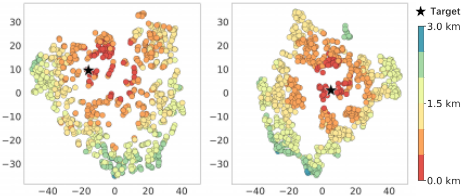
To verify whether RNKEE provides semantically rich embeddings, we evaluate the discriminability of road segments across varying geodesic distances in the latent space. Specifically, we sample a target road segment and its N-hop neighbors, binning them into 500m geographic intervals. The tSNE visualization (Fig. 5) shows that, unlike Node2Vec, RNKEE embeddings exhibit a distinct concentric diffusion pattern, where road segments transition from center to periphery as their geodesic distance increases. This visual consistency demonstrates RNKEE's superior ability to capture spatial-semantic relationships.
Generation Fidelity (RQ4)
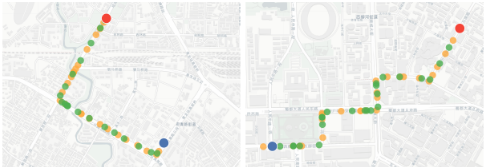
To visually assess the quality of the generated trajectories, we conducted trajectory generation experiments using RNTrajGen on the Chengdu dataset. As shown in Fig. 6, the generated results not only align well with the road network, but also exhibit movement characteristics similar to those of the ground-truth data. This further demonstrates RNTrajGen's strong capability to generate fine-grained trajectories that closely conform to the underlying road network.
Downstream Task Performance (RQ5)
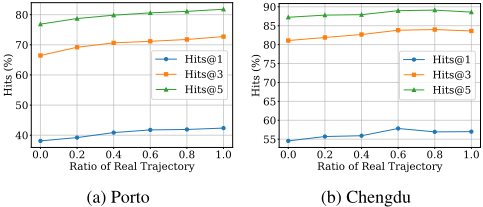
To evaluate the utility of generated trajectories, we conduct a next-location prediction task using an LSTM model. We split the real dataset into training, validation, and test sets (6:2:2). By gradually replacing real training data with RNTrajGengenerated trajectories while keeping the total training size constant, we measure performance via Hits@n. As shown in Fig. 7, the model achieves robust results even with 0% real data. This result fully demonstrates the practical utility of trajectories generated by RNTrajGen for downstream tasks.
6 Conclusion
In this paper, we propose RNTrajGen, a two-stage finegrained trajectory generation framework constrained by road networks, designed to generate fine-grained trajectories that align with road networks while exhibiting realistic characteristics. Specifically, we first design a Road Network Knowledge-Enhanced Encoder(RNKEE) to provide semantically rich segment representations for the trajectory generation task. Subsequently, a two-stage generation strategy is employed to produce fine-grained trajectories that are strictly aligned with the road network and exhibit realistic movement characteristics. Extensive experiments on real-world datasets demonstrate that RNTrajGen consistently outperforms stateof-the-art baseline models. Furthermore, ablation studies validate the independent contributions of each component within the model, with visual analysis further confirming that RNKEE can capture road network knowledge to provide semantically rich road segment embeddings. Finally, analysis of downstream tasks shows that the trajectories generated by RNTrajGen exhibit performance comparable to that of realworld trajectories.
Acknowledgements
This research was funded by the Science and Technology Development Program of Jilin Province (No. 20250203122SF).
@inproceedings{ijcai2026p324,
  title     = {Two-Stage Fine-Grained Trajectory Generation Constrained by Road Networks},
  author    = {Lv, Zewu and Fan, Zipei and Zhang, Zhiwen and Song, Xuan},
  booktitle = {Proceedings of the Thirty-Fifth International Joint Conference on
               Artificial Intelligence, {IJCAI-26}},
  publisher = {International Joint Conferences on Artificial Intelligence Organization},
  editor    = {Diego Calvanese},
  pages     = {2915--2923},
  year      = {2026},
  month     = {8},
  note      = {Main Track},
  doi       = {10.24963/ijcai.2026/324},
  url       = {https://doi.org/10.24963/ijcai.2026/324},
}
TY - CPAPER TI - Two-Stage Fine-Grained Trajectory Generation Constrained by Road Networks AU - Lv, Zewu AU - Fan, Zipei AU - Zhang, Zhiwen AU - Song, Xuan T2 - Proceedings of the Thirty-Fifth International Joint Conference on Artificial Intelligence, IJCAI-26 PB - International Joint Conferences on Artificial Intelligence Organization PY - 2026 SP - 2915 EP - 2923 DO - 10.24963/ijcai.2026/324 UR - https://doi.org/10.24963/ijcai.2026/324 ER -Copied
Machine-readable versions of this paper, for tools and AI agents:





