
IC3-Evolve: Proof-/Witness-Gated Offline LLM-Driven Heuristic Evolution for IC3 Hardware Model Checking
Proceedings of the Thirty-Fifth International Joint Conference on Artificial Intelligence. Main Track. Pages 271-278.
https://doi.org/10.24963/ijcai.2026/31
Keywords
- Agent-based and Multi-agent Systems: Formal verification, validation and synthesis
- Constraint Satisfaction and Optimization: Satisfiabilty
- Constraint Satisfaction and Optimization: Applications
- Constraint Satisfaction and Optimization: Solvers and tools
Abstract
IC3, also known as property-directed reachability (PDR), is a commonly-used algorithm for hardware safety model checking. It checks if a state transition system complies with a given safety property. IC3 either returns UNSAFE (indicating property violation) with a counterexample trace, or SAFE with a checkable inductive invariant as the proof to safety. In practice, the performance of IC3 is dominated by a large web of interacting heuristics and implementation choices, making manual tuning costly, brittle, and hard to reproduce.
This paper presents IC3-Evolve, an automated offline code-evolution framework that utilizes an LLM to propose small, slot-restricted and auditable patches to an IC3 implementation. Crucially, every candidate patch is admitted only through proof-/witness-gated validation: SAFE runs must emit a certificate that is independently checked, and UNSAFE runs must emit a replayable counterexample trace, preventing unsound edits from being deployed. Since the LLM is used only offline, the deployed artifact is a standalone evolved checker with zero ML/LLM inference overhead and no runtime model dependency. We evolve on the public hardware model checking competition (HWMCC) benchmark and evaluate the generalizability on unseen public and industrial model checking benchmarks, showing that IC3-Evolve can reliably discover practical heuristic improvements under strict correctness gates.
- [Biere et al., 2024] Armin Biere, Tobias Faller, Katalin Fazekas, Mathias Fleury, Nils Froleyks, and Florian Pol- litt. CaDiCaL 2.0. In Arie Gurfinkel and Vijay Ganesh, editors, Computer Aided Verification -36th International Conference, CAV 2024, Montreal, QC, Canada, July 24- 27, 2024, Proceedings, Part I, volume 14681 of Lec- ture Notes in Computer Science, pages 133-152. Springer, 2024.
- [Biere, 2014] Armin Biere. Aiger and-inverter-graph library and utilities (incl. aigsim). https://github.com/arminbiere/ aiger, 2014. Link
- [Bradley, 2011] Aaron R. Bradley. Sat-based model check- ing without unrolling. In Ranjit Jhala and David Schmidt, editors, Verification, Model Checking, and Abstract Inter- pretation, pages 70-87, Berlin, Heidelberg, 2011. Springer Berlin Heidelberg.
- [Bradley, 2013] Aaron R. Bradley. IC3ref: Ic3 reference im- plementation. https://github.com/arbrad/IC3ref, 2013. Link
- [Brayton and Mishchenko, 2010] Robert Brayton and Alan Mishchenko. Abc: An academic industrial-strength ver- ification tool. In International Conference on Computer Aided Verification, pages 24-40. Springer, 2010.
- [Eén et al., 2011] Niklas Eén, Alan Mishchenko, and Robert Brayton. Efficient implementation of property directed reachability. In 2011 Formal Methods in Computer-Aided Design (FMCAD), pages 125-134. IEEE, 2011.
- [Hu et al., 2023] Guangyu Hu, Wei Zhang, and Hongce Zhang. Neuropdr: Integrating neural networks in the pdr algorithm for hardware model checking. In 2023 ACM/IEEE 5th Workshop on Machine Learning for CAD (MLCAD), pages 1-6. IEEE, 2023.
- [Hu et al., 2024] Guangyu Hu, Jianheng Tang, Changyuan Yu, Wei Zhang, and Hongce Zhang. Deepic3: Guiding ic3 algorithms by graph neural network clause prediction. In 2024 29th Asia and South Pacific Design Automation Conference (ASP-DAC), pages 262-268. IEEE, 2024. [hwm, 2024] HWMCC 2024: Hardware model checking competition 2024 (results). https://hwmcc.github.io/2024/, 2024. Link
- [hwm, 2025a] HWMCC 2025: Hardware model checking competition 2025 (results). https://hwmcc.github.io/2025/, 2025. Link
- [hwm, 2025b] HWMCC: Hardware model checking compe- tition. https://hwmcc.github.io/, 2025. Link
- [Janßen et al., 2024] Christian Janßen, Cedric Richter, and Heike Wehrheim. Can chatgpt support software veri- fication? In International Conference on Fundamen- tal Approaches to Software Engineering, pages 266-279.
- [Le et al., 2021] Nham Le, Xujie Si, and Arie Gurfinkel. Data-driven optimization of inductive generalization. In FMCAD, pages 86-95, 2021.
- [Novikov et al., 2025] Alexander Novikov, Ngân Vũ, Mar- vin Eisenberger, Emilien Dupont, Po-Sen Huang, Adam Zsolt Wagner, Sergey Shirobokov, Borislav Ko- zlovskii, Francisco JR Ruiz, Abbas Mehrabian, et al. Al- phaevolve: A coding agent for scientific and algorithmic discovery. arXiv preprint arXiv:2506.13131, 2025.
- [OpenAI, 2025] OpenAI. Addendum to gpt-5 system card: Gpt-5-codex, 2025.
- [Pirzada et al., 2024] Muhammad AA Pirzada, Giles Reger, Ahmed Bhayat, and Lucas C Cordeiro. Llm-generated invariants for bounded model checking without loop un- rolling. In Proceedings of the 39th IEEE/ACM Interna- tional Conference on Automated Software Engineering, pages 1395-1407, 2024.
- [Su et al., 2024] Yuheng Su, Qiusong Yang, and Yiwei Ci. Predicting lemmas in generalization of ic3. In Proceed- ings of the 61st ACM/IEEE Design Automation Confer- ence, DAC '24, New York, NY, USA, 2024. Association for Computing Machinery.
- [Su et al., 2025a] Yuheng Su, Qiusong Yang, Yiwei Ci, Tian- jun Bu, and Ziyu Huang. The ric3 hardware model checker, 2025.
- [Su et al., 2025b] Yuheng Su, Qiusong Yang, Yiwei Ci, Yingcheng Li, Tianjun Bu, and Ziyu Huang. Deeply opti- mizing the sat solver for the ic3 algorithm, 2025.
- [Sun et al., 2024] Yiwen Sun, Furong Ye, Xianyin Zhang, Shiyu Huang, Bingzhen Zhang, Ke Wei, and Shaowei Cai. Autosat: Automatically optimize sat solvers via large lan- guage models. arXiv preprint arXiv:2402.10705, 2024.
- [Wu et al., 2024] Guangyuan Wu, Weining Cao, Yuan Yao, Hengfeng Wei, Taolue Chen, and Xiaoxing Ma. Llm meets bounded model checking: Neuro-symbolic loop invariant inference. In Proceedings of the 39th IEEE/ACM Inter- national Conference on Automated Software Engineering, pages 406-417, 2024.
- [Yu et al., 2021] Emily Yu, Armin Biere, and Keijo Hel- janko. Progress in certifying hardware model checking results. In Alexandra Silva and K. Rustan M. Leino, edi- tors, Computer Aided Verification, pages 363-386, Cham, 2021. Springer International Publishing.
- [Yu et al., 2025] Cunxi Yu, Rongjian Liang, Chia-Tung Ho, and Haoxing Ren. Autonomous code evolution meets np- completeness. arXiv preprint arXiv:2509.07367, 2025.
References were extracted automatically from the PDF and may contain errors.
Full text extracted automatically from the PDF; figures, tables and equations may differ. The PDF is the version of record.
1 Introduction
Formal property checking is a cornerstone of modern hardware verification. As integrated circuits grow in complexity, their state spaces quickly exceed what simulation can effectively explore, leaving deep corner-case behaviors untested, causing severe economic loss, thus motivating formal analysis in hardware verification, exemplified by hardware safety model checking.
For hardware safety model checking, IC3 [Bradley, 2011] (also known as property-directed reachability, PDR [E´en et al., 2011]) is a widely-used state-of-the-art algorithm. Importantly, IC3 is proof-producing: it either returns UNSAFE with a replayable counterexample trace, or returns SAFE with a checkable inductive invariant that certifies the property.
While IC3 provides a strong algorithmic foundation, its practical performance depends critically on numerous heuristics and engineering decisions-including generalization, clause propagation, and interactions with the underlying Boolean satisfiability (SAT) engines. As a result, improving an IC3 checker is often more about heuristic engineering than changing the core algorithmic framework. Unfortunately, this engineering loop is costly and brittle [Le et al., 2021; Hu et al., 2024]: even small heuristic changes typically require re-running large benchmark suites to reach stable conclusions; gains on one family of instances can easily induce regressions elsewhere. Manual tuning therefore demands substantial domain expertise [Le et al., 2021; Hu et al., 2024], making it difficult to reliably discover robust heuristic combinations.
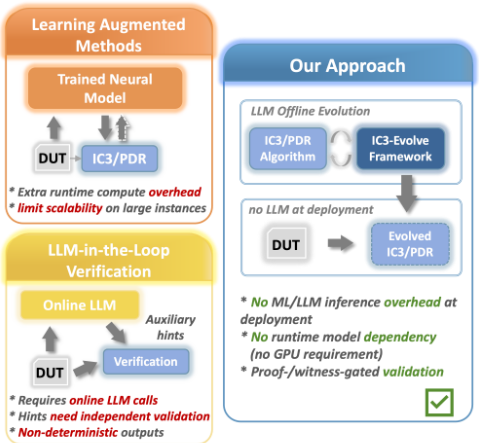
Recent advances in machine learning have also begun to influence Electronic Design Automation (EDA) and formal verification. In the context of IC3, prior work such as NeuroPDR [Hu et al., 2023] and DeepIC3 [Hu et al., 2024] explores learning-augmented solvers: a trained model predicts candidate clauses to guide IC3's proof search, showing promising results on selected benchmarks.
However, learning-augmented IC3 solvers often face practical barriers to industrial deployment. Learned components introduce training and inference costs, and their benefits can degrade on large-scale or heterogeneous workloads where robustness and throughput are paramount. Moreover, placing ML inference in the runtime loop adds latency and increases performance variance, prohibiting predictable behavior and integration into production flows. In recent HWMCC editions, the strongest-performing entries remain predominantly conventional model checkers rather than learning-augmented solvers [hwm, 2024; hwm, 2025a].
Another line of work uses LLMs in the verification loop to provide per-instance auxiliary hints (e.g., candidate invariants or guidance) to an existing checker [Janßen et al., 2024; Pirzada et al., 2024; Wu et al., 2024]. Such hints must be independently validated before use; moreover, integrating online LLM calls at verification time raises practical concerns about latency, reproducibility, and deployment.
These trends suggest both an opportunity and a bottleneck: today's strongest IC3 checkers remain largely heuristicengineered, yet manual tuning is labor-intensive and fragile. Meanwhile, recent LLM-based "code evolution" systems show that iterative propose-evaluate-refine loops can autonomously improve nontrivial algorithmic code under evaluation feedback. For example, AlphaEvolve [Novikov et al., 2025] demonstrates evaluator-driven evolutionary search for algorithmic optimization, while AutoSAT [Sun et al., 2024] and SATLUTION [Yu et al., 2025] apply related ideas to evolve SAT-solver heuristics under rigorous validation.
Motivated by this trend of research, we present IC3-Evolve, an offline LLM-driven framework that treats IC3 heuristic engineering as controlled code evolution. As shown in Figure 1, rather than placing ML/LLM inference in the verification-time loop, IC3-Evolve uses LLMs to propose constrained, auditable code edits to an IC3 checker and promotes edits only after proof-/witness-gated validation. The resulting artifact is a standalone evolved checker: the LLM is used only offline, so deployment incurs no ML/LLM inference overhead and no runtime model dependency. Building on this foundation, we introduce a workflow that explores both local and cross-module heuristic choices and evaluate the evolved engine on public and industrial benchmarks.
We make the following contributions:
- We introduce IC3-Evolve, an offline LLM-driven framework for evolving IC3 heuristics through slotrestricted, auditable code edits, compiling validated improvements directly into the checker (with no inferencetime overhead at deployment).
- We design and implement a heuristic-evolution workflow that explores local refinements and cross-module
- changes, including the Compass & Jump strategy to guide search across the solver's modification space.
- We enforce correctness via proof-/witness-gated validation: a proposed edit is accepted only if it passes hard checks with validation, preventing unsound changes from being deployed.
- We evaluate IC3-Evolve by evolving on the public HWMCC suite and assessing generalization on unseen public and industrial verification benchmarks from production flows, demonstrating that IC3-Evolve can discover practical heuristic improvements under strict correctness gates.
2 Background
2.1 IC3 in a Nutshell
IC3 is a proof-producing safety model checking algorithm: it tries to prove that no reachable execution can enter a "bad" state. Operationally, it alternates between (i) searching for counterexamples to the current proof attempt and (ii) learning clauses that rule them out. It either returns UNSAFE with a replayable counterexample trace, or returns SAFE with a checkable inductive invariant that certifies the property. Throughout the paper, we use proof to denote the SAFE certificate (inductive invariant), and witness to denote the UNSAFE counterexample trace.
We consider a finite-state transition system with state variables x, input variables y, initial-state predicate I(x), transition relation T(x, y, x′ ), and a safety property P(x), where x′ denotes the next-state copy of x. IC3 [Bradley, 2011] decides whether all reachable states satisfy P .
IC3 maintains a sequence of frames F0, . . . , Fk, where F0 = I and each Fi is represented as a formula over x. Intuitively, Fi over-approximates the set of states reachable within i steps. The frames are monotone (Fi ⇒ Fi+1), and for i ≥ 1 they are constrained to satisfy the property (Fi ⇒ P ). Additionally, the sequence satisfies the step condition: for all 0 ≤ i < k, Fi(x)∧T (x, y, x′ ) ⇒ Fi+1(x′ ). IC3 strengthens this sequence by learning lemmas that exclude unreachable states while preserving all reachable behaviors.
Algorithm 1 sketches the main loop of IC3. We use a cube to denote a conjunction of literals representing a (partial) state assignment, and a clause to denote a disjunction of literals used as a lemma. At a high level, IC3 alternates between two phases: (i) blocking, which finds a counterexample-toinduction (CTI) cube s by checking Fk∧T ∧¬P ′ (an Fk-state with a bad successor) for satisfiability and attempts to block s by learning a new lemma; and (ii) propagation, which tries to push learned lemmas forward to higher frames. If blocking a proof obligation reaches level 0, IC3 can construct a counterexample trace and returns UNSAFE. If two adjacent frames become identical (Fi = Fi+1), that common frame is a 1-step inductive invariant implying P, and IC3 returns SAFE.
2.2 Key Subroutines and Heuristic Touchpoints
Key point. Most implementation choices in IC3 control search order and resource allocation (e.g., which obligation to tackle next, how aggressively to generalize, and how much
Algorithm 1: IC3 Algorithm Overview
Input : ⟨I(x), T(x, y, x′ ), P(x)⟩ Output: SAFE or UNSAFE // x′ denotes the next-state copy of x; P ′ abbreviates P(x′ ) 1 F0 ← I; F1 ←P; k ← 1; Q← ∅; // Q stores proof obligations (s, i) 2 if I ∧¬P is SAT or I ∧ T ∧¬P ′ is SAT then 3 return UNSAFE 4 end 5 while true do 6 while Fk ∧ T ∧¬P ′ is SAT with witness cube s do 7 if not BLOCKONE(s, k) then 8 return UNSAFE 9 end 10 end 11 PUSHCLAUSES(k); 12 if ∃i < k : Fi = Fi+1 then 13 return SAFE 14 end 15 k ← k + 1; Fk ← P ; 16 end 17 Function BLOCKONE(s, k): 18 insert (s, k) into Q; // internally calls PREDGEN and INDGEN while discharging Q 19 return BL O C KPR O O FOB L I G A T I O N S(Q);SAT effort to spend). They do not affect soundness as long as every learned lemma is validated by the corresponding SAT checks and SAFE is returned only at a validated fixpoint; under resource limits they mainly affect practical completeness via timeouts. This makes these choices prime targets for systematic heuristic engineering (and for our offline code evolution later).
Algorithm 2 expands the key subroutines and makes explicit where heuristics dominate performance in practice. We use the cube/clause terminology as defined above. Most of IC3's runtime is spent answering incremental SAT queries of two types: (1) predecessor-search queries (for recursive blocking), and (2) relative-inductiveness queries (for generalization and pushing).
Proof obligations (BLOCKPROOFOBLIGATIONS). IC3 maintains a worklist Q of proof obligations (POs) (s, i), where s is a cube to be blocked at frame i. The policy for popping and re-inserting POs (e.g., depth-first vs. best-first, priority rules, aging) can strongly influence convergence: it can bias the solver toward quickly refuting shallow CTIs (bug finding) or toward accumulating stronger lemmas for deeper proofs. Practical implementations also rely on budgeting/backoff to avoid repeatedly spending SAT effort on "stuck" POs. Since frames are continuously strengthened, queued POs can become stale and are typically skipped once they are already blocked by the current target frame (i.e., Fi ∧ s becomes UNSAT).
Predecessor generalization (PREDGEN). When a PO (s, i) cannot be blocked directly, IC3 queries Fi-1 ∧T ∧s′ to
Algorithm 2: IC3 Key Subroutines
// s′ and c′ denote the primed versions obtained by substituting x ↦→x′ 1 Function BLOCKPROOFOBLIGATIONS(Q): 2 while Q ̸= ∅ do 3 (s, i) ← POP(Q); 4 if Fi ∧ s is UNSAT then continue; 5 if i = 0 then 6 return false 7 end 8 if Fi-1 ∧ T ∧ s′ is SAT then 9 p ←PREDGEN(GetWitness(), i -1, s); 10 insert (s, i) into Q; 11 insert (p, i - 1) into Q; 12 end 13 else 14 c ← INDGEN(s, i); 15 for j = 1 → i do 16 Fj ← Fj ∧ c 17 end 18 end 19 end 20 return true; 21 Function PREDGEN(p, j, s): // Drop literals from predecessor cube p while preserving reachability into s 22 return MINIMIZEPRED(Fj , T, p, s); 23 Function INDGEN(s, i): // Return c ⊆ ¬s such that I ⇒ c and Fi-1 ∧ c ∧ T ⇒ c′ 24 return RELINDUCTIVEMINIMIZE(I, Fi-1, T, ¬s); 25 Function PUSHCLAUSES(k): 26 for i = 1 → k - 1 do 27 foreach c ∈ Fi \ Fi+1 do 28 if Fi ∧ T ∧¬c′ is UNSAT then Fi+1 ← Fi+1 ∧ c ; 29 end 30 endobtain a predecessor cube p and enqueues (p, i - 1). PREDGEN attempts to generalize p (e.g., by dropping literals or using partial models) while preserving reachability into s. Stronger predecessor generalization can reduce search depth and the number of POs, but it typically requires extra SAT work and interacts heavily with the worklist strategy.
Inductive generalization (INDGEN). Given a CTI cube s at level i, INDGEN derives a blocking clause c ⊆ ¬s such that c is relatively inductive w.r.t. Fi-1 and does not exclude any initial state: I ⇒ c and Fi-1 ∧ c ∧ T ∧ ¬c′ is UNSAT. Most implementations start from ¬s and attempt to drop literals while keeping relative inductiveness, yielding MIC-style generalization and its extensions. They often leverage UNSAT cores/conflict clauses to guide minimization. Optimizations here can substantially reduce SAT calls and improve lemma quality, but they introduce trade-offs between generalization strength and computational overhead [Su et al., 2024].
Push and propagation (PUSHCLAUSES). To accelerate convergence, IC3 tries to push lemmas forward: if a lemma c ∈ Fi is also inductive relative to Fi, it can be added to Fi+1 (equivalently, if Fi ∧ T ∧ ¬c′ is UNSAT). The effectiveness of pushing depends on clause ordering, caching, and simplification/subsumption policies, as well as on budgeting decisions that prevent spending too much effort on low-yield push attempts.
3 Methodology
3.1 IC3-Evolve Framework Overview
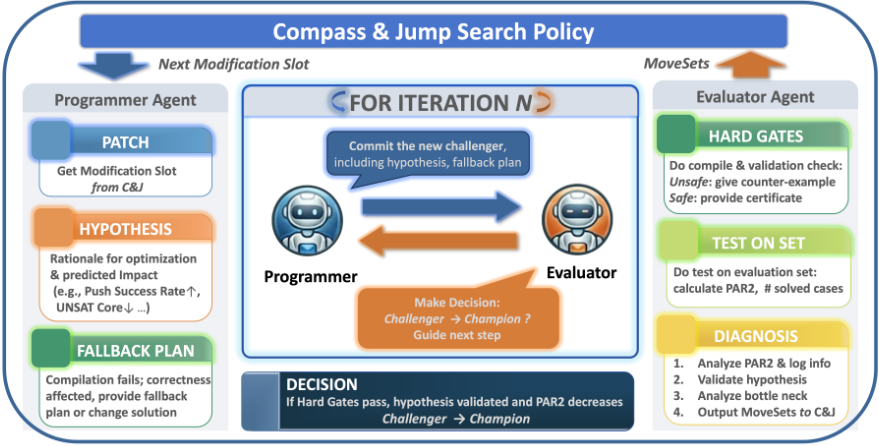
Figure 2 summarizes IC3-Evolve, our offline framework for evolving IC3 implementations via iterative, auditable code changes. Starting from a champion solver, each iteration selects a constrained modification scope (a set of heuristic slots) and asks a programmer agent to propose a small patch together with a hypothesis about its expected impact and a fallback plan in case the change proves invalid. The candidate is then built and evaluated by an evaluator agent. Crucially, we separate optimization from correctness: a patch is considered only if it passes proof-gated hard checks with independent witness validation-SAFE runs must emit a checkable inductive invariant/certificate, and UNSAFE runs must emit a counterexample trace that can be replayed by simulation. Among the validated candidates, we retain improvements based on benchmark performance (e.g., PAR2 and solved counts) and use the evaluator's diagnosis to steer subsequent iterations via the Compass&Jump policy.
3.2 Slot-Restricted Patch Space
To make code evolution controllable and reviewer-auditable, our IC3-Evolve exposes a number of heuristic slots that align with IC3's dominant runtime subroutines (cf. Section 2.2). Each iteration restricts the programmer agent to one (Compass) or a small set (Jump) of slots, so that proposed patches are localized, interpretable, and easy to revert. Table 1 summarizes the slots and representative optimization knobs. Importantly, slots constrain where we edit, not what constitutes correctness: soundness is enforced exclusively by the proof-gated validation described next.
Slot-specific knowledge packs. A slot specifies a curated set of files/functions (and optionally line ranges) that the programmer agent is allowed to modify in a given iteration. For each slot, we maintain a small, auditable knowledge pack that collects the most relevant external and internal references, including solver code excerpts, open-source implementations, and slot-specific papers and documentation. At each iteration, the Compass&Jump search policy retrieves and injects only the slot-relevant subset into the agents' prompts to reduce context noise and constrain edits toward well-understood patterns. These knowledge packs only improve proposal quality and interpretability; correctness is enforced solely by the proof-/witness-gated validation.
3.3 Two-Agent Closed-Loop Evolution
To operationalize heuristic engineering as a repeatable optimization process, IC3-Evolve runs a two-agent loop orchestrated by a lightweight Compass&Jump search policy.
| Slot | Scope (examples) |
|---|---|
| PO handling | BLOCKPROOFOBLIGATIONS: worklist order; stale-PO skip; requeue/budget / PO depth; SAT/PO; requeue rate |
| Ind. gen. | INDGEN: literal dropping; UNSAT cores; CTG/MIC budgets / core size; lemma yield; generalization SAT calls |
| Pred. gen. | PREDGEN: assumption order; predecessor selection; cooldown / chain length; predecessor SAT calls; depth |
| Push/prop. | PUSHCLAUSES: push order; caching; subsumption / push success; redundancy; frame stabilization |
| Cross-slot | Small multi-slot changes and synergies / overall PAR2 and bucketed regressions |
The framework maintains a current champion implementation and applies the promotion rule (promote or revert) for each proposed challenger. Validation and benchmarking are executed by the evaluator agent, which also produces a diagnostic MoveSet-a ranked list of structured recommendations m = (slot, direction, conf, risk, cost) summarizing the diagnosis and suggested next edits. Each iteration records full provenance (patch diffs, logs, metrics, and witnesses) to keep the process auditable and to support post-hoc diagnosis.
Iteration protocol. Given a champion solver, one evolution iteration proceeds as follows:
- (i) Select scope. The framework uses Compass&Jump to choose the next modification slot(s) and assembles slotrelevant context (knowledge pack excerpts, code snippets, and the previous MoveSet if available).
- (ii) Propose. The programmer agent produces a slotrestricted patch together with a hypothesis and a fallback plan.
- (iii) Validate. The evaluator agent applies the patch, builds the challenger, and runs hard checks including proof/witness-gated validation.
- (iv) Test. The evaluator agent evaluates the challenger on the evolution workload (a fixed HWMCC subset) under fixed timeouts, producing PAR2 and bucketed solved/- timeout statistics.
- (v) Diagnose & guide. The evaluator agent inspects the patch diff and evaluation artifacts, confirms (or refutes) the hypothesis, identifies bottlenecks, and returns a ranked MoveSet to guide the next slot and edit direction.
The challenger is promoted only if it passes hard gates and improves the objective without unacceptable regressions; otherwise, the framework rolls back to the champion and continues with the next MoveSet.
3.4 Proof-/Witness-Gated Evaluation&Promotion
Proof and witness hard gates. For each benchmark instance that a challenger solves within the timeout, we require
Algorithm 3: Compass & Jump search policy
Input : slots S; MoveSetM; progress history H; jump prob. pJUMP; jump size J ∈ {2, 3} Output: allowed slots A ⊆ S; guidance moves G; updated pJUMP 1 ifM= ∅ then 2 sample s ∼ UNIFORM(S); 3 return ({s}, ∅, pJUMP); 4 end 5 pJUMP ← ADJUSTJUMP(pJUMP,H); // decrease if steady, increase if stagnant 6 M← RANKBYSCORE(M); // using the linear score in Section 3.5 7 if RAND() < pJUMP then 8 G ← TOPDISTINCTSLOTS(M, J); 9 end 10 m⋆ ← SELECTBEST(M,H); // optionally risk-averse when volatile 11 G ← {m⋆ }; 12 A← {m.slot | m ∈ G }; 13 return (A, G, pJUMP);it to emit an artifact that can be checked independently of the evolved solver. If the solver reports UNSAFE, it must dump a counterexample trace that is replayed by AIGSIM [Biere, 2014] to confirm that the trace indeed reaches a bad state. If the solver reports SAFE, it must dump a proof (inductive invariant) that is validated by CERTIFAIGER [Yu et al., 2021]. Any mismatch (missing proof/witness artifact, replay/check failure, or inconsistent return code) immediately rejects the challenger regardless of its performance.
Promotion and feedback on failures. Only challengers that pass the hard gates are scored on performance metrics such as PAR2 and solved counts. When a challenger is rejected-either by witness validation or by failing to improve under the promotion rule-the evaluator inspects the diff and logs to produce a diagnosis and a ranked MoveSet, which guides the programmer agent in the next iteration. Following HWMCC-style certifying model-checking practice [hwm, 2025b], we count a solved instance only when its SAFE certificate or UNSAFE witness is independently checked; this is instance-level validation under trusted checkers and SAT infrastructure.
3.5 Search Policy: Compass&Jump
Compass&Jump is a lightweight search policy for choosing the next editable slot(s) in the slot-restricted patch space. After each iteration, the evaluator returns a MoveSet M, i.e., a ranked list of candidate moves m = (slot, direction, conf, risk, cost). We rank moves by a linear score score(m) = wc ·conf(m)-wr ·risk(m)-wk ·cost(m) (fixed weights). With probability pJUMP the policy enters Jump mode and enables edits to the top J ∈ {2, 3} moves from distinct slots, encouraging cross-slot synergies; otherwise it enters Compass mode and enables only the single best move (optionally preferring a lower-risk move when progress is volatile). The jump probability pJUMP is adapted from recent progress (decrease under steady improvement; increase under stagnation). Compass&Jump controls only search scope and guidance; correctness is guaranteed solely by the proof/witness-gated validation in Section 3.4.
4 Experiments
4.1 Experimental Setup
Platform. All experiments are conducted on Ubuntu 20.04.6 LTS, equipped with dual Intel ® Xeon ® Platinum 8375C CPUs at 2.90 GHz.
LLMmodel. We use GPT-5-Codex [OpenAI, 2025] as the underlying model for both the programmer and evaluator agents during offline evolution.
Benchmarks. We evolve on a workload of 100 public HWMCC AIGER instances [hwm, 2025b], selected to cover a broad range of difficulty, including trivial, non-trivial, and possibly timeout cases (spanning both SAFE and UNSAFE). To assess transferability to production settings, we evaluate the final evolved engine on another 100 HWMCC instances (not used during evolution) and 302 industrial verification instances provided by industry.
Evolution configuration. We start from IC3ref [Bradley, 2013], a lightweight textbook-style IC3 implementation with minimal built-in heuristics, which provides a clean and lightweight starting point for controlled evolution. We run 200 offline evolution iterations in total. In the first 100 iterations, we use a structured slot sweep to ensure broad coverage: edits are restricted to one slot at a time, and we move to the next slot after several consecutive non-improving attempts. In the remaining 100 iterations, we enable the Compass&Jump search policy to select slots based on the evaluator's MoveSet feedback and to occasionally allow multi-slot edits for exploring cross-slot synergies. We manage context by prioritizing local code/diffs and truncating logs and metrics under fixed budgets.
Timeout and metrics. We use a timeout of 1800 s per instance and report PAR2 (the averaged solving time, where a timeout is penalized as taking 2× the time limit).
4.2 Evolution Trace and Case Study
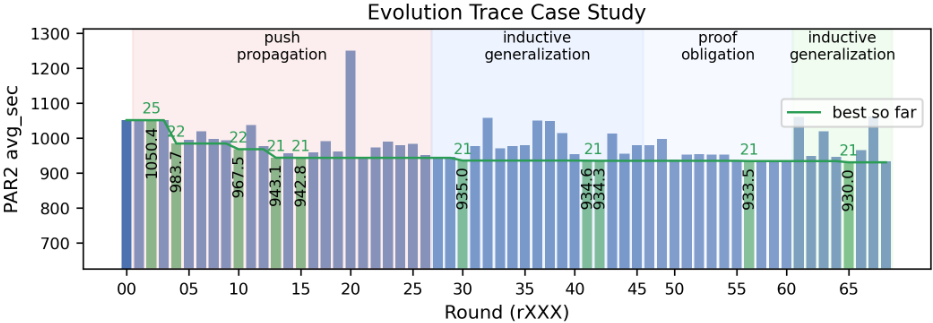
Figure 3 visualizes a typical offline evolution run. PAR2 improvements arrive as a sequence of punctuated "jumps" in the best-so-far line, interleaved with many non-improving (and thus rejected) challengers. The shaded phases correspond to different exposed heuristic slots, illustrating how the evolution process explores and composes improvements across solver subroutines while keeping correctness guarded by witness validation.
Case study: Push propagation (PUSHCLAUSES). We zoom into rounds r000-r013, where edits are restricted to the PUSHCLAUSES slot (all other code frozen). Across three accepted edits, PAR2 decreases from 1050.61 s to 943.07 s and timeouts drop from 25 to 21. Overall, the edits follow a consistent theme: avoid low-yield cleanup and reallocate effort toward frames with observed progress.
Milestones (green bars in Figure 3). We summarize bestso-far PAR2 (s) and timeouts (TO): r000 1050.61/25, r002 1050.42/25, r004 983.73/22, r013 943.07/21.
r002: observe & gate simplification. Simplification inside propagation can be expensive when few clauses are moving. The edit adds lightweight progress observation and triggers simplification only after successful pushing or at periodic checkpoints:
if pushedThisRound or periodicCheckpoint(): simplify() record pushSuccessRate()This reduces low-yield cleanup without changing IC3's proof checks, and sets up later stall-aware scheduling.
r004: skip repeatedly stalled frames. The next edit makes propagation stall-aware by tracking per-frame stall streaks and skipping push attempts on repeatedly unproductive frames:
if stallStreak[i] >= limit: continue pushFrame(i) updateStallStreak(i) // reset // else ++By redirecting effort to frames that still show improvement, the solver reduces churn and drops timeouts (25→22) with a clear PAR2 gain.
r013: stall-aware adaptive budgets. Finally, evolution learns an adaptive budgeting rule: allocate more push attempts to frames with recent successes, and cut budgets aggressively for deeply stalled frames with early termination:
budget <- adaptBudget(i) // stall/success history while clausesRemain(i) and budget>0: attemptPush(i) budget-- if earlyCut(i): breakCompared to the binary skip/try rule, adaptive budgets continuously reallocate work based on observed yield, further improving PAR2 to 943.07 s.
4.3 Comparison with Strong IC3 Baselines
Table 2 compares IC3-Evolve against several well-known IC3-based engines on public HWMCC benchmarks and an industrial benchmark suite. We report #Solved (split into #UNSAFE/#SAFE) and PAR2 under the same timeout limit. The baselines include the vanilla IC3ref [Bradley, 2013], IC3ref with a stronger SAT backend (IC3ref-CaDiCaL), ABC [Brayton and Mishchenko, 2010] (whose IC3 engine is a widely-used industrial-strength model checker), and rIC3 as a strong recent IC3 implementation.
A key fairness consideration is that a practical model checker is a pipeline that couples preprocessing, the model checking algorithm, and the SAT backend. In particular, rIC3 [Su et al., 2025a] is the recent HWMCC winner (HWMCC'24 [hwm, 2024] and HWMCC'25 [hwm, 2025a], in the bit-level safety tracks), making it a natural reference point for performance comparison. Since IC3-Evolve targets IC3 heuristic/code evolution rather than SAT-solver engineering, we control for the SAT backend by uniformly using CaDiCaL [Biere et al., 2024] in our evolved engine and comparing primarily against rIC3-CaDiCaL (rIC3 with CaDiCaL as the backend SAT solver, following the comparison setup in [Su et al., 2025b]). This setup accurately measures improvements attributable to IC3-level implementation choices.
| Solver | HWMCC Set A a | HWMCC Set B a | Industry Benchmark d | |||||||||
|---|---|---|---|---|---|---|---|---|---|---|---|---|
| #S/#T b | #U | #Safe | PAR2(s) | #S/#T | #U | #Safe | PAR2(s) | #S/#T | #U | #Safe | PAR2(s) | |
| IC3ref c | 75/100 | 21 | 54 | 1050.61 | 75/100 | 26 | 49 | 1068.33 | 187/302 | 39 | 148 | 1403.31 |
| IC3ref-CaDiCaL | 85/100 | 22 | 63 | 718.87 | 85/100 | 28 | 57 | 732.28 | 198/302 | 38 | 160 | 1302.13 |
| ABC | 86/100 | 22 | 64 | 665.59 | 88/100 | 26 | 62 | 618.59 | 185/302 | 36 | 149 | 1417.50 |
| rIC3-CaDiCaL | 86/100 | 21 | 65 | 639.61 | 89/100 | 27 | 62 | 524.35 | 182/302 | 36 | 146 | 1449.78 |
| IC3-Evolve | 92/100 | 24 | 68 | 490.67 | 94/100 | 28 | 66 | 464.56 | 225/302 | 36 | 189 | 1044.26 |
| Variant | HWMCC Set A (#Solved / PAR2(s)) | HWMCC Set B (#Solved / PAR2(s)) |
|---|---|---|
| Baseline | 75 / 1050.61 | 75 / 1068.33 |
| PO-only | 78 / 995.35 | 75 / 1093.42 |
| PredGen-only | 79 / 954.36 | 78 / 970.38 |
| IndGen-only | 78 / 927.80 | 84 / 803.73 |
| Push-only | 76 / 1016.05 | 75 / 1139.22 |
| Naive-Compose | 78 / 944.86 | 85 / 775.19 |
| IC3-Evolve | 92 / 490.67 | 94 / 464.56 |
Table 3: Slot-isolated and naive-composition ablation. Single-slotonly variants vs. Naive-Compose vs. full IC3-Evolve.
4.4 Ablation Study
No-gate counterfactual (why proof-/witness gating is necessary). In rounds r093-r094, IC3-Evolve proposed a new clause-cleaning heuristic that would have increased solved instances on the evolution workload by +9, and would be promoted under performance-only selection. However, the challenger failed independent witness validation
(certificate checking / trace replay) and was rejected by our proof-/witness gate. This counterfactual shows that witness gating is essential: it prevents unsound "improvements" from becoming champion and propagating into later rounds.
Slot-isolated evolution (IC3 optimization is not a lowhanging fruit). We restrict IC3-Evolve to one heuristic slot at a time and also test Naive-Compose, which merges the best single-slot edits without joint tuning. As shown in Table 3, these variants improve only modestly and often fail to transfer, indicating that robust gains require coordinated, regression-aware cross-slot evolution.
5 Conclusion and FutureWork
We presented IC3-Evolve, an offline LLM-driven framework that evolves IC3 heuristics through slot-restricted, auditable edits admitted only by proof-/witness-gated validation, producing a standalone checker with no runtime model dependency. Across public unseen and industrial workloads, IC3-Evolve improves over strong baselines, and ablations show that robust gains require coordinated cross-slot evolution with regression-aware promotion.
Acknowledgments
This work is supported by the National Natural Science Foundation of China (grant no. 62304194).
Contribution Statement
Mingkai Miao and Guangyu Hu (∗) contributed equally to this work. Hongce Zhang (†) is the corresponding author.
@inproceedings{ijcai2026p31,
  title     = {IC3-Evolve: Proof-/Witness-Gated Offline LLM-Driven Heuristic Evolution for IC3 Hardware Model Checking},
  author    = {Miao, Mingkai and Hu, Guangyu and Yang, Ziyi and Zhang, Hongce},
  booktitle = {Proceedings of the Thirty-Fifth International Joint Conference on
               Artificial Intelligence, {IJCAI-26}},
  publisher = {International Joint Conferences on Artificial Intelligence Organization},
  editor    = {Diego Calvanese},
  pages     = {271--278},
  year      = {2026},
  month     = {8},
  note      = {Main Track},
  doi       = {10.24963/ijcai.2026/31},
  url       = {https://doi.org/10.24963/ijcai.2026/31},
}
TY - CPAPER TI - IC3-Evolve: Proof-/Witness-Gated Offline LLM-Driven Heuristic Evolution for IC3 Hardware Model Checking AU - Miao, Mingkai AU - Hu, Guangyu AU - Yang, Ziyi AU - Zhang, Hongce T2 - Proceedings of the Thirty-Fifth International Joint Conference on Artificial Intelligence, IJCAI-26 PB - International Joint Conferences on Artificial Intelligence Organization PY - 2026 SP - 271 EP - 278 DO - 10.24963/ijcai.2026/31 UR - https://doi.org/10.24963/ijcai.2026/31 ER -Copied
Machine-readable versions of this paper, for tools and AI agents:





