
D2MDM2: A Brain-Inspired Deep Network Based on DDM Decision-Making Mechanism for Remote Sensing Change Detection
Proceedings of the Thirty-Fifth International Joint Conference on Artificial Intelligence. Main Track. Pages 2118-2126.
https://doi.org/10.24963/ijcai.2026/236
Keywords
- Computer Vision: Recognition (object detection, categorization)
- Computer Vision: Adversarial learning, adversarial attack and defense methods
- Humans and AI: Brain sciences
Abstract
Remote sensing change detection (RSCD) aims to identify changed regions in bitemporal images. However, conventional one-step modeling suffers from performance degradation caused by imaging temporal differences (e.g., illumination disturbances, seasonal variations). To address this issue, we formulate the problem as an “adversarial attack and defense” paradigm. Then, instead of traditional adversarial training, we propose a brain-inspired deep network based on the drift diffusion model (DDM) decision-making mechanism for RSCD, which is rooted in cognitive neuroscience. By simulating brain decision processes, the network enhances model robustness significantly. Specifically, we design the multi-stage reasoning unit to simulate DDM’s iterative evidence generation, stochastic representation unit with reparameterization sampling to model stochastic diffusion in decision-making, decision aggregation unit to replicate DDM’s evidence accumulation, and loss-guided unit with multi-loss joint constraints to simulate directional drift. Experimental results verify the model’s superior performance on multiple datasets and their perturbed versions.
- [Bandara and Patel, 2022] Wele Gedara Chaminda Bandara and Vishal M. Patel. A transformer-based siamese network for change detection. In IGARSS 2022 -2022 IEEE In- ternational Geoscience and Remote Sensing Symposium, pages 207-210, 2022.
- [Bernhard et al., 2023] Maximilian Bernhard, Niklas Strauß, and Matthias Schubert. Mapformer: Boosting change detection by using pre-change information. In 2023 IEEE/CVF International Conference on Computer Vision (ICCV), pages 16791-16800, 2023.
- [Chen et al., 2022] Hao Chen, Zipeng Qi, and Zhenwei Shi. Remote sensing image change detection with transform- ers. IEEE Transactions on Geoscience and Remote Sens- ing, 60:1-14, 2022.
- [Chen et al., 2023] Chao Chen, Jun-Wei Hsieh, Ping-Yang Chen, Yi-Kuan Hsieh, and Bo Wang. Saras-net: Scale and relation aware siamese network for change detection. Pro- ceedings of the AAAI Conference on Artificial Intelligence, abs/2212.01287, 2023.
- [Chen et al., 2024] Hongruixuan Chen, Jian Song, Chengxi Han, Junshi Xia, and Naoto Yokoya. Changemamba: Re- mote sensing change detection with spatiotemporal state space model. IEEE Transactions on Geoscience and Re- mote Sensing, 62:1-20, 2024.
- [Cho et al., 2023] Seungju Cho, Hongsin Lee, and Changick Kim. Enhancing robustness in incremental learning with adversarial training. In AAAI Conference on Artificial In- telligence, 2023.
- [Dai et al., 2025] Tao Dai, Song Wang, Hang Guo, Jianping Wang, and Zexuan Zhu. Diin: Diffusion iterative implicit network for arbitrary-scale super-resolution. In Proceed- ings of International Joint Conference on Artificia Intelli- gence (IJCAI-25), 2025.
- [Feng et al., 2022] Yuchao Feng, Honghui Xu, Jiawei Jiang, Hao Liu, and Jianwei Zheng. Icif-net: Intra-scale cross- interaction and inter-scale feature fusion network for bitemporal remote sensing images change detection. IEEE Transactions on Geoscience and Remote Sensing, 60:1- 13, 2022.
- [Feng et al., 2025] Yuxin Feng, Li Zhuo, Hui Zhang, and Jiafeng Li. Hybrid-mambacd: Hybrid mamba-cnn net- work for remote sensing image change detection with region-channel attention mechanism and iterative global- local feature fusion. IEEE Transactions on Geoscience and Remote Sensing, 63:1-12, 2025.
- [Gu et al., 2025] Binhao Gu, Lei Song, Youyong Kong, and Binjie Gu. M2f2net: Multi-stage mixed feature fusion network for remote sensing change detection. In ICASSP 2025 -2025 IEEE International Conference on Acoustics, Speech and Signal Processing (ICASSP), pages 1-5, 2025.
- [He et al., 2025] Xin He, Yili Wang, Wenqi Fan, Xu Shen, Xin Juan, Rui Miao, and Xin Wang. Mamba-based graph convolutional networks: tackling over-smoothing with se- lective state space. In Proceedings of the Thirty-Fourth International Joint Conference on Artificial Intelligence, IJCAI '25, 2025. IJCAI
- [Hills et al., 2024] Anthony Hills, Talia Tseriotou, Xenia Miscouridou, Adam Tsakalidis, and Maria Liakata. Excit- ing mood changes: A time-aware hierarchical transformer for change detection modelling. In Annual Meeting of the Association for Computational Linguistics, 2024.
- [Hung-Quang et al., 2024] Nguyen Hung-Quang, Yingjie Lao, Tung Pham, Kok-Seng Wong, and Khoa D Doan. Understanding the robustness of randomized feature de- fense against query-based adversarial attacks. In The Twelfth International Conference on Learning Represen- tations, 2024.
- [Lei et al., 2023] Tao Lei, Xinzhe Geng, Hailong Ning, Zhiyong Lv, Maoguo Gong, Yaochu Jin, and Asoke K. Nandi. Ultralightweight spatial-spectral feature cooper- ation network for change detection in remote sensing im- ages. IEEE Transactions on Geoscience and Remote Sens- ing, 61:1-14, 2023.
- [Li et al., 2024] Xiaoli Li, Hongzhong Li, Luyi Sun, Pan Chen, Longlong Zhao, and Jinsong Chen. Object-oriented sar image change detection based on speckle reducing anisotropic diffusion. In IGARSS 2024 -2024 IEEE In- ternational Geoscience and Remote Sensing Symposium, pages 10080-10083, 2024.
- [Lin et al., 2025] Shaoxiong Lin, Tao Lei, Tongfei Liu, Shuxin Zhang, Chongdan Min, and Asoke K. Nandi. Dy- namic sparse encoding and cross-temporal attention for re- mote sensing image change detection. In ICASSP 2025 - 2025 IEEE International Conference on Acoustics, Speech and Signal Processing (ICASSP), pages 1-5, 2025.
- [Liu et al., 2021] Yi Liu, Chao Pang, Zongqian Zhan, Xi- aomeng Zhang, and Xue Yang. Building change detection for remote sensing images using a dual-task constrained deep siamese convolutional network model. IEEE Geo- science and Remote Sensing Letters, 18(5):811-815, 2021.
- [Pla, 2010] Cognitive Load Theory. Cambridge University Press, 2010.
- [Ratcliff and McKoon, 2008] Roger Ratcliff and Gail McK- oon. The diffusion decision model: Theory and data for two-choice decision tasks. Neural Computation, 20(4):873-922, 2008.
- [Vinholi et al., 2024] João Gabriel Vinholi, Marco Chini, Anis Amziane, Patrick Matgen, and Renato Machado. Op- tical image translation using diffusion models in support of heterogeneous change detection. In IGARSS 2024 -2024 IEEE International Geoscience and Remote Sensing Sym- posium, pages 7231-7234, 2024.
- [Wang et al., 2023] Supeng Wang, Yuxi Li, Ming Xie, Ming- min Chi, Yabiao Wang, Chengjie Wang, and Wenbing Zhu. Align, perturb and decouple: toward better leverage of dif- ference information for rsi change detection. In Proceed- ings of the Thirty-Second International Joint Conference on Artificial Intelligence, IJCAI '23, 2023. IJCAI
- [Wang et al., 2024] Song Wang, Zhenyu Lei, Zhen Tan, Ji- aqi Ding, Xinyu Zhao, Yushun Dong, Guorong Wu, Tian- long Chen, Chen Chen, Aiying Zhang, and Jundong Li. Brainmap: Learning multiple activation pathways in brain networks. In AAAI Conference on Artificial Intelligence (AAAI), 2024.
- [Wang et al., 2025a] Bin Wang, Xiaohu Jiang, Pinle Qin, and Jianchao Zeng. Dsfdcd: Joint distribution sampling and feature decoupling deep network for remote sensing change detection. IEEE Transactions on Geoscience and Remote Sensing, 63:1-12, 2025.
- [Wang et al., 2025b] Bin Wang, Kang Zhao, Tong Xiao, Pinle Qin, and Jianchao Zeng. Rahff-net: Recall- adjustable hierarchical feature fusion network for remote sensing image change detection. IEEE Journal of Selected Topics in Applied Earth Observations and Remote Sens- ing, 18:176-190, 2025.
- [Wu et al., 2023] Xiao Wu, Yu Chen, Qiuyang Yan, Yuhang Zhao, Jilu Zhao, Xiaoqing Zhang, Risa Higashita, and Jiang Liu. Dminet: A lightweight dual-mixed channel-independent network for cataract recognition. In 2023 International Joint Conference on Neural Networks (IJCNN), pages 1-8, 2023.
- [Wu et al., 2024] Yicheng Wu, Xiangde Luo, Zhe Xu, Xiao- qing Guo, Lie Ju, Zongyuan Ge, Wenjun Liao, and Jian- fei Cai. Diversified and personalized multi-rater medical image segmentation. In 2024 IEEE/CVF Conference on Computer Vision and Pattern Recognition (CVPR), pages 11470-11479, 2024.
- [Xu et al., 2025] Shuyi Xu, He Sun, Xu Sun, Li Ni, and Lianru Gao. A hyperspectral change detection method for small vehicles. IEEE Transactions on Image Processing, 34:7874-7888, 2025.
- [Yang and Shadlen, 2007] Tianming Yang and Michael N. Shadlen. Probabilistic reasoning by neurons. Nature, 447(7148):1075-1080, 2007.
- [Yu et al., 2025] Xiaofei Yu, Yitong Li, Jie Ma, Chang Li, and Hanlin Wu. Diffusion-rscc: Diffusion probabilistic model for change captioning in remote sensing images. IEEE Transactions on Geoscience and Remote Sensing, 63:1-13, 2025.
- [Zhang et al., 2022] Jinsong Zhang, Mengdao Xing, Guang- Cai Sun, and Xin Shi. Vehicle trace detection in two-pass sar coherent change detection images with spatial feature enhanced unet and adaptive augmentation. IEEE Transac- tions on Geoscience and Remote Sensing, 60:1-15, 2022.
- [Zhang et al., 2026] Mingwei Zhang, Yuan Jiang, and Qi Wang. Enhancing vmamba for change detection via lightweight feature interaction and selection. Pattern Recognition, 172:112648, 2026.
- [Zhao et al., 2025] Jingyu Zhao, Jiahui Qu, and Wenqian Dong. Bi-diffcd: bidirectional diffusion guided collabo- rative change detection for arbitrary-modal remote sens- ing images. In Proceedings of the Thirty-Fourth Interna- tional Joint Conference on Artificial Intelligence, IJCAI '25, 2025. IJCAI
- [Zheng et al., 2021] Zhuo Zheng, Ailong Ma, Liangpei Zhang, and Yanfei Zhong. Change is everywhere: Single- temporal supervised object change detection in remote sensing imagery. In 2021 IEEE/CVF International Con- ference on Computer Vision (ICCV), pages 15173-15182, 2021.
References were extracted automatically from the PDF and may contain errors.
Full text extracted automatically from the PDF; figures, tables and equations may differ. The PDF is the version of record.
1 Introduction
RSCD has become a research hotspot with advancing imaging technologies. By comparing bitemporal images of same region [Chen et al., 2023], RSCD identifies surface transformations to support urban planning and environmental protection [Gu et al., 2025; Wang et al., 2025b; Zhao et al., 2025]. However, precisely controlling imaging conditions (e.g., illumination, climate) remains challenging, as cross-acquisition variations often introduce substantial detection noise.
Existing RSCD methodologies are primarily categorized into traditional [Xu et al., 2025] and deep learning [Wang et al., 2025a] approaches. Traditional methods rely on manually designed features and expert-led hyperparameter tuning. They suffer from restricted representation capabilities and weak generalization. In contrast, deep learning has become the dominant paradigm [Wang et al., 2023]. CNNbased frameworks [Zheng et al., 2021; Zhang et al., 2022] (e.g., FCN, U-Net) are widely used but are often limited by narrow receptive fields; Transformers have been introduced to capture global contextual information [Lin et al., 2025; Bernhard et al., 2023; Hills et al., 2024]; Mamba-based models achieve superior spatiotemporal modeling efficiency through unique selective scanning mechanisms [Feng et al., 2025; Zhang et al., 2026; He et al., 2025]; and DDPMs (Denoising Diffusion Probabilistic Models) offer a novel technical path by modeling complex data distributions through iterative diffusion and denoising processes [Dai et al., 2025; Vinholi et al., 2024; Li et al., 2024]. However, deep learning models often struggle with environmental disturbances like illumination fluctuations, which shift data distributions and degrade performance. These unpredictable variations can be framed as adversarial attacks on the CD. Consequently, bolstering robustness through an adversarial defense perspective offers a promising solution [Hung-Quang et al., 2024].
∗Corresponding Author
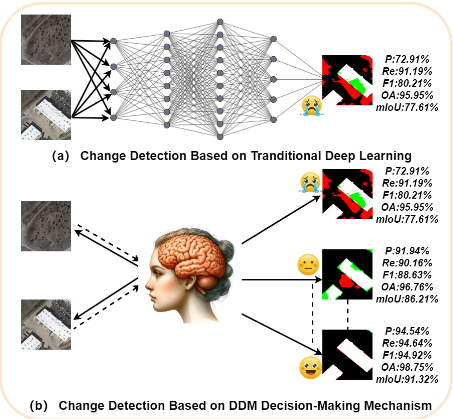
Existing adversarial training [Cho et al., 2023] often lack adaptability and thus fail to meet these practical. To address this critical limitation, we draw inspiration from the human brain, which is the only intelligent system endowed with innate robustness. As illustrated in Figure 1, traditional methods typically adopt one-step modeling to directly generate outputs. In contrast, the brain-inspired decision mechanism facilitates a coarse-to-fine detection process, a pattern consistently corroborated by cognitive neuroscience [Pla, 2010].
Inspired by this, this paper proposes a brain-inspired deep network based on DDM decision-making mechanism for RSCD. Firstly, U-Net performs multi-scale decomposition of input difference features, with the results fed into multi-stage reasoning unit; iterative updating of decision prior features enhances change region localization in a multi-stage progressive manner. Secondly, posterior probability is learned from bitemporal images and labels to train a prior distribution generator; random sampling from the prior distribution and fusion of decision features lay the foundation for modeling random diffusion characteristics. Thirdly, multi-stage generated decision maps are sequentially input into decision aggregation unit to deeply mine temporal correlations and achieve brain-inspired evidence accumulation. Finally, multi-loss directional guidance from the loss-guided unit drives the model to accurately focus on real change regions. The main contributions of this paper are as follows:
- Aiming at the impact of dynamic and uncertain illumination interference on RSCD, we treat it as adversarial attacks; adopting the brain-inspired mechanism of DDM significantly enhances model robustness.
- A multi-stage reasoning unit is designed to simulate the iterative evidence generation of DDM, and a stochastic representation unit to introduce randomness via reparameterization sampling, which jointly model braininspired stochastic diffusion.
- Leveraging DDM-based brain-inspired evidence accumulation, decision aggregation unit mines temporal correlations of multi-stage decision maps, with loss-guided unit incorporated to model DDM directional drift.
2 RelationWork
2.1 Drift DiffusionModel (DDM)
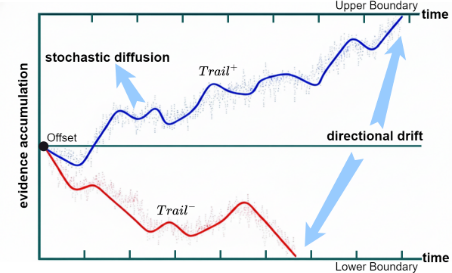
In neural learning, the DDM characterizes the brain's response patterns under noisy inputs. Perceptual decisionmaking research [Yang and Shadlen, 2007] has leveraged random dot motion experiments to reveal these neural mechanisms, while subsequent studies [Ratcliff and McKoon, 2008] have used the DDM to quantify correlations between accuracy, reaction time, evidence accumulation rate, and decision thresholds. Beyond the prefrontal-parietal network, similar accumulation patterns identified in brain regions like the basal ganglia [Wang et al., 2024] confirm that evidence accumulation is a universal cerebral decision mechanism. As illustrated in Figure 2, the accumulation trajectory is governed by two core components: directional drift, representing a systematic bias throughout the process, and random diffusion, denoting instantaneous, directionless noise perturbations. A decision is triggered when the accumulated evidence crosses a predefined threshold, with the duration from stimulus onset to threshold crossing defining the response time.
2.2 Distributed Sampling Learning
Distributed sampling learning refers to extracting features from a given or learned data distribution for model training. Through rational sampling, sample features that are representative of the overall data distribution can be obtained, facilitating model to learn the intrinsic patterns of the data. Among these techniques, reparameterization sampling represents the sampling process as a combination of deterministic function and noise variable, enabling sampling from complex probability distributions and efficient gradient computation simultaneously [Wu et al., 2024]. During deep learning training, sampling from the learned data distribution for model optimization can significantly reduce reliance on feature extraction operators such as convolution and self-attention, as well as cut down on computational resource requirements. Meanwhile, the randomness introduced by sampling can enrich feature diversity, thereby effectively enhancing the generalization and stability of the model [Yu et al., 2025].
3 Method
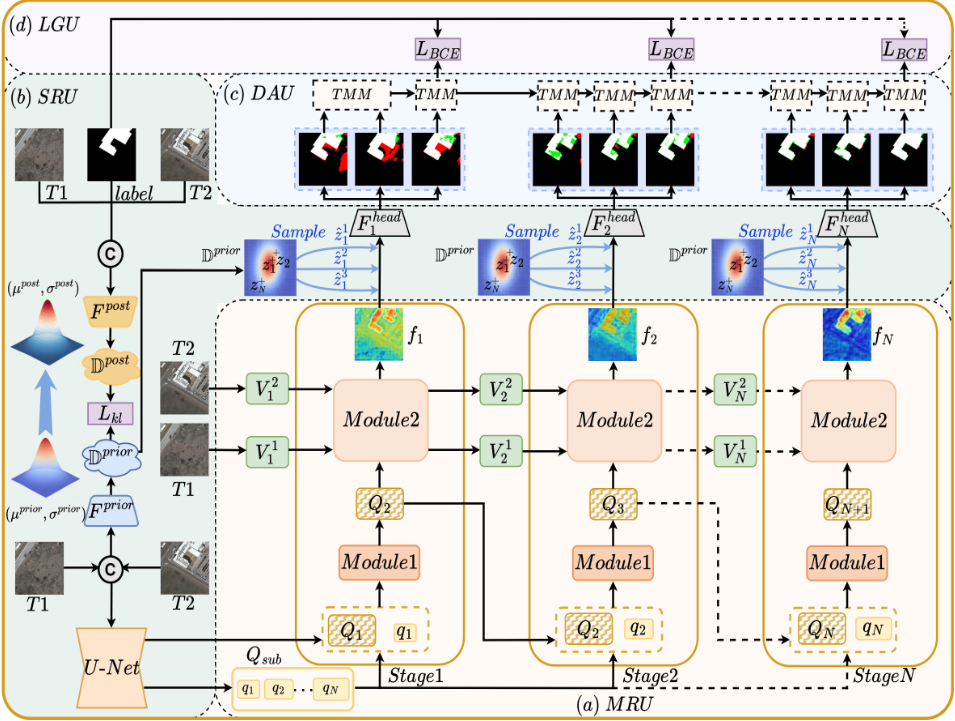
Figure 3 illustrates the overall architecture of our proposed network, i.e., D 2 MDM 2 . Notably, the DDM encompasses three core characteristics, namely stochastic diffusion, evidence accumulation and directional drift. To simulate brainlike decision-making process, several interconnected modules are constructed in the subsequent sections.
3.1 Multi-stage Reasoning Unit (MRU)
In DDM, evidence is generated iteratively and updated dynamically over multiple time steps. Inspired by the human visual system and DDM, this paper proposes MRU. This module aims to continuously revise decision prior features via a series of small-scale guidance factors across multiple stages, simulating the evidence iterative generation process of DDM.
We employ a U-Net backbone to extract multi-scale bitemporal features. Specifically, the second-largest scale output is designated as the initial decision prior Q1 ∈ R H2 × W2 ×C , while the remaining smaller-scale features constitute a guidance factor set Qsub = {q1, . . . , qN}. These guidance factors provide scale-specific discriminative cues to iteratively update and refine the decision prior. MRU operates through N stages. Each stage comprises guidance update and decision feature generation module, as illustrated in Figure 3.
Guidance Update Module. This module refines decision prior Qi by leveraging guidance factor qi, as illustrated in Figure 4. Through an attention mechanism, the module integrates multi-scale discriminative features to produce updated decision prior Qi+1. The operation is formulated as:
Where Aq→Q i denotes the attention weight, W Q 1 , W q 2 , and W Q 3 are learnable projection layers, and ⊗ denotes the matrix multiplication.
DecisionFeatureGenerationModule. Thismodule incorporates the updated decision prior Qi+1 into the bitemporal features, as illustrated in Figure 4. Leveraging a guided attention mechanism, it augments feature representations to explicitly distill and characterize change-discriminative information, ultimately yielding stage-specific decision feature fi.
First, we propose a reverse softmax (re-softmax) that can suppress the weights of similar regions and amplify the responses of differential regions. The formula is shown as:
Second, this paper adopts a bidirectional interaction mechanism to balance feature transfer and current decision-making demands. The decision prior feature Qi+1 is interacted with the stage-specific bitemporal features V k i (k ∈ {1, 2}), generating the state update features V k i+1 for transfer and the projection features V ˆk i for decision reasoning, respectively. The detailed process is as follows:
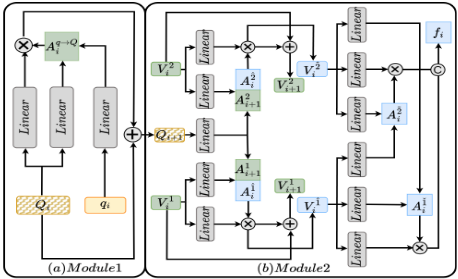
Notably, to enhance parameter efficiency, the forward and reverse attention components share a unified set of weight matrices W ˆQ 1 , W ˆ V 2 andW ˆ V 3 .
Finally, a cross reverse attention mechanism is introduced to capture the differential information between the stagespecific bitemporal features V ˆ1 i and V ˆ2 i and generate the final decision feature fi. The formula is as follows:
3.2 Stochastic Representation Unit (SRU)
In DDM, stochastic diffusion denotes the continuous noise injected during evidence accumulation, resulting in stochastic walk trajectories that drive decision variability. To simulate this mechanism, we propose SRU. Its integration with MRU enables the model to capture the inherent uncertainty and fluctuations during the decision-making process.
First, the concatenation map X derived from the dualtemporal images T1, T2 ∈ RH×W×3 is fed into a prior network parameterized by ω to generate a prior distribution Dprior (X). Moreover, this prior distribution is modeled as an axis-aligned multivariate Gaussian distribution, denoted as N (µprior , σprior ), where the mean and variance are obtained as follows:
Where F prior denotes a learnable generator for the prior distribution, as illustrated in Figure 3.
Additionally, to generate posterior distribution, we feed original images T1, T2 and label Y into posterior network parameterized by weights υ, thereby learning posterior distribution Dpost (T1, T2, Y ), denoted as N (µpost , σpost ). The mean and variance are obtained as follows:
Figure 5: Decision aggregation unit.
Where F post denotes learnable generator for posterior distribution, as illustrated in Figure 3.
To train prior network via posterior network, we adopt Kullback-Leibler (KL) divergence loss KL(Q ∥ P) = Ez∼Q [log Q(z) P (z) ] to penalize the discrepancy between posterior and prior distribution:
Then, reparameterization sampling is leveraged to perform multiple samplings from the prior distribution, yielding sampled features (ˆ z1 1 , ˆ z2 i ..., ˆ znN ) (where n denotes the number of samplings and N represents the number of stages). This not only ensures the differentiability of the sampling process but also introduces randomness into the model.
Finally, to simulate the stochastic diffusion characteristics, the sampled features (ˆ z1 1 , ˆ z2 i ..., ˆ znN ) and the decision feature fi are fed into the change detection head F head i separately to obtain the decision results. The process is as follows:
Where c⃝denotes the feature concatenation operation, and the decision map sequence {Mapji } (i ∈ [1,N], j ∈ [1, n]) lays the foundation for subsequent evidence accumulation.
3.3 Decision Aggregation Unit (DAU)
In DDM, evidence accumulation is a dynamic process that continuously integrates task-related information until a decision threshold is reached and a choice is output. In this paper, the sequences of multiple decision maps generated at each stage exhibit significant temporal dependence, prompting us to introduce DAU to explore the evolution rules among multistage decision features. This design is highly consistent with evidence accumulation in terms of physical mechanism.
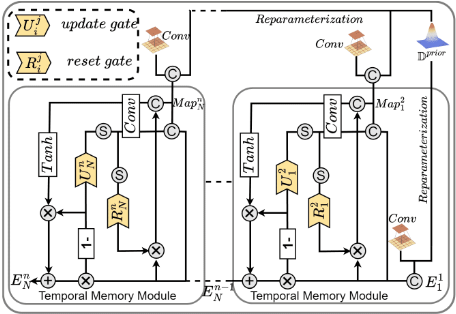
As illustrated in Figure 5, the previous hidden state Ej-1 i and the current time-step stateMapji are fed into the temporal memory module (TMM), yielding the activation values of the reset gate and update gate. The reset gate filters out redundant information irrelevant to the CD task, while the update gate
| Method | LEVIR-CD | SECOND | SYSUCD | ||||||||||||
|---|---|---|---|---|---|---|---|---|---|---|---|---|---|---|---|
| P | Re | F1 | OA | mIoU | P | Re | F1 | OA | mIoU | P | Re | F1 | OA | mIoU | |
| DTCDSCN | 72.86 | 89.23 | 80.22 | 98.56 | 82.75 | 62.03 | 70.92 | 66.17 | 87.23 | 67.43 | 82.91 | 70.47 | 76.19 | 89.57 | 74.51 |
| BIT | 92.16 | 70.68 | 80.01 | 98.20 | 82.40 | 69.42 | 64.37 | 66.80 | 88.72 | 68.71 | 80.52 | 72.55 | 76.16 | 89.33 | 74.32 |
| Change Former | 91.17 | 78.57 | 84.40 | 98.52 | 85.74 | 74.61 | 50.58 | 66.79 | 87.95 | 68.21 | 80.83 | 73.68 | 77.09 | 89.67 | 75.11 |
| ICIFNet | 95.70 | 70.12 | 80.94 | 98.32 | 83.12 | 78.21 | 53.96 | 63.86 | 87.79 | 66.61 | 84.60 | 70.70 | 77.03 | 90.06 | 75.36 |
| USSF-Net | 90.44 | 84.02 | 87.11 | 98.73 | 87.92 | 73.15 | 54.43 | 62.48 | 86.90 | 65.37 | 80.66 | 75.62 | 78.06 | 89.97 | 75.90 |
| DMINet | 94.38 | 74.08 | 83.01 | 98.46 | 84.68 | 74.18 | 58.50 | 65.41 | 87.63 | 67.30 | 79.17 | 80.66 | 79.91 | 90.43 | 77.36 |
| Change Mamba | 94.16 | 75.81 | 84.01 | 98.53 | 85.44 | 69.29 | 63.19 | 66.10 | 87.04 | 67.26 | 79.55 | 73.91 | 76.63 | 89.37 | 74.62 |
| Ours | 89.08 | 91.00 | 90.03 | 98.97 | 90.40 | 71.66 | 64.91 | 68.13 | 87.85 | 68.84 | 80.44 | 79.90 | 80.17 | 90.68 | 77.71 |
Table 1: Performance comparison of diffenert methods across various datasets
determines the key valid information that should be retained and passed to subsequent stages. As shown in the formulas:
Where Rj i denotes reset gate, U j i denotes update gate, and σ(·) represents Sigmoid activation function. Based on the filtering results of the reset gate, the weight of the hidden state Ej-1 i from the previous stage is adjusted; then, it is concatenated with the current time-step state Mapji , and the reset feature ˆEj i is generated via convolution and activation functions. This feature focuses on the fusion of key decision information in current stage and valid historical evidence:
Through weight modulation of the update gate, the evidence accumulated in the previous stage and the currently generated reset feature are dynamically fused to obtain the hidden state Ej i of the current stage, thus completing one round of evidence accumulation:
Here, we set E1 1 = Map11 . Through the above temporal iterative computation, the model can gradually integrate the valid information of multi-stage decision maps and complete the brain-inspired evidence accumulation process.
3.4 Loss-Guided Unit (LGU)
The core of directional drift in DDM lies in the characteristic that decision-making process is driven by goal-oriented signals and gradually shifts toward the correct decision direction. To simulate this characteristic, this paper constructs LGU. Through phased supervision and multi-loss collaboration, it balances the stability of model training and final detection accuracy, guides model to gradually focus on real change regions, and achieves brain-like directional drift.
We adopt the Binary Cross-Entropy (BCE) loss to supervise the prediction maps. Considering the multi-stage progressive localization characteristic of our model, to fully utilize middle-layer features and avoid gradient vanishing or overfitting during training, we impose constraints on the final hidden state hni of each stage, which is defined as the prediction map P i .
The BCE loss at the i - th stage is defined as follows:
Where Yhw represents the pixel value of label at position (h,w), and P ihw denotes the probability that model predicts the pixel at position (h, w) as a changed pixel in the i-th stage.
To integrate constraint effects of multiple losses, we construct a joint loss function LT , which is defined as follows:
This loss function ensures the training stability of each stage through multiple constraints while clarifying the model's optimization direction, which is highly consistent with the directed drift characteristic of DDM. The output of the final stage hnN is ultimately taken as the final CD result.
4 Experiment Setting
We evaluate our proposed D 2 MDM 2 change detector on three public change detection datasets, namely LEVIRCD, SECOND, and SYSUCD. LEVIR-CD is a large-scale U.S. building change detection dataset with 637 ultra-highresolution image pairs split into 256×256 sub-images for training/validation/testing. SECOND is a Chinese land cover change dataset with 4,662 aerial images cropped into subimages and split into three sets at a 7:2:1 ratio. SYSUCD is a 3-band Hong Kong aerial dataset with 20,000 image pairs capturing diverse changes and split 6:2:2 for experiments.
The model is implemented in PyTorch and trained on a single NVIDIA GeForce RTX 4090 GPU with batch size of 16. We utilize the AdamW optimizer with an initial learning rate of 0.001 and a weight decay of 5 × 10⁻⁴ . To facilitate convergence, the learning rate follows a step decay strategy, reducing to 70% of its previous value every 20 epochs across a total of 150 training epochs. For the multi-task objective function, the loss weight hyperparameters are empirically set as λ1 = 1 and λ2 = 1.
For objective evaluation, this paper adopts five evaluation metrics-Precision (P), Recall (Re), F1-score (F1), Overall Accuracy (OA), and mean Intersection over Union (mIoU)-to comprehensively assess the experimental results.
5 Experiment Result
5.1 Comparison for Regular Data
To verify the effectiveness of D 2 MDM 2 on RSCD, we compare it with several CD methods, including DTCDSCN [Liu et al., 2021], BIT [Chen et al., 2022], Change Former [Bandara and Patel, 2022], ICIFNet [Feng et al., 2022], USSFCNet [Lei et al., 2023], DMINet [Wu et al., 2023] and Change Mamba [Chen et al., 2024]. For fairness, all comparative methods are implemented using the codes released by their authors, and their respective parameters are set in accordance with the original literatures.
Objective Indicator. Table 1 presents the quantitative metrics of different models on three clean datasets without attacks. D 2 MDM 2 achieves excellent performance in comprehensive metrics such as F1-score and mIoU. For instance, its F1-score reaches 90.03% on LEVIR-CD dataset. This superior performance may be attributed to the DDM-inspired brain-like decision mechanism, which is highly consistent with the human cognitive process and gradually realizes the accurate localization of changed regions.
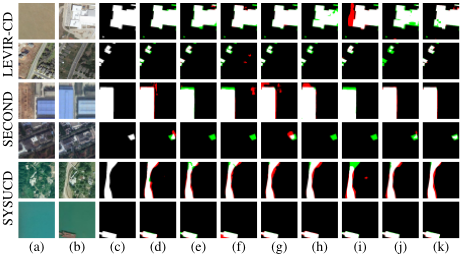
Visual Comparison. As illustrated in Figure 6, existing methods like DMINet and ChangeMamba suffer from missed detections of small targets, while DTCDSCN and BIT exhibit edge-related false alarms. Additionally, USSFC-Net yields significant false positives in large regions. In contrast, MRU effectively refines decision priors via guidance factors, achieving superior qualitative results across various scales.
5.2 Comparison for Local Perturbation Data
To evaluate robustness, we constructed an illumination disturbance set by simulating real HSV color space variations. For LEVIR-CD, SECOND, and SYSUCD, the perturbation ranges were determined as [-5.25, 12.57], [4.65, 30.82], and [-28.81, 29.95]. By applying random pixel-wise adjustments within these bounds, we synthesized realistic samples that reflect unpredictable environmental dynamics.
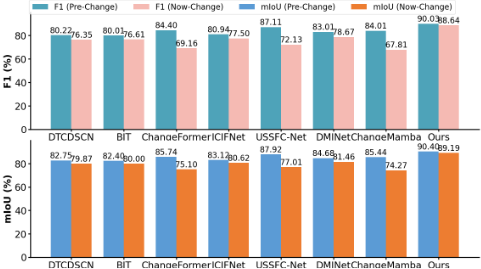
Objective Indicator. Figure 7 presents the quantitative metrics of different models for LEVIR-CD under illumination perturbation. It can be seen that the F1 and mIoU of our model remain leading across all datasets. This is because SRU effectively simulates random perturbations caused by noise, thus greatly improving the model's anti-interference ability.
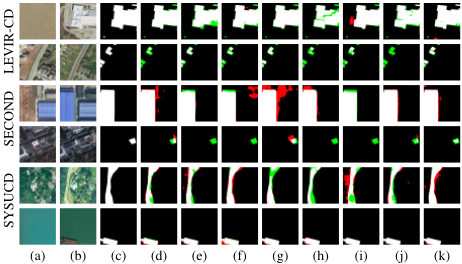
Visual Comparison. Figure 8 evaluates performance under illumination perturbations, which significantly degrade the accuracy of baseline methods (e.g., BIT, ICIFNet, DMINet, and ChangeMamba), leading to increased false alarms and misses. In contrast, our model maintains superior target integrity and robustness. This resilience is attributed to the loss-guided unit, which simulates the directed drift process of DDM. By focusing on change-related information and suppressing irrelevant redundant information through multi-loss constraints, it further improves the accuracy of changed region localization and the reliability of results.
5.3 Ablation Experiments
| DSF | P. | Re. | F1 | OA | mIoU |
|---|---|---|---|---|---|
| 2 | 73.01 | 88.35 | 79.95 | 97.74 | 82.12 |
| 3 | 89.08 | 91.00 | 90.03 | 98.97 | 90.40 |
| 4 | 94.71 | 78.13 | 85.63 | 98.66 | 86.74 |
| 5 | 93.26 | 77.80 | 84.83 | 98.58 | 86.09 |
| SRU | DAU | P. | Re. | F1 | OA mIoU |
| ✓ | 92.97 | 79.16 | 85.51 | 98.63 | 86.63 |
| ✓ | 94.80 | 76.92 | 84.93 | 98.61 | 86.18 |
| ✓ | ✓ 89.08 | 91.00 | 90.03 | 98.97 | 90.40 |
| N | P. | Re. | F1 | OA mIoU |
| 2 | 88.35 | 89.71 89.27 | 98.87 | 89.52 |
| 3 | 89.08 91.00 | 90.03 | 98.97 | 90.40 |
| 4 | 92.73 80.89 | 86.40 | 98.70 | 87.35 |
Ablation of Distribution Sampling Frequency (DSF). To introduce controllable randomness, multiple independent samples are fused with decision features. As shown in Table 2, model performance peaks at three samples. While moderate sampling enhances adaptability to complex interferences, excessive repetitions introduce redundant information and noise, leading to overfitting and increased overhead.
Ablation ofModule. We conducted ablation studies to verify the effectiveness of the proposed modules (i.e., SRU and DAU). As shown in Table 3, SRU effectively simulates the stochastic diffusion mechanism via random sampling, while DAU implements the evidence accumulation function. Together, these elements constitute the core of the DDM framework. The results clearly demonstrate that their integration significantly enhances the model's performance, validating the proposed brain-inspired decision-making logic.
Ablation of Stage Number. In Table 4, we analyze the impact of the number of iterative stages N. Since the effectiveness of DAU has been verified in previous experiments, N in this experiment starts from 2. It is not difficult to observe that the performance improves when N increases from 2 to 3, but decreases significantly when N exceeds 3. This may be because as the number of stages increases, extremely smallscale features emerge, making it harder for the model to learn more accurate changed regions. More experiment are provided in supplementary materials 1 .
5.4 Visualization
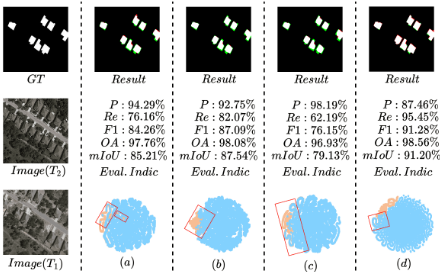
Visualization for Uncouple Space. To intuitively assess the CD performance, we utilize T-SNE to project changed (yellow) and unchanged (blue) pixel features onto a 2D plane. As illustrated in Figure 9, our model exhibits a significantly clearer semantic boundary and tighter feature clustering compared to existing methods. This superior feature separation aligns with our quantitative results, confirming the efficacy of the proposed brain-inspired mechanism.
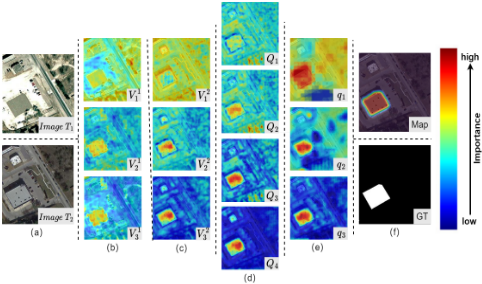
Visualization for Feature Heatmap. To intuitively analyze D 2 MDM 2 mechanism, Figure 10 visualizes key features. As the stages progress [Figure 10(b-d)], decision prior features exhibit an evident transition from coarse localization to precise differentiation, while bitemporal features increasingly concentrate on change regions. Furthermore, final change heatmap [Figure 10(f)] demonstrates sharp boundaries and accurate target localization. This evolutionary process validates that brain-inspired DDM mechanism effectively refines change cues through multi-stage evidence accumulation, thereby enhancing the discriminative power of model.
1 https://github.com/iceking111/D2MDM2
6 Conclusion
In this paper, we break through the constraints of traditional one-step CD paradigms by framing illumination-induced performance degradation as an adversarial attack-and-defense problem. We propose D 2 MDM 2 , a novel brain-inspired deep network that integrates DDM with cognitive neuroscience principles. By implementing MRU and the SRU, our model effectively captures the inherent uncertainty in RS environments while mimicking the human "coarse-to-fine" cognitive process. The inclusion of DAU and LGU ensure that model maintains focus on authentic change regions through directional drift modeling and evidence accumulation. Extensive evaluations on multiple datasets with complex illumination perturbations demonstrate that D 2 MDM 2 significantly outperforms several methods in both accuracy and robustness.
Acknowledgments
This work was supported in part by the Teaching Reform Innovation Program for Higher Education Institutions in Shanxi Province under Grant J20240856; Graduate Education Innovation Program in Shanxi Province under Grant 2025AL12; in part by the Basic Applied Research Projects of Shanxi Province in China under Grants 20210302124165 and TZLH20230818007; in part by the Ministry of Education industry-university cooperative collaborative education project under Grant 221002722143739; in part by the Natural Science Foundation of Hainan Province under Grant422QN350; in part by the National Natural Science Foundation of Youth Science Foundation Project under Grant42001360; in part by the Shanxi Province Graduate Education Innovation Plan under Grants 2025XS444 and 2025SJ326; and in part by the Research Project Supported by the Shanxi Scholarship Council of China under Grants 2024118.
@inproceedings{ijcai2026p236,
  title     = {D2MDM2: A Brain-Inspired Deep Network Based on DDM Decision-Making Mechanism for Remote Sensing Change Detection},
  author    = {Zhao, Kang and Zhang, Ye and Wang, Bin and Zeng, Jianchao},
  booktitle = {Proceedings of the Thirty-Fifth International Joint Conference on
               Artificial Intelligence, {IJCAI-26}},
  publisher = {International Joint Conferences on Artificial Intelligence Organization},
  editor    = {Diego Calvanese},
  pages     = {2118--2126},
  year      = {2026},
  month     = {8},
  note      = {Main Track},
  doi       = {10.24963/ijcai.2026/236},
  url       = {https://doi.org/10.24963/ijcai.2026/236},
}
TY - CPAPER TI - D2MDM2: A Brain-Inspired Deep Network Based on DDM Decision-Making Mechanism for Remote Sensing Change Detection AU - Zhao, Kang AU - Zhang, Ye AU - Wang, Bin AU - Zeng, Jianchao T2 - Proceedings of the Thirty-Fifth International Joint Conference on Artificial Intelligence, IJCAI-26 PB - International Joint Conferences on Artificial Intelligence Organization PY - 2026 SP - 2118 EP - 2126 DO - 10.24963/ijcai.2026/236 UR - https://doi.org/10.24963/ijcai.2026/236 ER -Copied
Machine-readable versions of this paper, for tools and AI agents:





