
STAR: Spatio-Temporal Attention Rebalancing for Eco-Friendly Autonomous Mobility-on-Demand Systems
Proceedings of the Thirty-Fifth International Joint Conference on Artificial Intelligence. Main Track. Pages 181-190.
https://doi.org/10.24963/ijcai.2026/21
Keywords
- Agent-based and Multi-agent Systems: Multi-agent learning
- Agent-based and Multi-agent Systems: Coordination and cooperation
- Planning and Scheduling: Learning in planning and scheduling
Abstract
Existing Autonomous Mobility-on-Demand (AMoD) systems and demand-responsive algorithms are designed to adaptively respond to traffic demands, enhancing traffic service quality and profitability. However, such approaches may exacerbate traffic congestion by concentrating vehicles in high-demand areas. In addition, repeated braking, acceleration, and low-speed driving in traffic jams lead to substantial increases in emissions. Moreover, existing Deep Reinforcement Learning (DRL)-based approaches fail to address the instability of cooperative learning in environments with highly variable rewards, such as carbon emissions. To address these issues, we propose the Spatio-Temporal Attention Rebalancing (STAR) framework, leveraging an encoder-decoder architecture. In the proposed framework, we maximize the number of requests served and minimize CO₂ emissions, while ensuring high service quality by limiting maximum travel delays and waiting times for passengers. To evaluate the proposed framework, we conduct simulations in realistic urban traffic scenarios. Experimental results demonstrate that our framework consistently outperforms existing baselines. In a large-scale scenario with a fleet of one hundred vehicles, our approach improves the service rate by up to 10.1% and reduces CO₂ emissions per passenger by up to 69.6% compared to the baseline methods. The proposed framework and baselines are publicly available at https://github.com/2jungeuni/eco-friendly-fleet-rebalancing.
- [Al-Abbasi et al., 2019] Abubakr Al-Abbasi, Arnob Ghosh, and Vaneet Aggarwal. DeepPool: Distributed model-free al- gorithm for ride-sharing using deep reinforcement learning. IEEE Transactions on Intelligent Transportation Systems, 20:4714-4727, 2019.
- [Alonso-Mora et al., 2017] Javier Alonso-Mora, Samitha Samaranayake, Alex Wallar, Emilio Frazzoli, and Daniela Rus. On-demand high-capacity ride-sharing via dynamic trip-vehicle assignment. Proceedings of the National Academy of Sciences, 114(3):462-467, 2017.
- [Chang et al., 2024] Xinyu Chang, Jing Wu, Zhaoyang Kang, et al. Estimating emissions reductions with carpooling and vehicle dispatching in ridesourcing mobility. npj Sustain- able Mobility and Transport, 1(16), 2024.
- [Dhanorkar and Burtch, 2022] Suvrat Dhanorkar and Gordon Burtch. The heterogeneous effects of p2p ride-hailing on traffic: Evidence from uber's entry in california. Trans- portation Science, 56(3):750-774, 2022.
- [Donovan et al., 2016] Brian Donovan, Alec Mori, Nimit Agrawal, Yalan Meng, Jong Lee, and Daniel Work. New York City hourly traffic estimates (2010-2013). University of Illinois at Urbana-Champaign, 2016.
- [Fagnant and Kockelman, 2015] Daniel J. Fagnant and Kara Kockelman. Preparing a nation for autonomous vehicles: opportunities, barriers and policy recommendations. Trans- portation Research Part A: Policy and Practice, 77:167- 181, 2015.
- [Fiedler et al., 2017] David Fiedler, Michal Čáp, and Michal Čertický. Impact of mobility-on-demand on traffic conges- tion: Simulation-based study. In 2017 IEEE 20th Interna- tional Conference on Intelligent Transportation Systems (ITSC), pages 1-6, 2017.
- [Fujimoto et al., 2018] Scott Fujimoto, Herke van Hoof, and David Meger. Addressing function approximation error in actor-critic methods. In International Conference on Machine Learning, 2018.
- [Guo et al., 2023] Jiaying Guo, Long Cheng, and Shen Wang. CoTV: Cooperative control for traffic light signals and connected autonomous vehicles using deep reinforcement learning. IEEE Transactions on Intelligent Transportation Systems, 24(10):10501-10512, 2023.
- [Haliem et al., 2020] Marina Haliem, Ganapathy Mani, Va- neet Aggarwal, and Bharat Bhargava. A distributed model- free ride-sharing algorithm with pricing using deep rein- forcement learning. In Proceedings of the 4th ACM Com- puter Science in Cars Symposium. Association for Comput- ing Machinery, 2020.
- [Jiao et al., 2021] Yan Jiao, Xiaocheng Tang, Zhiwei (Tony) Qin, Shuaiji Li, Fan Zhang, Hongtu Zhu, and Jieping Ye. Real-world ride-hailing vehicle repositioning using deep reinforcement learning. Transportation Research Part C: Emerging Technologies, 130:103289, 2021.
- [Mnih et al., 2015] Volodymyr Mnih, Koray Kavukcuoglu, David Silver, Andrei A. Rusu, Joel Veness, Marc G. Belle- mare, Alex Graves, Martin Riedmiller, Andreas K. Fid- jeland, Georg Ostrovski, Stig Petersen, Charles Beattie, Amir Sadik, Ioannis Antonoglou, Helen King, Dharshan Kumaran, Daan Wierstra, Shane Legg, and Demis Hassabis. Human-level control through deep reinforcement learning. Nature, 518(7540):529-533, 2015.
- [Qin et al., 2021] Guoyang Qin, Qi Luo, Yafeng Yin, Jian Sun, and Jieping Ye. Optimizing matching time inter- vals for ride-hailing services using reinforcement learning. Transportation Research Part C: Emerging Technologies, 129:103239, 2021.
- [Rashid et al., 2020] Tabish Rashid, Mikayel Samvelyan, Christian Schroeder De Witt, Gregory Farquhar, Jakob Foerster, and Shimon Whiteson. Monotonic value func- tion factorization for deep multi-agent reinforcement learn- ing. Journal of Machine Learning Research, 21(178):1-51, 2020.
- [Sahebdel et al., 2025] Mahsa Sahebdel, Ali Zeynali, Noman Bashir, Prashant Shenoy, and Mohammad Hajiesmaili. LEAD: Towards learning-based equity-aware decarboniza- tion in ridesharing platforms. In Proceedings of the 2025 ACM Conference on Fairness, Accountability, and Trans- parency, FAccT '25, page 817-827, New York, NY, USA, 2025. Association for Computing Machinery.
- [Sunehag et al., 2017] Peter Sunehag, Guy Lever, Audrunas Gruslys, Wojciech M. Czarnecki, Vinícius Flores Zam- baldi, Max Jaderberg, Marc Lanctot, Nicolas Sonnerat, Joel Z. Leibo, Karl Tuyls, and Thore Graepel. Value- decomposition networks for cooperative multi-agent learn- ing. ArXiv, abs/1706.05296, 2017.
- [Taxi and Commission, 2024] New York City Taxi and Limousine Commission. TLC trip record data. https://www.nyc.gov/site/tlc/about/tlc-trip-record- data.page, 2024. Accessed: 23-Apr-2025. Link
- [Tsao et al., 2019] Matthew Tsao, Dejan Milojevic, Clau- dio Ruch, Mauro Salazar, Emilio Frazzoli, and Marco Pavone. Model predictive control of ride-sharing au- tonomous mobility-on-demand systems. In Proceedings of the IEEE International Conference on Robotics and Au- tomation (ICRA), pages 6665-6671. IEEE, 2019.
- [Wang et al., 2020] Jianhao Wang, Zhizhou Ren, Terry Liu, Yang Yu, and Chongjie Zhang. QPLEX: Duplex dueling multi-agent q-learning. arXiv preprint arXiv:2008.01062, 2020.
- [Yu et al., 2018] Bing Yu, Haoteng Yin, and Zhanxing Zhu. Spatio-temporal graph convolutional networks: A deep learning framework for traffic forecasting. In Proceedings of the Twenty-Seventh International Joint Conference on Artificial Intelligence, IJCAI-18, pages 3634-3640. Interna- tional Joint Conferences on Artificial Intelligence Organi- zation, 7 2018. IJCAI
References were extracted automatically from the PDF and may contain errors.
Full text extracted automatically from the PDF; figures, tables and equations may differ. The PDF is the version of record.
1 Introduction
Traditional public transportation systems, which rely on fixed routes and schedules, face several limitations. Low ridership during off-peak hours not only reduces operational efficiency but also increases per-passenger carbon emissions. Furthermore, underserved areas remain poorly connected to public transit, reflecting the persistent First-Mile-Last-Mile (FMLM) problem. To address these issues, Autonomous Mobility-onDemand (AMoD) systems have emerged as a next-generation solution that flexibly optimizes routes and schedules in real time. Today, advances in demand forecasting and large-scale optimization make citywide deployments possible, reducing waiting times and improving reliability [Alonso-Mora et al., 2017]. However, capturing complex spatiotemporal demand dynamics over extended horizons remains computationally prohibitive in practice [Tsao et al., 2019]. To overcome these limitations, optimization-based AMoD studies have focused on vehicle rebalancing strategies, relocating idle vehicles to predicted demand hotspots to reduce waiting times and travel delays [Jiao et al., 2021; Haliem et al., 2020; Qin et al., 2021; Alonso-Mora et al., 2017]. However, such approaches may worsen traffic congestion by concentrating AMoD fleets in high-demand regions, which in turn leads to higher CO2 emissions [Fiedler et al., 2017; Fagnant and Kockelman, 2015]. Frequent stops, prolonged idling, and low-speed driving in congested areas substantially increase fuel consumption and CO2 emissions [Dhanorkar and Burtch, 2022].
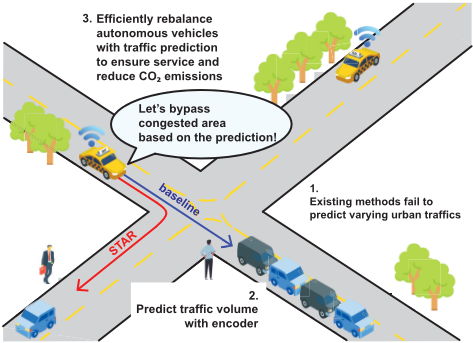
As shown in Fig. 1, congestion-induced CO2 emissions emerge from interactions among vehicles and background traffic. Moreover, these interactions evolve continuously over time, making emissions neither fixed nor fully predictable within traditional optimization frameworks. These observations motivate the adoption of learning-based approaches for AMoD rebalancing. In particular, Multi-Agent Reinforcement Learning (MARL) provides a natural framework for modeling decentralized vehicle interactions. However, deploying MARL at the city scale introduces fundamental challenges. In urban AMoD systems, interactions among vehicles, nearby passenger requests, and predicted traffic congestion are spatially sparse and temporally dynamic. At any given time, only a small subset of vehicles meaningfully influences system behavior, and the structure of these interactions shifts rapidly as traffic conditions evolve. Under such circumstances, valuedecomposition methods that rely on simple summation or averaging of individual value functions, such as Value Decomposition Networks (VDNs) [Sunehag et al., 2017], struggle to assign credit effectively. More sophisticated methods such as QMIX [Rashid et al., 2020] adopt monotonic mixing networks, but their weights depend only on the global state, failing to capture agent-specific context. Attention-based extensions such as QPLEX [Wang et al., 2020] address agent-wise weighting but rely on dueling decomposition and do not explicitly handle dynamically varying agent sets. As a result, these methods struggle to distinguish which agents are truly responsible for system-level outcomes, including service profitability and CO2 emissions. Moreover, they fail to adapt to dynamically varying agent sets, leading to severe credit assignment degradation in large-scale AMoD environments.
To tackle this challenge, we propose the Spatio-Temporal Attention Rebalancing (STAR) framework, a cooperative MARL approach for large-scale AMoD systems that jointly optimizes service profitability and CO2 emissions. At the core of our framework is the STAR mixer, a state-dependent attention mechanism designed to address sparse and non-stationary spatiotemporal interactions by enabling structured credit assignment. In addition, the STAR framework adopts a feasibilityfiltered control architecture. At each decision time step, a dispatching optimization module strictly enforces all hard service quality constraints, such as maximum waiting time and allowable travel delay. This design restricts policy learning to a feasible action space defined by these constraints. As a result, constraint satisfaction is guaranteed by construction, allowing the STAR agent to focus on optimizing long-term service performance and environmental sustainability.
We evaluate the STAR framework in a realistic urban simulation of New York City (NYC), focusing on For-Hire Vehicle (FHV) services such as Uber and Lyft. Real-world FHV trip data [Taxi and Commission, 2024] are integrated into the Simulation of Urban MObility (SUMO) environment, together with large-scale background traffic consisting of over 100, 000 Human-Driven Vehicles (HDVs). The high-fidelity setting enables a rigorous assessment of cooperative rebalancing under realistic congestion patterns and their environmental impacts. The following is a summary of key contributions:
- Eco-friendly cooperative AMoD framework. We propose the STAR framework, which jointly optimizes service profitability and CO2 emissions. By adopting a feasibility-filtered control architecture, STAR strictly enforces hard service-quality constraints while learning
| DeepPool '19 | Guo '23 | Chang '24 | Sahebdel '25 | STAR (Ours) | |
|---|---|---|---|---|---|
| RL-based | ✓ | ✓ | × | × | ✓ |
| Ridesharing | ✓ | × | ✓ | ✓ | ✓ |
| Emission-aware | × | ✓ | ✓ | ✓ | ✓ |
| Congestion modeled | × | ✓ | ✓ | ✓ | ✓ |
| Large-scale | △ | ✓ | △ | △ | ✓ |
long-term sustainable rebalancing policies.
- Spatio-temporal attention for robust credit assignment. We devise the STAR mixer, a state-dependent attention mechanism that addresses sparse and nonstationary spatiotemporal interactions in urban traffic. Unlike existing value-decomposition methods, the STAR mixer leverages agent-specific observations for credit assignment. As each attention weight is computed independently per agent, the design is inherently fleetsize-agnostic, enabling stable cooperative learning across varying fleet scales.
- Comprehensive evaluation under realistic traffic conditions. We validate STAR in a high-fidelity SUMO environment with real-world NYC traffic data. Experimental results show that STAR consistently outperforms baselines.
2 RelatedWorks
Several recent studies [Al-Abbasi et al., 2019; Guo et al., 2023; Chang et al., 2024; Sahebdel et al., 2025] have incorporated traffic congestion or emissions-related objectives into transportation systems. However, as summarized in Table 1, these works differ substantially from our setting in both domain and problem formulation. Among existing methods, Guo et al. [2023] focus on traffic signal control, an infrastructure-level problem distinct from vehicle fleet control. Chang et al. [2024] and Sahebdel et al. [2025] estimate emissions through offline analysis, lacking the capability for real-time and adaptive fleet control. Therefore, these methods [Guo et al., 2023; Chang et al., 2024; Sahebdel et al., 2025] are not directly applicable as baselines for online AMoD rebalancing.
Although DeepPool [Al-Abbasi et al., 2019] does not explicitly model background traffic congestion or directly optimize CO2 emissions, it remains the most relevant baseline for our problem setting. This is because it focuses on systemlevel operational efficiency and service profitability, which are closely related to vehicle utilization and, indirectly, to emission outcomes. To ensure a fair comparison under realistic traffic conditions, we reimplemented DeepPool within our SUMO environment. This allows us to isolate the effects of the cooperative coordination enabled by our framework and its congestion-aware credit-assignment mechanism.
| t | Discrete decision time step, t ∈ Z≥0. |
| Vt | Set of CAVs present at time t. |
| Rt | Set of passenger requests active at time t. |
| ri | Request time of passenger i. |
| Nt | Set of nodes at time t, which includes the pickup and drop-off locations of passenger requests and the current location of CAVs. |
| N p t | Pickup locations of active requests at time t, where N p t ⊂ Nt. |
| N d t | Drop-off locations of active requests at time t, where N d t ⊂ Nt. |
| ℓpi | Pickup location of request i, where ℓpi ∈ N p t . |
| ℓdi | Drop-off location of request i, where ℓdi ∈ N d t . |
| ℓtv | Current location of CAV v at time t, where ℓtv ∈ Nt. |
| xtnv | Binary variable indicating whether node n is included in the planned route of CAV v at time t. |
| ytnmv | Binary decision variable indicating whether the path from node n to m is included in the overall scheduled route of CAV v at time t. |
| zt iv | Binary decision variable indicating whether passenger request i is assigned to CAV v at time t. |
| atnv | Positive continuous decision variable representing the expected arrival time of CAV v at node n, as estimated at time t. |
| cnm | Expected CO2 emissions of CAV traveling from node n tom. |
| τ t v | Idle time of vehicle v at time t. |
| btv | On-board passenger count of vehicle v at time t. |
| ˆht | Predicted regional traffic volumes at time t. |
| ht | Observed regional traffic volumes at time t. |
| St | Set of completed requests at time t. |
3 ProblemFormulation
In this study, we consider a cooperative fleet rebalancing problem in which multiple vehicles make coordinated decisions to achieve shared system-level objectives. These vehicles are referred to as Cooperative Autonomous Vehicles (CAVs). They operate alongside Human-Driven Vehicles (HDVs), which generate background traffic and induce dynamic congestion. This section formalizes the system objectives and hard servicequality constraints. These constraints are not directly optimized by the learning agents but are instead enforced by a dispatching optimization module within the control pipeline. Under this formulation, the proposed STAR framework learns cooperative rebalancing policies within the resulting feasible decision space. All notations used throughout this section are summarized in Table 2.
3.1 Objectives
Our primary objectives are twofold: minimizing CO2 emissions
and serving the maximum number of passengers
at every decision time step t.
3.2 Constraints
This section describes the key constraints considered critical within our system. First, passengers assigned at the previous decision time must remain unchanged until service completion:
for all passengers not yet served and all vehicles. Here, a passenger is considered not yet served if the corresponding drop-off has not been completed. In addition, every vehicle has a maximum passenger capacity C:
All assigned passengers must be served within the maximum allowable waiting time W and travel delay T :
where M is a sufficiently large constant. If a passenger request i is assigned to vehicle v, both its pickup and drop-off locations must be included in the vehicle schedule:
In addition, pickup locations should be visited before drop-off locations:
4 Methodology
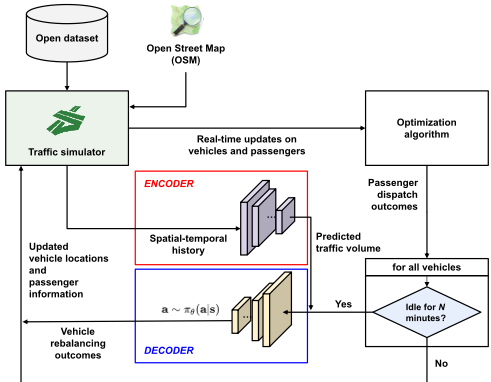
Building on the objectives and hard service-quality constraints defined in Section 3, we propose the Spatio-Temporal Attention Rebalancing (STAR) framework. An overview is illustrated in Fig. 2. The dispatching optimization module explicitly enforces all feasibility constraints, including maximum
Algorithm 1 STAR framework.
1: Initialize decision step t ← 0 2: while t < E do 3: St ←DispatchingOptimization(Vt,Rt,W, T) 4: if t ≥ Nh then 5: ˆht ← Encoder (ht-Nh:t-1) 6: for each vehicle vi ∈ Vt do 7: if vi is unmatched in St and τ t i > N then 8: a(i) t ←Decoder ( ˆht, st, otvi ) 9: end if 10: end for 11: Observe reward rt = w1ridle(t) +w2rsr(t) resulting from the joint action at-1 12: Store transition (st-1, at-1, rt, st), where at-1 denotes the rebalancing actions taken at decision step t - 1 13: Update encoder parameters by minimizing MAE between ˆht and ht 14: Update decoder parameters using sampled transitions from the replay buffer 15: end if 16: t ← t + 1 17: end whilewaiting time, maximum travel delay, and vehicle capacity, thereby defining the admissible decision space of the system. Within this feasible space, the proposed encoder-decoder Deep Reinforcement Learning (DRL) model learns cooperative fleet rebalancing policies aimed at improving service profitability and reducing CO2 emissions.
4.1 Overview
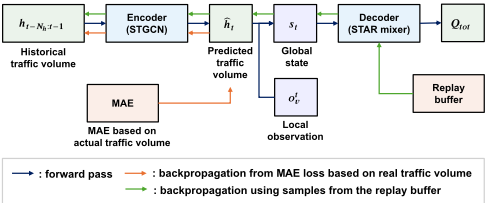
To simulate a more realistic urban driving environment, we integrate an actual road network from Open Street Map (OSM) into the Simulation of Urban MObility (SUMO) environment. Additionally, we use an open dataset [Donovan et al., 2016] providing real-time traffic volumes to simulate the movements of HDVs. In this simulated urban scenario, a fleet of CAVs operates in traffic congestion caused by HDVs and responds to passenger requests. Vehicle-to-passenger matching is performed at each decision time step using an optimization algorithm to maximize the number of served passengers while maintaining acceptable service quality. The matching algorithm is inspired by the greedy algorithm proposed by AlonsoMora et al. [Alonso-Mora et al., 2017] and complies with all constraints specified in Section 3.2. To further improve service rates and reduce environmental pollution, CAVs that remain idle beyond a specified threshold (N minutes) are identified for rebalancing. Observations of idle vehicles are provided to an encoder-decoder architecture within the proposed framework, which determines optimal repositioning locations by balancing objectives of increasing service rates and reducing CO2 emissions. Algorithm 1 summarizes the overall procedure of the proposed method under the Centralized Training and Decentralized Execution (CTDE) paradigm. During training, the encoder and decoder are optimized jointly, as shown in Fig. 3. The encoder is trained using both the supervised prediction loss and gradients propagated from the reinforcement learning objective, whereas the decoder is optimized as the reinforcement learning policy. The global state and the STAR mixer are used only during centralized training to enable coordinated credit assignment. During execution, each CAV selects its action based solely on its local observation.
4.2 Encoder
In the encoder-decoder architecture, the encoder generates predicted traffic congestion states ˆht and passes them to the decoder within the STAR framework. Effective trafficvolume forecasting is essential for eco-friendly AMoD systems to respond to dynamic congestion conditions involving spatial and temporal relationships. To address this, our framework adopts Spatio-Temporal Graph Convolutional Networks (STGCN) [Yu et al., 2018], which leverage Graph Convolutional Networks (GCNs) to capture these spatial and temporal dependencies. The encoder receives traffic volumes from the SUMO environment for the last Nh decision time steps, grouped into spatial regions via K-means clustering based on spatial proximity, and predicts traffic conditions for the next Np decision time steps. Although originally developed to estimate average vehicle speeds, STGCN is adapted in our framework to predict regional traffic volumes for the AMoD system, achieving a Mean Absolute Error (MAE) of approximately 0.74 at the 100th epoch, which we find sufficient to capture short-term congestion trends relevant for real-time rebalancing decisions.
4.3 Decoder
The decoder generates cooperative rebalancing actions for idle CAVs based on the predicted traffic states ˆht produced by the encoder. In the proposed STAR framework, the decoder is formulated as a cooperative Multi-Agent Reinforcement Learning (MARL) policy operating under a value-decomposition paradigm. Urban AMoD systems depend on sparse and nonstationary spatiotemporal interactions, where only a subset of vehicles meaningfully influences system-level outcomes such as service profitability and CO2 emissions at any given time. To address the resulting credit assignment challenges, the STAR framework introduces a state-dependent attentionbased mixing mechanism, referred to as the STAR mixer. Although centralized signals are used during training, each idle CAV v selects its rebalancing action atv based on its local observation otv at execution time. During centralized training, the individual agent action-values Qv (otv , atv ) are aggregated into a global action-value function through the STAR mixer:
where I = |V idle t | denotes the number of idle vehicles at time t. For each agent v, an attention logit is computed from the concatenation of the global state st and its local observation otv :
where fattn is a two-layer Multi-Layer Perceptron (MLP) with ReLU hidden activations and [·, ·] denotes concatenation. The attention weights are then obtained via softmax across agents:
which ensures αv > 0 and ∑v αv = 1. Since each ev is computed independently per agent, the mixer accommodates a variable number of active vehicles without architectural changes. Moreover, the aggregation in Eq. (9) is invariant to the ordering of agents. Furthermore, the non-negativity of αv satisfies the sufficient condition for the Individual-GlobalMax (IGM) principle [Rashid et al., 2020], as it guarantees ∂Qtot/∂Qv ≥ 0 for all v regardless of the state or the number of agents. This ensures that the local greedy actions derived fromQv are consistent with the global optimal joint action.
4.4 Markov Decision Process (MDP)
We model the fleet rebalancing problem as a Decentralized Partially Observable Markov Decision Process (Dec-POMDP).
State and observation
The global state st ∈ S represents the overall environment at time step t, including all vehicle states, passenger requests, and traffic conditions:
where otv is each vehicle's local observation, and ˆht is the predicted regional traffic volumes. In the decentralized execution setting, each CAV v makes decisions based exclusively on its local observation otv . To capture the local context while maintaining a fixed input dimension for the policy network, we define the observation as:
where ξ tv = (ℓtv , τ t v , btv ) is the per-vehicle state, and ρti = (ri, ℓpi , ℓdi ) is the state of a request. Crucially, Pk(v) denotes the set of the k nearest unassigned passenger requests to vehicle v, ensuring a fixed-sized input vector.
Action
At each decision time step t, every idle vehicle v ∈ V idle t selects a rebalancing location atv from a discrete action space A. Each agent selects its action greedily based on its individual value function, atv = argmaxa∈AQv (otv , a). The individual value functions are aggregated through a monotonic structure that guarantees that increasing any individual utility does not decrease the global state-action value, as formalized in Eq. (9).
Transitional dynamics
The transition function P (st+1|st, at) is implicitly defined by the SUMO traffic simulator. After agents take a joint action at at decision time step t, the system evolves for an interval ∆t. During this time, vehicles move, new requests arrive, and traffic conditions change, leading to the next global state st+1.
Reward
For cooperative behavior, all agents receive a shared global reward Rt at the end of each decision interval. The reward function is designed to learn a policy that improves the passenger service rate while simultaneously minimizing vehicle idle time, a proxy for reducing CO2 emissions. This proxy is used because direct carbon emission signals suffer from high variance and a wide dynamic range. Normalizing such high-variance signals often leads to reward sparsity, which destabilizes the learning process. Instead, we adopt vehicle idle time as a surrogate reward signal that produces smooth gradients and directly captures prolonged low-speed driving and stop-and-go congestion patterns known to increase fuel consumption and emissions [Dhanorkar and Burtch, 2022]. We empirically verify that cumulative idle time strongly correlates with per-service CO2 emissions in our simulation environment, with a Pearson correlation coefficient of 0.708. Thus, the reward function consists of two components.
- Passenger service reward (rsr). It encourages serving as many passengers as possible. It is defined as the cumulative service rate, the ratio of all serviced requests to all received requests up to time step t:
where |·| denotes the cardinality of a set, and X1:t is defined as ∪ti=1Xi for an arbitrary set X.
- Idle time penalty (ridle). It penalizes vehicles for being idle longer than a predefined threshold. The strategy aims to prevent significant carbon emissions from idling and helps vehicles avoid traffic jams. Specifically, the penalty is formulated using the hyperbolic tangent function to be smooth and saturated:
where τ t v is the duration vehicle v has been idle, δ is the maximum allowable idle duration, and γ is a scaling constant.
To balance these two competing objectives, the final reward function is a linear combination of these components:
where w1 and w2 are positive weighting factors that determine the relative importance of service rate and idle time reduction.
5 Experiments
We evaluate the proposed framework in a realistic urban traffic simulation built on Lower Manhattan, New York City, selected for its heterogeneous travel demand, and availability for high-quality public datasets [Donovan et al., 2016; Taxi and Commission, 2024]. Our study focuses on For-Hire Vehicle (FHV) services regulated by the New York City Taxi and Limousine Commission (TLC). The simulation environment is implemented in SUMO and integrates two real-world datasets. The first dataset consists of FHV passenger requests recorded in January 2024 [Taxi and Commission, 2024], which are injected into the simulator according to their original request times and pickup locations. The second dataset provides hourly average traffic volumes for road segments by day of the week [Donovan et al., 2016]. Based on these volumes, Human-Driven Vehicles (HDVs) are generated by randomly sampling departure times within each hourly interval, creating realistic background congestion. Moreover, vehicle-level CO2 emissions are estimated online using the Handbook Emission Factors for Road Transport (HBEFA), which models emissions as a function of speed, acceleration, deceleration, and road type. Following European standards, we adopt the HBEFA3/PC G EU4 category for gasoline passenger vehicles.
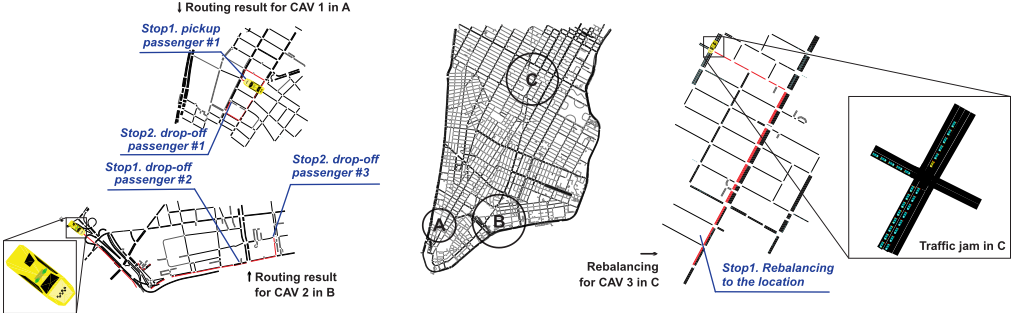
Each training epoch simulates a three-day horizon, starting on January 4, 2024. All experiments are performed on a machine equipped with 32GB RAM, an NVIDIA RTX 4090 GPU, and an AMD Ryzen 7 7800X3D CPU. Each epoch takes approximately 39.5 minutes, resulting in a total training time of about 39 hours and 40 minutes for 100 epochs. Using the best-performing checkpoint selected during training, we report all metrics as the mean and standard deviation over ten evaluation runs.
To provide an intuitive illustration of the operational challenges captured in this simulation, Fig. 4 shows a snapshot of the simulation environment. CAVs operate under realistic congestion induced by HDVs. In this example, one CAV is actively serving passengers, another is completing sequential drop-offs, and an idle CAV anticipates future demand by repositioning. Notably, the idle CAV is trapped in a heavily congested region, emitting high levels of CO2 while being unable to efficiently approach nearby passengers.
5.1 Baselines
To evaluate the STAR framework proposed in Section 4 for reducing CO2 emissions and improving the service rate of our AMoD system, three baselines are established.
- Greedy Rebalancing (GR) [Alonso-Mora et al., 2017]. The method operates in two sequential stages: greedy assignment and rebalancing. First, vehicles are greedily matched to passenger requests to maximize the number of served passengers using a demand-responsive assignment strategy. After this initial matching, the remaining idle vehicles are rebalanced to serve unassigned requests. This rebalancing stage is formulated as a linear assignment problem that minimizes the total travel time from idle vehicles to waiting passengers. The procedure is repeated until either all idle vehicles are dispatched or no unserved requests remain. Since no official open-source implementation is available, we implemented the algorithm based on its original description.
- Historical Average (HA). The method rebalances idle vehicles toward areas with the lowest traffic congestion. The target locations are selected based on average traffic volumes observed over the previous Nh decision steps. Passenger assignment is then performed using the matching procedure proposed by Alonso et al. [Alonso-Mora et al., 2017].
- DeepPool [Al-Abbasi et al., 2019]. It is a distributed, model-free ridesharing dispatch algorithm based on DQN, where each vehicle independently learns a dispatch policy through its own agent. The learned policy jointly minimizes supply-demand mismatch, passenger waiting time, idle driving distance, and additional delays from shared rides, enabling vehicles to both serve current requests and proactively reposition toward high-demand regions. Since the official implementation of DeepPool is not publicly available and was not designed for realistic urban simulators such as SUMO, we reimplemented its core mechanisms within our SUMO environment.
| # of CAVs | Scenario | Operational metrics | User experience metrics | |||
|---|---|---|---|---|---|---|
| CO2 per passenger (kg) ↓ | Service rate ↑ | Average travel distance (km) | Average travel delay (s) | Average waiting time (s) | ||
| 5 | GR HA DeepPool STAR (Ours) | 0.519 ± 0.008 0.594 ± 0.022 1.321 ± 0.022 0.397 ± 0.129 | 0.506 ± 0.014 0.485 ± 0.026 0.530 ± 0.111 0.582 ± 0.105 | 23.116 ± 1.166 33.812 ± 5.249 31.811 ± 6.022 27.267 ± 12.102 | 62.235 ± 6.338 61.627 ± 13.672 68.394 ± 12.227 101.371 ± 78.235 | 132.712 ± 1.385 138.163 ± 6.855 127.519 ± 19.354 133.310 ± 6.151 |
| 10 | GR HA DeepPool STAR (Ours) | 0.848 ± 0.030 1.029 ± 0.142 1.329 ± 0.065 0.466 ± 0.035 | 0.788 ± 0.016 0.784 ± 0.032 0.780 ± 0.025 0.830 ± 0.020 | 16.663 ± 5.319 10.984 ± 8.180 29.344 ± 9.947 23.140 ± 6.396 | 70.131 ± 12.740 57.807 ± 6.625 54.719 ± 7.935 60.311 ± 17.294 | 81.481 ± 2.189 86.327 ± 4.296 87.365 ± 4.183 76.311 ± 1.096 |
| 100 | GR HA DeepPool STAR (Ours) | 3.438 ± 0.082 3.753 ± 0.097 7.965 ± 0.257 2.418 ± 0.268 | 0.890 ± 0.012 0.916 ± 0.023 0.976 ± 0.000 0.980 ± 0.000 | 23.634 ± 5.342 16.328 ± 4.767 17.217 ± 5.155 18.445 ± 10.080 | 44.504 ± 7.140 59.683 ± 5.443 72.577 ± 14.002 66.504 ± 12.110 | 46.923 ± 0.017 57.942 ± 4.037 47.558 ± 1.385 47.272 ± 0.599 |
| Symbol | Description | Value |
|---|---|---|
| C | Maximum passenger capacity per vehicle | 3 |
| W | Maximum allowable waiting time | 3 minutes |
| T | Maximum allowable travel delay | 5 minutes |
| N | Idle time threshold for rebalancing | 3 minutes |
| ∆t | Decision time interval | 90 seconds |
| Nh | Historical horizon for traffic prediction | 12 |
| Np | Prediction horizon | 1 |
| K | Number of spatial regions for traffic aggregation | 13 |
| k | Number of nearest unserved requests in observation | 3 |
| w1 | Weight of idle time penalty | 0.5 |
| w2 | Weight of service rate reward | 0.5 |
5.2 Simulation results
We evaluate the STAR framework in terms of quantitative comparison against baselines, qualitative analysis of the attention mechanism, and computational complexity.
Quantitative results
Table 3 presents a comprehensive quantitative comparison of the STAR framework against several baselines across fleet sizes of 5, 10, and 100 CAVs to evaluate scalability. The key parameters used in these experiments are summarized in Table 4, while additional training settings, such as network layer sizes and learning rates, are provided in the released open-source code. Performance is evaluated using five metrics. Total CO2 emissions per passenger (kg) measures the average carbon emissions generated by the CAV fleet for each successfully served passenger. The service rate refers to the percentage of requests that are successfully serviced. The average travel distance (km) measures the mean distance traveled by CAVs, while the average travel delay (s) captures the additional time experienced by passengers in shared rides compared to solo trips. Lastly, the average waiting time (s) represents the average duration passengers wait from the moment of request until pickup. Among these metrics, we primarily focus on CO2 emissions and service rate, as they directly reflect the objective of our framework. The remaining metrics are reported for service quality evaluation. In particular, the user experience metrics verify that the STAR framework consistently satisfies the imposed constraints on maximum allowable waiting time and travel delay.
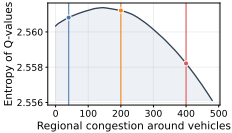
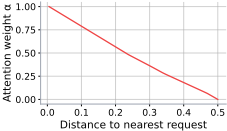
Figure 5: Interpretability of attention. The attention weights reflect both traffic congestion and proximity to passenger demand, indicating that the mechanism captures meaningful coordination signals.
As shown in Table 3, although the greedy rebalancing method [Alonso-Mora et al., 2017] focuses on maximizing service rate, the STAR framework consistently achieves higher service rates across all fleet sizes while substantially reducing CO2 emissions. Across all experimental scales, STAR reduces per-passenger CO2 emissions while improving service rates relative to all baseline methods. Specifically, for fleets of 5, 10, 100 CAVs, STAR reduces per-passenger CO2 emissions by up to 69.9%, 64.9%, and 69.6%, respectively, while increasing service rates by up to 20.0%, 6.4%, and 10.1%.
Qualitative results
To understand what the attention learns, we analyze the learned weights across the STAR framework scenarios reported in Table 3. Fig. 5 shows that attention does not depend on congestion alone. As shown in Fig. 5a, higher congestion leads to lower Q-value entropy, so the optimal rebalancing action is more clearly defined. In Fig. 5b, attention decreases with the distance to the nearest request, so agents closer to demand receive higher attention. Overall, these results indicate that the attention mechanism captures meaningful coordination rather than increasing model capacity.
| Number of CAVs | Number of parameters | Inference time (µs) | Training time (min / epoch) |
|---|---|---|---|
| 5 | 33, 755 | 145.2 | 32.0 |
| 10 | 66, 470 | 261.3 | 32.4 |
| 100 | 655, 340 | 2, 390.1 | 39.5 |
| # of CAVs | Scenario | CO2 per passenger (kg) ↓ | Service rate ↑ |
|---|---|---|---|
| 5 | DQN TD3 QMIX STAR (Ours) | 1.443 ± 0.038 0.875 ± 0.020 0.760 ± 0.204 0.397 ± 0.129 | 0.388 ± 0.013 0.462 ± 0.020 0.574 ± 0.115 0.582 ± 0.105 |
| 10 | DQN TD3 QMIX STAR (Ours) | 1.152 ± 0.197 1.007 ± 0.076 0.501 ± 0.102 0.466 ± 0.035 | 0.612 ± 0.088 0.538 ± 0.032 0.794 ± 0.073 0.830 ± 0.020 |
| 100 | DQN TD3 QMIX STAR (Ours) | 3.892 ± 0.406 2.423 ± 0.003 2.645 ± 0.144 2.418 ± 0.268 | 0.976 ± 0.000 0.966 ± 0.027 0.980 ± 0.000 0.980 ± 0.000 |
Computational complexity
As shown in Table 5, the number of parameters and inference time scale approximately linearly with the number of CAVs, while training time per epoch remains nearly constant, demonstrating that the STAR framework scales efficiently to large fleets.
5.3 Ablation study
In addition, we conduct an ablation study by replacing the decoder of our framework with three representative MultiAgent Reinforcement Learning (MARL) algorithms [Mnih et al., 2015; Fujimoto et al., 2018; Rashid et al., 2020] under the Centralized Training with Decentralized Execution (CTDE) paradigm. It allows us to isolate the effect of the proposed decoder design. Table 6 shows that STAR reduces per-passenger CO2 emissions by up to 48-72% compared to alternative decoders, while achieving superior service rates across all fleet sizes.
Furthermore, we perform sensitivity analyses by systematically varying key system parameters to evaluate the robustness of the proposed framework. In particular, to examine STAR's behavior under relaxed service quality constraints compared to the default setting in Table 4, we increase the maximumwaiting time, travel delay, and idle time threshold from (W, T, N) = (3, 5, 3) to (5, 7, 5) minutes. This setting allows greater flexibility in vehicle dispatch and rebalancing decisions. Under these looser constraints, the STAR framework is able to serve a large number of passengers even with a smaller fleet size, as shown in Fig. 6. However, this improvement in service coverage comes at the cost of increased per-passenger CO2 emissions, as vehicles are permitted to tolerate longer delays and idle periods. These results show the inherent trade-off between service efficiency and environmental sustainability. At the same time, the performance trends confirm that STAR responds robustly to variations in constraints.
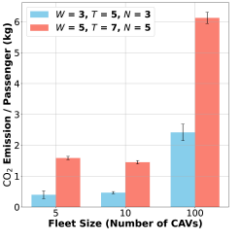
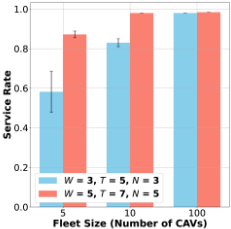
Figure 6: Trade-off under relaxed service quality constraints. Perpassenger CO2 emissions and service rate achieved by STAR when the waiting time, travel delay, and idle time constraints are relaxed from (W, T, N) = (3, 5, 3) to (5, 7, 5) minutes.
6 Conclusion
This paper presented the STAR framework, a cooperative MARL framework for eco-friendly fleet rebalancing in largescale AMoD systems. By combining spatio-temporal traffic prediction with attention-based value decomposition, STAR enables robust credit assignment under sparse and nonstationary urban interactions while strictly enforcing servicequality constraints.
Experiments in a high-fidelity SUMO environment with real-world demand and background traffic demonstrate that STAR improves service rates while substantially reducing per-passenger CO2 emissions across different fleet sizes, outperforming existing baselines. Future work will extend the STAR framework to heterogeneous fleets.
Ethical Statement
There are no ethical issues.
Acknowledgments
This work was supported by the InnoCORE program of the Ministry of Science and ICT (#N10250155), by the National Research Foundation of Korea (NRF) grant funded by the Korean government (MSIT) (No.RS-2022-NR070854), by the Institute of Information & communications Technology Planning & Evaluation (IITP) grant funded by the Korean government (MSIT) (No.RS-2020-II201336, Artificial Intelligence Graduate School Program (UNIST)), by the Green Venture R&D Program (#S3236472) funded by the Ministry of SMEs and Startups (MSS, Korea), and by the Electronics and Telecommunications Research Institute (ETRI) grant funded by the Korean government [26ZD1160, Regional Industry ICT Convergence Technology Advancement and Support Project in Daegu-GyeongBuk].
Contribution Statement
Jungeun Lee† : Conceptualization, Methodology, Software, Formal analysis, Investigation, Data curation, Writing - original draft, Writing - review & editing, Visualization. Seungjae Baek† : Formal analysis, Investigation, Writing - original draft, Writing - review & editing, Visualization. Seongjae Lee: Formal analysis, Investigation. Sunhwi Kim: Conceptualization, Software. Jeong hwan Jeon∗ : Conceptualization, Writing - review & editing, Supervision, Funding acquisition.
@inproceedings{ijcai2026p21,
  title     = {STAR: Spatio-Temporal Attention Rebalancing for Eco-Friendly Autonomous Mobility-on-Demand Systems},
  author    = {Lee, Jungeun and Baek, Seungjae and Lee, Seongjae and Kim, Sunhwi and Jeon, Jeong hwan},
  booktitle = {Proceedings of the Thirty-Fifth International Joint Conference on
               Artificial Intelligence, {IJCAI-26}},
  publisher = {International Joint Conferences on Artificial Intelligence Organization},
  editor    = {Diego Calvanese},
  pages     = {181--190},
  year      = {2026},
  month     = {8},
  note      = {Main Track},
  doi       = {10.24963/ijcai.2026/21},
  url       = {https://doi.org/10.24963/ijcai.2026/21},
}
TY - CPAPER TI - STAR: Spatio-Temporal Attention Rebalancing for Eco-Friendly Autonomous Mobility-on-Demand Systems AU - Lee, Jungeun AU - Baek, Seungjae AU - Lee, Seongjae AU - Kim, Sunhwi AU - Jeon, Jeong hwan T2 - Proceedings of the Thirty-Fifth International Joint Conference on Artificial Intelligence, IJCAI-26 PB - International Joint Conferences on Artificial Intelligence Organization PY - 2026 SP - 181 EP - 190 DO - 10.24963/ijcai.2026/21 UR - https://doi.org/10.24963/ijcai.2026/21 ER -Copied
Machine-readable versions of this paper, for tools and AI agents:





