
Listen and Count: Expanding the Frontier of Zero-shot Object Counting to Sound-centric Counting
Proceedings of the Thirty-Fifth International Joint Conference on Artificial Intelligence. Main Track. Pages 1740-1748.
https://doi.org/10.24963/ijcai.2026/194
© 2026 International Joint Conferences on Artificial Intelligence
Keywords
- Computer Vision: Scene analysis and understanding
- Computer Vision: Applications and Systems
- Computer Vision: Multimodal learning
Abstract
While class-agnostic object counting has recently evolved from image-exemplar to language-guided paradigms, existing methods are limited by text polysemy and the lack of prompts in audio-sensing scenarios. To overcome these challenges, we introduce a sound-centric counting paradigm, enabling models to "listen and count" using the vivid and discriminative signatures of sound cues. We propose S2ICount, which achieves seamless, fine-grained audio-visual alignment for sound-guided counting. At its core, SoundMamba leverages linear-complexity long-range semantic modelling to align cross-modal features, while the Sound Calibration Module designs a circular scanning mechanism to progressively reconcile modality discrepancies using multi-scale cues from a Stable Diffusion backbone. To enhance saliency awareness, a Multi-tier Hybrid Optimization strategy enforces consistency across magnitude, semantics, and distribution. In addition, we introduce SoundCount, the first large-scale sound-oriented counting dataset, comprising over 2,000 scenes and 1,650 audio sources across 66 object categories. Extensive experiments demonstrate that S2ICount achieves state-of-the-art performance, validating the effectiveness of sound as a robust guidance modality for counting. The dataset, demo and implementation code are made publicly accessible at https://github.com/ZSTU-CV-Lab/S2ICount.
- [Amini-Naieni et al., 2023] Niki Amini-Naieni, Kiana Amini-Naieni, Tengda Han, and Andrew Zisserman. Open-world text-specifed object counting. In BMVC, 2023.
- [Bai et al., 2023] Jinze Bai, Shuai Bai, Yunfei Chu, Zeyu Cui, Kai Dang, Xiaodong Deng, Yang Fan, Wenbin Ge, Yu Han, Fei Huang, et al. Qwen technical report. arXiv preprint arXiv:2309.16609, 2023.
- [Chen et al., 2020] Honglie Chen, Weidi Xie, Andrea Vedaldi, and Andrew Zisserman. Vggsound: A large-scale audio-visual dataset. In ICASSP 2020-2020 IEEE Interna- tional Conference on Acoustics, Speech and Signal Pro- cessing (ICASSP), pages 721-725. IEEE, 2020.
- [Devlin et al., 2019] Jacob Devlin, Ming-Wei Chang, Ken- ton Lee, and Kristina Toutanova. Bert: Pre-training of deep bidirectional transformers for language understand- ing. In Proceedings of the 2019 conference of the North American chapter of the association for computational lin- guistics: human language technologies, volume 1 (long and short papers), pages 4171-4186, 2019.
- [Girdhar et al., 2023] Rohit Girdhar, Alaaeldin El-Nouby, Zhuang Liu, Mannat Singh, Kalyan Vasudev Alwala, Ar- mand Joulin, and Ishan Misra. Imagebind: One em- bedding space to bind them all. In Proceedings of the IEEE/CVF conference on computer vision and pattern recognition, pages 15180-15190, 2023.
- [Guzhov et al., 2022] Andrey Guzhov, Federico Raue, Jörn Hees, and Andreas Dengel. Audioclip: Extending clip to image, text and audio. In ICASSP 2022-2022 IEEE In- ternational Conference on Acoustics, Speech and Signal Processing (ICASSP), pages 976-980. IEEE, 2022.
- [Hsieh et al., 2017] Meng-Ru Hsieh, Yen-Liang Lin, and Winston H Hsu. Drone-based object counting by spatially regularized regional proposal network. 2017.
- [Huang et al., 2024] Zhizhong Huang, Mingliang Dai, Yi Zhang, Junping Zhang, and Hongming Shan. Point segment and count: A generalized framework for object counting. In Proceedings of the IEEE/CVF Conference on Computer Vision and Pattern Recognition, pages 17067-17076, 2024.
- [Idrees et al., 2018] Haroon Idrees, Muhmmad Tayyab, Kis- han Athrey, Dong Zhang, Somaya Al-Maadeed, Nasir Ra- jpoot, and Mubarak Shah. Composition loss for counting, density map estimation and localization in dense crowds. 2018.
- [Jiang et al., 2023] Ruixiang Jiang, Lingbo Liu, and Chang- wen Chen. Clip-count: Towards text-guided zero-shot ob- ject counting. In ACM MM, pages 4535-4545, 2023.
- [Kang et al., 2024] Seunggu Kang, WonJun Moon, Euiyeon Kim, and Jae-Pil Heo. Vlcounter: Text-aware visual rep- resentation for zero-shot object counting. In AAAI, vol- ume 38, pages 2714-2722, 2024.
- [Kirillov et al., 2023] Alexander Kirillov, Eric Mintun, Nikhila Ravi, Hanzi Mao, Chloe Rolland, Laura Gustafson, Tete Xiao, Spencer Whitehead, Alexander C Berg, Wan-Yen Lo, et al. Segment anything. In Pro- ceedings of the IEEE/CVF international conference on computer vision, pages 4015-4026, 2023.
- [Lempitsky and Zisserman, 2010] Victor Lempitsky and An- drew Zisserman. Learning to count objects in images. In NeurIPS, volume 23, 2010.
- [Lin et al., 2025] Wei Lin, Chenyang Zhao, and Antoni B Chan. Point-to-region loss for semi-supervised point- based crowd counting. In Proceedings of the Computer Vision and Pattern Recognition Conference, pages 29363- 29373, 2025.
- [Liu et al., 2024a] Aixin Liu, Bei Feng, Bing Xue, Bingx- uan Wang, Bochao Wu, Chengda Lu, Chenggang Zhao, Chengqi Deng, Chenyu Zhang, Chong Ruan, et al. Deepseek-v3 technical report. arXiv preprint arXiv:2412.19437, 2024.
- [Liu et al., 2024b] Shilong Liu, Zhaoyang Zeng, Tianhe Ren, Feng Li, Hao Zhang, Jie Yang, Qing Jiang, Chunyuan Li, Jianwei Yang, Hang Su, et al. Grounding dino: Mar- rying dino with grounded pre-training for open-set object detection. In European conference on computer vision, pages 38-55. Springer, 2024.
- [Marsden et al., 2018] Mark Marsden, Kevin McGuinness, Suzanne Little, Ciara E Keogh, and Noel E O'Connor. People, penguins and petri dishes: Adapting object count- ing models to new visual domains and object types without forgetting. In Proceedings of the IEEE conference on com- puter vision and pattern recognition, pages 8070-8079, 2018.
- [Meng et al., 2025] Haoliang Meng, Xiaopeng Hong, Zhengqin Lai, and Miao Shang. Free lunch enhancements for multi-modal crowd counting. In Proceedings of the Computer Vision and Pattern Recognition Conference, pages 14013-14023, 2025.
- [Mundhenk et al., 2016] T Nathan Mundhenk, Goran Kon- jevod, Wesam A Sakla, and Kofi Boakye. A large con- textual dataset for classification, detection and counting of cars with deep learning. In European conference on com- puter vision, pages 785-800. Springer, 2016.
- [Pelhan et al., 2024] Jer Pelhan, Alan Lukezic, Vitjan Za- vrtanik, and Matej Kristan. A novel unified architec- ture for low-shot counting by detection and segmenta- tion. Advances in Neural Information Processing Systems, 37:66260-66282, 2024.
- [Qian et al., 2025] Yifei Qian, Zhongliang Guo, Bowen Deng, Chun Tong Lei, Shuai Zhao, Chun Pong Lau, Xi- aopeng Hong, and Michael P Pound. T2icount: Enhancing cross-modal understanding for zero-shot counting. In Pro- ceedings of the Computer Vision and Pattern Recognition Conference, pages 25336-25345, 2025.
- [Qin et al., 2023] Can Qin, Ning Yu, Chen Xing, Shu Zhang, Zeyuan Chen, Stefano Ermon, Yun Fu, Caiming Xiong, and Ran Xu. Gluegen: Plug and play multi-modal en- coders for x-to-image generation. In ICCV, pages 23085- 23096, October 2023.
- [Radford et al., 2021] Alec Radford, Jong Wook Kim, Chris Hallacy, Aditya Ramesh, Gabriel Goh, Sandhini Agar- wal, Girish Sastry, Amanda Askell, Pamela Mishkin, Jack Clark, et al. Learning transferable visual models from nat- ural language supervision. In International conference on machine learning, pages 8748-8763. PmLR, 2021.
- [Ranjan et al., 2021] Viresh Ranjan, Udbhav Sharma, Thu Nguyen, and Minh Hoai. Learning to count everything. In Proceedings of the IEEE/CVF Conference on Computer Vision and Pattern Recognition, pages 3394-3403, 2021.
- [Rombach et al., 2022] Robin Rombach, Andreas Blattmann, Dominik Lorenz, Patrick Esser, and Björn Ommer. High-resolution image synthesis with latent diffusion models. In Proceedings of the IEEE/CVF conference on computer vision and pattern recognition, pages 10684-10695, 2022.
- [Rouditchenko et al., 2020] Andrew Rouditchenko, Angie Boggust, David Harwath, Brian Chen, Dhiraj Joshi, Samuel Thomas, Kartik Audhkhasi, Hilde Kuehne, Rameswar Panda, Rogerio Feris, et al. Avlnet: Learning audio-visual language representations from instructional videos. arXiv preprint arXiv:2006.09199, 2020.
- [Shi et al., 2022] Min Shi, Hao Lu, Chen Feng, Chengxin Liu, and Zhiguo Cao. Represent, compare, and learn: A similarity-aware framework for class-agnostic counting. In Proceedings of the IEEE/CVF Conference on Computer Vision and Pattern Recognition, pages 9529-9538, 2022.
- [Shih et al., 2023] Yi-Jen Shih, Hsuan-Fu Wang, Heng-Jui Chang, Layne Berry, Hung-yi Lee, and David Harwath. Speechclip: Integrating speech with pre-trained vision and language model. In 2022 IEEE Spoken Language Technol- ogy Workshop (SLT), pages 715-722. IEEE, 2023.
- [Sindagi and Patel, 2018] Vishwanath A Sindagi and Vishal M Patel. A survey of recent advances in cnn-based single image crowd counting and density estimation. Pattern Recognition Letters, 107:3-16, 2018.
- [Sindagi et al., 2020] Vishwanath A Sindagi, Rajeev Yasarla, and Vishal M Patel. Jhu-crowd++: Large-scale crowd counting dataset and a benchmark method. arXiv preprint arXiv:2004.03597, 2020.
- [Sung-Bin et al., 2023] Kim Sung-Bin, Arda Senocak, Hyunwoo Ha, Andrew Owens, and Tae-Hyun Oh. Sound to visual scene generation by audio-to-visual latent alignment. In Proceedings of the IEEE/CVF Conference on Computer Vision and Pattern Recognition, pages 6430-6440, 2023.
- [Sung-Bin et al., 2025] Kim Sung-Bin, Kim Jun-Seong, Jun- seok Ko, Yewon Kim, and Tae-Hyun Oh. Soundbrush: Sound as a brush for visual scene editing. In Proceed- ings of the AAAI Conference on Artificial Intelligence, vol- ume 39, pages 7167-7175, 2025.
- [Tang et al., 2023] Zineng Tang, Ziyi Yang, Chenguang Zhu, Michael Zeng, and Mohit Bansal. Any-to-any generation via composable diffusion. Advances in Neural Information Processing Systems, 36:16083-16099, 2023.
- [Wang et al., 2020] Qi Wang, Junyu Gao, Wei Lin, and Xue- long Li. Nwpu-crowd: A large-scale benchmark for crowd counting. arXiv preprint arXiv:2001.03360, 2020.
- [Wang et al., 2022] Mingjie Wang, Hao Cai, Xian-Feng Han, Jun Zhou, and Minglun Gong. Stnet: Scale tree network with multi-level auxiliator for crowd counting. TMM, 25:2074-2084, 2022.
- [Wang et al., 2025] Mingjie Wang, Song Yuan, Xian-Feng Han, and Zili Yi. Draw what you hear: High-fidelity im- age generation and manipulation via soundadapter. IEEE Transactions on Neural Networks and Learning Systems, 2025.
- [Welsby and Cheung, 2023] Philip Welsby and Bernard MY Cheung. Chatgpt, 2023.
- [Wu et al., 2023] Yusong Wu, Ke Chen, Tianyu Zhang, Yuchen Hui, Taylor Berg-Kirkpatrick, and Shlomo Dub- nov. Large-scale contrastive language-audio pretraining with feature fusion and keyword-to-caption augmentation. In ICASSP 2023-2023 IEEE International Conference on Acoustics, Speech and Signal Processing (ICASSP), pages 1-5. IEEE, 2023.
- [Xu et al., 2023] Jingyi Xu, Hieu Le, Vu Nguyen, Viresh Ranjan, and Dimitris Samaras. Zero-shot object count- ing. In Proceedings of the IEEE/CVF Conference on Computer Vision and Pattern Recognition, pages 15548- 15557, 2023.
- [Yang et al., 2025] Wenhao Yang, Jianguo Wei, Wenhuan Lu, and Lei Li. You only speak once to see. In ICASSP 2025 -2025 IEEE International Conference on Acoustics, Speech and Signal Processing (ICASSP), pages 1-5, 2025.
- [Zhang et al., 2016] Yingying Zhang, Desen Zhou, Siqin Chen, Shenghua Gao, and Yi Ma. Single-image crowd counting via multi-column convolutional neural network. 2016.
- [Zhang et al., 2017] Shanghang Zhang, Guanhang Wu, Joao P Costeira, and José MF Moura. Fcn-rlstm: Deep spatio-temporal neural networks for vehicle counting in city cameras. In Proceedings of the IEEE international conference on computer vision, pages 3667-3676, 2017.
- [Zhang et al., 2024] Shiwei Zhang, Wei Ke, Shuai Liu, Xi- aopeng Hong, and Tong Zhang. Boosting semi-supervised crowd counting with scale-based active learning. In Pro- ceedings of the 32nd ACM International Conference on Multimedia, pages 8681-8690, 2024.
- [Zhang et al., 2025] Zhenfei Zhang, Ming-Ching Chang, and Xin Li. Training-free image manipulation localiza- tion using diffusion models. In Proceedings of the AAAI Conference on Artificial Intelligence, volume 39, pages 10376-10384, 2025.
- [Zhu et al., 2024] Huilin Zhu, Jingling Yuan, Zhengwei Yang, Yu Guo, Zheng Wang, Xian Zhong, and Shengfeng He. Zero-shot object counting with good exemplars. In European Conference on Computer Vision, pages 368- 385. Springer, 2024.
References were extracted automatically from the PDF and may contain errors.
Full text extracted automatically from the PDF; figures, tables and equations may differ. The PDF is the version of record.
1 Introduction
Driven by the success of deep learning, object counting has been extensively studied [Lempitsky and Zisserman, 2010; Sindagi and Patel, 2018; Wang et al., 2022] and applied to diverse scenarios, including security monitoring, traffic management, and agricultural yield estimate. Early work primarily focuses on class-specific tasks, such as crowd [Meng et al., 2025; Lin et al., 2025; Zhang et al., 2024] and vehicle counting [Mundhenk et al., 2016; Marsden et al., 2018; Zhang et al., 2017]. Despite high accuracy, these methods rely on labour-intensive datasets with limited categories and often generalize poorly to unseen classes. To address this, recent approaches [Jiang et al., 2023; Kang et al., 2024] aim for class-agnostic counting, enabling arbitrary-category counting without extensive annotations. As intrinsic class cues are absent, class-agnostic algorithms necessitate auxiliary guidance prompts, typically either image exemplars [Ranjan et al., 2021; Shi et al., 2022] or linguistic names [Jiang et al., 2023; Kang et al., 2024]. Specifically, as shown in Fig. 1 (a), traditional exemplar-based methods input raw images with exemplars to count specific objects, whereas recent multimodal approaches leverage easily-acquired language prompts to specify target categories, see Fig. 1 (b).
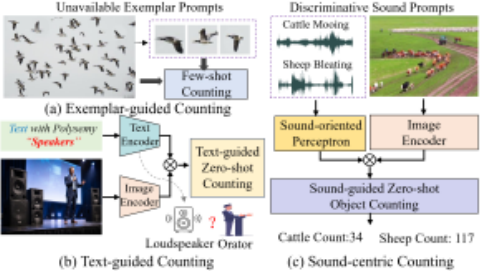
Therefore, language-vision multimodal counting has gained increasing attention, fuelled by large-scale pretrained text encoders (e.g., CLIP [Radford et al., 2021] and BERT [Devlin et al., 2019]). Text-guided methods [AminiNaieni et al., 2023; Pelhan et al., 2024; Qian et al., 2025] achieve strong performance by mining the generalization of these models and aligning text-image feature spaces via contrastive learning. Despite enabling compelling humanmachine interaction, text-centric approaches are limited in scenarios where language prompts are unavailable, such as audio-sensing robotics, automatic movie subtitle generation, or assistive applications for visually impaired users, where only sound signals (e.g., horse neighing or sheep bleating) are present. Moreover, sound conveys richer and more discriminative information than text, which often suffers from semantic ambiguity caused by polysemy (e.g., "Speaker" as loudspeaker v.s. orator), whereas sound signals provide distinctive acoustic signatures. Motivated by these observations, it is natural to equip counting agents with the ability to listen and count in a human-like manner, enhancing their capacity to perceive and interpret real-world environments. For example, steering robotic agents to monitor wildlife density based solely on animal vocalizations. Motivated by recent advances in multimodal feature learning, particularly pretrained audio-vision models (e.g., SpeechCLIP [Shih et al., 2023], AudioCLIP [Guzhov et al., 2022]), audio-guided vision tasks [Yang et al., 2025; Wang et al., 2025; Sung-Bin et al., 2025] have emerged as a promising direction in multimodal research. Building on these developments, we pioneer the use of sound as a guidance in object counting, introducing sound-centric class-agnostic counting, see Fig. 1 (c).
Accordingly, we propose S2ICount, a novel sound-guided counting protocol to explore sound-image collaboration. At a high level, S2ICount realizes an automatic pipeline of "receiving, perceiving, specifying, and counting" under sound guidance by bridging natural audio signals and visual scenes. At a finer scale, it comprises three key components: SoundMamba, Sound Calibration Module (SCM), and Multi-tier Hybrid Optimization scheme. SoundMamba aligns crossmodal sound-image semantics using textual prompts as a hub, leveraging Mamba's efficiency in modelling long-range dependencies. SCM progressively calibrates cross-modal discrepancies via a novel circular-scanning mamba module and multi-scale features from a Stable Diffusion backbone. Multitier Hybrid Optimization enforces comprehensive alignment in magnitude, semantics, and distribution during training. Beyond the protocol, we curate SoundCount, a large-scale sound-image dataset of over 2,351 scenes and 1,650 sound sources spanning 66 categories, addressing the scarcity of audio-informed counting data and providing a foundation for training, benchmarking, and deploying sound-guided counting. In summary, the contributions of this work are fourfold:
- Modality Breakthrough. This work expands the frontier of class-agnostic object counting for both the research or industry by pioneering sound guidance, a novel modality has thus far remained largely unexplored.
- Novel Sound-centric Counting Protocol. We propose S2ICount, a novel sound-centric counting protocol designed to allow models to listen and count in a humanlike manner by estimating instance counts specified by sound stimulus in audio-sensing scenarios.
- Fine-grained Feature Alignment. To achieve seamless cross-modal alignment between sound and image inputs, we architecture three sophisticated components
- including a SoundMamba, a Sound Calibration Module (SCM), and a Multi-tier Hybrid Optimization scheme.
- New Dataset and SOTA Performance. We further curate a large-scale multimodal dataset (SoundCount) to catalyze studies and applications in novel sound-centric counting protocol. Extensive experiments illustrate the state-of-the-art performance of our S2ICount, proving the efficacy of sound-image synergy for object counting.
2 RelatedWork
2.1 Class-agnostic Multimodal Counting
Recently, research on class-agnostic multimodal object counting has shifted from exemplar-based, single-modal approaches to linguistic-guided multimodal methods, which take raw images together with class-specific text prompts as input and achieving highly interactive counting without requiring difficult-to-acquire exemplar prompts. Earlier method like Patch-selection [Xu et al., 2023] utilizes VAEs to translate text prompts into visual exemplars, thereby recasting the text-guided task into a few-shot exemplar-based counting problem. To facilitate direct textual guidance independent of intermediate visual exemplars, a suite of recent approaches, such as CLIP-Count [Jiang et al., 2023], VLCounter [Kang et al., 2024], and CountX [Amini-Naieni et al., 2023], harnesses the rich priors of the widely adopted pre-trained CLIP model. By directly aligning textual features with visual characteristics, these models achieve efficient text-guided counting with superior interactivity and generalization robustness. In addition to CLIP, other large-scale vision-language models have also been pivoted toward text-guided counting tasks. For instance, PseCo [Huang et al., 2024] delves into the use of the Segment Anything Model (SAM) [Kirillov et al., 2023] by automatically generating candidate dense regions, while VACount [Zhu et al., 2024] capitalizes on the strong localization capabilities of Grounding DINO [Liu et al., 2024b] to obtain high-quality visual exemplar patches via text-driven detection. More recently, the powerful Stable Diffusion models has been integrated into T2ICount [Qian et al., 2025], providing fine-grained attention maps and multi-scale features to improve multimodal counting accuracy.
2.2 Audio-steeringMultimodal Models
While existing text-guided protocols endeavour to mimic human logic of write and count, they are vulnerable to intractable polysemy of textual descriptions and fail in environments restricted to auditory stimuli. Recent breakthroughs in other audio-visual tasks have tried to address these challenges by leveraging the unique acoustic fingerprints inherent in sound signals. Specifically, AVLNet [Rouditchenko et al., 2020] and SoundAdapter [Qin et al., 2023] achieve audiodriven cross-modal retrieval and generation, respectively, by bridging the latent gap between audio and vision inputs. Similarly, foundational models like SpeechCLIP [Shih et al., 2023], ImageBind [Girdhar et al., 2023], CoDi [Tang et al., 2023] and Sound2Scene [Sung-Bin et al., 2023] generalize the CLIP principle to incorporate speech and environmental sounds via multi-way contrastive learning to align audio-textimage feature spaces. The maturation of these audio-centric models catalyzes the transition toward sound-guided object counting, offering a pathway to resolve modality limitations in real-world multimodal counting agents.
3 Listen and Count via S2ICount
3.1 An Efficient Sound Adapter: SoundMamba
Training large-scale sound-vision counting models from scratch is extremely challenging due to the scarcity of wellpaired data, especially across diverse audio types. Fortunately, recent large-scale pre-trained multimodal models, such as CLIP for text-image, AudioCLIP [Guzhov et al., 2022] for audio-text-image, and CLAP [Wu et al., 2023] for audio-text alignment, provide a practical, cost-effective means to extract rich cross-modal features. Notably, CLAP, trained on eight datasets, offers the largest audio-text corpus and broad sound coverage to date. Leveraging its strong generalization, we adopt a frozen CLAP as our sound encoder to generate coarse sound features for the counting task.
Specifically, given a raw input sound S, the CLAP encoder first extracts coarse time-frequency representations. However, since we employ a CLIP-based Stable Diffusion (SD) backbone to facilitate acoustic guidance, the inherent incompatibility between the CLAP and CLIP feature spaces prevents direct integration, as raw sound embeddings would lead to significant semantic misalignment. To address this, we design an efficient adapter, SoundMamba, to project and precisely align sound representations into the CLIP-friendly textual embedding space required for subsequent diffusion workflows. SoundMamba sequentially integrates layer normalization, 1D convolution, GELU activation, and linear projection, followed by several Mamba blocks. To stabilize feature and gradient propagation, we incorporate residual learning throughout the adapter. The resulting embeddings are fused with local features derived from a MLP to achieve a synergy of local and global semantic cues, ultimately yielding a 768-dimensional sound latent. The rationale for employing Mamba blocks over traditional Transformers lies in their ability to capture long-range temporal dependencies while maintaining linear computational complexity.
3.2 Sound CalibrationModule
Diffusion models [Zhang et al., 2025] capture highdimensional data distributions through iterative denoising steps and have shown significant success across diverse generative benchmarks. Utilizing its superior image representation capability, the Stable Diffusion (SD) model [Rombach et al., 2022] is adopted as the backbone for sound-guided visual feature extraction. Specifically, the input image is first encoded by a VAE into a compact latent manifold, after which a pre-defined UNet operates on this latent while being steered by the well-aligned sound embeddings from SoundMamba. To optimize a trade-off between computational efficiency and counting accuracy, we extract one-step diffusion features as the final image representations. To gain fine-grained alignment between the sound latent and visual features across multiple scales, this paper introduces a Sound Calibration Module (SCM). Specifically, visual feature maps at four different scales are captured from distinct hierarchical levels of the UNet within the SD backbone, which are denoted as:
where H and W represent the spatial resolutions of the 2D visual feature maps.
The SCM recursively and hierarchically aggregates visual feature maps in a coarse-to-fine manner, progressively fusing information across increasing spatial resolution. This interscale transition is formally defined as:
where F ′ i denotes the ith-level fused characteristics, and Pi+1 represents the feature map propagated from the preceding lower-resolution level (with the base case P4 = F4). The operator Up(·) performs spatial upsampling, Cat(·) signifies channel-wise concatenation, and Linear(·) is utilized for feature projection and dimensional reduction.
To better compute similarity metrics between the sound latent and visual pixels across multi-scale feature maps, a Cross-attention Mechanism (CM) imposed on the fused visual features F ′ i and the sound latent s is a widely adopted approach. However, directly applying (CM) to locality-only F ′ i and global s tends to overlook correlations between the global distributions of the visual image and the sound token, making it difficult to handle the density shift issues in sound-vision counting problems. Therefore, in this paper, we propose Global Cross-attention Mechanism (GCM) that explicitly models global vision instance distribution across the entire scene by introducing a novel circular-scanning Mamba module to transform local features F ′ i into global representations Gi, while maintaining low computational overhead. The pipeline of GCM can be formulated as:
where CM stands for the conventional cross-attention operation, and M denotes the circular-scanning Mamba module proposed in this paper. Pi and S represent the image and audio features obtained after processing by the GCM, respectively.
Specifically, the circular scanning strategy is designed to impose a circular traversal over pixels in two-dimensional images, in both clockwise and counterclockwise directions. This design is motivated by the observation that object instances in natural scenes often exhibit circular or radial distribution patterns inherently caused by radial camera perspective, as illustrated by the cattle examples in Fig. 2. Compared with na¨ıve horizontal or vertical scanning, circular scanning is more effective at capturing global distribution characteristics and continuous instance density variations. First, the image center (xc, yc) is computed based on the row and column indices. Using a polar-coordinate transformation, each pixel (x, y) is then assigned to a discrete radial layer R(x, y) according to its distance from the image center.
where K denotes the radial discretization coefficient, whereas ⌊·⌋ means the floor operation. Meanwhile, the normalized angular position ˆ θ(x, y) of each pixel within its corresponding radial layer is computed to characterizes its relative polar angle with respect to the image center.
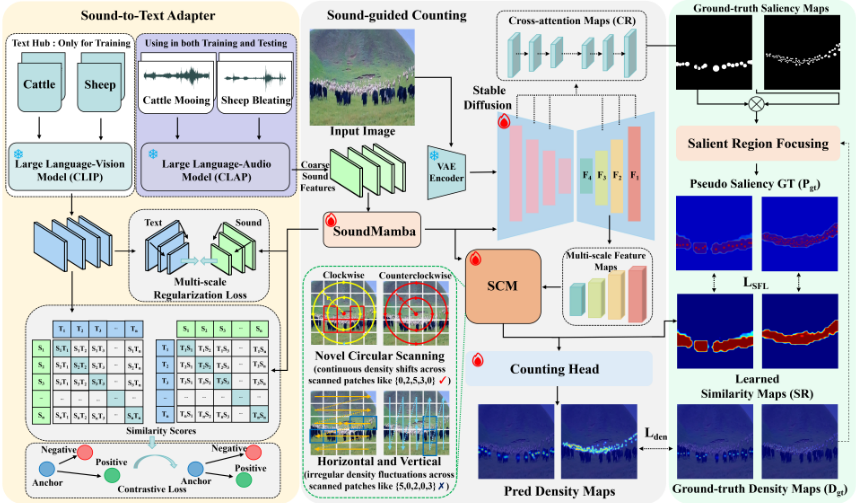
Based on the radial and angular components, we further define the pixel priority O(x, y) in the proposed circular scanning scheme as follows:
where M is a magnitude isolation constant satisfying M ≫ 1, ensuring that pixels from different radial layers are strictly ordered while preserving the angular ordering within each layer. According to this priority value, a deterministic circular scanning order over the entire image can be obtained.
3.3 Multi-tier Hybrid Optimization
We introduce a hybrid supervision scheme that enables reliable, semantic-, and distribution-invariant projection. Specifically, the proposed hybrid optimization integrates a Multiscale Regularization Loss to enforce magnitude consistency, a Contrastive Loss to preserve semantic coherence, and a Saliency-intent Filtering Loss to attain distribution alignment.
Multi-scale Regularization Loss
Our preliminary findings indicate that a strict single-scale MSE loss fails to reconcile the multi-granular discrepancies between sound and text features, resulting in brittle adaptation. Consequently, we propose a hierarchical regularization scheme for magnitude consistency that enforces alignment invariance of feature segments across multiple scales, leading to more semantically robust and well-calibrated crossmodal representation alignment. Specifically, we employ a bank of average pooling operators AVP with varying kernel sizes K ∈ {1, 3, 5, 7, 9, 11, 13} and corresponding strides S ∈ {1, 2, 4, 6, 8, 10, 12} to perform multi-scale temporal aggregation. This operation yields a hierarchical set of embeddings captured at diverse granularities. Hence, the multiscale regularization loss is formally defined as follows:
where Sound indicates the latent audio representations from SoundMamba, and Text signifies the target text embeddings from the frozen CLIP text encoder.
Positive-Negative Contrastive Loss
To preserve the semantic consistency across multimodal features and effectively model their intrinsic correlations, we incorporate a Positive-Negative Contrastive Loss to achieve holistic alignment between the audio and text modalities. Specifically, we adopt an InfoNCE [Radford et al., 2021] based objective to promote high-level semantic coherence by pulling positive sample pairs closer while pushing negative pairs farther apart in the embedding space.
Given a batch of n feature pairs, positive and negative labels are constructed in a self-supervised in-batch manner. For each instance i, the sound-text and text-sound embeddings pairs {si, ti} and {ti, si} with matching batch indices are designated as positive pairs. Conversely, all mismatched combinations {si, tj} and {ti, sj} (where j ̸= i) serve as negative samples. Therefore, a symmetric contrastive loss is formulated to optimize bidirectional similarity scores over all positive and negative sample pairs within the current training batch, defined as follows:
where Sim(·, ·) represents the cosine similarity measure, and eτ denotes a temperature parameter used to scale the similarity values. In summary, to ensure the embedding consistency in both magnitude and semantic, the final objective function for optimizing the SoundMamba during the training phase is formulated as Ladap = Lmse + Lsp.
Saliency-intent Filtering Loss
The fidelity of the similarity maps computed within the SCM is pivotal to the performance in prompt-guided counting pipelines. However, precisely isolating prompt-specific regions remains highly challenging in practice due to intensive background clutter and the semantic interference present in scenes with multiple object classes. To facilitate accurate sound-guided counting, we introduce a Salience-intent Filtering Loss (SFL) that enforces consistency between the diffusion-based attention maps and the learned similarity maps. This supervises both components to converge upon the correct sound-conditioned salient regions, effectively filtering out irrelevant background and inter-class distractors.
Specifically, cross-attention maps at multiple scales are first extracted from the diffusion model and then fused to form a unified attention map CR. The learned similarity map SR can be readily obtained from the SCM subnetwork. However, directly minimizing the distance between CR and SR is prone to training collapse due to the absence of explicit ground-truth supervision. To provide reliable supervision cues for learning saliency-aware maps, we use the groundtruth density map Dgt to construct an intermediate pseudosaliency map P gt as:
where (p, q) is spatial position, and ϕ and ξ are heuristicallypredefined thresholds. Then, the saliency-intent filtering loss is then written as LSFL = αLsal + Lback (Lsal = ∑pq 1 - SRp,q if P gt p,q = 1, Lback = ∑pq max(0, SRp,q) if P gt p,q = 0) where α denotes the weight of the Lsal. The overall hybrid optimization function for training S2ICount is given by L = Lden + Ladap + λLSFL, where λ denotes the weight of the LSFL.
4 SoundCount: ANewMultimodal Dataset
4.1 Dataset Overview
| Datasets | Image# | Class | Modality |
|---|---|---|---|
| ShanghaiTech [Zhang et al., 2016] | 1,198 | 1 | Image |
| QNRF [Idrees et al., 2018] | 1,535 | 1 | Image |
| NWPU [Wang et al., 2020] | 5,109 | 1 | Image |
| JHU [Sindagi et al., 2020] | 4,372 | 1 | Image |
| CARPK [Hsieh et al., 2017] | 1,448 | 1 | Image |
| FSC-147 [Ranjan et al., 2021] | 6,135 | 147 | Text-Image |
| SoundCount (ours) | 2,351 | 66 | Audio-Image |
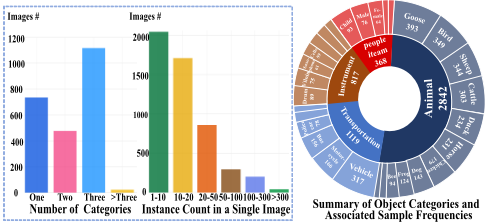
Existing visual counting benchmarks are limited by narrow category coverage (e.g., pedestrians, vehicles, cells) or singleclass-dominated images, and critically, they lack sound annotations, hindering progress in audio-guided counting. For instance, FSC-147 [Ranjan et al., 2021] includes multi-class scenes but no sound labels due to high annotation costs. To overcome these limitations, we introduce SoundCount, a large-scale audio-image paired dataset tailored for soundguided counting. As shown in Fig. 3, SoundCount comprises 2,351 scenes across 66 categories, from wildlife and musical instruments to transportation. Of these, 735 are singleclass images, while the rest depict complex multi-class scenes with an average of 58 instances per image, ranging from 1 to 2,092. The dataset's high density and background complexity make it a challenging benchmark. Comparisons with existing counting datasets are summarized in Tab. 1.
Synthetic Images with Multiple Categories
4.2 Image-Sound Data Collection and Curation
To circumvent the challenges inherent in scaling the acquisition of diverse multi-class scenes, we leverage two complementary data-collection strategies: generating synthetic images via off-the-shelf Multimodal Large Models (MLMs) and collecting real-world images from practical sources, culminating in a dataset of 2,351 images.
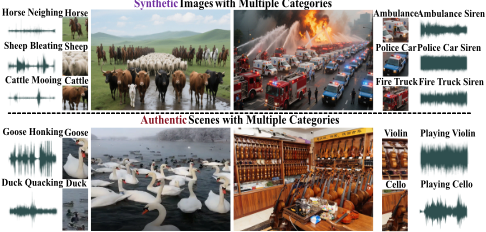
Synthetic Pipeline. Within the SoundCount, 1,328 images were synthesized using MLMs. Following a systematic comparative evaluation of leading foundational models, including Doubao, DeepSeek [Liu et al., 2024a], ChatGPT [Welsby and Cheung, 2023], and Qwen [Bai et al., 2023], we determined that consistently yields superior visual perceptual fidelity and structural controllability. The generation prompts were meticulously engineered to define complex scenes with multi-class coexistence and explicit random instance counts, often augmented with specific behavioural descriptions. For instance, a typical prompt specifies: "Morning scene at a suburban farm: 52 roosters crow at the rising sun; 48 cows low in the enclosure; 50 sheep bow their heads to graze and bleat". The synthetic samples are illustrated in the first row of Fig. 4.
Real-world Pipeline. Although synthetic data enables fast and efficient image generation, it often contains perceptual artifacts that can hinder real-world generalization. To bridge this gap, we augment our benchmark with authentic images collected via a retrieval-based strategy over a predefined set of object categories. Using major web search engines (e.g., Google, Bing, Baidu) and video platforms like TikTok, we manually curated images and extracted frames that meet our class and density requirements. To improve retrieval efficacy and prioritize high-density scenes, search queries were augmented with quantitative modifiers such as "many", "a large number of", and "a pile of". The authentic examples are visualized in the second row of Fig. 4.
Selection and Validation Heuristics. All candidate images underwent rigorous manual inspection to ensure data integrity according to the following criteria: i) Perceptual Fidelity: Images must possess sufficient resolution and clarity to facilitate the unambiguous discrimination of individual instances; ii) Instance Density: We prioritized high-occupancy scenes, as the utility of automated counting is most significant in dense status where manual counting is cognitively demanding; iii) Morphological Consistency: Target instances in a single scene should exhibit a reasonable degree of uniformity in semantic appearance to ensure learning stability.
Audio Source Collection. We curated audio files of 1,650 for SoundCount by first identifying and downloading audio samples corresponding to countable object categories within the large-scale VGGSound [Chen et al., 2020] repository. To ensure temporal consistency, each clip was segmented into a uniform 10-second window. Furthermore, all audio samples underwent manual screening to ensure category-specific clarity and signal integrity.
5 Experiments
5.1 Evaluation and Implementation Details
We evaluate the S2ICount on our self-curated SoundCount. Consistent with prior work in object counting, we use MAE
and RMSE as evaluation metrics. The S2ICount is initialized with pre-trained SD v1.5 and CLAP models. During training, the parameters of the VAE encoder and the CLAP model are frozen, while the U-Net is further fine-tuned. The base learning rate is set to 5 × 10⁻⁵ . To preserve the pre-trained priors, the learning rate of the U-Net is reduced to one-tenth of this base rate. Training is performed for 200 epochs using the AdamW optimizer, with a weight decay of 1 × 10⁻⁴ and a batch size of 4. The hyper-parameters α, λ, K, and M are empirically set to 2, 0.01, 20, and 1000, respectively.
| Prompt | Methods | Val Set | Test Set | ||
|---|---|---|---|---|---|
| MAE | RMSEMAE | RMSE | |||
| Text | CLIPCount | 19.38 | 64.32 | NA | NA |
| VLCounter | 25.00 | 67.30 | NA | NA | |
| T2ICount | 7.55 | 21.20 | NA | NA | |
| Sound | Clipcount+SoundMamba | 19.38 | 64.46 | 20.07 | 65.29 |
| VLCounter+SoundMamba22.43 | 66.36 | 19.78 | 64.88 | ||
| T2ICount+SoundMamba | 7.81 | 19.87 | 8.28 | 24.85 | |
| S2ICount (ours) | 6.80 | 18.72 | 7.87 | 23.20 | |
5.2 Comparisons with State of the Art
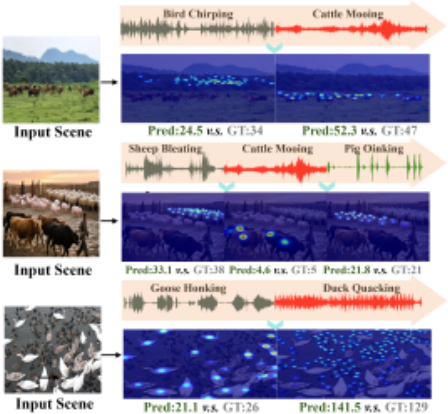
We carry out extensive experiments to compare the performance of our S2ICount with several state-of-the-art approaches. As shown in Tab. 2, the compared models can be broadly categorized into text-guided and sound-centric counting paradigms. Among text-guided methods, T2ICount achieves the best validation performance, with MAE of 7.55 and RMSE of 21.20. For sound-oriented approaches, we evaluate multiple variants, including existing SOTA multimodal counting models incorporating the SoundMamba module and our proposed S2ICount. Notably, S2ICount consistently outperforms all sound-based baselines and surpasses the strongest text-guided model, achieving a validation MAE of 6.80 and RMSE of 18.72. On the sound-guided test set, T2ICount with SoundMamba achieves a test MAE of 8.28 and a test RMSE of 24.85, whereas S2ICount further reduces the MAE to 7.87 and the RMSE to 23.20, yielding the best overall performance among all evaluated models. Several sound-guide counting results are visualized in Fig. 5.
5.3 Ablation Study
To validate the effectiveness of each core component in the proposed sound-oriented counting framework, we conduct ablation experiments on the SoundCount dataset. The quantitative results are reported in Tab. 3. Starting from a baseline configuration with only SoundMambaenabled, the model achieves a validation MAE of 7.19 and RMSE of 19.14, along with a test MAE of 8.45 and RMSE of 26.07. Incorporating SCM, Mamba, and LSFL reduces the test RMSE to
| Baseline | SoundMamba | SCM | Mamba | Circular Scanning | LSFL | Ladap | Val Set | Test Set | ||
|---|---|---|---|---|---|---|---|---|---|---|
| MAE | RMSE | MAE | RMSE | |||||||
| ✓ | ✓ | ✗ | ✗ | ✗ | ✗ | ✓ | 7.19 | 19.14 | 8.45 | 26.07 |
| ✓ | ✓ | ✓ | ✓ | ✗ | ✓ | ✓ | 7.21 | 18.57 | 7.98 | 21.93 |
| ✓ | ✓ | ✓ | ✗ | ✗ | ✓ | ✓ | 7.37 | 18.24 | 8.41 | 28.12 |
| ✓ | ✓ | ✓ | ✓ | ✓ | ✗ | ✓ | 7.52 | 19.89 | 7.88 | 24.31 |
| ✓ | ✓ | ✓ | ✓ | ✓ | ✓ | ✗ | 7.76 | 21.10 | 8.28 | 21.85 |
| ✓ | ✗ | ✓ | ✓ | ✓ | ✓ | ✗ | 9.09 | 20.91 | 9.27 | 21.25 |
| ✓ | ✗ | ✗ | ✗ | ✗ | ✗ | ✗ | 9.36 | 25.36 | 10.14 | 26.09 |
| ✓ | ✓ | ✓ | ✓ | ✓ | ✓ | ✓ | 6.80 | 18.72 | 7.87 | 23.20 |
21.93, indicating a clear improvement in generalization performance. Removing Mamba yields the lowest validation RMSE of 18.24; however, this comes at the cost of degraded test performance, with the RMSE increasing to 28.12. Introducing circular scanning while excluding LSFL further deteriorates validation performance, with the MAE and RMSE increasing to 7.52 and 19.89, respectively. Disabling the loss term Ladap leads to the lowest test RMSE of 21.85, but simultaneously worsens validation results, suggesting potential overfitting. In contrast, removing SoundMamba causes a substantial performance drop, with the validation MAE rising to 9.09 and the test MAE increasing to 9.27. With all components fully integrated, the proposed model achieves the best overall performance, attaining a validation MAE of 6.80 and a test MAE of 7.87. Conversely, removing all components produces the poorest performance across all evaluation metrics in both validation and test sets.
5.4 How do Audio Extractors Impact the Results?
To evaluate the effectiveness of varied pre-trained audio models for our method, comparative experiments are conducted on SoundCount dataset in Tab. 4. Two typical audio pretrained models (AudioCLIP and SpeechCLIP) are selected for comparison, while our method adopts a CLAP-based audio feature extraction strategy. On the validation set, Audio Clip achieves a mean absolute error of 12.61 and a root mean square error of 29.15, and Speech Clip yields a mean absolute error of 11.64 and a root mean square error of 32.22. On the test set, the two models obtain mean absolute errors of 14.01 and 13.51 as well as root mean square errors of 38.62 and 39.35 respectively. In contrast, our CLAP-based method outperforms both counterparts by a substantial margin, delivering the optimal validation mean absolute error of 6.80 and root mean square error of 18.72, along with the best test mean absolute error of 7.87 and root mean square error of 23.20.
| Methods | Val Set | Test Set | ||
|---|---|---|---|---|
| MAE | RMSE | MAE | RMSE | |
| S2ICount (AudioCLIP) | 12.61 | 29.15 | 14.01 | 38.62 |
| S2ICount (SpeechCLIP) | 11.64 | 32.22 | 13.51 | 39.35 |
| S2ICount (CLAP) | 6.80 | 18.72 | 7.87 | 23.20 |
6 Conclusion
In summary, this work introduces sound-guided counting via the novel S2ICount and the SoundCount dataset. S2ICount enables models to "listen and count", bridging audio-visual features through SoundMamba, a Sound Calibration Module, and Multi-tier Hybrid Optimization. SoundCount provides 2,351 scenes and 1,650 audio sources across 66 categories, addressing the scarcity of audio-informed counting data. Experiments demonstrate state-of-the-art performance, validating sound-image synergy and opening new directions for sound-centric multimodal object counting.
Acknowledgements
We thanks all reviewers and this work is supported by the National Natural Science Foundation of China (NSFC) under grant No.12526646, the Zhejiang Provincial Natural Science Foundation of China under Grant No.LQN25F020004, the Science Foundation of Zhejiang Sci-Tech University (ZSTU) under Grant No.22062338-Y.
@inproceedings{ijcai2026p194,
  title     = {Listen and Count: Expanding the Frontier of Zero-shot Object Counting to Sound-centric Counting},
  author    = {Wang, Mingjie and Li, Zhuohang and Zhang, Qi and Zhou, Jun and Yi, Zili and Gong, Minglun},
  booktitle = {Proceedings of the Thirty-Fifth International Joint Conference on
               Artificial Intelligence, {IJCAI-26}},
  publisher = {International Joint Conferences on Artificial Intelligence Organization},
  editor    = {Diego Calvanese},
  pages     = {1740--1748},
  year      = {2026},
  month     = {8},
  note      = {Main Track},
  doi       = {10.24963/ijcai.2026/194},
  url       = {https://doi.org/10.24963/ijcai.2026/194},
}
TY - CPAPER TI - Listen and Count: Expanding the Frontier of Zero-shot Object Counting to Sound-centric Counting AU - Wang, Mingjie AU - Li, Zhuohang AU - Zhang, Qi AU - Zhou, Jun AU - Yi, Zili AU - Gong, Minglun T2 - Proceedings of the Thirty-Fifth International Joint Conference on Artificial Intelligence, IJCAI-26 PB - International Joint Conferences on Artificial Intelligence Organization PY - 2026 SP - 1740 EP - 1748 DO - 10.24963/ijcai.2026/194 UR - https://doi.org/10.24963/ijcai.2026/194 ER -Copied
Machine-readable versions of this paper, for tools and AI agents:





