
CT2BSE: 3D BSE Microstructural Image Cross-Device Generation from µCT for Cement Hydration via Voxel Swin Transformer
Proceedings of the Thirty-Fifth International Joint Conference on Artificial Intelligence. Main Track. Pages 1106-1114.
https://doi.org/10.24963/ijcai.2026/124
Keywords
- Computer Vision: Computational photography
- Computer Vision: Image and video synthesis and generation
- Computer Vision: 3D computer vision
Abstract
Acquiring three-dimensional(3D) microstructural images of cement hydration reveals critical microscale features essential for understanding hydration mechanisms and advancing material development. Micro-computed tomography(µCT) is widely used to capture these images due to its non-destructive, repeatable 3D imaging capability, despite at high operational cost. However, µCT suffers from limited resolution, weak texture, and missing phase information. In contrast, backscattered electron(BSE) provides high-resolution, phase-sensitive, and texture-rich images but are confined to 2D form. Inspired by the idea of fusing BSE style into µCT images for computationally imaging 3D BSE data, this paper proposes a cross-device generation method, termed CT2BSE, to construct 3D BSE microstructural images from µCT for cement hydration. A Voxel Swin Transformer is proposed to extract 3D μCT features by improving Video Swin Transformer with a Content-Aware Positional Encoding–3D, making encoder better suited for homogeneous images such as cement. Furthermore, a Holistic Style Injector–3D is proposed to fuse 3D μCT features with 2D BSE characteristics, thereby mitigating feature instability caused by the extreme intensity variations typically exhibited in cement images. Subsequently, the fused features are decoded into 3D volumes aligned with the BSE style while preserving original microstructure. Experimental results demonstrate that CT2BSE can generate high-fidelity 3D BSE images from μCT.
- [Azadi et al., 2018] Samaneh Azadi, Matthew Fisher, Vladimir G Kim, Zhaowen Wang, Eli Shechtman, and Trevor Darrell. Multi-content gan for few-shot font style transfer. In Proceedings of the IEEE conference on com- puter vision and pattern recognition, pages 7564-7573, 2018.
- [Chung et al., 2019] Sang-Yeop Chung, Ji-Su Kim, Dietmar Stephan, and Tong-Seok Han. Overview of the use of micro-computed tomography (micro-ct) to investigate the relation between the material characteristics and proper- ties of cement-based materials. Construction and Building Materials, 229:116843, 2019.
- [Chung et al., 2024] Jiwoo Chung, Sangeek Hyun, and Jae- Pil Heo. Style injection in diffusion: A training-free ap- proach for adapting large-scale diffusion models for style transfer. In Proceedings of the IEEE/CVF conference on computer vision and pattern recognition, pages 8795- 8805, 2024.
- [Deng et al., 2022] Yingying Deng, Fan Tang, Weiming Dong, Chongyang Ma, Xingjia Pan, Lei Wang, and Changsheng Xu. Stytr2: Image style transfer with trans- formers. In Proceedings of the IEEE/CVF conference on computer vision and pattern recognition, pages 11326- 11336, 2022.
- [Galerne et al., 2025] Bruno Galerne, Jianling Wang, Lara Raad, and Jean-Michel Morel. Sgsst: Scaling gaussian splatting style transfer. In Proceedings of the Computer Vision and Pattern Recognition Conference, pages 26535- 26544, 2025.
- [Gallucci et al., 2007] E Gallucci, K Scrivener, A Groso, M Stampanoni, and G Margaritondo. 3d experimental in- vestigation of the microstructure of cement pastes using synchrotron x-ray microtomography (µct). Cement and Concrete Research, 37(3):360-368, 2007.
- [Gatys et al., 2016] Leon A Gatys, Alexander S Ecker, and Matthias Bethge. Image style transfer using convolutional neural networks. In Proceedings of the IEEE conference on computer vision and pattern recognition, pages 2414- 2423, 2016.
- [Huang et al., 2017] Haozhi Huang, Hao Wang, Wenhan Luo, Lin Ma, Wenhao Jiang, Xiaolong Zhu, Zhifeng Li, and Wei Liu. Real-time neural style transfer for videos. In Proceedings of the IEEE conference on computer vision and pattern recognition, pages 783-791, 2017.
- [Huang et al., 2023] Siyu Huang, Jie An, Donglai Wei, Jiebo Luo, and Hanspeter Pfister. Quantart: Quantizing image style transfer towards high visual fidelity. In Proceedings of the IEEE/CVF Conference on Computer Vision and Pat- tern Recognition, pages 5947-5956, 2023.
- [Jia et al., 2016] Xu Jia, Bert De Brabandere, Tinne Tuyte- laars, and Luc V Gool. Dynamic filter networks. Advances in neural information processing systems, 29, 2016.
- [Kim et al., 2024] Se-Yun Kim, Donghwi Eum, Hoonhee Lee, Kyoungsoo Park, Kenjiro Terada, and Tong-Seok Han. Evaluating tensile strength of cement paste using multiscale modeling and in-situ splitting tests with micro- ct. Construction and Building Materials, 411:134642, 2024.
- [Liu et al., 2021] Ze Liu, Yutong Lin, Yue Cao, Han Hu, Yixuan Wei, Zheng Zhang, Stephen Lin, and Baining Guo. Swin transformer: Hierarchical vision transformer using shifted windows. In Proceedings of the IEEE/CVF in- ternational conference on computer vision, pages 10012- 10022, 2021.
- [Liu et al., 2022] Ze Liu, Jia Ning, Yue Cao, Yixuan Wei, Zheng Zhang, Stephen Lin, and Han Hu. Video swin transformer. In Proceedings of the IEEE/CVF conference on computer vision and pattern recognition, pages 3202- 3211, 2022.
- [Mao et al., 2025] Li-xuan Mao, Fuqiang He, Lihui Li, Wei Xu, Yong Wang, and Qing-feng Liu. A quantitative study of phase assemblage in cement-fly ash-slag ternary sys- tems using machine learning-assisted bse-eds image anal- ysis. Construction and Building Materials, 498:143712, 2025.
- [Miarka et al., 2024] Petr Miarka, Daniel Kytỳř, Petr Koudelka, and Vlastimil Bílek. Damage localisation in fresh cement mortar observed via in situ (timelapse) x-ray µct imaging. Cement and Concrete Composites, 154:105736, 2024.
- [Mukherkjee et al., 2022] Debadyuti Mukherkjee, Pritam Saha, Dmitry Kaplun, Aleksandr Sinitca, and Ram Sarkar. Brain tumor image generation using an aggregation of gan models with style transfer. Scientific reports, 12(1):9141, 2022.
- [Ruder et al., 2016] Manuel Ruder, Alexey Dosovitskiy, and Thomas Brox. Artistic style transfer for videos. In German conference on pattern recognition, pages 26-36. Springer, 2016.
- [Saseendran et al., 2024] Vishnu Saseendran, Namiko Ya- mamoto, Peter J Collins, Aleksandra Radlińska, Sara Mueller, and Enrique M Jackson. Unlocking the potential: analyzing 3d microstructure of small-scale cement sam- ples from space using deep learning. npj Microgravity, 10(1):11, 2024.
- [Simonyan and Zisserman, 2014] Karen Simonyan and An- drew Zisserman. Very deep convolutional networks for large-scale image recognition. arXiv preprint arXiv:1409.1556, 2014.
- [Vigor et al., 2022] James E Vigor, Susan A Bernal, Xi- anghui Xiao, and John L Provis. Time-resolved 3d characterisation of early-age microstructural development of portland cement. Journal of Materials Science, 57(8):4952-4969, 2022.
- [Wang et al., 2020] Wenjing Wang, Shuai Yang, Jizheng Xu, and Jiaying Liu. Consistent video style transfer via re- laxation and regularization. IEEE Transactions on Image Processing, 29:9125-9139, 2020.
- [Wang et al., 2023] Zhizhong Wang, Lei Zhao, and Wei Xing. Stylediffusion: Controllable disentangled style transfer via diffusion models. In Proceedings of the IEEE/CVF international conference on computer vision, pages 7677-7689, 2023.
- [Wang et al., 2025] Chunfu Wang, Yuling Wang, and Yun- feng Pan. The fractal characteristics of cement-based ma- terials with grinding aid via bse image analysis. Scientific Reports, 15(1):37717, 2025.
- [Wu et al., 2021] Xiaolei Wu, Zhihao Hu, Lu Sheng, and Dong Xu. Styleformer: Real-time arbitrary style transfer via parametric style composition. In Proceedings of the IEEE/CVF international conference on computer vision, pages 14618-14627, 2021.
- [Xu et al., 2021] Wenju Xu, Chengjiang Long, Ruisheng Wang, and Guanghui Wang. Drb-gan: A dynamic resblock generative adversarial network for artistic style transfer. In Proceedings of the IEEE/CVF international conference on computer vision, pages 6383-6392, 2021.
- [Zhang et al., 2023] Yuxin Zhang, Nisha Huang, Fan Tang, Haibin Huang, Chongyang Ma, Weiming Dong, and Changsheng Xu. Inversion-based style transfer with diffu- sion models. In Proceedings of the IEEE/CVF conference on computer vision and pattern recognition, pages 10146- 10156, 2023.
- [Zhang et al., 2025] Shuhao Zhang, Hui Kang, Yang Liu, Fang Mei, and Hongjuan Li. Hsi: A holistic style injector for arbitrary style transfer. In Proceedings of the Computer Vision and Pattern Recognition Conference, pages 23433- 23442, 2025.
References were extracted automatically from the PDF and may contain errors.
Full text extracted automatically from the PDF; figures, tables and equations may differ. The PDF is the version of record.
1 Introduction
3D microstructural images are widely used in the study of cement[Gallucci et al., 2007] that is one of the most extensively used functional materials worldwide and the cornerstone of modern construction. They can intuitively characterize the spatial distribution and morphological characteristics of different phases at the micro-scale[Vigor et al.,
∗Corresponding author: Liangliang Zhang
2022], which helps to understand hydration mechanisms deeply, thereby supporting the development and optimization of advanced cementitious materials. Higher-quality 3D microstructural images can provide more reliable structural and scale information for investigating complex hydration processes involving temporally evolving chemical reactions and physical changes. Consequently, the acquisition of highquality 3Dmicrostructural images for cement hydration is regarded as a critical prerequisite for cement research.
µCT is the most popular device for acquiring 3D microstructural images of cement hydration [Chung et al., 2019]. The characteristic of this device is 3D imaging, and it does not require drying or vacuum dehydration of the sample, avoiding the destruction of samples. Moreover, µCT enables repeated scanning of the same sample owing to its nondestructive nature, making it particularly suitable for temporal research during cement hydration (up to 28 days).
However, the inherent flaws of µCT cannot be ignored, while µCT offers considerable advantages for 3D structure acquisition. Due to its imaging mechanism, µCT suffers from limited image quality, such as insufficient spatial resolution and a lack of texture-rich contrast, as well as a lack of explicit phase information, leading to incomplete 3D characterization.
In contrast, as another imaging device, BSE can provide high-resolution, texture-rich representations of the sample by reflecting the variations in the sample's ability to scatter the electron beam. More importantly, when combined with an energy-dispersive X-ray spectrometer (EDS), BSE allows the determination of phase distributions, but BSE typically provides only 2D images.
Considering the respective strengths of µCT in nondestructive 3D microstructure acquisition and BSE in producing high-quality 2D images with phase information, a question that arises here is whether we can fuse BSE style into µCT images and further cross-device generate 3D BSE images through computational imaging to compensate for the limitations of physical imaging from device itself. This would hold significant value for advancing research on cement hydration and, more broadly, for extending the imaging capabilities of devices through computational imaging.
Recent research has demonstrated that style transfer methods are capable of transforming images across different domains [Zhang et al., 2025; Deng et al., 2022; Gatys et al., 2016]. However, most existing approaches are primarily designed for 2D content and style representations. Although video style transfer can be regarded as operating on 3D inputs [Wang et al., 2020; Huang et al., 2017; Ruder et al., 2016], it remains fundamentally constrained by temporal inconsistency issues. Moreover, homogeneous images, such as cement microstructure, exhibit repetitive patterns and fractal-like self-similarity, which further complicate structural preservation and make model training challenging during the style transfer process. Therefore, overcoming dimensional limitations to achieve image-domain translation with structural preservation and without temporal inconsistency is of significant theoretical and practical importance.
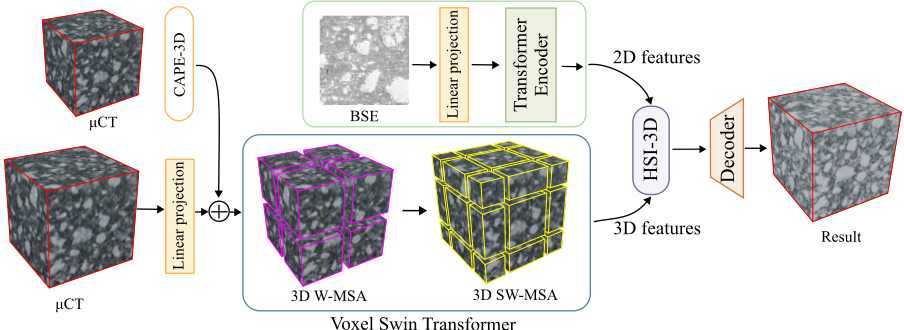
This paper proposes a 3D BSE microstructural image cross-device generation method from µCT (i.e., CT2BSE) for cement hydration via Voxel Swin Transformer. Specifically, a Voxel Swin Transformer incorporating CAPE-3D is proposed to enable more effective feature extraction from 3D µCT volumes for cement hydration, in which CAPE-3D replaces the conventional 3D relative position bias. Subsequently, a Holistic Style Injector-3D (HSI-3D) is proposed to fuse the 3D µCT features with the 2D BSE characteristics. Finally, the fused features are decoded into 3D volumes that are aligned with the BSE style while preserving the original microstructure through the optimization of composite content and style losses. The main contributions of this paper are summarized as follows:
- For the first time a 3DBSEmicrostructural image crossdevice generation method is proposed based on µCT and computational imaging.
- A Voxel Swin Transformer with CAPE-3D is proposed as an efficient 3D feature extractor, which addresses structural preservation in homogeneous images and alleviates the temporal inconsistency encountered in conventional frame-wise streaming processing.
- For the first time, 3D BSE images of cement hydration microstructure are constructed by transferring BSE style into µCT data, yielding high-fidelity and texture-rich 3D microstructural representations for cementitious materials.
- The HSI-3D is proposed to fuse multidimensional feature information and alleviate feature instability caused by the extreme intensity variations typically exhibited in cement images.
2 RelatedWorks
2.1 Style Transfer for Image and Video
Since Gatys et al. proposed neural style transfer using convolutional neural networks[Gatys et al., 2016], the field of arbitrary style transfer has experienced rapid development. A variety of generative-model-based approaches have subsequently been proposed, including methods based on variational autoencoders (VAEs) [Huang et al., 2023], generative adversarial networks (GANs) [Azadi et al., 2018; Xu et al., 2021; Mukherkjee et al., 2022], Transformers [Wu et al., 2021; Deng et al., 2022], and, more recently, diffusion models [Zhang et al., 2023; Wang et al., 2023; Chung et al., 2024].
Ruder et al. first proposed video style transfer [Ruder et al., 2016], which can be regarded as a natural extension of 2D style transfer to sequential data. However, the frame-byframe processing method will lead to temporal inconsistency issues. Consequently, subsequent studies have focused on enforcing temporal consistency through optical flow, temporal regularization, or spatiotemporal modeling [Wang et al., 2020; Huang et al., 2017]. These approaches have demonstrated strong capabilities in modeling complex style distributions and generating visually plausible results across diverse image domains.
2.2 Image-Based Cement Research
Image-based approaches are extensively employed in cement research[Saseendran et al., 2024; Kim et al., 2024; Wang et al., 2025], encompassing both µCT and BSE imaging modalities. BSE images are commonly used in conjunction with EDS to analyze phase information[Wang et al., 2025; Mao et al., 2025]. µCT images are used for in situ observation and performance evaluation[Miarka et al., 2024; Kim et al., 2024]. Both imaging modalities provide essential data foundations for cement research.
3 Method
3.1 Overall Framework
The overall architecture of CT2BSE is illustrated in Fig. 1, following an encoder-fusion-decoder paradigm. The µCT volume Ic ∈ RB×C×D×H×W serves as the content input, with the Voxel Swin Transformer efficiently extracting volumetric content features. The BSE image Is ∈ RB×C×H′×W ′ serves as the style input, and a Vision Transformer encoder is employed to obtain 2D style features.
For multidimensional feature fusion, the HSI-3D [Zhang et al., 2025] is proposed. The extracted 3D feature map Fc ∈ RB×C× D8 × H8 × W8 and the 2D feature map Fs ∈ RB×C× H′ 8 × W ′ 8 are fused through this novel attention-based transformation module with linear computational complexity. This module aligns and merges the content and style representations, producing the fused feature Fo ∈ RB×C× D8 × H8 × W8 .
A 3D convolution-based decoder, equipped with volumetric upsampling, subsequently reconstructs the output at the original spatial resolution, enabling stable cross-device translation.
3.2 Voxel Swin Transformer
The 3D images of cement hydration microstructure exhibit two fundamental characteristics. First, their volumetric size is extremely large, which imposes substantial memory and computational burdens on models based on conventional 3D convolutions or attention mechanisms. Second, the inherent homogeneity within the hydrated cement microstructure increases the difficulty of effective feature extraction. Consequently, efficient 3D representation learning for such data must simultaneously ensure computational feasibility and robustness to structural redundancy.
The Swin Transformer[Liu et al., 2021] is an improved variant of the Transformer architecture that discards global self-attention in favor of computing attention within predefined local windows. Its central idea is to restrict selfattention to these partitioned windows rather than performing global computation, thereby substantially reducing the overall computational complexity. The introduction of shifted windows further enables information exchange across neighboring regions, allowing the model to approximate the effect of global attention while maintaining significantly lower resource requirements. The Video Swin Transformer expands the architecture into a 3D version, enabling the extraction of features from 3D inputs.
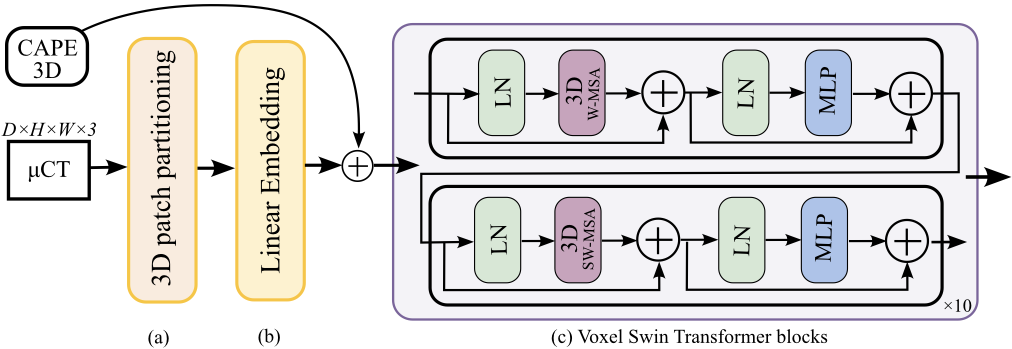
As illustrated in Figs. 2 and 3, the Voxel Swin Transformer has the following key characteristics. First, it adopts the 3D shifting-window mechanism from the Video Swin Transformer [Liu et al., 2022], enabling self-attention computation within local 3D regions and significantly reducing computational cost. Second, CAPE-3D is designed to replace the original 3D relative position bias, thereby preserving the structural skeleton before and after the enhancement. Third, the patch merging layers used in the Video Swin Transformer are removed to ensure that the number of tokens remains constant throughout the entire feature extraction process.
where Z l-1 denotes the input to the (l - 1)-th Swin Transformer-3D block, LN represents Layer Normalization, and 3D W-MSA refers to the 3D window-based multi-head self-attention module. The 3D SW-MSA indicates the multihead self-attention computed using shifted 3D windows. FFN denotes the feed-forward network.
3.3 CAPE-3D
Content-Aware Positional Encoding, originally introduced in StyTR-2 [Deng et al., 2022], is a positional encoding mechanism that has been shown to effectively preserve structural layouts in various style transfer tasks. For cement hydration microstructure, which is characterized by strong homogeneity, training instability frequently occurs, including mode collapse and undesirable alterations of the underlying skeletal structure. Such deviations may result in enhanced images that are no longer regarded as originating from the same physical object. To address this issue, the 3D relative position bias employed in the original Video Swin Transformer is discarded in the Voxel Swin Transformer, while CAPE is extended to a 3D formulation and incorporated instead. The computation pro-
where E denotes the input 3D tensor, AvgPooln×n×n represents the adaptive 3D average pooling operator, and Fpos denotes the 1×1 convolution used for positional feature transformation. The resulting positional encoding is subsequently upsampled to the original spatial dimensions through interpolation.
3.4 HSI-3D
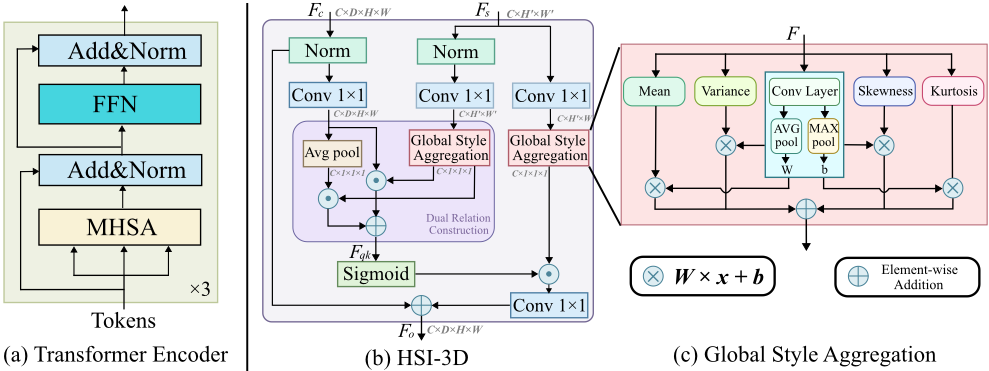
Zhang et al. proposed the Holistic Style Injector [Zhang et al., 2025], a 2D feature fusion mechanism that replaces the standard QK matrix multiplication with a Dual Relation Construction operator. This design mitigates over-attention to localized style regions, improves visual consistency, and reduces computational complexity to linear scale.
As illustrated in Fig. 3, the feature fusion requirement in this study involves aligning 3D content representations with 2D style representations. To this end, HSI is adapted into a 3D-compatible formulation, denoted as HSI-3D, with architectural modifications that enable its operation on volumetric inputs. Specifically, Fc denotes the 3D feature representation and Fs denotes the 2D feature representation. The query, key, and value tensors are constructed as Q = Conv(Norm(Fc)), K = Conv(Norm(Fs)), and V = Norm(Fs), respectively. Global context descriptors are obtained by Qc = AvgPooling(Q) and (Ks, Vs) are produced by applying the global style aggregator GSA to K and V , respectively. The overall computation is formulated as follows:
where ⊙ and ⊕ denote element-wise multiplication and element-wise addition with broadcasting, respectively. Unlike the original HSI formulation, the definition of the fusion coefficient λg for integrating 3D features is modified as follows:
In the Global Style Aggregation (GSA) module, four color moment statistics of the input features are computed and subsequently integrated through a dynamic network [Jia et al., 2016], which aggregates these moment descriptors into a unified style representation.
3.5 Loss Function
Content loss and style loss are widely used objectives in 2D style transfer, typically constructed from feature activations extracted at multiple layers of a pre-trained VGG network[Simonyan and Zisserman, 2014]. In this study, the generated 3D output is randomly sliced along the three orthogonal axes. For each sampled slice, the content loss is computed against the corresponding slice of the µCT image, while the style loss is computed against the BSE image. The detailed formulation is given as follows:
where Ic denotes a slice extracted from the µCT volume, and Io denotes the corresponding slice extracted from the generated 3D output. ϕi(·) denotes features extracted from the i-th layer in a pretrained VGG and Nl is the number of layers.
where Is denotes the 2D BSE image. µ(·) and σ(·) denote the mean and variance of extracted features, respectively.
In addition to the full-slice content and style losses, CT2BSE is designed to enhance the fidelity of fine-scale textural details in the generated results. To this end, for each randomly sampled slice, two additional cropped regions-corresponding to 14 and 18 of the original slice size-are extracted at randomly selected locations [Galerne et al., 2025]. Content and style losses are then computed using the same cropped locations from the µCT slice and the BSE image. The overall loss formulation is summarized as follows:
where λs denotes the weighting coefficient associated with each spatial scale, and ↓ 2i indicates that the image is randomly cropped to a region whose size is reduced to 1 2i of the original slice.
4 Experiments
4.1 Settings
The training and evaluation of the proposed model require two data modalities: µCT volumes and BSE images. In 2022, a set of high-quality µCT scans of cement hydration microstructure was acquired in the laboratory, with a voxel resolution of 3.5µm/pixel. Each volume has a spatial resolution of 1305 × 1305 × 1164. Corresponding BSE surface images of the same cement specimens were also collected at magnification levels of 35×, 100×, 200×, 400×, and 600×.
During training, two µCT volumes were randomly selected and cropped into 128 sub-volumes of size 256 × 256 × 256. Among them, three sub-images are randomly selected as test samples. For the BSE modality, all images captured at 200× magnification were used, each cropped into patches of size 256 × 256. Three BSE patches covering a range from darker to brighter tonal characteristics were selected as the test set. The model was implemented using the PyTorch framework and optimized with the Adam optimizer. Training was performed on an NVIDIA A100 GPU (80 GB), requiring approximately 12 hours to achieve satisfactory convergence.
4.2 Results of CT2BSE on Different Samples
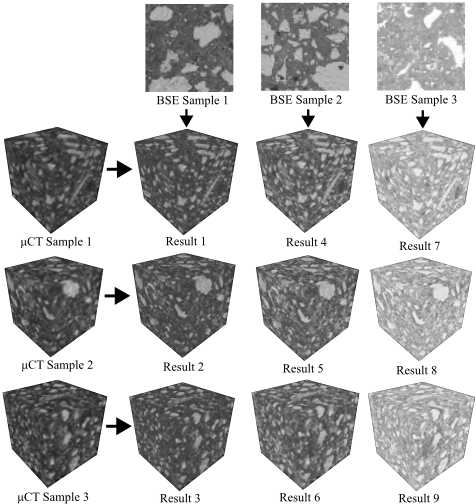
Fig. 4 presents the combinatorial results obtained from three µCT test samples and three BSE test samples. As expected, because the selected BSE images are arranged from dark to bright, the corresponding outputs exhibit a consistent progression in brightness. This demonstrates that the style characteristics inherent to the BSE modality are effectively transferred to the µCT images.
The enhanced results effectively mitigate common µCT artifacts, including local blurring and ambiguous phase boundaries, while substantially improving structural clarity and inter-phase contrast. Compared with the raw µCT images, the generated results exhibit clearer particle interiors, more pronounced unhydrated clinker phases, and more reliable phase discrimination. Meanwhile, the outputs closely resemble BSE images in tonal distribution and texture, consistently preserving characteristic granular features and bright-particle responses, leading to a more vivid and well-defined representation of the cement hydration microstructure.
4.3 Comparison with 2DMethods
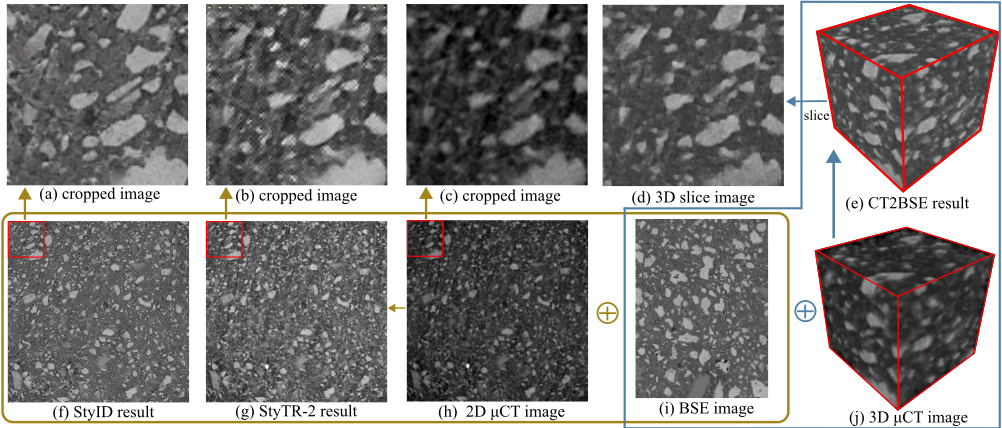
In the 2D baseline setting, StyTR-2 and StyleID are selected. As shown in Fig. 5, StyTR-2 and StyleID take a single 2D µCT image as input, whereas CT2BSE processes a full 3D microstructural volume that contains the corresponding 2D surface. Using the same BSE image as the style reference for both methods, subfigures (f) and (g) present baselines stylized outputs and subfigures (e) present CT2BSE output. For a fair comparison, a cropped region from the upper-left corner is extracted from the 2D output, while for the 3D model the slice corresponding to the same 2D surface is extracted to form subfigures (a), (b) and (d). A comparison between subfigures (a), (b) and (d) reveals that, although the 2D method performs reasonably well at a global scale, its fine-scale structures degrade significantly after cropping, exhibiting noticeable detail collapse. In contrast, the 2D slice derived from our 3D model preserves substantially clearer and more coherent microstructural details. This demonstrates the superiority of the proposed approach, particularly in maintaining structural fidelity at microscopic scales.
4.4 Multi-perspective Analysis
Traditional style-transfer pipelines often attempt to achieve 3D enhancement by independently applying 2D style transfer to each slice and subsequently stacking the outputs. However, this strategy inevitably introduces discontinuities between adjacent slices, leading to abrupt frame-to-frame variations that compromise the spatial coherence of the reconstructed 3D volume.
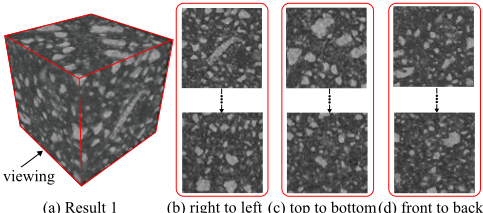
In contrast, CT2BSE directly models the 3D input as a volumetric entity, thereby eliminating inter-slice inconsistency. As illustrated in Fig. 7, the three orthogonal views of Result 1 consistently preserve clear and continuous structural details across axes, without exhibiting the slice-jumping artifacts commonly observed in 2D-based approaches.
4.5 Quantitative Evaluation
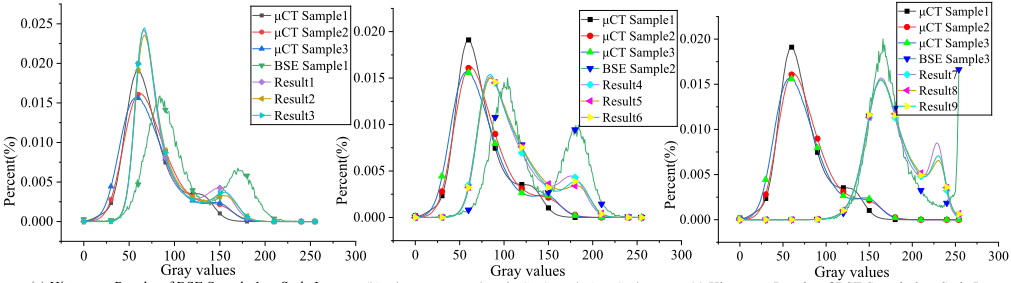
In typical cement images, the histogram often exhibits two dominant peaks corresponding to the unhydrated cement particles and the hydration products, respectively. By examining the horizontal positions of these peaks, one can infer the degree to which the stylization process reflects the characteristics of the target modality.
As shown in Fig. 6, subfigures (a), (b), and (c) illustrate the device-transfer results under BSE Samples 1, 2, and 3, respectively. Across all three BSE styles, the enhanced images show a clear shift of their peak positions toward the corresponding peaks of the BSE histograms. While the shift in (a) is relatively modest, the results in (b) and (c) achieve nearcomplete alignment: the second peak representing hydration products in (b), and the first peak corresponding to unhydrated cement particles in (c), both match closely with the peak positions of the respective BSE references. This alignment indicates that the device-transfer outputs successfully capture the statistical characteristics associated with the BSE imaging modality.
4.6 Ablation Experiment
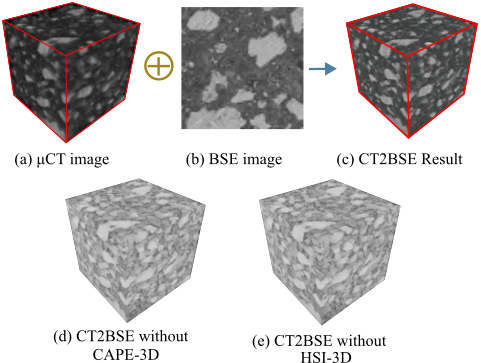
To further validate the effectiveness of the proposed HSI-3D and CAPE-3D modules, we design two complementary ablation experiments. Specifically, we compare the proposed HSI-3D with the classical AdaIN module by replacing HSI3D with AdaIN, and we also evaluate the impact of retaining the 3D relative position bias instead of using CAPE-3D.
For HSI-3D, as shown in subfigure (e) of Fig. 8, this variant fails to preserve the style characteristics of the BSE images. The underlying reason is that BSE images may contain large bright regions, resulting in extreme mean and variance values during training. These unstable statistics propagate through the decoder, causing undesirable and inconsistent stylization artifacts.
For CAPE-3D, as shown in subfigure (d) of Fig. 8, replacing CAPE-3D with the original 3D relative position bias of Swin Transformer leads to degraded stylization quality. This observation further confirms the necessity of CAPE-3D in maintaining stable and coherent style transfer within the 3D setting.
5 Conclusion
This paper proposes CT2BSE, which can cross-device generate 3D BSE microstructural images from µCT. A Voxel Swin Transformer equipped with CAPE-3D is proposed to efficiently extract 3D features while preserving the original microstructural content of cement hydration. Furthermore, a multidimensional feature fusion module is proposed to mitigate feature instability caused by the extreme grayscale variations inherent in cement images. Ultimately, high-fidelity 3D BSE images of cement hydration are cross-device generated from µCT to BSE using computational imaging paradigm.
However, CT2BSE requires substantial GPU memory, with the training process consuming 79,013 MiB out of 81,920 MiB. In future work, we plan to reduce the model size through knowledge distillation to make it more adaptable to a wider range of scenarios.
Acknowledgements
This work was supported by the National Natural Science Foundation of China (Grant No. 62403209); the Shandong Provincial Natural Science Foundation (Grant No. ZR2024QF021); the Research Project of Quancheng Laboratory under (Grant No. QCL20250304, QCL20250303); the Youth Innovation Team Program of Shandong Higher Education Institutions, China (Grant No. 2024KJH104); the University of Jinan Young Faculty Interdisciplinary Convergence Development Project2025 (XKJC-202507); the National Natural Science Foundation of China (Grant No. 61872419); the Shandong Provincial Natural Science Foundation (Grant Nos. ZR2022ZD02, ZR2023LZH015); "New 20 Rules for University"Program of Jinan City (Grant No. 202534127); the Natural Science Foundation of Shandong Province Computational Intelligence (Grant No. SDCI202404); the Key Research and Development Program of Shandong Province (Grant No. 2024CXPT084); the National "Challenge-Based" Major Science and Technology Project in the Building Materials Industry (Project No. 2023JBGS11-03); and the Highperformance Computing Platform at University of Jinan.
@inproceedings{ijcai2026p124,
  title     = {CT2BSE: 3D BSE Microstructural Image Cross-Device Generation from µCT for Cement Hydration via Voxel Swin Transformer},
  author    = {Gao, Haozhong and Zhang, Liangliang and Han, Yamin and Han, Ruiqi and Wang, Lin and Yang, Bo},
  booktitle = {Proceedings of the Thirty-Fifth International Joint Conference on
               Artificial Intelligence, {IJCAI-26}},
  publisher = {International Joint Conferences on Artificial Intelligence Organization},
  editor    = {Diego Calvanese},
  pages     = {1106--1114},
  year      = {2026},
  month     = {8},
  note      = {Main Track},
  doi       = {10.24963/ijcai.2026/124},
  url       = {https://doi.org/10.24963/ijcai.2026/124},
}
TY - CPAPER TI - CT2BSE: 3D BSE Microstructural Image Cross-Device Generation from µCT for Cement Hydration via Voxel Swin Transformer AU - Gao, Haozhong AU - Zhang, Liangliang AU - Han, Yamin AU - Han, Ruiqi AU - Wang, Lin AU - Yang, Bo T2 - Proceedings of the Thirty-Fifth International Joint Conference on Artificial Intelligence, IJCAI-26 PB - International Joint Conferences on Artificial Intelligence Organization PY - 2026 SP - 1106 EP - 1114 DO - 10.24963/ijcai.2026/124 UR - https://doi.org/10.24963/ijcai.2026/124 ER -Copied
Machine-readable versions of this paper, for tools and AI agents:





