
VFM-Dynamo: Accurate Non-rigid Motion Identification via Vision Foundation Model for Self-supervised Monocular Depth Estimation
Proceedings of the Thirty-Fifth International Joint Conference on Artificial Intelligence. Main Track. Pages 1052-1060.
https://doi.org/10.24963/ijcai.2026/118
© 2026 International Joint Conferences on Artificial Intelligence
Keywords
- Computer Vision: Video analysis and understanding
- Computer Vision: Motion and tracking
- Computer Vision: Image and video synthesis and generation
- Computer Vision: Vision, language and reasoning
- Computer Vision: 3D computer vision
Abstract
Accurate identification of non-rigid motion is crucial for geometric validity in self-supervised monocular depth estimation (MDE), yet it remains challenging for current methods. Inspired by Human Visual Perception (HVP), we present VFM-Dynamo, an efficient self-supervised MDE framework that disambiguates non-rigid objects by combining a vision foundation model (VFM) such as Grounding DINO and SAM with coarse to fine motion identification strategy: 1) Integrating visual-textual feature dependencies, we activate the capability of Grounding DINO global understanding with text prompts to detect potential object bounding boxes. 2) We then estimate coarse motion mask from reprojection error and photometric consistency to separate static from dynamic content. This mask provides coarse guidance for constraining rigid flow in static regions through two analogous estimates aligned by a consistency loss, and it drives a non-dynamical suppression module that removes boxes associated with static objects. 3) The remaining boxes are used to prompt SAM to produce refined motion identification, which in turn guide the joint optimization of depth and optical flow. Additionally, due to foreground–background mixing, standard interpolation-based upsampling often produces boundary artifacts. We introduce a learnable neighbor affinity interpolation (LNAI) module, which directly upsamples depth to full resolution and can be seamlessly integrated as a plug-and-play component. Experiments on a series of benchmarks demonstrate that proposed framework achieves state-of-the-art performance among unsupervised methods. Code is available at https://github.com/Qianqian3764/VFM-Dynamo.
- [Bello et al., 2024] Juan Luis Gonzalez Bello, Jaeho Moon, and Munchurl Kim. Self-supervised monocular depth es- timation with positional shift depth variance and adaptive disparity quantization. IEEE Transactions on Image Pro- cessing, 33:2074-2089, 2024.
- [Bian et al., 2019] Jiawang Bian, Zhichao Li, Naiyan Wang, Huangying Zhan, Chunhua Shen, Ming-Ming Cheng, and Ian Reid. Unsupervised scale-consistent depth and ego- motion learning from monocular video. Advances in neu- ral information processing systems, 32, 2019.
- [Chang and Wang, 2025] Zhiyong Chang and Yan Wang. Monomixer: Marrying convolution and vision transformer for efficient self-supervised monocular depth estimation. In Proceedings of the Thirty-Fourth International Joint Conference on Artificial Intelligence, pages 756-764, 2025. IJCAI
- [Cordts et al., 2016] Marius Cordts, Mohamed Omran, Se- bastian Ramos, Timo Rehfeld, Markus Enzweiler, Rodrigo Benenson, Uwe Franke, Stefan Roth, and Bernt Schiele. The cityscapes dataset for semantic urban scene under- standing. In Proceedings of the IEEE conference on com- puter vision and pattern recognition, pages 3213-3223, 2016.
- [Dong et al., 2024] Yue-Jiang Dong, Fang-Lue Zhang, and Song-Hai Zhang. Mal: motion-aware loss with temporal and distillation hints for self-supervised depth estimation. In 2024 IEEE International Conference on Robotics and Automation (ICRA), pages 7318-7324. IEEE, 2024.
- [Eigen et al., 2014] David Eigen, Christian Puhrsch, and Rob Fergus. Depth map prediction from a single image using a multi-scale deep network. Advances in neural in- formation processing systems, 27, 2014.
- [Feng et al., 2022] Ziyue Feng, Liang Yang, Longlong Jing, Haiyan Wang, YingLi Tian, and Bing Li. Disentangling object motion and occlusion for unsupervised multi-frame monocular depth. In European Conference on Computer Vision, pages 228-244. Springer, 2022.
- [Feng et al., 2025] Cheng Feng, Congxuan Zhang, Zhen Chen, Weiming Hu, Ke Lu, and Liyue Ge. Self-supervised monocular depth estimation with dual-path encoders and offset field interpolation. IEEE Transactions on Image Processing, 2025.
- [Geiger et al., 2013] Andreas Geiger, Philip Lenz, Christoph Stiller, and Raquel Urtasun. Vision meets robotics: The kitti dataset. Int. J. Robot. Res., 32(11):1231-1237, 2013.
- [Godard et al., 2017] Clément Godard, Oisin Mac Aodha, and Gabriel J Brostow. Unsupervised monocular depth es- timation with left-right consistency. In Proc. IEEE Conf. Comput. Vis. Pattern Recognit., pages 270-279, 2017.
- [Godard et al., 2019] Clément Godard, Oisin Mac Aodha, Michael Firman, and Gabriel J Brostow. Digging into self- supervised monocular depth estimation. In Proc. IEEE Int. Conf. Comput. Vis, pages 3828-3838, 2019.
- [Goli et al., 2025] Lily Goli, Sara Sabour, Mark Matthews, Marcus A Brubaker, Dmitry Lagun, Alec Jacobson, David J Fleet, Saurabh Saxena, and Andrea Tagliasacchi. Romo: Robust motion segmentation improves structure from motion. In Proceedings of the IEEE/CVF Interna- tional Conference on Computer Vision, pages 6155-6164, 2025.
- [Guizilini et al., 2020] Vitor Guizilini, Rares Ambrus, Sudeep Pillai, Allan Raventos, and Adrien Gaidon. 3d packing for self-supervised monocular depth estimation. In Proceedings of the IEEE/CVF conference on computer vision and pattern recognition, pages 2485-2494, 2020.
- [Hu et al., 2024] Xueting Hu, Ce Zhang, Yi Zhang, Bowen Hai, Ke Yu, and Zhihai He. Learning to adapt clip for few-shot monocular depth estimation. In Proceedings of the IEEE/CVF Winter Conference on Applications of Com- puter Vision, pages 5594-5603, 2024.
- [Kirillov et al., 2023] Alexander Kirillov, Eric Mintun, Nikhila Ravi, Hanzi Mao, Chloe Rolland, Laura Gustafson, Tete Xiao, Spencer Whitehead, Alexander C Berg, Wan-Yen Lo, et al. Segment anything. In Pro- ceedings of the IEEE/CVF international conference on computer vision, pages 4015-4026, 2023.
- [Klingner et al., 2020] Marvin Klingner, Jan-Aike Termöhlen, Jonas Mikolajczyk, and Tim Fingscheidt. Self-supervised monocular depth estimation: Solving the dynamic object problem by semantic guidance. In Com- puter Vision-ECCV 2020: 16th European Conference, Glasgow, UK, August 23-28, 2020, Proceedings, Part XX 16, pages 582-600. Springer, 2020.
- [Lee et al., 2021] Seokju Lee, Sunghoon Im, Stephen Lin, and In So Kweon. Learning monocular depth in dynamic scenes via instance-aware projection consistency. In Pro- ceedings of the AAAI conference on artificial intelligence, volume 35, pages 1863-1872, 2021.
- [Liu et al., 2019] Liang Liu, Guangyao Zhai, Wenlong Ye, and Yong Liu. Unsupervised learning of scene flow esti- mation fusing with local rigidity. In IJCAI, pages 876-882, 2019. IJCAI
- [Liu et al., 2024a] Jinfeng Liu, Lingtong Kong, Bo Li, Ze- rong Wang, Hong Gu, and Jinwei Chen. Mono-vifi: A unified learning framework for self-supervised single and multi-frame monocular depth estimation. In Proc. Eur. Conf. Comput. Vis., pages 90-107, 2024.
- [Liu et al., 2024b] Shilong Liu, Zhaoyang Zeng, Tianhe Ren, Feng Li, Hao Zhang, Jie Yang, Qing Jiang, Chunyuan Li, Jianwei Yang, Hang Su, et al. Grounding dino: Mar- rying dino with grounded pre-training for open-set object detection. In European conference on computer vision, pages 38-55. Springer, 2024.
- [Miao et al., 2023] Xingyu Miao, Yang Bai, Haoran Duan, Yawen Huang, Fan Wan, Xinxing Xu, Yang Long, and Yefeng Zheng. Ds-depth: Dynamic and static depth es- timation via a fusion cost volume. IEEE Transactions on Circuits and Systems for Video Technology, 2023.
- [Radford et al., 2021] Alec Radford, Jong Wook Kim, Chris Hallacy, Aditya Ramesh, Gabriel Goh, Sandhini Agar- wal, Girish Sastry, Amanda Askell, Pamela Mishkin, Jack Clark, et al. Learning transferable visual models from nat- ural language supervision. In International conference on machine learning, pages 8748-8763. PmLR, 2021.
- [Shao et al., 2024] Shuwei Shao, Zhongcai Pei, Weihai Chen, Dingchi Sun, and Peter CY Chen. Monodiffusion: self-supervised monocular depth estimation using diffu- sion model. IEEE Trans. Circuits Syst. Video Technol., 35(4):3664-3678, 2024.
- [Son and Lee, 2024] Eunjin Son and Sang Jun Lee. Cabins: Clip-based adaptive bins for monocular depth estimation. In Proceedings of the IEEE/CVF Conference on Computer Vision and Pattern Recognition, pages 4557-4567, 2024.
- [Su et al., 2024] Jianlin Su, Murtadha Ahmed, Yu Lu, Shengfeng Pan, Wen Bo, and Yunfeng Liu. Roformer: En- hanced transformer with rotary position embedding. Neu- rocomputing, 568:127063, 2024.
- [Sun and Hariharan, 2023] Yihong Sun and Bharath Hariha- ran. Dynamo-depth: Fixing unsupervised depth estima- tion for dynamical scenes. Advances in Neural Informa- tion Processing Systems, 36:54987-55005, 2023.
- [Sun and Hariharan, 2024] Yihong Sun and Bharath Hariha- ran. Dynamo-depth: fixing unsupervised depth estimation for dynamical scenes. Advances in Neural Information Processing Systems, 36, 2024.
- [Sun et al., 2018] Deqing Sun, Xiaodong Yang, Ming-Yu Liu, and Jan Kautz. Pwc-net: Cnns for optical flow using pyramid, warping, and cost volume. In Proc. IEEE Conf. Comput. Vis. Pattern Recognit., pages 8934-8943, 2018.
- [Sun et al., 2023] Libo Sun, Jia-Wang Bian, Huangying Zhan, Wei Yin, Ian Reid, and Chunhua Shen. Sc-depthv3: Robust self-supervised monocular depth estimation for dy- namic scenes. IEEE Transactions on Pattern Analysis and Machine Intelligence, 2023.
- [Uhrig et al., 2017] Jonas Uhrig, Nick Schneider, Lukas Schneider, Uwe Franke, Thomas Brox, and Andreas Geiger. Sparsity invariant cnns. In 2017 international con- ference on 3D Vision (3DV), pages 11-20. IEEE, 2017.
- [Watson et al., 2021] Jamie Watson, Oisin Mac Aodha, Vic- tor Prisacariu, Gabriel Brostow, and Michael Firman. The temporal opportunist: Self-supervised multi-frame monocular depth. In Proc. IEEE Conf. Comput. Vis. Pat- tern Recognit., pages 1164-1174, 2021.
- [Woo et al., 2024] Sungmin Woo, Wonjoon Lee, Woo Jin Kim, Dogyoon Lee, and Sangyoun Lee. Prodepth: Boost- ing self-supervised multi-frame monocular depth with probabilistic fusion. In Proc. Eur. Conf. Comput. Vis., pages 201-217, 2024.
- [Wu et al., 2025] Haifeng Wu, Shuhang Gu, Lixin Duan, and Wen Li. Geodepth: From point-to-depth to plane-to-depth modeling for self-supervised monocular depth estimation. In Proceedings of the Computer Vision and Pattern Recog- nition Conference, pages 11525-11535, 2025.
- [Xia et al., 2024] Weihao Xia, Raoul De Charette, Cengiz Oztireli, and Jing-Hao Xue. Dream: Visual decoding from reversing human visual system. In Proceedings of the IEEE/CVF Winter Conference on Applications of Com- puter Vision, pages 8226-8235, 2024.
- [Yin and Shi, 2018] Zhichao Yin and Jianping Shi. Geonet: Unsupervised learning of dense depth, optical flow and camera pose. In Proceedings of the IEEE conference on computer vision and pattern recognition, pages 1983- 1992, 2018.
- [Zhang et al., 2022] Renrui Zhang, Ziyao Zeng, Ziyu Guo, and Yafeng Li. Can language understand depth? In Pro- ceedings of the 30th ACM International Conference on Multimedia, pages 6868-6874, 2022.
- [Zhang et al., 2023] Ning Zhang, Francesco Nex, George Vosselman, and Norman Kerle. Lite-mono: A lightweight cnn and transformer architecture for self-supervised monocular depth estimation. In Proceedings of the IEEE/CVF conference on computer vision and pattern recognition, pages 18537-18546, 2023.
- [Zhang et al., 2025a] Mengtan Zhang, Yi Feng, Qijun Chen, and Rui Fan. Dcpi-depth: Explicitly infusing dense corre- spondence prior to unsupervised monocular depth estima- tion. IEEE Transactions on Image Processing, 2025.
- [Zhang et al., 2025b] Wenyao Zhang, Hongsi Liu, Bohan Li, Jiawei He, Zekun Qi, Yunnan Wang, Shengyang Zhao, Xinqiang Yu, Wenjun Zeng, and Xin Jin. Hybrid-grained feature aggregation with coarse-to-fine language guidance for self-supervised monocular depth estimation. In Pro- ceedings of the IEEE/CVF International Conference on Computer Vision, pages 6678-6692, 2025.
- [Zhao et al., 2022] Chaoqiang Zhao, Youmin Zhang, Mat- teo Poggi, Fabio Tosi, Xianda Guo, Zheng Zhu, Guan Huang, Yang Tang, and Stefano Mattoccia. Monovit: Self- supervised monocular depth estimation with a vision trans- former. In Proc. IEEE Int. Conf. 3D Vis., pages 668-678. IEEE, 2022.
- [Zheng et al., 2025] Heyuan Zheng, Yunji Liang, Lei Liu, and Zhiwen Yu. Diffsql: leveraging diffusion model for zero-shot self-supervised monocular depth estimation. In Proceedings of the Thirty-Fourth International Joint Con- ference on Artificial Intelligence, pages 8823-8831, 2025. IJCAI
- [Zhou et al., 2017] Tinghui Zhou, Matthew Brown, Noah Snavely, and David G Lowe. Unsupervised learning of depth and ego-motion from video. In Proc. IEEE Conf. Comput. Vis. Pattern Recognit., pages 1851-1858, 2017.
- [Zhou et al., 2025] Kaichen Zhou, Jia-Wang Bian, Jian-Qing Zheng, Jiaxing Zhong, Qian Xie, Niki Trigoni, and Andrew Markham. Manydepth2: Motion-aware self- supervised monocular depth estimation in dynamic scenes. IEEE Rob. Autom. Lett., pages 1-8, 2025.
- [Zou et al., 2018] Yuliang Zou, Zelun Luo, and Jia-Bin Huang. Df-net: Unsupervised joint learning of depth and flow using cross-task consistency. In Proceedings of the European conference on computer vision (ECCV), pages 36-53, 2018.
References were extracted automatically from the PDF and may contain errors.
Full text extracted automatically from the PDF; figures, tables and equations may differ. The PDF is the version of record.
1 Introduction
Monocular depth estimation (MDE) plays a fundamental role in computer vision, with broad applications in autonomous navigation, augmented reality, and video analysis. Previous supervised methods requires ground-truth depth annotations for training, whose collection is expensive and timeconsuming. Consequently, self-supervised methods leverage synchronized stereo-pairs [Godard et al., 2017] or geometric constraints [Zhou et al., 2017] from monocular video as supervision signals, making monocular training more attractive.
* Corresponding author.
Current training pipeline of self-supervised MDE methods typically minimize geometry consistency loss to jointly estimate depth and camera pose [Godard et al., 2019; Chang and Wang, 2025; Zheng et al., 2025]. This pipeline relies on rigid geometric projection under static scene assumption. Despite overall high performance, the inconsistent geometric locations of moving objects lead to misaligned pixel matching, providing no longer valid supervision signals. To address this problem, a critical step is identifying dynamic objects from the rigid background. Several works leveraged semantic labels [Klingner et al., 2020; Lee et al., 2021; Dong et al., 2024], optical flow [Yin and Shi, 2018; Liu et al., 2019; Miao et al., 2023; Zhou et al., 2025], geometry consistency [Bian et al., 2019; Godard et al., 2019] or the discrepancy between single-frame and multi-frame depth [Watson et al., 2021; Woo et al., 2024] to discern dynamic objects. However, semantic labels involve needless static objects whereas geometry/discrepancy-induced methods fail to guarantee the accuracy in modeling dynamic objects. More fundamentally, motion identification is a complex and challenging problem that has been studied for decades, but there are still open questions [Goli et al., 2025].
Recent research in object identification has been transformative, with the vision foundation model (VFM) such as Grounding DINO [Liu et al., 2024b] and SAM [Kirillov et al., 2023] emerging as a significant breakthrough. However, both of them face identification challenges if objects are momentarily motionless, and in distinguishing foreground objects from background 'noise'. This naturally raises the question:"Can we leverage the power of VFM for non-rigid moving object identification and advance self-supervised MDE ?"
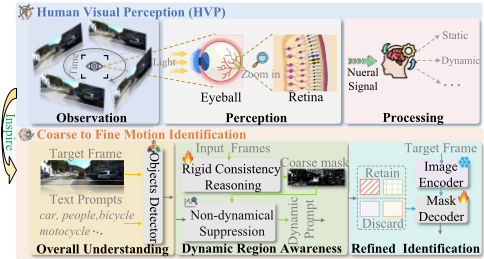
As shown in Figure 1, we propose VFM-Dynamo, a progressive motion identification pipeline inspired by Human Visual Perception (HVP) for self-supervised MDE, which simulates HVP process and effectively tailors VFM from global perception to fine-grained attention. Specifically, as in early HVP stages, by computing cross-modal correlations between visual features and text embeddings, we first drive Grounding DINO to derive reliable object boxes, achieving global perception of potential moving objects. Second, we design rigid consistency reasoning to derive coarse motion clues, acting as a selector of moving regions within a frame. This strategy decouples rigid flow in two different manners and penalizes the inconsistency in the predicted rigid flow between them, indirectly providing sufficient regularization for dynamic objects. We then introduce non-dynamical suppression, which leverages coarse motion identification to filter out static object boxes. Finally, the remaining dynamic object boxes serve as prompts for SAM to refine motion identification, further optimizing the joint training of depth and optical flow network. In addition, aim to alleviates the edge-blurring problem in the traditional upsampling method, we leverage the spatial coherence in neighbor pixels and propose a learnable neighbor affinity interpolation (LNAI) module to estimate the interpolation pixels from a lower resolution directly. The main contributions of our work are summarized as follows:
- To the best of our knowledge, our framework is the first work that tailors VFM for accurately non-rigid motion identification in self-supervised MDE. Inspired by HVP, our approach introduces a coarse to fine learning framework that leverages the advantage of VFM and flow to mitigate motion bias in training process.
- We propose an upsampling strategy that is compatible with existing self-supervised MDE pipelines and achieves significant performance improvements.
- We evaluate VFM-Dynamo framework on a serious of widely used datasets and establish a new state-of-the-art performance in dynamic areas.
2 RelatedWork
Self-Supervised Depth Estimation. Self-supervised methods mitigate the reliance on expensive 3D sensors and compute geometric consistency between stereo images [Godard et al., 2017] and monocular video frames [Zhou et al., 2017] for training. Since Monodepth2 [Godard et al., 2019] suggested a new benchmark with minimum reprojection loss, many advances adopt its methodology to improve depth predictions.
MonoMixer [Chang and Wang, 2025] compensated for the limited receptive field of convolutions with Transformer, improving performance while maintaining a lightweight architecture. DiffSQL [Zheng et al., 2025] leveraged the generative priors of stable diffusion for feature augmentation. Mono-ViFI [Liu et al., 2024a] incorporated a flow-based video frame interpolation model for temporal augmentation. Dynamic Scenes. To address the inaccurate training signals in dynamic scenes, identifying non-rigid motion from the rigid background is an essential step. MonoDepth2 [Godard et al., 2019] introduced an auto-masking for moving objects. SC-Depth [Bian et al., 2019] and SC-DepthV3 [Sun et al., 2023] derived motion segmentation from the proposed self-discovered mask. SGDepth [Klingner et al., 2020] and DynamicDepth [Feng et al., 2022] employed precomputed segmentation masks to identify objects. DFNet [Zou et al., 2018] and [Liu et al., 2019] achieved this through the forward-backward consistency and rigidity reasoning of optical flow. Dynamo-Depth [Sun and Hariharan, 2023] jointly learned depth, optical flow, and motion segmentation to disambiguate dynamic motion. ManyDepth [Watson et al., 2021] and ProDepth [Woo et al., 2024] exploited the inconsistency between single-frame and multi-frame depth. While these methods are insightful, the reliance on expensive semantic labels often includes irrelevant static objects, and other approaches struggle to accurately estimate the motion of all dynamic objects in the real world.
VFM-based Depth Estimation. VFM, such as visionlanguage models (VLMs) [Radford et al., 2021], Grounding DINO [Liu et al., 2024b] and SAM [Kirillov et al., 2023] are pre-trained on massive amounts of pairs of texts and images and has demonstrated powerful scene-reasoning abilities in computer vision tasks. DepthCLIP [Zhang et al., 2022] is a pioneering attempt that leveraged the pretrained knowledge of CLIP for zero-shot depth estimation. Furthermore, subsequent studies [Hu et al., 2024] and [Son and Lee, 2024] revealed that learnable prompts achieve better performance compared to manually designed templates. Hybriddepth [Zhang et al., 2025b] enhanced feature representation with aggregated multi-grained features from CLIP and DINO under contrastive language guidance. They are still limited to ambiguity introduced by the moving objects. Our work extends the robust VFM framework to non-rigid motion identification for self-supervised MDE by adapting it with coarse to fine framework and dynamic prompts.
3 Method
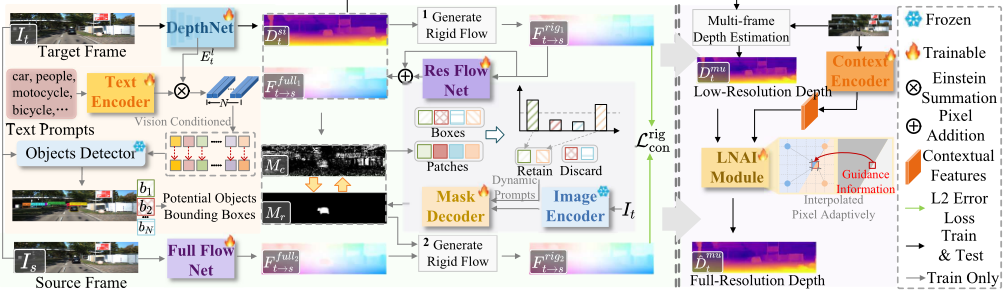
We focus on solving for the depth estimation in the dynamic scene observed from a moving camera. Figure 2 presents an overview of our method. In the following, we will describe specific components in details.
3.1 Motivation and Background
Unsupervised Depth and Optical Flow. Unsupervised depth and flow estimation both rely on photometric consistency between the synthesized image ˆ I and the original image I, formulated as:
where ρ is a measure of similarity calculated by L1 and SSIM, Θ is the model with learnable parameters.
Given a target image It and source image Is, s ∈ {t - 1, t + 1}, depth and optical flow synthesize image in fundamentally different ways. In terms of depth, the image ˆ I can be synthesized by predicted depth Dt and camera pose Tt→s:
where p is the pixel coordinates and K is camera intrinsics. In terms of optical flow, the image ˆ I can be synthesized by predicted flow field Ft→s:
In this case, optical flow reconstructs images via per-pixel motion warping, which naturally accommodates dynamic objects, whereas self-supervised depth estimation relies on rigid geometric projection/epipolar constraints, making it sensitive to violations caused by dynamic objects. Therefore, as optical flow is adept at tracking the movement of objects, this advantage motivates us to explore how such motion cues can be exploited during self-supervised depth training to provide effective regularization for dynamic regions.
Human Visual Perception. In visual cognition, humans tend to follow a global-to-local perception paradigm, in which a visual image is first perceived as an integrated whole and subsequently analyzed in terms of its constituent parts [Xia et al., 2024]. This observation motivates us to investigate whether we can mimic the staged process of HVP: global scene understanding to motion clues-driven region localization and refined non-rigid motion identification.
3.2 Coarse to Fine Motion Identification
To properly exploit the advantages of optical flow for dynamic objects, we reason rigid flow of static scene in two different manners and enforce consistency constraints between them. This process depends on accurate identification of moving objects, which is hindered by the complexity and time-varying nature of object motion. Inspired by HVP, we introduce VFM and design a coarse to fine motion identification strategy to effectively address this issue.
Overall Understanding. As in early HVP stages, we harness open-vocabulary 2D detector-Grounding DINO [Liu et al., 2024b] to access the overall scene understanding. Relevant text prompts, such as "car, people, motorcycle, bicycle,...," are defined and fed into trainable text encoder to output text embeddings T = [T1, ..., TN] ∈ RN×C . To ensure that the text embeddings are more similar to its corresponding visual features, text-visual similarity is computed as:
where El t ∈ RC×H×W is visual features from the last layer of DepthNet encoder. ⊗ is einstein summation over channel dimension. We normalize it along spatial dimension and aggregate visual features to derive text-guided visual features:
where E′t represents the aggregated visual features corresponding to each text token.
Finally, we adaptively update the text embeddings via a gated residual fusion:
where σ(·) denotes the sigmoid function. Then the vision conditioned text embeddings ˆ T are adopted to predict bounding boxes Bobj = {bi}Ni=1 for all referred objects.
Non-rigid Motion Awareness. We input It into the depth network D to estimate the depth Dsi t and concat It and Is as input to the PoseNet P, from which we estimate the relative camera pose Tt→s. Then the rigid flow that purely induced by the camera motion can be obtained:
where F rig1 t→s describes the motion of a rigid scene projected onto image plane. Afterwards, we cascade ResFlowNet R to learn non-rigid residual that capture object motion:
where ˆ I optr t denotes the synthesize image calculated by F rig1 t→s , The final full flow prediction F full1 t→s = F rig1 t→s +F non t→s . According to Equation 2 and 3, the synthetic image ˆ I d t and ˆ I opt t are reconstructed usingDsi t and F full1 t→s respectively, and then calculate the difference with the target image:
where α is set to 0.85. Instead of averaging differences over all source images, we use the minimum and predict coarse motion mask:
where [ ] is the Iverson bracket. In cases where binary mask Mc is 1 in regions considered to be dynamic, and 0 otherwise.
And then we predict the full flow F full2 t→s via concating and passing It and Is to a FullflowNet F. The rigid flow F rig2 t→s is computed in a manner gated by the motion mask Mc:
The consistency between the rigid optical flows generated from two distinct manners is enforced:
where ∥ ∥2 represents L2 norm.
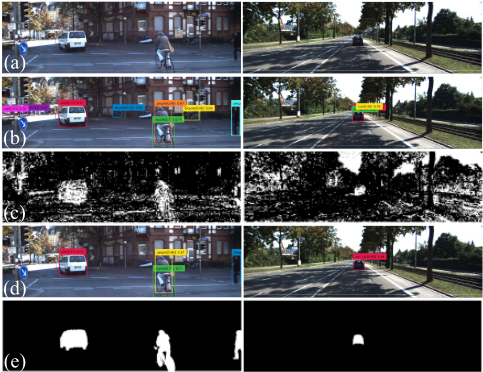
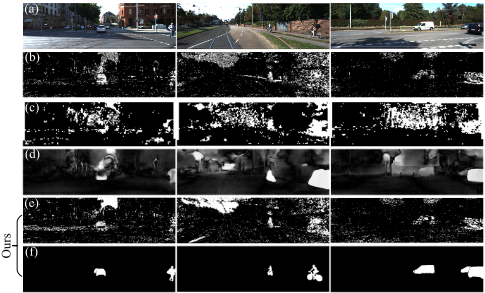
In real-world scenes, the prevalence of low-texture regions and frequent occlusions makes it difficult to strictly satisfy the aforementioned criteria in Equation 10. As shown in the third row of Figure 3, Mc inevitably contains substantial noise, preventing consistency constraint in Equation 12. SAM [Kirillov et al., 2023] is exploited to refine coarse motion cues and obtain accurate motion masks.
Refined Identification. With coarse motion mask Mc, we measure overlap ratio and suppress non-dynamical objects:
where |Ω(bi)| is the area of box bi, τ is the threshold and we set 0.45. Each candidate box bi, specified by its four corner coordinates, is evaluated by computing its overlap ratio over the enclosed patches in Mc.
Finally, we harness the dynamic bounding box to prompt SAM with a trainable mask decoder:
where Mr is the refined motion identification, which substitutes Mc to facilitate rigid consistency reasoning on more reliable static regions.
3.3 Learnable Neighbor Affinity Interpolation
Most existing methods upsample low-resolution predictions to full resolution using fixed interpolation schemes (e.g., nearest-neighbor and bilinear) which often result in boundary artifacts. To alleviate this problem, we propose a Learnable Neighbor Affinity Interpolation (LNAI) module.
After general multi-frame depth estimation, the regressed depth Dmu t ∈ RH×W×1 could be obtained. We extracted contextual features Ψ ∈ RH×W×C from target frame, where C = 144. Our interpolation step can be defined as:
where U denotes LANI module. ˆDmu t is interpolated full resolution depth and Dmu t is multi-frame depth at 14 -resolution.
As shown in Figure 4, we first enriched Ψ with RoPE [Su et al., 2024] positional embeddings and derive matrices Y1 and Y2 through projection layer:
For Y1 ∈ RH×W×144 , we divide the channels into 16 groups, with 9 channels in each group and reshape it to the size of HW × 16 × 1 × 9. Then for Y2 ∈ RH×W×144 , we similarly group the features along the channel dimension and reshape it into size of 16×9×H×W. Afterwards, we divide Y2 into HW ×16×9 local windows with the size of N ×N, and reshape it to the size of HW×16×9×N 2 , the neighbor affinity A can be computed as:
where k ∈ {1, 2, . . . ,HW} is the index of contextual features, g ∈ {1, 2, . . . , 16} is the index of feature group. n ∈
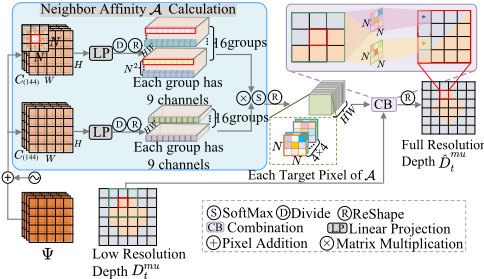
{1, 2, . . . ,N 2 } is the index of neighbors, l ∈ {1, 2, . . . , 9} is the index of channel within each group. xk,g,l and xg,n,l are the points in the local window Ω ∈ N 2 . Then we execute softmax on A and reshape it into size of N 2 ×4×4×H×W.
To align with the N × N affinity A, we divide Dmu t into HW local windows with the size of N ×N and reshape it to the size of N 2 × 1 × 1 × H ×W. After that, we yield full resolution depth:
where ⊕ is combination operation, each target interpolated pixel is weighted by a window that is not shared by another pixel. Finally, we reshape the full resolution depth to the size of 4H × 4W × 1.
3.4 Loss Functions
Flow Photometric Loss. We adopt the same measurement in Equation 9 to compute the photometric loss of full flow F f ull1 t→s and F full2 t→s :Lopt
Depth Loss. For single-frame depth Dsi t and multi-frame depth ˆDmu t , we similarly compute photometric loss and use smoothness loss [Godard et al., 2017] Lsm to regularize:
where µ is auto-mask [Godard et al., 2019] and γ = 0.001. Final Loss. In summary, the final loss function becomes a weighted sum of the above terms:
where Ldsi p and Ldmu p is the loss of Dsi t and ˆDmu t . λ1, λ2 and λ3 are the loss weights and we set 0.001, 0.1, 0.1 respectively.
4 Experiments
We evaluate our method on three challenging datasets: KITTI [Geiger et al., 2013], DDAD [Guizilini et al., 2020] and Cityscapes [Cordts et al., 2016]. We use standard metrics to measure model performance. For dynamic regions, we follow the protocol from SC-DepthV3 [Sun et al., 2023].
4.1 Datasets
KITTI. We adopt Eigen split [Eigen et al., 2014] of KITTI, comprising 39,810 training images and 4,424 validation images. The test set includes 697 raw LiDAR frames and 652 sparsity-corrected ground truth images [Uhrig et al., 2017]. Depth is capped at 80m and images are resized to 640 × 192. DDAD. DDAD is a challenging driving dataset with more dynamic objects. It contains 3,950 test frames, with depth capped at 200m and image resolution set to 640 × 384.
Cityscapes. Cityscapes is a benchmark designed for urban scene understanding, including a substantial number of dynamic objects and containing 1,525 test images. The depth range is capped at 80m and images are resized to 512 × 192.
4.2 Implementation Details
We use two NVIDIA RTX 3090 GPUs and Pytorch with batch size 6 for all training experiments. We employ the AdamW optimizer to minimize the loss functions and train the network for 20 epochs. For our baseline model, the DepthNet D follows the same architecture in [Zhao et al., 2022]. The remaining network components adopt the design of [Watson et al., 2021]. We unfreeze PWCNet [Sun et al., 2018] as FullflowNet F in our framework. ResFlowNet R follows the same architecture in [Miao et al., 2023] and a pre-trained ResNet18 is used as our context encoder. Other experimental settings are similar with [Watson et al., 2021].
4.3 Results on KITTI
As shown in Table 1, for raw data, compared with DiffSQL [Zheng et al., 2025], our Abs Rel and RMSE error improve 8.5% and 4.1%. Compared with motion focused method DualDepth [Feng et al., 2025], our Abs Rel error improves 5.5%. When compared with Mono-ViFI [Liu et al., 2024a], our method performs best on the Abs Rel, RMSElog, δ1, and δ2. Since Mono-ViFI leverages a pretrained flow-based video frame interpolation model during inference to capture temporal information, it requires access to future frames that are not yet observed when making current predictions. For dynamic areas, existing motion focused methods fail to sustain consistent performance and show performance drop while our method achieves state-of-the-art results. Moreover, since raw LiDAR data is not well suited for reliably evaluating performance in dynamic areas, we further assess our method using the sparsity-corrected ground truth [Uhrig et al., 2017]. VFM-Dynamo outperforms other comparison methods on almost metrics for both full image and dynamic areas.
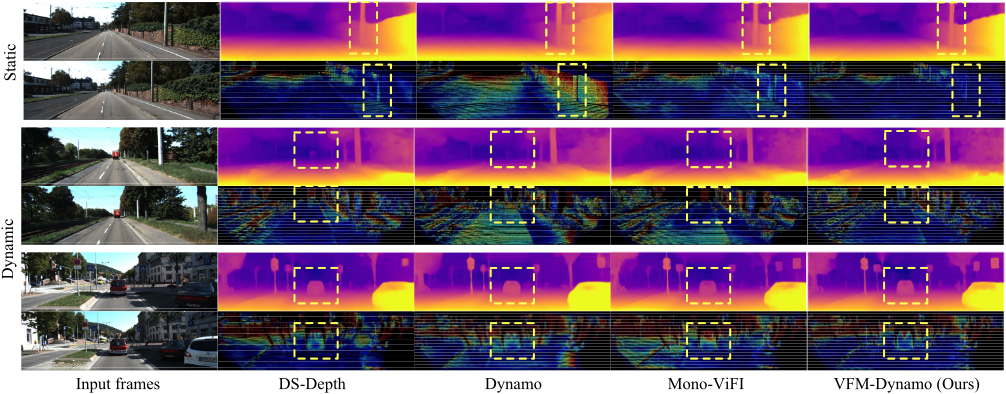
Qualitative results are shown in Figure 5, DS-Depth and Dynamo are two motion focused methods that utilize optical flow to introduce motion priors. The last two cases involve dynamic objects (yellow boxes), while comparison methods fail to estimate accurate depth. In the first case, our methods preserves noticeably sharper depth around object boundaries.
Figure 6 shows visual results for the two types of motion identification. MonoDepth2 [Godard et al., 2019] and ManyDepth [Watson et al., 2021] generate binary mask sometimes fails to (i) identify moving objects (e.g., missing car and cyclist in first two cases). ProDepth [Woo et al., 2024] produces soft mask but cannot (ii) distinguish between multiple objects (e.g., entangled car segmentation in the last case), while our method incorporates motion prior with dynamic prompts, resulting in the accurate identification of moving objects.
| Train | Full Image | ||||||||||||
|---|---|---|---|---|---|---|---|---|---|---|---|---|---|
| Method | Venue | Abs Rel ↓ | Sq Rel ↓ | RMSE ↓ | RMSElog↓ | δ1 ↑ | δ2 ↑ | δ3 ↑ | Abs Rel ↓ | Dynamic RMSE ↓ | δ1 ↑ | ||
| Raw GT | |||||||||||||
| NMF | Lite-Mono [Zhang et al., 2023] | CVPR'23 | M | 0.107 | 0.765 | 4.561 | 0.183 | 0.886 | 0.963 | 0.983 | 0.185 | 7.301 | 0.760 |
| SC-DepthV3 [Sun et al., 2023] | TPAMI'23 | M | 0.118 | 0.756 | 4.709 | 0.188 | 0.864 | 0.960 | 0.984 | 0.205 | - | 0.703 | |
| MonoDiffusion [Shao et al., 2024] | TCSVT'24 | M | 0.103 | 0.720 | 4.412 | 0.178 | 0.894 | 0.965 | 0.984 | 0.184 | 7.218 | 0.760 | |
| GeoDepth [Wu et al., 2025] | CVPR'25 | M | 0.100 | 0.694 | 4.381 | 0.176 | 0.897 | 0.966 | 0.984 | - | - | - | |
| Mono-ViFI [Liu et al., 2024a] | ECCV'24 | M | 0.091 | 0.589 | 4.088 | 0.166 | 0.912 | 0.969 | 0.986 | 0.188 | 7.247 | 0.746 | |
| DCPI-Depth [Zhang et al., 2025a] | TIP'25 | M | 0.095 | 0.662 | 4.274 | 0.170 | 0.902 | 0.967 | 0.985 | - | - | - | |
| Hybrid-depth [Zhang et al., 2025b] | ICCV'25 | M | 0.093 | 0.596 | 4.113 | 0.167 | 0.910 | 0.970 | 0.986 | - | - | - | |
| DiffSQL [Zheng et al., 2025] | IJCAI'25 | MS | 0.094 | 0.684 | 4.306 | 0.169 | 0.902 | 0.967 | 0.984 | - | - | - | |
| MF | Dynamo [Sun and Hariharan, 2023] | NIPS'23 | M | 0.112 | 0.758 | 4.505 | 0.183 | 0.873 | 0.959 | 0.984 | 0.211 | 7.314 | 0.713 |
| DS-Depth [Miao et al., 2023] | TCSVT'23 | M | 0.095 | 0.698 | 4.329 | 0.173 | 0.905 | 0.966 | 0.984 | 0.192 | 7.457 | 0.742 | |
| Manydepth2 [Zhou et al., 2025] | RAL'25 | M | 0.091 | 0.649 | 4.232 | 0.170 | 0.909 | 0.968 | 0.984 | 0.169 | 6.880 | 0.778 | |
| DualDepth [Feng et al., 2025] | TIP'25 | M | 0.091 | 0.703 | 4.215 | 0.171 | 0.911 | 0.967 | 0.984 | - | - | - | |
| VFM-Dynamo (Ours) | This paper | M | 0.086 | 0.642 | 4.129 | 0.165 | 0.916 | 0.971 | 0.986 | 0.165 | 6.740 | 0.780 | |
| Improved GT | |||||||||||||
| NMF | MonoDiffusion [Shao et al., 2024] | TCSVT'24 | M | 0.073 | 0.377 | 3.451 | 0.115 | 0.935 | 0.988 | 0.997 | 0.122 | 4.955 | 0.853 |
| AQUANet [Bello et al., 2024] | TIP'24 | M | 0.073 | 0.374 | 3.572 | 0.115 | 0.935 | 0.985 | 0.996 | - | - | - | |
| Mono-ViFI [Liu et al., 2024a] | ECCV'24 | M | 0.066 | 0.301 | 3.120 | 0.103 | 0.951 | 0.992 | 0.998 | 0.125 | 4.879 | 0.841 | |
| DiffSQL [Zheng et al., 2025] | IJCAI'25 | MS | 0.065 | 0.338 | 3.259 | 0.105 | 0.947 | 0.990 | 0.998 | - | - | - | |
| Dynamo [Sun and Hariharan, 2024] | NIPS'23 | M | 0.087 | 0.454 | 3.685 | 0.130 | 0.917 | 0.985 | 0.997 | 0.147 | 5.261 | 0.808 | |
| MF | DS-Depth [Miao et al., 2023] | TSCVT'23 | M | 0.067 | 0.358 | 3.303 | 0.108 | 0.946 | 0.989 | 0.997 | 0.130 | 5.252 | 0.831 |
| Manydepth2 [Zhou et al., 2025] | RAL'25 | M | 0.070 | 0.399 | 3.456 | 0.113 | 0.941 | 0.989 | 0.997 | 0.147 | 4.842 | 0.817 | |
| VFM-Dynamo (Ours) | This paper | M | 0.057 | 0.329 | 3.116 | 0.098 | 0.956 | 0.993 | 0.998 | 0.110 | 4.592 | 0.871 | |
4.4 Results on DDAD and Cityscapes
The DDAD and Cityscapes datasets include a significant number of moving objects than KITTI because almost vehicles and pedestrian are moving on the road. As depicted in Table 2, VFM-Dynamo achieve superior performance compared with other methods, which demonstrates the excellent zero-shot generalization ability of our model.
4.5 Ablation Study
Our ablation study includes coarse to fine motion identification and LNAI module. All variants are trained on KITTI. The proposed components and their variants are integrated into a unified baseline model for fair comparison.
Effectiveness of coarse to fine. In Table 3, full flow F full1 t→s calculated from depth improves performance as it introduces additional geometric constraints (row 2). We then add Lrig con calculated from coarse mask (row 3), providing attention for dynamic areas indirectly. Furthermore, we adapt VFM for fine-grained motion mask. Removing dynamic prompts (DP) from coarse mask leads to performance drop (row 4) as the mask output by SAM inevitably contains static objects that hinder the rigid consistency constraint. Vision conditioned (VC) textual features integrate scene-aware visual features, yielding better performance than text features alone (row 5). Necessity of accurate non-rigid motion identification. As shown in Table 4, we apply the proposed method to refine the non-rigid motion identification of baseline approaches. For ProDepth [Woo et al., 2024], which uses a soft motion mask, we introduce a thresholding operation (threshold = 0.5) to adapt it to our framework. All methods show significant performance improvements, demonstrating that accurate motion identification effectively mitigates interference from erroneous geometric correspondences during training.
| Data | Methods | Full Image | Dynamic | |||
|---|---|---|---|---|---|---|
| Abs Rel ↓ | RMSE ↓ | δ1 ↑ | Abs Rel ↓ | δ1 ↑ | ||
| MonoDiffusion | 0.254 | 19.916 | 0.544 | 0.246 | 0.531 | |
| DS-Depth | 0.297 | 19.115 | 0.521 | 0.264 | 0.525 | |
| DDAD | ProDepth | 0.263 | 19.432 | 0.524 | 0.278 | 0.451 |
| ManyDepth2 | 0.236 | 18.270 | 0.348 | 0.262 | 0.505 | |
| VFM-Dynamo | 0.210 | 18.116 | 0.623 | 0.220 | 0.586 | |
| Cityscapes | MonoDiffusion | 0.152 | 8.111 | 0.796 | 0.112 | 0.875 |
| DS-Depth | 0.170 | 8.461 | 0.741 | 0.166 | 0.744 | |
| ProDepth | 0.146 | 7.706 | 0.801 | 0.143 | 0.813 | |
| ManyDepth2 | 0.157 | 8.001 | 0.774 | 0.124 | 0.851 | |
| VFM-Dynamo | 0.140 | 8.015 | 0.808 | 0.101 | 0.894 | |
| Stage | Setting | Full Image | Dynamic | |||
|---|---|---|---|---|---|---|
| Abs Rel ↓ | RMSE ↓ | δ1 ↑ | Abs Rel ↓ | δ1 ↑ | ||
| Baseline | 0.092 | 4.479 | 0.910 | 0.252 | 0.722 | |
| Coarse (Mc) | w/o Lrig con w/ Lrig con | 0.090 | 4.415 | 0.911 | 0.223 | 0.731 |
| 0.090 | 4.404 | 0.912 | 0.217 | 0.736 | ||
| Fine (Mr ) | w/o DP VC | 0.091 | 4.453 | 0.909 | 0.236 | 0.730 |
| w/o | 0.090 | 4.301 | 0.913 | 0.197 | 0.752 | |
| Full | 0.088 | 4.203 | 0.915 | 0.184 | 0.760 | |
Universality of LNAI module. We adopt single-frame methods, including MonoDepth2 [Godard et al., 2019] and Litemono [Zhang et al., 2023], the multi-frame method Many- Depth [Watson et al., 2021] as baselines. For MonoDepth2 and ManyDepth, we remove the decoder of DepthNet from the last two scales, and for Lite-mono, we remove it from the last scale, retaining depth outputs only at 18 , 14 , and 14 resolution, respectively. Subsequently, we integrate the LNAI module to upsample the 14 -resolution depth maps directly to full resolution. As shown in Table 5, the LNAI module consistently improves nearly all metrics across all baseline methods. Moreover, by eliminating the final decoding stages, the introduction of LNAI incurs almost no additional inference overhead, highlighting its potential to enhance the efficiency of approaches that employ complex decoders.
| Methods | Dynamic | |||
|---|---|---|---|---|
| Abs Rel ↓ | Sq Rel ↓ | RMSE ↓ | δ1 ↑ | |
| MonoDepth2 +RM | 0.204 0.197 (↑3.43%) | 3.096 3.010 (↑2.78%) | 8.052 7.741 (↑3.86%) | 0.735 0.740 (↑0.68%) |
| ManyDepth +RM | 0.206 | 3.170 2.907 (↑8.30%) | 7.908 7.552 (↑4.50%) | 0.734 (↑0.27%) |
| 0.202 (↑1.94%) | 2.820 | 7.455 | 0.736 | |
| ProDepth | 0.182 | 0.766 | ||
| +RM | 0.178 (↑2.20%) | 2.772 (↑1.70%) | 7.375 (↑1.07%) | 0.766 (↑0.00%) |
| Methods | Time (s) | Full Image | |||
|---|---|---|---|---|---|
| Abs Rel ↓ | Sq Rel ↓ | RMSE ↓ | δ1 ↑ | ||
| MonoDepth2 +LNAI | 0.0301 +0.008 | 0.115 0.113 (↑1.74%) | 0.903 0.849 (↑5.98%) | 4.863 4.854 (↑0.19%) | 0.877 0.879 (↑0.23%) |
| ManyDepth +LNAI | 0.0433 +0.006 | 0.098 0.097 (↑1.02%) | 0.770 0.699 (↑9.22%) | 4.459 4.431 (↑0.63%) | 0.900 0.901 (↑0.11%) |
| +LNAI | 0.0313 +0.002 | 0.107 0.106 (↑0.93%) | 0.765 0.760 | 4.540 | 0.886 |
| Lite-Mono | 4.561 | ||||
| (↑0.65%) | (↑0.46%) | 0.889 (↑0.34%) | |||
| Metric | DS-Depth | ProDepth | ManyDepth2 | DualDepth | Ours |
|---|---|---|---|---|---|
| Params (M) | 73.03 | 39.80 | 39.79 | 53.30 | 47.59 |
| Time (s) | 0.1103 | 0.1080 | 0.1802 | - | 0.1151 |
Model complexity. In Table 6, our proposed model attains a good balance between model size and runtime speed. Notice that VFM-Dynamo outperforms the recent well-designed models ManyDepth2 [Zhou et al., 2025] and DualDepth [Feng et al., 2025] both in runtime and accuracy (Table 1).
4.6 Conclusion
In this paper, we present VFM-Dynamo, a novel selfsupervised MDE methods inspired by HVP and designed a coarse to fine motion identification strategy. Additionally, we facilitate the direct upsampling of low-resolution depth to full-resolution using neighbor affinity and proposed approach can be seamlessly integrated into existing self-supervised methods. In future work, we would like to utilize VFM to distinguish the dynamic objects in the end-to-end manner.
Acknowledgements
This work was supported by the National Key R&D Program of China under Grant (2025YFF0519403) and National Natural Science Foundation of China (U2468223, 51827813).
@inproceedings{ijcai2026p118,
  title     = {VFM-Dynamo: Accurate Non-rigid Motion Identification via Vision Foundation Model for Self-supervised Monocular Depth Estimation},
  author    = {Du, Qianqian and Yin, Hui and Miao, Xingyu and Liang, Zhengyin},
  booktitle = {Proceedings of the Thirty-Fifth International Joint Conference on
               Artificial Intelligence, {IJCAI-26}},
  publisher = {International Joint Conferences on Artificial Intelligence Organization},
  editor    = {Diego Calvanese},
  pages     = {1052--1060},
  year      = {2026},
  month     = {8},
  note      = {Main Track},
  doi       = {10.24963/ijcai.2026/118},
  url       = {https://doi.org/10.24963/ijcai.2026/118},
}
TY - CPAPER TI - VFM-Dynamo: Accurate Non-rigid Motion Identification via Vision Foundation Model for Self-supervised Monocular Depth Estimation AU - Du, Qianqian AU - Yin, Hui AU - Miao, Xingyu AU - Liang, Zhengyin T2 - Proceedings of the Thirty-Fifth International Joint Conference on Artificial Intelligence, IJCAI-26 PB - International Joint Conferences on Artificial Intelligence Organization PY - 2026 SP - 1052 EP - 1060 DO - 10.24963/ijcai.2026/118 UR - https://doi.org/10.24963/ijcai.2026/118 ER -Copied
Machine-readable versions of this paper, for tools and AI agents:





