
Stackelberg vs. Nash in the Lottery Colonel Blotto Game
Proceedings of the Thirty-Fourth International Joint Conference on Artificial Intelligence. Main Track. Pages 3961-3969.
https://doi.org/10.24963/ijcai.2025/441
Keywords
- Game Theory and Economic Paradigms: GTEP: Noncooperative games
- Game Theory and Economic Paradigms: GTEP: Other
Abstract
Resource competition problems are often modeled using Colonel Blotto games, where players take simultaneous actions. However, many real-world scenarios involve sequential decision-making rather than simultaneous moves.
To model these dynamics, we represent the Lottery Colonel Blotto game as a Stackelberg game, in which one player, the leader, commits to a strategy first, and the other player, the follower, responds. We derive the Stackelberg equilibrium for this game, formulating the leader's strategy as a bi-level optimization problem.
To solve this, we develop a constructive method based on iterative game reductions, which allows us to efficiently compute the leader’s optimal commitment strategy in polynomial time. Additionally, we identify the conditions under which the Stackelberg equilibrium coincides with the Nash equilibrium. Specifically, this occurs when the budget ratio between the leader and the follower equals a certain threshold, which we can calculate in closed form. In some instances, we observe that when the leader’s budget exceeds this threshold, both players achieve higher utilities in the Stackelberg equilibrium compared to the Nash equilibrium.
Lastly, we show that, in the best case, the leader can achieve an infinite utility improvement by making an optimal first move compared to the Nash equilibrium.
- [Anbarci et al., 2023] Nejat Anbarci, Kutay Cingiz, and Mehmet S Ismail. Proportional resource allocation in dy- namic n-player blotto games. Mathematical Social Sci- ences, 125:94-100, 2023.
- [Anwar et al., 2024] Md Sanzeed Anwar, Grant Schoenebeck, and Paramveer S Dhillon. Filter bub- ble or homogenization? disentangling the long-term effects of recommendations on user consumption patterns. In Proceedings of the ACM on Web Conference 2024, pages 123-134, Singapore, 2024. ACM.
- [Behnezhad et al., 2018] Soheil Behnezhad, Avrim Blum, Mahsa Derakhshan, MohammadTaghi HajiAghayi, Mo- hammad Mahdian, Christos H Papadimitriou, Ronald L Rivest, Saeed Seddighin, and Philip B Stark. From bat- tlefields to elections: Winning strategies of blotto and au- diting games. In Proceedings of the Twenty-Ninth Annual ACM-SIAM Symposium on Discrete Algorithms, pages 2291-2310, New Orleans, Louisiana, USA, 2018. SIAM, SIAM.
- [Boix-Adserà et al., 2020] Enric Boix-Adserà, Benjamin L Edelman, and Siddhartha Jayanti. The multiplayer colonel blotto game. In Proceedings of the 21st ACM Conference on Economics and Computation, pages 47-48, Hungary, 2020. ACM.
- [Borel, 1921] Emile Borel. La théorie du jeu et les équations intégrales à noyau symétrique. Comptes rendus de l'Académie des sciences, 173:1304-1308, 1921.
- [Brânzei et al., 2012] Simina Brânzei, Clara Forero, Kate Larson, and Peter Bro Miltersen. Equilibria of chinese auctions. arXiv e-prints, pages arXiv-1208, 2012.
- [Cavusoglu et al., 2008] Huseyin Cavusoglu, Srinivasan Raghunathan, and Wei T Yue. Decision-theoretic and game-theoretic approaches to it security investment. Jour- nal of Management Information Systems, 25(2):281-304, 2008.
- [Chandan et al., 2020] Rahul Chandan, Keith Paarporn, and Jason R Marden. When showing your hand pays off: An- nouncing strategic intentions in colonel blotto games. In 2020 American Control Conference (ACC), pages 4632- 4637, Denver, CO, USA, 2020. IEEE, IEEE.
- [Chandan et al., 2022] Rahul Chandan, Keith Paarporn, Mahnoosh Alizadeh, and Jason R Marden. Strategic in- vestments in multi-stage general lotto games. In 2022 IEEE 61st Conference on Decision and Control (CDC), pages 4444-4448, Cancun, Mexico, 2022. IEEE, IEEE.
- [Conitzer and Sandholm, 2006] Vincent Conitzer and Tuo- mas Sandholm. Computing the optimal strategy to com- mit to. In Proceedings of the 7th ACM conference on Electronic commerce, pages 82-90, Ann Arbor, Michigan, USA, 2006. ACM.
- [Dasgupta and Nti, 1998] Ani Dasgupta and Kofi O. Nti. De- signing an optimal contest. European Journal of Political Economy, 14(4):587-603, 1998.
- [Deng et al., 2023] Xiaotie Deng, Yotam Gafni, Ron Lavi, Tao Lin, and Hongyi Ling. From monopoly to competi- tion: Optimal contests prevail. In Brian Williams, Yiling Chen, and Jennifer Neville, editors, Thirty-Seventh AAAI Conference on Artificial Intelligence, AAAI 2023, pages 5608-5615, Washington, DC, USA, 2023. AAAI Press.
- [Duffy and Matros, 2015] John Duffy and Alexander Ma- tros. Stochastic asymmetric blotto games: Some new re- sults. Economics Letters, 134:4-8, 2015.
- [Dziubiński, 2013] Marcin Dziubiński. Non-symmetric dis- crete general lotto games. International Journal of Game Theory, 42:801-833, 2013.
- [Friedman, 1958] Lawrence Friedman. Game-theory models in the allocation of advertising expenditures. Operations research, 6(5):699-709, 1958.
- [Fu and Iyer, 2019] Qiang Fu and Ganesh Iyer. Multimar- ket value creation and competition. Marketing Science, 38(1):129-149, 2019.
- [Ghosh and Kleinberg, 2014] Arpita Ghosh and Robert Kleinberg. Behavioral mechanism design: Optimal contests for simple agents. CoRR, abs/1406.1790, 2014.
- [Haggiag et al., 2022] Coral Haggiag, Sigal Oren, and Ella Segev. Picking the right winner: Why tie-breaking in crowdsourcing contests matters. In IJCAI, pages 307-313, Vienna, Austria, 2022. ijcai.org. IJCAI
- [Hart, 2008] Sergiu Hart. Discrete colonel blotto and general lotto games. International Journal of Game Theory, 36(3- 4):441-460, 2008.
- [Hausken et al., 2008] Kjell Hausken, Vicki M Bier, and Jun Zhuang. Defending against terrorism, natural disaster, and all hazards. In Game theoretic risk analysis of security threats, pages 65-97. Springer, 2008.
- [Hausken, 2012] Kjell Hausken. On the impossibility of de- terrence in sequential colonel blotto games. International Game Theory Review, 14(02):1250011, 2012.
- [Hicks, 1935] John R Hicks. Marktform und gleichgewicht, 1935.
- [Hortala-Vallve and Llorente-Saguer, 2012] Rafael Hortala- Vallve and Aniol Llorente-Saguer. Pure strategy nash equi- libria in non-zero sum colonel blotto games. International Journal of Game Theory, 41(2):331-343, 2012.
- [Iliaev et al., 2023] David Iliaev, Sigal Oren, and Ella Segev. A tullock-contest-based approach for cyber security in- vestments. Annals of Operations Research, 320(1):61-84, 2023.
- [Jackson and Nei, 2015] Matthew O Jackson and Stephen Nei. Networks of military alliances, wars, and interna- tional trade. Proceedings of the National Academy of Sci- ences, 112(50):15277-15284, 2015.
- [Kim et al., 2018] Geofferey Jiyun Kim, Jerim Kim, and Bara Kim. A lottery blotto game with heterogeneous items of asymmetric valuations. Economics letters, 173:1-5, 2018.
- [Klumpp et al., 2019] Tilman Klumpp, Kai A Konrad, and Adam Solomon. The dynamics of majoritarian blotto games. Games and Economic Behavior, 117:402-419, 2019.
- [Kohli et al., 2012] Pushmeet Kohli, Michael Kearns, Yoram Bachrach, Ralf Herbrich, David Stillwell, and Thore Grae- pel. Colonel blotto on facebook: The effect of social rela- tions on strategic interaction. In Proceedings of the 4th Annual ACM Web Science Conference, pages 141-150, Evanston, IL, USA, 2012. ACM.
- [Korzhyk et al., 2010] Dmytro Korzhyk, Vincent Conitzer, and Ronald Parr. Complexity of computing optimal stack- elberg strategies in security resource allocation games. In Maria Fox and David Poole, editors, Proceedings of the Twenty-Fourth AAAI Conference on Artificial Intel- ligence, AAAI 2010, Atlanta, Georgia, USA, July 11- 15, 2010, pages 805-810, Atlanta, Georgia, USA, 2010. AAAI Press.
- [Kovenock and Arjona, 2019] Dan Kovenock and David Rojo Arjona. A full characterization of best- response functions in the lottery colonel blotto game. Economics letters, 182:33-36, 2019.
- [Kovenock and Roberson, 2021] Dan Kovenock and Brian Roberson. Generalizations of the general lotto and colonel blotto games. Economic Theory, 71:997-1032, 2021.
- [Letchford and Conitzer, 2010] Joshua Letchford and Vin- cent Conitzer. Computing optimal strategies to commit to in extensive-form games. In David C. Parkes, Chrysan- thos Dellarocas, and Moshe Tennenholtz, editors, Pro- ceedings 11th ACM Conference on Electronic Commerce (EC-2010), Cambridge, Massachusetts, USA, June 7-11, 2010, pages 83-92, Cambridge, Massachusetts, USA, 2010. ACM.
- [Letina et al., 2023] Igor Letina, Shuo Liu, and Nick Netzer. Optimal contest design: Tuning the heat. Journal of Eco- nomic Theory, 213:105616, 2023.
- [Levy et al., 2017] Priel Levy, David Sarne, and Igor Rochlin. Contest design with uncertain performance and costly participation. In Carles Sierra, editor, Proceedings of the Twenty-Sixth International Joint Conference on Arti- ficial Intelligence, IJCAI 2017, Melbourne, Australia, Au- gust 19-25, 2017, pages 302-309, Melbourne, Australia, 2017. ijcai.org. IJCAI
- [Li and Zheng, 2021] Xinmi Li and Jie Zheng. Even-split strategy in sequential colonel blotto games. Available at SSRN 3947995, 2021.
- [Li and Zheng, 2022] Xinmi Li and Jie Zheng. Pure strat- egy nash equilibrium in 2-contestant generalized lottery colonel blotto games. Journal of Mathematical Eco- nomics, 103:102771, 2022.
- [Macdonell and Mastronardi, 2015] Scott T Macdonell and Nick Mastronardi. Waging simple wars: a complete char- acterization of two-battlefield blotto equilibria. Economic Theory, 58(1):183-216, 2015.
- [Osorio, 2013] Antonio Osorio. The lottery blotto game. Economics Letters, 120(2):164-166, 2013.
- [Pagey et al., 2023] Rohan Pagey, Mohammad Mannan, and Amr Youssef. All your shops are belong to us: security weaknesses in e-commerce platforms. In Proceedings of the ACM web conference 2023, pages 2144-2154, Austin, TX, USA, 2023. ACM.
- [Perchet et al., 2022] Vianney Perchet, Philippe Rigollet, and Thibaut Le Gouic. An algorithmic solution to the blotto game using multi-marginal couplings. In Proceed- ings of the 23rd ACM Conference on Economics and Com- putation, pages 208-209, Boulder, CO, USA, 2022. ACM.
- [Renou, 2009] Ludovic Renou. Commitment games. Games and Economic Behavior, 66(1):488-505, 2009.
- [Roberson, 2006] Brian Roberson. The colonel blotto game. Economic Theory, 29(1):1-24, 2006.
- [Schelling, 1960] Thomas C. Schelling. The Strategy of Con- flict. Harvard University Press, Cambridge, MA, 1960.
- [Tang et al., 2016] Pingzhong Tang, Zihe Wang, and Xiao- quan (Michael) Zhang. Optimal commitments in asym- metric auctions with incomplete information. In Proceed- ings of the 2016 ACM Conference on Economics and Com- putation, EC '16, Maastricht, The Netherlands, July 24- 28, 2016, pages 197-211, Maastricht, The Netherlands, 2016. ACM.
- [Xie and Zheng, 2022] Haochen Xie and Jie Zheng. Dy- namic resource allocation in tug-of-war. SSRN Elec- tronic Journal, 2022. Available at SSRN: https://ssrn. com/abstract=4090793 or http://dx.doi.org/10.2139/ssrn. 4090793. DOI
- [Xu and Zhou, 2018] Jin Xu and Junjie Zhou. Discrimina- tory power and pure strategy nash equilibrium in the lot- tery blotto game. Operations Research Letters, 46(4):424- 429, 2018.
- [Xu et al., 2022] Jin Xu, Yves Zenou, and Junjie Zhou. Equilibrium characterization and shock propagation in conflict networks. Journal of Economic Theory, 206:105571, 2022.
- [Zhuang and Bier, 2007] Jun Zhuang and Vicki M Bier. Bal- ancing terrorism and natural disasters-defensive strategy with endogenous attacker effort. Operations Research, 55(5):976-991, 2007.
References were extracted automatically from the PDF and may contain errors.
Full text extracted automatically from the PDF; figures, tables and equations may differ. The PDF is the version of record.
1 Introduction
Competing for resources with limited budgets in strategic settings has diverse and impactful applications. These scenarios arise in areas such as electoral competition, security, crowdsourcing and recommendation systems [Behnezhad et al., 2018; Pagey et al., 2023; Haggiag et al., 2022; Anwar et al., 2024]. Many of these applications are modeled by Colonel Blotto games [Borel, 1921], which have garnered significant attention from researchers across disciplines, including computer science, economics, and sociology [Kohli et al., 2012; Jackson and Nei, 2015; Fu and Iyer, 2019].
Colonel Blotto games have numerous variants, where players allocate limited resources across multiple battlefields. Resources can be discrete, like troops, or continuous, like bid prices in auctions. Player utility on each battlefield depends on the invested resources and the battlefield's outcome function, which can follow either a winner-takes-all rule or a proportional rule. The latter, known as the Lottery Colonel Blotto game, is the focus of this paper.
Colonel Blotto games are highly versatile, and most existing research treats them as normal-form games, emphasizing equilibrium existence and computation in restricted settings [Roberson, 2006; Hortala-Vallve and Llorente-Saguer, 2012; Macdonell and Mastronardi, 2015; Perchet et al., 2022]. However, many real-world scenarios involve sequential decision-making rather than simultaneous play. For example, in marketplaces such as advertising auctions, ecommerce, and cloud services, large enterprises often act as leaders, committing to budget distribution strategies that smaller retailers observe and respond to. These dynamics highlight the importance of studying Colonel Blotto games in sequential settings, like Stackelberg games, where one player commits to a strategy before the other makes its decision [Hicks, 1935; Schelling, 1960]. In this paper, we model the Lottery Colonel Blotto game as a Stackelberg game.
The Stackelberg game can be viewed as a sequential game. Many previous studies have focused on scenarios involving an attacker as the follower and a defender as the leader, both operating under cost constraints rather than budget limitations. In these models, each player determines their effort to maximize their individual payoffs [Zhuang and Bier, 2007; Cavusoglu et al., 2008; Hausken et al., 2008; Hausken, 2012]. However, [Iliaev et al., 2023] point out that models without budget constraints are easier to solve for Nash equilibria, as they reduce to a single-battlefield model with multiple values. [Iliaev et al., 2023] also consider budget constraints in their comparison of sequential and simultaneous games. However, they only impose budget constraints on the follower, while the first mover incurs costs without any budget limitations, and both players have symmetric valuations for the battlefield. In contrast, we propose a more general model for broader applicability, in which both the leader and the follower have budgets, and the battlefield values are asymmetric. We also compare the sequential game (the Stackelberg equilibrium) with the simultaneous game (Nash equilibria) to explore the differences in outcomes under these conditions.
To compare sequential and simultaneous games, we analyze the Stackelberg equilibrium and Nash equilibria. However, obtaining a closed-form representation of Nash equilibria in Colonel Blotto games is a known challenge [Perchet et al., 2022; Li and Zheng, 2022]. Such representations have only been derived in specific cases, such as when battlefield values are identical [Roberson, 2006] or when players have symmetrical budgets [Hortala-Vallve and LlorenteSaguer, 2012; Boix-Adser`a et al., 2020]. We focus on comparing the Stackelberg equilibrium with Nash equilibria, particularly in cases where Nash equilibria can be explicitly solved. In these solvable instances, we have made some interesting observations. For the Stackelberg equilibrium, the key challenge is computing the leader's optimal commitment. Previous work has suggested negative conclusions about this problem. Specifically, finding an optimal pure strategy for the leader is NP-hard in normal-form games [Conitzer and Sandholm, 2006; Korzhyk et al., 2010; Letchford and Conitzer, 2010], as it involves solving a bilevel optimization problem [Renou, 2009]. To address this, we explore new insights into optimal commitment and bestresponse dynamics, which allow us to compare the Stackelberg equilibrium with Nash equilibria in these games.
1.1 Our Contribution
Our contributions are multi-fold:
- We offer a novel understanding of the follower's best response using a water-filling approach.
- We construct a series of game reductions by splitting battlefields, ensuring that the follower's valuation for each sub-battlefield is uniform. We have proven that there exists an injective mapping between players' strategies before and after each reduction of the game. Additionally, the players' utilities remain unchanged. By analyzing the leader's commitment in the reduced game, we characterize the optimal commitment in the original game. Ultimately, we reduce the support of the follower's best response strategy from 2n -1 to n, where n is the number of battlefields.
- By reformulating the leader's objective and reducing the search space for the follower's best response strategy, we can compute the leader's optimal commitment strategy by a polynomial number of iterations.
- We provide the sufficient and necessary conditions, under which the Stackelberg equilibrium coincides with the Nash equilibria of the simultaneous-move game.
- Finally, we address our motivating questions by constructing extreme cases that compare the leader's utility when using the optimal commitment strategy to its utility in Nash equilibria. We observe that this ratio is also dependent on the leader's budget relative to the follower's budget. Furthermore, we provide an example illustrating how the follower's utility may still increase when faced with the leader's optimal commitment.
1.2 RelatedWork
Colonel Blotto Games and Their Variants. There is an extensive body of literature on Colonel Blotto games.
When the outcome function is winner-takes-all, the player who allocates the most resources to a battlefield wins that battlefield. In this line of work, a pure Nash equilibrium does not always exist, while a mixed Nash equilibrium always does [Roberson, 2006; Macdonell and Mastronardi, 2015]. Specifically, each player's strategy is a complex joint distribution over an n-dimensional simplex. [Roberson, 2006] provides a closed-form solution for the Nash equilibrium in the case of two players and multiple battlefields with equal value. [Macdonell and Mastronardi, 2015] provide a detailed and comprehensive analysis of the Nash equilibrium in the case of two players and two battlefields with different values. In view of the difficulty in analyzing Nash equilibrium, researchers propose the General Lotto game, a well-known variant. Specifically, each player's strategy is a joint distribution over the n-dimensional simplex, ensuring that the expected allocation of resources does not exceed the budget, rather than strictly staying within the budgets [Hart, 2008; Dziubi´nski, 2013; Kovenock and Roberson, 2021]. The Nash equilibrium solution of the General Lotto game has been obtained [Kovenock and Roberson, 2021].
When the outcome function is proportional, the probability of a player winning a battlefield depends on the proportion of resources they allocate compared to the total resources allocated by all players. This type of Colonel Blotto games is also called the Lottery Colonel Blotto game. In this line of work, it is called symmetric if all players have equal budgets; otherwise, it is asymmetric. When all battlefields have the same value, and this value is consistent for all players, the game is homogeneous. If the battlefields possess different values, but these values remain the same for every player, the game is heterogeneous. Finally, when the battlefields' values differ, and these values vary for each player, the game is termed a generalized game. The Lottery Colonel Blotto game has been proven to possess pure Nash equilibria [Kim et al., 2018]. [Friedman, 1958] shows that the pure Nash equilibrium is unique and exhibits proportionality features in a two-player setup with heterogeneous battlefield values and asymmetric player budgets. [Duffy and Matros, 2015] extend Friedman's analysis from two players to multiple players. [Kim et al., 2018] provide a method to identify all pure Nash equilibria in the case of two players with asymmetric budgets and multiple battlefields with generalized values, and present an example where the pure Nash equilibrium is not unique. [Kovenock and Arjona, 2019] provide the best response given the strategy of the other player. However, none of the existing work has provided a closed-form representation of the pure Nash equilibria [Kim et al., 2018; Kovenock and Arjona, 2019]. In a variant where the outcome function of a battlefield is determined by the Tullock rent-seeking contest success function, the proportional rule is parameterized by a battle-specific discriminatory power and a battle-and-contestant-specific lobbying effectiveness [Xu and Zhou, 2018; Osorio, 2013; Li and Zheng, 2022]. In this variant, the existence of a pure Nash equilibrium is not always guaranteed. [Xu et al., 2022] provide sufficient conditions for the existence of the pure Nash equilibria, while [Li and Zheng, 2022] analyze the properties of the pure Nash equilibria and provide sufficient conditions for its uniqueness.
Sequential Colonel Blotto Games. There are two types of sequentiality: one is the sequentiality of the actions taken by players, and the other is the sequentiality of the appearance of the battlefields.
In the sequentiality of the actions taken by players, the first player makes a move, followed by the second player. Many studies have compared sequential games and simultaneous games, in other contexts. For instance, [Zhuang and Bier, 2007] identify equilibrium strategies for both attacker and defender in simultaneous and sequential games, although their model does not consider players' budgets. [Chandan et al., 2020] consider three-stage Colonel Blotto games with stronger and weaker players. In their model, the weaker player has the option to pre-commit resources to a single battlefield of its choice, and the stronger player can choose whether to allocate resources to win that battlefield. [Chandan et al., 2022] propose a two-stage General Lotto game, in which one of the players has reserved resources that can be strategically pre-allocated across the battlefields in the first stage and the players then engage by simultaneously allocating their real-time resources against each other.
In the sequentiality of the appearance of the battlefields, all players simultaneously allocate resources in the first battlefield, then allocate resources in the second battlefield, and so on. [Anbarci et al., 2023] analyze dynamic Blotto contests, where battlefields are presented to players in a predetermined sequential order. They focus on the sub-game perfect equilibrium, exploring the existence and uniqueness of this solution concept. [Xie and Zheng, 2022] construct a pure strategy Markov perfect equilibrium (when it exists) and provide closed-form solutions for players' strategies and winning probabilities. [Klumpp et al., 2019] explore the strategic allocation of resources in a dynamic setting where winning a majority of battlefields is the goal. They provide the optimal strategies for both players in sub-game perfect equilibrium. [Li and Zheng, 2021] reveal that the even-split strategy is robust when players have incomplete information about the other player's resource allocation.
Other Variants and Applications. The Colonel Blotto games and their variants, along with the Tullock contest, all-pay auction, and their generalizations, can find wide application in various domains. These include competition design [Deng et al., 2023], contest design [Ghosh and Kleinberg, 2014; Levy et al., 2017; Letina et al., 2023; Dasgupta and Nti, 1998], and auctions [Tang et al., 2016; Brˆanzei et al., 2012].
2 Preliminaries
In the Stackelberg model of the Lottery Colonel Blotto game, let a and b represent the leader and the follower, respectively. Both players have limited budget constraints, where xa > 0 and xb > 0. These players allocate their budgets across n battlefields, represented by the set [n] = {1, 2, . . . , n}. For player i ∈ {a, b}, let xij ≥ 0 denote the budget invested by player i in battlefield j. Throughout this paper, we consider players' pure strategies, which are denoted as xi = (xi1, xi2, · · · , xin). The strategy set for player i is: Xi ≜ {xi : ∑nj=1 xij = xi and xij ≥ 0}.
Player i ∈ {a, b} assigns a value to battlefield j as vij ∈ Q>0. Hence, the game can be represented as
Given a strategy profile (xa, xb), the utility of player i ∈ {a, b} on battlefield j ∈ [n] is defined as the proportion of the budget allocated by player i relative to the total budgets allocated by both players. That is,
In the event that both players allocate zero budget to a battlefield j, we assume that the follower will win the entire battlefield. This assumption is based on the rationale that the follower can achieve this outcome by allocating even an arbitrarily small amount of budget to j ∈ [n]. This assumption guarantees the existence of the follower's best response strategy. Using a linear aggregation function, player i's utility in the game is given by:
When xaj > 0, for all j ∈ [n], [Kovenock and Arjona, 2019] characterize the other player's best response function as follows.
Lemma 1. [Kovenock and Arjona, 2019] Given the leader's strategy xa = (xaj)nj=1 , where xaj > 0, ∀j ∈ [n], assume without loss of generality that all battlefields are ordered such that vb1 xa1 ≥ vb2 xa2 ≥ · · · ≥ vbn xan . The unique optimal budget allocation of the follower, xb = (xb1, xb2, · · · , xbn), to battlefield j ∈ [n] is characterized as follows:
where K(xa) = {1, · · · , k∗ } is such that
This characterization is a useful tool for our subsequent analysis. To use this result to characterize the leader's optimal commitment, we first assume that the leader will allocate a positive budget to every battlefield. Following a series of constructions in Section 3, we identify the support of the follower's best response strategies and provide a closedform expression of the leader's optimal commitment strategy in Section 4. To complete this analysis, we will verify that the leader indeed allocates a positive budget to every battlefield in the optimal commitment strategy. We focus on the pure strategy of the leader.
The uniqueness of the follower's best response xb will facilitate the subsequent analysis. However, providing a closedform representation of the leader's optimal commitment strategy remains very challenging. This difficulty primarily arises from the uncertainty with regard to which battlefields the follower will abandon, specifically where xbj = 0 for j ∈ [n]\K(xa). For simplicity, we denote K(xa) = [n]\K(xa) and the support k∗ = |K(xa)|. In the following section, we characterize the support of the follower's best response strategy when the leader employs optimal commitment strategy. This analysis, in turn, will aid in fully computing the leader's optimal commitment strategy.
Due to space limitations, some lemmas and most of the proofs are included in the full version of the paper 1 .
3 The Support of the Follower's Best Response Strategy
The computation of the leader's optimal commitment strategy can be formulated as a bi-level optimization problem. In this scenario, the leader, assuming the follower is a utility maximizer, selects an optimal strategy in the upper-level optimization task, while the follower provides the best response in the lower-level optimization task. The complexity is compounded by the fact that the support of each player's strategy profile can have up to 2n-1 possible combinations. Additionally, it is challenging to determine the exact budget allocation for each battlefield.
In this section, we demonstrate that when the leader employs optimal commitment strategy, the support of the follower's best response strategy is limited to at most n possible combinations. This significantly reduces the search space for the leader's optimal commitment strategy.
We achieve this characterization by constructing a series of auxiliary games.
- Consider a game G, with the leader's commitment strategy denoted by xa (which may not be optimal), and the follower's best response denoted by xb. If we divide a single battlefield into multiple sub-battlefields in such a way that the leader and follower's valuations of the original battlefield are evenly distributed among these sub-battlefields, the resulting game is denoted by G (1) . By evenly distributing their budgets across these subbattlefields, the utilities for both the leader and the follower remain unchanged in G (1) .
- By repeatedly performing this battlefield-splitting process, we create a game in which the follower values all battlefields equally. Without loss of generality, we can rename the battlefields so that the leader values them in increasing order. Denote this game by G (2) . In the optimal commitment strategy, the leader should allocate more or at least equal budget to battlefields that they value strictly higher in order to achieve a strictly greater payoff.
- Furthermore, we observe that, in the optimal commitment strategy, when the leader values two battlefields equally, they should allocate an equal budget to both battlefields.
- Following the above procedure, we obtain a game where vb1 = vb2 = . . . , meaning the follower values all bat-
1 The full paper is available at https://arxiv.org/pdf/2410.07690.
tlefields equally. Meanwhile, the leader values the battlefields in increasing order, with some values strictly increasing and others remaining equal. Our final operation is to merge these battlefields that split from the same battlefield. In this new game G (3) , the leader and follower's values and budgets across these sub-battlefields are merged into the original battlefield. Their utilities remain unchanged from G (2) .
With these constructions and observations, we now provide the main result of this section.
assume without loss of generality that the battlefields are ordered such that va1 vb1 ≤ va2 vb2 ≤ · · · ≤ van vbn . Then, when the leader employs the optimal commitment strategy xa, the support of the follower's best response strategy has at most n possibilities. Specifically, K(xa) ∈ {{1}, {1, 2}, . . . , {1, 2, . . . , n}}. Additionally, if for j, h ∈ [n], vaj vbj = vah vbh , then the optimal commitment xa satisfies xaj xah = vaj vah .
Technical Remark: The constructions in this section to derive the main result rely on an interpretation different from the one provided by [Kovenock and Arjona, 2019]. To prove Lemma 1, they represent the second player's best response strategy as the solution to an optimization problem. By verifying that (3) satisfies the Kuhn-Tucker conditions, which are both necessary and sufficient, they conclude that (3) is the unique global constrained maximizer of the problem.
In contrast, we interpret the follower's optimization problem as a water-filling process. Initially, the follower allocates their budget to the battlefields with the highest marginal utility. Note that the first and second derivatives of the follower's utility from battlefield j are:
Hence, the utility ubj is a concave function with respect to xbj. As the budget allocation to battlefield j increases, its marginal utility decreases until it matches the marginal utility of other battlefields with initially lower marginal utility. From this point, the follower distributes its budget across these battlefields, maintaining equal marginal utility, until it eventually decreases to an even lower level. Ultimately, the follower exhausts its entire budget. The lowest marginal utility is given
It is essential to consider whether these game-splitting and merging operations, as well as the leader's strategies xa, alter the structure of the set K(xa). This set, K(xa), represents the battlefields on which the follower allocates positive budgets. Essentially, there is a mapping between the leader's commitment set and the follower's strategy set xb across the original game G and the subsequent games G (k) for k = 1, 2, 3.
4 The Leader's Optimal Commitment Strategy
Theorem 1 characterizes K(xa), the support of the follower's best response strategy when the leader employs its optimal commitment strategy xa. In this section, we formulate the leader's objective as an optimization problem for any given set K(xa). By solving the optimization problem for all n possible realizations of the set K(xa) as described in Theorem 1, and comparing the optimal values, we identify the optimal commitment strategy xa.
Assume the support of the follower's best response strategy, when the leader employs its optimal commitment strategy, is given by K. Given a specific set K(xa) = K, i.e., the set of battlefields in which the follower participates when playing a best response, the leader's optimal commitment strategy can be determined by solving the following optimization problem (OC).
The leader's utility is derived from two components: the battlefield set K, where the leader and the follower share the battlefield proportional to their resources allocated, and the set K, where the leader has completely won the battlefield. Equation (7) represents the leader's budget constraint. Inequalities (8) assume the leader allocates a positive amount of budget to every battlefield in the optimal commitment strategy. Constraints (9) to (11) describe the follower's best response strategy as outlined in Lemma 1.
Next, we characterize the budget that the leader allocates to the battlefields where the follower does not compete. This characterization is based on interpreting the follower's best response strategy through a water-filling approach, but from the leader's perspective. Consider any battlefield j ∈ K. On one hand, the leader must allocate sufficient budget to these battlefields so that the follower's marginal utility on these battlefields is lower than on other battlefields, making competition unappealing. On the other hand, the leader does not need to allocate an excessive amount of resources to force the follower to withdraw. Therefore, there exists a minimum threshold of resources that the leader must allocate to these battlefields in K, which is sufficient but not wasteful. This threshold value is provided below.
Lemma 2. In the leader's optimal commitment xa, we have
We simplify the optimization problem (OC) in three aspects: (i) we add the expression for xaj , j ∈ K as a constraint in (OC); (ii) we substitute xbj as outlined in (9) and (11) into the objective function (6), thereby removing xbj from the leader's optimization problem; (iii) we note that the second term of (6) can be removed, as it becomes a constant when the set K is fixed. Denote the objective ˆua(xa) = ua(xa, xb) - ∑j∈K vaj .
Therefore, given the set K(xa) = K, the optimization problem (OC) can be reformulated as (OC'), as shown below.
Solving (OC') is still challenging, as it is not a typical convex programming problem that can be solved in polynomial time. Additionally, heuristics that approximate the optimal solution do not help us in ultimately comparing the Stackelberg equilibrium with the Nash equilibria. To address this challenge, we develop the following characterization of the leader's optimal commitment strategy xaj , when j ∈ K.
Lemma 3. Let xa be the leader's optimal commitment. There exist two parameters, α and β, such that vaj √vbj - α√vbj = √xajβ, for all j ∈ K(xa).
Together with (13) and (14), we can eliminate the parameter β in Lemma 3 by establishing an equation through the leader's optimal commitment strategy xa. By substituting xaj's into (12), we reformulate the leader's utility as a function of the parameter α. This transforms the non-convex optimization problem (OC') into a single-variable function maximization problem. Note that K(xa) can be one of the sets {{1}, {1, 2}, . . . , {1, 2, . . . , n}}. By considering one possible realization of K(xa) at a time and taking the derivative of the objective function with respect to α, we can identify xaj 's as below. We refer to each of these strategies xa that corresponds to a set K(xa) as a candidate optimal commitment strategy.
Theorem 2. In a Stackelberg game
for each set K ∈ {{1}, {1, 2}, · · · , {1, 2, · · · , n}}, we can, in O(n) steps, formulate an optimization problem involving a univariate continuous function defined over the union of two half-open intervals. The solution to this problem represents the leader's optimal commitment strategy.
Due to the complexity of the expression of the leader's optimal commitment, we provide its specific formula in the proof of Theorem 2. Since the optimization objective for each K is a univariate continuous function, this allows us to perform simulation experiments.
The Leader's Optimal Commitment Strategy. Following Theorem 2, in a Stackelberg game G := ⟨{a, b}, [n], xa, xb, (vaj)nj=1 , (vbj)nj=1 ⟩, we compute the candidate optimal commitment strategy xa for each set K(xa) ∈ {{1}, {1, 2}, . . . , {1, 2, . . . , n}}. For each candidate strategy xa, we then determine the leader's utility. The strategy xa that yields the highest utility is identified as the leader's optimal commitment strategy.
Recall that the best response function provided by [Kovenock and Arjona, 2019] requires xaj > 0, for all j ∈ [n]. To conclude this section, we demonstrate that if there exists a battlefield j such that xaj = 0 in the leader's optimal commitment strategy, as identified through our process, then increasing xaj to an arbitrarily small budget and carefully adjusting resource allocation in other battlefields will enhance the leader's utility. Therefore, the leader's optimal commitment strategy must satisfy this prerequisite.
Lemma 4. In the leader's optimal commitment xa, for ∀j ∈ [n], xaj > 0.
5 Stackelberg vs. Nash
In this section, we investigate the necessary and sufficient conditions under which the Stackelberg equilibrium coincides with the Nash equilibria.
Let's define vaj vbj as the relative value ratio of the two players over battlefield j. Our first observation is that the relative value ratio can only have two distinct values if a Stackelberg equilibrium is also a Nash equilibrium.
Lemma 5. Let xa be the leader's optimal commitment strategy and xb be the follower's best response to xa. If xa is also the best response strategy to xb, then the cardinality of the set { vaj vbj , ∀j ∈ [n]} is at most two.
To prove this lemma, we apply Lemma 1 twice, since xa and xb are best response strategies to each other. Together with Lemma 3, we can establish a quadratic equation whose single variable is vaj vbj , ∀j ∈ [n]. Since a quadratic equation can have at most two distinct roots, the lemma is proved.
Lemma 5 allows us to merge battlefields with identical relative value ratios. This step is essential for proving the main result of this section, as detailed below.
Theorem 3. There exists a function f : R4 → R such that a Stackelberg equilibrium is also a Nash equilibrium if and only if one of the following conditions hold:
- The relative value ratio is consistent across all battlefields. That is, there exists a constant c such that vaj vbj = c, for ∀j ∈ [n].
- There exists a set M ⊊ [n] and its complement M such that (1) vaj vbj = vak vbk for ∀j, k ∈ M, and vaj vbj = vak vbk for ∀j, k ∈ M, and (2) xa xb = f (∑j∈M vaj , ∑j∈M vbj , ∑j∈M vaj , ∑j∈M vbj ).
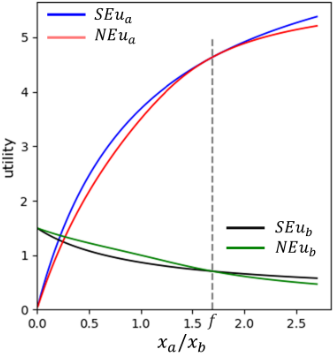
The function f in Theorem 3 is complicated, so we provide its specific expression in the proof. To reinforce the understanding of Theorem 3, particularly the second case, we construct a class of instances and demonstrate how the utilities of both players vary across the two equilibria as their relative budgets change, as shown in Figure 1.
Let the budgets of the two players be r and 1, respectively, with their relative budget ratio defined as r = xa xb . Let va1 = 1, va2 = 5, vb1 = 1, and vb2 = 0.5. Clearly, this game satisfies the second case of Theorem 3. In Figure 1, SEua and SEub represent the utilities of players a and b in the Stackelberg equilibrium, while NEua and NEub denote their utilities in the Nash equilibrium. As r changes, the utilities of the two players in both equilibria also change. Notably, there exists a value of r such that r = xa xb = f(1, 1, 5, 0.5), at which both players achieve the same utility in both equilibria.
Furthermore, several interesting observations emerge from these instances. When xa xb > f, both players experience higher utilities in the Stackelberg equilibrium than in the Nash equilibrium. In other words, an increase in the leader's utility does not necessarily reduce the follower's utility. Specifically, the leader's optimal commitment in the Stackelberg equilibrium allocates more resources to the higher-value battlefield (Battlefield 2) and fewer resources to the lowervalue battlefield (Battlefield 1) compared to the Nash equilibrium. Since the follower values the battlefields in the opposite way, they prefer Battlefield 1. This allows the follower to derive more utility from Battlefield 1, leading to an increase in their utility under the Stackelberg equilibrium. Conversely, when the leader's budget is relatively small (i.e., when the ratio is less than f), the situation reverses. This is illustrated by the following calculation:
- If xa xb = 0.5, which is less than f, the unique Nash equilibrium is x∗a = (0.025, 0.475), x∗b = (0.340, 0.660), where NEua = 2.161, NEub = 1.223. The Stackelberg equilibrium is xa = (0.136, 0.364), xb = (0.559, 0.441), where SEua = 2.458, SEub = 1.079.
- If xa xb = 2, which is greater than f , the unique Nash equi-
librium is x∗a = (0.667, 1.333), x∗b = (0.833, 0.167), where NEua = 4.889, NEub = 0.611. The Stackelberg equilibrium is xa = (0.543, 1.457), xb = (0.847, 0.153), where SEua = 4.915, SEub = 0.657.
6 Leader's Advantage
In this section, we analyze the advantages of the leader as a first mover, with these advantages being contingent upon the leader's budget relative to that of the follower. Specifically, we consider three cases: (1) the number of battlefields n > 2, we find that when the leader's budget is relatively large, the advantages of the leader is marginal; (2) n = 2, we provide an upper bound and a lower bound on the ratio of the leader's utility under the Stackelberg equilibrium to that under the Nash equilibrium; and (3) n = 2 and the leader's budget is relatively small, we find that the advantages of the leader could be infinite.
There are n > 2 battlefields. The following theorem gives a lower bound for the leader's utility in Nash equilibria.
Theorem 4. For any game
the leader's utility in the Nash equilibrium is greater than or equal to xa xa+xb · (∑nj=1 vaj).
Proof. Let (x∗a , x∗b ) denote the Nash equilibrium. Consider a leader's strategy ˆxaj = xa xb x∗bj , we have ua(x∗a , x∗b ) ≥ ua(ˆxa, x∗b ). Furthermore, we have
It shows that the utility of the leader in the Nash equilibrium is greater than or equal to xa xa+xb · (∑nj=1 vaj).
By Theorem 4, we have the following corollary.
Corollary 1. Let uNE a and uSE a denote the leader's utility under the Nash equilibrium and Stackelberg equilibrium, respectively. We have uSE a uNE a ≤ xa+xb xa .
Proof. Let (˜xa, ˜xb) denote the Stackelberg equilibrium, then by Theorem 4, we have
Rearranging the inequality yields ua(˜xa,˜xb) ua(x∗a ,x∗b ) ≤ xa+xb xa .
This corollary shows that when xa is relatively large, ua( ˜xa, ˜xb) ua(x∗a ,x∗b ) approaches 1. Hence, when the leader's budget is relatively large, the leader can make a commitment to enhance its own benefits, but the improvement is marginal.
There are two battlefields. We consider a game with two battlefields. Analyzing two-battlefield scenario can provide insights into the leader's advantages in games with multiple battlefields. Let ˜ G := ⟨{a, b}, {1, 2}, xa, 1, (va1, 1), (vb1,
1)⟩. Without loss of generality, let va1 ≤ vb1. For the game ˜ G, [Li and Zheng, 2022] present an approach to compute Nash equilibria. We can utilize this approach to compute Nash equilibria. The following theorem gives the range of the ratio.
Theorem 5. In game ˜ G, let ˆxa denote the leader's optimal commitment, ˆxb denote the follower's best response, and uNE a denote the leader's utility in the Nash equilibrium. Then, the ratio of Player a's utility in the Stackelberg equilibrium to its utility in the Nash equilibrium is bounded by
There are two battlefields and the leader's budget is relatively small. By Theorem 5, we can derive the following corollary, which describes the leader's advantage when the leader's budget is relatively small.
Corollary 2. In game ˜ G, the ratio of the leader's utility when moving first to its utility in the Nash equilibrium approaches infinity.
To illustrate this corollary, we consider an extreme case ˜ G := ⟨{a, b}, {1, 2}, ϵ, 1, (ϵ, 1), (o(ϵ), 1)⟩. We observe when the leader's budget is dominated by the follower's budget, and the follower's value on the first battlefield is negligible compared to the leader's value on the first battlefield, the ratio of the leader's utility when moving first to its utility in the Nash equilibrium approaches infinity.
Although this corollary focuses on two battlefields, using the reduction method presented in Section 3, we can extend the analysis to multiple battlefields. Therefore, this corollary holds for scenarios with more than two battlefields as well.
7 Conclusion and FutureWork
We explore the advantages of the first mover in the Lottery Colonel Blotto game. To address this, we reduce the number of supports in the follower's best response strategies from 2n - 1 to n. We derive a method to calculate the leader's commitment for each possible support, allowing selection of the optimal one from these n potential commitments. In addition, we provide the necessary and sufficient conditions under which the Stackelberg equilibrium and Nash equilibrium are equivalent. We find that the two equilibria are equivalent when the budget ratio between the leader and the follower is exactly equal to a certain functional value, which depends on the ratio of the valuations of the battlefields by the leader and the follower. Furthermore, we analyze the ratio of the leader's utility under the Stackelberg equilibrium to that under the Nash equilibrium.
This work opens several directions for further research. First, analyzing the ratio between the follower's utility under Stackelberg and Nash equilibria may yield deeper understanding of the incentives and trade-offs involved. Second, it is of interest to study which player benefits more from committing early, and under what conditions a player prefers to act as the leader or the follower. Finally, extending the model to settings with multiple followers introduces new layers of strategic complexity, where the interaction among followers becomes both theoretically rich and analytically challenging.
Acknowledgments
We thank the fnancial support fromNational Natural Science Foundation of China (Grant No. 62172422 and 72192805), and Key Laboratory of Interdisciplinary Research of Computation and Economics (Shanghai University of Finance and Economics), Ministry of Education. Jie Zhang was partially supported by a Leverhulme Trust Research Project Grant (2021 - 2024) and the EPSRC grant (EP/W014912/1).
@inproceedings{ijcai2025p441,
  title     = {Stackelberg vs. Nash in the Lottery Colonel Blotto Game},
  author    = {Liu, Yan and Ni, Bonan and Shen, Weiran and Wang, Zihe and Zhang, Jie},
  booktitle = {Proceedings of the Thirty-Fourth International Joint Conference on
               Artificial Intelligence, {IJCAI-25}},
  publisher = {International Joint Conferences on Artificial Intelligence Organization},
  editor    = {James Kwok},
  pages     = {3961--3969},
  year      = {2025},
  month     = {8},
  note      = {Main Track},
  doi       = {10.24963/ijcai.2025/441},
  url       = {https://doi.org/10.24963/ijcai.2025/441},
}
TY - CPAPER TI - Stackelberg vs. Nash in the Lottery Colonel Blotto Game AU - Liu, Yan AU - Ni, Bonan AU - Shen, Weiran AU - Wang, Zihe AU - Zhang, Jie T2 - Proceedings of the Thirty-Fourth International Joint Conference on Artificial Intelligence, IJCAI-25 PB - International Joint Conferences on Artificial Intelligence Organization PY - 2025 SP - 3961 EP - 3969 DO - 10.24963/ijcai.2025/441 UR - https://doi.org/10.24963/ijcai.2025/441 ER -Copied
Machine-readable versions of this paper, for tools and AI agents:





