
Where and When: Predict Next POI and Its Explicit Timestamp in Sequential Recommendation
Proceedings of the Thirty-Fourth International Joint Conference on Artificial Intelligence. Main Track. Pages 3507-3515.
https://doi.org/10.24963/ijcai.2025/390
Keywords
- Data Mining: DM: Recommender systems
- Data Mining: DM: Information retrieval
Abstract
Sequential point-of-interest (POI) recommendation aims to recommend the next POI for users in accordance with their historical check-in information. However, few attempts treat timestamps of check-ins as a core factor for sequence models, leading to insufficient insight into user behavior and subsequently suboptimal recommendations. To address these limitations, we propose to assign equal importance to both POIs and their timestamps, shifting the point of view to recommend the next POI and predict the corresponding timestamp. Along these lines, we present the Time-Aware POI Recommender with Timestamp Prediction (TAPT), a multi-task learning framework for explainable POI recommendations. Specifically, we begin by decoupling timestamps into multi-dimensional vectors and propose a timestamp encoding module to explicitly encode these vectors. Additionally, we design a specialized timestamp prediction module built on the traditional sequence-based POI recommender backbone, effectively learning the strong correlation between POIs and their corresponding timestamps through these two modules. We evaluated the proposed model with three real-world LBSN datasets and demonstrated that TAPT achieves comparable or superior performance in POI recommendation compared to the baseline backbone. Besides, TAPT can not only recommend the next POI, but predict the corresponding timestamp in the future.
- [Chang et al., 2023] Jianxin Chang, Chenbin Zhang, Zhiyi Fu, Xiaoxue Zang, Lin Guan, Jing Lu, Yiqun Hui, Dewei Leng, Yanan Niu, Yang Song, and Kun Gai. TWIN: two- stage interest network for lifelong user behavior modeling in CTR prediction at kuaishou. In KDD, pages 3785-3794. ACM, 2023.
- [Cho et al., 2011] Eunjoon Cho, Seth A. Myers, and Jure Leskovec. Friendship and mobility: user movement in location-based social networks. In KDD, pages 1082- 1090. ACM, 2011.
- [Devlin et al., 2019] Jacob Devlin, Ming-Wei Chang, Ken- ton Lee, and Kristina Toutanova. BERT: pre-training of deep bidirectional transformers for language understand- ing. In NAACL-HLT (1), pages 4171-4186. Association for Computational Linguistics, 2019.
- [Dong et al., 2023] Jiaxiang Dong, Haixu Wu, Haoran Zhang, Li Zhang, Jianmin Wang, and Mingsheng Long. Simmtm: A simple pre-training framework for masked time-series modeling. In NeurIPS, 2023.
- [Du et al., 2023] Hanwen Du, Huanhuan Yuan, Pengpeng Zhao, Fuzhen Zhuang, Guanfeng Liu, Lei Zhao, Yanchi Liu, and Victor S. Sheng. Ensemble modeling with con- trastive knowledge distillation for sequential recommen- dation. In SIGIR, pages 58-67. ACM, 2023.
- [He and McAuley, 2016] Ruining He and Julian J. McAuley. Fusing similarity models with markov chains for sparse se- quential recommendation. In ICDM, pages 191-200. IEEE Computer Society, 2016.
- [Hidasi et al., 2016a] Balázs Hidasi, Alexandros Karat- zoglou, Linas Baltrunas, and Domonkos Tikk. Session- based recommendations with recurrent neural networks. In ICLR (Poster), 2016.
- [Hidasi et al., 2016b] Balázs Hidasi, Massimo Quadrana, Alexandros Karatzoglou, and Domonkos Tikk. Paral- lel recurrent neural network architectures for feature-rich session-based recommendations. In RecSys, pages 241- 248. ACM, 2016.
- [Huang et al., 2023] Chengkai Huang, Shoujin Wang, Xi- anzhi Wang, and Lina Yao. Dual contrastive transformer for hierarchical preference modeling in sequential recom- mendation. In SIGIR, pages 99-109. ACM, 2023.
- [Jiang et al., 2024] Yiheng Jiang, Yuanbo Xu, Yongjian Yang, Funing Yang, Pengyang Wang, Chaozhuo Li, Fuzhen Zhuang, and Hui Xiong. Trimlp: A founda- tional mlp-like architecture for sequential recommenda- tion. ACM Trans. Inf. Syst., 42(6):157:1-157:34, 2024.
- [Kang and McAuley, 2018] Wang-Cheng Kang and Julian J. McAuley. Self-attentive sequential recommendation. In ICDM, pages 197-206. IEEE Computer Society, 2018.
- [Krichene and Rendle, 2020] Walid Krichene and Steffen Rendle. On sampled metrics for item recommendation. In KDD, pages 1748-1757. ACM, 2020.
- [Li et al., 2020] Jiacheng Li, Yujie Wang, and Julian J. McAuley. Time interval aware self-attention for sequen- tial recommendation. In WSDM, pages 322-330. ACM, 2020.
- [Li et al., 2022] Yinfeng Li, Chen Gao, Xiaoyi Du, Huazhou Wei, Hengliang Luo, Depeng Jin, and Yong Li. Automati- cally discovering user consumption intents in meituan. In KDD, pages 3259-3269. ACM, 2022.
- [Lian et al., 2020] Defu Lian, Yongji Wu, Yong Ge, Xing Xie, and Enhong Chen. Geography-aware sequential loca- tion recommendation. In KDD, pages 2009-2019. ACM, 2020.
- [Liu et al., 2016] Qiang Liu, Shu Wu, Liang Wang, and Tie- niu Tan. Predicting the next location: A recurrent model with spatial and temporal contexts. In AAAI, pages 194- 200. AAAI Press, 2016.
- [Luo et al., 2021] Yingtao Luo, Qiang Liu, and Zhaocheng Liu. STAN: spatio-temporal attention network for next location recommendation. In WWW, pages 2177-2185. ACM / IW3C2, 2021.
- [Manotumruksa et al., 2018] Jarana Manotumruksa, Craig Macdonald, and Iadh Ounis. A contextual attention re- current architecture for context-aware venue recommen- dation. In SIGIR, pages 555-564. ACM, 2018.
- [Qin et al., 2024] Yifang Qin, Hongjun Wu, Wei Ju, Xiao Luo, and Ming Zhang. A diffusion model for POI rec- ommendation. ACM Trans. Inf. Syst., 42(2):54:1-54:27, 2024.
- [Rendle et al., 2010] Steffen Rendle, Christoph Freuden- thaler, and Lars Schmidt-Thieme. Factorizing personal- ized markov chains for next-basket recommendation. In WWW, pages 811-820. ACM, 2010.
- [Song et al., 2021] Wenzhuo Song, Shoujin Wang, Yan Wang, and Shengsheng Wang. Next-item recommenda- tions in short sessions. In RecSys, pages 282-291. ACM, 2021.
- [Sun et al., 2019] Fei Sun, Jun Liu, Jian Wu, Changhua Pei, Xiao Lin, Wenwu Ou, and Peng Jiang. Bert4rec: Sequen- tial recommendation with bidirectional encoder represen- tations from transformer. In CIKM, pages 1441-1450. ACM, 2019.
- [Tang and Wang, 2018] Jiaxi Tang and Ke Wang. Person- alized top-n sequential recommendation via convolutional sequence embedding. In WSDM, pages 565-573. ACM, 2018.
- [Twardowski, 2016] Bartlomiej Twardowski. Modelling contextual information in session-aware recommender systems with neural networks. In RecSys, pages 273-276. ACM, 2016.
- [Vaswani et al., 2017] Ashish Vaswani, Noam Shazeer, Niki Parmar, Jakob Uszkoreit, Llion Jones, Aidan N. Gomez, Lukasz Kaiser, and Illia Polosukhin. Attention is all you need. In NIPS, pages 5998-6008, 2017.
- [Wang et al., 2019a] Chenyang Wang, Min Zhang, Weizhi Ma, Yiqun Liu, and Shaoping Ma. Modeling item- specific temporal dynamics of repeat consumption for rec- ommender systems. In WWW, pages 1977-1987. ACM, 2019.
- [Wang et al., 2019b] Shoujin Wang, Liang Hu, Yan Wang, Longbing Cao, Quan Z. Sheng, and Mehmet A. Orgun. Se- quential recommender systems: Challenges, progress and prospects. In IJCAI, pages 6332-6338. ijcai.org, 2019. IJCAI
- [Wang et al., 2020] Chenyang Wang, Min Zhang, Weizhi Ma, Yiqun Liu, and Shaoping Ma. Make it a chorus: Knowledge-and time-aware item modeling for sequential recommendation. In SIGIR, pages 109-118. ACM, 2020.
- [Wang et al., 2021] Chenyang Wang, Weizhi Ma, Min Zhang, Chong Chen, Yiqun Liu, and Shaoping Ma. To- ward dynamic user intention: Temporal evolutionary ef- fects of item relations in sequential recommendation. ACM Trans. Inf. Syst., 39(2):16:1-16:33, 2021.
- [Wang et al., 2022] En Wang, Yiheng Jiang, Yuanbo Xu, Liang Wang, and Yongjian Yang. Spatial-temporal interval aware sequential POI recommendation. In ICDE, pages 2086-2098. IEEE, 2022.
- [Xu et al., 2024] Hangtong Xu, Yuanbo Xu, and Yongjian Yang. Separating and learning latent confounders to en- hancing user preferences modeling. In International Con- ference on Database Systems for Advanced Applications, pages 67-82. Springer, 2024.
- [Xu et al., 2025] Hangtong Xu, Yuanbo Xu, Chaozhuo Li, and Fuzhen Zhuang. Causal structure representation learn- ing of unobserved confounders in latent space for recom- mendation. ACM Trans. Inf. Syst., April 2025. Just Ac- cepted.
- [Yang et al., 2015] Dingqi Yang, Daqing Zhang, Vincent W. Zheng, and Zhiyong Yu. Modeling user activity prefer- ence by leveraging user spatial temporal characteristics in lbsns. IEEE Trans. Syst. Man Cybern. Syst., 45(1):129- 142, 2015.
- [Yang et al., 2020] Dingqi Yang, Benjamin Fankhauser, Paolo Rosso, and Philippe Cudré-Mauroux. Location pre- diction over sparse user mobility traces using rnns: Flash- back in hidden states! In IJCAI, pages 2184-2190. ij- cai.org, 2020. IJCAI
- [Yang et al., 2022] Song Yang, Jiamou Liu, and Kaiqi Zhao. Getnext: Trajectory flow map enhanced transformer for next POI recommendation. In SIGIR, pages 1144-1153. ACM, 2022.
- [Yuan et al., 2019] Fajie Yuan, Alexandros Karatzoglou, Ioannis Arapakis, Joemon M. Jose, and Xiangnan He. A simple convolutional generative network for next item rec- ommendation. In WSDM, pages 582-590. ACM, 2019.
- [Zhang et al., 2023] Yuting Zhang, Yiqing Wu, Ran Le, Yongchun Zhu, Fuzhen Zhuang, Ruidong Han, Xiang Li, Wei Lin, Zhulin An, and Yongjun Xu. Modeling dual period-varying preferences for takeaway recommendation. In KDD, pages 5628-5638. ACM, 2023.
- [Zhou et al., 2022] Kun Zhou, Hui Yu, Wayne Xin Zhao, and Ji-Rong Wen. Filter-enhanced MLP is all you need for sequential recommendation. In WWW, pages 2388-2399. ACM, 2022.
References were extracted automatically from the PDF and may contain errors.
Full text extracted automatically from the PDF; figures, tables and equations may differ. The PDF is the version of record.
1 Introduction
The rapid growth of location-based social networks (LBSNs) has sparked significant interest in personalized location recommendation services [Wang et al., 2019b]. One key approach within these services is sequential point-of-interest (POI) recommendation, which focuses on recommending the next POI that a user might explore based on his or her previous visit sequence [Manotumruksa et al., 2018]. With advancements in information technology, researchers have developed numerous deep learning methods in this field [Wang et al., 2022; Lian et al., 2020; Xu et al., 2025]. These methods include Multi-Layer Perceptron (MLP) [Zhou et al., 2022; Jiang et al., 2024], Recurrent Neural Networks (RNN) [Hidasi et al., 2016a; Yang et al., 2020], Convolutional Neural Networks (CNN) [Tang and Wang, 2018; Yuan et al., 2019], and Transformer-based models [Lian et al., 2020; Luo et al., 2021; Devlin et al., 2019]. Researchers have recognized the potential of these architectures and extended them to sequential POI recommendations, leveraging both spatial and temporal information to capture user preferences and predict the next POI based on previous visits.
∗ Corresponding author.
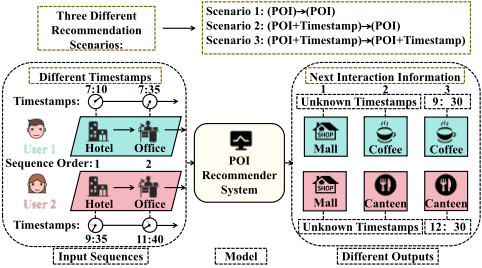
Despite the commendable performance achieved by existing methods, they exhibit two main limitations when modeling POI transitions, as shown in Scenario 1 and Scenario 2 in Figure 1. Scenario 1: Recommend POIs based on sequential correlations. By prioritizing sequential correlations, these methods overlook the specific timestamp information embedded within sequences and, therefore, lead to an incomplete modeling of user behavior, producing suboptimal recommendations [Rendle et al., 2010; Kang and McAuley, 2018; Sun et al., 2019; Xu et al., 2024]. Scenario 2: Recommend POIs with timestamps as auxiliary information. Scenario 2 builds upon Scenario 1 by incorporating timestamps as auxiliary inputs, enabling the model to capture sequential dependencies through temporal signals and produce personalized recommendations. Nevertheless, both scenarios concentrate exclusively on predicting the next check-in POI while overlooking the associated timestamp, thereby compromising recommendation timeliness and impeding the realtime deployment of LBSN services.
To resolve the bottlenecks in the aforesaid scenarios, we introduce a new scenario. Scenario 3: Recommend the next check-in POI and predict the corresponding timestamp simultaneously. In this scenario, the recommendations possess practical significance in terms of timeliness, facilitate timely individual travel planning, and enhance the effectiveness of LBSN applications. Since individuals tend to visit locations based on specific temporal and spatial contexts, accurately predicting their next destination at the most probable time will enhance the relevance and usability of such services. As shown in Figure 1, two users with the same POI sequence but different timestamp sequences are shown on the left, and the results of three scenarios are compared on the right. In Scenario 1, the system recommends identical POIs to both users due to identical input sequences. In Scenario 2, the timestamp information is an auxiliary input to the model, leading to different POI recommendations, but without corresponding time information. Our proposed Scenario 3 recommends personalized POIs for users while predicting timestamps for their next interactions, reflecting when and where users are likely to go, and providing a holistic recommendation service.
To realize the above concept, we propose the Time-Aware POI recommender with Timestamp prediction (TAPT) as a multi-task learning framework. Our approach begins by decoupling timestamps into multidimensional vectors, which are then encoded into trainable embeddings via a timestamp encoder, which explicitly leverages check-in timestamps. Next, we design a connection layer to combine POI and timestamp embeddings into joint embeddings. We feed this joint embedding into a POI recommendation backbone and pass the output from the backbone into a designed timestamp predictor, enabling multitask learning through a unified loss function. To validate the effectiveness of TAPT, we conduct extensive experiments on three public LBSN datasets. The results demonstrate that TAPT achieves comparable or even superior POI recommendation performance compared to the baseline backbone. Besides, TAPT can recommend the next POI and predict the corresponding timestamp in the future. Our contributions are summarized as follows:
- This paper tackles the next check-in time prediction in the sequential POI recommendation scenario, which has been overlooked by previous works. It lights on a novel approach for meaningful and timely recommendations.
- This paper proposes an end-to-end multi-target learning framework, which attaches equal importance to both the next POI classification and time prediction.
- Experimental results on three real-world datasets validate its superior recommendation quality and temporal prediction precision compared to baseline models. The code for our work is available at: https://github.com/ MICLab-Rec/TAPT.
2 RelatedWork
2.1 Sequential POI Recommendation
Numerous excellent sequential POI recommendation methods have emerged with the advancement of information technology and the increasing availability of user check-in data. Traditional methods typically use Markov Chains [He and McAuley, 2016] and Matrix Factorization [Twardowski, 2016] to model the transition patterns between POIs [Liu et al., 2016]. For instance, FPMC [Rendle et al., 2010] linearly combines the two to model transitions between POIs across a series of baskets. With the advancement of deep learning technologies, RNN-based [Hidasi et al., 2016b] and CNNbased [Yuan et al., 2019] models have demonstrated high efficiency in sequence modeling. Among these, GRU4Rec [Hidasi et al., 2016a] utilizes a modified gated recurrent unit to learn the patterns of users' dynamic preferences, while Caser [Tang and Wang, 2018] employs horizontal and vertical convolutional kernels to capture sequential dependencies from both local and global perspectives. Meanwhile, the success of Transformer-based models [Vaswani et al., 2017] has also inspired the development of Transformer-based sequence encoders. For example, SASRec [Kang and McAuley, 2018] is the pioneering approach to incorporate self-attention networks into the sequential recommendation domain. Bert4Rec [Sun et al., 2019] advances this by extending SASRec to capture bidirectional sequential dependencies. To account for temporal factors, TiSASRec [Li et al., 2020] develops a timeaware self-attention mechanism to examine how varying time intervals impact predictions. Besides, the FMLP4Rec [Zhou et al., 2022] method combines multi-head self-attention with frequency domain modeling to enhance sequence modeling capabilities in recommender systems. STAN [Luo et al., 2021] is a transformer-based model that modifies the attention coefficients by incorporating temporal and spatial interval information to capture sequential dependencies more effectively. However, these methods either overlook or only implicitly consider the timestamp information of check-ins. GeoSAN [Lian et al., 2020] introduces a novel self-attentionbased geography encoder, demonstrating state-of-the-art performance in modeling precise locations.
2.2 Timestamp Encoding
Timestamp encoding has been extensively researched in both academia and industry. Some previous works typically encode the time gaps in sequential models[Chang et al., 2023], which captures the significance of sequential information but fail to directly model time information. Other works divide a day into morning, noon, evening, and night, applying different graph models to takeaway recommendations at different times of the day [Zhang et al., 2023]. However, this method is clearly difficult to generalize to other tasks. Meanwhile, the timestamp encoding method [Li et al., 2022] encodes the hours of the day as hour embeddings, discretely perceiving timestamp information. However, these methods merely use timestamp encoding as auxiliary information and do not leverage this encoding to predict the next interaction timestamp.
3 Preliminaries
3.1 Basic Definition
Definition 1: (Check-in) A check-in is represented as c = (u, p, ℓ, t), where user u visits POI p at timestamp t, and ℓ represents the geographical coordinates of p.
Definition 2: (Check-in Sequence) A check-in sequence consists of a chronologically ordered set of check-in records. Let Su = {c1, c2, · · · , cm} represent the check-in sequence of user u, where ck denotes the k-th check-in in the sequence, and m denotes the length of the sequence.
Definition 3: (Sequential POI Recommendation) Given user u's check-in sequence, the goal of sequential POI recommendation is to recommend the Top-K POIs that the user will most likely be interested in at the next interaction.
Definition 4: (Sequential Timestamp Prediction) Given user u's check-in sequence, the objective of sequential timestamp prediction is to forecast the timestamp of the user's next visit to a specific POI.
3.2 ProblemDefinition
Given a user u's historical sequence Su , the POI recommendation and timestamp prediction problem can be formalized as
where Ru is the Top-K recommendation list and ˜ tu is the predicted timestamp for the next check-in. F(·) represents the multi-task learning framework we aim to learn.
3.3 Data Observations and Analyses
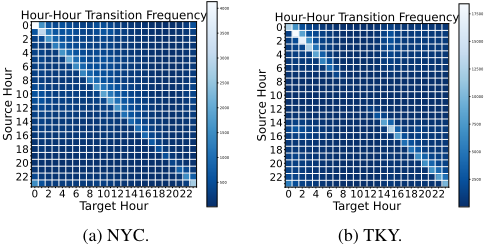
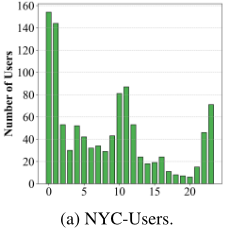
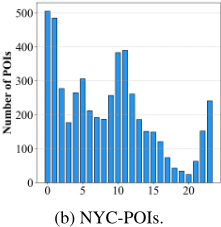
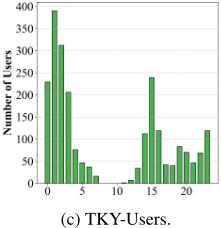
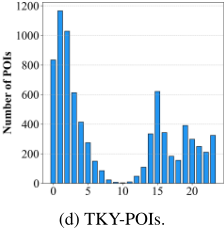
To address the proposed problem, we conduct data analyses on the NYC and TKY datasets. We split all historical checkin sequences into consecutive pairs and treat the former and the latter check-in as source and target, respectively. Then, we statistically analyze the distribution of time transferring from sources to targets. Figure 2 shows these transitions, with the X-axis representing the target hour and the Y-axis the source hour. Each element indicates the frequency of transitions between the corresponding hours. We observe frequent transitions between adjacent hours, as shown by the diagonal dominance in the transition matrix. This indicates that timestamps play an important role in POI recommendation due to short-interval behavioral patterns. Secondly, we analyze the most active hour for each user and examine the peak hour for each POI. The temporal distributions are plotted in Figure 3, with the X-axis representing the hours of the day and the Y-axis showing the number of active users (or popular POIs) during each time period. We can conclude a pattern that the number of users performing check-in behaviors and the number of POIs being accessed exhibit synchronized changes over time. Specifically, both numbers achieve the peak point at midnight and reach the lowest point at 8 p.m. in NYC whereas the situation comes at 1 a.m. and 10 a.m. in TKY, respectively.
Motivated by these observations, predicting the next checkin time can be helpful in deploying LBSN services. This paper proposes a simple and effective method to establish the contact between POI recommendation and time prediction.
4 Methodology
4.1 Encoder Module
Figure 4 illustrates the overall architecture of TAPT. The encoder module of TAPT, consisting of the POI encoder and the timestamp encoder, encodes the POI and timestamp sequences derived from a user's check-in history. For the POI sequence, we transform it into Ep ∈ Rm×d1 through POI embedding techniques, where m represents the sequence length and d1 represents the POI embedding dimension.
where Ep denotes the encoded POI embedding, ei ∈ R1×d1 is the embedding vector of the i-th POI in the sequence. We split each timestamp into three components to capture daily behavior patterns: hour, minute, and second. These discrete values are transformed into embeddings, allowing the model to capture the temporal aspects of each check-in with fine granularity. For instance, the hour component has 24 discrete values, ranging from 0 to 23.
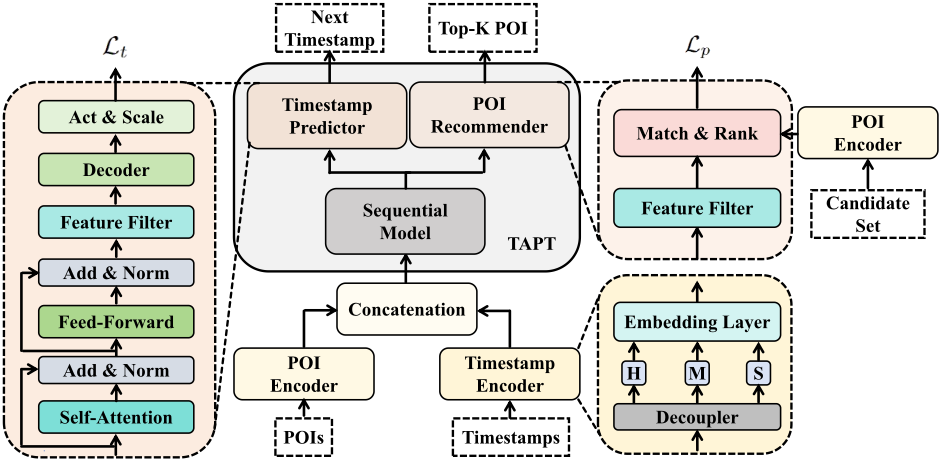
where T ∈ Rm×3 represents the decoupled timestamp sequence, and Ti ∈ R1×3 denotes the timestamp at the i-th time step. Furthermore, hi, mi, and si represent the hour, minute, and second of the i-th time step to capture the user's behavior within a single day. Next, we encode T into timestamp embeddings as follows:
where Et ∈ Rm×d2 is the timestamp embedding, with d2 as the timestamp embedding dimension, and ti ∈ R1×d2 is the embedding of each timestamp Ti after encoding. We decompose timestamps as discrete hour, minute, and second indices, and embed them to high-dimensional representations hi, mi, and si, where the vocabulary sizes are 24, 60 and 60, respectively.
where ∥ denotes the concatenation operation. After obtaining the POI embeddings and timestamp embeddings, we input both into a concatenation layer to produce a joint embedding. This joint embedding is used to learn the strong correlations between POIs and timestamps and to facilitate subsequent multitask learning. The process is as follows:
where E ∈ Rm×d represents the joint embedding, with d = d1 + d2, and ∥ denoting the concatenation operation.
4.2 POI Recommender Module
We feed E into the backbone of the POI recommendation model, allowing it to learn time-aware POI preferences and capture user behavior timestamp features.
where Z ∈ Rm×d represents the learned representation, Backbone(·) denotes the backbone of the sequential POI recommendation model, and we extract the first d1 elements from Z along the last dimension to form the POI-related representation matrix Zp ∈ Rm×d1 . Therefore, the preference score is calculated as follows:
where yi,j is the preference score of the j-th POI in the candidate set, f(·) is the inner product function, Zpi ∈ R1×d1 is the user preference vector at the i-th position in Zp, and Cj ∈ R1×d1 is the embedding vector of the j-th POI in the candidate set.
4.3 Timestamp Predictor Module
In the timestamp prediction branch, we employ a Transformer to model the transition pattern of temporal information and avoid the instability brought by various backbones. Given the input Z, we calculate the linearly transformed features.
whereWQ,WK,WV ∈ Rd×d are learnable parameters and Q,K,V ∈ Rm×d . We process the above features through a multi-head self-attention model:
MultiHead(Q, K, V) = Concat(head1, . . . , headi)WO,
The outputs of the attention heads are merged via a linear transformation Wo ∈ Rd×d , integrating information across attention spaces. Next, we apply a residual connection and layer normalization to the output.
We feed Z1 ∈ Rm×d through the feed-forward network with residual connections and normalization to enhance feature transformation and capture nonlinear relationships.
where W1 ∈ Rd×dh and W2 ∈ Rdh×d are the learnable weight matrices, and b1 ∈ R1×dh and b2 ∈ R1×d are the bias terms, while Z′ ∈ Rm×d is the further learned joint representation. Subsequently, we extract the last d2 elements fromZ′ along the last dimension to form the timestamp-related features Zt ∈ Rm×d2 , where d = d1 + d2. Then, we decode Zt through a decoder, translating the extracted features into meaningful timestamp predictions.
where Z′t ∈ Rm×3 is the decoded representation, and the parameters W ∈ Rd2×3 and b ∈ R1×3 are trainable parameters in the model. Finally, Z′t is mapped back to discrete values that reflect timestamp information through an activation function and scaling operation.
where ˆTi ∈ Rm×3 is the final predicted timestamp information. Scale(·) and Sigmoid(·) represent the scaling and activation operations, respectively. Equation (14) is designed to predict the hour, minute, and second of the next checkin. Since Sigmoid(·) restricts values in [0, 1], the Scale(·) function maps the results into three ranges, i.e., [0, 23], [0, 59] and [0, 59], corresponding to the hour, minute, and second index, respectively. After the above steps, we predict the final hour, minute, and second to infer the timestamp of the user's next interaction.
4.4 Model Training
During the model training process, our proposed TAPT framework functions as a multi-task learning system, incorporating two distinct loss functions:
where Lp denotes the loss function for the POI recommendation, such as Binary Cross-Entropy (BCE) [Li et al., 2020].
| Dataset | TKY | NYC | Gowalla |
|---|---|---|---|
| #user | 2,293 | 1,083 | 36,371 |
| #POI | 7,873 | 5,135 | 129,939 |
| #check-in | 447,570 | 147,938 | 3,136,496 |
| sparsity | 97.52% | 97.33% | 99.93% |
| avg. seq. length | 193.19 | 134.60 | 84.24 |
where m denotes the length of the POI sequence, σ represents the sigmoid function, yi,p is the logits for the i-th positive sample, and yi,n is the logits for the i-th negative sample.
In equation (15), λ is a hyperparameter that balances the two loss functions. We use the Mean Squared Error (MSE) loss for optimizing Lt.
where Ti is the true timestamp of the i-th sample, and ˆ Ti is the predicted timestamp of the i-th sample.
5 Experiments
5.1 Datasets
We evaluate our framework using three publicly available LBSN datasets from Foursquare (Tokyo and New York City) [Yang et al., 2015] and Gowalla (California and Nevada) [Cho et al., 2011]. We filter out inactive users (fewer than 20 POI visits) and unpopular POIs (fewer than 10 interactions) to ensure data quality [Yang et al., 2022]. The check-in records are organized in chronological order. The initial 80% of the data is allocated for training, the subsequent 10% for validation, and the final 10% for testing. Table 1 summarizes the details of the three processed datasets.
5.2 Baselines
We choose the following sequential models for POI recommendation as baseline backbones. 1) GRU4Rec [Hidasi et al., 2016a]: Uses a Gated Recurrent Unit to model user interaction sequences for recommendations. 2) Caser [Tang and Wang, 2018]: Embeds POIs in user interaction history as images, using convolutional filters to capture both local and global sequential dependencies. 3) SASRec [Kang and McAuley, 2018]: Leverages users' long-term semantics and recent actions simultaneously for accurate POI recommendations. 4) BERT4Rec [Sun et al., 2019]: Addresses the limitations of unidirectional sequential recommenders by modeling user behavior sequences under the BERT framework [Devlin et al., 2019]. 5) TiSASRec [Li et al., 2020]: Utilizes timestamps and time intervals between user-POI interactions to improve next-POI prediction. 6) FMLP4Rec [Zhou et al., 2022]: Proposes a full MLP model that adaptively reduces noise information in the frequency domain through a learnable filter to perform POI recommendation. 7) STAN [Luo et al., 2021]: Models relative spatial-temporal information among POIs with a bi-layer attention architecture, creating a state-of-the-art sequential POI recommender.
| Dataset | TKY | Gowalla | ||||||||||
|---|---|---|---|---|---|---|---|---|---|---|---|---|
| Metric | H@5 | N@5 | H@10 | N@10 | H@5 | N@5 | NYC H@10 | N@10 | H@5 | N@5 | H@10 | N@10 |
| GRU4Rec | 0.4588 | 0.3217 | 0.5717 | 0.3516 | 0.4903 | 0.3730 | 0.5688 | 0.3971 | 0.2445 | 0.1677 | 0.3355 | 0.1990 |
| w. TAPT | 0.4666 | 0.3226 | 0.5931 | 0.3649 | 0.4866 | 0.3707 | 0.5771 | 0.3944 | 0.2610 | 0.1823 | 0.3516 | 0.2113 |
| Improv. | 1.70% | 0.27% | 3.74% | 3.78% | -0.75% | -0.61% | 1.45% | -0.67% | 6.74% | 8.70% | 4.76% | 6.18% |
| Caser | 0.3764 | 0.2626 | 0.5207 | 0.3078 | 0.4257 | 0.2908 | 0.5309 | 0.3260 | 0.2903 | 0.2072 | 0.3739 | 0.2358 |
| w. TAPT | 0.3812 | 0.2636 | 0.5358 | 0.3154 | 0.4269 | 0.2887 | 0.5372 | 0.3246 | 0.2998 | 0.2148 | 0.3843 | 0.2428 |
| Improv. | 1.27% | 0.38% | 2.89% | 2.46% | 0.28% | -0.72% | 1.18% | -0.42% | 3.27% | 3.66% | 2.78% | 2.96% |
| SASRec | 0.4610 | 0.3242 | 0.5844 | 0.3636 | 0.4691 | 0.3356 | 0.5660 | 0.3688 | 0.2433 | 0.1672 | 0.3283 | 0.1946 |
| w. TAPT | 0.4719 | 0.3279 | 0.6066 | 0.3780 | 0.4875 | 0.3525 | 0.5873 | 0.3853 | 0.2565 | 0.1764 | 0.3435 | 0.2052 |
| Improv. | 2.36% | 1.14% | 3.79% | 3.96% | 3.92% | 5.03% | 3.76% | 4.47% | 5.42% | 5.50% | 4.62% | 5.44% |
| BERT4Rec | 0.4374 | 0.3268 | 0.5238 | 0.3529 | 0.4746 | 0.3538 | 0.5439 | 0.3684 | 0.3200 | 0.2399 | 0.3743 | 0.2513 |
| w. TAPT | 0.4416 | 0.3313 | 0.5312 | 0.3671 | 0.4820 | 0.3612 | 0.5568 | 0.3843 | 0.3276 | 0.2462 | 0.3857 | 0.2598 |
| Improv. | 0.96% | 1.37% | 1.41% | 4.02% | 1.55% | 2.09% | 2.37% | 4.31% | 2.37% | 2.62% | 3.04% | 3.38% |
| TiSASRec | 0.4422 | 0.3095 | 0.5608 | 0.3452 | 0.5078 | 0.3649 | 0.5956 | 0.3899 | 0.2143 | 0.1510 | 0.2954 | 0.1813 |
| w. TAPT | 0.4514 | 0.3119 | 0.5770 | 0.3562 | 0.5240 | 0.3791 | 0.6128 | 0.4035 | 0.2233 | 0.1576 | 0.3051 | 0.1883 |
| Improv. | 2.08% | 0.77% | 2.88% | 3.18% | 3.79% | 3.89% | 2.88% | 3.48% | 4.19% | 4.37% | 3.28% | 3.86% |
| FMLP4Rec | 0.4278 | 0.3001 | 0.5203 | 0.3304 | 0.4220 | 0.3004 | 0.4995 | 0.3259 | 0.3347 | 0.2426 | 0.3988 | 0.2634 |
| w. TAPT | 0.4396 | 0.3068 | 0.5255 | 0.3332 | 0.4303 | 0.3044 | 0.5014 | 0.3265 | 0.3376 | 0.2481 | 0.4083 | 0.2711 |
| Improv. | 2.75% | 2.23% | 0.99% | 0.84% | 1.96% | 1.33% | 0.38% | 0.18% | 0.86% | 2.26% | 2.38% | 2.92% |
| GeoSAN | 0.4736 | 0.3328 | 0.5874 | 0.3711 | 0.5129 | 0.3736 | 0.5960 | 0.3844 | 0.3117 | 0.2432 | 0.4011 | 0.2724 |
| w. TAPT | 0.4882 | 0.3419 | 0.6046 | 0.3816 | 0.5216 | 0.3772 | 0.6152 | 0.3937 | 0.3232 | 0.2486 | 0.4154 | 0.2830 |
| Improv. | 3.10% | 2.74% | 2.93% | 2.84% | 1.71% | 0.99% | 3.23% | 2.42% | 3.71% | 2.26% | 3.58% | 3.92% |
| STAN | 0.4921 | 0.3575 | 0.6023 | 0.3826 | 0.5243 | 0.3891 | 0.6097 | 0.4178 | 0.3034 | 0.2635 | 0.4112 | 0.2914 |
| w. TAPT | 0.5026 | 0.3594 | 0.6206 | 0.3914 | 0.5342 | 0.3933 | 0.6270 | 0.4324 | 0.3178 | 0.2799 | 0.4255 | 0.3062 |
| Improv. | 2.15% | 0.55% | 3.05% | 2.32% | 1.90% | 1.10% | 2.85% | 4.75% | 6.25% | 3.50% | 5.10% | |
| 3.50% | ||||||||||||
8) GeoSAN [Lian et al., 2020]: Introduces a novel selfattention-based geography encoder, demonstrating state-ofthe-art performance in modeling precise locations.
5.3 EvaluationMetrics
We evaluate the sequential POI recommendation task using two widely adopted Top-K metrics, Hit Ratio (HR@K) and NDCG@K, with K ∈ {5, 10} [Wang et al., 2020; Song et al., 2021; Sun et al., 2019]. Higher values indicate better performance. All POIs are considered as candidates during evaluation for stable and convincing results [Krichene and Rendle, 2020; Qin et al., 2024].
For the timestamp prediction task, we select Mean Absolute Error (MAE) as the evaluation metric to intuitively measure the difference between the predicted timestamps and the actual values. A lower MAE indicates better predictive performance [Dong et al., 2023].
5.4 Experiment Settings
We implement TAPT and all baseline models in Pytorch. The POI and timestamp hidden dimensions are set to 128 and 30, respectively. The maximum sequence lengths for TKY, NYC, and Gowalla are 200, 150, and 100. We use the Adam optimizer with a learning rate of 0.001, a dropout rate of 0.2, and a batch size of 128. All baseline implementations are either provided by the original authors or based on the original papers. We set and tune the hyperparameters according to the instructions in the original papers [Du et al., 2023]. TAPT and the baselines share the same backbone parameters. During training, we set the number of negative samples to 1, following the previous settings [Huang et al., 2023; Wang et al., 2020; Wang et al., 2019a; Wang et al., 2021].
5.5 Recommendation Performance Comparison
We compare the recommendation performance of each baseline with TAPT, as shown in Table 2. The results demonstrate that TAPT achieves comparable or superior performance, which we attribute to the joint embeddings of POIs and timestamps, enabling richer contextual representations and capturing fine-grained POI preferences tied to timestamps.
Specifically, our TAPT model demonstrates notable improvements on the Gowalla dataset over the TKY and NYC datasets, attributed to the strong association between POIs and timestamps in Gowalla, facilitating effective learning of personalized POI preferences. Additionally, our TAPT
achieves notable performance improvements across various sequential backbones, demonstrating the effectiveness of combining our timestamp encoding method with existing sequence recommendation models. However, TAPT achieves a modest improvement over the next POI recommendation methods, which already incorporate rich spatial-temporal information.
5.6 Prediction Performance
Currently, no methods predict the timestamp information corresponding to recommended POIs. Therefore, we present our prediction results in Table 3 without comparisons, where each time unit represents 1 hour. While TAPT successfully predicts the timestamp for the user's next action, there remains a considerable gap in accuracy. In real LBSN datasets, user behavior exhibits significant randomness in the timestamp dimension, making it challenging to model.
Specifically, our TAPT achieves a low prediction gap on the TKY dataset relative to the remaining datasets. We believe this dataset features regular and consistent check-in data in the timestamp dimension, enabling the model to capture timestamp variation patterns.
5.7 Parameter Sensitivity Analysis
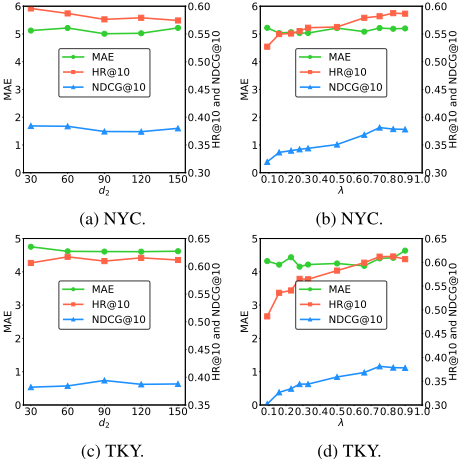
We examine the effect of the timestamp embedding dimension d2 and the weight coefficient λ on the performance of the dual-task model. As shown in Figure 5, the performance of POI recommendation and timestamp prediction remains stable across variations in the timestamp embedding dimension d2, demonstrating the robustness of our model. The parameter λ is crucial for balancing the loss functions of the two tasks. When λ is small, POI recommendation performance suffers due to insufficient optimization. However, when λ is set to 0.75, TAPT achieves optimal and stable performance, while timestamp prediction remains stable across λ values.
| Backbone | TKY | NYC | Gowalla |
|---|---|---|---|
| GRU4Rec | 4.5033 | 5.1897 | 5.7957 |
| Caser | 4.5893 | 5.2072 | 5.7481 |
| SASRec | 4.6879 | 5.2472 | 5.7364 |
| BERT4Rec | 4.4372 | 5.0677 | 5.6935 |
| TiSASRec | 4.4536 | 5.1382 | 5.7245 |
| FMLP4Rec | 4.9103 | 5.3494 | 5.8527 |
| GeoSAN | 4.6274 | 5.2981 | 5.7556 |
| STAN | 4.5212 | 5.2138 | 5.7387 |
5.8 Visualization
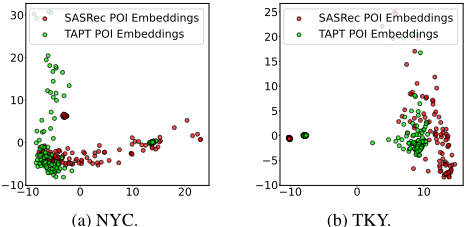
To assess our method's effectiveness, we visualize the POI representations in Figure 6. The red points are scattered, indicating that the original model struggles to cluster similar POIs. In contrast, the green points show strong clustering, particularly in key areas, suggesting that our method effectively captures POI similarities for accurate recommendations. Additionally, TAPT exhibits low variance along the first principal component (horizontal axis), demonstrating effective separation of POIs in this dimension. Our method successfully learns user behavior patterns across timestamps to generate time-aware recommendations.
6 Conclusion
This paper proposes TAPT, a multi-task learning framework for interpretable POI recommendation. Specifically, we decouple timestamps into multi-dimensional vectors and design a timestamp encoding module to encode these vectors explicitly. Additionally, we design a specialized timestamp prediction module that builds on the sequence-based POI recommender backbone to address both the POI recommendation and timestamp prediction tasks. Extensive experiments conducted on three public LBSN datasets consistently demonstrate that TAPT achieves comparable or superior performance in POI recommendation compared to the baseline backbone.
Acknowledgments
This work is supported by the Natural Science Foundation of China No. 62472196, Jilin Science and Technology Research Project 20230101067JC, National Key R&D Program of China under Grant No. 2021ZD0112501 and 2021ZD0112502, National Natural Science Foundation of China under Grant No. 62272193, National Key R&D Program of China under Grant Nos. 2022YFB3103700 and 2022YFB3103702.
@inproceedings{ijcai2025p390,
  title     = {Where and When: Predict Next POI and Its Explicit Timestamp in Sequential Recommendation},
  author    = {Xu, Yuanbo and Shen, Hongxu and Jiang, Yiheng and Wang, En},
  booktitle = {Proceedings of the Thirty-Fourth International Joint Conference on
               Artificial Intelligence, {IJCAI-25}},
  publisher = {International Joint Conferences on Artificial Intelligence Organization},
  editor    = {James Kwok},
  pages     = {3507--3515},
  year      = {2025},
  month     = {8},
  note      = {Main Track},
  doi       = {10.24963/ijcai.2025/390},
  url       = {https://doi.org/10.24963/ijcai.2025/390},
}
TY - CPAPER TI - Where and When: Predict Next POI and Its Explicit Timestamp in Sequential Recommendation AU - Xu, Yuanbo AU - Shen, Hongxu AU - Jiang, Yiheng AU - Wang, En T2 - Proceedings of the Thirty-Fourth International Joint Conference on Artificial Intelligence, IJCAI-25 PB - International Joint Conferences on Artificial Intelligence Organization PY - 2025 SP - 3507 EP - 3515 DO - 10.24963/ijcai.2025/390 UR - https://doi.org/10.24963/ijcai.2025/390 ER -Copied
Machine-readable versions of this paper, for tools and AI agents:





