
A Little of That Human Touch: Achieving Human-Centric Explainable AI via Argumentation
Proceedings of the Thirty-Third International Joint Conference on Artificial Intelligence. Early Career. Pages 8565-8570.
https://doi.org/10.24963/ijcai.2024/983
Keywords
- Agent-based and Multi-agent Systems: MAS: Human-agent interaction
- AI Ethics, Trust, Fairness: ETF: Trustworthy AI
- Knowledge Representation and Reasoning: KRR: Argumentation
- AI Ethics, Trust, Fairness: ETF: Explainability and interpretability
Abstract
As data-driven AI models achieve unprecedented feats across previously unthinkable tasks, the diminishing levels of interpretability of their increasingly complex architectures can often be sidelined in place of performance. If we are to comprehend and trust these AI models as they advance, it is clear that symbolic methods, given their unparalleled strengths in knowledge representation and reasoning, can play an important role in explaining AI models. In this paper, I discuss some of the ways in which one branch of such methods, computational argumentation, given its human-like nature, can be used to tackle this problem. I first outline a general paradigm for this area of explainable AI, before detailing a prominent methodology therein which we have pioneered. I then illustrate how this approach has been put into practice with diverse AI models and types of explanations, before looking ahead to challenges, future work and the outlook in this field.
- [Albini et al., 2023] Emanuele Albini, Antonio Rago, Pietro Baroni, and Francesca Toni. Achieving descriptive accu- racy in explanations via argumentation: The case of prob- abilistic classifiers. Frontiers Artif. Intell., 6, 2023.
- [Amgoud and Ben-Naim, 2018] Leila Amgoud and Jonathan Ben-Naim. Evaluation of arguments in weighted bipolar graphs. Int. J. Approx. Reason., 99:39-55, 2018.
- [Amgoud et al., 2008] Leila Amgoud, Claudette Cayrol, Marie-Christine Lagasquie-Schiex, and P. Livet. On bipo- larity in argumentation frameworks. Int. J. Intell. Syst., 23(10):1062-1093, 2008.
- [Antaki and Leudar, 1992] Charles Antaki and Ivan Leudar. Explaining in conversation: Towards an argument model. Europ. J. of Social Psychology, 22:181-194, 1992.
- [Atkinson et al., 2017] Katie Atkinson, Pietro Baroni, Mas- similiano Giacomin, Anthony Hunter, Henry Prakken, Chris Reed, Guillermo Ricardo Simari, Matthias Thimm, and Serena Villata. Towards artificial argumentation. AI Magazine, 38(3):25-36, 2017.
- [Ayoobi et al., 2023] Hamed Ayoobi, Nico Potyka, and Francesca Toni. Sparx: Sparse argumentative explanations for neural networks. In ECAI, pages 149-156, 2023.
- [Baroni et al., 2019] Pietro Baroni, Antonio Rago, and Francesca Toni. From fine-grained properties to broad principles for gradual argumentation: A principled spec- trum. Int. J. Approx. Reason., 105:252-286, 2019.
- [Benferhat et al., 2002] Salem Benferhat, Didier Dubois, Souhila Kaci, and Henri Prade. Bipolar representation and fusion of preferences on the possibilistic logic framework. In KR, pages 421-448, 2002.
- [Bertrand et al., 2022] Astrid Bertrand, Rafik Belloum, James R. Eagan, and Winston Maxwell. How cognitive biases affect XAI-assisted decision-making: A systematic review. In AIES, pages 78-91, 2022.
- [Bertrand et al., 2023] Astrid Bertrand, James R. Eagan, and Winston Maxwell. Questioning the ability of feature-based explanations to empower non-experts in robo-advised fi- nancial decision-making. In FAccT, pages 943-958, 2023.
- [Besnard and Hunter, 2001] Philippe Besnard and Anthony Hunter. A logic-based theory of deductive arguments. Ar- tif. Intell., 128(1-2):203-235, 2001.
- [Black and Hunter, 2007] Elizabeth Black and Anthony Hunter. A generative inquiry dialogue system. In AAMAS, page 241, 2007.
- [Borg and Bex, 2021] AnneMarie Borg and Floris Bex. A basic framework for explanations in argumentation. IEEE Intell. Syst., 36(2):25-35, 2021.
- [Cocarascu et al., 2019] Oana Cocarascu, Antonio Rago, and Francesca Toni. Extracting dialogical explanations for review aggregations with argumentative dialogical agents. In AAMAS, pages 1261-1269, 2019.
- [Cyras et al., 2021] Kristijonas Cyras, Antonio Rago, Emanuele Albini, Pietro Baroni, and Francesca Toni. Ar- gumentative XAI: A survey. In IJCAI, pages 4392-4399, 2021. IJCAI
- [Cyras et al., 2022] Kristijonas Cyras, Timotheus Kampik, and Qingtao Weng. Dispute trees as explanations in quan- titative (bipolar) argumentation. In ArgXAI, 2022.
- [Dejl et al., 2021] Adam Dejl, Chloe He, Pranav Mangal, Hasan Mohsin, Bogdan Surdu, Eduard Voinea, Emanuele Albini, Piyawat Lertvittayakumjorn, Antonio Rago, and Francesca Toni. Argflow: A toolkit for deep argumenta- tive explanations for neural networks. In AAMAS, pages 1761-1763, 2021.
- [Dung, 1995] Phan Minh Dung. On the acceptability of ar- guments and its fundamental role in nonmonotonic reason- ing, logic programming and n-person games. Artif. Intell., 77(2):321-358, 1995.
- [Ferrario and Loi, 2022] Andrea Ferrario and Michele Loi. How explainability contributes to trust in AI. In FAccT, pages 1457-1466, 2022.
- [Ferreira et al., 2022] João Ferreira, Manuel de Sousa Ribeiro, Ricardo Gonc ¸alves, and João Leite. Looking inside the black-box: Logic-based explanations for neural networks. In KR, 2022.
- [Furman et al., 2023] Damián Ariel Furman, Pablo Torres, José A. Rodríguez, Diego Letzen, Maria Vanina Martinez, and Laura Alonso Alemany. High-quality argumentative information in low resources approaches improve counter- narrative generation. In EMNLP, pages 2942-2956, 2023.
- [Guo et al., 2023] Yihang Guo, Tianyuan Yu, Liang Bai, Jun Tang, Yirun Ruan, and Yun Zhou. Argumentative expla- nation for deep learning: A survey. In ICUS, pages 1738- 1743, 2023.
- [Hunter, 2018] Anthony Hunter. Towards a framework for computational persuasion with applications in behaviour change. Argument Comput., 9(1):15-40, 2018.
- [Jacovi and Goldberg, 2020] Alon Jacovi and Yoav Gold- berg. Towards faithfully interpretable NLP systems: How should we define and evaluate faithfulness? In ACL, pages 4198-4205, 2020.
- [Keane et al., 2021] Mark T. Keane, Eoin M. Kenny, Eoin Delaney, and Barry Smyth. If only we had better coun- terfactual explanations: Five key deficits to rectify in the evaluation of counterfactual XAI techniques. In IJCAI, pages 4466-4474, 2021. IJCAI
- [Leite and Martins, 2011] João Leite and João G. Martins. Social abstract argumentation. In IJCAI, pages 2287- 2292, 2011. IJCAI
- [Lundberg and Lee, 2017] Scott M. Lundberg and Su-In Lee. A unified approach to interpreting model predictions. In NIPS, pages 4765-4774, 2017.
- [Marques-Silva and Ignatiev, 2022] João Marques-Silva and Alexey Ignatiev. Delivering trustworthy AI through formal XAI. In AAAI, pages 12342-12350, 2022.
- [Mercier and Sperber, 2011] Hugo Mercier and Dan Sper- ber. Why do humans reason? arguments for an argumen- tative theory. Behavioral and brain sciences, 34(2):57-74, 2011.
- [Miller, 2019] Tim Miller. Explanation in artificial intelli- gence: Insights from the social sciences. Artif. Intell., 267:1-38, 2019.
- [Miller, 2023] Tim Miller. Explainable AI is dead, long live explainable AI!: Hypothesis-driven decision support using evaluative AI. In FAccT, pages 333-342, 2023.
- [Min et al., 2024] Bonan Min, Hayley Ross, Elior Sulem, Amir Pouran Ben Veyseh, Thien Huu Nguyen, Oscar Sainz, Eneko Agirre, Ilana Heintz, and Dan Roth. Re- cent advances in natural language processing via large pre- trained language models: A survey. ACM Comput. Surv., 56(2):30:1-30:40, 2024.
- [Olah et al., 2018] Chris Olah, Arvind Satyanarayan, Ian Johnson, Shan Carter, Ludwig Schubert, Katherine Ye, and Alexander Mordvintsev. The building blocks of in- terpretability. Distill, 2018.
- [Pearl, 1999] Judea Pearl. Reasoning with cause and effect. In IJCAI, pages 1437-1449, 1999.
- [Polberg and Hunter, 2018] Sylwia Polberg and Anthony Hunter. Empirical evaluation of abstract argumentation: Supporting the need for bipolar and probabilistic ap- proaches. Int. J. Approx. Reason., 93:487-543, 2018.
- [Potyka et al., 2023] Nico Potyka, Xiang Yin, and Francesca Toni. Explaining random forests using bipolar argumen- tation and markov networks. In AAAI, pages 9453-9460, 2023.
- [Potyka, 2018] Nico Potyka. Continuous dynamical systems for weighted bipolar argumentation. In KR, pages 148- 157, 2018.
- [Potyka, 2021] Nico Potyka. Interpreting neural networks as quantitative argumentation frameworks. In AAAI, pages 6463-6470, 2021.
- [Rago et al., 2016] Antonio Rago, Francesca Toni, Marco Aurisicchio, and Pietro Baroni. Discontinuity-free deci- sion support with quantitative argumentation debates. In KR, pages 63-73, 2016.
- [Rago et al., 2018a] Antonio Rago, Pietro Baroni, and Francesca Toni. On instantiating generalised properties of gradual argumentation frameworks. In SUM, pages 243- 259, 2018.
- [Rago et al., 2018b] Antonio Rago, Oana Cocarascu, and Francesca Toni. Argumentation-based recommendations: Fantastic explanations and how to find them. In IJCAI, pages 1949-1955, 2018. IJCAI
- [Rago et al., 2020] Antonio Rago, Oana Cocarascu, Christos Bechlivanidis, and Francesca Toni. Argumentation as a framework for interactive explanations for recommenda- tions. In KR, pages 805-815, 2020.
- [Rago et al., 2021] Antonio Rago, Oana Cocarascu, Chris- tos Bechlivanidis, David A. Lagnado, and Francesca Toni. Argumentative explanations for interactive recommenda- tions. Artif. Intell., 296:103506, 2021.
- [Rago et al., 2022] Antonio Rago, Pietro Baroni, and Francesca Toni. Explaining causal models with argumen- tation: the case of bi-variate reinforcement. In KR, 2022.
- [Rago et al., 2023a] Antonio Rago, Hengzhi Li, and Francesca Toni. Interactive explanations by conflict resolution via argumentative exchanges. In KR, pages 582-592, 2023.
- [Rago et al., 2023b] Antonio Rago, Fabrizio Russo, Emanuele Albini, Francesca Toni, and Pietro Baroni. Explaining classifiers' outputs with causal models and argumentation. FLAP, 10(3):421-509, 2023.
- [Sartor et al., 2022] Giovanni Sartor, Michal Araszkiewicz, Katie Atkinson, Floris Bex, Tom M. van Engers, En- rico Francesconi, Henry Prakken, Giovanni Sileno, Frank Schilder, Adam Wyner, and Trevor J. M. Bench-Capon. Thirty years of artificial intelligence and law: the second decade. Artif. Intell. Law, 30(4):521-557, 2022.
- [Sassoon et al., 2021] Isabel Sassoon, Nadin Kökciyan, San- jay Modgil, and Simon Parsons. Argumentation schemes for clinical decision support. Argument Comput., 12(3):329-355, 2021.
- [Sukpanichnant et al., 2021] Purin Sukpanichnant, Antonio Rago, Piyawat Lertvittayakumjorn, and Francesca Toni. Neural qbafs: Explaining neural networks under lrp-based argumentation frameworks. In AIxIA, pages 429-444, 2021.
- [Vassiliades et al., 2021] Alexandros Vassiliades, Nick Bassiliades, and Theodore Patkos. Argumentation and explainable artificial intelligence: a survey. Knowl. Eng. Rev., 36:e5, 2021.
- [Vaswani et al., 2017] Ashish Vaswani, Noam Shazeer, Niki Parmar, Jakob Uszkoreit, Llion Jones, Aidan N. Gomez, Lukasz Kaiser, and Illia Polosukhin. Attention is all you need. In NIPS, pages 5998-6008, 2017.
- [Vesic et al., 2022] Srdjan Vesic, Bruno Yun, and Predrag Teovanovic. Graphical representation enhances human compliance with principles for graded argumentation se- mantics. In AAMAS, pages 1319-1327, 2022.
- [Wong et al., 2024] Felix Wong, Erica J. Zheng, Jacque- line A. Valeri, Nina M. Donghia, Melis N. Anahtar, Sato- taka Omori, Alicia Li, Andres Cubillos-Ruiz, Aarti Krish- nan, Wengong Jin, Abigail L. Manson, Jens Friedrichs, Ralf Helbig, Behnoush Hajian, Dawid K. Fiejtek, Flo- rence F. Wagner, Holly H. Soutter, Ashlee M. Earl, Jonathan M. Stokes, Lars D. Renner, and James J. Collins. Discovery of a structural class of antibiotics with explain- able deep learning. Nat., 626(7997):177-185, 2024.
References were extracted automatically from the PDF and may contain errors.
Full text extracted automatically from the PDF; figures, tables and equations may differ. The PDF is the version of record.
1 Introduction
Explainable AI (XAI) is a field of research dedicated to methods for explaining the outputs of AI models, which may be deployed in everything from everyday tasks, e.g. explaining a movie recommendation [Rago et al., 2018b], to endeavours on which millions of lives depend, e.g. using XAI for drug discovery [Wong et al., 2024]. These methods are usually designed to target metrics, which can be roughly categorised as either machine-centric or human-centric. The former set of metrics, most often evaluated empirically using datasets, concern the AI model only, e.g. faithfulness [Jacovi and Goldberg, 2020], i.e. how closely the explanations align with the AI model. Meanwhile, the latter set of metrics, e.g. whether users comprehend or trust the AI model and/or the explanation, are more elusive and often subjective. Indeed, how explainability facilitates trust in users is far from trivial [Ferrario and Loi, 2022]. Consequently, user studies with XAI methods are lacking in the literature [Keane et al., 2021].
∗Adapted from the Bruce Springsteen single "Human Touch".
Concurrently, a prominent trend of late has been the use of techniques from symbolic AI to explain the outputs of data-driven models which lack interpretability [Ferreira et al., 2022], notably targeting trust [Marques-Silva and Ignatiev, 2022]. Symbolic methods are arguably second-to-none in representing and reasoning with the knowledge behind a decision, giving a variety of tools to tackle this problem. One such research area is that of computational argumentation, as introduced in the seminal [Dung, 1995], a branch of logic which excels in uncertainty management and conflict resolution. This has led to its successful application in diverse domains from law [Sartor et al., 2022] to medicine [Sassoon et al., 2021]. Another of argumentation's strengths is its human-like nature: it has been argued that all human reasoning [Mercier and Sperber, 2011] and the majority of statements in explanation [Antaki and Leudar, 1992] are argumentative. This affords great potential for producing explanations which perform not only in machine-centric metrics, but also in the more elusive human-centric metrics.
In this paper, I first introduce a family of argumentation formalisms which have proved popular in explaining AI models, examining their particular intricacies which render them suitable for this task (§2). Next, I outline one methodology for extracting argumentative representations which harbour the relevant explanatory information from AI models (§3), before covering a set of instantiations of this methodology (§4). I then showcase some of the explanations generated by this methodology, considering their format and interactivity (§5). Finally, I discuss existing challenges, future work and the outlook for this fruitful avenue of research (§6).
2 Gradual Argumentation for Explanation
Argumentation (see [Atkinson et al., 2017] for an overview) has long been known to excel in representing knowledge and resolving conflicts therein. Abstract argumentation frameworks (AFs) [Dung, 1995] represent arguments as abstract entities in a graph with a relation of attack showing which arguments are in conflict. However, it has been suggested that a number of applications, notably those where human cognition is concerned [Benferhat et al., 2002], call for an additional relation that is diametrically opposed to attack. This motivated the introduction of a support relation in bipolar argumentation frameworks (BAFs) [Amgoud et al., 2008] and has since been verified in user studies as aligning with human reasoning and, notably, being distinct from the notion of defence (attacking an argument's attacker) [Polberg and Hunter, 2018].
Gradual semantics have also been introduced to incorporate uncertainty into the evaluation of arguments in both AFs [Besnard and Hunter, 2001] and BAFs [Amgoud et al., 2008]. Further, intrinsic strengths, i.e. a quantitative evaluation of arguments before the effects of other arguments are considered, allow for additional information, e.g. social media votes in AFs [Leite and Martins, 2011], to be embodied in arguments. BAFs with an intrinsic strength, or quantitative BAFs (QBAFs) [Baroni et al., 2019], are applicable in a number of settings, e.g. law, social media, engineering and e-democracy [Rago et al., 2018a]. This is complemented by the fact that there is a rich variety of gradual semantics for QBAFs in the literature, e.g. [Rago et al., 2016; Potyka, 2018; Amgoud and Ben-Naim, 2018], offering different behaviours for different contexts. Indeed, there is a direct mapping of a particular semantics to multi-layer perceptrons (MLPs) [Potyka, 2021]. These semantics' behaviours are typically characterised by theoretical properties (see [Amgoud and Ben-Naim, 2018; Baroni et al., 2019] for overviews), many of which are intuitive from an explanatory viewpoint. It is for these reasons that I posit that QBAFs are particularly amenable to abstracting away the explanatory knowledge to be delivered to humans, with their theoretical properties forming the building blocks of explanations, as we will see in §3.
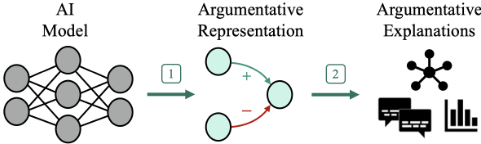
This family of argumentation formlisms is just one of a whole host which have been used to explain AI models (see [Cyras et al., 2021; Vassiliades et al., 2021; Guo et al., 2023] for recent overviews). However, the nexus of this paper will be on the use of (the various derivatives of) AFs, under gradual semantics, to explain the outputs of AI models. In particular, I will focus on those that follow the general paradigm shown in Figure 1. Here, an argumentative representation, e.g. a QBAF, is first extracted from an AI model, harbouring the explanatory information used to generate various forms of (thus argumentative) explanation to be delivered to users. Such a modular approach allows for uniform explanations to be created across different AI models and settings, which may bring benefits from a regulatory viewpoint, or simply for delivering consistent explanations to humans that they are comfortable with.
3 Forging Argumentative Representations
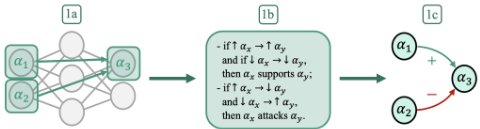
A methodology which we have pioneered, and forms the basis of the core ideas through a number of the approaches discussed in §4, is the forging of argumentative representations from AI models [Rago et al., 2022]. This process begins with the identification of potential arguments and relations in an AI model, limiting the explanation to those which are relevant, as is formalised as a principle for explanations in [Cyras et al., 2022]. We then determine which potential arguments and potential relations could be instantiated as part of the argumentation representation harbouring the explanatory information, thus ensuring the explanation is selective, as recommended by [Miller, 2019]. To do so, we reverse the usual process of gradual evaluation of arguments based on their relations with other arguments. Instead, we interpret some quantitative evaluation of the components in the AI model which are potential arguments, e.g. an activation value in a neural network. We then define an explanation mould, i.e. a set of relation characterisations such that if two potential arguments with a potential relation between them satisfy such constraints, we categorise the potential relation as an argumentative relation, e.g. an attack or support. These relation characterisations may thus be obtained by reinterpreting properties of gradual semantics. Given an input, we can then forge an argumentative representation which explains the AI model, based on predefined behaviours tailored to the user and setting. This process is illustrated in Figure 2.
In [Rago et al., 2022], we deployed this methodology to explain structural causal models [Pearl, 1999], using an explanation mould based on the reinterpretation of the property of bi-variate reinforcement [Amgoud and Ben-Naim, 2018]. Our theoretical analysis demonstrated advantages of the resulting argumentative representation from both explanatory and argumentative viewpoints. Then, in [Rago et al., 2023b], we forged argumentative representations to explain classifiers in general, demonstrating empirically its advantages over SHAP [Lundberg and Lee, 2017] in certain conditions. Both explanations here were input-output, i.e. those where only the inputs and outputs of the AI model are required. However, mechanistic explanations, which consider the AI model's internal functionality, are not beyond the potential of the methodology, as we will see in §4.
4 Argumentative Representations of AI Models
The general methodology of forging argumentative explanations has been deployed for different types of AI models in various settings. Neural networks of various types and architectures have also been shown to be amenable to argumentative explanations via the forging process. We pioneered this approach in [Dejl et al., 2021], selecting (single or groups of) neurons to be potential arguments in the forging process, allowing for different architectures, e.g. MLPs or convolutional neural networks (CNNs), in various tasks, e.g. text or image classification. This work was extended in [Sukpanichnant et al., 2021], where we interpreted an existing explanation method as a gradual semantics for the QBAFs representing neural networks. Meanwhile, the authors of [Ayoobi et al., 2023] took a different approach, including the step of sparsifying an MLP before translating it to a gradual argumentation framework, which outperformed the baselines in faithfulness.
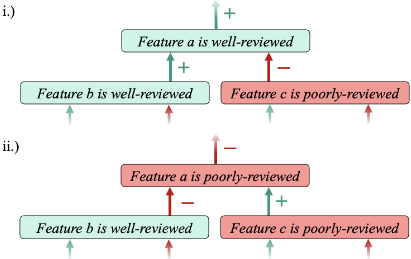
Another fruitful domain for this methodology is in recommender systems. We defined an explainable recommender system with a purpose-built graphical structure, from which argumentation frameworks with three relations (attacks, supports and neutralisers) can be extracted, consisting of the reasoning for the recommendation [Rago et al., 2018b]. A similar process is used in [Cocarascu et al., 2019], in which we deploy a variation of the forging methodology for aggregating movie reviews. Here, arguments are generated from entities in an ontology with the part of relation, instances of which serve as potential relations since more specific entities can be seen as attacking or supporting more general entities that they are part of. We use the intrinsic strength in a QBAF to represent the sentiment from reviews on each argument, extracted via NLP techniques, which are then used to determine the argumentative relations, as illustrated in Figure 3. The method gives an automated way of extracting argumentative explanations which are faithful to the review aggregation.
Other types of model have been explained with roughly the same methodology, e.g. Bayesian [Albini et al., 2023] and tree-based [Potyka et al., 2023] classifiers, with notable benefits in the explanations' faithfulness.
5 Generating Argumentative Explanations
In §4 we saw how argumentative representations may be extracted from AI models, but such argumentation frameworks alone are not sufficient explanations for humans, as demonstrated by the works on explaining argumentation frameworks themselves, e.g. [Borg and Bex, 2021]. These argumentation representations instead provide the means for generating explanations in a variety of different forms. Indeed, it has been shown that it is not only the content of an explanation which is crucial for performing in human-centric metrics such as comprehensibility and trust, but also the explanation's format [Bertrand et al., 2023]. Also important is an explanation's level of interactivity, a capability which is in line with the movement towards human-like, social explanations, as advocated by [Miller, 2019].
With the content of an explanation having been determined by the forging process, we now consider the effect of format. We demonstrated argumentation's capability for generating explanations of different formats in recommender systems, but also for supporting interactivity via human feedback, ensuring that this additional information affects the recommendations in an intuitive manner [Rago et al., 2020; Rago et al., 2021]. In [Rago et al., 2021], we undertook user studies which examined the effect of three different formats of argumentative explanation, namely textual, tabular and conversational, for recommendations in the movie domain. We found that users' comprehensibility of and trust in the recommender system improved after receiving explanations of any of the formats. Further, we found that humans did indeed have preferences over the format of explanation, but also that these preferences were diverse, a finding which corroborated that in [Rago et al., 2020]. Given that this is the case for something as seemingly innocuous as a movie recommendation, I would posit that this effect may be even more pronounced in high-stakes settings. This highlights the need for our methodology, supporting a range of explanations via a modular approach.
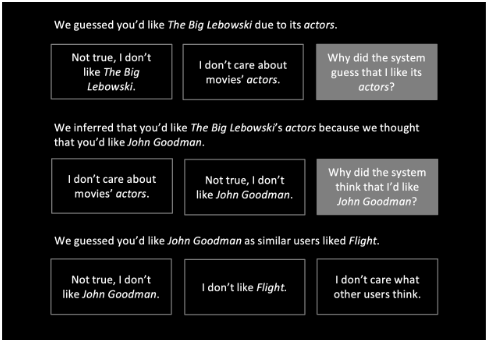
Argumentation itself has long been known to be an effective means for supporting dialogues, e.g. in persuasion [Hunter, 2018] or inquiry [Black and Hunter, 2007]. A recent contribution of ours in this area was a general framework for interactivity in explainable AI (and beyond) [Rago et al., 2023a]. Here, we frame the process of explanation between agents, e.g. a machine and a human, as a conflict resolution problem, using QBAFs once again. Given the fact that a number of AI models can be represented as (possibly restricted forms of) QBAFs, as we have seen in §4, we provide the groundwork for a comprehensive line of research into whether they can also represent humans' reasoning processes, and thus machine-human interactions. We also demonstrate the potential for representing cognitive biases, which are known to be a crucial component in XAI [Bertrand et al., 2022]. Finally, we show that greedily selecting the strongest, most relevant reasoning is not always the most effective in explanation, compared with taking an argumentative strategy in the selection.
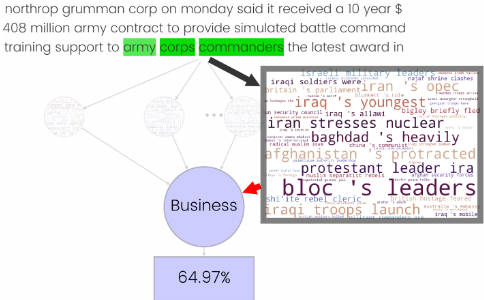
Interactivity can also be simply providing the means for users to select the content of information shown in an explanation, e.g. such that it is cognitively manageable or tailored to that individual user's preferences. We demonstrated argumentation's potential for this in [Dejl et al., 2021; Sukpanichnant et al., 2021], where arguments in explanations showing the words or pixels which activated a filter in a CNN are highlighted when selected, as demonstrated in Figure 5. In [Sukpanichnant et al., 2021] we also provided a comparison with the method of [Olah et al., 2018] within image classification, noting that, in our approach, the positions of the extracted arguments in the image were less influential.
6 Challenges, FutureWork and Outlook
We have seen that gradual argumentation provides a comprehensive repertoire for explaining the outputs of data-driven AI models. I introduced the methodology of forging an argumentative representation based on the explanatory content required for an AI model, task and application, before generating different forms of argumentative explanation depending on users' explanatory requirements. I then demonstrated the scope of this methodology across a subset of the domains in which it has been deployed. However, many challenges remain in this field, each bringing opportunities for future work.
One of the most prominent challenges is the widespread deployment of argumentative systems in real-world applications. As XAI proliferates, it is imperative that this wave of interest is ridden by argumentative XAI researchers, especially in applications such as engineering, which is fertile but somewhat untouched ground for AI models and their explanations. For this to take place, argumentative XAI methods need to prove they can navigate the bottlenecks of knowledge acquisition and scale, and their professed advantages in aligning with human behaviour and achieving user-centric metrics need to be validated in user studies, as in [Vesic et al., 2022]. This is especially the case for interactivity: as AI models become ever more intertwined with our daily lives, this offers an excellent opportunity for argumentative XAI to take advantage of its strengths in representing these interactions, via frameworks such as that we introduced [Rago et al., 2023a].
The representation of state-of-the-art AI models in argumentative forms is also an outstanding task. For example, most of the argumentative representations of neural networks in the literature concern either MLPs or CNNs. Such an abstraction for the transformer architecture [Vaswani et al., 2017] driving large language models (LLMs) [Min et al., 2024] is lacking, as far as I am aware. A simpler route may be to supplement the LLM with an explainable, argumentative wrapper, given the recent benefits which have been seen in training LLMs with argumentative knowledge [Furman et al., 2023]. A separate line of research which looks fruitful is the use of argumentation to explain tree-based classifiers, e.g. as in [Potyka et al., 2023], particularly given their widespread use in financial domains.
Other research directions which present opportunities for argumentative explanations include the proposed realignment of the XAI paradigm towards evaluative AI [Miller, 2023], wherein humans are given multiple options from an AI model, rather than a single output, with positive and negative reasoning for each. BAFs or QBAFs, with their attack and support relations, may prove to be effective here. Similarly, argumentation seems a natural fit for contestable AI, which is required by law in some jurisdictions, e.g. GDPR, article 22(3) 1 , states that a data subject shall have "at least the right [. . . ] to contest the decision".
1 https://gdpr-text.com/read/article-22/.
Acknowledgements
The author was partially funded by J.P. Morgan and by the Royal Academy of Engineering under the Research Chairs and Senior Research Fellowships scheme, and by ERC under the European Union's Horizon 2020 research and innovation programme (grant agreement No. 101020934). Any views or opinions expressed herein are solely those of the author.
@inproceedings{ijcai2024p983,
  title     = {A Little of That Human Touch: Achieving Human-Centric Explainable AI via Argumentation},
  author    = {Rago, Antonio},
  booktitle = {Proceedings of the Thirty-Third International Joint Conference on
               Artificial Intelligence, {IJCAI-24}},
  publisher = {International Joint Conferences on Artificial Intelligence Organization},
  editor    = {Kate Larson},
  pages     = {8565--8570},
  year      = {2024},
  month     = {8},
  note      = {Early Career},
  doi       = {10.24963/ijcai.2024/983},
  url       = {https://doi.org/10.24963/ijcai.2024/983},
}
TY - CPAPER TI - A Little of That Human Touch: Achieving Human-Centric Explainable AI via Argumentation AU - Rago, Antonio T2 - Proceedings of the Thirty-Third International Joint Conference on Artificial Intelligence, IJCAI-24 PB - International Joint Conferences on Artificial Intelligence Organization PY - 2024 SP - 8565 EP - 8570 DO - 10.24963/ijcai.2024/983 UR - https://doi.org/10.24963/ijcai.2024/983 ER -Copied
Machine-readable versions of this paper, for tools and AI agents:





