
Self-Adaptive Swarm System (SASS)
Proceedings of the Thirtieth International Joint Conference on Artificial Intelligence. Doctoral Consortium. Pages 5040-5041.
https://doi.org/10.24963/ijcai.2021/722
© 2021 International Joint Conferences on Artificial Intelligence
Keywords
- Uncertainty in AI: Bayesian Networks
- Robotics: Multi-Robot Systems
- Machine Learning: Bayesian Learning
- Agent-based and Multi-agent Systems: Agent Theories and Models
Abstract
Distributed artificial intelligence (DAI) studies artificial intelligence entities working together to reason, plan, solve problems, organize behaviors and strategies, make collective decisions and learn. This Ph.D. research proposes a principled Multi-Agent Systems (MAS) cooperation framework -- Self-Adaptive Swarm System (SASS) -- to bridge the fourth level automation gap between perception, communication, planning, execution, decision-making, and learning.
- [Koller and Friedman, 2009] Daphne Koller and Nir Fried- man. Probabilistic graphical models: principles and tech- niques. MIT press, 2009.
- [Nikolaev and Iba, 2006] Nikolay Nikolaev and Hitoshi Iba. Adaptive learning of polynomial networks: genetic programming, backpropagation and Bayesian methods. Springer Science & Business Media, 2006.
- [Rizk et al., 2018] Yara Rizk, Mariette Awad, and Edward W Tunstel. Decision making in multiagent systems: A sur- vey. IEEE Transactions on Cognitive and Developmental Systems, 10(3):514-529, 2018.
- [Rizk et al., 2019] Yara Rizk, Mariette Awad, and Edward W Tunstel. Cooperative heterogeneous multi-robot systems: A survey. ACM Computing Surveys (CSUR), 52(2):1-31, 2019.
- [Stone and Veloso, 2000] Peter Stone and Manuela Veloso. Multiagent systems: A survey from a machine learning perspective. Autonomous Robots, 8(3):345-383, 2000.
- [Wang and Yeung, 2020] Hao Wang and Dit-Yan Yeung. A survey on bayesian deep learning. ACM Computing Sur- veys (CSUR), 53(5):1-37, 2020.
- [Wooldridge, 2009] Michael Wooldridge. An introduction to multiagent systems. John Wiley & Sons, 2009.
- [Yang and Parasuraman, 2020a] Qin Yang and Ramviyas Parasuraman. A game-theoretic utility network for coop- erative multi-agent decisions in adversarial environments. arXiv preprint arXiv:2004.10950, 2020.
- [Yang and Parasuraman, 2020b] Qin Yang and Ramviyas Parasuraman. Hierarchical needs based self-adaptive framework for cooperative multi-robot system. In 2020 IEEE International Conference on Systems, Man, and Cy- bernetics (SMC), pages 2991-2998. IEEE, 2020.
- [Yang and Parasuraman, 2020c] Qin Yang and Ramviyas Parasuraman. Needs-driven heterogeneous multi-robot cooperation in rescue missions. In 2020 IEEE Interna- tional Symposium on Safety, Security, and Rescue Robotics (SSRR), pages 252-259. IEEE, 2020.
- [Yang and Parasuraman, 2021] Qin Yang and Ramviyas Parasuraman. How can robots trust each other? a rela- tive needs entropy based trust assessment models. arXiv preprint arXiv:2105.07443, 2021.
- [Yang et al., 2019] Qin Yang, Zhiwei Luo, Wenzhan Song, and Ramviyas Parasuraman. Self-Reactive Planning of Multi-Robots with Dynamic Task Assignments. In IEEE International Symposium on Multi-Robot and Multi-Agent Systems (MRS) 2019, 2019. Extended Abstract.
References were extracted automatically from the PDF and may contain errors.
Full text extracted automatically from the PDF; figures, tables and equations may differ. The PDF is the version of record.
1 Introduction
In the artificial systems, distributed artificial intelligence (DAI) has developed more than three decades as a subfield of artificial intelligence (AI). It has been divided into two sub-disciplines: Distributed Problem Solving (DPS) focuses on the information management aspects of systems with several branches working together towards a common goal; Multi-Agent Systems (MAS) deals with behavior management in collections of several independent entities, or agents [Stone and Veloso, 2000]. For cooperative MAS, the individual is aware of other group members, and actively shares and integrates its needs, goals, actions, plans, and strategies to achieve a common goal and benefit the entire group, especially building so-called artificial social systems [Wooldridge, 2009], such as Multi-Robot Systems (MRS).
For low-level planning and control, [Rizk et al., 2019] groups the system based on the cooperative tasks' complexity as four levels of automation, and no references were found currently. For high-level MAS decision-making and learning, recent studies mainly concern partial cooperation and do not consider deeper cooperative relationships among agents representing more complex team strategies [Rizk et al., 2018]. Combining the information from perceiving the environments and inferring the corresponding strategies and the world's conditional (or even causal) relations in those scenarios, a unified probabilistic framework to tightly integrate deep learning and Bayesian models adapting the environments and achieving the tasks with reasonable time complexity and efficient and effective information exchange between the perception component and the task-specific component are still challenging problems [Wang and Yeung, 2020].
2 Contributions
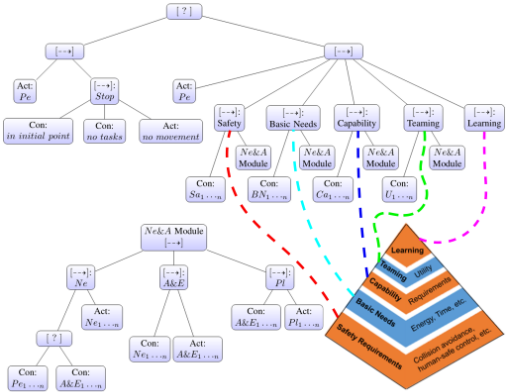
This Ph.D. research proposes a principled MAS cooperation framework called Self-Adaptive Swarm System (SASS) [Yang et al., 2019; Yang and Parasuraman, 2020b]. Fig. 1 shows needs-driven SASS mechanism represented as a Behavior Tree and we briefly introduce our contributions as follow:
Robot Needs Hierarchy To model an artificial intelligence agent's motivations and needs, we classify the Robot Needs Hierarchy as five different levels: safety needs (collision avoidance, human-safety control, etc.); basic needs (energy, time constraints, etc.); capability (heterogeneity, hardware differences, etc.); teaming (global utility, team performance, etc.); and self-upgrade (learning).
Negotiation-Agreement Mechanism We propose a distributed Negotiation-Agreement mechanism for selection (task assignment), formation (shape control), and routing (path planning) through automated planning of state-action sequences, helping MAS solve the conflicts in cooperation.
Atomic Operations By decomposing the complex tasks into a series of simple sub-tasks based on the Atomic Operations: Selection, Formation, and Routing, agents can recursively achieve all sub-tasks until MAS completes the mission.
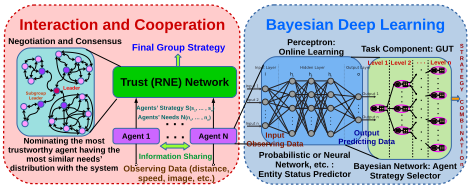
Game-theoretic Utility Tree (GUT) GUT [Yang and Parasuraman, 2020a] is a new state-space Bayesian network model [Koller and Friedman, 2009] for artificial intelligent agent decision-making in uncertain and adversarial environments. It builds hierarchical relationships between individual behaviors and interactive entities and helps agents infer the following step strategy combination representing more complex behaviors to adapt to various scenarios through given the observations and the arriving data in real-time.
Relative Needs Entropy (RNE) Based on the Robot Needs Hierarchy model, Trust can be defined as the difference or distance of needs distribution between agents or groups in a specific scenario. Statistics regard Relative Entropy as the similarity of high-dimensional sample sets. Here, we call it - Relative Needs Entropy (RNE) [Yang and Parasuraman, 2021], which describes the reliability and stability of the relationships between agents in MAS cooperation.
GUT-Based Bayesian Adaptive Learning By designing the appropriate Trust (RNE) Network, building suitable perception models, estimating reasonable parameters, simplifying the corresponding GUT model, and implementing structure learning (Fig. 2), adaptive learning [Nikolaev and Iba, 2006] can efficiently optimize the group strategy fitting the specific scenarios in MAS interaction and cooperation.
Explore Domain From the realistic and practical perspective, Explore Domain [Yang and Parasuraman, 2020a] analyzes how to organize more complex relationships and behaviors in MAS cooperation, achieving tasks with higher success probability and lower costs in adversarial environments.
Urban search and rescue (USAR) Through organizing heterogeneous agents' needs for MAS cooperation in USAR, we consider the Group's Utility (teaming needs) as the number of victims or valuable properties rescued as much as possible in a limited time [Yang and Parasuraman, 2020c].
3 Conclusion
In the SASS, Robot Needs Hierarchy is the foundation. It surveys the system's utility from individual needs. Balancing the rewards between agents and groups for MAS through interaction and adaptation in cooperation optimizes the global system's utility and guarantees sustainable development for each group member, much like human society does.
As a novel DAI model, the planning and control govern the individual low-level safety and basic needs; capability and teaming needs are the preconditions and requirements of MAS cooperation in decision-making for achieving tasks; individuals upgrade themselves from interaction, cooperation, and adaptation in the process for the highest level needs learning, helping SASS self-evolution.
@inproceedings{ijcai2021p722,
  title     = {Self-Adaptive Swarm System (SASS)},
  author    = {Yang, Qin},
  booktitle = {Proceedings of the Thirtieth International Joint Conference on
               Artificial Intelligence, {IJCAI-21}},
  publisher = {International Joint Conferences on Artificial Intelligence Organization},
  editor    = {Zhi-Hua Zhou},
  pages     = {5040--5041},
  year      = {2021},
  month     = {8},
  note      = {Doctoral Consortium},
  doi       = {10.24963/ijcai.2021/722},
  url       = {https://doi.org/10.24963/ijcai.2021/722},
}
TY - CPAPER TI - Self-Adaptive Swarm System (SASS) AU - Yang, Qin T2 - Proceedings of the Thirtieth International Joint Conference on Artificial Intelligence, IJCAI-21 PB - International Joint Conferences on Artificial Intelligence Organization PY - 2021 SP - 5040 EP - 5041 DO - 10.24963/ijcai.2021/722 UR - https://doi.org/10.24963/ijcai.2021/722 ER -Copied
Machine-readable versions of this paper, for tools and AI agents:





