
Interacting with Explanations through Critiquing
Proceedings of the Thirtieth International Joint Conference on Artificial Intelligence. Main Track. Pages 515-521.
https://doi.org/10.24963/ijcai.2021/72
Keywords
- AI Ethics, Trust, Fairness: Explainability
- Humans and AI: Personalization and User Modeling
- Data Mining: Recommender Systems
Abstract
Using personalized explanations to support recommendations has been shown to increase trust and perceived quality. However, to actually obtain better recommendations, there needs to be a means for users to modify the recommendation criteria by interacting with the explanation. We present a novel technique using aspect markers that learns to generate personalized explanations of recommendations from review texts, and we show that human users significantly prefer these explanations over those produced by state-of-the-art techniques.
Our work's most important innovation is that it allows users to react to a recommendation by critiquing the textual explanation: removing (symmetrically adding) certain aspects they dislike or that are no longer relevant (symmetrically that are of interest). The system updates its user model and the resulting recommendations according to the critique. This is based on a novel unsupervised critiquing method for single- and multi-step critiquing with textual explanations. Empirical results show that our system achieves good performance in adapting to the preferences expressed in multi-step critiquing and generates consistent explanations.
- [Antognini and Faltings, 2020] Diego Antognini and Boi Faltings. Hotelrec: a novel very large-scale hotel recommendation dataset. In the Language Resources and Evaluation Conference, 2020.
- [Antognini et al., 2021] Diego Antognini, Claudiu Musat, and Boi Faltings. Multi-dimensional explanation of target variables from documents. Proceedings of the AAAI Conference on Artificial Intelligence, 35, 2021.
- [Burke et al., 1996] Robin D. Burke, Kristian J. Hammond, and Benjamin C. Young. Knowledge-based navigation of complex information spaces. In Proceedings of the Thirteenth National Conference on Artificial Intelligence, page 462-468, 1996.
- [Catherine and Cohen, 2017] Rose Catherine and William Cohen. Transnets: Learning to transform for recommendation. In Pro- ceedings of the ACM conference on recommender systems, 2017.
- [Chen and Pu, 2012] Li Chen and Pearl Pu. Critiquing-based rec- ommenders: survey and emerging trends. User Modeling and User-Adapted Interaction, 22(1-2), 2012.
- [Chen et al., 2019] Zhongxia Chen, Xiting Wang, Xing Xie, Tong Wu, Guoqing Bu, Yining Wang, and Enhong Chen. Co-attentive multi-task learning for explainable recommendation. In IJCAI, pages 2137-2143, 2019. IJCAI
- [Chen et al., 2020] Zhongxia Chen, Xiting Wang, Xing Xie, Mehul Parsana, Akshay Soni, Xiang Ao, and Enhong Chen. Towards explainable conversational recommendation. IJCAI, 2020. IJCAI
- [Dong et al., 2017] Li Dong, Shaohan Huang, Furu Wei, Mirella Lapata, Ming Zhou, and Ke Xu. Learning to generate product reviews from attributes. In the Conference of the European Asso- ciation for Computational Linguistics, pages 623-632, 2017.
- [He et al., 2017] Xiangnan He, Lizi Liao, Hanwang Zhang, Liqiang Nie, Xia Hu, and Tat-Seng Chua. Neural collaborative filter- ing. In Proceedings of the 26th international conference on world wide web, pages 173-182, 2017.
- [Kunkel et al., 2018] Johannes Kunkel, Tim Donkers, Catalin- Mihai Barbu, and Jürgen Ziegler. Trust-related effects of exper- tise and similarity cues in human-generated recommendations. In 2nd Workshop on Theory-Informed User Modeling, 2018.
- [Kunkel et al., 2019] Johannes Kunkel, Tim Donkers, Lisa Michael, Catalin-Mihai Barbu, and Jürgen Ziegler. Let me explain: Impact of personal and impersonal explanations on trust in recommender systems. In Proceedings of the CHI Conference on Human Factors in Computing Systems, 2019.
- [Li et al., 2017] Piji Li, Zihao Wang, Zhaochun Ren, Lidong Bing, and Wai Lam. Neural rating regression with abstractive tips gen- eration for recommendation. In the ACM SIGIR conference on Research and Development in Information Retrieval, 2017.
- [Li et al., 2019] Piji Li, Zihao Wang, Lidong Bing, and Wai Lam. Persona-aware tips generation. In The World Wide Web Confer- ence, 2019.
- [Luo et al., 2020] Kai Luo, Scott Sanner, Ga Wu, Hanze Li, and Hojin Yang. Latent linear critiquing for conversational recom- mender systems. In Proceedings of the 29th International Con- ference on the World Wide Web, 2020.
- [Mann and Thompson, 1988] William C Mann and Sandra A Thompson. Rhetorical structure theory: Toward a functional the- ory of text organization. Text-interdisciplinary Journal for the Study of Discourse, 8(3):243-281, 1988.
- [McAuley and Leskovec, 2013] Julian McAuley and Jure Leskovec. Hidden factors and hidden topics: understand- ing rating dimensions with review text. In the ACM conference on Recommender systems, pages 165-172. ACM, 2013.
- [Musat and Faltings, 2015] Claudiu Cristian Musat and Boi Falt- ings. Personalizing product rankings using collaborative filtering on opinion-derived topic profiles. In Twenty-Fourth International Joint Conference on Artificial Intelligence, 2015.
- [Ni and McAuley, 2018] Jianmo Ni and Julian McAuley. Person- alized review generation by expanding phrases and attending on aspect-aware representations. In Proceedings of the Association for Computational Linguistics, pages 706-711, 2018.
- [Ni et al., 2019] Jianmo Ni, Jiacheng Li, and Julian McAuley. Justi- fying recommendations using distantly-labeled reviews and fine- grained aspects. In the 2019 Conference on Empirical Methods in Natural Language Processing (EMNLP-IJCNLP), 2019.
- [Pu et al., 2006] Pearl Pu, Paolo Viappiani, and Boi Faltings. In- creasing user decision accuracy using suggestions. In Proceed- ings of the SIGCHI conference on Human Factors in computing systems, pages 121-130, 2006.
- [Radford et al., 2019] Alec Radford, Jeffrey Wu, Rewon Child, David Luan, Dario Amodei, and Ilya Sutskever. Language mod- els are unsupervised multitask learners. OpenAI blog, 2019.
- [Reilly et al., 2005] James Reilly, Kevin McCarthy, Lorraine McGinty, and Barry Smyth. Explaining compound critiques. Ar- tificial Intelligence Review, 2005.
- [Sun et al., 2020] Peijie Sun, Le Wu, Kun Zhang, Yanjie Fu, Richang Hong, and Meng Wang. Dual learning for explainable recommendation: Towards unifying user preference prediction and review generation. In Proceedings of World Wide Web, 2020.
- [Tintarev and Masthoff, 2015] Nava Tintarev and Judith Masthoff. Explaining recommendations: Design and evaluation. In Recom- mender systems handbook, pages 353-382. Springer, 2015.
- [Wang et al., 2019] Ke Wang, Hang Hua, and Xiaojun Wan. Con- trollable unsupervised text attribute transfer via editing entangled latent representation. In Annual Conference on Neural Informa- tion Processing Systems, pages 11034-11044, 2019.
- [Williams and Tou, 1982] Michael D Williams and Frederich N Tou. Rabbit: an interface for database access. In Proceedings of the ACM Conference, pages 83-87, 1982.
- [Wu et al., 2019] Ga Wu, Kai Luo, Scott Sanner, and Harold Soh. Deep language-based critiquing for recommender systems. In Proceedings of the 13th ACM Conference on Recommender Sys- tems, pages 137-145, 2019.
- [Yao et al., 2019] Lili Yao, Nanyun Peng, Ralph Weischedel, Kevin Knight, Dongyan Zhao, and Rui Yan. Plan-and-write: Towards better automatic storytelling. In Proceedings of the AAAI Con- ference on Artificial Intelligence, pages 7378-7385, 2019.
- [Zhang and Curley, 2018] Jingjing Zhang and Shawn P Curley. Ex- ploring explanation effects on consumers' trust in online recom- mender agents. International Journal of Human-Computer In- teraction, 34(5):421-432, 2018.
- [Zhang et al., 2014] Yongfeng Zhang, Guokun Lai, Min Zhang, Yi Zhang, Yiqun Liu, and Shaoping Ma. Explicit factor mod- els for explainable recommendation based on phrase-level senti- ment analysis. In the 37th ACM SIGIR conference on Research & development in information retrieval, pages 83-92, 2014.
- [Zhang et al., 2020] Tianyi Zhang, Varsha Kishore, Felix Wu, Kil- ian Q. Weinberger, and Yoav Artzi. Bertscore: Evaluating text generation with bert. In ICLR 2020, 2020.
References were extracted automatically from the PDF and may contain errors.
Full text extracted automatically from the PDF; figures, tables and equations may differ. The PDF is the version of record.
1 Introduction
Explanations of recommendations are beneficial. Modern recommender systems accurately capture users' preferences and achieve high performance. But, their performance comes at the cost of increased complexity, which makes them seem like black boxes to users. This may result in distrust or rejection of the recommendations [Tintarev and Masthoff, 2015].
There is thus value in providing textual explanations of the recommendations, especially on e-commerce websites, because such explanations enable users to understand why a particular item has been suggested and hence to make better decisions [Kunkel et al., 2018]. Furthermore, explanations increase overall system transparency [Tintarev and Masthoff, 2015] and trustworthiness [Zhang and Curley, 2018].
However, not all explanations are equivalent. [Kunkel et al., 2019] showed that highly personalized justifications using natural language lead to substantial increases in perceived recommendation quality and trustworthiness compared to simpler explanations, such as aspect, template, or similarity.
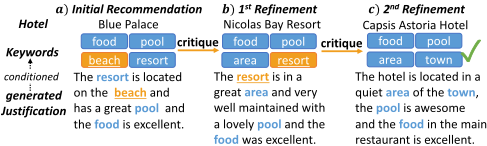
A second, and more important, benefit of explanations is that they provide a basis for feedback: if a user is unsatisfied with a recommendation, understanding what generated it allows them to critique it (Fig. 1). Critiquing - a conversational method of incorporating user preference feedback regarding item attributes into the recommended list of items - has several advantages. First, it allows the system to correct and improve an incomplete or inaccurate model of the user's preferences, which improves the user's decision accuracy [Chen and Pu, 2012]. Compared to preference elicitation, critiquing is more flexible: users can express preferences in any order and on any criteria [Reilly et al., 2005].
Useful explanations are hard to generate. Prior research has employed users' reviews to capture their preferences and writing styles (e.g., [Dong et al., 2017]). From past reviews, they generate synthetic ones that serve as personalized explanations of ratings given by users. However, many reviews are noisy, because they partly describe experiences or endorsements. It is thus nontrivial to identify meaningful justifications inside reviews. [Ni et al., 2019] proposed a pipeline for identifying justifications from reviews and asked humans to annotate them. [Chen et al., 2019; Chen et al., 2020] set the justification as the first sentence. However, these notions of justification were ambiguous, and they assumed that a review contains only one justification.
Recently, [Antognini et al., 2021] solved these shortcomings by introducing a justification extraction system with no prior limits imposed on their number or structure. This is important because a user typically justifies his overall rating with multiple explanations: one for each aspect the user cares about [Musat and Faltings, 2015]. The authors showed that there is a connection between faceted ratings and snippets within the reviews: for each subrating, there exists at least one text fragment that alone suffices to make the prediction. They employed a sophisticated attention mechanism to favor long, meaningful word sequences; we call these markers. Building upon their study, we show that these markers serve to create better user and item profiles and can inform better user-item pair justifications. Fig. 2 illustrates the pipeline.
From explanations to critiquing. To reflect the overlap between the profiles of a user and an item, one can produce a set of keyphrases and then a synthetic justification. The user can correct his profile, captured by the system, by critiquing certain aspects he does not like or that are missing or not relevant anymore and obtain a new justification (Fig. 1). [Wu et al., 2019] introduced a keyphrase-based critiquing method in which attributes are mined from reviews, and users interact with them. However, their models need an extra autoencoder to project the critique back into the latent space, and it is unclear how the models behave in multi-step critiquing.
We overcome these drawbacks by casting the critiquing as an unsupervised attribute transfer task: altering a keyphrase explanation of a user-item pair representation to the critique. To this end, we entangle the user-item pair with the explanation in the same latent space. At inference, the keyphrase classifier modulates the latent representation until the classifier identifies it as the critique vector.
In this work, we address the problem recommendation with fine-grained explanations. We first demonstrate how to extract multiple relevant and personalized justifications from the user's reviews to build a profile that reflects his preferences and writing style (Fig. 2). Second, we propose TRECS, a recommender with explanations. T-RECS explains a rating by first inferring a set of keyphrases describing the intersection between the profiles of a user and an item. Conditioned on the keyphrases, the model generates a synthetic personalized justification. We then leverage these explanations in an unsupervised critiquing method for single- and multistep critiquing. We evaluate our model using two real-world recommendation datasets. T-RECS outperforms strong baselines in explanation generation, effectively re-ranks recommended items in single-step critiquing. Finally, T-RECS also better models the user's preferences in multi-step critiquing while generating consistent textual justifications.
2 RelatedWork
2.1 Textual Explainable Recommendation
Researchers have investigated many approaches to generating textual explanations of recommended items for users. [McAuley and Leskovec, 2013] proposed a topic model to discover latent factors from reviews and explain recommendations. [Zhang et al., 2014] improved the understandability of topic words and aspects by filling template sentences.
Another line of research has generated synthetic reviews as explanations. Prior studies have employed users' reviews and tips to capture their preferences and writing styles. [Catherine and Cohen, 2017] predicted and explained ratings by encoding the user's review and identifying similar reviews. [Chen et al., 2019] extended the previous work to generate short synthetic reviews. [Sun et al., 2020] optimized both tasks in dual forms. [Dong et al., 2017] proposed an attribute-tosequence model to learn how to generate reviews given categorical attributes. [Ni and McAuley, 2018] improved review generation by leveraging aspect information using a seq-toseq model with attention. Instead of reviews, others have generated tips [Li et al., 2017; Li et al., 2019]. However, the tips are scarce and uninformative [Chen et al., 2019]; many reviews are noisy because they describe partially general experiences or endorsements [Ni et al., 2019].
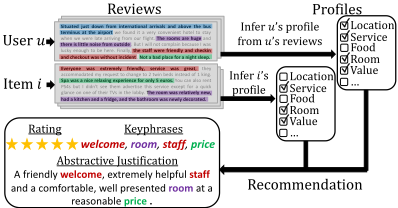
[Ni et al., 2019] built a seq-to-seq model conditioned on the aspects to generate relevant explanations for an existing recommender system; the fine-grained aspects are provided by the user in the inference. They identified justifications from reviews by segmenting them into elementary discourse units (EDU) [Mann and Thompson, 1988] and asking annotators to label them as "good" or "bad" justifications. [Chen et al., 2019] set the justification as the first sentence. All assumed that a review contains only one justification. Whereas their notions of justification were ambiguous, we extract multiple justifications from reviews using markers that justify subratings. Unlike their models, ours predicts keyphrases on which the justifications are conditioned and integrates critiquing.
2.2 Critiquing
Refining recommended items allows users to interact with the system until they are satisfied. Some methods are example critiquing [Williams and Tou, 1982], in which users critique a set of items; unit critiquing [Burke et al., 1996], in which users critique an item's attribute and request another one instead; and compound critiquing [Reilly et al., 2005] for more aspects. The major drawback of these approaches is the assumption of a fixed set of known attributes.
[Wu et al., 2019] circumvented this limitation by extending the neural collaborative filtering model [He et al., 2017]. First, the model explains a recommendation by predicting a set of keywords (mined from users' reviews). In [Chen et al., 2020], based on [Chen et al., 2019], the model samples only
.
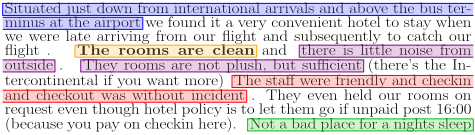
Figure 3: Extracted justifications from a hotel review. The inferred markers depict the excerpts that explain the ratings of the aspects: Service, Cleanliness, Value, Room, and Location. We denote in bold the EDU-based justification from the model of [Ni et al., 2019].
one keyword via the Gumbel-Softmax function. Our work applies a deterministic strategy similar to [Wu et al., 2019].
Second, [Wu et al., 2019] project the critiqued keyphrase explanations back into the latent space, via an autoencoder that perturbs the training, fromwhich the rating and the explanation are predicted. In this manner, the user's critique modulates his latent representation. The model of [Chen et al., 2020] is trained in a two-stage manner: one to perform recommendation and predict one keyword and another to learn critiquing from online feedback, which requires additional data. By contrast, our model is simpler and learns critiquing in an unsupervised fashion: it iteratively edits the latent representation until the new explanation matches the critique. Finally, [Luo et al., 2020] examined various linear aggregation methods on latent representations for multi-step critiquing. In comparison, our gradient-based critiquing iteratively updates the latent representation for each critique.
3 Extracting Justifications fromReviews
In this section, we introduce the pipeline for extracting highquality and personalized justifications from users' reviews. We claim that a user justifies his overall experience with multiple explanations: one for each aspect he cares about. Indeed, it has been shown that users write opinions about the topics they care about [Zhang et al., 2014]. Thus, the pipeline must satisfy two requirements: 1. extract text snippets that reflect a rating or subrating, and 2. be data driven and scalable to mine massive review corpora and to construct a large personalized recommendation justification dataset.
[Antognini et al., 2021] proposed the multi-target masker (MTM) to find text fragments that explain faceted ratings in an unsupervised manner. MTM fulfills the two requirements. For each word, the model computes a distribution over the aspect set, which corresponds to the aspect ratings (e.g., service, location) and "not aspect." In parallel, the model minimizes the number of selected words and discourages aspect transition between consecutive words. These two constraints guide the model to produce long, meaningful sequences of words called markers. The model updates its parameters by using the inferred markers to predict the aspect sentiments jointly and improves the quality of the markers until convergence.
Given a review, MTM extracts the markers of each aspect. A sample is shown in Fig. 3. Similarly to [Ni et al., 2019], we filter out markers that are unlikely to be suitable justifications: including third-person pronouns or being too short. We use the constituency parse tree to select markers are verb phrases.
4 T-RECS: AMulti-Task Transformer with Explanations and Critiquing
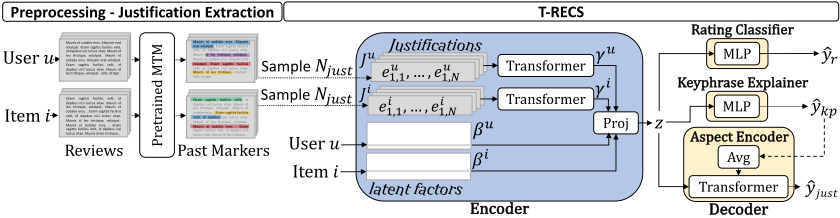
Fig. 4 depicts the pipeline and our proposed T-RECS model. Let U and I be the user and item sets. For each user u ∈ U (respectively an item i ∈ I), we extract markers from the user's reviews on the training set, randomly select Njust, and build a justification reference J u (symmetrically J i ).
Given a user u, an item i, and their justification history J u and J i , our goal is to predict 1. a rating yr, 2. a keyphrase explanation ykp describing the relationship between u and i, and 3. a natural language justification yjust = {w1, ..., wN}, where N is the length of the justification. yjust explains the rating yr conditioned on ykp.
4.1 Model Overview
For each user and item, we extract markers from their past reviews (in the train set) and build their justification history J u and J i , respectively (see Section 3). T-RECS is divided into four submodels: an Encoder E, which produces the latent representation z from the historical justifications and latent factors of the user u and the item i; a Rating Classifier C r , which classifies the rating ˆ yr; a Keyphrase Explainer C kp , which predicts the keyphrase explanation ˆ ykp of the latent representation z; and a Decoder D, which decodes the justification ˆ yjust from z conditioned on ˆ ykp, encoded via the Aspect Encoder A. T-RECS involves four functions: z = E(u, i);ˆ yr = C r (z);ˆ ykp = C kp (z); ˆ yjust = D(z, A(ˆ ykp)). The above formulation contains two types of personalized explanations: a list of keyphrases ˆ ykp that reflects the different aspects of item i that the user u cares about (i.e., the overlap between their profiles) and a natural language explanation ˆ yjust that justifies the rating, conditioned on ˆ ykp. The set of keyphrases is mined from the reviews and reflects the different aspects deemed important by the users. The keyphrases enable an interaction mechanism: users can express agreement or disagreement with respect to one or multiple aspects and hence critique the recommendation.
Entangling User-Item
A key objective of T-RECS is to build a powerful latent representation. It accurately captures user and item profiles with their writing styles and entangles the rating, keyphrases, and a natural language justification. Inspired by the superiority of the Transformer for text generation tasks [Radford et al., 2019], we propose a Transformer-based encoder that learns latent personalized features from users' and items' justifications. We first pass each justification J u j (respectively J i j ) through the Transformer to compute the intermediate representations huj (respectively hij ). We apply a sigmoid function on the representations and average them to get γ u and γ i :
In parallel, the encoder maps the user u (item i) to the latent factors βu (βi ) via an embedding layer. We compute the latent representation z by concatenating the latent personalized features and factors and applying a linear projection: z = E(u, i) = W[γ u ‖ γ i ‖ βu ‖ βi ] + b, where ‖ is the concatenation operator, and W and b the projection parameters.
Rating Classifier & Keyphrase Explainer
Our framework classifies the interaction between the user u and item i as positive or negative. Moreover, we predict the keyphrases that describe the overlap of their profiles. Both models are a two-layer feedforward neural network with LeakyRelu activation function. Their respective losses are:
where Lr is the mean square error, Lkp the binary crossentropy, and K the whole set of keyphrases.
Justification Generation
The last component consists of generating the justification. Inspired by "plan-and-write" [Yao et al., 2019], we advance the personalization of the justification by incorporating the keyphrases ˆ ykp. In other words, T-RECS generates a natural language justification conditioned on the 1. user, 2. item, and 3. aspects of the item that the user would consider important. We encode these via the Aspect Encoder A that takes the average of their word embeddings from the embedding layer in the Transformer. The aspect embedding is denoted by akp and added to the latent representation: ˜ z = z + akp. Based on ˜ z, the Transformer decoding block computes the output probability ˆ yt,w just for the word w at time-step t. We train using teacher-forcing and cross-entropy with label smoothing:
We train T-RECS end-to-end and minimize jointly the loss L = λrLr +λkpLkp +λjustLjust, where λr, λkp, and λjust control the impact of each loss. All objectives share the latent representation z and are thus mutually regularized by the function E(u, i) to limit overfitting by any objective.
4.2 Unsupervised Critiquing
The purpose of critiquing is to refine the recommendation based on the user's interaction with the explanation, the keyphrases ˆ ykp, represented with a binary vector. The user critiques either a keyphrase k by setting ˆ yk kp = 0 (i.e., disagreement) or symmetrically adding a new one (i.e.,ˆ yk kp = 1).
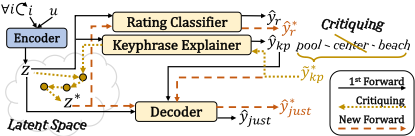
We denote the critiqued keyphrase explanation as ˜ y∗ kp . The overall critiquing process is depicted in Fig. 5. Inspired by the recent success in editing the latent space on the unsupervised text attribute transfer task [Wang et al., 2019], we employ the trained Keyphrase Explainer C kp and the critiqued explanation ˜ y∗ kp to provide the gradient from which we update the latent representation z (depicted in yellow). More formally, given a latent representation z and a binary critique vector ˜ y∗ kp , we want to find a new latent representation z∗ that will produce a new keyphrase explanation close to the critique, such that |C kp (z∗ ) - ˜ y∗ kp | ≤ T, where T is a threshold. In order to achieve this goal, we iteratively compute the gradient with respect to z instead of the model parameters C kp θ . We then modify z in the direction of the gradient until we get a new latent representation z∗ that C kp considers close enough to ˜ y∗ kp (shown in orange). We emphasize that we use the gradient to modulate z rather than the parameters C kp .
Let denote the gradient as gt and a decay coefficient as ζ. For each iteration t and z∗ 0 = z, the modified latent representation z∗ t at the tth iteration can be formulated as follows:
Because this optimization is nonconvex, there is no guarantee that the difference between the critique vector and the inferred explanation will differ by only T . In our experiments in Section 5.4, we found that a limit of 50 iterations works well, and that the newly induced explanations remain consistent.
5 Experiments
5.1 Experimental Settings
Datasets. We evaluate the quantitative performance of TRECS using two real-world, publicly available datasets: BeerAdvocate [McAuley and Leskovec, 2013] and HotelRec [Antognini and Faltings, 2020]. They contain 1.5 and 50 million reviews from BeerAdvocate and TripAdvisor. In addition to the overall rating, users also provided five-star aspect ratings. We binarize the ratings with a threshold t: t > 4 for hotel reviews and t > 3.5 for beer reviews. We further filter out all users with fewer than 20 interactions and sort them chronologically. We keep the first 80% of interactions per user as the training data, leaving the remaining 20% for validation and testing. We sample two justifications per review. We need to select keyphrases for explanations and critiquing. Hence, we follow the processing in [Wu et al., 2019] to extract 200 keyphrases (distributed uniformly over the aspect categories) from the markers on each dataset.
Implementation Details. To extract markers, we trained MTM with the hyperparameters reported by the authors. We build the justification history J u ,J i , with Njust = 32. We set the embedding and attention dimension to 256 and to 1024 for the feed-forward network. The encoder and decoder consist of two layers of Transformer with 4 attention heads. We use a batch size of 128, dropout of 0.1, and Adam with learning rate 0.001. For critiquing, we choose a threshold and decay coefficient T = 0.015, ζ = 0.9 and T = 0.01, ζ = 0.975 for hotel and beer reviews. We tune all models on the dev set. For reproducibility purposes, we provide details in Appendix. 1
5.2 RQ 1: Are Markers Appropriate Justifications?
We derive baselines from [Ni et al., 2019]: we split a review into elementary discourse units (EDUs) and apply their classifier to get justifications; it is trained on a manually annotated dataset and generalizes well to other domains. We employ two variants: EDU One and EDU All. The latter includes all justifications, whereas the former includes only one.
We perform a human evaluation using Amazon's Mechanical Turk (see Appendix for more details) to judge the quality of the justifications extracted from the Markers, EDU One, and EDU All on both datasets. We employ three setups: an evaluator is presented with 1. the three types of justifications; 2. only those from Markers and EDU All; and 3. EDU One instead of EDU All. We sampled 300 reviews (100 per setup) with generated justifications presented in random order. The annotators judged the justifications by choosing the most convincing in the pairwise setups and otherwise using best-worst scaling. We report the win rates for the pairwise comparisons and a normalized score ranging from -1 to +1.
Table 2 shows that justifications extracted from Markers are preferred, on both datasets, more than 80% of the time. Moreover, when compared to EDU All and EDU One, Markers achieve a score of 0.74, three times higher than EDU All. Therefore, justifications extracted from the Markers are significantly better than EDUs, and a single justification cannot explain a review. Fig. 3 shows a sample for comparison.
1 Appendices are available at http://arxiv.org/pdf/2005.11067.pdf
| #Inter. | Avg. #KP per | |||||||
|---|---|---|---|---|---|---|---|---|
| Dataset | #Users | #Items | Dens. | KP Cov. | Just. | Rev. | User | |
| Hotel | 72,603 | 38896 | 2.2M | 0.08% | 97.66% | 2.15 | 3.79 | 115 |
| Beer | 7,304 | 8,702 | 1.2M | 2.02% | 96.87% | 3.72 | 6.97 | 1,210 |
| Winner Loser | Hotel | Beer Win Rate | |||||
|---|---|---|---|---|---|---|---|
| Markers EDU All | Win Rate 81%** | 77%** | |||||
| Markers EDU One Model | Score | 93%** | #B | #W | Score | 90%** #B | #W |
| EDU One | -0.95** | 1 | 96 | -0.93** | 2 | 95 | |
| EDU All | 0.21** | 24 | 3 | 0.20** | 23 | 3 | |
| Markers | 0.74 | 75 | 1 | 0.73 | 75 | 2 | |
5.3 RQ 2: Does T-RECS Generate High-Quality, Relevant, and Personalized Explanations?
Natural Language Explanations. We consider five baselines: ExpansionNet [Ni and McAuley, 2018] is a seq-to-seq model with a user, item, aspect, and fusion attention mechanism that generates personalized reviews. DualPC [Sun et al., 2020] and CAML [Chen et al., 2019] generate an explanation based on a rating and the user-item pair. Ref2Seq improves upon ExpansionNet by learning only from historical justifications of a user and an item. AP-Ref2Seq [Ni et al., 2019] extends Ref2Seq with aspect planning [Yao et al., 2019], in which aspects are given during the generation. All models use beam search during testing and the same keyphrases as aspects. We employ BLEU, ROUGE-L, BertScore [Zhang et al., 2020], the perplexity for the fluency, and RKW for the explanation consistency as in [Chen et al., 2020]: the ratio of the target keyphrases present in the generated justifications.
The main results are presented in Table 3 (more in Appendix). T-RECS achieves the highest scores on both datasets. We note that 1. seq-to-seq models better capture user and item information to produce more relevant justifications, and 2. using a keyphrase plan doubles the performance on average and improving explanation consistency.
We run a human evaluation, with the best models according to RKW , using best-worst scaling on the dimensions: overall, fluency, informativeness, and relevance. We sample 300 explanations and showed them in random order. Table 4 shows that our explanations are largely preferred on all criteria.
Keyphrase Explanations. We compare T-RECS with the popularity baseline and the models proposed in [Wu et al., 2019], which are extended versions of the NCF model [He et al., 2017]. E-NCF and CE-NCF augment the NCF method with an explanation and a critiquing neural component. Also, the authors provide variational variants: VNCF, E-VNCF, and CE-VNCF. Here, we omit NCF and VNCF because they are trained only to predict ratings. We report the following metrics: NDCG, MAP, Precision, and Recall at 10.
| Model | BLEU | R-L | BERTScore | PPL↓ | RKW |
|---|---|---|---|---|---|
| ExpansionNet | 0.53 | 6.91 | 74.81 | 28.87 | 60.09 |
| DualPC | 1.53 | 16.73 | 86.76 | 28.99 | 13.12 |
| Hotel CAML | 1.13 | 16.67 | 87.77 | 29.10 | 9.38 |
| Ref2Seq | 1.77 | 16.45 | 86.74 | 29.07 | 13.19 |
| AP-Ref2Seq | 7.28 | 33.71 | 88.31 | 21.31 | 90.20 |
| T-RECS | 7.47 | 34.10 | 90.23 | 17.80 | 93.57 |
| ExpansionNet | 1.22 | 9.68 | 72.32 | 22.28 | 82.49 |
| DualPC | 2.08 | 14.68 | 85.49 | 21.15 | 10.60 |
| Beer CAML | 2.43 | 14.99 | 85.96 | 21.29 | 10.18 |
| Ref2Seq | 3.51 | 15.96 | 85.27 | 22.34 | 12.10 |
| AP-Ref2Seq | 15.89 | 46.50 | 91.35 | 12.07 | 91.52 |
| T-RECS | 16.54 | 47.20 | 91.50 | 10.24 | 94.96 |
| Hotel | Beer | |||||||
|---|---|---|---|---|---|---|---|---|
| Model | O | F | I | R | O | F | I | R |
| ExpansionNet | -0.58 | -0.67 | -0.52 | -0.56 | -0.03 | -0.31 | 0.10 | -0.01 |
| Ref2Seq | -0.27 | -0.19 | -0.30 | -0.26 | -0.69 | -0.34 | -0.71 | -0.69 |
| AP-Ref2Seq | 0.30 | 0.32 | 0.29 | 0.29 | 0.22 | 0.25† | 0.21† | 0.25 |
| T-RECS | 0.55 | 0.54 | 0.53 | 0.53 | 0.49 | 0.39 | 0.39 | 0.45 |
Table 5 shows that T-RECS outperforms the CE-(V)NCF models by 60%, Pop by 20%, and E-(V)NCF models by 10% to 30% on all datasets. Pop performs better than CE-(V)NCF, showing that many keywords are recurrent in reviews. Thus, predicting keyphrases from the user-item latent space is a natural way to entangle them with (and enable critiquing).
5.4 RQ 3: Can T-RECS Enable Critiquing?
Single-Step Critiquing. For a given user, T-RECS recommends an item and generates personalized explanations, where the user can interact by critiquing one or multiple keyphrases. However, no explicit ground truth exists to evaluate the critiquing. We use F-MAP [Wu et al., 2019] to measure the effect of a critique. Given a user, a set of recommended items S, and a critique k, let Sk be the set of items containing k in the explanation. The F-MAP measures the ranking difference of the affected items Sk before and after critiquing k, using the Mean Average Precision at N. A positive F-MAP indicates that the rank of items in Sk fell after k is critiqued. We compare T-RECS with CE-(V)NCF and average the F-MAP over 5, 000 user-keyphrase pairs.
Fig. 6a presents the F-MAP performance on both datasets. All models show an anticipated positive F-MAP. The performance of T-RECS improves considerably on the beer dataset and is significantly higher for N ≤ 10 on the hotel dataset. The gap in performance may be caused by the extra loss of the autoencoder, which brings noise during training. T-RECS only iteratively edits the latent representation at test time.
Multi-Step Critiquing. Evaluating multi-step critiquing via ranking is difficult because many items can have the keyphrases of the desired item. Instead, we evaluate whether
| Hotel | Beer | |||||||
|---|---|---|---|---|---|---|---|---|
| Model | NDCG | MAP | P | R | NDCG | MAP | P | R |
| Pop | 0.333 | 0.208 | 0.143 | 0.396 | 0.250 | 0.229 | 0.176 | 0.253 |
| E-NCF | 0.341 | 0.215 | 0.137 | 0.380 | 0.249 | 0.220 | 0.179 | 0.262 |
| CE-NCF | 0.229 | 0.143 | 0.092 | 0.255 | 0.192 | 0.172 | 0.136 | 0.197 |
| E-VNCF | 0.344 | 0.216 | 0.139 | 0.386 | 0.236 | 0.210 | 0.170 | 0.248 |
| CE-VNCF | 0.229 | 0.134 | 0.107 | 0.297 | 0.203 | 0.178 | 0.148 | 0.215 |
| T-RECS | 0.376 | 0.236 | 0.158 | 0.436 | 0.316 | 0.280 | 0.228 | 0.332 |
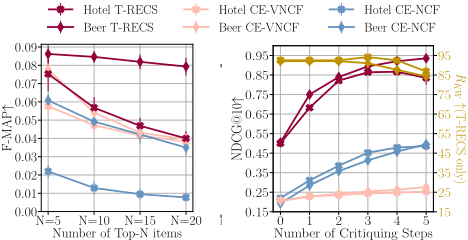
- (a) Falling MAP for different top-N. Error bars show the standard deviation.
(b) Keyphrase prediction over multistep critiquing with 95% confidence interval. We also report the explanation consistency RKW for T-RECS.
Figure 6: Single- (top) and multi-step (bottom) critiquing.
a system obtains a complete model of the user's preferences following [Pu et al., 2006]. A user expresses his keyphrase preferences iteratively according to a randomly selected liked item. After each step, we evaluate the keyphrase explanations. For T-RECS, we also report the explanation consistency RKW. We run up to five-steps critiques over 1, 000 random selected users and up to 5, 000 random keyphrases for each dataset. Fig. 6b shows that T-RECS builds through the critiques more accurate user profiles and consistent explanations. CE-NCF's top performance is significantly lower than T-RECS, and CE-VNCF plateaus, surely because of the KL divergence regularization, which limits the amount of information stored in the latent space. The explanation quality in T-RECS depends on the accuracy of the user's profile and may become saturated once we find it after four steps. 2
6 Conclusion
Recommendations can carry much more impact if they are supported by explanations. We presented T-RECS, a multitask learning Transformer-based recommender, that produces explanations considered significantly superior when evaluated by humans. The second contribution of T-RECS is the user's ability to react to a recommendation by critiquing the explanation. We designed an unsupervised method for multistep critiquing with explanations. Experiments show that TRECS obtains stable and significant improvement in adapting to the preferences expressed in multi-step critiquing.
2 We could not compare T-RECS with [Chen et al., 2020] because the authors did not make the code available due to copyright issues.
@inproceedings{ijcai2021p72,
  title     = {Interacting with Explanations through Critiquing},
  author    = {Antognini, Diego and Musat, Claudiu and Faltings, Boi},
  booktitle = {Proceedings of the Thirtieth International Joint Conference on
               Artificial Intelligence, {IJCAI-21}},
  publisher = {International Joint Conferences on Artificial Intelligence Organization},
  editor    = {Prof. Zhi-Hua Zhou},
  pages     = {515--521},
  year      = {2021},
  month     = {8},
  note      = {Main Track},
  doi       = {10.24963/ijcai.2021/72},
  url       = {https://doi.org/10.24963/ijcai.2021/72},
}
TY - CPAPER TI - Interacting with Explanations through Critiquing AU - Antognini, Diego AU - Musat, Claudiu AU - Faltings, Boi T2 - Proceedings of the Thirtieth International Joint Conference on Artificial Intelligence, IJCAI-21 PB - International Joint Conferences on Artificial Intelligence Organization PY - 2021 SP - 515 EP - 521 DO - 10.24963/ijcai.2021/72 UR - https://doi.org/10.24963/ijcai.2021/72 ER -Copied
Machine-readable versions of this paper, for tools and AI agents:





