
InfOCF-Web: An Online Tool for Nonmonotonic Reasoning with Conditionals and Ranking Functions
Proceedings of the Thirtieth International Joint Conference on Artificial Intelligence. Demo Track. Pages 4996-4999.
https://doi.org/10.24963/ijcai.2021/711
Keywords
- Knowledge Representation and Reasoning: General
- Constraint Programming: General
- Uncertainty in AI: General
Abstract
InfOCF-Web provides implementations of system P and system Z inference, and of inference relations based on c-representation with respect to various inference modes and different classes of minimal models. It has an easy-to-use online interface for computing ranking models of a conditional knowledge R, and for answering queries and comparing inference results of nonmonotonic inference relations induced by R.
- [Adams, 1975] Ernest W. Adams. The Logic of Condition- als: An Application of Probability to Deductive Logic. Synthese Library. Springer Science+Business Media, Dor- drecht, NL, 1975.
- [Beierle and Kutsch, 2019] Christoph Beierle and Steven Kutsch. Computation and comparison of nonmonotonic skeptical inference relations induced by sets of ranking models for the realization of intelligent agents. Applied Intelligence, 49(1):28-43, Jan 2019.
- [Beierle et al., 2013] C. Beierle, G. Kern-Isberner, and K. Södler. A declarative approach for computing ordinal conditional functions using constraint logic programming.
- In H. Tompits, S. Abreu, J. Oetsch, J. Pührer, D. Seipel, M. Umeda, and A. Wolf, editors, Applications of Declar- ative Programming and Knowledge Management, volume 7773 of LNAI, pages 175-192. Springer, 2013.
- [Beierle et al., 2016a] C. Beierle, C. Eichhorn, and G. Kern- Isberner. Skeptical inference based on c-representations and its characterization as a constraint satisfaction prob- lem. In M. Gyssens and G. R. Simari, editors, Founda- tions of Information and Knowledge Systems -9th Inter- national Symposium, FoIKS 2016, Linz, Austria, March 7-11, 2016. Proceedings, volume 9616 of LNCS, pages 65-82. Springer, 2016.
- [Beierle et al., 2016b] C. Beierle, C. Eichhorn, G. Kern- Isberner, and S. Kutsch. Skeptical, weakly skeptical, and credulous inference based on preferred ranking functions. In ECAI-2016, volume 285, pages 1149-1157. IOS Press, 2016.
- [Beierle et al., 2018] Christoph Beierle, Christian Eichhorn, Gabriele Kern-Isberner, and Steven Kutsch. Properties of skeptical c-inference for conditional knowledge bases and its realization as a constraint satisfaction problem. Ann. Math. Artif. Intell., 83(3-4):247-275, 2018.
- [Beierle et al., 2019] Christoph Beierle, Steven Kutsch, and Kai Sauerwald. Compilation of static and evolving condi- tional knowledge bases for computing induced nonmono- tonic inference relations. Ann. Math. Artif. Intell., 87(1- 2):5-41, 2019.
- [Beierle et al., 2021] Christoph Beierle, Christian Eichhorn, Gabriele Kern-Isberner, and Steven Kutsch. Properties and interrelationships of skeptical, weakly skeptical, and cred- ulous inference induced by classes of minimal models. Ar- tificial Intelligence, 297, 2021. (in press, online 2 Mar 2021).
- [Benferhat et al., 1992] S. Benferhat, D. Dubois, and H. Prade. Representing default rules in possibilistic logic. In Proceedings 3th International Conference on Principles of Knowledge Representation and Reasoning KR'92, pages 673-684, 1992.
- [Benferhat et al., 1999] S. Benferhat, D. Dubois, and H. Prade. Possibilistic and standard probabilistic seman- tics of conditional knowledge bases. J. of Logic and Computation, 9(6):873-895, 1999.
- [Goldszmidt and Pearl, 1996] Moisés Goldszmidt and Judea Pearl. Qualitative probabilities for default reasoning, be- lief revision, and causal modeling. Artificial Intelligence, 84(1-2):57-112, 1996.
- [Kern-Isberner, 2001] Gabriele Kern-Isberner. Conditionals in Nonmonotonic Reasoning and Belief Revision -Con- sidering Conditionals as Agents. Number 2087 in Lecture Notes in Computer Science. Springer Science+Business Media, Berlin, DE, 2001.
- [Kern-Isberner, 2002] G. Kern-Isberner. Handling condi- tionals adequately in uncertain reasoning and belief revi- sion. Journal of Applied Non-Classical Logics, 12(2):215- 237, 2002.
- [Kern-Isberner, 2004] G. Kern-Isberner. A thorough axiom- atization of a principle of conditional preservation in belief revision. Ann. Math. Artif. Intell., 40(1-2):127-164, 2004.
- [Kraus et al., 1990] S. Kraus, D. Lehmann, and M. Magidor. Nonmonotonic reasoning, preferential models and cumu- lative logics. Artificial Intelligence, 44:167-207, 1990.
- [Kutsch and Beierle, 2021] Steven Kutsch and Christoph Beierle. Semantic classification of qualitative conditionals and calculating closures of nonmonotonic inference rela- tions. Int. J. Approx. Reason., 130:297-313, 2021.
- [Kutsch, 2019] Steven Kutsch. InfOCF-Lib: A Java library for OCF-based conditional inference. In Proc. DKB/KIK- 2019, volume 2445 of CEUR Workshop Proceedings, pages 47-58. CEUR-WS.org, 2019.
- [Kutsch, 2020] Steven Kutsch. Knowledge representation and inductive reasoning using conditional logic and sets of ranking functions, 2020. Dissertation, FernUniversität in Hagen.
- [Lewis, 1973] D. Lewis. Counterfactuals. Harvard Univer- sity Press, Cambridge, Mass., 1973.
- [Makinson, 1994] David Makinson. General Patterns in Nonmonotonic Reasoning. In Dov M. Gabbay, C. J. Hog- ger, and J. A. Robinson, editors, Handbook of Logic in Artificial Intelligence and Logic Programming, volume 3, pages 35-110. Oxford University Press, New York, NY, USA, 1994.
- [Pearl, 1990] Judea Pearl. System Z: A natural ordering of defaults with tractable applications to nonmonotonic rea- soning. In Rohit Parikh, editor, Proceedings of the 3rd con- ference on Theoretical aspects of reasoning about knowl- edge (TARK1990), pages 121-135, San Francisco, CA, USA, 1990.
- [Spohn, 1988] Wolfgang Spohn. Ordinal Conditional Func- tions: A Dynamic Theory of Epistemic States. In Causa- tion in Decision, Belief Change and Statistics: Proceed- ings of the Irvine Conference on Probability and Causa- tion, volume 42 of The Western Ontario Series in Phi- losophy of Science, pages 105-134, Dordrecht, NL, 1988. Springer Science+Business Media.
References were extracted automatically from the PDF and may contain errors.
Full text extracted automatically from the PDF; figures, tables and equations may differ. The PDF is the version of record.
1 Introduction
Reasoning with conditionals encoding plausible rules of the form "If A, then usually B" has been an area of interest in AI for a long time. While many different semantic approaches have been proposed for dealing with conditionals (e.g. [Lewis, 1973; Kraus et al., 1990; Benferhat et al., 1999]), the actual implementation of the resulting nonmonotonic inference relations seem to have attracted less attention. InfOCF-Web is a system that in addition to providing implementations of system P [Adams, 1975] and system Z [Pearl, 1990] inference, realizes various inference relations based on c-representations [Kern-Isberner, 2001] as models for conditional knowledge bases. It supports several modes of inference and different notions of minimality. The main objective of InfOCF-Web is to easily enable experiments regarding model computations, query answering, and comparison of inference results for small knowledge bases via a web interface. InfOCF-Web is the only currently available experimentation platform of its kind. For working with e.g. multiple or larger knowledge bases and queries, the Java library InfOCF-Lib underlying InfOCF-Web is available.
2 Background: Conditionals and OCFs
Let L be a propositional language over a finite signature Σ. We write AB for A ∧ B for formulas A,B ∈ L. We denote the set of all interpretations over L as Ω. For ω ∈ Ω, ω |= A means that A ∈ L holds in ω. We define the set (L | L) = {(B|A) | A,B ∈ L} of conditionals over L. The intuition of a conditional (B|A) is that if A holds then usually B holds, too. As semantics for conditionals, we use functions κ : Ω → N such that κ(ω) = 0 for at least one ω ∈ Ω, called ordinal conditional functions (OCF), introduced (in a more general form) in [Spohn, 1988]. They express degrees of plausibility of possible worlds where a lower degree denotes "less surprising". Each κ uniquely extends to a function mapping sentences to N ∪ {∞} given by κ(A) = min{κ(ω) | ω |= A} where min∅ = ∞. An OCF κ accepts a conditional (B|A), written κ |= (B|A), if κ(AB) < κ(AB). This can also be understood as a nonmonotonic inference relation where A κ-entails B, written A|∼ κB, if κ accepts (B|A); formally, this is given by
A finite set R ⊆ (L|L) of conditionals is called a knowledge base. An OCF κ accepts R, written κ |= R, if κ accepts all conditionals in R, and R is consistent if an OCF accepting R exists [Goldszmidt and Pearl, 1996].
3 Main Features of InfOCF-Web
(1) System P The axiom system P [Adams, 1975; Kraus et al., 1990] provides an important standard for plausible, nonmonotonic inferences. B is a system P inference from A in the context of R, written A|∼pRB, if B can be derived from the conditionals in R using the axioms of system P. This holds iff A |∼ κB for all κ |= R [Kraus et al., 1990].
(2) System Z is based on the ranking function κZ , which is the unique Pareto-minimal OCF that accepts R [Pearl, 1990]. A conditional (B|A) is tolerated by a set of conditionals R if there is a world ω ∈ Ω such that ω |= AB and ω |= ∧ni=1 (Ai ∨ Bi). The definition of κZ relies on the unique inclusion-maximal partition of R, denoted by OP(R) = (R0, . . . , Rk), which is the ordered partition of R where each Ri is the (with respect to set inclusion) maximal subset of ⋃kj=i Rj that is tolerated by ⋃kj=i Rj [Goldszmidt and Pearl, 1996]. B can be inferred from A by system Z in the context of R iff A |∼ κZ B holds.
(3) C-Representations Other than system Z, the approach of c-representations does not use the most severe falsification of a conditional, but assigns an individual impact to each conditional and generates the world ranks as a sum of impacts of falsified conditionals. For an in-depth introduction to crepresentations and their use of the principle of conditional preservation ensured by respecting conditional structures, we refer to [Kern-Isberner, 2001; Kern-Isberner, 2004].
Definition 1 (c-representation [Kern-Isberner, 2001]). A crepresentation of a knowledge base R is a ranking function κ #� η constructed from #� η = (η1 , . . . , ηn) with integer impacts ηi ∈ N0 , i ∈ {1 , . . . , n} assigned to each conditional (Bi|Ai) such that κ accepts R and is given by:
While for each consistent R, the system Z ranking function κZ is uniquely determined, there may be many different c-representations of R, denoted by Oc(R). They can be characterized as the solutions of a constraint satisfaction problem CR(R) [Kern-Isberner, 2004; Beierle et al., 2018].
Definition 2 (CR(R)). Let R = {(B1|A1), . . . , (Bn|An)}. The constraint satisfaction problem for c-representations of R, denoted by CR(R), on the constraint variables {η1, . . . , ηn} ranging over N0 is given by the the constraints, for all i ∈ {1, . . . , n}:
A solution of CR(R) is an n-tuple (η1, . . . , ηn) ∈ Nn0 . For a constraint satisfaction problem CSP, the set of solutions is Sol(CSP). It has been shown that CR(R) is sound and complete, i.e., Oc(R) = {κ#� η | #� η ∈ Sol(CR(R))} [KernIsberner, 2004], see also [Beierle et al., 2018].
(4) Modes of Inference As pointed out in [Makinson, 1994], historically there have been three different viewpoints when working with multiple plausible models for a knowledge base R: the choice perspective, focusing on a selected model, the skeptical perspective, considering the intersection of all models, and the credulous perspective, considering the union of all models. System Z represents the choice perspective by identifying a single ranking model for every consistent knowledge base. In [Beierle et al., 2016b], the notion of weakly skeptical inference is introduced. Here, we formalize these different modes of inference over any set of OCFs.
Definition 3 (inference modes over M). Let R be a knowledge base, M be a set of ranking models of R, and let A and B be formulas. Then B is a skeptical (credulous, or weakly skeptical, respectively) inference over M in the context of R from A, denoted by A |∼sk ,M R B (A|∼cr,M R B, or A|∼ws,M R B, respectively) if the following holds:
- A|∼sk,M R B, if A|∼κB for all κ ∈M.
- A|∼cr,M R B, if there is a κ ∈M such that A|∼κB.
- A|∼ws,M R B, if A ≡ ⊥, or there is a κ ∈ M such that A |∼κB and there is no κ ∈ M such that A |∼κB.
(5) C-Inference Every single c-representation induces a nonmonotonic inference relation as defined in (1). Applying the different inference modes to the set of all c-representations yields the notion of c-inference [Beierle et al., 2016a]. Then B is a skeptical (credulous, or weakly skeptical, respectively) c-inference in the context of R from A, denoted by A |∼sk ,c R B (A |∼cr ,c R B, or A |∼ws,c R B, respectively), if A|∼sk,M R B (A |∼cr ,M R B, or A|∼ws,M R B, respectively) withM = Oc(R).
(6) Minimal models While c-representations provide an excellent basis for model-based inference [Kern-Isberner, 2002; Kern-Isberner, 2001], from the point of view of minimal specificity (see e.g. [Benferhat et al., 1992]), those crepresentations yielding minimal degrees of implausibility are most interesting [Beierle et al., 2013] For a knowledge base R and #� η = (η1, . . . , ηn) and #� η ′ = (η′1 , . . . , η′n ) with #� η , #� η ′ ∈ Sol(CR(R)), we define:
We write #� η ≺· #� η ′ if #� η ≼· #� η ′ and #� η ′ ̸≼· #� η for · ∈ {+, cw,O}. A vector #� η is sum-minimal if #� η ≼+ #� η ′ for all #� η ′ ∈ Sol(CR(R)); it is componentwise minimal (or cw-minimal) if there is no vector #� η ′ ∈ Sol(CR(R)) such that #� η ′ ≺cw #� η ; and it is ind-minimal if there is no vector #� η ′ ∈ Sol(CR(R)) such that #� η ′ ≺O #� η .
Thus, while sum-minimal and cw-minimal are defined by just taking the components of the solution vectors #� η into account, ind-minimality refers to the OCF induced by #� η .
- Minimal c-inference is obtained by combining the different inference modes with sets of minimal models. Let
- ∈ {+, cw,O}. Then B is a skeptical (credulous, or weakly skeptical, respectively) ·-min-inference in the context of R from A, denoted by A|∼sk,· R B (A|∼cr,· R B, or A|∼ws,· R B, resp.), if A|∼sk,M· R B (A|∼cr,M· R B, or A|∼ws,M· R B, resp.) with M· = {κ#� η | #� η ∈ Sol(CR(R)) and #� η is ·-minimal}.
Each of the various c-inference relations presented above can be approximated and captured by adding ηi ⩽ MI to the underlying CSP CR(R), thus taking only those impact vectors into account whose impacts are not greater than the maximal impact MI ∈ N [Beierle and Kutsch, 2019].
4 SystemWalkthrough and Realisation
InfOCF-Web 1 provides implementations for all inference systems presented in the previous section. Its user interface is shown in Figure 1. In the top left, the user can either manually enter a conditional knowledge base, load a knowledge base from a file, or load a pre-selected demo knowledge base. The syntax is briefly described in the user interface and follows the structure illustrated by the knowledge base Rbird given in Figure 1. To the left of the knowledge base, the user can select ranking models to be calculated. Besides the finite sets of minimal c-representations, the set of all c-representations up to a selected maximal impact can be calculated. The field labelled 'Solutions' then shows the calculated impact vectors, while the top right field will show the actual ranking functions induced by the solutions. If the system Z ranking function is computed, the solutions field will show the ordered partition on which the system Z ranking model is based. The calculated ranking functions can then be downloaded in a convenient csv-format. For Rbird, there are two cw-minimal c-representations induced by the impact vectors #� η1 = (1, 1, 0, 2, 2) and #� η2 = (1, 0, 1, 2, 2). The first few possible worlds and the ranks under the c-representation κ#� η1 can be seen in the top right in Figure 1.
1 https://www.fernuni-hagen.de/wbs/research/infocf-web/
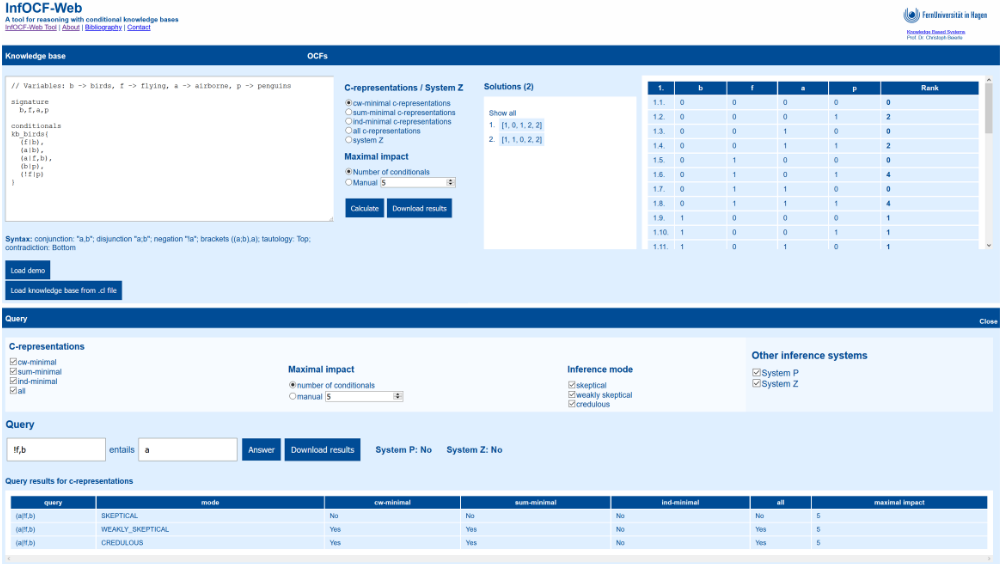
The bottom half of the interface is used for querying the inference relations induced by the loaded knowledge base. The user can select multiple sets of c-representations as well as system Z and system P inference. A selected maximal impact is used for inference over sets of c-representations employing the inference modes skeptical, weakly skeptical, and credulous. The query is entered as 'A entails B' for two formulas A and B. Since system P and system Z inference are not affected by the selected inference mode (system P inference is inherently skeptical, while in the case of system Z inference the three inference modes coincide), the query results are displayed next to the query itself. The results for the selected c-inference relations are displayed in a table underneath the query. Figure 1 shows the results for the query 'Does f ∧ b entail a?'. The answers determined by InfOCF-Web for all selected inference systems show that system P and system Z agree on this query, while there are differences among the various c-inference relations; a thorough investigation of properties and interrelationships of all inference methods provided by InfOCF-Web can be found in [Beierle et al., 2021].
InfOCF-Web is a web application based on the Java library InfOCF-Lib [Kutsch, 2019]. System P inference is implemented by computing the ordered partition and thus testing the consistency of the knowledge base augmented by the negated query. System Z inference, as well as minimal cinference relations, are implemented by calculating the necessary ranking functions and checking the minimal ranks of verification and falsification of the query. While computing OCFs induced by impact vectors for c-representations is done in Java [Kutsch, 2020], the impact vectors are computed as solutions of CR(R) by employing a CSP solver component implemented in a Prolog backend [Beierle et al., 2013]; also answering c-inferences over all c-representations is performed by a Prolog CSP solver by checking the solvability of corresponding CSPs (cf. [Beierle et al., 2018]). Whereas the objective of InfOCF-Web is to offer a convenient web interface for small scale inference experiments, InfOCF-Lib offers a broad selection of classes that allow the user to construct conditional knowledge bases, calculate various sets of ranking functions, and solve inference tasks also with respect to sets of knowledge bases and multiple queries; furthermore, sophisticated implementation features such as employing compilation techniques [Beierle et al., 2019] or additional facilities like computing complete inference closures [Kutsch, 2020; Kutsch and Beierle, 2021] are provided.
Acknowledgements
We are grateful to Martin Austen, Alexander Droßel, Fadil Kallat, Matthias Porath, Sandra Schufmann, Leon Schwarzer, Karl S¨odler, and Matthias Wirths for being involved in creating InfOCF-Web. This work was partially supported by DFG Grant BE 1700/9-1 awarded to Christoph Beierle.
@inproceedings{ijcai2021p711,
  title     = {InfOCF-Web: An Online Tool for Nonmonotonic Reasoning with Conditionals and Ranking Functions},
  author    = {Kutsch, Steven and Beierle, Christoph},
  booktitle = {Proceedings of the Thirtieth International Joint Conference on
               Artificial Intelligence, {IJCAI-21}},
  publisher = {International Joint Conferences on Artificial Intelligence Organization},
  editor    = {Zhi-Hua Zhou},
  pages     = {4996--4999},
  year      = {2021},
  month     = {8},
  note      = {Demo Track},
  doi       = {10.24963/ijcai.2021/711},
  url       = {https://doi.org/10.24963/ijcai.2021/711},
}
TY - CPAPER TI - InfOCF-Web: An Online Tool for Nonmonotonic Reasoning with Conditionals and Ranking Functions AU - Kutsch, Steven AU - Beierle, Christoph T2 - Proceedings of the Thirtieth International Joint Conference on Artificial Intelligence, IJCAI-21 PB - International Joint Conferences on Artificial Intelligence Organization PY - 2021 SP - 4996 EP - 4999 DO - 10.24963/ijcai.2021/711 UR - https://doi.org/10.24963/ijcai.2021/711 ER -Copied
Machine-readable versions of this paper, for tools and AI agents:





