
Relational Gating for ''What If'' Reasoning
Proceedings of the Thirtieth International Joint Conference on Artificial Intelligence. Main Track. Pages 4015-4022.
https://doi.org/10.24963/ijcai.2021/553
Keywords
- Natural Language Processing: Question Answering
Abstract
This paper addresses the challenge of learning to do procedural reasoning over text to answer "What if..." questions. We propose a novel relational gating network that learns to filter the key entities and relationships and learns contextual and cross representations of both procedure and question for finding the answer. Our relational gating network contains an entity gating module, relation gating module, and contextual interaction module. These modules help in solving the "What if..." reasoning problem. We show that modeling pairwise relationships helps to capture higher-order relations and find the line of reasoning for causes and effects in the procedural descriptions. Our proposed approach achieves the state-of-the-art results on the WIQA dataset.
- [Asai and Hajishirzi, 2020] Akari Asai and Hannaneh Ha- jishirzi. Logic-guided data augmentation and regulariza- tion for consistent question answering. In ACL, July 2020.
- [Dalvi et al., 2018] Bhavana Dalvi, Lifu Huang, Niket Tan- don, Wen tau Yih, and P. Clark. Tracking state changes in procedural text: a challenge dataset and models for process paragraph comprehension. In NAACL-HLT, 2018.
- [Dalvi et al., 2019] Bhavana Dalvi, Niket Tandon, Antoine Bosselut, Wen-tau Yih, and Peter Clark. Everything hap- pens for a reason: Discovering the purpose of actions in procedural text. In EMNLP, 2019.
- [Devlin et al., 2019] J. Devlin, Ming-Wei Chang, Kenton Lee, and Kristina Toutanova. Bert: Pre-training of deep bidirectional transformers for language understanding. In NAACL-HLT, 2019.
- [Dua et al., 2019] Dheeru Dua, Yizhong Wang, Pradeep Dasigi, Gabriel Stanovsky, Sameer Singh, and Matt Gard- ner. Drop: A reading comprehension benchmark requiring discrete reasoning over paragraphs. In NAACL-HLT, 2019.
- [Feng et al., 2020] Yanlin Feng, Xinyue Chen, Bill Yuchen Lin, Peifeng Wang, Jun Yan, and Xiang Ren. Scalable multi-hop relational reasoning for knowledge-aware ques- tion answering. In EMNLP, 2020.
- [Henaff et al., 2017] Mikael Henaff, J. Weston, Arthur Szlam, Antoine Bordes, and Y. LeCun. Tracking the world state with recurrent entity networks. In ICLR, 2017.
- [Huang et al., 2021] Yinya Huang, Meng Fang, Xunlin Zhan, Qingxing Cao, Xiaodan Liang, and Liang Lin. Rem- net: Recursive erasure memory network for commonsense evidence refinement. In AAAI, 2021.
- [Liu et al., 2019] Y. Liu, Myle Ott, Naman Goyal, Jingfei Du, Mandar Joshi, Danqi Chen, Omer Levy, M. Lewis, Luke Zettlemoyer, and Veselin Stoyanov. Roberta: A robustly optimized bert pretraining approach. ArXiv, abs/1907.11692, 2019.
- [Madaan et al., 2020] Aman Madaan, Dheeraj Rajagopal, Yiming Yang, Abhilasha Ravichander, Eduard Hovy, and Shrimai Prabhumoye. Eigen: Event influence genera- tion using pre-trained language models. arXiv preprint arXiv:2010.11764, 2020.
- [Parikh et al., 2016] Ankur Parikh, Oscar Täckström, Dipan- jan Das, and Jakob Uszkoreit. A decomposable attention model for natural language inference. In Proceedings of the 2016 Conference on Empirical Methods in Natural Language Processing, pages 2249-2255, Austin, Texas, November 2016. Association for Computational Linguis- tics.
- [Rajagopal et al., 2020] Dheeraj Rajagopal, Niket Tandon, Peter Clark, Bhavana Dalvi, and Eduard Hovy. What-if I ask you to explain: Explaining the effects of perturbations in procedural text. In Findings of EMNLP 2020, 2020.
- [Rajpurkar et al., 2016] Pranav Rajpurkar, Jian Zhang, Kon- stantin Lopyrev, and Percy Liang. SQuAD: 100,000+ questions for machine comprehension of text. In EMNLP, 2016.
- [Rajpurkar et al., 2018] Pranav Rajpurkar, Robin Jia, and Percy Liang. Know what you don't know: Unanswerable questions for SQuAD. In Proceedings of the 56th Annual Meeting of the Association for Computational Linguistics (Volume 2: Short Papers), pages 784-789, Melbourne, Australia, July 2018. Association for Computational Lin- guistics.
- [Tandon et al., 2018] Niket Tandon, Bhavana Dalvi, Joel Grus, Wen-tau Yih, Antoine Bosselut, and Peter Clark. Reasoning about actions and state changes by injecting commonsense knowledge. In Proceedings of the 2018 Conference on Empirical Methods in Natural Language Processing, pages 57-66, Brussels, Belgium, October- November 2018. Association for Computational Linguis- tics.
- [Tandon et al., 2019] Niket Tandon, Bhavana Dalvi, Keisuke Sakaguchi, Peter Clark, and Antoine Bosselut. WIQA: A dataset for "what if..." reasoning over procedural text. In EMNLP, 2019.
- [Vaswani et al., 2017] Ashish Vaswani, Noam Shazeer, Niki Parmar, Jakob Uszkoreit, Llion Jones, Aidan N Gomez, Łukasz Kaiser, and Illia Polosukhin. Attention is all you need. In Advances in neural information processing sys- tems, pages 5998-6008, 2017.
- [Velickovic et al., 2018] Petar Velickovic, Guillem Cucurull, Arantxa Casanova, Adriana Romero, Pietro Liò, and Yoshua Bengio. Graph attention networks. In ICLR, 2018.
- [Zheng and Kordjamshidi, 2020] Chen Zheng and Parisa Kordjamshidi. SRLGRN: Semantic role labeling graph reasoning network. In EMNLP, 2020.
- [Zheng et al., 2020] Chen Zheng, Quan Guo, and Parisa Ko- rdjamshidi. Cross-modality relevance for reasoning on language and vision. In ACL, 2020.
References were extracted automatically from the PDF and may contain errors.
Full text extracted automatically from the PDF; figures, tables and equations may differ. The PDF is the version of record.
Relational Gating for "What If" Reasoning
Chen Zheng and Parisa Kordjamshidi
Michigan State University
{zhengc12, kordjams}@msu.edu
Abstract
This paper addresses the challenge of learning to
- do procedural reasoning over text to answer "What
- if..." questions. We propose a novel relational gat-
- ing network that learns to filter the key entities
and relationships and learns contextual and cross
representations of both procedure and question for
finding the answer. Our relational gating network
contains an entity gating module, relation gating module, and contextual interaction module. These
modules help in solving the "What if..." reason-
ing problem. We show that modeling pairwise relationships helps to capture higher-order relations
and find the line of reasoning for causes and effects
in the procedural descriptions. Our proposed ap-
proach achieves the state-of-the-art results on the
WIQA dataset.
1 Introduction
The recent research on reasoning over procedural text has
achieved promising results [Rajpurkar et al., 2016; Rajpurkar
et al., 2018; Henaff et al., 2017; Dalvi et al., 2018; Tandon
et al., 2018]. Specific to this problem, a WIQA dataset and task [Tandon et al., 2019] was proposed as a benchmark for the evaluation of reasoning capabilities of learning models on procedural text by introducing "what . . . if" questions. The "what . . . if" reasoning problem is a procedural text QA that relates to reading comprehension, multi-hop reasoning, and commonsense reasoning which makes the task rich in containing various challenging linguistic and semantic phenomena. Moreover, the "what . . . if" reasoning is built based on linguistic perturbations and generating possible cause-effect relationships expressed in the context of a paragraph. Its goal is to predict what would happen if a process was perturbed in some way. It requires understanding and tracing the changes in events and entities through a paragraph. Figure 1 shows some examples of WIQA task. There are three types of questions in the dataset, including in-paragraph where the answer to the question is in the procedure itself, out-of-paragraph where the answer does not exist in the text and needs external knowledge, and irrelevant (no effect) changes [Tandon et al., 2019]. Given a procedural text, we answer questions with the "what . . . if" style.
Procedural Text:
- A frog lays eggs in the water.
- Tadpoles develop inside of the eggs.
- The eggs hatch.
- The tadpoles eat and grow.
- The tadpoles grow legs and form into frogs.
- The frogs leave the water.
Questions and Answers:
- Suppose tadpoles eat more food happens, how will it affect more frogs?
- (A) More (B) less (C) No effect
- Suppose the weather is unusually bad
- happens, how will it affect the tadpoles will
need more food?
- (A) More (B) less (C) No effect
Figure 1: WIQA task contains procedural paragraphs, and a large collection of "what-if" questions. The bold font candidate answers are the gold answers.
There are several challenges in the "what...if" reasoning over procedural text. The first challenge is reasoning over the qualitative comparison expressions for describing the changes in the procedure that can make a positive or negative change. For example, reasoning over comparative words such as (larger, smaller), (more, less), (higher, lower). This task requires the ability to extract the important entities through the procedural text and understand their influences. Several previous works primarily use formal models for implicit qualitative comparisons [Parikh et al., 2016]. Tandon et al. uses BERT to predict answers by implicit representations. However, they ignore explicit reasoning over qualitative comparisons between entities and the way they affect each other.
The second challenge is reasoning over relations between pairs of entities, we call it relational reasoning. Although recent pre-trained language models (LM) achieve promising performance on QA, there is still a gap between LM and human performance due to the lack of relational reasoning over entities [Feng et al., 2020]. For example, given the question "suppose more animals that hunt frogs happens, how will it affect more tadpoles loses", the LM is difficult to consider the relation "hunt" between the entity pair ("animals", "frogs").
Asai and Hajishirzi uses a Transformer model with regularization to produce consistent answers. The model obtains a good result with augmented data following logical constraints. However, these constraints ignore the importance of relational reasoning, and can not capture the higher-order chain of reasoning based on pairwise relations.
The third challenge is the multi-hop reasoning. In-para and out-of-para question categories need multiple hops of reasoning to answer the questions. Like Tandon et al. said, given the question, indirect effects (2 hops or 3 hops) are much harder to answer than direct effects (1-hop). For example, predicting "cloudy day" results in the direct effect in "less sunshine" is less challenging than the indirect effect in "less photosynthesis". Recently, Madaan et al. presents EIGEN to leverage pre-trained language models to generate the reasoning chain.
The fourth challenge is the lexical variability in expressing the same concept, which makes entity alignment hard. For example, the same entities and events referred to by different terms, like (insect, bee), (become, form). Entity alignment requires the alignment between question and paragraph entities, and the alignment between the entities appearing in the different paragraphs themselves. Unfortunately, all current works ignore the importance of entity alignment for tracing the entities and finding the relation between different entities in the question and paragraph.
Therefore, we propose a novel end-to-end Relational Gating Network (RGN) for procedural text reasoning. The RGN framework answers the procedural text question and solves challenges of qualitative comparison, relational reasoning, multi-hop reasoning, and entity alignment. RGN jointly learns to extract the key entities through our entity gating mechanism, finds the line of reasoning and relations between the key entities through relation gating mechanism, and captures the entity alignment through contextual entity interaction. The main motivation of the two gating mechanisms is to learn the line of reasoning and to address the multi-hop reasoning challenge. This distinguishes the RGN model from the existing works. Concretely, we build an entity gating module to extract and filter the key entities in the question and context and highlight the entities that are compared qualitatively. Furthermore, we design a relation gating module with an alignment of crucial entities to capture the higherorder chain of reasoning based on pairwise relations. This technique helps relational reasoning and consequently multihop reasoning in the procedure. Moreover, we propose an efficient module, called contextual interaction module, to incorporate cross information from Question and Content interactions during training in an efficient way to help entities alignments.
The contributions of this work are as follows: 1) We propose a Relational Gating Network (RGN) that captures the most important entities and relationships involved in qualitative comparison, causal reasoning and multi-hop reasoning. 2) We propose a contextual interaction module to effectively and efficiently align the question and paragraph entities. Moreover, the contextual interaction module captures the interacting entities and the change statements and helps to understand the qualitative comparisons. 3) We evaluate the methods and analyze the results on "what...if" question answering using the WIQA dataset. We improve state-of-theart on WIQA published results. We show the significance of the entity gating module and relation gating module on procedural reasoning over text.
2 RelatedWork
In recent years, large-scale Language Models [Devlin et al., 2019; Liu et al., 2019] made a huge progress in solving various QA tasks on popular benchmarks such as SQuAD V1 [Rajpurkar et al., 2016] and SQuAD V2 [Rajpurkar et al., 2018]. However, in those benchmarks, there is no need for multi-hop reasoning and also the given text is sufficient to predict the answer. Therefore, the developed QA models fail to answer the questions that need procedural reasoning and understanding causes and effects [Dua et al., 2019]. Therefore, several newQA benchmarks created [Dalvi et al., 2018; Dalvi et al., 2019] and aim to track the explicit entity states and find explainable answers given a text. Tandon et al. proposed the WIQA task that aims to solve "what...if" procedural reasoning and understand the effects of qualitative reasoning.
Several previous works achieved impressive performance on procedural text reasoning [Madaan et al., 2020; Huang et al., 2021; Asai and Hajishirzi, 2020; Tandon et al., 2019]. Rem-Net [Huang et al., 2021] uses a recursive memory network to find the answer. Rajagopal et al. constructs the explanations based on the effects of perturbations in procedural text. However, these models ignore the importance of capturing the higher-order chain of reasoning based on pairwise relations. However, on a different thread of work on visual question answering, Zheng et al. considers the relevance beyond entities in multiple modalities and proposes a model to obtain the higher-order relevance of pairwise relations and shows its effectiveness. Graph-based models [Velickovic et al., 2018; Zheng and Kordjamshidi, 2020] help in using the relational context and finding the relation between different entities. Madaan et al. designs an EIGEN model that generates the influence graph for multi-hop reasoning. However, graph models are difficult to deal with the explicit reasoning over qualitative comparison expressions. In contrast, our RGN model finds the line of reasoning and relations using entity gating module and relation gating modules. These two modules help RGN to reason over qualitative comparisons for describing the changes in the procedural text. We will explain more details about the differences between baseline models and the RGN model in Section 3.
3 Relational Gating Network
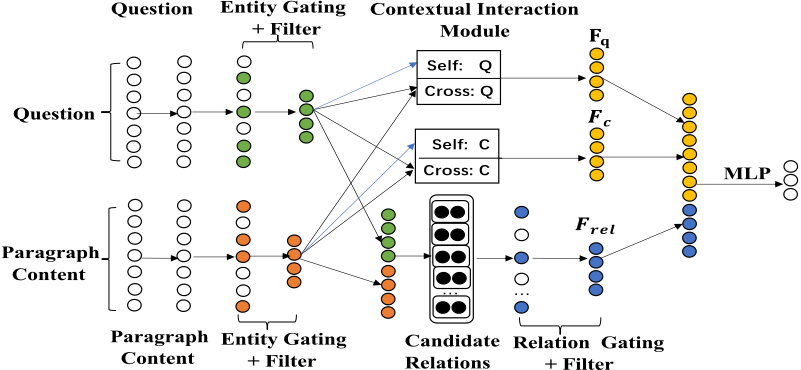
Relational Gating Network (RGN) aims to establish a framework for reasoning over procedural text. The end-to-end network uses an entity gating module to extract and filter the critical entities in question and paragraph content. We enable a higher-order chain of reasoning patterns based on the pairwise relationships between key entities generated from the entity gating and relation gating representations. We propose a practical contextual interaction module to improve the entity alignment in an efficient way. Figure 2 shows the proposed architecture. This section introduces our network and the training approach in detail.
3.1 ProblemFormulation
Formally, the task is to select one of the candidate answers a, (A) More; (B) Less; (C) No effect, given a question q and the paragraph content C. The paragraph content includes several sentences C = {s1, s2, . . . , sn}. Therefore, for each data sample, the data format is a triplet of (q, C, a).
3.2 Entity Representations
For each data sample, we form the input E based on the question q and the paragraph content C as follows:
where [CLS] and [SEP] are the special tokens used in RoBERTa [Liu et al., 2019]. We feed input E to a pre-trained LM to obtain token representations. Then we use E[CLS] representation as the compact representation of the paragraph. After that, we use E to obtain E[CLS], Eq, and EC, which are shown as follows:
where Eq represents the question contextual representation, EC represents the paragraph contextual content representation, d is the learned representation dimension for tokens, m represents the max length of the question, and n represents the max length of the paragraph content. Each token will be a candidate entity.
3.3 Entity Gating
The intuition behind the entity gating module is to filter several key entities representations from both question, Eq, and paragraph content, EC. We call this process entity gating which is shown in Figure 2. Given the question Eq, for each entity Ewi q , we use a multi-layer perceptron and a softmax layer to obtain an entity importance score U wi q :
We compute the new entity representations E′q by multiplying the entity representations and their scores in Uq. Then we choose the entities with top-k scores. We denote the set of filtered key entities after gating the question as Vq = [V 1 q , V 2 q , . . . , V k q ] ∈ Rk×d . Vq is the question gated entity representation, k is the number of filtered entities and V i q is d-dimensional embedding for the i-th filtered entities.
Notice that the process of computing paragraph entity gating VC ∈ Rk×d is the same as the question entity gating Vq. Using the entity gating mechanism improves the interpretability of our deep model as we can explicitly see the selected entities and interpret their qualitative comparisons. A more detailed analysis is shown in Section 5.1.
3.4 Relation Gating
"What if" reasoning requires not only an understanding of the question and paragraph contexts, but also requires reasoning over entities and their relations. Therefore, we take the representations beyond entities into consideration by using a relation gating module. This extension allows RGN to capture the higher-order chain of reasoning based on pairwise relations, which is one of the main contributions of our paper. The pairs of entities can help to understand the connections between words and finding the line of reasoning. Moreover, relation gating aims to pair un-directed relations between entities for capturing the crucial relations, like "tadpole (losses) tail" and "less severe", as well as the pairs of entities that help to understand the line of reasoning. We call this process relation gating module, which is shown in Figure 2.
In this module, first, we concatenate Vq and VC, which are obtained from Section 3.3 and form candidate set V =
{Vq; VC}. Then we pair every two gated entities and form V i,j rel = [V i ; V j ] ∈ R1×2d . Furthermore, the candidate relational representation, Vrel, is a non-linear mapping R2d → R2d modeled by fully connected layers from candidate relation.
where r is the size of total relation candidate pairs, that is, r = 2k×(2k-1) 2 . Given each candidate relation V i rel , we compute a multi-layer perceptron and a softmax layer to obtain a relational importance score, T i :
We compute the new relation representation V ′ rel by multiplying the relation representations and their scores in T. We select the relations with top-k scores. Using all the scores increases the number of parameters and the computational cost significantly, moreover, the redundant entities make the learning harder and consequently less accurate. We denote the set of filtered key relations after gating relations as Frel ∈ Rk×2d to the gated relation representation.
3.5 Contextual InteractionModule
Entity alignment is one of the challenges in procedural reasoning. Although we separately propose entity gating and relation gating in the above sections, aligning questions with the paragraph is still important. We found that a simple concatenation of gated entity representations from the question Vq and the paragraph content VC shows a good performance. However, concatenated representations and multi-layer perceptrons have a limited capacity for modeling the interactions.
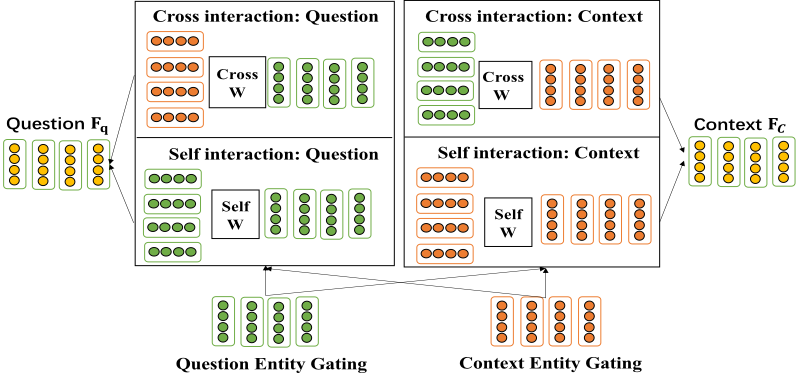
As shown in Figure 3, we have developed a novel and fast encoding model, namely Contextual Interaction Module.
The model needs to incorporate information from QuestionContent interactions, and meanwhile avoid expensive architectures such as Multi-Head attentions [Vaswani et al., 2017] because those are infeasible for large-scale datasets. Thus, we developed a model that uses only linear projections and inner products of both sides, i.e., question and context, and we apply a mechanism like simplified self-attention to model the interactions as described below.
Given the Vq, we compute the self-interaction of the question's gated entities, F self q ,
where W self ∈ Rd×k is a projection matrix. The crossinteractions between gated entities and paragraph entities can be calculated as
where W cross ∈ Rd×k is also a projection matrix. Then we concatenate the two matrices F self q and F cross q . Finally, we obtain the question contextual representation Fq as follows:
Notice that the process of paragraph contextual representation FC ∈ Rk×2d is the same as the question contextual representation Fq. Therefore, the output includes two representations. One is the paragraph contextual representation containing information from the question, and the question contextual representation containing information from the paragraph.
3.6 Output Prediction
After acquiring all the contextual entity representations and gated relations representations, we concatenate them and use the result as the final representation, F. The process is de-
Finally, a task-specific classifier MLP (F ) predicts the output.
| Models | in-para | out-of-para | no-effect | Test V1 Acc |
|---|---|---|---|---|
| Majority | 45.46 | 49.47 | 55.0 | 30.66 |
| Adaboost [Devlin et al., 2019] | 49.41 | 36.61 | 48.42 | 43.93 |
| Decomp-Attn [Parikh et al., 2016] | 56.31 | 48.56 | 73.42 | 59.48 |
| BERT (no para) [Devlin et al., 2019] | 60.32 | 43.74 | 84.18 | 62.41 |
| BERT [Tandon et al., 2019] | 79.68 | 56.13 | 89.38 | 73.80 |
| RoBERTa [Tandon et al., 2019] | 74.55 | 61.29 | 89.47 | 74.77 |
| EIGEN [Madaan et al., 2020] | 73.58 | 64.04 | 90.84 | 76.92 |
| REM-Net [Huang et al., 2021] | 75.67 | 67.98 | 87.65 | 77.56 |
| Logic-Guided [Asai and Hajishirzi, 2020] | - | - | - | 78.50 |
| RGN | 80.32 | 68.63 | 91.06 | 80.18 |
| Human | - | - | - | 96.33 |
3.7 Training Strategy
We use the cross-entropy loss for training the RGN model. To update the weights of the Entity Gating module described in Section 3.3, we use a 0/1 tensor (1 for top-k indices, 0 for others) to record the top-k indices extracted from the score tensor Uq. Next, we use that tensor to multiply the entity representation matrix E′q to obtain the gated entity representations Vq. Therefore, the model can backpropagate the error by updating the learned weights. We use the same method to update the weights of the Relation Gating module. The RGN model can be trained end-to-end with cross-entropy loss.
4 Experimental Setup
4.1 Dataset
WIQA is a large-scale collection of "what . . . if" reasoning. WIQA dataset 1 contains two parts: paragraphs describing a procedural text and multiple-choice questions. The task is to answer the questions given a paragraph of description. Table 2 shows the detailed data statistics and data distribution of the WIQA dataset.
| Data | Train | Dev | Test V1 | Test V2 | Total | |
|---|---|---|---|---|---|---|
| Questions | 29808 | 6894 | 3993 | 3003 | 43698 | |
| type | in-para | 7303 | 1655 | 935 | 530 | 10423 |
| Question | out-of-para | 12567 | 2941 | 1598 | 1218 | 18326 |
| no-effect | 9936 | 2298 | 1460 | 1255 | 14949 | |
| Total | 29808 | 6894 | 3993 | 3003 | 43698 | |
| Number | #hops=0 | 9936 | 2298 | 1460 | 1255 | 14949 |
| #hops=1 | 6754 | 1510 | 835 | 245 | 9254 | |
| of hops | #hops=2 | 8969 | 2145 | 1153 | 1027 | 13294 |
| #hops=3 | 4149 | 941 | 545 | 476 | 6111 | |
| Total | 29808 | 6894 | 3993 | 3003 | 43698 | |
4.2 Experiment Setting
We implemented RGN using PyTorch 2 . We used RoBERTaBase in our model. Therefore, all of the representations are
1 WIQA dataset is available at http://data.allenai.org/wiqa/.
2 Our code is available at https://github.com/HLR/RGN.
| Models | in | out | no-eff | Test V2 |
|---|---|---|---|---|
| Random | 33.33 | 33.33 | 33.33 | 33.33 |
| Majority | 00.00 | 00.00 | 100.0 | 41.80 |
| RoBERTa | 70.69 | 60.20 | 91.11 | 75.34 |
| REM-Net | 70.94 | 63.22 | 91.24 | 76.29 |
| REM-Net (RoBERTa-large) | 76.23 | 69.13 | 92.35 | 80.09 |
| QUARTET | 74.49 | 65.65 | 95.30 | 82.07 |
| [Rajagopal et al., 2020] RGN (RoBERTa-base) | 75.91 | 66.15 | 92.12 | 79.95 |
| RGN (RoBERTa-large) | 78.40 | 68.83 | 93.01 | 82.46 |
| Human | - | - | - | 96.30 |
768-dimensions. For each data sample, we keep 128 tokens as the max length for the question, and 256 tokens as the max length for paragraph contents. Notice that both gated entity representations for question and paragraph use k = 10 for selecting top-k entities in our experiments. The value of this hyper-parameter was selected after experimenting with various values in {3, 5, 7, 10, 15, 20} using the development dataset. For the Gated relation representations, top-10 ranked pairs are used to reduce the computational cost and reduce the unnecessary relations. In the relation gating process, we use two hidden layers for multi-layer perceptrons. The task-specific output classifier contains two MLP layers. The model is optimized using the Adam optimizer. The training batch size is 4. During training, we freeze the parameters of RoBERTa in the first two epochs, and we stop the training after no performance improvements observed on the development dataset which happens after 8 epochs.
5 Results and Analysis
We show the model performance on the WIQA task compared to other baselines in Table 1 and Table 3. We observe that, in general, Transformer-based models outperform other models, like Deomp-Attn [Parikh et al., 2016]. This promising performance demonstrates the effectiveness of Transformers [Vaswani et al., 2017] and strong pre-trained contextual representations [Devlin et al., 2019; Liu et al., 2019]. Moreover, our RGN achieves state-of-the-art results compared to all other models. Especially, RGN outperforms Tandon et al. by 6.38% and outperforms current state-of-the-art model on test V1, logic-guided [Asai and Hajishirzi, 2020], by around 1.6%. Moreover, our RGN model achieves the SOTA on WIQA test V2. The improved performance demonstrates that entity gating, relation gating, and contextual interaction module are effective for "what...if" procedural reasoning. We provide a detailed analysis of the advantage of RGN from different perspectives.
| Model | # hops = 1 | # hops = 2 | # hops = 3 |
|---|---|---|---|
| BERT(no para) | 58.1% | 47.3% | 42.8% |
| BERT | 71.6 % | 62.5% | 59.5% |
| RoBERTa | 73.5 % | 63.9% | 61.1% |
| EIGEN | 78.78 % | 63.49% | 68.28 % |
| RGN | 80.5% | 71.2% | 70.0% |
Effects on Relational Reasoning and Multi-Hops: In-para and out-of-para question categories require multiple hops of reasoning to answer the questions. As shown in Table 4, we found that the accuracy improved 7.0% for 1 hop, 7.3% for 2 hops, and 8.9% for 3 hops compared to RoBERTa which does not have the two gating mechanisms and Contextual Interaction Module. As we expect, the RGN framework has made a huge progress in reasoning with multiple hops and the improvement in the performance of the baselines is more when the number of hops increases. For qualitative analysis, we show successful cases from our RGN in Figure 4. We observe that RGN is capable of bridging question and paragraph content by extracting key entities. In the successful cases, which is shown in Figure 4, RGN helps in constructing the chain of "water droplets are in clouds → droplets combine to form bigger drops in the clouds" through key entities "water", "clouds", and "droplets". Moreover, we observe that the key entities "water", "clouds", and "droplets" also obtain high attention scores.
Effects on Qualitative Comparisons: Like Tandon et al. said, around 65% of the change statements make use of qualitative comparisons to describe the changes in the procedure. For example, change statements use comparative words such as (more, less), (colder, hotter). Besides, the change statement for a positive or negative influence is context-dependent, making the "what . . . if" reasoning challenging. The qualitative comparisons are improved in both in-para, out-of-para, and no-effect using RGN. The results are shown in Table 3. We observe that RGN outperforms 6.74% on in-para and 4.59% on out-of-para compared to EIGEN [Madaan et al., 2020] -a very recent baseline.
5.1 Ablation Study
Effects of Entity Gating: In the first study, we remove the entity gating and relation gating modules. Notice that the contextual interaction module uses the whole question entities and paragraph entities when RGN does not use these two modules. Using whole entities significantly increases the computational cost. Moreover, Table 5 shows that the accuracy is lower about 5.3% compared to full RGN when applied on the development dataset. This experiment demonstrates that using all the entities without gating mechanism has a negative influence on the contextual interaction module and drops the performance.
| Ablations | in | out | no-eff | dev acc |
|---|---|---|---|---|
| RGN (w/o gating ent & rel) | 76.2 | 61.1 | 89.2 | 75.3 |
| RGN (w/o gating rel) | 78.4 | 63.6 | 89.9 | 77.4 |
| RGN | 81.7 | 69.2 | 91.3 | 80.6 |
| RGN (w/o CIM) | 80.2 | 68.4 | 90.5 | 79.7 |
| RGN (- CIM+Multi-Head) | 81.3 | 68.9 | 91.7 | 80.3 |
| RGN (add regularization) | 82.0 | 69.1 | 91.6 | 80.8 |
Effect of Relation Gating: The goal of the relation gating is to capture the higher-order chain of reasoning based on pairwise relations. The relation gating module extracts the important candidate relations by pairing up entities after gating entities. More importantly, the pairs of entities can help understanding the connections between words and finding the line of procedural reasoning. Our model captures the important pairs of influencing entities "tadpole (losses) tail" and "animal (hunts) frog".
When we keep the entity gating module and remove the relation gating module, we observe that the accuracy of WIQA decreases 3.3% compared to the full RGN framework. Moreover, the model without the relation gating module can not capture the key relations. The results show that thee performance on the out-of-para questions decreases 5.6% compared to the full RGN model. Section 5.2 shows more examples and analysis.
Effects of Contextual Interaction Module (CIM): Tandon et al. shows that around 15% of the influence changes have difficulties for handling the entity alignment part due to the language variability. In other words, paragraph entities use different terms, such as ("removes", "expels") for expressing the same semantics. Especially, the problem of language variability becomes more severe for the multi-hop cases that require aligning the question with several sentences in the paragraph. Without the Contextual Interaction Module, the development accuracy decreases more than 1%. As shown in Table 4, the accuracy improves significantly in the direct effect (1 hop) and indirect effects (2 hops or 3 hops) compared to all strong baselines. This demonstrates the effectiveness of the interaction module. In an additional experiment, we replaced the CIM with the Multi-Head attention that uses an encoder of the Multi-Head attention composed of a stack of N = 6 identical layers. Each layer has two sub-layers. The first layer is multi-head self-attention, and the second is a fully connected network [Vaswani et al., 2017]. The computational time was 936 (ms/batch) for our contextual interaction module while it is 3002 (ms/batch) for the Transformer while the accuracy is fairly similar.
Effects of Regularization: To improve the capacity of relational reasoning challenge described in section 1, we follow Asai and Hajishirzi work that augments the data by making variations in the questions and imposing consistency between answers of those questions. It uses a regularization term in the learning objective (based on cross entropy loss denoted as Loriginal) and the regularization term denoted as Lconsistency), called inconsistency loss. Therefore, the whole loss function is shown as follows:
| Successful Cases | Question: suppose water is absorbed into the clouds and grow happens, how will it affect clouds are filled with rain droplets? Content: ['Water evaporates from the ground up to the sky', 'Water droplets are in clouds', 'Droplets combine to form bigger drops in the clouds', 'The drops get heavy', 'Gravity makes the drops fall.'] GoldAnswer: More |
| Question: suppose more activity of the heart happens, how will it affect less waste being removed from the body. Content: ['Blood is full of different waste', 'Blood travels through the body', 'The blood enters the kidneys', 'The kidneys filter the blood', 'The waste is seperated', 'The urine contains the waste', 'The urine is expelled from the body.'] GoldAnswer: Less | |
| Failing Cases | Question: suppose more fruit is produced happens, how will it affect MORE plants. Content: ['The seed germinates', 'The plant grows', 'The plant flowers', 'Produces fruit', 'The fruit releases seeds', 'The plant dies.'] GoldAnswer: More |
| Question: suppose the climate changes happens, how will it affect there are fewer clouds? Content: ['Water evaporates because of the sun', 'Water vapor rises into the air as it evaporates', 'Water vapor forms clouds as it mixes with dust and impurities', 'Clouds become heavier and larger over time', 'Clouds eventually become too heavy to stay in the sky', 'Some water vapor exits clouds as rain.'] GoldAnswer: Less |
We found that the RGN model with consistency regularization has about 0.1%- 0.15% further improvement.
5.2 Qualitative Analysis
For a better understanding of how our proposed model performs qualitatively, we show successful cases and failing cases from our RGN framework in Figure 4. We can observe that RGN is surprisingly capable of bridging the question and content in the in-para category.
Although the RGN framework has achieved state-of-theart performance, the framework cannot always capture the line of reasoning. The bottom part of Figure 4 shows some failing cases. In the first failing case, RGN gives a wrong prediction because the content sentence "the plant dies" is captured as a strong negative influence by our model. Although our model bridges the relation between "fruit" and "plant", the critical term "dies" obtains a high gating score and misleads our final prediction.
Commonsense reasoning is the other type of error made by RGN. Out-of-paragraph questions require commonsense external knowledge. For example, in the second failing case of Figure 4, the question contains "climate change" and the paragraph does not contain the cause of the "climate change". This needs external knowledge between "climate change" and "water evaporate". Since answering the question requires external knowledge, it is hard to build a casual relationship for this example. However, the improvement on the outof-paragraph is due to observing multiple examples in the dataset that use the same type of commonsense. Because the relational gating helps to find the line of reasoning, our RGN model captures those from observing the relationships frequently and learns shortcuts. For example, in the second successful case of figure 4, the relational gating module captures the pairwise relation between "heart body" and "blood body" due to multiple occurrences in the data -filling the information gap for reasoning.
6 Conclusion
Our paper proposes an end-to-end Relational Gating Network (RGN) to help "what . . . if" procedural reasoning over text for answering cause and effect questions. Particularly, we propose an entity gating module, relation gating module, and contextual interaction module to find the answer. We demonstrate that the proposed approach can effectively solve the challenges in the "what . . . if" reasoning, including multiplehop reasoning, qualitative comparison, and entity alignment. We successfully evaluate our RGN on the WIQA dataset and achieve state-of-the-art performance. Our gating mechanism and contextual interaction module can be easily used in solving various QA tasks that need to reason over entities and their relationships and follow a procedure. The gating mechanism can be extended to work at various levels of granularity such as sentence and paragraph levels to filter important pieces of information and to find the line of reasoning for answering the questions.
Acknowledgments
This project is supported by National Science Foundation (NSF) CAREER award #2028626 and partially supported by the Office of Naval Research (ONR) grant #N00014-20-12005. Any opinions, findings, and conclusions or recommendations expressed in this material are those of the authors and do not necessarily reflect the views of the National Science Foundation nor the Office of Naval Research. We thank all reviewers for their thoughtful comments and suggestions.
@inproceedings{ijcai2021p553,
  title     = {Relational Gating for ''What If'' Reasoning},
  author    = {Zheng, Chen and Kordjamshidi, Parisa},
  booktitle = {Proceedings of the Thirtieth International Joint Conference on
               Artificial Intelligence, {IJCAI-21}},
  publisher = {International Joint Conferences on Artificial Intelligence Organization},
  editor    = {Zhi-Hua Zhou},
  pages     = {4015--4022},
  year      = {2021},
  month     = {8},
  note      = {Main Track},
  doi       = {10.24963/ijcai.2021/553},
  url       = {https://doi.org/10.24963/ijcai.2021/553},
}
TY - CPAPER TI - Relational Gating for ''What If'' Reasoning AU - Zheng, Chen AU - Kordjamshidi, Parisa T2 - Proceedings of the Thirtieth International Joint Conference on Artificial Intelligence, IJCAI-21 PB - International Joint Conferences on Artificial Intelligence Organization PY - 2021 SP - 4015 EP - 4022 DO - 10.24963/ijcai.2021/553 UR - https://doi.org/10.24963/ijcai.2021/553 ER -Copied
Machine-readable versions of this paper, for tools and AI agents:
 Welcome
 Future Conferences
 AI Journal Division
 IJCAI Proceedings
 About IJCAI
 IJCAI Awards