
MRD-Net: Multi-Modal Residual Knowledge Distillation for Spoken Question Answering
Proceedings of the Thirtieth International Joint Conference on Artificial Intelligence. Main Track. Pages 3985-3991.
https://doi.org/10.24963/ijcai.2021/549
Keywords
- Natural Language Processing: Sentiment Analysis and Text Mining
- Natural Language Processing: Speech
- Natural Language Processing: Question Answering
Abstract
Spoken question answering (SQA) has recently drawn considerable attention in the speech community. It requires systems to find correct answers from the given spoken passages simultaneously. The common SQA systems consist of the automatic speech recognition (ASR) module and text-based question answering module. However, previous methods suffer from severe performance degradation due to ASR errors. To alleviate this problem, this work proposes a novel multi-modal residual knowledge distillation method (MRD-Net), which further distills knowledge at the acoustic level from the audio-assistant (Audio-A). Specifically, we utilize the teacher (T) trained on manual transcriptions to guide the training of the student (S) on ASR transcriptions. We also show that introducing an Audio-A helps this procedure by learning residual errors between T and S. Moreover, we propose a simple yet effective attention mechanism to adaptively leverage audio-text features as the new deep attention knowledge to boost the network performance. Extensive experiments demonstrate that the proposed MRD-Net achieves superior results compared with state-of-the-art methods on three spoken question answering benchmark datasets.
- [Busso et al., 2008] Carlos Busso, Murtaza Bulut, Chi-Chun Lee, Abe Kazemzadeh, Emily Mower, Samuel Kim, Jeannette N. Chang, Sungbok Lee, and Shrikanth S. Narayanan. IEMOCAP: interactive emotional dyadic mo- tion capture database. Lang. Resour. Evaluation, 2008.
- [Chuang et al., 2020] Yung-Sung Chuang, Chi-Liang Liu, and Hung-Yi Lee. SpeechBERT: Cross-modal pre-trained language model for end-to-end spoken question answer- ing. In INTERSPEECH. ISCA, 2020.
- [Devlin et al., 2019] Jacob Devlin, Ming-Wei Chang, Ken- ton Lee, and Kristina Toutanova. BERT: pre-training of deep bidirectional transformers for language understand- ing. In NAACL, pages 4171-4186, 2019.
- [Gao et al., 2020] Mengya Gao, Yujun Shen, Quanquan Li, and Chen Change Loy. Residual knowledge distillation. arXiv preprint arXiv:2002.09168, 2020.
- [Hahn and Choi, 2019] Sangchul Hahn and Heeyoul Choi. Self-knowledge distillation in natural language process- ing. In RANLP, pages 423-430, 2019.
- [Hinton et al., 2015] Geoffrey Hinton, Oriol Vinyals, and Jeff Dean. Distilling the knowledge in a neural network. arXiv preprint arXiv:1503.02531, 2015.
- [Houlsby et al., 2019] Neil Houlsby, Andrei Giurgiu, Stanis- law Jastrzebski, Bruna Morrone, Quentin De Laroussilhe, Andrea Gesmundo, Mona Attariyan, and Sylvain Gelly. Parameter-efficient transfer learning for NLP. In ICML, 2019.
- [Jiao et al., 2020] Xiaoqi Jiao, Yichun Yin, Lifeng Shang, Xin Jiang, Xiao Chen, Linlin Li, Fang Wang, and Qun Liu. TinyBERT: Distilling BERT for natural language un- derstanding. In EMNLP, 2020.
- [Kuo et al., 2020] Chia-Chih Kuo, Shang-Bao Luo, and Kuan-Yu Chen. An audio-enriched bert-based framework for spoken multiple-choice question answering. In INTER- SPEECH, pages 4173-4177. ISCA, 2020.
- [Lee et al., 2018] Chia-Hsuan Lee, Shang-Ming Wang, Huan-Cheng Chang, and Hung-yi Lee. ODSQA: open- domain spoken question answering dataset. In SLT, pages 949-956. IEEE, 2018.
- [Lee et al., 2019] Chia-Hsuan Lee, Yun-Nung Chen, and Hung-yi Lee. Mitigating the impact of speech recogni- tion errors on spoken question answering by adversarial domain adaptation. In ICASSP, pages 7300-7304. IEEE, 2019.
- [Li et al., 2018] Chia-Hsuan Li, Szu-Lin Wu, Chi-Liang Liu, and Hung-yi Lee. Spoken SQuAD: A study of mitigating the impact of speech recognition errors on listening com- prehension. In INTERSPEECH, pages 3459-3463. ISCA, 2018.
- [Lu et al., 2019] Jiasen Lu, Dhruv Batra, Devi Parikh, and Stefan Lee. Vilbert: Pretraining task-agnostic visiolin- guistic representations for vision-and-language tasks. In NeurIPS, pages 13-23, 2019.
- [Luo et al., 2019] Shang-Bao Luo, Hung-Shin Lee, Kuan-Yu Chen, and Hsin-Min Wang. Spoken multiple-choice ques- tion answering using multimodal convolutional neural net- works. In ASRU, pages 772-778. IEEE, 2019.
- [Panayotov et al., 2015] Vassil Panayotov, Guoguo Chen, Daniel Povey, and Sanjeev Khudanpur. Librispeech: An ASR corpus based on public domain audio books. In ICASSP, pages 5206-5210. IEEE, 2015.
- [Rajpurkar et al., 2016] Pranav Rajpurkar, Jian Zhang, Kon- stantin Lopyrev, and Percy Liang. Squad: 100, 000+ ques- tions for machine comprehension of text. In EMNLP, pages 2383-2392, 2016.
- [Schneider et al., 2019] Steffen Schneider, Alexei Baevski, Ronan Collobert, and Michael Auli. wav2vec: Unsu- pervised pre-training for speech recognition. In INTER- SPEECH, pages 3465-3469. ISCA, 2019.
- [Siriwardhana et al., 2020] Shamane Siriwardhana, Andrew Reis, Rivindu Weerasekera, and Suranga Nanayakkara. Jointly Fine-Tuning "BERT-like" Self Supervised Models to Improve Multimodal Speech Emotion Recognition. In INTERSPEECH. ISCA, 2020.
- [Su and Fung, 2020] Dan Su and Pascale Fung. Improving spoken question answering using contextualized word rep- resentation. In ICASSP, pages 8004-8008, 2020.
- [Sun et al., 2020] Zhongkai Sun, Prathusha Kameswara Sarma, William A. Sethares, and Yingyu Liang. Learn- ing relationships between text, audio, and video via deep canonical correlation for multimodal language analysis. In AAAI, pages 8992-8999. AAAI Press, 2020.
- [Tsai et al., 2019] Yao-Hung Hubert Tsai, Shaojie Bai, Paul Pu Liang, J. Zico Kolter, Louis-Philippe Morency, and Ruslan Salakhutdinov. Multimodal Transformer for Unaligned Multimodal Language Sequences. In ACL, pages 6558-6569, 2019.
- [Wang et al., 2018] Hui Wang, Hanbin Zhao, Xi Li, and Xu Tan. Progressive blockwise knowledge distillation for neural network acceleration. In IJCAI, pages 2769-2775, 7 2018. IJCAI
- [You et al., 2020a] Chenyu You, Nuo Chen, Fenglin Liu, Dongchao Yang, and Yuexian Zou. Towards data distil- lation for end-to-end spoken conversational question an- swering. arXiv preprint arXiv:2010.08923, 2020.
- [You et al., 2020b] Chenyu You, Nuo Chen, and Yuexian Zou. Contextualized attention-based knowledge trans- fer for spoken conversational question answering. arXiv preprint arXiv:2010.11066, 2020.
- [You et al., 2021] Chenyu You, Nuo Chen, and Yuexian Zou. Knowledge distillation for improved accuracy in spoken question answering. In ICASSP, pages 7793-7797. IEEE, 2021.
- [Zhu et al., 2018] Chenguang Zhu, Michael Zeng, and Xue- dong Huang. SDNet: Contextualized attention-based deep network for conversational question answering. arXiv preprint arXiv:1812.03593, 2018.
References were extracted automatically from the PDF and may contain errors.
Full text extracted automatically from the PDF; figures, tables and equations may differ. The PDF is the version of record.
1 Introduction
In recent years, spoken question answering (SQA) has received remarkable attention by researchers. The goal of SQA is to fully understand the spoken content of the passage and questions, and then provide an accurate language answer. Commonly, this challenging task includes two sub-tasks: automatic speech recognition (ASR) and text question answering (TQA). In general, the SQA system first utilizes the ASR module to transfer spoken content to sequential utterances in text form, and then employs the TQA module to tackle the auto-transcribed text documents. In this way, taking ASR transcriptions as input brings noisy signals (e.g., substitution error), which misleads the system to make wrong predictions.
∗Equal contribution.
†Contact Author
In other words, this leads to a suboptimal performance of spoken question answering.
Several studies have been proposed to alleviate automatic speech recognition errors [Li et al., 2018; Lee et al., 2018; Lee et al., 2019; You et al., 2020b; Kuo et al., 2020]. Li et al. [2018] and Lee et al. [2018] utilized sub-word units to generate the auto-transcriptions to mitigate the impact of speech recognition errors. However, such methods bring the SQA system limited performance gains. More recently, Lee et al. [2019] learned the domain-invariant representations by projecting audio and text features into the common latent space for the development of SQA systems. However, these methods turn out to be susceptible to training instability. Subsequently, You et al. [2021] demonstrated that knowledge distillation [Hinton et al., 2015] (KD) proved to be a promising way to achieve superior performance, in which employs a soft-label distillation loss to transfer the knowledge of T trained on the clean text (manual transcriptions) to S trained on the ASR transcriptions. Nevertheless, they only focus on resolving the challenge in a textual way without considering the acoustic-level information to further improve the model performance.
The machine learning research community has devoted substantial efforts to leverage various types of knowledge from multiple domains to improve the model performance. Previous work [Su and Fung, 2020] has shown that spoken content can provide additional cues for remarkable performance improvements. Moreover, Siriwardhana et al. [2020] adopted the pre-trained "BERT-like" language model in the self-supervised manner to fuse both speech and text features to tackle the multi-modal speech emotion recognition task. Concurrent with our research, Kuo et al. [2020] built an audio-enriched BERT-based (aeBERT) framework for the spoken multiple-choice question answering task. However, most existing methods are not unified approach to address spoken language tasks, which is impractical in real-world applications .
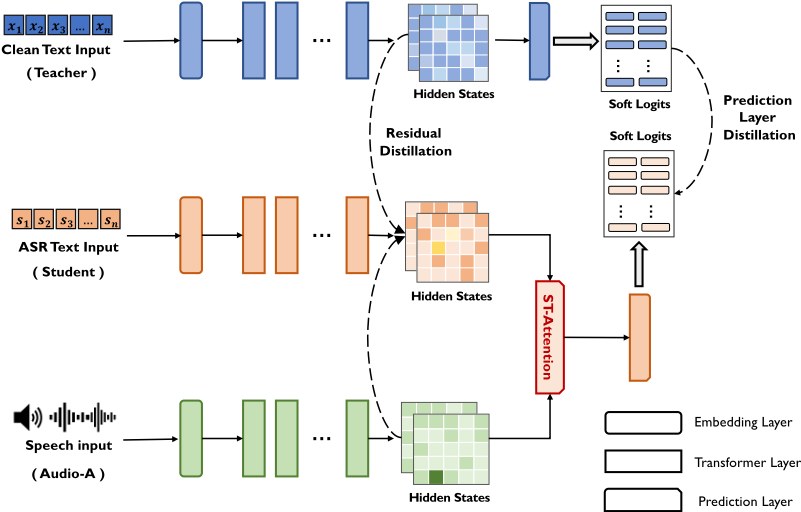
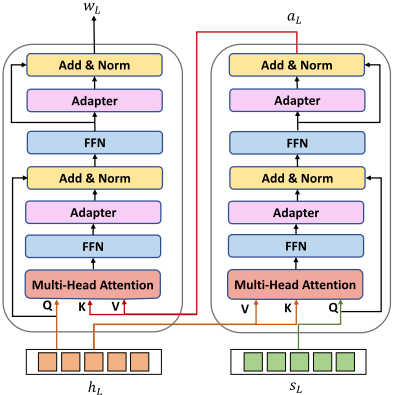
In this paper, we propose a deep multi-modal residual knowledge distillation framework for SQA tasks, called MRD-Net. Specifically, multi-domain features are treated as knowledge in this work. In our teacher-student paradigm, we first train the teacher model (T) on text transcriptions, and then the student model (S) is trained on ASR transcriptions with the goal of achieving the comparable performance. To further enhance the process of knowledge transfer, we propose an audio-assistant model (Audio-A) to learn the residual error between the hidden state features of T and S (See Figure 1). Furthermore, we introduce a novel attention (STAttention) mechanism by utilizing the scaled dot-product between multi-modal key-value and query vector pairs in the attention module as the audio-text knowledge to boost the performance (See Figure 2). With such knowledge transferring scheme, S can achieve the ideal mimicking on T efficiently. We validate the proposed method on three benchmark datasets, and experimentally demonstrate that our proposed method achieves superior performance compared with state-of-the-art methods.
The contributions of our work are summarized as follows:
- We propose a novel distillation model, MRD-Net, for the spoken question answering task, by introducing the multi-modal residual knowledge distillation (MRKD) strategy to alleviate the ASR errors. Moreover, we propose an Audio-A to learn residual error between the teacher and student models, which helps significantly improve model performance.
- We build a novel attention mechanism, termed as STAttention, to aid multi-modal knowledge transfer process with diverse-grained representations. Moreover, we further validate the proposed attention mechanism on other downstream multi-modal language processing tasks, and show its generalization ability.
- We evaluate the proposed MRD-Net on three commonly used speech question answering datasets, and prove that MRD-Net significantly outperforms state-of-the-art methods.
2 RelatedWork
2.1 Spoken Question Answering
Spoken question answering aims at enabling machine learning systems to automatically find the relevant answers from the given spoken documents. Typically, the spoken question answering system includes two main modules: automatic speech recognition and text question answering (TQA). Specifically, the ASR module first converts spoken content into noisy transcriptions, and then the noisy transcriptions are treated as input to TQA module to find the answers in given spoken transcriptions by leveraging robust information retrieval (IR) techniques. But existing work [Su and Fung, 2020] has proved that noisy ASR errors would significantly degrade the SQA performance. Much effort has been devoted to alleviate this issue. Utilizing sub-word unit in SQA [Li et al., 2018; Lee et al., 2018] achieved competitive performance in SQA tasks by mitigating the impact of speech recognition errors. The key idea of such methods is that ASR errors can be viewed as substitutions of word sequences for another ones (e.g., "feature" to "feather"). Therefore, the sub-word information can still be transferred correctly while the common error was missing or wrongly added one or two word transcriptions in ASR systems. A very recent work, called SpeechBERT [Chuang et al., 2020], introduced a pre-trained BERT-based language model for SQA tasks to jointly learn audio-text features for significant accuracy performance improvements.
2.2 Knowledge Distillation
In KD scheme [Hinton et al., 2015], the teacher model T(·) is to transfer richer knowledge to the student model S(·). In other words, the student network is trained with the purpose of fully reproducing the predictive behavior of the teacher network. Suppose fT and fS denote the behavior functions of T and S, respectively, behavior functions aim to transform network inputs into informative feature representations, and distill the knowledge from T to S. To further promote the distillation process, many attempts [Hahn and Choi, 2019; Gao et al., 2020] have been proposed. Gao et al. [2020] proposed residual knowledge distillation (RKD) strategy by adopting a residual learning strategy into the standard KD framework. Especially, RKD aims to supervise S to acquire knowledge from T, and then employ an assistant model A to learn the residual difference between S and T, such that A can further ease the process of knowledge transfer. Although our study shares a similar topic, our research method differs. Our experimental results show significant performance improvements by enabling the Audio-assistant model to capture the multi-modal residual knowledge to refine the learned feature representations. Most importantly, we focus on the question of utilizing multiple domain knowledge for network performance improvements.
3 Method
In this section, we detail a novel distillation method for the spoken question answering task. First, we present the design decisions for the proposed BERT-based network. We then present the proposed multi-modal residual knowledge distillation (MRKD) algorithm (See Figure 1). Next, we introduce the proposed ST-Attention mechanism (See Figure 2), and perform prediction-layer distillation to guide the learning framework throughout the training process. Finally, we describe how to incorporate the progressive learning in the training procedure in Section 3.5.
3.1 ProblemFormulation
The backbone of the proposed MRD-Net is similar to BERT [Devlin et al., 2019]. We follow the spoken question answering convention in [Lee et al., 2018; Kuo et al., 2020] that set the ASR token sequences of passages and corresponding questions as input to the following module. Specifically, a special token [CLS] is added to the beginning of the input sequences, and a special boundary token [SEP] is applied to separate token sequences. Given a passage P = {p1, p2, ..., pn}, and the corresponding question Q = {q1, q2, ..., qm}, these two sequences are packed together into {[CLS], q1, q2, ..., qm, [SEP], p1, p2, ..., pn, [SEP]}. Then the pre-trained BERT is employed to extract hidden state features from the given token sequences. A task-specific layer finally predicts the possibility of each token. Although directly adopting the pre-trained BERT language model has achieved good performance, there exist noisy ASR errors in the transcriptions, which significantly lead to the degradation of SQA performance. Thus, the key research problem becomes how to effectively alleviate the ASR errors and robust behavior functions. Different from previous natural language processing (NLP) models, we consider how to leverage spoken features to achieve better performance.
3.2 Multi-Modal Residual Knowledge Distillation
Knowledge Distillation. MRD-Net uses a pretrained BERT as the backbone of teacher and student models, consisting of 12 Transformer layers with the word embedding dimension of 768. Specifically, T is trained on manual transcriptions, and S on ASR transcriptions, including highly noisy ASR errors. Thus, there exists a substantial gap between the learning capacities of T and S.
Audio-Assistant. To narrow down the performance gap between the representation abilities of T and S, we use a BERTlike network trained on discretized speech tokens as the Audio-A. Concretely, a pre-trained VQ-Wav2Vec [Schneider et al., 2019] is trained on Librispeech-960 [Panayotov et al., 2015] to encode speech signals to a sequence of input tokens. Audio-A then utilizes contextual information from speech token sequences to aid the S in the mimicking process by learning the residual error between the feature maps of S and T. It is worth noting that Audio-A shares the similar structure with S and T (See Section 4.2).
Intuitively, we perform MRKD to encourage S to fully acquire knowledge from T in the distillation process. More concretely, in our proposed MRKD setting, S targets to mimic the hidden state representations of T to achieve comparable performance. Since there exists a huge gap of the learning capacities between T and S, we introduce Audio-A to facilitate the knowledge transfer process.
In MRKD, each model consists of the L-layer Transformer model, as shown in Figure 1. Let hAL , hTL , and hSL denote the hidden state features of Audio-A, T and S, respectively. Then, we train Audio-A by minimizing the following loss function:
where the size of hidden state features hAL , hTL , and hSL are l1 ×d1, l2 ×d2, and l2 ×d2, respectively. l1 and l2 refer to the length of input speech word tokens and text word tokens, and d1 and d2 are the word embedding dimensions, respectively. Then we compute residual-error-involved feature representations by summing the feature maps with the residual error with hL = hSL + hAL , will be used as the input of the following St-Attention.
3.3 ST-Attention
To achieve more accurate distillation process, we propose a novel ST-Attention mechanism by fusing audio features and textual features (See Figure 2). Let hL and sL represent feature representations in both text and spoken forms. The calculation of ST-Attention mechanism depends on the three components of key, query and value matrices with Transformer layers. Different from self-attention mechanism, we first set key-value pairs from textual features and queries from acoustic information as input. The attention heads compute attention maps aL in the speech domain with additional text context information. Then, we choose aL as key-value pairs with hL as queries into the following module to generate audiotext feature representations wL. To ease the process of knowledge transfer, we adopt the Adapter [Houlsby et al., 2019] in the ST-Attention mechanism with the parameter-efficient tuning to yield a compact and extensible model for every new NLP task. The feature map wL is used for inference.
3.4 Prediction Layer Distillation
In addition to mimick the behavior of the L-th layer, we also utilize the standard knowledge distillation [Hinton et al., 2015]. Specifically, we compute the soft cross-entropy loss to guide S to learn from the softened output of T. More concretely, wTL and wSL = wL denote the logits vectors generated by T and S, and y represents the corresponding sequence of ground-truth. We perform prediction layer distillation, and the objective is defined as:
where LNLL and LCE denote the negative log-likelihood loss and cross-entropy loss, respectively. pτ(·) refers to the softmax function with temperature τ . α is a hyper-parameter .
In the training phase, to achieve better performance, the knowledge transfer process consists of two steps. S first distill knowledge from the softened output of T, and then Audio-A is introduced to help refine the feature representations by capturing the underlying knowledge to improve the performance significantly.
3.5 MRKDwith Progressive Learning
Inspired by the recent success [Wang et al., 2018], we incorporate progressive learning into MRKD to enable more effective knowledge transfer. In this fashion, S is able to capture both high-level and low-level information from T, leading to significant performance gains. Concretely, we perform MRKD with each block to advance the process of the knowledge transfer. For example, in the first layer, S1 attempts to mimic the feature map of T1, and then Audio-A1 learns the residual error given the intermediate feature maps. After that, residual-error-involved features are utilized as the input for the following training. Following this learning strategy, both S is able to learn richer knowledge from T at multiple levels. In this way, S can be optimized at one time with
| Data Usage | Experimental Results | ||
|---|---|---|---|
| Training | Dev & Test | EM | F1 |
| Manual | Manual | 67.73 | 77.71 |
| Manual | ASR | 41.79 | 54.70 |
| ASR | ASR | 40.58 | 54.12 |
| ASR | Manual | 42.53 | 54.81 |
4 Experiments
4.1 Datasets
In this section, we evaluate the effectiveness of the proposed method on a variety of speech question answering tasks.
Spoken-SQuAD Spoken-SQuAD [Li et al., 2018] is an English listening comprehension dataset, which contains 37k ASR transcripts question pairs in the training set and 5.4k in the testing set, respectively. In Spoken-SQuAD, the spoken documents are in spoken form, and the questions and answers are in the text form. Specially, the word error rate (WER) is 22.77% on the training set, and 22.73% on the testing set, respectively. The manual written documents of SpokenSQuAD are from the original SQuAD dataset [Rajpurkar et al., 2016], which is one of the most popular machine reading comprehension benchmark datasets.
FGC 2018 Formosa Grand Challenge (FGC) dataset 1 is a Mandarin Chinese spoken multi-choice question answering (MCQA) dataset, which includes 7k passage-questionchoices (PQC) pairs as the training set and 1.5k as the development set, respectively. Each PQC pair consists of a passage, a question, and four corresponding answers, in that only one choice is the correct answer. In FGC dataset, all passages, questions, and multiple choices are in spoken form. Following the standard setting in [Kuo et al., 2020], we utilize the Kaldi toolkit to build up our ASR system where the WER is about 20.4%.
Spoken-CoQA Spoken-CoQA [You et al., 2020a] is an English spoken conversational question answering (SCQA) dataset, which consists of 40k and 3.8k question-answer pairs from 4k conversations in the training set and 380 conversations in test set from seven diverse domains, respectively. The WER is 18.7%. In Spoken-CoQA, questions and passages are both in text and spoken form, and answers are in the text form, respectively. In the spoken conversational question answering task, the machine comprehension systems aim to fully understand the spoken multi-turn dialogues, and then answer questions among the passage and conversations.
1 https://fgc.stpi.narl.org.tw/activity/techai2018
| Method | Spoken-SQuAD | Spoken-CoQA | FGC | ||||
|---|---|---|---|---|---|---|---|
| EM | F1 | AOS | EM | F1 | AOS | Accuracy (%) | |
| SDNet [Zhu et al., 2018] | 57.81 | 71.84 | 64.72 | 41.51 | 53.12 | 42.57 | 76.70 |
| HMM [Luo et al., 2019] | 54.43 | 65.11 | 46.88 | 37.71 | 50.09 | 34.75 | 72.00 |
| Lee et al. [2019] | 51.11 | 63.11 | - | - | - | - | 69.88 |
| Speech-BERT [Chuang et al., 2020] | 51.09 | 63.09 | 59.61 | 40.41 | 51.77 | 43.11 | 68.72 |
| vanilla BERT [Devlin et al., 2019] | 58.31 | 70.20 | 64.12 | 40.58 | 54.12 | 48.01 | 77.00 |
| Su and Fung [2020] | 59.71 | 70.94 | 65.01 | 42.11 | 55.64 | 48.17 | 77.78 |
| aeBERT [Kuo et al., 2020] | 59.37 | 70.36 | 67.87 | 44.38 | 55.67 | 50.34 | 78.20 |
| MRD-Net | 62.31 | 74.95 | 70.81 | 49.24 | 60.78 | 54.02 | 81.91 |
| Progressive MRD-Net | 63.12 | 75.89 | 71.79 | 50.75 | 61.99 | 54.68 | 82.73 |
4.2 Experimental Settings
In this study, we use BPE as the tokenizer to generate token sequences as input for both T and S, and Audio-A adopts VQWav2Vec as tokenizer. The maximum sequence lengths of T and S are 512, and the Audio-A is 1024. We utilize AdamW optimizer in training, and the learning rate is set to 8e-6. All models are trained using 4 as the batch size. The hyperparameter τ and α are set to 1 and 0.9, respectively. Specially, when training MRD-Net on Spoken-CoQA dataset, we utilize conversation history via adding the last question with previous 2 rounds of questions and ground-truth answers. When training MRD-Net on FGC, we concatenate ASR token sequences of a passage, a question, and the corresponding answers in training. We train our student model using 2 NVIDIA 2080Ti GPU. We choose Exact Matched (EM) percentage and F1 score as the evaluation metrics for SpokenCoQA and Spoken-SQuAD, and use accuracy to evaluate the model on FGC. Furthermore, we adopt Audio Overlapping Score (AOS) [Li et al., 2018] to evaluate overlap of time span between predictions and ground-truth answers.
4.3 Results
To demonstrate the performance degradation caused by ASR errors, we first evaluate the standard BERT on Spoken-CoQA dataset, which only set text document as inputs for answer predictions. In Table 1, we find that using standard BERT to train and to make inferences on the manual transcriptions achieves 67.73%/77.71% on EM/F1 scores, which outperforms that in other settings. This indicates that speech recognition errors lead to poor performances of the SQA systems, confirming the similar patterns in [Lee et al., 2019].
We also demonstrate the effectiveness of our proposed method. The results on Spoken-SQuAD, Spoken-CoQA, and FGC datasets are reported in Table 2. From Table 2, we can draw two following conclusions. i) The proposedmethod significantly outperforms all other evaluated methods. For example, on FGC dataset, aeBERT is the best language model among all the 7 evaluated methods. Compared with aeBERT, our proposed model achieves 81.91% (+ 3.71% improvement) in terms of accuracy. Moreover, MRD-Net is capable of achieving superior performance on Spoken-SQuAD and Spoken-CoQA datasets. The results suggest that our proposed method is capable of improving the performance in a variety of language tasks. ii) Here we introduce the progressive learning strategy to MRD-Net (Progressive MRD-Net). Table 2 shows that Progressive MRD-Net can perform better than that without using progressive learning, improving the results by 0.81%/0.96% and 0.98% on Spoken-SQuAD, 1.51%/1.21% and 0.66% on Spoken-CoQA and 0.82% on FGC, in terms of EM, F1, and AOS scores, respectively. This suggests that some missing low-level feature representations embedded in both text corpora and speech documents can help with the performance improvements.
| Model | S-SQuAD | S-CoQA | FGC Accuracy |
|---|---|---|---|
| F1 | F1 | (%) | |
| MRD-Net | 74.95 | 60.78 | 81.91 |
| - w/o pl distillation | 73.87 | 59.23 | 80.75 |
| - w/o Audio-A | 73.09 | 58.12 | 80.42 |
| - w/o ST-Attention | 72.81 | 58.61 | 79.07 |
| - w/ MSE | 74.32 | 60.13 | 81.20 |
5 Ablation Study
In this section, we conduct ablation studies to analyze the following contributions of: i) validating the effectiveness of different components, ii) examining different distillation objectives, iii) investigating how ST-Attention results in performance gain, iv) exploring how the hyperparameter selection affects network performance. Note that here we utilize the pre-trained BERT as the backbone for T and S in this study.
Different Components of MRD-Net We report results in Table 3. We can clearly see that removing either perdition layer distillation or Audio-A leads to a significant performance drop over three benchmark datasets. This confirms the Hyper-parameter τ
| Algorithm | S-SQuAD F1 | S-CoQA F1 | FGC Accuracy (%) |
|---|---|---|---|
| KD (Text only) | 72.23 | 57.68 | 78.81 |
| RKD (Text only) | 73.09 | 58.12 | 80.75 |
| KD (Audio only) | 64.51 | 52.31 | 70.01 |
| "[CLS]"-based | 69.32 | 53.10 | 76.43 |
| Attention-based | 74.11 | 59.11 | 80.78 |
| MRD-Net | 74.95 | 60.78 | 81.91 |
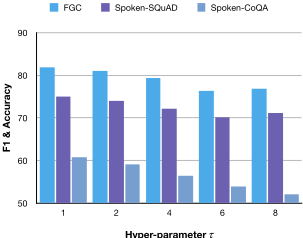
Figure 3: Performance of different temperature τ .
importance of the knowledge transfer process and audio features in this setting. The results also indicate that the acousticlevel information distilled from Audio-A can help S to deeply model the behavior of T. Specifically, we observe that without using ST-Attention leads to the performances drop by 2.14%, 2.17% and 2.84%, respectively. Moreover, it is worth to note that using mean-squared-error (MSE) loss instead of Eq.1 also suffers performance degradation.
Effects of Distillation Objectives We investigate the effects of distillation objectives on the proposed method. The quantitative results are reported in Table 4. From Table 4, we can obtain the following conclusion. i) Compared with directly using knowledge distillation strategy on either text corpora or audio documents, the proposed model achieves better performance by using both acoustic and textual features. This indicates the importance of multi-domain knowledge for SQA tasks. ii) Directly utilizing the [CLS] token in BERT [Devlin et al., 2019] to process passage for the following knowledge transfer process leads to the significant performance drop. This shows that, compared with the simple sentence-level classifier tasks, the SQA task is more challenging for machine systems to fully comprehend the passages and make correct predictions. iii) Our proposed MRKD approach outperforms the attention-based distillation approach [Jiao et al., 2020]. Although knowledge embedded in attention weights contains more syntax and coreference information, it is hard to align similar abstract concepts in speech representations. In contrast, our proposed method can effectively tackle the above issues.
| Algorithm | S-SQuAD F1 | S-CoQA F1 | FGC Accuracy (%) |
|---|---|---|---|
| Multi-T [2019] | 71.93 | 56.69 | 78.76 |
| Co-Att [2019] | 72.82 | 58.07 | 79.63 |
| ICCN [2020] | 71.71 | 57.31 | 79.01 |
| S-Fusion [2020] | 68.16 | 51.79 | 75.13 |
| ST-Attention | 74.95 | 60.78 | 81.91 |
| - w/o Adapters | 74.41 | 60.15 | 81.13 |
| Algorithm | Happy | Sad | Angry | Neutral | ||||
|---|---|---|---|---|---|---|---|---|
| Acc(h) | F1(h) | Acc(h) | F1(h) | Acc(h) | F1(h) | Acc(h) | F1(h) | |
| Multi-T [2019] | 84.4 | 81.9 | 77.7 | 74.1 | 73.9 | 70.2 | 62.5 | 59.7 |
| ICCN [2020] | 87.41 | 84.72 | 86.26 | 85.93 | 88.62 | 88.02 | 69.73 | 68.47 |
| Co-Attention [2019] | 88.64 | 87.61 | 89.01 | 88.3 | 93.04 | 93.21 | 80.31 | 79.09 |
| Shallow-Fusion [2020] | 89.71 | 88.34 | 89.48 | 89.2 | 93.82 | 93.9 | 80.93 | 81.01 |
| St-Attention | 90.76 | 89.42 | 90.54 | 89.7 | 94.21 | 94.76 | 82.31 | 82.77 |
Effects of ST-Attention We also investigate the effectiveness of ST-Attention mechanism. As shown in Table 5, using ST-Attention achieves superior performance compared with other methods. Furthermore, we can see that using Adapters results in small performance degradation. This demonstrates that Adapters can yield performance gains by filtering out useless knowledge. To illustrate the generality and robustness of the proposed ST-Attention mechanism, we further validate ST-Attention on the multi-modal emotion recognition task. For a fair comparison, we adopt various multimodal fusion mechanisms into the BERT-liked model [Siriwardhana et al., 2020]. Following the setting in [Sun et al., 2020], we choose four most commonly used emotion categories, including Happy, Sad, Angry, and Neutral on IEMOCAP dataset [Busso et al., 2008]. In parallel, we use Binary Accuracy and F1-Score for evaluation. As shown in Table 6, we observe that our method achieves better performance than other evaluated methods among all emotion categories.
Effects of Temperature τ We present the model performance with different temperature τ in Figure 3. τ is chosen from {1, 2, 4, 6, 8}. From Figure 3, MRD-Net achieves superior results when τ is set to 1.
6 Conclusion
We propose a novel speech question answering framework, called MRD-Net, which further distills knowledge from T to alleviate ASR errors. Specially, we introduce audio-A to aid knowledge transfer process for performance improvements. In addition, we introduce ST-Attention mechanism by incorporating audio-text representations to further distill multidomain knowledge to bring further performance improvements. Extensive experiments demonstrate the effectiveness of the proposed method on a variety of tasks. In future work, we will explore new training strategies by only leveraging acoustic features to achieve comparable performance.
@inproceedings{ijcai2021p549,
  title     = {MRD-Net: Multi-Modal Residual Knowledge Distillation for Spoken Question Answering},
  author    = {You, Chenyu and Chen, Nuo and Zou, Yuexian},
  booktitle = {Proceedings of the Thirtieth International Joint Conference on
               Artificial Intelligence, {IJCAI-21}},
  publisher = {International Joint Conferences on Artificial Intelligence Organization},
  editor    = {Zhi-Hua Zhou},
  pages     = {3985--3991},
  year      = {2021},
  month     = {8},
  note      = {Main Track},
  doi       = {10.24963/ijcai.2021/549},
  url       = {https://doi.org/10.24963/ijcai.2021/549},
}
TY - CPAPER TI - MRD-Net: Multi-Modal Residual Knowledge Distillation for Spoken Question Answering AU - You, Chenyu AU - Chen, Nuo AU - Zou, Yuexian T2 - Proceedings of the Thirtieth International Joint Conference on Artificial Intelligence, IJCAI-21 PB - International Joint Conferences on Artificial Intelligence Organization PY - 2021 SP - 3985 EP - 3991 DO - 10.24963/ijcai.2021/549 UR - https://doi.org/10.24963/ijcai.2021/549 ER -Copied
Machine-readable versions of this paper, for tools and AI agents:





