
Discrete Multiple Kernel k-means
Proceedings of the Thirtieth International Joint Conference on Artificial Intelligence. Main Track. Pages 3111-3117.
https://doi.org/10.24963/ijcai.2021/428
Keywords
- Machine Learning: Clustering
- Machine Learning: Kernel Methods
- Machine Learning: Multi-instance; Multi-label; Multi-view learning
Abstract
The multiple kernel k-means (MKKM) and its variants utilize complementary information from different kernels, achieving better performance than kernel k-means (KKM). However, the optimization procedures of previous works all comprise two stages, learning the continuous relaxed label matrix and obtaining the discrete one by extra discretization procedures. Such a two-stage strategy gives rise to a mismatched problem and severe information loss. To address this problem, we elaborate a novel Discrete Multiple Kernel k-means (DMKKM) model solved by an optimization algorithm that directly obtains the cluster indicator matrix without subsequent discretization procedures. Moreover, DMKKM can strictly measure the correlations among kernels, which is capable of enhancing kernel fusion by reducing redundancy and improving diversity. What’s more, DMKKM is parameter-free avoiding intractable hyperparameter tuning, which makes it feasible in practical applications. Extensive experiments illustrated the effectiveness and superiority of the proposed model.
- [Calandriello and Rosasco, 2018] Daniele Calandriello and Lorenzo Rosasco. Statistical and computational trade-offs in kernel k-means. In Proc. NeurIPS, pages 9357-9367, 2018.
- [Du et al., 2015] Liang Du, Peng Zhou, Lei Shi, Hanmo Wang, Mingyu Fan, Wenjian Wang, and Yi-Dong Shen. Robust multiple kernel k-means using l21-norm. In Proc. IJCAI, pages 3476-3482, 2015. IJCAI
- [Gönen and Margolin, 2014] Mehmet Gönen and Adam A Margolin. Localized data fusion for kernel k-means clus- tering with application to cancer biology. In Proc. NIPS, pages 1305-1313, 2014.
- [Hartigan and Wong, 1979] J. A. Hartigan and M. A. Wong. Algorithm as 136: A k-means clustering algorithm. Jour- nal of the Royal Statistical Society, 28(1):100-108, 1979.
- [He and Zhang, 2018] Li He and Hong Zhang. Kernel k- means sampling for nyström approximation. IEEE Trans. Image Process., 27(5):2108-2120, 2018.
- [Huang et al., 2011] Hsin-Chien Huang, Yung-Yu Chuang, and Chu-Song Chen. Multiple kernel fuzzy clustering. IEEE Trans. Fuzzy Syst., 20(1):120-134, 2011.
- [Kang et al., 2018] Zhao Kang, Xiao Lu, Jinfeng Yi, and Zenglin Xu. Self-weighted multiple kernel learning for graph-based clustering and semi-supervised classification. In Proc. IJCAI, pages 2312-2318, 2018. IJCAI
- [Liu et al., 2016] Xinwang Liu, Yong Dou, Jianping Yin, Lei Wang, and En Zhu. Multiple kernel k-means clustering with matrix-induced regularization. In Proc. AAAI, pages 1888-1894, 2016.
- [Liu et al., 2017] Xinwang Liu, Sihang Zhou, Yueqing Wang, Miaomiao Li, Yong Dou, En Zhu, and Jianping Yin. Optimal neighborhood kernel clustering with multiple ker- nels. In Proc. AAAI, pages 2266-2272, 2017.
- [Schölkopf et al., 1998] Bernhard Schölkopf, Alexander Smola, and Klaus-Robert Müller. Nonlinear compo- nent analysis as a kernel eigenvalue problem. Neural computation, 10(5):1299-1319, 1998.
- [Van Laarhoven and Marchiori, 2016] Twan Van Laarhoven and Elena Marchiori. Local network community de- tection with continuous optimization of conductance and weighted kernel k-means. The Journal of Machine Learn- ing Research, 17(1):5148-5175, 2016.
- [Vankadara and Ghoshdastidar, 2020] Leena C Vankadara and Debarghya Ghoshdastidar. On the optimality of ker- nels for high-dimensional clustering. In Proc. AISTATS, pages 2185-2195, 2020.
- [Wang et al., 2019a] Shusen Wang, Alex Gittens, and Michael W Mahoney. Scalable kernel k-means clustering with nyström approximation: relative-error bounds. The Journal of Machine Learning Research, 20(1):431-479, 2019.
- [Wang et al., 2019b] Siwei Wang, Xinwang Liu, En Zhu, Chang Tang, Jiyuan Liu, Jingtao Hu, Jingyuan Xia, and Jianping Yin. Multi-view clustering via late fusion align- ment maximization. In Proc. IJCAI, pages 3778-3784, 2019. IJCAI
- [Wright, 2015] Stephen J Wright. Coordinate descent algo- rithms. Math. Program., 151(1):3-34, 2015.
- [Xu et al., 2017] Jinglin Xu, Junwei Han, Feiping Nie, and Xuelong Li. Re-weighted discriminatively embedded k- means for multi-view clustering. IEEE Trans. Image Pro- cess., 26(6):3016-3027, 2017.
- [Yu et al., 2011] Shi Yu, Leon Tranchevent, Xinhai Liu, Wolfgang Glanzel, Johan AK Suykens, Bart De Moor, and Yves Moreau. Optimized data fusion for kernel k- means clustering. IEEE Trans. Pattern Anal. Mach. Intell., 34(5):1031-1039, 2011.
- [Zhao et al., 2009] Bin Zhao, James T Kwok, and Changshui Zhang. Multiple kernel clustering. In Proc. SDM, pages 638-649, 2009.
References were extracted automatically from the PDF and may contain errors.
Full text extracted automatically from the PDF; figures, tables and equations may differ. The PDF is the version of record.
1 Introduction
Clustering is one of the most fundamental topics in machine learning and data mining. Out of various clustering algorithms, k-means [Hartigan and Wong, 1979] enjoys a huge popularity because of efficiency and simpleness, but it fails to cope with non-globular clusters which are very common in practice. Thus, researchers put forward a series of models to solve this problem, e.g., kernel k-means clustering (KKM) [Sch¨olkopf et al., 1998] using a kernel function to embed the original data into a high-dimensional Reproducing Kernel Hilbert Space (RKHS) where standard k-means clustering is performed with linearly separable mapped data [Van Laarhoven and Marchiori, 2016; He and Zhang, 2018; Calandriello and Rosasco, 2018; Wang et al., 2019a; Vankadara and Ghoshdastidar, 2020]. Although KKM intends to improve the clustering performance by introducing kernel functions, it is unable to identify whether a specific kernel function is suitable for a particular task in advance. To alleviate this problem, it's a good idea to allow the algorithm to adaptively choose the appropriate kernels, exploiting complementary information from different kernels to enhance learning, which is known as multiple kernel learning [Zhao et al., 2009; Xu et al., 2017; Kang et al., 2018].
∗Corresponding Author
Huang et al. proposed multiple kernel k-means clustering (MKKM) applying multiple kernel learning settings to kernel k-means clustering [Huang et al., 2011], which unifies the kernel fusion process and clustering into a single optimization framework. A concurrent work OKKC optimizes the kernel coefficients and cluster membership based on the same Rayleigh quotient objective and claims to have less complexity [Yu et al., 2011]. In the past decades, many studies have been devoted to improving MKKM. G¨onen et al. proposed localized multiple kernel k-means (LMKKM) to adaptively change the kernel coefficients with a localized data fusion approach acquiring sample-specific characteristics of the data [G¨onen and Margolin, 2014]. Besides, Du et al. replaced the squared error term of k-means with ℓ2,1-norm based one and proposed a robust multiple kernel k-means clustering (RMKKM) algorithm to improve the robustness with respect to noises and outliers [Du et al., 2015]. Liu et al. argued that previous works haven't significantly considered the correlation among different kernels and proposed a MKKM-MR model which conducts a matrix-induced regularization to reduce the redundancy and enhance the diversity of selected kernels [Liu et al., 2016].
Although previous works made some progress in MKKM clustering performance, they suffer from various problems. Dealing with the NP-hard cluster assignment problem, they all utilize the two-stage process: learning the continuous relaxation matrix and obtaining the discrete clustering indicator matrix by extra discretization process, which result in a mismatched problem and severe information loss. Moreover, existing MKKM models overlook the correlation among different kernels, leading to fusion of mutually redundant kernels and bad effect on the diversity of information sources. What's worse, most existing models achieve desirable clustering performance by tuning hyperparameters from regularization terms, which is intractable in practice owing to tedious setting and hard searching of hyperparameters.
In this paper, we elaborate a novel Discrete Multiple Kernel k-means (DMKKM) clustering model, which aims at overcoming the limitations and weaknesses caused by the above problems. The major contributions of our model can be summarized as follows. Firstly, DMKKM is able to directly obtain cluster indicator matrix without subsequent steps, which works as the first model to directly solve the cluster assignment problem avoiding information loss and over reliance on extra discretization procedures. Secondly, our model is capable of measuring the correlation among kernels by penalizing the selection of highly correlated kernels, which successfully enhances kernel fusion by reducing redundancy and improving diversity. Thirdly, the proposed model is completely parameter-free avoiding intractable hyperparameter tuning, which makes it more feasible in practice. Lastly, extensive experiments conducted on several real-world benchmark datasets demonstrate the effectiveness and efficiency of our proposed model.
2 RelatedWork
2.1 Kernel k-means (KKM)
Given a data matrix X = [x1, · · · , xn] ∈ Rd×n where n is the number of data points and d is the dimension of features. Let φ(·) : Rd → H be a kernel mapping that maps X onto a reproducing kernel Hilbert space H. Let F ∈ Bn×c denote the cluster indicator matrix represented by F ∈ Ind where c is the number of clusters. If φ(xi) is assigned to the jth cluster then Fij = 1, otherwise Fij = 0. The objective of kernel k-means (KKM) is to minimize the sum of the squared errors defined by
where mj denotes the center of the j-th cluster. Problem (1) can be reformulated in matrix form:
where φ(X) = [φ(x1), · · · , φ(xn)] and M = [m1, · · · ,mc] denotes the clustering centroid matrix. Taking the derivative of Eq. (2) w.r.t. M and setting it to zero, we have
Substituting Eq. (3) to Eq. (2) yields
where K = φ(X)T φ(X) ∈ Rn×n is a kernel matrix with the 〈i, j〉-th element K(i, j) = φ(xi)T φ(xj). Problem (4) is NP-hard since the elements of F are constrained to be discrete values. A widely used way is to relax the discrete constraint of F and allow ˜ F = F(F T F)- 1 2 to take arbitrary real values, so problem (4) becomes
where I denotes the identity matrix. The optimal solution to problem (5) is formed by the eigenvectors of K corresponding to its largest c eigenvalues. Since ˜ F is now in relaxed continuous form and has mixed signs, we have to lean upon other discretization procedures, such as k-means, so as to obtain the discrete cluster indicator matrix F .
2.2 Multiple Kernel k-means (MKKM)
In multiple kernel settings, each data point has multiple feature representations via a group of kernel mappings {φp(·)}vp=1 which is represented as φγ(xi) = [γ1φ1(xi); · · · ; γvφv(xi)], where γ = [γ1, · · · , γv]T denotes the coefficients of each base kernel and needs to be optimized through learning. Kγ = ∑vp=1 γ 2 pKp denotes kernel matrix with the 〈i, j〉-th element Kγ(i, j) = φγ (xi)T φγ (xj ) = ∑vp=1 γ 2 p φp(xi)T φp(xj ).
By replacing the kernel matrix K in Eq. (4) with Kγ, the objective of multiple kernel k-means (MKKM) can be formulated as
where 1 is a column vector with all elements being 1. This problem can be solved by alternatively updating F and γ:
1) Update F with γ fixed. Taking the same two-stage strategy as KKM does, problem (6) becomes
where ˜ F denotes the continuous relaxation of F(F T F)- 1 2 . The optimal solution ˜ F is obtained as the c eigenvectors of Kγ corresponding to the largest c eigenvalues. Then, F is obtained from ˜ F through other discretization procedures.
2) Update γ with F fixed. Problem (6) becomes
where γ can be optimized via solving the above quadratic programming (QP) problem with linear constraints.
2.3 MKKMwithMatrix-induced Regularization (MKKM-MR)
By observing that MKKM does not sufficiently consider the correlation among base kernels, Liu et al. proposed to reduce the redundancy and enhance the diversity of selected kernels by incorporating a matrix-induced regularization [Liu et al., 2016], as fulfilled in the following
where M denotes a matrix with M(p, q) = Tr(KT p Kq) and λ denotes the regularization parameter. This problem can be solved by alternatively updating F and γ:
1) Update F with γ fixed. The solution of F is the same as MKKM.
2) Update γ with F fixed. Problem (8) becomes
where D is a diagonal matrix with the i-th diagonal element Dii = Tr(Kp(I -F (F T F )-1F T )) and γ can be optimized via solving the above quadratic programming problem with linear constraints.
3 The Proposed Discrete Multiple Kernel k-means (DMKKM)
In this section, we elaborate the Discrete Multiple Kernel kmeans (DMKKM) model. We first present the formulation and then develop an efficient algorithm for optimization.
3.1 The Proposed DMKKMModel
As mentioned above, the solutions of F in KKM, MKKM and MKKM-MR comprise two independent stages: first learning continuous relaxation ˜ F and then learning F from ˜ F by the discretization procedures. Such two-stage solutions are likely to result in severe information loss and unsatisfying clustering performance. To avoid this situation, we intend to devise a novel multiple kernel k-means (DMKKM) model which is able to directly generate the discrete clustering indicator matrix F .
In the multiple kernel setting, each data point φα(xi) is represented as φα(xi) = [√α1φ1(xi); · · · ; √αvφv(xi)], where α = [α1, · · · , αv]T denotes the coefficients of each base kernel and needs to be optimized during learning. Kα = ∑vp=1 αpKp is the kernel matrix with the 〈i, j〉-th element Kα(i, j) = ∑vp=1 αpφp(xi)T φp(xj). Our discrete multiple kernel k-means (DMKKM) model can be formulated as
where Kα = KTα is a symmetric matrix, F ∈ Ind denote the cluster indicator matrix and ‖ · ‖F denotes the Frobenius norm. Problem (11) can be further reduced to
In problem (12), minimizing Tr(KαKα) is equivalent to minimizing ∑vp=1 ∑vq=1 αpαqTr(KpKq), where Tr(KpKq) measures the correlation between Kp and Kq. To be specific, the larger the value of Tr(KpKq) is, the higher correlation between Kp and Kq, and vice versa. On the one hand, if Kp and Kq are more correlated, minimizing the value of αpαq Tr(KpKq) is able to greatly reduce the risk of simultaneously assigning αp and αq with large weights. On the other hand, if Kp and Kq are less correlated, minimizing the value of αpαqTr(KpKq) is able to greatly reduce the risk of simultaneously assigning αp and αq with small weights. Therefore, minimizing Tr(KαKα) can significantly contribute to reducing the redundancy and enforcing the diversity of selected kernels.
3.2 Optimization Algorithm
Problem (12) can be solved with an alternative optimization approach. Concretely, the following shows the alternative optimization procedures updating F and α.
Step 1: Update F when α is fixed. Problem (12) becomes the following objective function:
Algorithm 1 Coordinate descent to solve problem (13)
Input: Kα ∈ Rn×n , initial cluster label F ∈ Ind Output: Final cluster label F ∈ Ind
- 1: Precompute f T l Kαfl and f T l fl, ∀l ∈ {1, . . . , c}. 2: while not converge do 3: for i = 1 . . . n do 4: Let m be the location of 1 in the i-th row of F . 5: for s = 1 . . . c do 6: Calculate L(s) by Eq. (22) or Eq. (27). 7: end for 8: s∗ ← arg maxs L(s). 9: F(i, s∗ ) ← 1, F(i,m) ← 0. 10: end for 11: end while
which is equivalent to the following vector form:
where fl denotes the l-th column of F , which denotes indicator clustering matrix obtained from the latest iteration. Now, we are going to obtain the discrete clustering indicator matrix F directly by utilizing coordinate descent technique [Wright, 2015], during which all variables are fixed except the i-th row being updated to its optimal value.
When we aim at updating the i-th row of F, it's clear that there are c kinds of possible situations including {[1, 0, · · · , 0], . . . , [0, 0, · · · , 1]} with varying position of element 1. To be specific, we denote F (s) with s ∈ {1, . . . , c} as {F (1) , · · · ,F (c) } varying from different situations of the i-th row of F. For example, F (s) denotes that only the s-th element in the i-th row of F is 1 and the rest ones are 0's, noting that F (s) and F are identical except the i-th row. Hence, the objective function of updating a row can be expressed as
where f (s) l is the l-th column of F (s) . It's viable to solve problem (15) by directly iterating through all s to find the optimal one, but the computational complexity of the bruteforce search is expensive. Next, we introduce how the computational burden can be skillfully reduced. Let's introduce a constant F (0) in which all elements in the i-th row are 0, while the rest rows are identical to F. Therefore, problem (15) is equivalent to
where f (0) l is the l-th column of F (0) . It's clear that F (s) and F (0) are identical except the s-th column, so problem (16) can be simplified as
Algorithm 2 The procedure to solve problem (11)
Input: Kernels {Kp ∈ Rn×n }vp=1 , number of clusters c Output: Final cluster label F ∈ Ind
- 1: Let α = 1v/v, random initialize cluster labels F .
- 2: while not converge do
- 3: Update F by Algorithm 1.
- 4: Update α by Eq. (29).
- 5: end while
In order to find the optimal s of problem (17), we need to calculate its numerators and denominators corresponding to different s ∈ {1, 2, · · · , c}, but directly calculating them is still time-consuming. Inspired by the fact that F (s) is closely related to F , we then demonstrate how to efficiently calculate the numerators and denominators in Eq. (17) by reusing previously calculated intermediate variables. For convenience, we denote the position of element 1 in the i-th row of F as m, i.e., F (s) = F when s = m. To be more detailed, we separately discuss as:
When s = m, we gain f (s) s = fs, and f (0) s = f (s) s - δ denoting δ ∈ Rn as a column vector with i-th element being 1 and the rest being 0, so the numerators and denominators of Eq. (17) can be obtained by
where Kα(:, i) is the i-th column of Kα, and Kα(i, i) is the element settled in the i-th row of Kα(:, i), and thus we have
When s ̸= m, we gain f (0) s = fs, and f (s) s = fs + δ, so the numerators and denominators can be obtained by
so we have
According to Eq. (22) or Eq. (27), we gain the ideal value of s reaching the optimal L(s) and denote it as s∗ , which is the position of element 1 in the i-th row. Through the repeated iteration, we finish updating the i-th row of updated optimal F as shown in Algorithm 1. In practice, we break the iteration once the increasing rate of Eq. (13) is less than the threshold with the value of 10-3 .
Step 2: Update α when F is fixed. Problem (12) becomes:
For simplicity, let us introduce a matrix M ∈ Rv×v whose 〈p, q〉-th element is defined as M(p, q) = Tr(KpKq) and a vector d ∈ Rv = [Tr(F T K1F(F T F)-1 ), · · · ,Tr(F T KvF(F T F)-1 )]T . Problem (28) can be transformed into the following quadratic programming (QP) problem with linear constraints
which can be solved by any standard QP solver.
The overall optimization procedure for our proposed DMKKMmodel is summarized in Algorithm 2.
3.3 Complexity Analysis
The time complexities of calculating Eqs. (22) and (27) are both O(n), so finding the optimal s∗ is O(nc). Considering F contains only n 1s while the rest are all 0s, the complexity can be regarded as O(n). Suppose Algorithm 1 converges after t1 iterations, its time complexity is O(n2 t1). The time complexity of the rest of Algorithm 2 is dominated by calculating the vector d, which takes O(n2 v). Since the number of kernels v is usually very small, the QP solver converges very fast in practice, and thus can be ignored. In summary, the time complexity of Algorithm 2 is O((n2 t1 + n2 v)t) denoting the number of the outer loop as t. Our algorithm is highly efficient comparing with other MKKM models utilizing the two-stage optimization algorithm, in which the time complexity of eigenvalue decomposition is cubic to n.
4 Experiments
In this section, we evaluate the clustering performance of the proposed DMKKM model on a number of real-world datasets. Besides, we meticulously analyze the properties of coefficients obtained by learning, meanwhile showing convergence curves to verify the efficiency of the algorithm.
| Name | # Samples | # Kernels | # Classes |
|---|---|---|---|
| Handwritten | 2000 | 6 | 10 |
| Pima | 768 | 8 | 2 |
| ProteinFold | 694 | 12 | 27 |
| SensITVehicle | 1500 | 2 | 3 |
| UCI DIGIT | 2000 | 3 | 10 |
| Washington | 230 | 2 | 5 |
| Wisconsin | 265 | 2 | 5 |
| Dataset | Metric | MKKM | OKKC | LMKKM | RMKKM | MKKM-MR | ONKC | MVC-LFA | DMKKM |
|---|---|---|---|---|---|---|---|---|---|
| Handwritten | ACC | 0.6825 | 0.6870 | 0.6550 | 0.6410 | 0.8910 | 0.9235 | 0.9355 | 0.9160 |
| NMI | 0.6598 | 0.6703 | 0.6475 | 0.6742 | 0.8265 | 0.8454 | 0.8670 | 0.8472 | |
| ARI | 0.5411 | 0.5510 | 0.5033 | 0.5384 | 0.7811 | 0.8398 | 0.8631 | 0.8267 | |
| Pima | ACC | 0.5716 | 0.5104 | 0.5208 | 0.5065 | 0.6536 | 0.6549 | 0.6471 | 0.6563 |
| NMI | 0.0010 | 0.0005 | 0.0048 | 0.0000 | 0.0646 | 0.0753 | 0.0819 | 0.0824 | |
| ARI | 0.0073 | -0.0008 | -0.0006 | -0.0012 | 0.0928 | 0.0949 | 0.0852 | 0.0966 | |
| ProteinFold | ACC | 0.2853 | 0.2997 | 0.2262 | 0.2882 | 0.3732 | 0.3732 | 0.3646 | 0.3862 |
| NMI | 0.3507 | 0.3988 | 0.3537 | 0.3940 | 0.4454 | 0.4471 | 0.4280 | 0.4717 | |
| ARI | 0.1456 | 0.1385 | 0.0844 | 0.1425 | 0.1911 | 0.1927 | 0.1916 | 0.1932 | |
| SensITVehicle | ACC | 0.5787 | 0.5567 | 0.4240 | 0.4120 | 0.6560 | 0.5433 | 0.6927 | 0.6813 |
| NMI | 0.1389 | 0.1388 | 0.0674 | 0.0537 | 0.2113 | 0.1143 | 0.2681 | 0.2405 | |
| ARI | 0.1454 | 0.1584 | 0.0605 | 0.0473 | 0.2400 | 0.1149 | 0.2967 | 0.2739 | |
| UCI DIGIT | ACC | 0.4225 | 0.4725 | 0.4780 | 0.4150 | 0.9090 | 0.9125 | 0.9020 | 0.9330 |
| NMI | 0.4548 | 0.4813 | 0.4846 | 0.4687 | 0.8368 | 0.8425 | 0.8295 | 0.8715 | |
| ARI | 0.3272 | 0.3066 | 0.3111 | 0.3173 | 0.8131 | 0.8206 | 0.8008 | 0.8589 | |
| Washington | ACC | 0.4478 | 0.4783 | 0.4957 | 0.4696 | 0.5609 | 0.6087 | 0.5870 | 0.6130 |
| NMI | 0.0491 | 0.0571 | 0.1433 | 0.0433 | 0.3172 | 0.3494 | 0.3335 | 0.3799 | |
| ARI | 0.0662 | 0.0390 | 0.1203 | 0.0594 | 0.3086 | 0.3904 | 0.3561 | 0.4033 | |
| Wisconsin | ACC | 0.5547 | 0.5623 | 0.4566 | 0.5245 | 0.5585 | 0.5962 | 0.5623 | 0.5925 |
| NMI | 0.2288 | 0.2532 | 0.1629 | 0.2474 | 0.3323 | 0.3360 | 0.3505 | 0.3565 | |
| ARI | 0.2188 | 0.2028 | 0.0730 | 0.2339 | 0.2660 | 0.3073 | 0.2878 | 0.3166 |
4.1 Dataset Descriptions
Seven real-world benchmark datasets are employed to evaluate the clustering performance, including Handwritten, Pima, ProteinFold, SensITVehicle, UCI DIGIT, Washington and Wisconsin. All these datasets are downloaded from Xinwang Liu's page 1 and more details can be found in their published papers. More importantly, we summarize their statistical properties in Table 1.
4.2 ComparisonModels
We compare our proposed DMKKM model with several multi-kernel k-means clustering models, including:
- Multiple Kernel k-means (MKKM) [Huang et al., 2011]: The algorithm performs kernel k-means and updates kernel coefficients alternately, as introduced in Section 2.2.
- Optimized Kernel k-means Clustering (OKKC) [Yu et al., 2011]: This is a concurrent work of MKKM, but optimizes the kernel coefficients and cluster membership based on the same Rayleigh quotient objective.
- Localized Multiple Kernel k-means (LMKKM) [G¨onen and Margolin, 2014]: The model learns the kernel coefficients with a localized approach.
- Robust Multiple Kernel k-means (RMKKM) [Du et al., 2015]: RMKKM replaced the squared error term of kmeans with ℓ2,1-norm based one to make it more robust.
1 https://xinwangliu.github.io
- Multiple Kernel k-means with Matrix-induced Regularization (MKKM-MR) [Liu et al., 2016]: The model introduced a matrix-induced regularization to reduce the redundancy and enhance the diversity of selected kernels.
- Optimal Neighborhood Kernel Clustering (ONKC) [Liu et al., 2017]: This model allows the optimal kernel to reside in the neighborhood of the base kernels to enlarge the region from which an optimal kernel can be chosen.
- Multi-view Clustering via Late Fusion Alignment Maximization (MVC-LFA) [Wang et al., 2019b]: This model proposes to maximally align the consensus partition with the weighted base partitions, and they theoretically prove that it is equivalent to minimize the loss function of k-means clustering.
Among these models, MKKM, OKKC, LMKKM and DMKKM are parameter-free, while RMKKM, MKKM-MR have one hyperparameter, and ONKC, MVC-LFA have two hyperparameters.
4.3 Experimental Settings
For the sake of fairness, we perform gird search to determine the hyperparameters for all comparison models with parameters choosing their best results, under the guidance of relative papers, though our DMKKM is completely parameter-free model. The source codes are downloaded from the authors' pages or requested from the authors.
4.4 Result Analyses
Clustering performance. Table 2 presents the results of three widely-adopted clustering performance metrics, including clustering accuracy (ACC), normalized mutual information (NMI) and adjusted rand index (ARI). According to the presented results, we can conclude through observation as follows: a) Our proposed DMKKMmodel achieved the best clustering performance on 5 out of 7 datasets, indicating its superb performance. b) Comparing to other parameter-free models, our model not only consistently outperforms them on all datasets, but also achievs a huge advantage over them, showing excellent superiority. c) Comparing to other parameterized models, our model surpasses them in most of cases. Despite MVC-LFA achieving better performance on Handwritten and SensITVehicle datasets with a very small lead. However, MVC-LFA has 2 hyperparameters and badly relies on rigorous grid search, which makes it impractical for production use. In reverse, our proposed model is totally parameter-free which is much more feasible for production use.
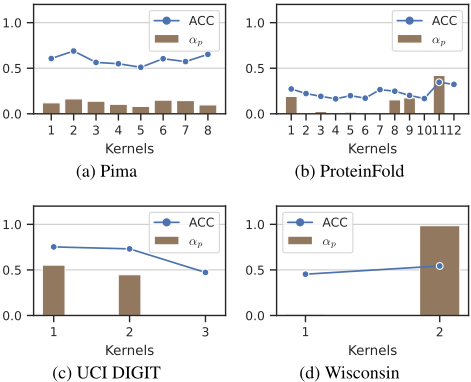
Properties of learned coefficients. In this part, we analyse the properties of the learned coefficients αp of each kernel. Kernels usually work as various feature representations of data samples, but some kinds of kernels may be more discriminative than others for particular tasks, which may contribute to better clustering performance. Thus, such kinds of kernels deserve more significance, in other word, more weight, so as to achieve better performance through multi-kernel clustering models. Arguably, the single-kernel clustering models like KKM will obtain better performance with the help of more distinctive kernel, so we utilize the clustering accuracy (ACC) of KKM as a metric to identify the significance of kernels. To be specific, the higher clustering accuracy KKM can achieve, the more discriminative a kernel is. Ideally, our proposed DMKKMmodel is supposed to assign larger αp to the kernels where KKM achieved higher ACC. We plot the learned αp and corresponding KKM accuracy of each kernel on 4 datasets in Figure 1. It can be shown that our model succeeds in assigning larger coefficients to kernels which are more discriminative, so our proposed model is able to identify more discriminative kernels among multiple kernels, which may help to improve the clustering performance.
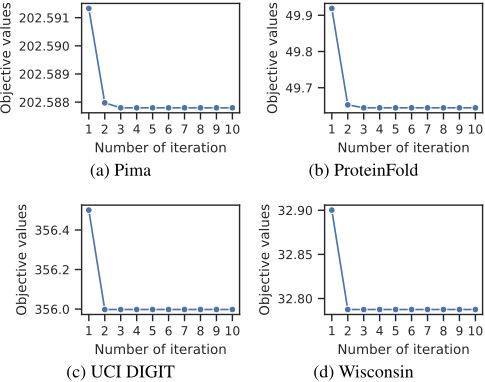
Convergence analysis. To demonstrate the effectiveness of our optimization algorithm, we plot the convergence curves of Algorithm 2 on 4 datasets in Figure 2, where the x-axes denotes the number of iterations and the y-axes denotes the objective value of Eq. (11). It can be shown that the objective values decrease monotonically until Algorithm 2 converges. All the curves plateau within 10 iterations, which means that our optimization algorithm is of high efficiency.
5 Conclusion
In this paper, we propose a novel multiple kernel k-means clustering model, namely DMKKM, utilizing an efficient iterative algorithm to solve it. Our model can directly obtain the cluster indicator matrix without subsequent discretization steps, avoiding severe information loss. Moreover, our model is capable of measuring the correlation among kernels, which greatly enhances kernel fusion through reducing redundancy and improving diversity. What's more, our model is totally parameter-free, which is more feasible in practice. Extensive experiments on several real-world datasets demonstrate its superb performance and potentiality in practical applications.
Acknowledgments
This work was supported in part by the National Key Research and Development Program of China under Grant 2018AAA0101902, in part by the Natural Science Basic Research Program of Shaanxi (Program No. 2021JM-071), in part by the National Natural Science Foundation of China under Grant 61936014 and Grant 61772427, and in part by the Fundamental Research Funds for the Central Universities under Grant G2019KY0501.
@inproceedings{ijcai2021p428,
  title     = {Discrete Multiple Kernel k-means},
  author    = {Wang, Rong and Lu, Jitao and Lu, Yihang and Nie, Feiping and Li, Xuelong},
  booktitle = {Proceedings of the Thirtieth International Joint Conference on
               Artificial Intelligence, {IJCAI-21}},
  publisher = {International Joint Conferences on Artificial Intelligence Organization},
  editor    = {Zhi-Hua Zhou},
  pages     = {3111--3117},
  year      = {2021},
  month     = {8},
  note      = {Main Track},
  doi       = {10.24963/ijcai.2021/428},
  url       = {https://doi.org/10.24963/ijcai.2021/428},
}
TY - CPAPER TI - Discrete Multiple Kernel k-means AU - Wang, Rong AU - Lu, Jitao AU - Lu, Yihang AU - Nie, Feiping AU - Li, Xuelong T2 - Proceedings of the Thirtieth International Joint Conference on Artificial Intelligence, IJCAI-21 PB - International Joint Conferences on Artificial Intelligence Organization PY - 2021 SP - 3111 EP - 3117 DO - 10.24963/ijcai.2021/428 UR - https://doi.org/10.24963/ijcai.2021/428 ER -Copied
Machine-readable versions of this paper, for tools and AI agents:





