
Ranking Extensions in Abstract Argumentation
Proceedings of the Thirtieth International Joint Conference on Artificial Intelligence. Main Track. Pages 2047-2053.
https://doi.org/10.24963/ijcai.2021/282
Keywords
- Knowledge Representation and Reasoning: Computational Models of Argument
Abstract
Extension-based semantics in abstract argumentation provide a criterion to determine whether a set of arguments is acceptable or not. In this paper, we present the notion of extension-ranking semantics, which determines a preordering over sets of arguments, where one set is deemed more plausible than another if it is somehow more acceptable. We obtain extension-based semantics as a special case of this new approach, but it also allows us to make more fine-grained distinctions, such as one set being "more complete'' or "more admissible'' than another. We define a number of general principles to classify extension-ranking semantics and develop concrete approaches. We also study the relation between extension-ranking semantics and argument-ranking based semantics, which rank individual arguments instead of sets of arguments.
- [Amgoud and Ben-Naim, 2013] L. Amgoud and J. Ben- Naim. Ranking-based semantics for argumentation frame- works. In Proceedings of the 7th International Conference on Scalable Uncertainty Management (SUM'13), pages 134-147, 2013.
- [Amgoud et al., 2016] Leila Amgoud, Jonathan Ben-Naim, Dragan Doder, and Srdjan Vesic. Ranking arguments with compensation-based semantics. In Principles of Knowl- edge Representation and Reasoning: Proceedings of the Fifteenth International Conference, KR 2016, Cape Town, South Africa, April 25-29, 2016, pages 12-21, 2016.
- [Arieli and Rienstra, 2014] Ofer Arieli and Tjitze Rienstra. Preferential reasoning based on abstract argumentation se- mantics. In Computational Models of Argument -Proceed- ings of COMMA 2014, Atholl Palace Hotel, Scottish High- lands, UK, September 9-12, 2014, pages 77-88, 2014.
- [Atkinson et al., 2017] K. Atkinson, P. Baroni, M. Gia- comin, A. Hunter, H. Prakken, C. Reed, G.R. Simari, M. Thimm, and S. Villata. Toward artificial argumenta- tion. AI Magazine, 38(3):25-36, October 2017.
- [Baroni et al., 2011] Pietro Baroni, Martin Caminada, and Massimiliano Giacomin. An introduction to argu- mentation semantics. Knowledge Engineering Review, 26(4):365-410, 2011.
- [Bonzon et al., 2016] Elise Bonzon, Jérôme Delobelle, Sébastien Konieczny, and Nicolas Maudet. A com- parative study of ranking-based semantics for abstract argumentation. In Thirtieth AAAI Conference on Artificial Intelligence, 2016.
- [Bonzon et al., 2018] Elise Bonzon, Jérôme Delobelle, Sébastien Konieczny, and Nicolas Maudet. Combining extension-based semantics and ranking-based semantics for abstract argumentation. In 16th International Con- ference on Principles of Knowledge Representation and Reasoning, 2018.
- [Booth et al., 2013] Richard Booth, Souhila Kaci, Tjitze Rienstra, and Leendert W. N. van der Torre. A logical theory about dynamics in abstract argumentation. In Scal- able Uncertainty Management -7th International Confer- ence, SUM 2013, Washington, DC, USA, September 16-18, 2013. Proceedings, pages 148-161, 2013.
- [Caminada and Pigozzi, 2011] Martin Caminada and Gabriella Pigozzi. On judgment aggregation in ab- stract argumentation. Auton. Agents Multi Agent Syst., 22(1):64-102, 2011.
- [Caminada et al., 2012] Martin W. A. Caminada, Wal- ter Alexandre Carnielli, and Paul E. Dunne. Semi-stable semantics. J. Log. Comput., 22(5):1207-1254, 2012.
- [Coste-Marquis et al., 2014] Sylvie Coste-Marquis, Sébastien Konieczny, Jean-Guy Mailly, and Pierre Marquis. On the revision of argumentation systems: Minimal change of arguments statuses. In Proceedings of the 14th International Conference on Principles of Knowledge Representation and Reasoning (KR'14), 2014.
- [Delobelle et al., 2016] Jérôme Delobelle, Adrian Haret, Sébastien Konieczny, Jean-Guy Mailly, Julien Rossit, and Stefan Woltran. Merging of abstract argumentation frame- works. KR, 2016(33-42):7, 2016.
- [Diller et al., 2018] Martin Diller, Adrian Haret, Thomas Linsbichler, Stefan Rümmele, and Stefan Woltran. An extension-based approach to belief revision in abstract ar- gumentation. Int. J. Approx. Reason., 93:395-423, 2018.
- [Dung, 1995] Phan Minh Dung. On the Acceptability of Ar- guments and its Fundamental Role in Nonmonotonic Rea- soning, Logic Programming and n-Person Games. Artifi- cial Intelligence, 77(2):321-358, 1995.
- [Grossi and Modgil, 2019] Davide Grossi and Sanjay Mod- gil. On the graded acceptability of arguments in abstract and instantiated argumentation. Artificial Intelligence, 275:138-173, October 2019.
- [Konieczny et al., 2015] Sébastien Konieczny, Pierre Mar- quis, and Srdjan Vesic. On supported inference and ex- tension selection in abstract argumentation frameworks. In European Conference on Symbolic and Quantitative Approaches to Reasoning and Uncertainty, pages 49-59. Springer, 2015.
- [Rienstra and Thimm, 2018] Tjitze Rienstra and Matthias Thimm. Ranking functions over labellings. In San- jay Modgil, Katarzyna Budzynska, and John Lawrence, editors, Proceedings of the Seventh International Con- ference on Computational Models of Argumentation (COMMA'18), volume 305 of Frontiers in Artificial In- telligence and Applications, pages 393-404, Warsaw, Poland, September 2018.
- [Rienstra, 2014] Tjitze Rienstra. Argumentation in Flux - Modelling Change in the Theory of Argumentation. PhD thesis, University of Luxembourg/University of Montpel- lier II, 2014.
- [Verheij, 1996] Bart Verheij. Two approaches to dialectical argumentation: admissible sets and argumentation stages. Proc. NAIC, 96:357-368, 1996.
- [Yun et al., 2018] Bruno Yun, Srdjan Vesic, Madalina Croitoru, and Pierre Bisquert. Viewpoints using ranking- based argumentation semantics. In Computational Mod- els of Argument -Proceedings of COMMA 2018, Warsaw, Poland, 12-14 September 2018, pages 381-392, 2018.
References were extracted automatically from the PDF and may contain errors.
Full text extracted automatically from the PDF; figures, tables and equations may differ. The PDF is the version of record.
1 Introduction
Formal argumentation [Atkinson et al., 2017] is concerned with models of rational decision-making based on representations of arguments and their relationships. A particular important approach is that of abstract argumentation [Dung, 1995], which represents argumentative settings as directed graphs. Here, arguments are identified by vertices and an attack from one argument to another is represented as a directed edge. Reasoning is usually performed in abstract argumentation by considering extensions, i. e., sets of arguments that are jointly acceptable given some formal account of "acceptability". Therefore, this classical approach differentiates between "acceptable" arguments and "rejected" arguments.
A number of approaches have been developed aiming at determining the relative degree of acceptance of the arguments of an argumentation framework. In these approaches, a ranking-based, graded or gradual semantics associates every argumentation framework with an ordering of the arguments according to their relative degree of justification or acceptability [Amgoud and Ben-Naim, 2013; Amgoud et al., 2016; Bonzon et al., 2016; Yun et al., 2018; Grossi and Modgil, 2019]. In this paper, we contribute to this line of research but we take a different approach. An extension-ranking semantics τ maps an argumentation framework AF to a preorder ⪯τAF over all extensions (sets of arguments). Intuitively, for two extensions E, E′ of AF, E ⪯τAF E′ holds whenever E is at least as plausible as E′ . While any extension-based semantics 1 σ can be defined in terms of an extension-ranking semantics -i. e. by defining the extension of AF to be the minimal elements according to ⪯τAF -, the general framework of extension-ranking semantics is more expressive than that. For instance, an extension-ranking semantics can be used to compare extensions that are not complete, admissible, or even conflict-free in the classical sense. Moreover, an extensionranking semantics retains the ability to represent constellations of arguments that can jointly be acceptable, which is not possible if we define the semantics of an argumentation framework in terms of a single ranking over arguments.
Extension-ranking semantics have a number of potential applications. One is decision making under constraints, where we need solutions (typically represented by extensions of an argumentation framework) that satisfy constraints that may not be satisfiable by the set of extensions under an extension semantics. In such a situation we can select the most plausible extensions among those that satisfy the constraint. Another application is belief dynamics [Booth et al., 2013; Coste-Marquis et al., 2014; Diller et al., 2018], where rankings over extensions can be used as a relation of epistemic entrenchment. Other problems where the ability to compare extensions is useful are belief merging and judgment aggregation [Delobelle et al., 2016; Caminada and Pigozzi, 2011]. In this work we take a first step towards this matter by (1) proposing a number of general principles for extension-ranking semantics, and (2) proposing a number of extension-ranking semantics that generalise admissible, complete, grounded, preferred and stable semantics. Finally, we show how an extension-ranking semantics can be used to define an argument ranking.
This paper is structured as follows. In Section 2 we recall the necessary basics of abstract argumentation theory. In Section 3 we introduce the notion of extension-ranking semantics. We then propose a number of general principles for extension-ranking semantics in Section 4 and a number of instances of extension-ranking semantics in Section 5. Section 6 deals with the connection between extension-ranking semantics and argument rankings. We discuss related work in Section 7 and conclude in Section 8.
1 In the remainder of this paper, we refer to extension-based semantics simply as extension semantics to unify notation with extension-ranking semantics.
2 Preliminaries
An argumentation framework AF is a pair AF = (Arg,R) where Arg is a set of arguments and R is a relation R ⊆ Arg × Arg [Dung, 1995]. We assume that Arg is finite. An argument A is said to attack an argument B if (A, B) ∈ R. We say that an argument A is defended by a set E ⊆ Arg if every argument B ∈ Arg that attacks A is attacked by some C ∈ E. For A ∈ Arg define A- = {B | (B,A) ∈ R} and A+ = {B | (A, B) ∈ R}, so the sets of attackers of A and the set of arguments attacked by A. For a set of arguments E ⊆ Arg we extend these sets by defining E+ and E- via E+ = ⋃A∈E A+ and E- = ⋃A∈E A-, respectively.
An extension semantics determines a set of extensions (i. e., jointly acceptable sets of arguments) of an argumentation framework. Given an argumentation framework AF = (Arg,R), an extension E ⊆ Arg is called admissible (ad) if and only if E is conflict-free (cf), i. e., there are no arguments A, B ∈ E with (A, B) ∈ R, and E defends every A ∈ E, and is called complete (co) if, additionally, it satisfies if E defends A then A ∈ E. A complete extension E is grounded (gr) if and only if E is ⊆-minimal; is preferred (pr) if and only if E is ⊆-maximal; is stable (st) if and only if Arg = E ∪ E+. Note that the grounded extension is uniquely determined and that stable extensions may not exist [Dung, 1995]. The grounded extension can also be defined as the least fixed point of the characteristic function. Given an argumentation framework AF = (Arg,R), the characteristic function FAF : 2Arg → 2Arg is defined via
Given σ ∈ {cf, ad, co, gr, pr, st} and argumentation framework AF we denote the set of all σ-extensions by σ(AF). 2
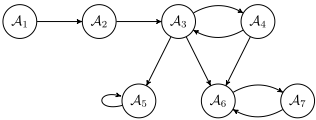
Example 1. Consider the abstract argumentation framework AF1 depicted as a directed graph in Figure 1. AF1 has four complete extensions E1 = {A1}, E2 = {A1,A7}, E3 = {A1,A3,A7}, and E4 = {A1,A4,A7}. E1 is the grounded extension, while E3 and E4 are both preferred, but only E3 is stable.
3 Extension-Ranking Semantics
An extension semantics σ provides a simple way to assess whether a given set of arguments is acceptable: either an extension E is a σ-extension or not. In this section, we take a more general perspective on this issue by considering preorders over extensions.
Definition 1. An extension ranking on AF is a preorder 3 ⪯ over the powerset of arguments 2Arg . An extension-ranking semantics τ is a function that maps each AF to an extension ranking ⪯τAF on AF. 4
2 Although typically not considered a semantics, we treat cf and ad as such, to simplify presentation.
3 A preorder is a (binary) relation that is reflexive (E ⪯ E for all E) and transitive (E1 ⪯ E2 and E2 ⪯ E3 implies E1 ⪯ E3).
Note that extension rankings are not necessarily total. For an extension-ranking semantics τ , an extension ranking ⪯τAF , E,E′ ⊆ Arg, and for E ⪯τAF E′ we say that E is at least as plausible as E′ by τ in AF. We introduce the usual abbreviations: E is strictly more plausible than E′ , denoted E ≺τAF E′ , if E ⪯τAF E′ but not E′ ⪯τAF E; E and E′ are incomparable, denoted E ≍τAF E′ , if neither E ⪯τAF E′ nor E′ ⪯τAF E; and E and E′ are equally plausible, denoted E ≡τAF E′ , if E ⪯τAF E′ and E′ ⪯τAF E.
Definition 2. We denote by minτ(AF) the minimal (or most plausible) elements of ⪯τAF , i. e., minτ(AF) = {E ⊆ Arg|∄E′ ⊆ Arg with E′ ≺τAF E}.
Extension-ranking semantics provide an expressive semantical framework that generalises extension semantics. In fact, extension semantics can directly be used to define very naive instances of extension-ranking semantics as follows.
Definition 3. Given an extension semantics σ, we define the least-discriminating extension-ranking semantics wrt. σ, denoted LDσ by: E ≺LDσ AF E′ if E ∈ σ(AF) and E′ /∈ σ(AF); and E ≡LDσ AF E′ , if E,E′ ∈ σ(AF) or E,E′ /∈ σ(AF).
Our aim with extension-ranking semantics is to provide a finer distinction between extensions than extension semantics. In this paper, we focus on extension-ranking semantics that refine least-discriminating extension-ranking semantics wrt. σ by providing a more fine-grained differentiation of those extensions that are not σ-extensions. In other words, for any two extensions that are no σ-extensions, we want to be able to say that one of them may be "closer" to being a σextension than the other. A complementary approach, which we deal with in future work, is to provide a more fine-grained differentiation of σ-extensions instead.
4 Principles for Extension-Ranking Semantics
In this section, we define a number of general principles to describe various aspects of an intuitively well-behaved extension-ranking semantics. The first set of principles aims at relating extension-ranking semantics with extension semantics. The σ-generalisation principle states that the most plausible extensions of an argumentation framework are exactly the σ-extensions of the argumentation framework. We also distinguish σ-soundness (i. e., the most plausible extensions are σ-extensions) and σ-completeness (i. e., every σextension is a most plausible extension).
Definition 4. Let σ be an extension semantics and τ an extension-ranking semantics. τ satisfies
- σ-soundness iff for all AF: minτ (AF) ⊆ σ(AF).
- σ-completeness iff for all AF: minτ (AF) ⊇ σ(AF).
- σ-generalisation iff τ satisfies both σ-soundness and σcompleteness.
The least-discriminating extension-ranking semantics satisfy their corresponding generalisation principles:
4 Our use of the term ranking does not imply that we work with total orders. This is consistent with terminology used in the literature on argument-ranking semantics (see, e.g., [Bonzon et al., 2016]).
Proposition 1. ⪯LDσ AF satisfies σ-generalisation.
We now consider additional principles pertaining to independence of different parts of an argumentation framework. Composition states that after combining two disjoint argumentation frameworks into one, the extension ranking follows the rankings on the restricted AFs. The other way round, decomposition postulates that after splitting an argumentation framework into two disjoint argumentation frameworks, the rankings on the restricted sub-AFs obey the ranking on the total AF.
Definition 5. Let τ be an extension-ranking semantics. 5
- τ satisfies composition if for every AF such that AF = (Arg1,R1) ·∪ (Arg2,R2) and E,E′ ⊆ Arg1 ∪Arg2:
- τ satisfies decomposition if for every AF such that AF = (Arg1,R1) ·∪ (Arg2,R2) and E,E′ ⊆ Arg1 ∪Arg2:
An important property of rational accounts of argumentation is reinstatement, i. e., the ability to make an attacked argument acceptable by attacking its attackers. Complete semantics implements this property in a strict fashion: if an argument can be reinstated by an extension, it must be included in that extension. Therefore, an extension containing an argument it defends is more plausible than an extension without that argument. We define two different versions of this principle, a weak and a strong version. The weak version states that by adding a defended argument (that also introduces no further conflicts) we will not lower the plausibility of any extension. The strong version ensures, that by adding a reasonable argument to a set, the plausibility of that set will be strictly higher than before.
Definition 6. Let τ be an extension-ranking semantics.
- τ satisfies weak reinstatement iff A ∈ FAF(E), A /∈ E and A /∈ (E- ∪ E+) implies E ∪ {A} ⪯τAF E.
- τ satisfies strong reinstatement iff A ∈ FAF(E), A /∈ E and A /∈ (E- ∪ E+) implies E ∪ {A} ≺τAF E.
Note that the condition A /∈ (E- ∪E+) above is needed in order to not add additional conflicts to the extension (which may again lower the plausibility of the extension).
Finally, we define a principle similar in spirit to the Abstraction postulate from ranking-based semantics [Bonzon et al., 2016]. For that, an isomorphism γ between two argumentation frameworks AF = (Arg, R) and AF′ = (Arg′ , R′ ) is a bijective function γ : AF → AF′ such that (A1,A2) ∈ R iff (γ(A1), γ(A2)) ∈ R′ for all A1,A2 ∈ Arg. Our principle of syntax independence states that the names of each argument is not important for the resulting extension ranking.
Definition 7. An extension-ranking τ satisfies syntax independence if for every pair of AFs AF = (Arg,R), AF′ = (Arg′ ,R′ ) and for every isomorphism γ : AF → AF′ , for all E,E′ ⊆ Arg, we have E ⪯τAF E′ iff γ(E) ⪯τAF′ γ(E′ ).
5 Instances of Extension-Ranking Semantics
In this section we propose a number of instances of extensionranking semantics. Each extension-ranking semantics generalises one of the main extension semantics, namely the admissible, complete, preferred, grounded, and (semi-)stable semantics.
5.1 Base Functions
To define the extension-ranking semantics, we first define four base functions that each focuses on modelling a single aspect of argumentative evaluation. These base functions and their corresponding base extension rankings will be combined later (in Sections 5.2-5.6) to obtain the desired generalisations. In Section 5.7 we evaluate these functions wrt. the principles discussed in the previous section.
The first aspect we consider is conflict-freeness, which is usually an undisputed and desirable property of every extension semantics. More concretely, a conflict-free extension is regarded as more plausible than a non-conflict-free extension. Generalising this idea, we deem an extension E as more plausible than another extension E′ if E has strictly less conflicts than E′ (wrt. set inclusion). We model this aspect with the following CF base function and CF base extension ranking (where CF stands for "conflicts").
Definition 8. Let AF = (Arg,R) and E ⊆ Arg. Define the CF base function CF via
and the corresponding CF base extension ranking ⪯CF AF via
Example 2. Consider again AF1 from Example 1. Let E5 = {A2,A3} and E6 = {A2,A3,A4}. We have CF(E5, AF1) = {(A2,A3)} and CF(E6, AF1) = {(A2,A3), (A3,A4), (A4,A3)}. Hence E5 is more plausible than E6 with respect to their conflicts, E5 ≺CF AF1 E6.
Another generally desirable property is admissibility. More precisely, we consider an extension defending all its elements as more plausible than an extension containing at least one undefended argument. Hence, an extension E is more plausible than another extension E′ if E has strictly less undefended arguments than E′ (wrt. set inclusions). The following UD base function and UD base extension ranking (UD stands for "undefended") capture this idea.
Definition 9. Let AF = (Arg,R) and E ⊆ Arg. Define the UD base function UD via
and the corresponding UD base extension ranking ⪯UD AF via
A complete extension contains every argument it defends. Hence, an extension containing all its defended arguments (without adding conflicts) is more plausible, than an extension not containing an argument that is actually defended. More generally speaking, an extension E is more plausible than another extension E′ if there are less arguments consistently defended by E and not contained in E than there are for E′ (wrt. set inclusion). By consistent defense we mean arguments that are defended by E and do not attack E. In order to model this notion of consistent defense adequately, we need a more general notion of defense than what it is provided by the characteristic function FAF.

Example 3. Consider the argumentation framework AF2 depicted in Figure 2 and the extension E1 = {A2}. Observe that FAF2 (E1) = {A1,A4}. However, given that we wish to determine the set of arguments that are consistently defended by E1 we expect as outcome the set {A2,A4} since A1 attacks a member of our initial set and should be ignored, therefore also leaving A2 within the outcome. Iterating the notion of consistent defense we end up with the set {A2,A4,A6} modelling the intuition that A4 and A6 are consistently defended when we assume that A2 is accepted.
The function F ∗ implements the above intuition as follows. Definition 10. The function F ∗ AF : 2Arg → 2Arg is defined via
with
Applying F ∗ on Example 3 we get as desired F ∗ AF2 ({A2}) = {A2, A4, A6}.
Finally we can define the DN base function, that models the concept of consistent defense (DN meaning "consistent defended and not in").
Definition 11. Let AF = (Arg, R) and E ⊆ Arg. We define the DN base function DN via
and the corresponding DN base extension ranking ⪯DN AF via
The final property we will take a look at is stability. A set is stable, if it attacks every argument not contained in it. To generalise this concept we state that an extension E is more plausible than another extension E′ if E attacks strictly more arguments thanE′ (wrt. set inclusion). We capture this aspect with the UA base function and the UA base extension ranking (UA meaning "unattacked").
Definition 12. Let AF = (Arg, R) and E ⊆ Arg. Define the UA base function UA via
and the corresponding UA base extension ranking ⪯UA AF via
5.2 Admissible Extension-Ranking Semantics
By combining the base extension-rankings defined in the previous section, we can define different extension-ranking semantics that generalise the extension semantics defined in Section 2. We start with the admissible extension-ranking semantics. Recall that an admissible extension is conflict-free and defends all its elements. We generalise this by assessing those extensions as more plausible that feature fewer conflicts and fewer undefended arguments. This is achieved by the lexicographic combination of the ⪯CF AF and ⪯UD AF -rankings.
Definition 13. Let AF = (Arg, R) and E, E′ ⊆ Arg. Define the admissible extension-ranking semantics r-ad via
Example 4. Consider AF1 from Example 1. The sets E7 = {A2} and E8 = {A2,A6} are both conflict-free, but not admissible. However UD(E7, AF1) = {A2} and UD(E8, AF1) = {A2, A6}, so E7 ⪯r-ad AF1 E8.
Since the most conflicting extension Eall = Arg is a most plausible extension for every base function except ⪯CF AF we use the lexicographic combination of first the ⪯CF AF -ranking and then the ⪯UD AF -ranking to ensure that Eall is always ranked worse, than any other extension E′ ⊂ Eall.
5.3 Complete Extension-Ranking Semantics
Recall that a complete extension is an admissible extension that includes all the arguments it defends. We generalise this by favouring extensions that are more admissible and, in case of equal admissibility, favouring extensions that include larger sets of defended arguments. This is achieved by the lexicographic combination of ⪯r-ad AF and ⪯DN AF -rankings.
Definition 14. Let AF = (Arg,R) and E,E′ ⊆ Arg. We define the complete extension-ranking semantics r-co via
Example 5. Consider AF1 from Example 1. The sets E9 = {A7} and E10 = {A4} are both admissible, but not complete. However DN(E9, AF1) = {A1} and UD(E10, AF1) = {A1,A7}, so E9 ⪯r-co AF1 E10.
5.4 Grounded Extension-Ranking Semantics
A grounded extension is a complete extension that is minimal with respect to set inclusion. We generalise this by favouring extensions that are more complete and, in case of equal completeness, favouring smaller extensions. This is achieved by the lexicographic combination of ⪯r-co AF - and ⊆-rankings.
Definition 15. Let AF = (Arg,R) and E,E′ ⊆ Arg. We define the grounded extension-ranking semantics r-gr via
Example 6. Consider AF1 from Example 1. The sets E2 = {A1,A7} and E3 = {A1,A3,A7} are both complete, but not grounded. However E2 ⊂ E3, so E2 ⪯r-gr AF1 E3.
5.5 Preferred Extension-Ranking Semantics
Recall that a preferred extension is an admissible extension that is maximal with respect to set inclusion. Accordingly, the preferred extension-ranking semantics is based on favouring extensions that are more admissible and, in case of equal admissibility, favouring extensions that are larger with respect to set inclusion. This is achieved by the lexicographic combination of the ⪯r-ad AF and ⊇-rankings.
Definition 16. Let AF = (Arg,R) and E,E′ ⊆ Arg. We define the preferred extension-ranking semantics r-pr via
Example 7. We continue Example 1. There, the sets E1 = {A1} and E2 = {A1,A7} are both complete, but not preferred. However E2 ⊂ E1, so E1 ⪯r-pr AF1 E2.
5.6 (Semi-)Stable Extension-Ranking Semantics
Recall that a stable extension is a conflict-free extension that attacks all arguments not included in the extension. We can define a corresponding extension-ranking semantics that favours extensions that are more conflict-free and, in case of equal conflict-freeness, favours extensions that are minimal with respect to the set of arguments not included in the extension and not attacked by the extension. This is achieved by the lexicographic combination of the ⪯r-co AF and ⪯UA AF rankings. However, the result is not st-sound, since not every argumentation framework has a stable extension. In fact, this extension-ranking semantics generalises the semi-stable semantics [Caminada et al., 2012].
Definition 17. For AF = (Arg, R), an extension E ⊆ Arg is a semi-stable extension if and only if E is a complete extension where E ∪ E+ is maximal wrt. set inclusion.
Definition 18. Let AF = (Arg,R) and E,E′ ⊆ Arg. We define the semi-stable extension-ranking semantics r-sst via
Example 8. Consider AF1 from Example 1. The sets E2 = {A1,A7} and E4 = {A1,A4,A7} are both complete, but not stable. However UA(E2, AF1) = {A3,A4,A5} and UA(E4, AF1) = {A5}, so E4 ⪯r-sst AF1 E2.
5.7 Compliance to Principles
The following result summarises the compliance of our approaches with the principles defined in Section 4.
Theorem 1. An extension-ranking semantics τ ∈ {r-ad, r-co, r-gr, r-pr, r-sst} satisfies the respective principles as stated in Table 1. 6
We see that every extension-ranking semantics satisfies only σ-generalisation for the extension semantics they are based on. Hence these extension-ranking semantics do indeed generalise extension-based reasoning.
Another important result is that every extension-ranking semantics satisfies composition and decomposition. This results in the desirable property that combining two independent argumentation frameworks will not change the plausibility of any extension.
6 The proof of Theorem 1 can be found in an online appendix at http://mthimm.de/misc/proofs ijcai21 srthk.pdf
| Principles | r-ad | r-co | r-gr | r-pr | r-sst |
|---|---|---|---|---|---|
| cf-generalisation | X | X | X | X | X |
| ad-generalisation | ✓ | X | X | X | X |
| co-generalisation | X | ✓ | X | X | X |
| gr-generalisation | X | X | ✓ | X | X |
| pr-generalisation | X | X | X | ✓ | X |
| sst-generalisation | X | X | X | X | ✓ |
| composition | ✓ | ✓ | ✓ | ✓ | ✓ |
| decomposition | ✓ | ✓ | ✓ | ✓ | ✓ |
| weak reinstatement | ✓ | ✓ | ✓ | ✓ | ✓ |
| strong reinstatement | X | ✓ | ✓ | ✓ | ✓ |
| syntax independence | ✓ | ✓ | ✓ | ✓ | ✓ |
We see that all extension-ranking semantics defined above do satisfy the weak version of the reinstatement principle. Hence we can be sure that by adding a reasonable argument (i. e., an argument defended by the set such that its addition will not create new conflicts) we do not lower the plausibility of a set. Only the admissible extension-ranking semantics does not satisfy strong reinstatement. So strong reinstatement behaves similar as the reinstatement principle for extension semantics, as there also only the admissible semantics does not satisfy reinstatement (as extensions may be admissible that do not include all defended arguments).
Example 9. Consider the argumentation framework AF3 = {{A1, A2, A3}, {(A1, A2), (A2, A3}}. The sets E1 = {A1} and E2 = {A1,A3} are both admissible. By applying the admissible extension-ranking semantics to both sets, we get E1 ≡r-ad AF3 E2. However A3 is the only suitable candidate to be reinstated for E1. But E1 ∪ {A3} ̸≺r-ad AF3 E1, as they are equally plausible. So the admissible extension-ranking semantics does not satisfy strong reinstatement.
As every extension-ranking semantics defined as above never considers the names of the arguments, we see that all of them do satisfy syntax independence.
6 Projection on Argument Ranking
The approach of extension-ranking semantics can be also be used to define a ranking over arguments. The area of argument-ranking semantics has been researched over the last few years, see [Bonzon et al., 2016] for an overview. Here arguments are ordered based on their acceptability (i. e., argument A1 is more acceptable than A2 in an argumentation framework AF, A1 ✂AF A2). We project an extension ranking to an argument ranking as follows:
Definition 19. Let τ be an extension-ranking semantics and AF = (Arg,R). We define an argument ranking ✂τAF via A1 ✂τAF A2 iff there is a set E with A1 ∈ E s.t for all E′ with A2 ∈ E′ we have E ⪯τAF E′ .
In other words argument A1 is at least as acceptable as A2, if there is a set containing A1, which is at least as plausible as every set containing A2, with respect to an extension-ranking semantics τ .
Similar to the principles defined above, there exists a number of rationality postulates for argument-ranking semantics. Here, we will only recall three very simple ones, namely, Abstraction, Independence and Self-contradiction.
The postulate abstraction denotes, that names of arguments are not relevant for an argument-ranking.
Abstraction For every pair of AFs AF = (Arg,R), AF′ = (Arg′ , R′ ) and for every isomorphism γ : AF → AF′ , for all A1,A2 ∈ Arg, we have A1 ✂AF A2 iff γ(A1) ✂AF′ γ(A2).
The connected components of AF are the set of maximal subgraphs AF′ of AF, denoted by cc(AF), such that for every pair A1,A2 ∈ AF′ there is a path connecting them (while ignoring the direction of the edges). With Independence we state, that every connected component behaves independently from each other wrt. their rankings.
Self-contradiction denotes that self-attacking arguments shall be ranked lower than any other argument.
Self-contradiction For every argumentation framework AF = (Arg,R) and for all A1,A2 ∈ Arg with (A1,A1) /∈ R and (A2,A2) ∈ R then A1 ⪯AF A2 and A2 ̸⪯AF A1.
For any argument ranking defined by the transformation from Definition 19, using an extension-ranking semantics, which satisfies syntax independence, will satisfy abstraction since the names of the arguments are not important.
There is a connection between decomposition and independence, as both behave similar. This is because the restriction of a most plausible extension of an argumentation framework to a subgraph is also most plausible for that subgraph. Hence, an argument ranking constructed with the projection from Definition 19 satisfies independence, if the underlying extension-ranking semantics satisfies decomposition.
An argument ranking defined with the projection from Definition 19 satisfies Self-contradiction if the underlying extension-ranking semantics satisfies cf-soundness. This shows, that conflict-free extensions are always ranked higher, than not conflict-free sets. This implies that {A1} ≺CF AF E′ , if E′ contains a self-attacking argument.
Proposition 2. Let τ ∈ {r-ad, r-co, r-gr, r-pr, r-sst} and AF = (Arg, R). The argument ranking ✂τAF satisfies abstraction, independence and self-contradiction.
7 RelatedWork
A number of works study methods to order arguments according to their (relative) degree of acceptability [Amgoud et al., 2016; Amgoud and Ben-Naim, 2013; Bonzon et al., 2016; Grossi and Modgil, 2019]. In [Yun et al., 2018], a framework is developed to determine a ranking over a set of extensions, on the basis of a ranking over arguments. In the previous section we dealt with the converse problem, i.e., determining a ranking over arguments based on a ranking over extensions.
Orderings over labellings of argumentation frameworks have been considered in [Arieli and Rienstra, 2014], [Rienstra, 2014] and [Rienstra and Thimm, 2018]. The latter two works consider some general principles for such orderings, namely conditional directionality and SCC stratification, which are counterparts of the directionality and SCC decomposability principles used in abstract argumentation [Baroni et al., 2011]. In future work we plan to study similar principles in the current extension-based setting as well.
The works [Bonzon et al., 2018; Konieczny et al., 2015] also consider approaches to rank sets of arguments, but their focus is on providing a more fine-grained differentiation of sets that are extensions wrt. some semantics. In particular, [Konieczny et al., 2015] use such rankings to select the best extensions out of the set of all extensions. They do this by, e. g., promoting those extensions where the members are also ranked high by some given argument ranking. Similarly, [Bonzon et al., 2018] combines extension semantics with argument rankings in order to improve the argument ranking by the information provided by the extensions, and vice versa. So these approaches are somewhat complementary to our approach, since we focus on the problem of differentiating sets of arguments that are not extensions wrt. some semantics, cf. the property of σ-generalisation.
Several approaches to model belief change involve preorders over extensions or labellings of an argumentation framework [Booth et al., 2013; Coste-Marquis et al., 2014; Diller et al., 2018]. Roughly speaking, given an argumentation framework AF and extension semantics σ, a pre-order ⪯ over sets of arguments of AF is used where the minimal sets are the σ-extensions of AF, and the result of revision is determined by the minimal sets of arguments that satisfy the new information. In future work we plan to study the extension-ranking semantics that we defined in this context as well, by studying relationships between principles satisfied by the extension-ranking semantics, and postulates satisfied by corresponding revision operators.
8 Conclusion
In this work we presented an approach to generalise the extension-based reasoning process in abstract argumentation. This approach allows us to make a more fine-grained distinction between sets, based on their "completeness" or "admissiblity". We also developed concrete approaches as well as a number of general principles to classify these approaches. In the end we bridge the gap between extension-ranking semantics and argument-ranking semantics, by describing relationships between these two concepts.
As for future work we plan to define more principles and also develop a number of extension-ranking approaches, which are not based on the admissible semantics, like stage semantics [Verheij, 1996]. Further we can combine the rankings not only by lexicographic combination rather use different preference aggregation methods. Another possibility is to not only differentiate non-σ-extension, but also σ-extensions. Also we want to tighten the bond between extension-ranking and argument-ranking, as these two concepts are closely related.
Acknowledgments
The work reported here has been supported by the Deutsche Forschungsgemeinschaft (project numbers 375588274 and 423456621).
@inproceedings{ijcai2021p282,
  title     = {Ranking Extensions in Abstract Argumentation},
  author    = {Skiba, Kenneth and Rienstra, Tjitze and Thimm, Matthias and Heyninck, Jesse and Kern-Isberner, Gabriele},
  booktitle = {Proceedings of the Thirtieth International Joint Conference on
               Artificial Intelligence, {IJCAI-21}},
  publisher = {International Joint Conferences on Artificial Intelligence Organization},
  editor    = {Zhi-Hua Zhou},
  pages     = {2047--2053},
  year      = {2021},
  month     = {8},
  note      = {Main Track},
  doi       = {10.24963/ijcai.2021/282},
  url       = {https://doi.org/10.24963/ijcai.2021/282},
}
TY - CPAPER TI - Ranking Extensions in Abstract Argumentation AU - Skiba, Kenneth AU - Rienstra, Tjitze AU - Thimm, Matthias AU - Heyninck, Jesse AU - Kern-Isberner, Gabriele T2 - Proceedings of the Thirtieth International Joint Conference on Artificial Intelligence, IJCAI-21 PB - International Joint Conferences on Artificial Intelligence Organization PY - 2021 SP - 2047 EP - 2053 DO - 10.24963/ijcai.2021/282 UR - https://doi.org/10.24963/ijcai.2021/282 ER -Copied
Machine-readable versions of this paper, for tools and AI agents:





