
Local Representation is Not Enough: Soft Point-Wise Transformer for Descriptor and Detector of Local Features
Proceedings of the Thirtieth International Joint Conference on Artificial Intelligence. Main Track. Pages 1150-1156.
https://doi.org/10.24963/ijcai.2021/159
© 2021 International Joint Conferences on Artificial Intelligence
Keywords
- Computer Vision: Recognition: Detection, Categorization, Indexing, Matching, Retrieval, Semantic Interpretation
- Computer Vision: 2D and 3D Computer Vision
Abstract
Significant progress has been witnessed for the descriptor and detector of local features, but there still exist several challenging and intractable limitations, such as insufficient localization accuracy and non-discriminative description, especially in repetitive- or blank-texture regions, which haven't be well addressed. The coarse feature representation and limited receptive field are considered as the main issues for these limitations. To address these issues, we propose a novel Soft Point-Wise Transformer for Descriptor and Detector, simultaneously mining long-range intrinsic and cross-scale dependencies of local features. Furthermore, our model leverages the distinct transformers based on the soft point-wise attention, substantially decreasing the memory and computation complexity, especially for high-resolution feature maps. In addition, multi-level decoder is constructed to guarantee the high detection accuracy and discriminative description. Extensive experiments demonstrate that our model outperforms the existing state-of-the-art methods on the image matching and visual localization benchmarks.
- [Balntas et al., 2017] Vassileios Balntas, Karel Lenc, Andrea Vedaldi, and Krystian Mikolajczyk. Hpatches: A bench- mark and evaluation of handcrafted and learned local de- scriptors. In CVPR, pages 5173-5182, 2017.
- [Barroso-Laguna et al., 2019] Axel Barroso-Laguna, Edgar Riba, Daniel Ponsa, and Krystian Mikolajczyk. Key. net: Keypoint detection by handcrafted and learned cnn filters. In ICCV, 2019.
- [Carion et al., 2020] Nicolas Carion, Francisco Massa, Gabriel Synnaeve, Nicolas Usunier, Alexander Kirillov, and Sergey Zagoruyko. End-to-end object detection with transformers. arXiv preprint arXiv:2005.12872, 2020.
- [DeTone et al., 2018] Daniel DeTone, Tomasz Malisiewicz, and Andrew Rabinovich. Superpoint: Self-supervised in- terest point detection and description. In CVPR, 2018.
- [Dosovitskiy et al., 2020] Alexey Dosovitskiy, Lucas Beyer, Alexander Kolesnikov, Dirk Weissenborn, Xiaohua Zhai, Thomas Unterthiner, Mostafa Dehghani, Matthias Min- derer, Georg Heigold, Sylvain Gelly, et al. An image is worth 16x16 words: Transformers for image recognition at scale. arXiv preprint arXiv:2010.11929, 2020.
- [Dusmanu et al., 2019] Mihai Dusmanu, Ignacio Rocco, Tomas Pajdla, Marc Pollefeys, Josef Sivic, Akihiko Torii, and Torsten Sattler. D2-net: A trainable cnn for joint de- scription and detection of local features. In CVPR, 2019.
- [Dusmanu et al., 2020] Mihai Dusmanu, Johannes L Schönberger, and Marc Pollefeys. Multi-view optimiza- tion of local feature geometry. In ECCV, 2020.
- [Fu et al., 2019] Jun Fu, Jing Liu, Haijie Tian, Yong Li, Yongjun Bao, Zhiwei Fang, and Hanqing Lu. Dual at- tention network for scene segmentation. In CVPR, 2019.
- [He et al., 2018] Kun He, Yan Lu, and Stan Sclaroff. Lo- cal descriptors optimized for average precision. In CVPR, 2018.
- [Huang et al., 2019a] Lang Huang, Yuhui Yuan, Jianyuan Guo, Chao Zhang, Xilin Chen, and Jingdong Wang. Inter- laced sparse self-attention for semantic segmentation. In ICCV, 2019.
- [Huang et al., 2019b] Zilong Huang, Xinggang Wang, Lichao Huang, Chang Huang, Yunchao Wei, and Wenyu Liu. Ccnet: Criss-cross attention for semantic segmenta- tion. In ICCV, 2019.
- [Li et al., 2020] Xueyi Li, Tianfei Zhou, Jianwu Li, Yi Zhou, and Zhaoxiang Zhang. Group-wise semantic mining for weakly supervised semantic segmentation. AAAI, 2020.
- [Lin et al., 2017] Tsung-Yi Lin, Piotr Dollár, Ross Girshick, Kaiming He, Bharath Hariharan, and Serge Belongie. Fea- ture pyramid networks for object detection. In CVPR, 2017.
- [Luo et al., 2020] Zixin Luo, Lei Zhou, Xuyang Bai, Hongkai Chen, Jiahui Zhang, Yao Yao, Shiwei Li, Tian Fang, and Long Quan. Aslfeat: Learning local features of accurate shape and localization. In CVPR, 2020. [Mishkin et al., 2018] Dmytro Mishkin, Filip Radenovic, and Jiri Matas. Repeatability is not enough: Learning affine regions via discriminability. In ECCV, 2018.
- [Noh et al., 2017] Hyeonwoo Noh, Andre Araujo, Jack Sim, Tobias Weyand, and Bohyung Han. Large-scale image re- trieval with attentive deep local features. In ICCV, pages 3456-3465, 2017.
- [Pautrat et al., 2020] Rémi Pautrat, Viktor Larsson, Mar- tin R. Oswald, and Marc Pollefeys. Online invariance se- lection for local feature descriptors. In ECCV, 2020.
- [Radenović et al., 2018] Filip Radenović, Ahmet Iscen, Giorgos Tolias, Yannis Avrithis, and Ondřej Chum. Revis- iting oxford and paris: Large-scale image retrieval bench- marking. In CVPR, pages 5706-5715, 2018.
- [Revaud et al., 2019] Jerome Revaud, Philippe Weinzaepfel, César De Souza, Noe Pion, Gabriela Csurka, Yohann Cabon, and Martin Humenberger. R2d2: Repeatable and reliable detector and descriptor. In NeurIPS, 2019.
- [Sattler et al., 2018] Torsten Sattler, Will Maddern, Carl Toft, Akihiko Torii, Lars Hammarstrand, Erik Stenborg, Daniel Safari, Masatoshi Okutomi, Marc Pollefeys, Josef Sivic, et al. Benchmarking 6dof outdoor visual localiza- tion in changing conditions. In CVPR, 2018.
- [Schonberger and Frahm, 2016] Johannes L Schonberger and Jan-Michael Frahm. Structure-from-motion revisited. In CVPR, 2016.
- [Sun et al., 2020] Yifan Sun, Changmao Cheng, Yuhan Zhang, Chi Zhang, Liang Zheng, Zhongdao Wang, and Yichen Wei. Circle loss: A unified perspective of pair sim- ilarity optimization. In CVPR, 2020.
- [Tian et al., 2017] Yurun Tian, Bin Fan, and Fuchao Wu. L2- net: Deep learning of discriminative patch descriptor in euclidean space. In CVPR, 2017.
- [Tyszkiewicz et al., 2020] Michał Tyszkiewicz, Pascal Fua, and Eduard Trulls. Disk: Learning local features with pol- icy gradient. NeurIPS, 2020.
- [Vaswani et al., 2017] Ashish Vaswani, Noam Shazeer, Niki Parmar, Jakob Uszkoreit, Llion Jones, Aidan N Gomez, Łukasz Kaiser, and Illia Polosukhin. Attention is all you need. In NeurIPS, 2017.
- [Wang et al., 2018] Xiaolong Wang, Ross Girshick, Abhinav Gupta, and Kaiming He. Non-local neural networks. In CVPR, 2018.
- [Zhang et al., 2020] Dong Zhang, Hanwang Zhang, Jinhui Tang, Meng Wang, Xiansheng Hua, and Qianru Sun. Fea- ture pyramid transformer. In ECCV, 2020.
- [Zhang, 2000] Zhengyou Zhang. A flexible new technique for camera calibration. IEEE TPAMI, 2000.
- [Zheng et al., 2020] Sixiao Zheng, Jiachen Lu, Hengshuang Zhao, Xiatian Zhu, Zekun Luo, Yabiao Wang, Yanwei Fu, Jianfeng Feng, Tao Xiang, Philip HS Torr, et al. Rethinking semantic segmentation from a sequence-to- sequence perspective with transformers. arXiv preprint arXiv:2012.15840, 2020.
References were extracted automatically from the PDF and may contain errors.
Full text extracted automatically from the PDF; figures, tables and equations may differ. The PDF is the version of record.
1 Introduction
Establishing accurate correspondences among images plays a crucial role in many Computer Vision tasks, including but not limited to wide-baseline stereo, image retrieval, visual localization, Structure-from-Motion and 3D construction. Such correspondences are generally estimated by matching local features, which comprise keypoints detection and description. Keypoints detection is to predict the coordinate of the keypoint in the image, and the description is to generate a vector describing the image patch around the keypoint. However, environmental changes, including viewpoint and illumination, make the pipeline particularly challenging.
One of the key challenges in keypoints detection and description is the local representation short of identification which is derived from limited receptive field, especially in the blank ground or repetitive texture such as white-black chessboard. Many existing methods design an extra block to identify such regions and filter them when detecting [Revaud et al., 2019]. While the paradox is that the typical repetitive substance, i.e., chessboard is widely applied in the camera calibration [Zhang, 2000], which requires rigorous accurate correspondences. The critical difference is that the keypoints description for calibration is the relative representation based on other adjacent-to-remote keypoints and global information.
∗Corresponding author.
Therefore, it is conceptually considered that the limited local representation for description of local features is not enough and global contextual information is as important to descriptor. Inspired by the Transformer's success in NLP[Vaswani et al., 2017], we propose an elaborate Transformer structure to capture long-range dependencies, enriching the representation of local features and fixing the matching issues.
Another key challenge of keypoints detection and description is to coordinately solve two subtasks, i.e., keypoints localization and classification. The former requires the model to capture keypoints position accurately, while the latter expects the model to extract high-level semantic information of the keypoints. Recent joint detection and description methods extract keypoints from the deep but coarse feature maps, leading to defective localization accuracy. Therefore a transformer pyramid is conducted to fix such issues. Three kinds of attention modules are developed to mine cross-level and intrinsic dependencies, enabling interacting features across space. The multi-level descriptor and detector based on the pyramid promises reliable pixel-level prediction.
Furthermore, the high-resolution feature maps in the shallow levels require heavy computation and memory cost, limiting the potential benefit of transformer in practical application. So most methods usually adopt the attention operation on the deeper coarse feature maps to economize the computation sources. Beneficial from the soft point-wise selection module, we take the detected keypoints as the Keys set in our soft point-wise transformer, so as to decrease the dense affinity matrix complexity from O(n2 ) to O(const×n), squeezing the main cost in the transformer.
The main contributions of this paper are summarized as follows. Firstly, an attention-based transformer is developed to capture long-range dependencies, which is crucial for generating discriminative description. Secondly, the crossscale attention module and multi-level decoder are conducted to predict more accurate pixel-level scale-invariant keypoints detection. Thirdly, we propose the novel soft point-wise transformer, leveraging the detected keypoints to decrease the memory and computation complexity remarkably. Lastly, the learned network significantly outperforms prior state-ofthe-art methods.
2 RelatedWorks
In this section, we give a brief review of local features learning based on CNNs and computer vision transformer.
Joint local features learning. Recently, the increasing attention has been focused on the joint learning of feature descriptor and detector. In terms of descriptor learning, the ranking loss [Tian et al., 2017; He et al., 2018] has been primarily used as a de-facto standard. However, there exist some conflicts between descriptor and detector such as big-or-small receptive field and deep-or-shallow features.
To break through the limitation of restricted receptive field, D2Net [Dusmanu et al., 2019] used the deep stacked convolutional network as backbone and detected-and-described upon the last feature maps. R2D2 [Revaud et al., 2019] utilized dilated convolutions to improve the keypoints localization accuracy and generate pixel-level description, while limited in the mutual-vision boundary area. More recent ASLFeat [Luo et al., 2020] used multi-level keypoints predictions to restore spatial resolution and low-level details.
Visual transformer. Transformer [Vaswani et al., 2017] and its variants have proven its success of unsupervised or self-supervised pertaining frameworks in various NLP tasks. Therefore, there are many attempts to explore the benefits of Transformer in computer vision tasks [Li et al., 2020]. DANet [Fu et al., 2019] developed the context information by combining spatial and channel attention in the scene segmentation. Non-local Networks [Wang et al., 2018] utilized a self-attention mechanism, enabling a single feature from any position to perceive features of all the other positions, thus harvesting full-image contextual information. Recent methods also attempt to replace the convolutional neural network with transformer pipeline, like ViT [Dosovitskiy et al., 2020] in image classification, DETR [Carion et al., 2020] in object detection and SETR [Zheng et al., 2020] in semantic segmentation. While there exists few related work in the descriptor and detector of local features.
3 Methodology
Two ingredients are essential for adopting transformer on joint local feature learning: (1) an architecture that outputs keypoints detection and description simultaneously; (2) attention optimization for efficient contextual information capture.
3.1 Architecture
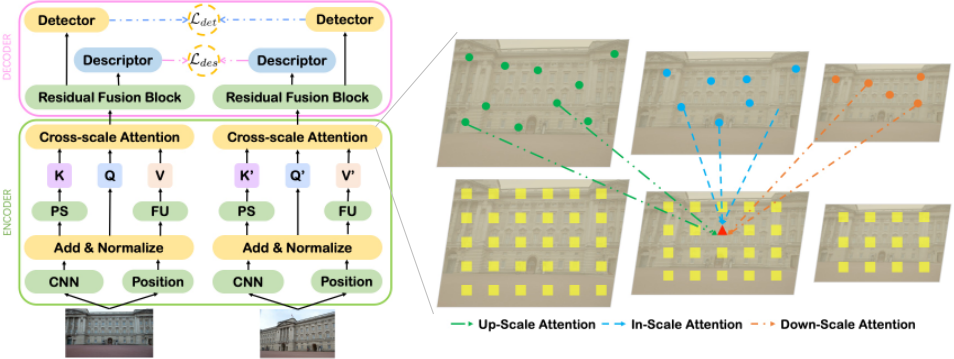
As illuminated in Figure 1, the overall architecture of soft point-wise transformer for description and detection of local features is designed as an encoder-decoder pipeline.
FeatureUniformization. To exploit the inter-dependencies between channel maps, a feature uniformization module is built at first. Given a local feature F ∈ RC×H×W , we first reshape F to RC×N , and then perform a matrix multiplication between the F and the transpose of F to compute the channel attention map as:
in which Xji measures the ith channel's impact on the j th channel. Then we perform the weighted element-wise sum operation and 1×1 convolution to obtain the fixed dimension feature map e ∈ RC×H×W :
where the γ is a learning scale parameter. The final feature of each channel is a weighted sum of features of all channels and original features, which models the long-range dependencies between feature maps, improving feature discriminability.
Cross-scale Attention. By mapping each point's representation into a latent fixed dimensional embedding space, we obtain a 1D sequence of point embeddings for a certain scale of the input image I. To encode the point spatial information, we learn a specific embedding pi for every location i with a Multi-Layer Perception, which is added to ei to form the final sequence input E = {e1 + p1, e2 + p2, ..., eN + pN}. Therefore, the spatial information is kept through the orderless self-attention and residual fusion.
Following the non-local operation [Wang et al., 2018], we define the generic attention operation as:
Here i is the index of the output position and j is the index that enumerates all possible positions. The {Q,K, V } represents the query, key and value for the attention, computed as {EWQ,EWK,EWV }. {WQ,WK,WV } ∈ RC∗d are the learnable parameters of three linear projection layers and d is the dimension of {Q, K, V }.
When the {Q,K} comes from the same feature map, we call it as In-Scale attention. We further extend the K from the deeper or shallower feature maps, and we call it as Up-Scale and Down-Scale attention, respectively. The Up-Scale attention is developed to enrich the high-level feature representation of "patch" with the lower-level feature representation of "point". And the Down-Scale attention is developed in the opposite direction. The Up-Scale and Down-Scale attention jointly mine the cross-level dependencies to enrich the local feature maps from shallow to deep layers.
Residual Fusion. The In-Scale and Cross-scale attention generate three intensive feature maps with the same dimension, exploiting different scale information independently. Then we fuse these separate feature maps into a comprehensive feature map. Different from simply adding or concentrating them together [Lin et al., 2017], we propose the residual fusion block to better combine features.
To allow the network to concentrate on more discriminative features, we first compute the residual between features FD ∈ Rd×H×W from down-scale attention and features FI ∈ Rd×H×W from in-scale attention. Then we can obtain the synthetic bottom-to-top representation ˆ FI :
Intuitively, the residual feature represents the abundant shape details like corner, edge and blob existing in shallow layer while degraded in the deep representation.
Similar operation is also adopt between the updated features ˆ FI and features FU ∈ Rd×H×W from up-scale attention:
Finally we obtain the fusion feature maps P ∈ Rd×H×W fed into the decoder to output the keypoints detection and description. The residual block allows the network to focus on only the distinct information among different levels, while passing the common knowledge, enabling a more discriminative residual feature learning compared with trivial adding or concatenating.
Multi-level Decoder. Above feature uniformization, crossscale attention and residual fusion modules make up the encoder of the transformer structure. As illuminated in the Figure 1, a dual-head decoder, i.e., descriptor and detector is adopt on multi-level feature maps to extract multi-scale descriptions and keypoints. The detector and descriptor simultaneously output the 3D description D ∈ Rd×H×W and the detection score map S ∈ [0, 1]H×W .
Descriptor. We set the 3D tensor P as a dense set of descriptor vectors D. These descriptor vectors can be readily compared between images to establish correspondences using the Euclidian distance with the hypothesis that the same keypoints will produce similar descriptors even in different conditions. In practice, a channel-wise L2-Normalization is applied to generate more robust feature presentation prior to comparing them.
with i = 1. . .H and j = 1. . .W.
Detector. We also suppose that the 3D tensor P as a collection of 2D response maps at different channels. These detection score maps are analogous to the Difference-of-Gaussian (DoG) response maps obtained in Scale Invariant Feature Transform (SIFT). In practice, an element-wise square operation followed by a 1×1 convolution and softmax function are adopt to obtain the detection response score S of each descriptor.
with i = 1. . .H and j = 1. . .W, where the θ(∗) represents the softmax operation. Only the locations with high confidence are selected as keypoints. Similar to multi-scale object detection, a non-maximum suppression (NMS) is applied to remove the detection points that are spatially too close.
Note that we build the feature maps from the encoder as a feature pyramid. The dual-head multi-level decoder extracts the final results upon the multi-level pyramid.
3.2 Soft Point-wise Attention
Recent works show that the keypoints located in the uniform and even well textured regions like tree leafages or ocean waves, could lead to bad matching[Revaud et al., 2019]. So some works learn to distinguish such regions and filter them as less discriminative keypoints. While directly deleting such keypoints will result in defective detection accuracy and discontinuities especially in large repetitive regions.
The attention module and position encoding will improve the discrimination of the local features representation. While the original attention module needs to generate enormous affinity matrix to measure the relationships with the complexity of O(N 2 ), where N is the number of input points. Highresolution feature maps are essential for accurate keypoints localization, taking heavy computation and memory cost.
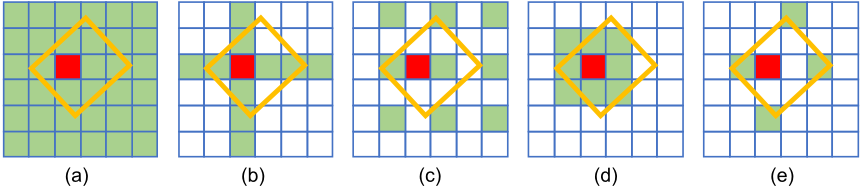
To address the above mentioned issue, our motivation is to replace the common single dense feature maps with sparse representative features. Without loss of generality, we propose the soft point-wise attention module which aggregates contextual information with the most representative keypoints, greatly reducing the complexity from O(N 2 ) to O(const × N).
The key of the soft point-wise attention is the soft keypoints selection, similar to our detector head but more efficient. We require a point (i, j) being selected by a hard dualmaximum strategy, i.e., the feature value in the location (i, j) of channel k is the local maximum both in spatial-wise and channel-wise. To be amenable for back-propagation during the training procedure, the above selection procedure is softened as follows.
The soft spatial detection score and soft channel score are defined as:
where F is the feature map and N(i, j) is the set of 8 neighbors of the pixel (i, j). The soft selection takes both scores into account and performs an image-level normalization:
Only the locations with high confidence (greater than the keypoints detection threshold) will be selected as the keys set ˆK = φ(K) ∈ RC×const , where φ(∗) is the soft keypoint selection operation. And the attention in Eq.(3) with soft pointwise selection is computed as:
In addition, we compare our soft point-wise attention block with the original non-local block and other optimization methods [Huang et al., 2019b; Huang et al., 2019a; Zhang et al., 2020] in Figure 2.
3.3 Implementation
Training. During the training time, the SPTD2 will be extended into a Siamese Network to simultaneously generate the keypoints detection score maps {S, S′ } and descriptors {D,D′ } of the correspond image pair {I, I ′ } ∈ R3×H×W . Our SPTD2 is independent of the backbone network, we use the VGG16 BN to evaluate our models during the experiments. In practice, the first feature map F 1 ∈ RC×H/2×W/2 and the feature maps smaller than RC×H/16×W/16 are dropped when building the transformer pyramid. For every input image pair, we select a random 200 × 200 crop centered around one correspondence.
Testing. During the testing time, the single image is fed into the model to generate the detection score maps and descriptors with the original resolution. All detection results will be aligned with the original image resolution and the descriptions are then bilinear interpolated at the refined positions. A non-maximum suppression is also applied on the multi-head detection score maps to remove the overlapping keypoints.
Loss design. As illuminated in the Figure 1, the loss function integrates the detection loss Ldet and the description loss Ldes. The detection loss is formulated as:
where the Lc computes the cosine similarity of the correspond detection score maps and the Lp tries to maximize the local peak of the detection score maps [Revaud et al., 2019].
The description loss is written as:
where C is the correspondences between I and I ′ , Sc and S′lc are their detection scores, dlc and d′lc are their corresponding descriptors, and theM(∗) is the circle loss[Sun et al., 2020] for representation learning.
The final loss function is formulated as Ldet + λLdes.
4 Experiments
In this section, we evaluate the performance of the proposed model on the image matching and visual localization tasks. We show that the our model can achieve state-of-the-art performance on these tasks. Moreover, extensive experiments for ablation study show that our SPTD2 is effective.
| Method | Pub. | #Features | #Matches | AUC | ||
|---|---|---|---|---|---|---|
| 2px | 5px | 10px | ||||
| SIFT | IJCV | 4.1K | - | 39.49 | 49.57 | 55.15 |
| HesAff + RootSIFT | NIPS17 | 6.7K | 2.9K | 39.99 | 52.25 | 60.40 |
| HAN + HN++ | ECCV18 | 3.9K | 2.0K | 42.61 | 56.85 | 65.50 |
| LF-Net | NIPS18 | 0.5K | 0.2K | 38.74 | 48.69 | 53.59 |
| SuperPoint | CVPR18 | 1.7K | 0.9K | 44.08 | 59.04 | 68.09 |
| DELF | ICCV17 | 4.6K | 1.9K | 44.73 | 49.70 | 58.91 |
| SIFT + ContextDesc | CVPR19 | 4.1K | 1.7K | 47.23 | 58.25 | 65.33 |
| D2-Net MS | CVPR19 | 4.9K | 1.7K | 19.49 | 37.78 | 56.17 |
| R2D2 MS | NIPS19 | 4.9K | 1.7K | 43.35 | 64.17 | 75.18 |
| SIFT + LISRD | ECCV20 | 4.1K | - | 48.12 | 57.80 | 62.50 |
| DISK | NIPS20 | 7.7K | 3.9K | - | 69.80 | - |
| Key.Net | ICCV19 | - | - | 40.87 | 56.04 | 65.30 |
| D2-Net + Ref | ECCV20 | - | - | 54.24 | 67.62 | 75.57 |
| ASLFeat MS | CVPR20 | 4.8K | 2.1K | 50.10 | 66.93 | 76.90 |
| Ours | - | 5.0K | 1.9K | 56.20 | 72.17 | 79.80 |
4.1 Training Details
Datasets. The acquisition of sufficient ground-truth supervision to train keypoints detector and descriptor has been a bottleneck over years due to the ill-defined interest points. So we treat the keypoints detection and description as a selfsupervised task, to make the detector discover better and easier keypoints by defining local maxima in the detection score maps as the target. A similar pipeline as [Revaud et al., 2019] is developed to obtain dense ground-truth matching data.
The image pairs are composed by two aspects: 1) using the existing image pairs extracted from the Aachen Day-Night dataset [Sattler et al., 2018] about the same sceneries and 2) applying a manual transformation such as homography transform or random rotation on pascal voc and the web images [Radenovi´c et al., 2018] to obtain image pairs.
Parameters. ANVIDIARTX3090 card is used to train our model using Adam optimizer with β1 = 0.9, β2 = 0.999 for 30 epochs on the datasets. The initial learning rate is set to 1e-4 and decayed to 5e-5 in 30 epoch with 8 batch size. The testing is conducted on the same machine. The r and λ in loss function are set to 0.5 and 1, respectively. The multilevel balance parameters wl in Equ.(11) and Equ.(12) are all set to 1.
4.2 Image Matching
We first evaluate our SPTD2 on the image matching task.
Datasets. To compare with other methods fairly, our method is evaluated on the HPatches dataset [Balntas et al., 2017] including 116 different sequences of 6 images with accurate homography. To compare with other methods fairly, 8 high-resolution sequences are also excluded, leaving 52 and 56 sequences with illumination or viewpoint variations respectively.
Evaluation metrics. For fair comparison, we utilize three metrics, mean matching accuracy (MMA), keypoint repeatability (Rep) and matching score (MS) as evaluation metrics following [DeTone et al., 2018]. The correct match is required to be a mutual nearest neighbor during brute-force searching. To evaluate the metrics fairly and accurately, the public code from [Dusmanu et al., 2019] and [Luo et al., 2020] is used to compute the corresponding metric.
| baseline | FU | IA | UA | DA | RF | MMA(%) | MS(%) | REP(%) |
|---|---|---|---|---|---|---|---|---|
| ✓ | 62.26 | 25.57 | 63.11 | |||||
| ✓ | ✓ | 74.00 | 28.37 | 67.38 | ||||
| ✓ | ✓ | ✓ | 76.66 | 39.37 | 71.16 | |||
| ✓ | ✓ | ✓ | ✓ | 77.71 | 43.13 | 73.89 | ||
| ✓ | ✓ | ✓ | ✓ | ✓ | 77.77 | 44.32 | 75.86 | |
| ✓ | ✓ | ✓ | ✓ | ✓ | ✓ | 78.33 | 44.76 | 78.28 |
Comparisons with other methods. We compare the mean matching accuracy with the state-of-the-art methods, namely DELF [Noh et al., 2017], SuperPoint [DeTone et al., 2018], multi-scale D2-Net [Dusmanu et al., 2019], R2D2 [Revaud et al., 2019], ASLFeat [Luo et al., 2020], LISRD descriptors with SIFT detector [Pautrat et al., 2020], DISK[Tyszkiewicz et al., 2020], Key.Net [Barroso-Laguna et al., 2019], D2-Net and Refinement [Dusmanu et al., 2020], HardNet++ descriptors with HesAFFNet regions and [Mishkin et al., 2018] (HAN + HN++), etc. Unless otherwise specified, we report either results reported in original papers, or derived from authors' public implementations with default parameters. We limit the maximum number of features of our method to 5K.
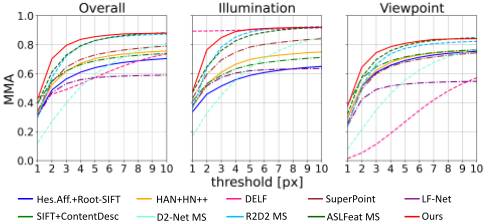
As shown in the Table 1 and Figure 3, SPTD2 achieves overall the best results regarding both illumination and viewpoint variations at different thresholds. Specifically, SPTD2 delivers remarkable improvements upon other methods especially for low range error thresholds, which in particular demonstrates that the keypoints localization error has been largely reduced. Besides, our method notably outperforms the more recent ASLFeat (78.33 vs 72.64 for MMA@3 overall), which also applied multi-level detection.
| Method | Resolution | Memory(MB) | GFLOPs |
|---|---|---|---|
| SA | 2168 | 619 | |
| DANet | 2339 | 1110 | |
| RCCA | 2048×128×128 | 427 | 804 |
| ISSA | 252 | 386 | |
| Ours | 364 | 359 |
Ablations on Attention module. We further conduct diagnostic analysis to verify the effectiveness of the essential modules in our approach. We use the VGG-structure as the default backbone for all the studies. The performance of our baseline model with default parameters is given in the first row of the Table 2. The effect of each essential component of our SPTD2 on image matching task is shown as follows.
Ablations on soft point-wise transformer. As shown in Table 3, applying the soft point-wise attention module reduces the computation complexity and GPU memory compared to original attention module [Wang et al., 2018], RCCA [Huang et al., 2019b], DANet [Fu et al., 2019], ISSA [Huang et al., 2019a]. We further verify the impact of the detection threshold in the soft point-wise transformer. The detection threshold determines the number of keypoints which will be kept in the Keys set. The computation complexity will be higher with lower threshold. While derisory keypoints will influence the performance of the attention module to capture enough information. It's interesting that the soft point-wise attention module will degrade into the original attention module when the threshold is set to 0. We then choose the keypoints with the top-2K scores when the threshold is lower than 0.8 because of "CUDA out of memory". We set the threshold to {0.6, 0.8, 0.9, 0.95} and get corresponding MMA@3 at {78.33, 78.31, 74.56, 72.37}. So we set the threshold at 0.8 to reach the best balance of performance and computation load.
4.3 Visual Localization
To further verify the effectiveness of the novel SPTD2, we evaluate it on the task of visual localization, which aims to estimate the camera pose within a given scene using images sequence. The task was proposed in [Sattler et al., 2018] to evaluate the performance of local features in the context of localization. To evaluate our method fairly, we also produce the public format of keypoints and compare with other methods on the official evaluation server.
Datasets. We resort the Aachen Day-Night dataset [Sattler et al., 2018] to demonstrate the effect on visual localization tasks, which contains images from the old inner city of Aachen, Germany. The key challenge in the dataset lies on matching images with extreme day-night changes.
Evaluation metrics. The evaluation is done using The Visual Localization Benchmark, which takes a pre-defined visual localization pipeline based on COMLAP [Schonberger and Frahm, 2016]. The successfully localized images are counted within three error tolerances (0.25m, 2◦ ) / (0.5m, 5◦ )
| Method | #Features | Dim | 0.25m, 2◦ | 0.5m, 5◦ | 5m, 10◦ | |
|---|---|---|---|---|---|---|
| Day | D2-Net | 19.3K | 512 | 83.7 | 91.6 | 96.5 97.2 |
| R2D2 | 10K | 128 | 86.9 | 94.3 | ||
| ASLFeat | 10K | 128 | 85.2 | 93.2 | 96.1 | |
| Ours | 10K | 128 | 87.1 | 95.4 | 98.8 | |
| D2-Net | 19.3K | 512 | 80.6 | 87.8 | 96.9 | |
| Night V1.0 R2D2 | 10K | 128 | 79.6 | 87.8 | 95.9 | |
| ASLFeat | 10K | 128 | 82.7 | 87.8 | 95.9 | |
| Ours | 10K | 128 | 78.8 | 89.3 | 99.0 | |
| D2-Net | 19.3K | 512 | 68.1 | 85.9 | 97.9 | |
| Night V1.1 R2D2 | 10K | 128 | 69.6 | 84.3 | 97.9 | |
| ASLFeat | 10K | 128 | 72.8 | 85.3 | 96.9 | |
| Ours | 10K | 128 | 72.5 | 87.3 | 97.9 |
/ (5m, 10◦ ), representing the maximum position error in meters and degrees, respectively.
Results. Our SPTD2 is compared with the typical joint detector and descriptor methods D2-Net, R2D2 and ASLFeat. Note that there exist some greater scores in the benchmark website, while they use greater matching strategy, which is unfair to evaluate. Here all methods are evaluated with the default matching strategy to compare fairly. As shown in Table 4, our SPTD2 performs surprisingly well under challenging illumination changes especially for strict accuracy metrics for the estimated pose. While in the night environment setting, the cross-scale attention modules bring some noises from the non-discriminative dark background, which hinders our performance. On the other hand, methods in Table 4, build image pyramid (MS) in inference to improve the localization performance, while making low running speed. We employ the multi-scale detection and description with the multi-level detector and descriptor in decoder, which is over 2 times quicker than MS operation. With 21/4 scaling-factor MS, we improve the localization accuracy with {+1.7%,+2.3%,+1.8%} for (0.25m, 2◦ ).
5 Conclusions
In this paper, we propose a novel transformer-based architecture to jointly learn the local features descriptor and detector. The novel soft point-wise transformer simultaneously mines the long-range intrinsic and cross-scale dependencies of local features. The cross-scale attention module and multilevel decoder can guarantee the keypoints localization accuracy and discriminative descriptions especially in repetitive regions. Compared to other attention optimization methods, the soft point-wise attention remarkably decreases the computation and memory complexity. Experiments show SPTD2 significantly outperforms prior state-of-the-art methods.
Acknowledgments
This research is supported by Research Project of Intelligent sense technology of swarming drone under Grant 301021304.
@inproceedings{ijcai2021p159,
  title     = {Local Representation is Not Enough: Soft Point-Wise Transformer for Descriptor and Detector of Local Features},
  author    = {Wang, Zihao and Li, Xueyi and Li, Zhen},
  booktitle = {Proceedings of the Thirtieth International Joint Conference on
               Artificial Intelligence, {IJCAI-21}},
  publisher = {International Joint Conferences on Artificial Intelligence Organization},
  editor    = {Zhi-Hua Zhou},
  pages     = {1150--1156},
  year      = {2021},
  month     = {8},
  note      = {Main Track},
  doi       = {10.24963/ijcai.2021/159},
  url       = {https://doi.org/10.24963/ijcai.2021/159},
}
TY - CPAPER TI - Local Representation is Not Enough: Soft Point-Wise Transformer for Descriptor and Detector of Local Features AU - Wang, Zihao AU - Li, Xueyi AU - Li, Zhen T2 - Proceedings of the Thirtieth International Joint Conference on Artificial Intelligence, IJCAI-21 PB - International Joint Conferences on Artificial Intelligence Organization PY - 2021 SP - 1150 EP - 1156 DO - 10.24963/ijcai.2021/159 UR - https://doi.org/10.24963/ijcai.2021/159 ER -Copied
Machine-readable versions of this paper, for tools and AI agents:





