
Learning to Discretely Compose Reasoning Module Networks for Video Captioning
Proceedings of the Twenty-Ninth International Joint Conference on Artificial Intelligence. Main track. Pages 745-752.
https://doi.org/10.24963/ijcai.2020/104
Keywords
- Computer Vision: Language and Vision
Abstract
Generating natural language descriptions for videos, i.e., video captioning, essentially requires step-by-step reasoning along the generation process. For example, to generate the sentence “a man is shooting a basketball”, we need to first locate and describe the subject “man”, next reason out the man is “shooting”, then describe the object “basketball” of shooting. However, existing visual reasoning methods designed for visual question answering are not appropriate to video captioning, for it requires more complex visual reasoning on videos over both space and time, and dynamic module composition along the generation process. In this paper, we propose a novel visual reasoning approach for video captioning, named Reasoning Module Networks (RMN), to equip the existing encoder-decoder framework with the above reasoning capacity. Specifically, our RMN employs 1) three sophisticated spatio-temporal reasoning modules, and 2) a dynamic and discrete module selector trained by a linguistic loss with a Gumbel approximation. Extensive experiments on MSVD and MSR-VTT datasets demonstrate the proposed RMN outperforms the state-of-the-art methods while providing an explicit and explainable generation process. Our code is available at https://github.com/tgc1997/RMN.
- [Anderson et al., 2018] Peter Anderson, Xiaodong He, Chris Buehler, Damien Teney, Mark Johnson, Stephen Gould, and Lei Zhang. Bottom-up and top-down attention for image captioning and visual question answering. In CVPR, 2018.
- [Andreas et al., 2016] Jacob Andreas, Marcus Rohrbach, Trevor Darrell, and Dan Klein. Neural module networks. In CVPR, 2016.
- [Bahdanau et al., 2015] Dzmitry Bahdanau, Kyunghyun Cho, and Yoshua Bengio. Neural machine translation by jointly learning to align and translate. In ICLR, 2015.
- [Banerjee and Lavie, 2005] Satanjeev Banerjee and Alon Lavie. Meteor: An automatic metric for mt evaluation with improved correlation with human judgments. In Proceedings of the acl workshop on intrinsic and extrinsic evaluation measures for ma- chine translation and/or summarization, pages 65-72, 2005.
- [Carreira and Zisserman, 2017] Joao Carreira and Andrew Zisser- man. Quo vadis, action recognition? a new model and the kinet- ics dataset. In CVPR, 2017.
- [Chen and Dolan, 2011] David L Chen and William B Dolan. Col- lecting highly parallel data for paraphrase evaluation. In ACL, 2011.
- [Chen and Jiang, 2019] Shaoxiang Chen and Yu-Gang Jiang. Mo- tion guided spatial attention for video captioning. In AAAI, 2019.
- [Cirik et al., 2018] Volkan Cirik, Taylor Berg-Kirkpatrick, and Louis-Philippe Morency. Using syntax to ground referring ex- pressions in natural images. In AAAI, 2018.
- [Donahue et al., 2015] Jeffrey Donahue, Lisa Anne Hendricks, Ser- gio Guadarrama, Marcus Rohrbach, Subhashini Venugopalan, Kate Saenko, and Trevor Darrell. Long-term recurrent convolu- tional networks for visual recognition and description. In CVPR, 2015.
- [Guadarrama et al., 2013] Sergio Guadarrama, Niveda Krish- namoorthy, Girish Malkarnenkar, Subhashini Venugopalan, Ray- mond Mooney, Trevor Darrell, and Kate Saenko. Youtube2text: Recognizing and describing arbitrary activities using semantic hierarchies and zero-shot recognition. In ICCV, 2013.
- [He et al., 2016] Kaiming He, Xiangyu Zhang, Shaoqing Ren, and Jian Sun. Deep residual learning for image recognition. In CVPR, 2016.
- [Hong et al., 2019] Richang Hong, Daqing Liu, Xiaoyu Mo, Xi- angnan He, and Hanwang Zhang. Learning to compose and rea- son with language tree structures for visual grounding. T-PAMI, 2019.
- [Hou et al., 2019] Jingyi Hou, Xinxiao Wu, Wentian Zhao, Jiebo Luo, and Yunde Jia. Joint syntax representation learning and vi- sual cue translation for video captioning. In ICCV, 2019.
- [Hu et al., 2017] Ronghang Hu, Jacob Andreas, Marcus Rohrbach, Trevor Darrell, and Kate Saenko. Learning to reason: End-to-end module networks for visual question answering. In ICCV, 2017.
- [Hu et al., 2018] Ronghang Hu, Jacob Andreas, Trevor Darrell, and Kate Saenko. Explainable neural computation via stack neural module networks. In ECCV, 2018.
- [Jang et al., 2017] Eric Jang, Shixiang Gu, and Ben Poole. Cate- gorical reparameterization with gumbel-softmax. In ICLR, 2017.
- [Kay et al., 2017] Will Kay, Joao Carreira, Karen Simonyan, Brian Zhang, Chloe Hillier, Sudheendra Vijayanarasimhan, Fabio Vi- ola, Tim Green, Trevor Back, Paul Natsev, Mustafa Suleyman, and Andrew Zisserman. The kinetics human action video dataset. arXiv:1705.06950, 2017.
- [Kingma and Ba, 2015] Diederik P Kingma and Jimmy Ba. Adam: A method for stochastic optimization. In ICLR, 2015.
- [Kojima et al., 2002] Atsuhiro Kojima, Takeshi Tamura, and Ku- nio Fukunaga. Natural language description of human activities from video images based on concept hierarchy of actions. IJCV, 50(2):171-184, 2002.
- [Li et al., 2017] Xuelong Li, Bin Zhao, Xiaoqiang Lu, et al. Mam- rnn: Multi-level attention model based rnn for video captioning. In IJCAI, 2017.
- [Lin, 2004] Chin-Yew Lin. ROUGE: A package for automatic eval- uation of summaries. In Text Summarization Branches Out, July 2004.
- [Liu et al., 2018] Daqing Liu, Zheng-Jun Zha, Hanwang Zhang, Yongdong Zhang, and Feng Wu. Context-aware visual policy net- work for sequence-level image captioning. In ACM MM, 2018.
- [Liu et al., 2019] Daqing Liu, Hanwang Zhang, Feng Wu, and Zheng-Jun Zha. Learning to assemble neural module tree net- works for visual grounding. In ICCV, 2019.
- [Pan et al., 2017] Yingwei Pan, Ting Yao, Houqiang Li, and Tao Mei. Video captioning with transferred semantic attributes. In CVPR, 2017.
- [Papineni et al., 2002] Kishore Papineni, Salim Roukos, Todd Ward, and Wei-Jing Zhu. Bleu: a method for automatic evalu- ation of machine translation. In ACL, 2002.
- [Pei et al., 2019] Wenjie Pei, Jiyuan Zhang, Xiangrong Wang, Lei Ke, Xiaoyong Shen, and Yu-Wing Tai. Memory-attended recur- rent network for video captioning. In CVPR, 2019.
- [Ren et al., 2016] Shaoqing Ren, Kaiming He, Ross Girshick, and Jian Sun. Faster r-cnn: Towards real-time object detection with region proposal networks. In NIPS, 2016.
- [Russakovsky et al., 2015] Olga Russakovsky, Jia Deng, Hao Su, Jonathan Krause, Sanjeev Satheesh, Sean Ma, Zhiheng Huang, Andrej Karpathy, Aditya Khosla, Michael S. Bernstein, Alexan- der C. Berg, and Fei-Fei Li. Imagenet large scale visual recogni- tion challenge. IJCV, 115:211-252, 2015.
- [Szegedy et al., 2017] Christian Szegedy, Sergey Ioffe, Vincent Vanhoucke, and Alexander A Alemi. Inception-v4, inception- resnet and the impact of residual connections on learning. In AAAI, 2017.
- [Tian and Oh, 2019] Junjiao Tian and Jean Oh. Image captioning with compositional neural module networks. In AAAI, 2019. IJCAI
- [Vedantam et al., 2015] Ramakrishna Vedantam, C Lawrence Zit- nick, and Devi Parikh. Cider: Consensus-based image descrip- tion evaluation. In CVPR, 2015.
- [Venugopalan et al., 2015] Subhashini Venugopalan, Marcus Rohrbach, Jeffrey Donahue, Raymond Mooney, Trevor Darrell, and Kate Saenko. Sequence to sequence-video to text. In ICCV, 2015.
- [Wang et al., 2018] Bairui Wang, Lin Ma, Wei Zhang, and Wei Liu. Reconstruction network for video captioning. In CVPR, 2018.
- [Wang et al., 2019] Bairui Wang, Lin Ma, Wei Zhang, Wenhao Jiang, Jingwen Wang, and Wei Liu. Controllable video caption- ing with pos sequence guidance based on gated fusion network. In CVPR, 2019.
- [Xu et al., 2016] Jun Xu, Tao Mei, Ting Yao, and Yong Rui. Msr- vtt: A large video description dataset for bridging video and lan- guage. In CVPR, 2016.
- [Yang et al., 2019a] T. Yang, Z. Zha, and H. Zhang. Making history matter: History-advantage sequence training for visual dialog. In ICCV, 2019.
- [Yang et al., 2019b] Xu Yang, Hanwang Zhang, and Jianfei Cai. Learning to collocate neural modules for image captioning. In ICCV, 2019.
- [Yao et al., 2015] Li Yao, Atousa Torabi, Kyunghyun Cho, Nicolas Ballas, Christopher Pal, Hugo Larochelle, and Aaron Courville. Describing videos by exploiting temporal structure. In ICCV, 2015.
- [Zha et al., 2019] Z. Zha, D. Liu, H. Zhang, Y. Zhang, and F. Wu. Context-aware visual policy network for fine-grained image cap- tioning. T-PAMI, 2019.
- [Zhang and Peng, 2019] Junchao Zhang and Yuxin Peng. Object- aware aggregation with bidirectional temporal graph for video captioning. In CVPR, 2019.
References were extracted automatically from the PDF and may contain errors.
Full text extracted automatically from the PDF; figures, tables and equations may differ. The PDF is the version of record.
1 Introduction
Video captioning, the task aims to automatically generate natural language descriptions for videos, has received increasing attention in computer vision and machine learning. Even though our community achieves the significant advance in visual recognition [He et al., 2016; Ren et al., 2016] and natural language understanding [Bahdanau et al., 2015], video captioning is still a very challenging task and far away from satisfactory for it not only requires a thorough understanding of the input videos, but also requires step-by-step visual reasoning along the generation process.
∗Equal Contribution
†Corresponding Author
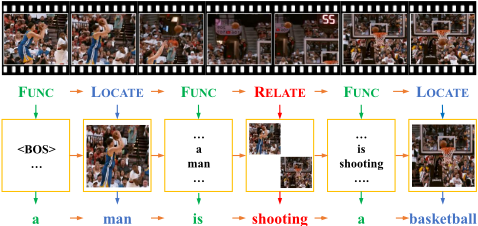
As illustrated in Figure 1, to describe the video, we human may have the following reasoning process: 1) identifying the subject to describe of the video, i.e., "man", 2) inferring what is the man doing, i.e., "shooting", 3) identifying what is the object of "shooting", i.e., "basketball", 4) generating the final description "a man is shooting a basketball" by inserting several function words. In a nutshell, there are three fundamental reasoning mechanisms involved: 1) Locate one region to generate visual words, 2) Relate pairwise regions to generate action words, 3) Generate function words according to the language context.
Most existing video captioning methods [Venugopalan et al., 2015; Donahue et al., 2015] follow the encoder-decoder framework, where a CNN is employed as an encoder to produce the video features and an RNN is employed as a decoder to generate the captions. Those methods usually neglect the nature of the above human-level reasoning, thus hurting the explainability of the generation process. Even though there are some recent works have explored the visual reasoning in visual question answering [Andreas et al., 2016; Hu et al., 2017; Yang et al., 2019a] and visual grounding [Cirik et al., 2018; Liu et al., 2019; Hong et al., 2019] by decomposing the questions or referring expressions into a linear or tree reasoning structure with several neural modules, the situation in the video captioning is more challenging because 1) unlike still images, videos contain richer visual content thus requiring more complex visual reasoning over both space and time, 2) unlike questions or referring expressions which are given in advance, the video descriptions are not available during the inference. Therefore, the model must dynamically compose the reasoning structure along the generation process.
To tackle the above two challenges, we propose a novel video captioning framework named Reasoning Module Networks (RMN). Firstly, to perform visual reasoning over both space and time, our RMN employs three fundamental spatiotemporal reasoning modules: a) LOCATE module to locate one single region over the video by a spatial-temporal attention, thus generating the visual words, e.g., "man" and "basketball" in Figure 1; b) RELATE module to relate pairwise regions over the video by first detecting the object of each frame, and then modeling the action by pairing two frames, thus generating the action words, e.g., "shooting" in Figure 1; and c) FUNC module to generate the function words according to the language context, e.g., "a" and "is" in Figure 1. Secondly, to compose the reasoning structure along the generation process, our RMN employs a dynamic and discrete module selector. To jointly train both the three modules and the selector in an end-to-end manner, we adopt the recently proposed Gumbel approximation [Jang et al., 2017] to make the discrete sampling process differentiable, and then constraint the module selector with a linguistic loss of part-ofspeech (POS) tag labels.
We validate the effectiveness of the proposed RMN by conducting extensive experiments on two widely-used datasets MSVD [Chen and Dolan, 2011] and MSR-VTT [Xu et al., 2016]. RMN outperforms the state-of-the-art video captioning methods on most metrics. Qualitative results indicate the generation process is explicit and explainable.
Our main contributions are three-fold: 1) We propose a novel framework named reasoning module networks (RMN) for video captioning with three spatio-temporal visual reasoning modules; 2) We adopt a discrete module selector to dynamically compose the reasoning process with modules; 3) Our RMN achieves new state-of-the-art performance with an explicit and explainable generation process.
2 RelatedWork
2.1 Video Captioning
There are two main directions to solve the video captioning problem. In the early stage, template-based methods [Kojima et al., 2002; Guadarrama et al., 2013], which first define a sentence template with grammar rules and then aligned subject, verb and object of the sentence template with video content, were widely studied. Those methods are hard to generate flexible language due to the fixed syntactic structure of the predefined template. Benefit from the rapid development of deep neural networks, the sequence learning methods [Venugopalan et al., 2015; Yao et al., 2015; Pan et al., 2017] are widely used to describe the video with flexible natural language, most of these methods are based on the encoder-decoder framework. [Venugopalan et al., 2015] proposed S2VT model which regards the video captioning task as a machine translation task. [Yao et al., 2015] introduced a temporal attention mechanism to assign weights to the features of each frame and then fused them based on the attention weights. [Li et al., 2017; Chen and Jiang, 2019] further applied spatial attention mechanisms on each frame.
Recently, [Wang et al., 2019] and [Hou et al., 2019] proposed to leverage Part-of-Speech (POS) tags to boost video captioning. [Wang et al., 2019] encodes the predicted POS sequences into hidden features, which further guides the generation process. [Hou et al., 2019] mixes word probabilities of multiple components at each timestep conditioned on the inferred POS tags. However, both of them lack the reasoning capability for rich video content. On the contrary, we propose three well-designed reasoning module networks that correspond to three fundamental reasoning mechanisms.
2.2 Neural Module Networks
Neural module networks is a general framework that explicitly models the compositionality of languages by decomposing the network into neural modules. It has been widely used in visual question answering and visual grounding. [Andreas et al., 2016] employs an off-the-shelf parser to parse the questions into a tree, leading to brittleness caused by parsing errors. [Hu et al., 2017] trains an RNN to decode the language into the sequence, thus requiring extra human annotations. [Hu et al., 2018] removes language parser and additional annotations by using a soft and continuous module layout. However, the case of video captioning is more complex since there are no fully observed captions during inference thus all the above methods are not applicable. To this end, we design a dynamic module selector to construct the reasoning procedure step-by-step during the generation process.
Recently, the pioneering works [Liu et al., 2018; Zha et al., 2019; Yang et al., 2019b; Tian and Oh, 2019] are trying to adopt neural module networks into image captioning. However, their modules are designed to produce several types of features and their module compositions relied on a soft attention mechanism. As a contrast, our RMN employs several sophisticated spatio-temporal reasoning modules to perform more complex visual reasoning over videos, and designs a discrete and dynamic module selector to make a selection at each step, making the generation process explicit and explainable.
3 Approach
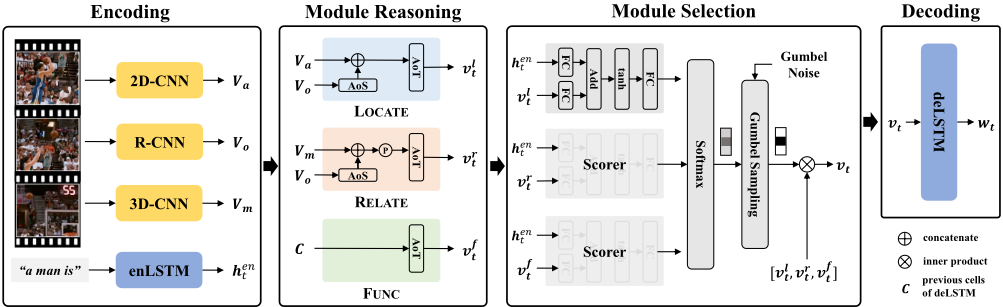
In this section, we will describe the proposed Reasoning Module Networks (RMN) in more detail. Figure 2 gives a walk-through example of our RMN at timestep t. Our RMN can be divided into four stages: Encoding (Section 3.1), Module Reasoning (Section 3.2), Module Selection (Section 3.3), and Decoding (Section 3.4). In Section 3.5, we detail the joint training strategy for both reasoning modules and the module selector.
3.1 Encoder
For the given video of N frames, we first represent it with three types of features, i.e., appearance features Va extracted from a 2D-CNN, object features Vo extracted from a R-CNN on each frame, and motion features Vm extracted from a 3DCNN. Note that to model temporal information for those visual features, we have post-processed Va and Vm with BiLSTMs. And Vo contains an additional dimension on space.
For the previous generated words {w1, · · · , wt-1}, we encode them by a LSTM (denoted as enLSTM) which takes the global visual feature ¯ v, the last generated word embedding vector et-1, and the last timestep hidden state hde t-1 of deLSTM (cf. Eqn. (9)) as input:
It is worth noticing that since hen t encodes rich information from history, it will be used to guide the reasoning process and the module selection.
3.2 ReasoningModules
As mentioned in the Introduction, there are three fundamental reasoning mechanisms involved in video captioning. Therefore, we design three corresponding reasoning modules. In the following, we will first introduce the attention functions used in the modules, and then describe each module in detail.
Attention Functions
We follow the widely used additive attention formulation [Bahdanau et al., 2015]:
where V and q are values and queries of attention, w1, W2, and W3 are trainable parameters, 1 is an all-one vector. Note that, the attention can be executed on any dimensions, therefore, we further define AoS(·) as the Attention over the dimension on Space, and define AoT(·) as the Attention over the dimension on Time.
LOCATE Module
It is designed to generate visual words, e.g., "man" and "basketball". Generating this type of words requires the model to attend on one specific region over both space and time. Therefore, we first apply an Attention over Space (AoS) for object features Vo and then apply an Attention over Time (AoT) together with Va, formally:
where ⊕ denotes concatenate operation.
RELATE Module
It is designed to generate action words, e.g., "riding" and "shooting". Modeling action requires reasoning over both space and time. Take Figure 1 as an example, to generate the word "shooting", we must be aware that the man is holding a basketball, and then notice that the basketball is flying to the basket, finally we can inference that the man is "shooting". It means we must connect two scenes at different time. To achieve this reasoning mechanism, we insert a pairwise interaction (i.e., concatenate every possible pair of two tensors) between the AoS and AoT, formally:
where P(·, ·) denotes the pairwise interaction function that Pij (A, B) = Ai ⊕ Bj .
FUNC Module
It is designed to generate function words to complete the whole sentences. Since the function words only require language information, thus we propose to recall the history decoder cell states of deLSTM (cf. Eqn. (9)) to generate the current words by an AoT, formally:
So far, we have detailed the three proposed reasoning modules. Next, we will describe how to make a selection of those modules at each timestep.
3.3 Module Selector
As illustrated in Figure 2, the module selection consists of two steps. First, we calculate a score for each module to measure the probability of each module could be selected. Second, we sampling one determined module based on those scores with Gumbel Softmax [Jang et al., 2017] strategy.
In detail, we formulate the scoring function S(·, ·) as:
Thus we can get slt = S(hen t , vlt ), srt = S(hen t , vr t ), and sft = S(hen t , vf t ) for the three LOCATE, RELATE, and FUNC modules, respectively.
After that, the straightforward selection method is directly choosing the module with the maximum score. However, it will block the gradients off the module selector for the function arg max is non-differentiable. To this end, we apply a relaxation between forward pass and backward pass, formally:
where we take an approximation that relaxes the discrete onehot decision vector zt into a continuous ˜ zt. G is the Gumbel noise drawn from i.i.d. Gumbel(0, 1). τ is a temperature parameter to control the strength of softmax. Please refer to [Jang et al., 2017] for more mathematical details.
With this decision vector zt, we can get the final visual reasoning result as:vt = zt ⊗ [vlt , vr t , vf t ], (8)
where ⊗ denotes inner product. It is worth noticing that zt is an one-hot vector, thus only one determined module will be selected in the forward pass.
3.4 Decoder
For each timestep t, we decode the final visual reasoning result by a LSTM (denotes as deLSTM):
Recall that the hidden and cell states were used in Eqn. (1) and Eqn. (5). Further, we decode the word probability pt as:
where MLP is two-layers with tanh as activation function.
3.5 End-to-End Training
Thanks to the Gumbel-Softmax strategy, our RMN model can be trained in an end-to-end manner. Given a video and the corresponding ground-truth caption {w∗ t } for t ∈ [1, T], where T is the sentence length, the objective is to minimize the cross-entropy loss function given by:
Further, to ensure the module selector sticking on the linguistic structure, we propose to supervise the module selection by extra Part-of-Speech (POS) tag labels. Accordingly, we apply a Kullback-Leibler Divergence (KLD) loss to make the predicted module decision vector ˜ z and the ground-truth tag distribution S∗ = {s∗t }, t ∈ [1, T] as close as possible, formally:
To collect the ground-truth S∗ , we first detected POS tag labels by Spacy Tagging Tool 1 , and then assigned [NN*] and [JJ*] to the LOCATE module, [VB*] to the RELATE module, and the other to the FUNC module.
Therefore, the overall loss function of our RMN model is given by:
where λ is a trade-off weight.
4 Experiments
4.1 Datasets andMetrics
We conduct experiments on two widely used video captioning datasets with several standard evaluation metrics to verify the effectiveness of our proposed method.
Datasets
MSVD. The MSVD dataset [Chen and Dolan, 2011] consists of 1,970 short video clips selected from Youtube, where each one depicts a single activity in the open domain, and each video clip is annotated with multi-lingual captions. Since we only consider the English captions in this paper, each video clip has roughly 41 descriptions. To be consistent with previous works, we split the dataset to 3 subsets, 1,200 clips for training, 100 clips for validation, and the remaining 670 clips for testing.
MSR-VTT. The MSR-VTT [Xu et al., 2016] is a large-scale dataset for the open domain video captioning, which consists of 10,000 video clips from 20 categories, and each video clip is annotated with 20 English sentences by Amazon Mechanical Turks. There are about 29,000 unique words in all captions. Following the existing works, we use the standard splits, namely 6,513 clips for training, 497 clips for validation, and 2,990 clips for testing.
Evaluation Metrics
We use several widely used automatic evaluation metrics to evaluate the quality of the generated captions, i.e., BLEU [Papineni et al., 2002], METEOR [Banerjee and Lavie, 2005], CIDEr [Vedantam et al., 2015], ROUGE-L [Lin, 2004]. Most of these metrics are originally proposed for machine translation or image captioning, the higher score indicates better quality of the captions.
4.2 Implementation Details
Dataset Preprocessing
We first convert all captions to lower case and remove punctuations, then we truncate the captions with more than 26 words and zero pad the captions with less than 26 words. The vocabulary size is set to 7,351 for MSVD and 9,732 for MSR-VTT with removing the words appear less than twice and five times respectively.
1 https://spacy.io
| Settings | MSVD | MSR-VTT | |||||||||||
|---|---|---|---|---|---|---|---|---|---|---|---|---|---|
| Model | LOCATE | RELATE | FUNC | Discrete | Lpos | B@4 | R | M | C | B@4 | R | M | C |
| RMN (LOCATE) | ✓ | 52.5 | 73.1 | 35.8 | 90.0 | 40.7 | 60.5 | 27.7 | 46.9 | ||||
| RMN (RELATE) | ✓ | 52.8 | 73.1 | 36.1 | 90.0 | 40.1 | 60.6 | 28.1 | 47.1 | ||||
| RMN (S) | ✓ | ✓ | ✓ | 53.2 | 73.2 | 35.8 | 90.8 | 41.0 | 60.6 | 28.0 | 47.2 | ||
| RMN (H) | ✓ | ✓ | ✓ | ✓ | 51.5 | 72.0 | 35.1 | 88.4 | 41.9 | 60.9 | 28.1 | 48.1 | |
| RMN (S+L) | ✓ | ✓ | ✓ | ✓ | 52.5 | 72.7 | 36.1 | 92.8 | 42.1 | 61.3 | 28.3 | 49.1 | |
| RMN (H+L) | ✓ | ✓ | ✓ | ✓ | ✓ | 54.6 | 73.4 | 36.5 | 94.4 | 42.5 | 61.6 | 28.4 | 49.6 |
Feature Extraction
In our experiments, we use InceptionResNetV2 (IRV2) [Szegedy et al., 2017] as 2D CNN and I3D [Carreira and Zisserman, 2017] as 3D CNN to extract appearance features and motion features respectively, then we equally-spaced 26 features for each video. The IRV2 is trained on ILSVRC-2012CLS image classification dataset [Russakovsky et al., 2015] and the I3D is trained on Kinetics action classification dataset [Kay et al., 2017]. We adopt Faster-RCNN [Ren et al., 2016] which is trained by [Anderson et al., 2018] to extract 36 region features for each frame (26 equally-spaced frames for each video).
Training Details
Our model is optimized by Adam Optimizer [Kingma and Ba, 2015], the initial learning rate is set to 1e-4. For the MSVD dataset, the hidden size of the LSTM is 512 and the learning rate is divided by 10 every 10 epochs. For the MSRVTT dataset, the hidden size of the LSTM is 1,300 and the learning rate is divided by 3 every 5 epochs. During testing, we use beam search with size 2 for the final caption generation.
4.3 Ablation Study
As shown in Table 1, we compare our RMN against a set of other ablated models with various settings: (1) RMN (LOCATE): the model that only deployed with Locate module; (2) RMN (RELATE): the model that only deployed with Related module; (3) RMN (S): the model that softly fuses three modules, i.e., zt in Eqn. (8) is computed as softmax(log([slt , srt , sft ]); (4) RMN (H): the model that hard selects one of three modules; (5) RMN (S+L): the model that softly fuses three modules and trained by linguistic loss; (6) RMN (H+L): the model that hard selects one of three modules and trained by linguistic loss. According to the results shown in Table 1, we have the following observations.
Effect of Reasoning Modules
RMN (RELATE) consistently outperforms RMN (LOCATE) on both MSVD and MSR-VTT. This is because the RELATE module models much richer visual action information than LOCATE, leading to performance improvement over RMN (LOCATE).
RMN (S) outperforms RMN (LOCATE) and RMN (RELATE) under most metrics. This indicates that by fusing different types of reasoning mechanisms, the model can generate better video descriptions.
Effect of Gumbel Strategy
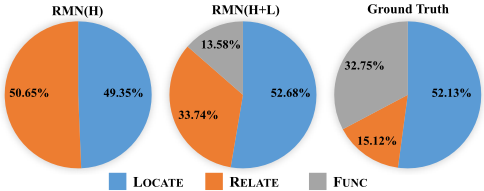
Comparing RMN (H) with RMN (LOCATE) and RMN (RELATE), we observe opposite results on MSVD and MSRVTT. To figure out the reasons for this observation, we count the proportion of the three modules occupied in Figure 3. We can find that without the linguistic loss, RMN (H) only employs two modules, i.e., LOCATE module and RELATE module, indicating the failure of training.
Therefore, the reason for the opposite results is that RMN (H) failed in training on MSVD while succeeded on MSRVTT. Actually, even though Gumbel strategy can relax the discrete decision to continuous decision, it still requires large training examples. Therefore, RMN (H) underperforms RMN (LOCATE) and RMN (RELATE) on MSVD which only contains 1,200 training samples, while outperforming them on MSR-VTT which contains 6,513 training samples.
Similarly, even though RMN(S) surpasses RMN(H) under some metrics, but if we employ the linguistic loss to make GT: there is a man riding a vehicle into the forest


RMN: a man is riding a vehicle in a forest
(a) MSR-VTT: 7393

GT: a man is playing a flute
RMN: a man is playing a flute
(d) MSVD: z0zb--BOhDY_16_22

GT: a group of boys are playing basketball with a coach
RMN: a group of people are playing basketball
(b) MSR-VTT: 7458

GT: a man and a woman are speaking on the phone
RMN: two people are talking on the phone
(e) MSVD: q3I3R_gqy8M_34_37

GT: there is a man in blue is swimming in the sea
RMN: a man is swimming in the sea and talking about the sea
(c) MSR-VTT: 7505
GT: someone is pouring tomato sauce into a pot of meat
RMN: a man is pouring sauce into a pot
(f) MSVD: hJFBXHtxKIc_204_209
| MSVD | ||||
|---|---|---|---|---|
| Models | B@4 | R | M | C |
| MAM-RNN [Li et al., 2017] | 41.3 | 68.8 | 32.2 | 53.9 |
| RecNet [Wang et al., 2018] | 52.3 | 69.8 | 34.1 | 80.3 |
| MARN [Pei et al., 2019] | 48.4 | 71.9 | 35.1 | 92.2 |
| OA-BTG [Zhang and Peng, 2019] | 56.9 | - | 36.2 | 90.6 |
| POS-CG [Wang et al., 2019] | 52.5 | 71.3 | 34.1 | 92.0 |
| Mixture [Hou et al., 2019] | 52.8 | 71.8 | 36.1 | 87.8 |
| RMN (S+L) | 52.5 | 72.7 | 36.1 | 92.8 |
| RMN (H+L) | 54.6 | 73.4 | 36.5 | 94.4 |
| MSR-VTT | ||||
|---|---|---|---|---|
| Models | B@4 | R | M | C |
| RecNet [Wang et al., 2018] | 39.1 | 59.3 | 26.6 | 42.7 |
| MARN [Pei et al., 2019] | 40.4 | 60.7 | 28.1 | 47.1 |
| OA-BTG [Zhang and Peng, 2019] | 41.4 | - | 28.2 | 46.9 |
| POS-CG [Wang et al., 2019] | 42.0 | 61.6 | 28.2 | 48.7 |
| Mixture [Hou et al., 2019] | 42.3 | 62.8 | 29.7 | 49.1 |
| RMN (S+L) | 42.1 | 61.3 | 28.3 | 49.1 |
| RMN (H+L) | 42.5 | 61.6 | 28.4 | 49.6 |
sure both soft fusion and hard module selector works well, RMN (H+L) outperforms RMN (S+L) with a margin.
Effect of Linguistic Loss
Comparing RMN (H+L) with RMN (H), as well as comparing RMN (S+L) with RMN (S), we find that the linguistic loss consistently improves the performance, indicating the importance of linguistic information for video captioning.
We can also observe the consistent results in Figure 3. By imposing the linguistic loss, we can enforce the module selector sticking with the linguistic structure, and the proportion of each module is approaching to the ground-truth.
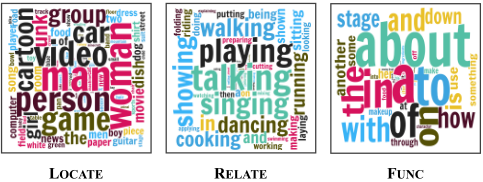
Further, we carried out the word cloud statistics as shown in Figure 4. We can find that the three modules have a strong pattern: the LOCATE module mainly generates visual words, e.g., "man" and "person"; the RELATE module mainly generates action words, e.g., "playing" and "talking"; the FUNC module mainly generates function words, e.g., "about" and "to". It indicates that the model has learned linguistic knowledge correctly.
4.4 Comparison with State-of-the-Art
We compare our proposed RMN with the most recent stateof-the-art methods on MSVD and MSR-VTT datasets. According to whether they leverage the POS labels, we categorize them into two groups: 1) traditional encoder-decoder based models MAM-RNN [Li et al., 2017], RecNet [Wang et al., 2018], MARN [Pei et al., 2019], and OA-BTG [Zhang and Peng, 2019], and 2) POS strengthened model POSCG [Wang et al., 2019] and Mixture [Hou et al., 2019].
As shown in Table 2, we can find that: 1) the methods that leverage POS labels outperform the methods without POS information, and 2) our proposed reasoning module network outperforms the methods with POS labels on most metrics and achieves new state-of-the-art. It is worth noting that CIDEr is proposed for captioning task specifically, and is considered more consistent with human judgment. Our model achieves the best CIDEr score on both datasets, which demonstrates our RMN model can generate captions that more in line with human descriptions.
4.5 Qualitative Analysis
In this section, we would like to investigate the generation process of our model by qualitative results. Here we provide some video captioning examples in Figure 5. As expected, our module selection is explicit and reasonable, for example, we compose "man", "flute", and "phone" with the LOCATE module, "playing", "riding", and "talking" with RELATE module, and "a", "of", and "the" with FUNC module.
The above observations suggest that the generation process of the proposed RMN is totally explicit, since at each timestep the module selects one determined module to produce the current word. In addition, each module is welldesigned to perform spatio-temporal visual reasoning, e.g., the spatio-temporal attention for LOCATE module and pairwise interaction reasoning over both space and time for RELATE module, indicating that our model is explainable.
5 Conclusion
In this paper, we proposed a novel reasoning neural module networks (RMN) for video captioning that performs visual reasoning on each step along the generation process. Specifically, we designed three sophisticated reasoning modules for spatio-temporal visual reasoning. To dynamically compose the reasoning modules, we proposed a discrete module selector which is trained by a linguistic loss with a Gumbel approximation. Extensive experiments verified the effectiveness of the proposed RMN, and the qualitative results indicated the caption generation process is explicit and explainable.
Acknowledgments
This work was supported by the National Key R&D Program of China under Grant 2017YFB1300201, the National Natural Science Foundation of China (NSFC) under Grants U19B2038, 61620106009 and 61725203 as well as the Fundamental Research Funds for the Central Universities under Grant WK2100100030.
@inproceedings{ijcai2020p104,
  title     = {Learning to Discretely Compose Reasoning Module Networks for Video Captioning},
  author    = {Tan, Ganchao and Liu, Daqing and Wang, Meng and Zha, Zheng-Jun},
  booktitle = {Proceedings of the Twenty-Ninth International Joint Conference on
               Artificial Intelligence, {IJCAI-20}},
  publisher = {International Joint Conferences on Artificial Intelligence Organization},
  editor    = {Christian Bessiere},
  pages     = {745--752},
  year      = {2020},
  month     = {7},
  note      = {Main track},
  doi       = {10.24963/ijcai.2020/104},
  url       = {https://doi.org/10.24963/ijcai.2020/104},
}
TY - CPAPER TI - Learning to Discretely Compose Reasoning Module Networks for Video Captioning AU - Tan, Ganchao AU - Liu, Daqing AU - Wang, Meng AU - Zha, Zheng-Jun T2 - Proceedings of the Twenty-Ninth International Joint Conference on Artificial Intelligence, IJCAI-20 PB - International Joint Conferences on Artificial Intelligence Organization PY - 2020 SP - 745 EP - 752 DO - 10.24963/ijcai.2020/104 UR - https://doi.org/10.24963/ijcai.2020/104 ER -Copied
Machine-readable versions of this paper, for tools and AI agents:





