
The pywmi Framework and Toolbox for Probabilistic Inference using Weighted Model Integration
Proceedings of the Twenty-Eighth International Joint Conference on Artificial Intelligence. Demos. Pages 6530-6532.
https://doi.org/10.24963/ijcai.2019/946
Keywords
- AI: Knowledge Representation and Reasoning
- AI: Uncertainty in AI
Abstract
Weighted Model Integration (WMI) is a popular technique for probabilistic inference that extends Weighted Model Counting (WMC) -- the standard inference technique for inference in discrete domains -- to domains with both discrete and continuous variables. However, existing WMI solvers each have different interfaces and use different formats for representing WMI problems. Therefore, we introduce pywmi (http://pywmi.org), an open source framework and toolbox for probabilistic inference using WMI, to address these shortcomings. Crucially, pywmi fixes a common internal format for WMI problems and introduces a common interface for WMI solvers. To assist users in modeling WMI problems, pywmi introduces modeling languages based on SMT-LIB.v2 or MiniZinc and parsers for both. To assist users in comparing WMI solvers, pywmi includes implementations of several state-of-the-art solvers, a fast approximate WMI solver, and a command-line interface to solve WMI problems. Finally, to assist developers in implementing new solvers, pywmi provides Python implementations of commonly used subroutines.
- [Barrett et al., 2010] Clark Barrett, Aaron Stump, and Ce- sare Tinelli. The SMT-LIB Standard: Version 2.0. In A. Gupta and D. Kroening, editors, Proceedings of the 8th International Workshop on Satisfiability Modulo Theories (Edinburgh, UK), 2010.
- [Belle et al., 2015] Vaishak Belle, Andrea Passerini, and Guy Van den Broeck. Probabilistic Inference in Hybrid Domains by Weighted Model Integration. In IJCAI, pages 2770-2776, 2015. IJCAI
- [De Loera et al., 2013] Jesús A De Loera, Brandon Dutra, Matthias Koeppe, Stanislav Moreinis, Gregory Pinto, and Jianqiu Wu. Software for exact integration of polynomials over polyhedra. Computational Geometry, 46(3):232-252, 2013.
- [De Salvo Braz et al., 2016] Rodrigo De Salvo Braz, Ciaran O'Reilly, Vibhav Gogate, and Rina Dechter. Probabilistic inference modulo theories. In IJCAI, pages 3591-3599, 2016. IJCAI
- [Dries et al., 2015] Anton Dries, Angelika Kimmig, Wannes Meert, Joris Renkens, Guy Van den Broeck, Jonas Vlas- selaer, and Luc De Raedt. Problog2: Probabilistic logic programming. In Joint European Conference on Machine Learning and Knowledge Discovery in Databases, pages 312-315. Springer, 2015.
- [Gario and Micheli, 2015] Marco Gario and Andrea Micheli. Pysmt: a solver-agnostic library for fast proto- typing of smt-based algorithms. In SMT Workshop 2015, 2015.
- [Gehr et al., 2016] Timon Gehr, Sasa Misailovic, and Martin Vechev. PSI: Exact Symbolic Inference for Probabilistic Programs. In CAV, pages 62-83. Springer, 2016.
- [Kolb et al., 2018] Samuel Kolb, Martin Mladenov, Scott Sanner, Vaishak Belle, and Kristian Kersting. Efficient Symbolic Integration for Probabilistic Inference. In IJCAI, pages 5031-5037, 2018. IJCAI
- [Morettin et al., 2019] Paolo Morettin, Andrea Passerini, and Roberto Sebastiani. Advanced smt techniques for weighted model integration. Artificial Intelligence, 2019.
- [Nethercote et al., 2007] Nicholas Nethercote, Peter J Stuckey, Ralph Becket, Sebastian Brand, Gregory J Duck, and Guido Tack. MiniZinc: Towards a standard CP modelling language. In International Conference on Principles and Practice of Constraint Programming, pages 529-543. Springer, 2007.
- [Sanner et al., 2011] Scott Sanner, Karina Valdivia Delgado, and Leliane Nunes De Barros. Symbolic Dynamic Pro- gramming for Discrete and Continuous State MDPs. In UAI, 2011.
- [Zuidberg Dos Martires et al., 2019] Pedro Zuidberg Dos Martires, Anton Dries, and Luc De Raedt. Exact and Approximate Weighted Model Integration with Probabil- ity Density Functions Using Knowledge Compilation. In AAAI, 2019.
References were extracted automatically from the PDF and may contain errors.
Full text extracted automatically from the PDF; figures, tables and equations may differ. The PDF is the version of record.
1 ModelingWMI Problems
In a nutshell, WMI [Belle et al., 2015] traces back to SAT, the problem of deciding if a Boolean formula is satisfiable. #SAT builds on SAT but answers the question of how many models satisfy a formula and WMC extends #SAT by allowing models to be weighted. Like SMT(LRA) extends SAT to answer satisfiability for logical formulas with linear inequalities over real variables, WMI extends WMC to integrate over (instead of summing) over the (possibily infinitely many) weighted models of an SMT(LRA) formula. A WMI problem consists of a support φ, an SMT(LRA) formula that describes all feasible worlds, a weight function w : Rr ×Bb ↦→ R that assigns a weight to every possible world and a set of queries, every query being an SMT(LRA) formula whose probability we want to compute. Worlds are value assignments to the problem variables. Internally, pywmi represents WMI problems as tuples 〈dom, φ,w,Q〉. The domain dom contains problem variables, their types and, optionally, the valid ranges for numeric variables (e.g., x ∈ [0, 1]). Both SMT(LRA) formulas (φ, q ∈ Q) and weight functions (w) are represented as Abstract Syntax Trees (ASTs) using the implementation provided by the PySMT library [Gario and Micheli, 2015].
∗ SK is supported by the Research Foundation-Flanders (FWO), this work has been partially supported by the ERC AdG 694980 and received funding from EU's Horizon 2020 programme under grant agreement No 823783.
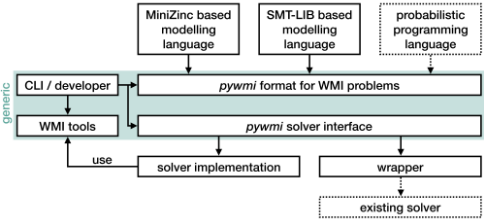
The internal representation is exposed to developers and, for example, probabilistic programming languages can interface with it. For example, a language such as Problog [Dries et al., 2015] produces ground programs to be solved using WMC, an extension with continuous variables can solve ground programs using WMI instead. However, for endusers, pywmi also provides two modeling languages for WMI problems that can be directly parsed to the pywmi representation (see Figure 1 for an overview). Both formats can be used to compactly encode a WMI problem, differing in the syntax used for the expressions (inspired by MiniZinc [Nethercote et al., 2007] or SMT-LIB.v2 [Barrett et al., 2010]).
As an example, consider modelling a factory that produces banana and chocolate flavoured ice cream. Figure 2 shows a toy model of the factory production in the MiniZinc-inspired syntax. Variables b and c represent the amount of banana and
1 var float : b; % banana-flavoured ice cream 2 var float : c; % chocolate-flavoured ice cream 3 var bool : weekday; % weekday or weekend 4 5 par float : CAPACITY = 10.0; 6 7 % production is nonnegative 8 constraint (b >= 0) /\ (c >= 0); 9 10 % production cannot exceed the storage capacity 11 constraint (b + c < CAPACITY); 12 13 weight : (if weekday then 5/7 else 2/7) * 14 (if weekday 15 then (0.004 * b + 0.002 * c) 16 else (0.002 * b + 0.004 * c)) 17 18 % queries and evidence 19 constraint (not weekday); 20 query (b >= 2*c); 21 query (b >= 9.0) \/ (c > 9.0);chocolate ice cream produced in a work day by the factory, while weekday is a Boolean variable distinguishing between weekdays and weekends. Intuitively, the production is determined by physical constraints, i.e., being non-negative and not exceeding the capacity of the factory, and market trends causing the preference over flavours to produce to be inverted in the weekends. In this toy example, the density functions combines the probability of weekday vs weekend and a linear combination of the amount of flavours produced, conditioned on weekday, that increases with the amount of ice cream produced. The WMI file can also contain evidence, e.g., conditioning on weekend days, and a list of queries to, for example, compute the probability that the banana ice cream production at least doubles the chocolate one (0.40), or the probability of having a particularly high production of any flavour (0.03).
2 Framework forWMI Solvers
Given a WMI problem in a standardized format, a WMI solver is employed to calculate weighted model integrals, most frequently, with the aim to compute query probabilities. The core interface for WMI solvers in pywmi consists of two methods: 1) computing a weighted model integral, given a domain, support and weight functions; and 2) computing the probability of a set of queries, given a domain, support, weight function and a set of queries. As computing the probabilities of a set of queries can be reduced to a set of weighted model integral computations, pywmi offers a default implementation. However, solvers that can only compute query probabilities or offer more efficient ways to compute query probabilities (e.g., using knowledge compilation [Kolb et al., 2018]), can override the default implementation.
The solving interface makes it possible to use any supported solver to solve any WMI problem in the common representation format. For users, pywmi offers a command-line interface to call or compare different solvers for a problem. Additionally, it can assist with converting file formats, installing new solvers or visualizing WMI problems. For developers, pywmi offers a growing amount of common functionality that might be useful to manipulating WMI problems or implementing a new solver, such as, easy-to-use data-structures for WMI problems and domains, wrappers around numeric integration software (e.g., Latte [De Loera et al., 2013]) and symbolic computation systems (e.g., PSI [Gehr et al., 2016]) that make it easy to write backend-agnostic solvers, and subroutines for computing with PySMT ASTs, linear inequalities, polynomials, sampling from WMI densities, evaluating points w.r.t. to their feasibility and density, etc.
3 ComparingWMI Solvers
As mentioned, pywmi allows the performance of different solvers to be compared. Aside from a common interface, however, pywmi also provides implementations for many state-of-the-art algorithms. These implementations either wrap around existing tools or libraries, or are (re-)implemented natively in pywmi. For solvers with external dependencies, pywmi tries to make the installation as easy as possible by automating installations or providing detailed instructions. The supported solvers are: WMI-PA [Morettin et al., 2019], XADD-based path-enumeration [Sanner et al., 2011] or bound-resolution (BR) algorithms [Kolb et al., 2018], symbolic SDD-based solver Symbo [Zuidberg Dos Martires et al., 2019], PRAiSE [De Salvo Braz et al., 2016] 1 . Additionally, pywmi includes a native implementation of XADDs and the BR algorithm, a fast approximate solver based on rejection-sampling and new WMI solvers are currently being developed using pywmi.
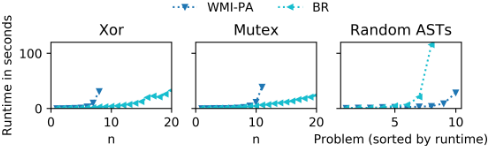
Using pywmi, we can now easily compare how different solvers behave on different problems. For example, we can compare how two state-of-the-art solvers (WMI-PA and BR) compare on some of the problems they introduce: highly structured xor and mutex problems with sparse inequalities (introduced alongside the BR solver), and synthetic WMI problems with random ASTs as support and weight function (using the WMI-PA problem generator). Running both solvers on these problems shows that the search-based WMIPA solver and its numeric integration software outperform the BR solver for the WMI problems with random ASTs, while the compilation-based BR solver better exploits the structure of the xor and mutex problems (Figure 3).
1 through the WMI-PA wrapper, without support for raw WMI computations - only query probabilities
@inproceedings{ijcai2019p946,
  title     = {The pywmi Framework and Toolbox for Probabilistic Inference using Weighted Model Integration},
  author    = {Kolb, Samuel and Morettin, Paolo and Zuidberg Dos Martires, Pedro and Sommavilla, Francesco and Passerini, Andrea and Sebastiani, Roberto and de Raedt, Luc},
  booktitle = {Proceedings of the Twenty-Eighth International Joint Conference on
               Artificial Intelligence, {IJCAI-19}},
  publisher = {International Joint Conferences on Artificial Intelligence Organization},
  editor    = {Sarit Kraus},
  pages     = {6530--6532},
  year      = {2019},
  month     = {8},
  note      = {Demos},
  doi       = {10.24963/ijcai.2019/946},
  url       = {https://doi.org/10.24963/ijcai.2019/946},
}
TY - CPAPER TI - The pywmi Framework and Toolbox for Probabilistic Inference using Weighted Model Integration AU - Kolb, Samuel AU - Morettin, Paolo AU - Zuidberg Dos Martires, Pedro AU - Sommavilla, Francesco AU - Passerini, Andrea AU - Sebastiani, Roberto AU - de Raedt, Luc T2 - Proceedings of the Twenty-Eighth International Joint Conference on Artificial Intelligence, IJCAI-19 PB - International Joint Conferences on Artificial Intelligence Organization PY - 2019 SP - 6530 EP - 6532 DO - 10.24963/ijcai.2019/946 UR - https://doi.org/10.24963/ijcai.2019/946 ER -Copied
Machine-readable versions of this paper, for tools and AI agents:





