
Difficulty Controllable Generation of Reading Comprehension Questions
Proceedings of the Twenty-Eighth International Joint Conference on Artificial Intelligence. Main track. Pages 4968-4974.
https://doi.org/10.24963/ijcai.2019/690
Keywords
- Natural Language Processing: Question Answering
- Natural Language Processing: Natural Language Generation
- Natural Language Processing: Natural Language Processing
Abstract
We investigate the difficulty levels of questions in reading comprehension datasets such as SQuAD, and propose a new question generation setting, named Difficulty-controllable Question Generation (DQG). Taking as input a sentence in the reading comprehension paragraph and some of its text fragments (i.e., answers) that we want to ask questions about, a DQG method needs to generate questions each of which has a given text fragment as its answer, and meanwhile the generation is under the control of specified difficulty labels---the output questions should satisfy the specified difficulty as much as possible. To solve this task, we propose an end-to-end framework to generate questions of designated difficulty levels by exploring a few important intuitions. For evaluation, we prepared the first dataset of reading comprehension questions with difficulty labels. The results show that the question generated by our framework not only have better quality under the metrics like BLEU, but also comply with the specified difficulty labels.
- [Chen et al., 2019] Wang Chen, Yifan Gao, Jiani Zhang, Ir- win King, and Michael R. Lyu. Title-guided encoding for keyphrase generation. In AAAI, 2019.
- [Danon and Last, 2017] Guy Danon and Mark Last. A syntactic approach to domain-specific automatic question generation. CoRR, abs/1712.09827, 2017.
- [Du and Cardie, 2018] Xinya Du and Claire Cardie. Harvest- ing paragraph-level question-answer pairs from wikipedia. In ACL, 2018.
- [Du et al., 2017] Xinya Du, Junru Shao, and Claire Cardie. Learning to ask: Neural question generation for reading comprehension. In ACL, 2017.
- [Gao et al., 2019] Yifan Gao, Lidong Bing, Piji Li, Irwin King, and Michael R. Lyu. Generating distractors for read- ing comprehension questions from real examinations. In AAAI, 2019.
- [Heilman and Smith, 2010] Michael Heilman and Noah A. Smith. Good question! statistical ranking for question generation. In HLT-NAACL, 2010.
- [Kumar et al., 2018] Vishwajeet Kumar, Kireeti Boorla, Yo- gesh Meena, Ganesh Ramakrishnan, and Yuan-Fang Li. Automating reading comprehension by generating ques- tion and answer pairs. In PAKDD, 2018.
- [Labutov et al., 2015] Igor Labutov, Sumit Basu, and Lucy Vanderwende. Deep questions without deep understand- ing. In ACL, 2015.
- [Lai et al., 2017] Guokun Lai, Qizhe Xie, Hanxiao Liu, Yiming Yang, and Eduard Hovy. Race: Large-scale reading comprehension dataset from examinations. arXiv preprint arXiv:1704.04683, 2017.
- [Liao et al., 2018] Yi Liao, Lidong Bing, Piji Li, Shuming Shi, Wai Lam, and Tong Zhang. Quase: Sequence editing under quantifiable guidance. In EMNLP, 2018.
- [Lindberg et al., 2013] David Lindberg, Fred Popowich, John C. Nesbit, and Philip H. Winne. Generating natural language questions to support learning on-line. In ENLG, 2013.
- [Luong et al., 2015] Thang Luong, Hieu Pham, and Christo- pher D. Manning. Effective approaches to attention-based neural machine translation. In EMNLP, 2015.
- [Mazidi and Nielsen, 2014] Karen Mazidi and Rodney D. Nielsen. Linguistic considerations in automatic question generation. In ACL, 2014.
- [Mostafazadeh et al., 2016] Nasrin Mostafazadeh, Ishan Misra, Jacob Devlin, Margaret Mitchell, Xiaodong He, and Lucy Vanderwende. Generating natural questions about an image. In ACL, 2016.
- [Rajpurkar et al., 2016] Pranav Rajpurkar, Jian Zhang, Kon- stantin Lopyrev, and Percy S. Liang. Squad: 100, 000+ questions for machine comprehension of text. In EMNLP, 2016.
- [See et al., 2017] Abigail See, Peter J. Liu, and Christo- pher D. Manning. Get to the point: Summarization with pointer-generator networks. In ACL, 2017.
- [Seo et al., 2017] Min Joon Seo, Aniruddha Kembhavi, Ali Farhadi, and Hannaneh Hajishirzi. Bidirectional attention flow for machine comprehension. ICLR, 2017.
- [Serban et al., 2016] Iulian Serban, Alberto García-Durán, C ¸aglar Gülc ¸ehre, Sungjin Ahn, A. P. Sarath Chandar, Aaron C. Courville, and Yoshua Bengio. Generating fac- toid questions with recurrent neural networks: The 30m factoid question-answer corpus. In ACL, 2016.
- [Shen et al., 2017] Tianxiao Shen, Tao Lei, Regina Barzilay, and Tommi S. Jaakkola. Style transfer from non-parallel text by cross-alignment. In NIPS, pages 6833-6844, 2017.
- [Song et al., 2018] Linfeng Song, Zhiguo Wang, Wael Hamza, Yue Zhang, and Daniel Gildea. Leveraging context information for natural question generation. In NAACL-HLT, 2018.
- [Su et al., 2016] Yu Su, Huan Sun, Brian Sadler, Mudhakar Srivatsa, Izzeddin Gur, Zenghui Yan, and Xifeng Yan. On generating characteristic-rich question sets for qa evalua- tion. In EMNLP, 2016.
- [Sugawara et al., 2017] Saku Sugawara, Yusuke Kido, Hikaru Yokono, and Akiko Aizawa. Evaluation metrics for machine reading comprehension: Prerequisite skills and readability. In ACL, 2017.
- [Sun et al., 2018] Xingwu Sun, Jing Liu, Yajuan Lyu, Wei He, Yanjun Ma, and Shi Wang. Answer-focused and position-aware neural question generation. In EMNLP, 2018.
- [Vanderwende, 2007] Lucy Vanderwende. Answering and questioning for machine reading. In AAAI Spring Sym- posium: Machine Reading, 2007.
- [Wang et al., 2017] Wenhui Wang, Nan Yang, Furu Wei, Baobao Chang, and Ming Zhou. Gated self-matching net- works for reading comprehension and question answering. In ACL, 2017.
- [Yuan et al., 2017] Xingdi Yuan, Tong Wang, C ¸aglar Gülc ¸ehre, Alessandro Sordoni, Philip Bachman, Sandeep Subramanian, Saizheng Zhang, and Adam Trischler. Machine comprehension by text-to-text neural question generation. In Rep4NLP@ACL, 2017.
- [Zhang et al., 2018] Jiani Zhang, Xingjian Shi, Junyuan Xie, Hao Ma, Irwin King, and Dit-Yan Yeung. Gaan: Gated at- tention networks for learning on large and spatiotemporal graphs. In UAI, 2018.
- [Zhao et al., 2018] Yao Zhao, Xiaochuan Ni, Yuanyuan Ding, and Qifa Ke. Paragraph-level neural question gen- eration with maxout pointer and gated self-attention net- works. In ENNLP, 2018.
- [Zhou et al., 2017] Qingyu Zhou, Nan Yang, Furu Wei, Chuanqi Tan, Hangbo Bao, and Ming Zhou. Neural ques- tion generation from text: A preliminary study. In NLPCC, 2017.
References were extracted automatically from the PDF and may contain errors.
Full text extracted automatically from the PDF; figures, tables and equations may differ. The PDF is the version of record.
1 Introduction
Question Generation (QG) aims to generate natural and human-like questions from a range of data sources, such as image [Mostafazadeh et al., 2016], knowledge base [Serban et al., 2016; Su et al., 2016], and free text [Du et al., 2017]. Besides for constructing SQuAD-like dataset [Rajpurkar et al., 2016], QG is also helpful for the intelligent tutor system: The instructor can actively ask the learner questions according to reading comprehension materials [Heilman and Smith, 2010] or particular knowledge [Danon and Last, 2017]. In this paper, we focus on QG for reading comprehension text. For example, Figure 1 gives three questions from SQuAD, our goal is to generate such questions.
QG for reading comprehension is a challenging task because the generation should not only follow the syntactic structure of questions, but also ask questions to the point, i.e., work needs to generate questions that are asked about the specified answers and satisfy the difficulty levels as much as possible. For example, given the sentence S3 and the answer "the electric guitar" in Figure 1, the system should be capable of asking both a hard question like Q3 and an easy one such as "What is often emphasised as a rhythm instrument?". DQG has rich application scenarios. For instance, when instructors prepare learning materials for students, they may want to balance the numbers of hard questions and easy questions. Besides, the generated questions can be used to test how a QA system works for questions with diverse difficulty levels.
∗This work was partially done when Yifan Gao was an intern at Tencent AI Lab working with Lidong Bing, who was a full-time researcher there.
Generating questions with designated difficulty levels is a more challenging task. First, no existing large-scale QA dataset has difficulty labels for questions to train a reliable neural network model. Second, for a single sentence and answer pair, we want to generate questions with diverse difficulty levels. However, the current datasets like SQuAD only have one given question for each sentence and answer pair. Finally, there is no metric to evaluate the difficulty of questions. To overcome the first issue, we prepare a dataset of reading comprehension questions with difficulty labels. Specifically, we design a method to automatically label SQuAD questions with multiple difficulty levels, and obtain 76K questions with difficulty labels.
To overcome the second issue, we propose a framework that can learn to generate questions complying with the specified difficulty levels by exploring the following intuitions. To answer a SQuAD question, one needs to locate a text fragment in the input sentence as its answer. Thus, if a question has more hints that can help locate the answer fragment, it would be easier to answer. For the examples in Figure 1, the hint "atomic number" in Q1 is very helpful, because, in the corresponding sentence, it is just next to the answer "8", while for Q3, the hint "instrument" is far from the answer "The electric guitar". The second intuition is inspired by the recent research on style-guided text generation, which incorporates a latent style representation (e.g., sentiment label or review rating score) as an input of the generator [Shen et al., 2017; Liao et al., 2018]. Similarly, performing difficulty control can be regarded as a problem of sentence generation towards a specified attribute or style. On top of the typical seq2seq architecture, our framework has two tailor-made designs to explore the above intuitions: (1) Position embeddings are learned to capture the proximity hint of the answer in the input sentence; (2) Global difficulty variables are learned to control the overall "difficulty" of the questions. For the last issue, we propose to employ the existing reading comprehension (RC) systems to evaluate the difficulty of generated questions. Intuitively, questions which cannot be answered by RC systems are more difficult than these correctly answered ones.
In the quantitative evaluation, we compare our DQG model with state-of-the-art models and ablation baselines. The results show that our model not only generates questions of better quality under the metrics like BLEU and ROUGE, but also has the capability of generating questions complying with the specified difficulty labels. The manual evaluation finds that the language quality of our generated questions is better, and our model can indeed control the question difficulty.
2 Task Definition
In the DQG task, our goal is to generate SQuAD-like questions of diverse difficulty levels for a given sentence. Note that the answers of SQuAD questions are text spans in the input sentence, and they are significantly different from RACE questions [Lai et al., 2017] such as "What do you learn from the story?". Considering their different emphases, SQuAD questions are more suitable for our task, while the difficulty of RACE questions mostly comes from the understanding of the story but not from the way how the question is asked. Thereby, we assume that the answers for asking questions are given, and they appear as text fragments in the input sentences by following the paradigm of SQuAD.
We propose an end-to-end framework to handle DQG. Formally, let a denote the answer for asking question, let s denote the sentence containing a from a reading comprehension paragraph. Given a, s, and a specified difficulty level d as input, the DQG task is to generate a question q which has a as its answer, and meanwhile should have d as its difficulty level.
3 The Protocol of Difficulty Labeling
SQuAD [Rajpurkar et al., 2016] is a reading comprehension dataset containing 100,000+ questions on Wikipedia articles. The answer of each question is a text fragment from the corresponding input passage. We employ SQuAD questions to prepare our experimental dataset.
The difficulty level is a subjective notion and can be addressed in many ways, e.g., syntax complexity, coreference resolution and elaboration [Sugawara et al., 2017]. To avoid the ambiguity of the "question difficulty" in this preliminary study, we design the following automatic labeling protocol and study the correlation between automatically labelled difficulty with human difficulty. We first define two difficulty levels, Hard and Easy, in this preliminary dataset for the sake of simplicity and practicality. We employ two RC systems, namely R-Net [Wang et al., 2017] 1 and BiDAF [Seo et al., 2017] 2 , to automatically assess the difficulty of the questions. The labeling protocol is: A question would be labelled with Easy if both R-Net and BiDAF answer it correctly under the exact match metric, and labelled with Hard if both systems fail to answer it. The remaining questions are eliminated for suppressing the ambiguity.
Note that we cannot directly employ the original data split of SQuAD to train a model of R-Net or BiDAF, and use the model to assess all questions. Such assessment is not appropriate, because models will overfit training questions and label them all as easy ones. To avoid this problem, we re-split the original SQuAD questions into 9 splits and adopt a 9-fold strategy. To label every single split (the current split), 7 splits are used as the training data, and the last split is used as the validation data. Then the trained model is used to assess the difficulty of questions in the current split. This way guarantees that the model is never shown with the questions for automatic labeling. Finally, we obtain 44,723 easy questions and 31,332 hard questions.
1 https://github.com/HKUST-KnowComp/R-Net
2 https://github.com/allenai/bi-att-flow
To verify the reasonability of our labeling protocol, we evaluate its consistency with human being's judgment. We sample 100 Easy questions and 100 Hard questions, and hire 3 annotators to rate the difficulty level of all these questions on a 1-3 scale (3 for the most difficult). The result shows that average difficulty rating for the Easy questions is 1.90 while it is 2.52 for the Hard ones.
4 Framework Description
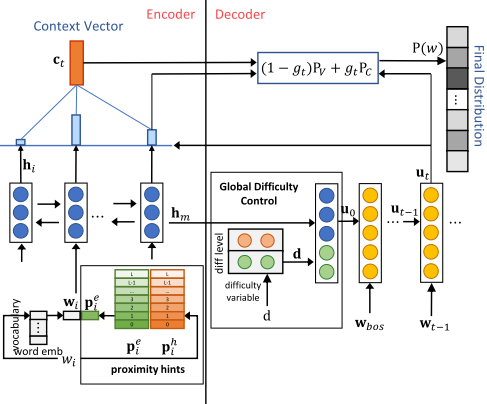
Given an input sentence s = (w1,w2, ...,wm), a text fragment a in s, and a difficulty level d, our task is to generated a question q, which is asked with s as its background information, takes a as its answer, and has d as its difficulty. The architecture of our difficulty-controllable question generator is depicted in Figure 2. The encoder takes two types of inputs, namely, the word embeddings and the relative position embeddings (capturing the proximity hints) of sentence words (including the answer words). Bidirectional LSTMs are employed to encode the input into contextualized representations. Besides two standard elements, namely attention and copy, the decoder contains a special initialization to control the difficulty of the generated question. Specifically, we map the difficulty label d into a global difficulty variable with a lookup table, and combine the variable with the last hidden state of the encoder to initialize the decoder.
4.1 Exploring Proximity Hints
Recall that our first intuition tells that the proximity hints are helpful for answering the SQuAD-like questions. Before introducing our design for implementing the intuition, we quantitatively verify it by showing some statistics. Specifically, we examine the average distance of those nonstop question words that also appear in the input sentence to the answer fragment. For example, for Q1 in Figure 1 and its corresponding input sentence "Oxygen is a chemical element with symbol O and atomic number 8", we calculate the word-level average distance of words "atomic", "number", "element", and "oxygen" to the answer "8". The statistics are given in Table 1. In contrast, the average distance of all nonstop sentence words to the answer is also given in the bottom line. If we only count those nonstop question words, we find that their distance to the answer fragment is much smaller than the sentence words, namely 8.43 vs. 11.20. We call this Question Word Proximity Hint (QWPH). More importantly, the distance for hard questions is significantly larger than that for easy questions, namely 9.71 vs. 7.67, which well verifies our intuition that if a question has more obvious proximity hints (i.e., containing more words that are near the answer in the corresponding sentence), it would be easier to solve. We model QWPH for easy questions and hard questions separately and call this Difficulty Level Proximity Hint (DLPH).
| Easy | Hard | All | |
|---|---|---|---|
| Avg. distance of question words | 7.67 | 9.71 | 8.43 |
| Avg. distance of all sentence words | 11.23 | 11.16 | 11.20 |
To implement the QWPH intuition, our model learns a lookup table which maps the distance of each sentence word to the answer fragment, i.e., 0 (for answer words), 1, 2, etc., into a position embedding: (p0, p1, p2, ..., pL), where pi ∈ Rdp and dp is the dimension. L is the maximum distance we consider. Different from QWPH that is difficulty agnostic, the DLPH intuition additionally explores the information of question difficulty levels. Therefore, we define two lookup tables: (pe0 , pe1 , pe2 , ..., peL) for the Easy label, and (ph0 , ph1 , ph2 , ..., phL) for the Hard label. Note that the above position embeddings not only carry the information of sentence word position, but also let our model know which aspect (i.e., answer) to ask with the embeddings of position 0.
4.2 Characteristic-rich Encoder
The characteristic-rich encoder incorporates several features into a contextualized representation. For each sentence word w, an embedding lookup table is firstly used to map tokens in the sentence into dense vectors: (w1, w2, ...,wm), where wi ∈ Rdw of dw dimensions. Then we concatenate its word embedding and position embedding (proximity hints) to derive a characteristic-rich embedding: x = [w; p]. We use bidirectional LSTMs to encode the sequence (x1, x2, ..., xm) to get a contextualized representation for each token:
where -→h i and ←- h i are the hidden states at the i-th time step of the forward and the backward LSTMs. We concatenate them together as hi = [-→h i; ←- h i].
4.3 Difficulty-controllable Decoder
We use another LSTM as the decoder to generate the question. We employ the difficulty label d to initialize the hidden state of the decoder. During the decoding, we incorporate the attention and copy mechanisms to enhance the performance.
Global Difficulty Control. We regard the generation of difficulty-controllable questions as a problem of sentence generation towards a specified style, i.e., easy or hard. To do so, we introduce a global difficulty variable to control the generation. We follow the recent works for the task of style transfer that apply the control variable globally, i.e., using the style variable to initialize the decoder [Liao et al., 2018]. Specifically, for the specified difficulty level d, we first map it to its corresponding difficulty variable d ∈ Rdd , where dd is the dimension of a difficulty variable. Then we use the concatenation of d with the final hidden state hm of the encoder to initialize the decoder hidden state u0 = [hm; d]. Note that in the training stage, we feed the model the ground truth difficulty labels, while in the testing stage, our model can take any specified difficulty labels, i.e., difficulty-controllable, for question generation. We have also tried some variations by adding this variable to other places such as every encoder or decoder input in the model but it does not work.
| Train | Dev | Test | |
|---|---|---|---|
| # easy questions | 34,813 | 4,973 | 4,937 |
| # hard questions | 24,317 | 3,573 | 3,442 |
| Easy ratio | 58.88% | 58.19% | 58.92% |
Decoder with Attention & Copy. The decoder predicts the word probability distribution at each decoding timestep to generate the question. At the t-th timestep, it reads the word embedding wt and the hidden state ut-1 of the previous timestep to generate the current hidden state ut = LSTM(ut-1,wt). Then the decoder employs the attention mechanism [Luong et al., 2015; Zhang et al., 2018; Chen et al., 2019] and copy mechanism [See et al., 2017] to generate the question by copying words in the sentence or generating words from a predefined vocabulary.
5 Experiments
5.1 Experimental Settings
Dataset. Our prepared dataset is split according to articles of the SQuAD data, and Table 2 provides the detailed statistics. Across the training, validation and test sets, the splitting ratio is around 7:1:1, and the easy sample ratio is around 58% for all three.
Baselines and Ablation Tests. We only employ neural network based methods as our baselines, since they perform better than non-neural methods as shown in recent works [Du et al., 2017; Zhou et al., 2017]. The first baseline models the question generation as a seq2seq problem incorporating the attention mechanism, and we refer to it as L2A [Du et al., 2017]. The second baseline Ans adds answer indicator embedding to the seq2seq model, similar to [Zhou et al., 2017; Kumar et al., 2018]. Two ablations that only employ the question word proximity hint or the difficulty level proximity hint are referred to as QWPH and DLPH. Moreover, we examine the effectiveness of the global difficulty control (GDC) combined with QWPH and DLPH, refer to them as QWPHGDC and DLPH-GDC. All these methods are enhanced by the copy mechanism.
Model Details and Parameter Settings. The embedding dimensions for the position embedding and the global difficulty variable, i.e. dp and dd, are set to 50 and 10 respectively.
| Easy Questions Set | Hard Questions Set | |||||||
|---|---|---|---|---|---|---|---|---|
| R-Net | BiDAF | R-Net | BiDAF | |||||
| EM | F1 | EM | F1 | EM | F1 | EM | F1 | |
| Ans | 82.16 | 87.22 | 75.43 | 83.17 | 34.15 | 60.07 | 29.36 | 55.89 |
| QWPH | 82.66 | 87.37 | 76.10 | 83.90 | 33.35 | 59.50 | 28.40 | 55.21 |
| QWPH-GDC | 84.35 | 88.86 | 77.23 | 84.78 | 31.60 | 57.88 | 26.68 | 54.31 |
| DLPH | 85.49 | 89.50 | 78.35 | 85.34 | 28.05 | 54.21 | 24.89 | 51.25 |
| DLPH-GDC | 85.82 | 89.69 | 79.09 | 85.72 | 26.71 | 53.40 | 24.47 | 51.20 |
| Easy Questions Set | Hard Questions Set | |||||||
|---|---|---|---|---|---|---|---|---|
| R-Net | BiDAF | R-Net | BiDAF | |||||
| EM | F1 | EM | F1 | EM | F1 | EM | F1 | |
| QWPH-GDC | 7.41 | 5.72 | 7.13 | 5.88 | 6.45 | 5.47 | 6.13 | 5.10 |
| DLPH | 12.41 | 9.51 | 11.28 | 8.49 | 12.01 | 10.45 | 10.51 | 9.37 |
| DLPH-GDC | 12.91 | 9.95 | 12.40 | 9.23 | 12.68 | 10.76 | 11.22 | 9.97 |
We use the maximum relative distance L = 20 in the position embedding. We adopt teacher-forcing in the encoder-decoder training and use the ground truth difficulty labels. In the testing procedure, we select the model with the lowest perplexity and beam search with size 3 is employed for question generation. All important hyper-parameters, such as dp and dd, are selected on the validation dataset.
5.2 Difficulty Control Results
We run R-Net and BiDAF to assess the difficulty of our generated hard and easy questions. Here the R-Net and BiDAF systems are trained using the same train/validation splits as shown in Table 2, and we report their performance under the standard reading comprehension measures for SQuAD questions, i.e., Exact Match (EM) and macro-averaged F1 score (F1), on the easy and hard question sets respectively. For all experiments, we firstly show the performance of difficultycontrollable question generation by feeding ground truth difficulty labels, then we feed the reverse difficulty labels to demonstrate our model can control the difficulty of generated questions.
Recall that the generated questions can be split into an easy set and a hard set according to the difficulty labels. Here we evaluate the generated questions from the perspective that a reading comprehension system (e.g., R-Net and BiDAF) should perform better on the generated questions in the easy set, and perform worse on the hard question set. If a pipeline does not use the answer information, its generated questions are likely not about the answers, thus both BiDAF and R-Net cannot work well no matter for easy or hard questions. Therefore, we do not use L2A here.
As shown in Table 3, for the easy set, the questions generated by the methods using the difficulty label "Easy" are easier to answer. Specifically, compared with Ans and QWPH which cannot control the difficulty, QWPH-GDC, DLPH, and DLPH-GDC generate easier questions, showing that they have the capability of generating difficulty-controllable questions. One instant doubt is that a model can simply produce trivial questions by having them contain the answer words. In fact, our models do not have this behaviour, because it will increase the training loss. To further verify this, we calculate the occurrence rate of answer words in the generated questions. The result shows that only 0.09% answer words appear in the questions generated by our models.
| Easy Question Set | Hard Question Set | |||||
|---|---|---|---|---|---|---|
| F | D | R | F | D | R | |
| Ans | 2.91 | 2.02 | 0.74 | 2.87 | 2.12 | 0.58 |
| DLPH-GDC | 2.94 | 1.84 | 0.76 | 2.87 | 2.26 | 0.64 |
For the hard set, we can draw the same conclusion by keeping in mind that a lower score indicates the corresponding method performs better in generating difficulty-controllable questions. (Note that questions irrelevant to the answer can also yield lower scores, and we have more discussion about this issue in Section 5.3 for the human evaluation.) This observation shows that incorporating the difficulty information locally by the two position embeddings or globally by the difficulty-controlled initialization indeed guides the generator to generate easier or harder questions. Comparing DLPH and QWPH-GDC, we find that the local difficulty control by the position embedding is more effective. DLPH-GDC performs the best by combining the local and global difficulty control signals.
Moreover, we find that QWPH achieves slightly better performance than Ans baseline. A large performance gap between QWPH-GDC and QWPH again validates the effectiveness of the global difficulty control. Meanwhile, the improvement from QWPH to DLPH shows that the local difficulty level proximity hint can stress the question difficulty at each time step to perform better.
On the other hand, another way to validate our model is testing whether our model can control the difficulty by feeding the reversed difficulty labels. For example, for a question in the easy set, if we feed the "Hard" label together with the input sentence and answer of this question into our model, we expect the generated question should be harder than feeding the "Easy" label. Concretely, if a method has the better capability in controlling the difficulty, on two sets of questions generated with this method by taking the true label and the reversed label, the performance gap of a reading comprehension system should be larger. The results of this experiment are given in Table 4. We only compare models which have difficulty control capability. The model combining local and global difficulty signals, i.e., DLPH-GDC, achieves the largest gap, which again shows that: (1) DLPH-GDC has the strongest capability of generating difficulty-controllable questions; (2) The local difficulty control (i.e. DLPH) is more effective than the global (i.e. QWPH-GDC).
5.3 Manual Evaluation
We hire 3 annotators to rate the model generated questions. We randomly sampled 100 question with "Easy" labels and 100 with "Hard" labels from the test set, and let each annotator annotate these 200 cases. During the annotation, each data point contains a sentence, an answer, and the questions generated by different models, without showing the difficulty labels. We consider three metrics: Fluency(F), Difficulty(D) and Relevance(R). The annotators are first asked to read the generated questions to evaluate their grammatical correctness and fluency. Then, all annotators are required to rate the difficulty of each generated question by considering the corresponding sentence and answer. Finally, for relevance, we ask the annotators to judge if the question is asking about the answer. Fluency and Difficulty take values from {1, 2, 3} (3 means the top fluency or difficulty), while Relevance takes a binary value (1 or 0).
Table 5 shows the results of the manual evaluation. We compare our best model DLPH-GDC with the Ans baseline. We separate the Easy questions and Hard questions for statistics. For both question sets, both models achieve high scores on Fluency, owing to the strong language modeling capability of neural models. For Difficulty, we can find that DLPH-GDC can generate easier or harder questions than Ans by feeding the true difficulty labels. Another observation is that, for the Ans baseline, questions generated in the Easy set are easier than those in the Hard set, which validates our difficulty labelling protocol from another perspective. Note that for human beings, all SQuAD-like questions are not really difficult, therefore, the difference of Difficulty values between the easy set and the hard set is not large.
Furthermore, we can observe our model can generate more relevant questions compared with the Ans baseline. The reason could be that our position embedding can not only tell where the answer words are, but also indicate the distance of the context words to the answer. Thus, it provides more information to the model for asking to the point questions. Ans only differentiates the answer token and non-answer token, and treats all non-answer tokens equally.
Recall that we had the concern regarding Table 3 that the generated hard questions by our difficulty-controlling models say DLPH-GDC may simply be irrelevant to the answer, which makes DLPH-GDC achieves lower EM/F1 scores than the Ans baseline. By comparing the Relevance scores in Table 5 and EM/F1 scores in Table 3 for Hard Question Set, we find that the questions generated by DLPH-GDC are more relevant (as shown in Table 5) and more difficult (as shown in both Tables 3 and 5) than those generated by the Ans baseline. This observation resolves our doubt on the irrelevance issue and supports the conclusion that our DLPH-GDC does generate more difficult and relevant questions which can fail the two RC pipelines.
5.4 Automatic Evaluation of Question Quality
Here we evaluate the similarity of generated questions with the ground truth. Since our dataset is not parallel (i.e., for a sentence and answer pair, our dataset only has one question with the "easy" or "hard" label), here we only evaluate the question quality by feeding the ground truth difficulty labels. We employ BLEU (B), METEOR (MET) and ROUGE-L (RL) scores by following [Du et al., 2017]. BLEU evaluates the average N-gram precision on a set of reference sentences, with a penalty for overly long sentences. ROUGE-L is commonly employed to evaluate the recall of the longest common subsequences, with a penalty for short sentences.
| B1 | B2 | B3 | B4 | MET | R-L | |
|---|---|---|---|---|---|---|
| L2A | 36.01 | 21.61 | 14.97 | 10.88 | 15.99 | 38.06 |
| Ans | 43.51 | 29.06 | 21.35 | 16.22 | 20.53 | 45.66 |
| QWPH | 43.75 | 29.28 | 21.61 | 16.46 | 20.70 | 46.02 |
| QWPH-GDC | 43.99 | 29.60 | 21.86 | 16.63 | 20.87 | 46.26 |
| DLPH | 44.11 | 29.64 | 21.89 | 16.68 | 20.94 | 46.22 |
| DLPH-GDC | 43.85 | 29.48 | 21.77 | 16.56 | 20.79 | 46.16 |
Table 6 shows the quality of generated questions. Comparing the first three methods, we can find that the answer and position information helps a lot for asking to the point questions, i.e., more similar to the ground truth. Moreover, QWPH performs better than Ans, indicating that further distinguishing the different distance of the non-answer words to the answer provides richer information for the model to generate better questions. The results in the lower half show that, given the ground truth difficulty labels, these three methods with the capability of difficulty control are better than the first three methods. These three models achieve comparable performance, and DLPH-GDC sacrifices a little in N-gram based performance here while achieving the best difficulty control capability (refer to Tables 3 & 4).
5.5 Case Study
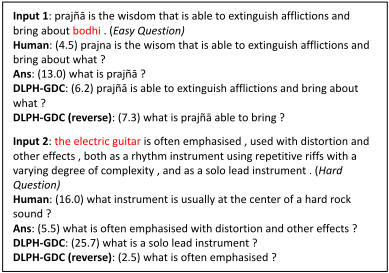
Figure 3 provides some examples of generated questions (with answers marked in red). The number after the model is the average distance of the overlapped nonstop words between the question and the input sentence to the answer fragment. The average distance corresponds to the our intuition proximity hints well. Compared with questions generated by Ans baseline, our model can give more hints (shorter distance) when asking easier questions and give less hints (longer distance) when asking harder questions.
For the first example, we observe that the ground truth question generated by Human is quite easy, just replacing the answer "bodhi" with "what". Among the three systems, Ans asks a question that is not about the answer. While both DLPH-GDC and DLPH-GDC (reverse) are able to generate to the point questions. Specifically, by taking the "Easy" label, DLPH-GDC tends to use more words from the input sentence, while DLPH-GDC (reverse) uses less and its generated question is relatively difficult. For the second example, we find our system is also applicable to the question with "Hard" label.
6 RelatedWork
In this section, we primarily review question generation (QG) works on free text. Vanderwende [2007] proposed this task, later on, several rule-based approaches were proposed. They manually design some question templates and transform the declarative sentences to interrogative questions [Mazidi and Nielsen, 2014; Labutov et al., 2015; Lindberg et al., 2013; Heilman and Smith, 2010]. These Rule-based approaches need extensive human labor to design question templates, and usually can only ask annotators to evaluate the generated questions.
Du et al. [2017] proposed the first automatic QG framework. They view QG as a seq2seq learning problem to learn the mapping between sentences and questions in reading comprehension. Moreover, the procedure of QG from a sentence is not a one-to-one mapping, because given a sentence, different questions can be asked from different aspects. As Du et al. [2017] mentioned, in their dataset, each sentence corresponds to 1.4 questions on average. Seq2seq learning may not perform well for learning such a one-to-many mapping. Some recent works attempt to solve this issue by assuming the aspect has been already known when asking a question [Zhou et al., 2017; Yuan et al., 2017] or can be detected with a third-party pipeline [Du and Cardie, 2018]. This assumption makes sense, because for humans to ask questions, we usually first read the sentence to decide which aspect to ask. In this paper, we explore another important dimension in QG, i.e., generating questions with controllable difficulty, that has never been studied before.
7 Conclusions
In this paper, we present a novel setting, namely difficultycontrollable question generation for reading comprehension, which to the best of our knowledge has never been studied before. We propose an end-to-end approach to learn the question generation with designated difficulty levels. We also prepared the first dataset for this task, and extensive experiments show that our framework can solve this task reasonably well. One interesting future direction is to explore generating multiple questions for different aspects in one sentence [Gao et al., 2019].
Acknowledgments
This work is supported by the Research Grants Council of the Hong Kong Special Administrative Region, China (No. CUHK 14208815 and No. CUHK 14210717 of the General Research Fund). We thank Department of Computer Science and Engineering, The Chinese University of Hong Kong for the conference grant support. We would like to thank Jianan Wang for her efforts in the preliminary investigation.
@inproceedings{ijcai2019p690,
  title     = {Difficulty Controllable Generation of Reading Comprehension Questions},
  author    = {Gao, Yifan and Bing, Lidong and Chen, Wang and Lyu, Michael and King, Irwin},
  booktitle = {Proceedings of the Twenty-Eighth International Joint Conference on
               Artificial Intelligence, {IJCAI-19}},
  publisher = {International Joint Conferences on Artificial Intelligence Organization},
  editor    = {Sarit Kraus},
  pages     = {4968--4974},
  year      = {2019},
  month     = {8},
  note      = {Main track},
  doi       = {10.24963/ijcai.2019/690},
  url       = {https://doi.org/10.24963/ijcai.2019/690},
}
TY - CPAPER TI - Difficulty Controllable Generation of Reading Comprehension Questions AU - Gao, Yifan AU - Bing, Lidong AU - Chen, Wang AU - Lyu, Michael AU - King, Irwin T2 - Proceedings of the Twenty-Eighth International Joint Conference on Artificial Intelligence, IJCAI-19 PB - International Joint Conferences on Artificial Intelligence Organization PY - 2019 SP - 4968 EP - 4974 DO - 10.24963/ijcai.2019/690 UR - https://doi.org/10.24963/ijcai.2019/690 ER -Copied
Machine-readable versions of this paper, for tools and AI agents:





