
Learning Deep Decentralized Policy Network by Collective Rewards for Real-Time Combat Game
Proceedings of the Twenty-Eighth International Joint Conference on Artificial Intelligence. Main track. Pages 1305-1311.
https://doi.org/10.24963/ijcai.2019/181
Keywords
- Heuristic Search and Game Playing: Game Playing
- Heuristic Search and Game Playing: Game Playing and Machine Learning
- Machine Learning Applications: Applications of Reinforcement Learning
- Machine Learning Applications: Game Playing
Abstract
The task of real-time combat game is to coordinate multiple units to defeat their enemies controlled by the given opponent in a real-time combat scenario. It is difficult to design a high-level Artificial Intelligence (AI) program for such a task due to its extremely large state-action space and real-time requirements. This paper formulates this task as a collective decentralized partially observable Markov decision process, and designs a Deep Decentralized Policy Network (DDPN) to model the polices. To train DDPN effectively, a novel two-stage learning algorithm is proposed which combines imitation learning from opponent and reinforcement learning by no-regret dynamics. Extensive experimental results on various combat scenarios indicate that proposed method can defeat different opponent models and significantly outperforms many state-of-the-art approaches.
- [Cesa-Bianchi et al., 2007] Nicolo Cesa-Bianchi, Yishay Mansour, and Gilles Stoltz. Improved second-order bounds for prediction with expert advice. Machine Learning, 2007.
- [Churchill and Buro, 2013] David Churchill and Michael Buro. Portfolio greedy search and simulation for large- scale combat in starcraft. In IEEE CIG, 2013.
- [Churchill et al., 2012] David Churchill, Abdallah Saffidine, and Michael Buro. Fast heuristic search for rts game combat scenarios. In AIIDE, 2012.
- [Foerster et al., 2018] Jakob N Foerster, Gregory Farquhar, Triantafyllos Afouras, Nantas Nardelli, and Shimon Whiteson. Counterfactual multi-agent policy gradients. In AAAI, 2018.
- [Hester et al., 2018] Todd Hester, Matej Vecerik, Olivier Pietquin, Marc Lanctot, Tom Schaul, Bilal Piot, Horgan Dan, John Quan, Andrew Sendonaris, and Gabriel Dulacarnold. Deep q-learning from demonstrations. In AAAI, 2018.
- [Ho and Ermon, 2016] Jonathan Ho and Stefano Ermon. Generative adversarial imitation learning. In NIPS, 2016.
- [Hu et al., 2018] Yue Hu, Juntao Li, Xi Li, Gang Pan, and Mingliang Xu. Knowledge-guided agent-tactic-aware learning for starcraft micromanagement. In IJCAI, 2018. IJCAI
- [Kang et al., 2018] Bingyi Kang, Zequn Jie, and Jiashi Feng. Policy optimization with demonstrations. In ICML, 2018.
- [Kong et al., 2017] Xiangyu Kong, Bo Xin, Fangchen Liu, and Yizhou Wang. Revisiting the master-slave architecture in multi-agent deep reinforcement learning. arXiv, 2017.
- [LeCun et al., 2015] Yann LeCun, Yoshua Bengio, and Geoffrey Hinton. Deep learning. Nature, 2015.
- [Lelis, 2017] Levi H. S. Lelis. Stratified strategy selection for unit control in real-time strategy games. In IJCAI, 2017. IJCAI
- [Li, 2018] Yuxi Li. Deep reinforcement learning. arXiv preprint arXiv:1810.06339, 2018.
- [Lowe et al., 2017] Ryan Lowe, Yi Wu, Aviv Tamar, Jean Harb, OpenAI Pieter Abbeel, and Igor Mordatch. Multi-agent actor-critic for mixed cooperative-competitive environments. In NIPS. 2017.
- [Maas et al., 2013] Andrew L Maas, Awni Y Hannun, and Andrew Y Ng. Rectifier nonlinearities improve neural network acoustic models. In ICML, 2013.
- [Mnih et al., 2013] Volodymyr Mnih, Koray Kavukcuoglu, David Silver, Alex Graves, Ioannis Antonoglou, Daan Wierstra, and Martin Riedmiller. Playing atari with deep reinforcement learning. arXiv, 2013.
- [Mnih et al., 2015] Volodymyr Mnih, Koray Kavukcuoglu, David Silver, Andrei A Rusu, Joel Veness, Marc G Bellemare, Alex Graves, Martin Riedmiller, Andreas K Fidjeland, Georg Ostrovski, et al. Human-level control through deep reinforcement learning. Nature, 2015.
- [Moraes and Lelis, 2018] Rubens O. Moraes and Levi H. S. Lelis. Asymmetric action abstractions for multi-unit control in adversarial real-time games. In AAAI, 2018.
- [Nguyen et al., 2018] Duc Thien Nguyen, Akshat Kumar, and Hoong Chuin Lau. Credit assignment for collective multiagent rl with global rewards. In NIPS, 2018.
- [Oh et al., 2016] Junhyuk Oh, Valliappa Chockalingam, Satinder Singh, and Honglak Lee. Control of memory, active perception, and action in minecraft. arXiv, 2016.
- [Oliehoek et al., 2008] Frans A Oliehoek, Matthijs TJ Spaan, and Nikos Vlassis. Optimal and approximate q- value functions for decentralized pomdps. Journal of Artificial Intelligence Research, 32:289-353, 2008.
- [Peng et al., 2017] Peng Peng, Quan Yuan, Ying Wen, Yaodong Yang, Zhenkun Tang, Haitao Long, and Jun Wang. Multiagent bidirectionally-coordinated nets for learning to play starcraft combat games. arXiv, 2017.
- [Pomerleau, 1991] D. A. Pomerleau. Efficient training of artificial neural networks for autonomous navigation. Neural Computation, 3(1):88-97, 1991.
- [Rashid et al., 2018] Tabish Rashid, Mikayel Samvelyan, Christian Schroeder, Gregory Farquhar, Jakob Foerster, and Shimon Whiteson. QMIX: Monotonic value function factorisation for deep multi-agent reinforcement learning. In ICML, 2018.
- [Ross et al., 2011] Stephane Ross, Geoffrey J. Gordon, and J. Andrew Bagnell. A reduction of imitation learning and structured prediction to no-regret online learning. In Aistats, 2011.
- [Roughgarden, 2016] Tim Roughgarden. Twenty Lectures on Algorithmic Game Theory, pages 230-247. Cambridge University Press, 1st edition, 2016.
- [Russakovsky et al., 2015] Olga Russakovsky, Jia Deng, Hao Su, Jonathan Krause, Sanjeev Satheesh, Sean Ma, Zhiheng Huang, Andrej Karpathy, Aditya Khosla, Michael Bernstein, et al. Imagenet large scale visual recognition challenge. IJCV, 2015.
- [Schaal, 1997] Stefan Schaal. Learning from demonstration. In NIPS, 1997.
- [Silver et al., 2016] D Silver, A. Huang, C. J. Maddison, A Guez, L Sifre, den Driessche G Van, J Schrittwieser, I Antonoglou, V Panneershelvam, and M Lanctot. Mastering the game of go with deep neural networks and tree search. Nature, 529(7587):484-489, 2016.
- [Song et al., 2018] Jiaming Song, Hongyu Ren, Dorsa Sadigh, and Stefano Ermon. Multi-agent generative adversarial imitation learning. In NIPS, 2018.
- [Sukhbaatar and Fergus, 2016] Sainbayar Sukhbaatar and Rob Fergus. Learning multiagent communication with backpropagation. In NIPS, 2016.
- [Sun et al., 2017] Wen Sun, Arun Venkatraman, Geoffrey J. Gordon, Byron Boots, and J. Andrew Bagnell. Deeply AggreVaTeD: Differentiable imitation learning for sequential prediction. In ICML, pages 3309-3318, 2017.
- [Tian et al., 2017] Yuandong Tian, Qucheng Gong, Wenling Shang, Yuxin Wu, and C. Lawrence Zitnick. Elf: An extensive, lightweight and flexible research platform for real-time strategy games. In NIPS, 2017.
- [Usunier et al., 2016] Nicolas Usunier, Gabriel Synnaeve, Zeming Lin, and Soumith Chintala. Episodic exploration for deep deterministic policies: An application to starcraft micromanagement tasks. arXiv, 2016.
- [Williams, 1992] Ronald J. Williams. Simple statistical gradient-following algorithms for connectionist reinforcement learning. In Machine Learning, volume 8, pages 229-256. Springer, 1992.
References were extracted automatically from the PDF and may contain errors.
Full text extracted automatically from the PDF; figures, tables and equations may differ. The PDF is the version of record.
1 Introduction
The task of real-time (RT) combat game is to coordinate multiple units to defeat their enemies controlled by the given (or built-in) opponent in a real-time scenario. It is significantly challenging to play such a game due to its extremely large state-action space which grows exponentially with the number of the controlled units. In addition, expertlevel labeled data are often unreliable or simply unavailable, and the time allowed for planning is on the order of milliseconds. Deep reinforcement learning (RL) [Li, 2018] proposes a promising way to this task. That is, the allied units are modeled as agents and controlled by deep neural networks, which are trained by exploring the action-state space and calculating rewards by playing with the opponent. Since the controlled units are multiple and perform actions simultaneously, hence it is naturally modeled the task as a multi-agent reinforcement learning (MARL) problem.
In an MARL system, the first issue is the learning paradigm. Since the joint state-action space of all agents is known and the rewards are collective, a direct method is the centralized learning [Usunier et al., 2016]. However, the joint action space grows exponentially with the number of agents, and it is hard to model the network when the number of agents is large and uncertain. To cope with these complexities, it is often necessary to resort to decentralized policies, where each agent selects its own action conditioned only on its observation. To learn effective decentralized policies, some existing works [Hu et al., 2018] are designed by single-agent action exploration and ignore multi-agent cooperation. These methods often fail to encourage individual agents to sacrifice themselves for team advantages. For example, in a combat, the healthy agents should go forward to draw enemy fire and cover other injured agents. This task is always failed when each agent is only driven by its individual rewards. Hence, we model the RT combat game as a collective decentralized partially observable Markov decision process (CDec-POMDP)[Nguyen et al., 2018], and follow centralized training with decentralized execution framework [Oliehoek et al., 2008; Foerster et al., 2018; Rashid et al., 2018; Lowe et al., 2017; Nguyen et al., 2018]. That is, multiple agents coordinate their behavior by acting in a decentralized way which is learned from collective rewards. To this aim, a Deep Decentralized Policy Network (DDPN) is proposed in this paper to model the decentralized policies and control ally units. The input of the DDPN is the feature of an agent's observation, and the output is its policy.
∗Contact Author. This work was supported by the Natural Science Foundation of China (NSFC) under Grants 61702515.
Another issue is the learning algorithm. The standard RL
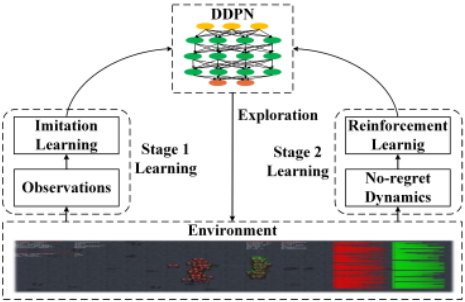
pipeline [Mnih et al., 2015] trains the network from scratch by exploring the action-state space and calculating rewards. However, compared with the Atari games [Mnih et al., 2015] and the MineCraft scenarios [Oh et al., 2016], which both focus on the control of a single agent with a fixed and limited set of actions, the combat game is much more challenging because its action-state space is extremely large and the feasible action-states only occupy a very small portion of the whole space. Therefore, randomizing actions will cause the learning algorithm to reach sub-optimal plateaux with a large probability. A lot of exploration is required for learning [Usunier et al., 2016]. Furthermore, randomizing actions often disorganize the agents, which leads rapidly to defeat without any effective feedback. In addition, it is hard to identify each agent action's own contribution from the collective rewards, and the optimal policy of one agent depends on other agents' policies, which make the learning unstable. To handle these difficulties, a novel learning algorithm is proposed as shown in Fig. 1, which contains the following two stages: 1) In the first stage, the ally units are controlled to explore the opponent's policy and observe the enemies' actions. After collecting several observations as training samples, the DDPN is pre-trained by online imitation learning. 2) Since our goal is to defeat the opponent rather than imitate it, the DDPN is further optimized in the second stage. The regret is used to evaluate policies and a no-regret dynamics algorithm is introduced to approximate the joint no-regret policies of multiple agents. Then, a novel RL algorithm is proposed based on the approximated no-regret policies, and we prove it is self-improved and can learn better policy from the first stage learning. These two stages of learning are complementary to each other. On one hand, the DDPN learned from stage 1 is not optimal and needs to be further optimized. On the other hand, the imitation learning can provide a good initial guidance of exploration and a reasonable starting point of RL.
In summary, the main contributions of this work are in three-fold: 1) we model the RT combat game task as CDecPOMDP and a staged learning algorithm is proposed to train the DDPN; 2) a self-improved RL algorithm is proposed based on no-regret dynamics to learn decentralized policies from collective rewards; and 3) extensive experimental results on various combat scenarios demonstrate that the proposed method can defeat different opponent models and significantly outperforms many state-of-the-art approaches.
2 RelatedWork
The field of AI has made significant progresses in the last decade due to the successes of deep learning [LeCun et al., 2015] such as image classification [Russakovsky et al., 2015] or playing various games including Go [Silver et al., 2016] and the Atari video games [Mnih et al., 2015]. However, it remains challenging to build highlevel AI programs in complex environments. RT combat game is such a problem due to its large state-action space and lack of expert-level annotations. Recently, a few of works utilize the RT combat game to test AI algorithms and several experiment platforms [Churchill et al., 2012;
Tian et al., 2017] have been opened.
The simplest approaches, which are widely used in most RT combat game AI bots, are hand-crafted heuristics which define static behaviors based on human prior knowledge. To obtain better solutions, a few of approaches [Churchill et al., 2012; Churchill and Buro, 2013; Lelis, 2017; Moraes and Lelis, 2018] build game tree for current game states and aim to search the optimal solutions with help of heuristics. However, it is hard to search an effective policy online due to the real-time limitations. Inspired by the success of DQN [Mnih et al., 2015], the other type of methods model the task as deep MARL problem and learn deep neural networks by centralized learning [Usunier et al., 2016; Kong et al., 2017], decentralized learning [Peng et al., 2017; Hu et al., 2018] or centralized learning with decentralized execution [Foerster et al., 2018; Rashid et al., 2018]. We also follow the later setting, and the main differences compared with [Foerster et al., 2018; Rashid et al., 2018] are: 1) They train the network from scratch, while the proposed DDPN is trained by staged learning. The imitation learning from opponent provides a good starting point of RL. 2) The no-regret dynamics algorithm is introduced to approximate the joint no-regret policies. We learn one agent's policy by assuming other agents are all performing actions as no-regret policies, which makes the learning more effective and stable.
The proposed method can be regarded as learning from demonstrations (LfD) [Schaal, 1997], and the demonstrations are provided by the opponent. LfD is widely-used to facilitate RL, and the direct method is to recover experts' strategies from demonstrations by supervised learning [Pomerleau, 1991; Ross et al., 2011; Sun et al., 2017] or generative adversarial learning [Ho and Ermon, 2016; Song et al., 2018]. However, our task is to defeat the opponent rather than just imitate it. To learn better policies from demonstrations, a few of approaches [Hester et al., 2018; Kang et al., 2018] are proposed to explore the environment by LfD. These two methods are both designed for single agent tasks and try to find better policies by exploring around demonstrations. However, the joint state-action space of multiple agents is much larger and the exploration may be inefficient. Several existing works are also proposed by combining imitation learning and RL together [Silver et al., 2016; Hu et al., 2018]. AlphaGo [Silver et al., 2016] is designed for two-agent zero-sum competitive task and cannot be applied to RT combat game directly. OGTL [Hu et al., 2018] is designed for RT combat game and also starts learning by imitating the opponent. However, it relies on independent single-agent action exploration and ignores multi-agent cooperation. Different with OGTL, the DDPN is trained by collective rewards of joint actions and can learn cooperative polices more effectively.
3 ProblemDefinition
In RT combat game task, the enemy units and the opponent's strategy are modeled as a part of environment [Usunier et al., 2016; Peng et al., 2017; Foerster et al., 2018; Kong et al., 2017; Hu et al., 2018]. Hence, we define the task as collective decentralized partially observable Markov decision process (CDec-POMDP) [Nguyen et al., 2018] described by a tuple 〈S, U,A,P,O, r,N, λ〉 consisting of: State space S is a finite set of distinct states which can be visited in the game. An episode is defined as a set of game states in time series {S1, S2, ..., ST} where St is the game state at time t and only related to St-1. The terminal state ST means all units of at least one player have been wiped out or T exceeds the time limitations. Agents U = {u1, ..., uN} where each agent corresponds to an ally unit and N may be varied at different states. Action space A is the finite discrete set of possible actions that can be performed for agents. State transition function Pt = P(St+1|St,A) is induced by performing joint actions A = {ai}Ni=1 simultaneously at state St where ai is performed by ui. Observation function O(S) = {Oi(S)}Ni=1 where Oi(S) is the observation of agent ui at state S. The decentralized policy of ui is defined as {pi(a|Oi(s))}a∈A corresponding to the probabilities of actions to perform. Although the joint state-action space is known to each agent, the observations are more robust and easy to model at game states where the numbers of units are large and uncertain. Reward r(St+1, St,A) is a bounded function to measure the reward (or payoff) of the joint state-action, and it is defined as the sum of damage inflicted on the opponent units minus the damage taken, which is similar to previous works [Usunier et al., 2016; Foerster et al., 2018]. It is collective and shared by all agents. λ ∈ [0, 1) is the discount factor.
Given any state S ∈ S, initialize the game as S1 = S. At each time step t, each agent ui receives a state St ∈ S, selects an action ai ∈ A simultaneously, following joint policies π = {pi}Ni=1 . All agents receive a global reward rt, and the state is transited to St+1 according to P until reaching a terminal state ST . The state value V π (s) is calculated by the cumulative rewards with the discount factor λ:
where E is the expectation. According to V π (S), the stateaction value Qπ (S, A) is defined as:
where S′ ∼ P(S′ |S,A). According to these definitions, we aims to find decentralized policies {p(a|Oi(S))}a∈A for any agent ui to defeat the opponent. We utilize the deep neural network parameterized by θ to model these policies, named Deep Decentralized Policy Network (DDPN). That is, for any agent (ui) and the corresponding game state (S), the input of the DDPN is the feature of the unit's observation f o (ui, S), and the output {pθ(a|f o (ui, S))}a∈A is its decentralized policy. All units share same network parameters, and the individual policy relies on the input of DDPN.
4 Two-Stage Learning Algorithm
This section introduces the staged learning algorithm for the DDPN which is composed of imitation learning and reinforcement learning, as shown in Fig. 1.
Input: Initial DDPN parameters θ and data Buffer B. Output: Updated DDPN parameters: θ Ep ← 1. while Non-convergent do Initialize the game state S randomly. while S is non-terminal do for i = 1, ..., N do Extract the feature of its observation: f o (ui, S), and calculate its policy pθ (a|f o (ui, S)) . Choose action ai ∼ pθ (a|f o (u, S)). for ue ∈ U e do Extract the feature of its observation: f o (ue , S), and observe its action aeu . Update B with (f o (ue , S), aeu ). Update S by performing {ai}Ni=1 . if Ep mod EUpdate = 0 then Update θ using B by Eq. (3). Ep ← Ep + 1.4.1 Stage 1: Imitation Learning
The opponent's policy is similar to a black box and its deterministic actions can be viewed without knowledge of its internal workings. In the first stage, the DDPN is trained by mimicking enemy units' actions. For any state S ∈ S, we can observe the actions {aue}ue∈U e performed by enemy units U e . They are regarded as demonstrations to play the game, and DDPN is trained by minimizing the cross-entropy loss function:
To learn DDPN efficiently, an imitation learning algorithm is proposed in Alg. 1 by online update. Alg. 1 regards the observations of enemy actions as demonstrations, and it still works when the demonstrations are human-designed heuristics or from experience replays.
4.2 Stage 2: Reinforcement Learning
Since our goal is to defeat the opponent rather than just imitate it, hence we aim to further improve the polices in the second stage. Consider the DDPN learned from the first stage as the initial policies π0 = {p0i }i=1,...,N, then V 0 (S) and Q0 (S,A) can be calculated by simulating π0 in Eq. (1) and Eq. (2) respectively. The regret value is introduced to represent how much the agents "regret" having used the policies π = {pi}i=1,...,N. It roughly evaluates the gap between the current policies and the optimal policies:
where M is the number of independent simulations, Am = {ami }i=1,...,N are joint actions and ami ∼ pi. If the joint policies π∗ = {p∗i }i=1,...,N satisfy limM→+∞ R (π∗ , S, M) = 0, then π∗ are the desired joint no-regret policies. As proved
Algorithm 2: The multiplicative weights algorithm.
Input: Agent u, game state S and normalized Q0 (S, a) ∈ [0, 1] for any a ∈ A.
Output: {p∗ (a|O(S))}a∈A
Initialize weight w(a) = 1 for each action.
while Non-convergent do
in [Cesa-Bianchi et al., 2007], the multiplicative weights (MW) algorithm (Alg. 2) converges to the no-regret policy in single-agent cases.
Unfortunately, as the joint state-action space grows exponentially with the number of agents and the no-regret policy of one agent depends on others' policies, it is difficult to solve the joint no-regret policies in multi-agent cases. To handle this challenge, Alg. 2 is extended to the no-regret dynamics algorithm (Alg. 3) to approximately estimate the joint no-regret policies {p∗i }Ni=1 . Then, {p∗i }Ni=1 are further used to learn DDPN by Eq. (5) where η is the learning rate, and an asynchronous RL algorithm is proposed in Alg. 4.
Here we theoretically analyse the effectiveness of the proposed algorithm. In each iteration of Alg. 3, each agent finds its no-regret policy by assuming other agents' policies are certain, and Alg. 3 is convergent as proven in [Roughgarden, 2016]. Although there is no theoretical guarantee that {p∗i }Ni=1 are joint no-regret policies, yet we can still prove that they are better policies than the initial policies π0 , that is V ∗ (S) ≥ V 0 (S) for any state S ∈ S where V ∗ (S) is simulated by performing {p∗i }Ni=1 in Eq. (1). Proof: Suppose pki is the policy of ui after the k-th iteration of Alg. 3. Since Alg. 2 is no-regret for each single agent when other agents' polices are known, hence:
where S is any game state. Consider a game initialized by S1 = S, according to Eq. (6), we have:
Algorithm 3: The no-regret dynamics algorithm
Input: The game state S, agents u1, ..., uN, and the initialized policies π0 = {p0i }Ni=1 .
Output: {p∗i (a|Oi(S))}a∈A for each agent ui.
Initialize p∗i = p0i for each agent ui.
for k = 1, 2, ..., K do
Fix the polices of agents {uj}j̸=i as {p∗j }j̸=i. Find the no-regret policy pki for ui by Alg. 2. Update p∗i (a|Oi(S)) = pki (a|Oi(S)).
According to Eq. (7), Alg. 3 will find a local optimum where the starting point is the previous policy. In practice, most existing opponent policies are implemented by rule-based scripts and far from the local optimum. Hence, the proposed method can improve these policies significantly in practice. Furthermore, the learning policies are continually regarded as new initial policies of Alg. 3 during the learning procedure to improve constantly.
5 Experiments
The proposed method is tested using SparCraft [Churchill et al., 2012], which is a simulator of the StarCraft local combat game and is widely adopted to test combat game algorithms [Churchill et al., 2012; Churchill and Buro, 2013; Lelis, 2017; Moraes and Lelis, 2018]. It is chosen as the experimental platform because its efficient simulation function can accelerate the algorithms. In addition, unlike the StarCraft environment [Usunier et al., 2016], the SparCraft implements several kinds of opponent models to better validate the robustness of the proposed method.
5.1 Experiment Settings
The action space contains three types of discrete actions: noop, move[directions] and attack[enemy ids], where directions is set to 4 corresponding to left, right, up and down, and enemy ids is the number of enemy units at the initial state of the combat scenario. To an ally unit, [enemy ids] is the list of its attack targets, and arranged in ascending order of the remaining hit points. The feature of an agent's observation is concatenated of the properties [Foerster et al., 2018] of the corresponding unit, the 10 closest ally units and 10 closest enemy units. To make sure the feature vector is unique and identical to each state, the ally and enemy units are arranged in ascending order of the distance to the agent. If the numbers of ally and enemy units are less than 10, then the feature vector is filled with 0 to make the length of feature vector identical at any state. DDPN is composed of 4 fully connected (FC) layers, 3 batch normalization layers following the first 3 FC layers respectively. A softmax layer is used to output the probabilities. The widths of the FC layers are 256, 128, 128, and directions + enemy ids + 1 respectively. The leaky rectified linear function [Maas et al., 2013] is used as an activation function for the first 3 FC layers. We utilize this
Algorithm 4: RL algorithm of DDPN. Input: DDPN parameters θ0 learned by Alg. 1. Output: Updated DDPN parameters θ. Initialize: ˜ θ ← θ0 , θ ← θ0 . Ep = 1. while Non-convergent do Initialize game state S randomly. while S is non-terminal do for i = 1, ..., N do Extract feature f o (ui, S). Choose action ai ∼ p˜ θ (a|f o (ui, S)). Calculate the joint no-regret policies by Alg. 3 which is initialized by pθ(a|f o (ui, S)). Update ˜ θ by Eq. (5). Update S by performing {ai}Ni=1 . if Ep mod EUpdate = 0 then Update θ ← ˜ θ. Ep ← Ep + 1.simple network architecture because it needs to forward the network in real time.
The opponents are the rule-based heuristics implemented in SparCraft, including: (1) Attack-Value (v) where units attack the unit with the highest value (damage per frame / current hit points) within range and a unit not within the range of any enemy moves toward the closest enemy. (2) Attack-Closest (c) which is similar to v except each unit attack the closest enemy unit. (3) Kiter (k) is similar to c, it instead moves a fixed distance away from the closest enemy when it is necessary to cool down the weapon. (4) Kiter Value (kv) will attack the enemy units as same as v if the weapon is ready to attack, and it will move as same to k otherwise. To summarize, c and v are two most straightforward and simplest heuristics who only focus on how to attack. The scripts k and kv additionally consider how to move when the weapon is not ready. The "move and attack" mode of k and kv is also known as "hit-and-run" 1 which is often used by professional players. In experiments, "DDPN x" denotes the DDPN model trained by the opponent x. The Marine (m) and Zealot (z) are chosen as two typical unit types for ranged and melee units respectively. The test combat scenarios differ in the unit numbers and types: two small scale combats m5v5 and z5v5, a large-scale combat m30v30, a heterogeneous combat 5m5z where the ally and enemy units are both composed of 5 Marines and 5 Zealots, and two unbalanced combats m15v16 and m18v20 where we control 15(18) Marines against 16(20) Marines and our force is weaker than the opponent. Two circle regions in the combat area are chosen for ally and enemy units respectively, and each unit is born randomly in the corresponding region in each scenario. All of the win rates in the paper are accounted with 200 independent battles.
The decay factor λ is set to 0.995, and the iterations of Alg. 2 and Alg. 3 are both set to 5. To simulate Eq. (2) and Eq. (1) efficiently, actions with the maximum possibility are performed. In addition, η = 0.6 in Alg. 3 and DDPN is learned by SGD with learning rate 10-3 . The models are trained on GeForce GTX 1080 and tested on a desktop PC with one 2.4 GHz CPU and 8G RAM.
1 http://tvtropes.org/pmwiki/pmwiki.php/Main/HitAndRunTactics.
| Scenarios | m5v5 | z5v5 | m30v30 | 5m5z | m15v16 | m18v20 |
|---|---|---|---|---|---|---|
| UCT v | 0.95 | 0.91 | 0.83 | 0.89 | 0.72 | 0.41 |
| A-B v | 0.97 | 0.90 | 0.78 | 0.90 | 0.66 | 0.39 |
| DQN v | 0.95 | 0.89 | 0.86 | 0.66 | 0.37 | 0.15 |
| PG v | 0.89 | 0.85 | 0.77 | 0.85 | 0.42 | 0.20 |
| OGTL v | 1.00 | 0.96 | 0.92 | 0.76 | 0.86 | 0.45 |
| GMEZO* | 1.00 | - | - | - | 0.79 | - |
| BicNet* | 0.92 | - | - | - | 0.71 | - |
| CommNet* | 0.95 | - | - | - | 0.68 | - |
| MS-MARL* | - | - | - | - | 0.82 | - |
| DDPN v | 0.99 | 0.95 | 0.93 | 0.85 | 0.87 | 0.73 |
| UCT c | 0.93 | 0.86 | 0.85 | 0.84 | 0.69 | 0.36 |
| A-B c | 0.99 | 0.90 | 0.79 | 0.89 | 0.70 | 0.32 |
| DQN c | 0.97 | 0.92 | 0.74 | 0.63 | 0.35 | 0.11 |
| PG c | 0.89 | 0.85 | 0.91 | 0.68 | 0.36 | 0.19 |
| OGTL c | 0.94 | 0.96 | 0.89 | 0.76 | 0.80 | 0.51 |
| DDPN c | 0.96 | 0.91 | 1.00 | 0.92 | 0.84 | 0.79 |
| UCT k | 0.81 | 0.80 | 0.75 | 0.78 | 0.59 | 0.20 |
| A-B k | 0.82 | 0.85 | 0.72 | 0.79 | 0.63 | 0.25 |
| DQN k | 0.77 | 0.71 | 0.65 | 0.54 | 0.19 | 0.09 |
| PG k | 0.76 | 0.85 | 0.73 | 0.58 | 0.26 | 0.10 |
| OGTL k | 0.82 | 0.79 | 0.81 | 0.61 | 0.42 | 0.32 |
| DDPN k | 0.89 | 0.84 | 0.84 | 0.80 | 0.77 | 0.65 |
| UCT kv | 0.79 | 0.81 | 0.76 | 0.72 | 0.56 | 0.16 |
| A-B kv | 0.80 | 0.83 | 0.75 | 0.74 | 0.55 | 0.16 |
| DQN kv | 0.73 | 0.71 | 0.51 | 0.49 | 0.14 | 0.08 |
| PG kv | 0.76 | 0.70 | 0.59 | 0.57 | 0.29 | 0.11 |
| OGTL kv | 0.79 | 0.83 | 0.72 | 0.61 | 0.46 | 0.27 |
| DDPN kv | 0.88 | 0.85 | 0.91 | 0.78 | 0.76 | 0.61 |
5.2 Comparative Results
We consider two type of methods as competing baselines including: 1) heuristic-based search methods, including UCT [Churchill and Buro, 2013] and Alpha-Beta (A-B) search [Churchill et al., 2012] which have been implemented in SparCraft both use the opponent's policy to help search for fair comparison; and 2) deep learning based methods including two well-known general RL algorithms DQN [Mnih et al., 2013] and PG [Williams, 1992], and 5 state-of-the-art deep RL algorithms designed for the RT combat game including OGTL [Hu et al., 2018], GMEZO [Usunier et al., 2016], BicNet [Peng et al., 2017], CommNet [Sukhbaatar and Fergus, 2016] and MS-MARL [Kong et al., 2017]. The DQN is re-implemented as centralized learning by the framework proposed in [Usunier et al., 2016], and PG and OGTL are re-implemented in a decentralized way [Hu et al., 2018] which utilizes the same feature and network architecture as us. The results of GMEZO, BicNet, CommNet and MS-MARL are reported in [Peng et al., 2017; Kong et al., 2017]. Due to different experimental settings, these comparative results are only indicative. As stated in [Peng et al., 2017], their opponents have the similar effect to w, hence we compare these results with the DDPN w.
From the comparative results presented in Table 1, we observe the following key findings: 1) the win rates of our DDPN model are much larger than 0.5 in all combat scenarios, and outperforms other competing methods overall. It demonstrates the effectiveness of the proposed method. 2) UCT and Alpha-Beta can achieve high win rates in balanced combats, while the performances are very limited in unbalanced combats. It is difficult to search the effective cooperative policies from the extremely large game tree under real-time limitation (40ms). 3) DQN and PG perform well in small combats against easy opponent models (v and c), while the win rates decline dramatically in large scale combats against hard opponent models because it is hard to learn an effective network from scratch in an extremely large state-action space. 4) OGTL is also designed by combing imitation learning of opponent and RL. It performs well in balanced combats and performs poorly in unbalanced combats. The reason is that it ignores multi-agent cooperation during learning and the cooperation plays an important role in unbalanced combats. Different with OGTL, the proposed DDPN utilizes collective rewards and can learn more effective multi-agent cooperative polices.
5.3 Ablation Studies
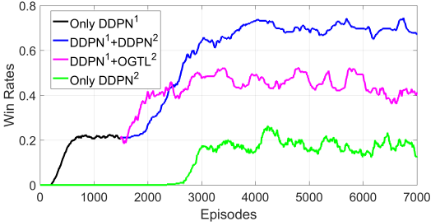
To validate the contributions of the staged learning, two additional versions of the DDPN are evaluated in this experiment: "only DDPN1 " which means the model is only trained by imitation learning proposed in Alg. 1, and "only DDPN2 " which means we train the DDPN by Alg. 4 directly with random initialization. To better validate the contributions of Alg. 4, we compare the proposed method with the stage learning method OGTL as "DDPN1+OGTL2 ", where the network is pre-trained by Alg. 1 and further improved by the RL proposed in [Hu et al., 2018]. Fig. 2 shows average win rates as a function of training episode for each method on m18v20 against with "w", and it is evident that: 1) "DDPN1 " can learn primary policy while its win rate is low. 2) The performance of "Only DDPN2 " is poor because it is difficult to effectively explore the large action-state space from scratch. 3) "DDPN1+DDPN2 " outperforms "only DDPN1 " and "only DDPN2 " clearly and it indicates these two stages are indeed complementary to each other. In addition, the improvement is more significant than "DDPN1+OGTL2 ". The reason is that Alg. 4 utilizes collective rewards to learn multi-agent cooperative policies, while "OGTL2 " only uses single-agent action explorations.
| Scenarios | m5v5 | m15v15 | m18v18 | m30v30 | m18v20 |
|---|---|---|---|---|---|
| DQN v | 0.73 | 0.48 | 0.40 | 0.05 | 0.01 |
| GMEZO* | 0.80 | 0.80 | 0.82 | - | 0.17 |
| DDPN v | 0.89 | 0.94 | 0.93 | 0.92 | 0.67 |
| Opponents | Mean | c | v | k | kv |
|---|---|---|---|---|---|
| DDPN c | 0.86 | 0.93 | 0.95 | 0.79 | 0.78 |
| DDPN v | 0.85 | 0.91 | 1.00 | 0.70 | 0.78 |
| DDPN k | 0.93 | 1.00 | 1.00 | 0.84 | 0.89 |
| DDPN kv | 0.93 | 1.00 | 1.00 | 0.82 | 0.91 |
To evaluate the robustness to different combat scales, DDPN trained on one scenario is tested on other scenarios with a different number of units. As shown in Table 2, DDPN is more robust than the centralized learning methods GMEZO and DQN. The reason is that DDPN relies on observations of an agent, which is more robust than whole joint state-action space.
In addition, a cross-opponent experiment is conducted to validate the influence of various opponents. In particular, the DDPN model trained by one opponent will fight against to another one such as DDPN c vs. k. The experiment is carried on m30v30 and the comparison results are shown in Table 3. DDPN not only defeats the opponent model who is used to train the network, but also is applicable to other opponents. For example, DDPN c can defeat kv even c and kv are implemented by totally different rules. In addition, the effectiveness of the DDPN is positively correlated to the opponent. The mean win rates of k and kv are higher than c and v, where the former two heuristics are the improved versions of the latter two. It is reasonable because the DDPN is learned from the opponent and more effective opponent model leads to more effective DDPN.
6 Conclusion
This paper formulates the task of real-time combat game as a collective decentralized partially observable Markov decision process (CDec-POMDP), and designs a Deep Decentralized Policy Network (DDPN) to model the decentralized polices. To train DDPN effectively, a novel two-stage learning algorithm is proposed which first performs imitation learning from opponent and then self-improved reinforcement learning by no-regret dynamics. Experimental results in several scenarios demonstrate that the method can defeat different rule-based scripts and significantly outperforms the state-of-the-art deep learning based approaches.
@inproceedings{ijcai2019p181,
  title     = {Learning Deep Decentralized Policy Network by Collective Rewards for Real-Time Combat Game},
  author    = {Peng, Peixi and Xing, Junliang and Cao, Lili and Mu, Lisen and Huang, Chang},
  booktitle = {Proceedings of the Twenty-Eighth International Joint Conference on
               Artificial Intelligence, {IJCAI-19}},
  publisher = {International Joint Conferences on Artificial Intelligence Organization},
  editor    = {Sarit Kraus},
  pages     = {1305--1311},
  year      = {2019},
  month     = {8},
  note      = {Main track},
  doi       = {10.24963/ijcai.2019/181},
  url       = {https://doi.org/10.24963/ijcai.2019/181},
}
TY - CPAPER TI - Learning Deep Decentralized Policy Network by Collective Rewards for Real-Time Combat Game AU - Peng, Peixi AU - Xing, Junliang AU - Cao, Lili AU - Mu, Lisen AU - Huang, Chang T2 - Proceedings of the Twenty-Eighth International Joint Conference on Artificial Intelligence, IJCAI-19 PB - International Joint Conferences on Artificial Intelligence Organization PY - 2019 SP - 1305 EP - 1311 DO - 10.24963/ijcai.2019/181 UR - https://doi.org/10.24963/ijcai.2019/181 ER -Copied
Machine-readable versions of this paper, for tools and AI agents:





