
Hintikka's World: Agents with Higher-order Knowledge
Proceedings of the Twenty-Seventh International Joint Conference on Artificial Intelligence. Demos. Pages 5859-5861.
https://doi.org/10.24963/ijcai.2018/862
Keywords
- Knowledge Representation, Reasoning, and Logic: Non-classical logics for Knowledge Representation
- Knowledge Representation, Reasoning, and Logic: Automated Reasoning and Theorem Proving
Abstract
In this demonstration paper, we present a pedagogical tool called Hintikka's world for showing how artificial agents can reason about higher-order knowledge (an agent knows that another agent knows that...). The system provides famous AI examples such as Muddy children and Russian cards. The system also allows to implement user's own examples via the description of a Kripke model or via its generation by the generic tableau method prover MetTeL2.
- [Arslan et al., 2015] Burcu Arslan, Rineke Verbrugge, Niels Taatgen, and Bart Hollebrandse. Teaching children to at- tribute second-order false beliefs: A training study with feedback. In Proceedings of the 37th Annual Meeting of the Cognitive Science Society, CogSci 2015, Pasadena, California, USA, July 22-25, 2015, 2015.
- [Aucher and Bolander, 2013] Guillaume Aucher and Thomas Bolander. Undecidability in epistemic planning. In IJCAI 2013, Proceedings of the 23rd International Joint Conference on Artificial Intelligence, Beijing, China, August 3-9, 2013, pages 27-33, 2013. IJCAI
- [Aumann, 1999] Robert J. Aumann. Interactive epistemol- ogy I: knowledge. Int. J. Game Theory, 28(3):263-300, 1999.
- [Baltag et al., 1998] Alexandru Baltag, Lawrence S Moss, and Slawomir Solecki. The logic of public announce- ments, common knowledge, and private suspicions. In Proceedings of the 7th conference on Theoretical aspects of rationality and knowledge, pages 43-56.
- [Bolander and Andersen, 2011] Thomas Bolander and Mikkel Birkegaard Andersen. Epistemic planning for single and multi-agent systems. Journal of Applied Non-Classical Logics, 21(1):9-34, 2011.
- [Charrier and Schwarzentruber, 2015] Tristan Charrier and Franc ¸ois Schwarzentruber. Arbitrary public announce- ment logic with mental programs. In Proceedings of the 2015 International Conference on Autonomous Agents and Multiagent Systems, AAMAS 2015, Istanbul, Turkey, May 4-8, 2015, pages 1471-1479, 2015.
- [Devin and Alami, 2016] Sandra Devin and Rachid Alami. An implemented theory of mind to improve human-robot shared plans execution. In The Eleventh ACM/IEEE In- ternational Conference on Human Robot Interation, HRI 2016, Christchurch, New Zealand, March 7-10, 2016, pages 319-326, 2016.
- [Halpern and Fagin, 1989] Joseph Y. Halpern and Ronald Fagin. Modelling knowledge and action in distributed sys- tems. Distributed Computing, 3(4):159-177, 1989.
- [Halpern and Moses, 1992] Joseph Y. Halpern and Yoram Moses. A guide to completeness and complexity for modal logics of knowledge and belief. Artif. Intell., 54(2):319- 379, 1992.
- [Halpern and Vardi, 1991] Joseph Y. Halpern and Moshe Y. Vardi. Model checking vs. theorem proving: A mani- festo. In Proceedings of the 2nd International Conference on Principles of Knowledge Representation and Reason- ing (KR'91). Cambridge, MA, USA, April 22-25, 1991., 1991.
- [Horrocks et al., 2007] Ian Horrocks, Ullrich Hustadt, Ul- rike Sattler, and Renate Schmidt. 4 computational modal logic. In Patrick Blackburn, Johan Van Benthem, and Frank Wolter, editors, Handbook of Modal Logic, vol- ume 3 of Studies in Logic and Practical Reasoning, pages 181 -245. Elsevier, 2007.
- [Knight et al., 2017] Sophia Knight, Bastien Maubert, and Franc ¸ois Schwarzentruber. Reasoning about knowledge and messages in asynchronous multi-agent systems. Math- ematical Structures in Computer Science, page 1-42, 2017.
- [Saffidine et al., 2018] Abdallah Saffidine, Franc ¸ois Schwarzentruber, and Bruno Zanuttini. Knowledge- based policies for qualitative decentralized pomdps. In In Sheila McIlraith and Kilian Weinberger, editors, Proc. 32nd AAAI Conference on Artificial Intelligence (AAAI 2018), 2018.
- [Scassellati, 2002] Brian Scassellati. Theory of mind for a humanoid robot. Auton. Robots, 12(1):13-24, 2002.
- [Sébastien Lê Cong, 2018] Franc ¸ois Schwarzentruber Sébastien Lê Cong, Sophie Pinchinat. Small undecidable problems in epistemic planning. In Proceedings of the 27th International Joint Conference on Artificial Intelligence (IJCAI) and the 23rd European Conference on Artificial Intelligence (ECAI), Stockholm, 13-19 July 2018, 2018.
- [Tishkovsky et al., 2012] Dmitry Tishkovsky, Renate A. Schmidt, and Mohammad Khodadadi. The tableau prover generator mettel2. In Logics in Artificial Intelligence -13th European Conference, JELIA 2012, Toulouse, France, September 26-28, 2012. Proceedings, pages 492- 495, 2012.
- [van Benthem et al., 2015] Johan van Benthem, Jan van Ei- jck, Malvin Gattinger, and Kaile Su. Symbolic model checking for dynamic epistemic logic. In Logic, Ratio- nality, and Interaction -5th International Workshop, LORI 2015 Taipei, Taiwan, pages 366-378, 2015.
- [van Ditmarsch and Kooi, 2015] Hans van Ditmarsch and Barteld Kooi. One Hundred Prisoners and a Light Bulb. Springer, 2015.
- [van Ditmarsch et al., 2008] Hans van Ditmarsch, Wiebe van der Hoek, and Barteld Kooi. Dynamic Epistemic Logic. Springer, Dordecht, 2008.
- [van Ditmarsch et al., 2012] Hans van Ditmarsch, Jan van Eijck, Ignacio Hernández-Antón, Floor Sietsma, Sunil Si- mon, and Fernando Soler-Toscano. Modelling crypto- graphic keys in dynamic epistemic logic with DEMO. In Highlights on Practical Applications of Agents and Multi-Agent Systems, PAAMS 2012 Special Sessions, Sala- manca, Spain, 28-30 March, 2012, pages 155-162, 2012.
- [van Ditmarsch, 2003] Hans P. van Ditmarsch. The russian cards problem. Studia Logica, 75(1):31-62, 2003.
- [van Eijck, 2007] Jan van Eijck. Demo-a demo of epis- temic modelling. In Interactive Logic. Selected Papers from the 7th Augustus de Morgan Workshop, London, vol- ume 1, pages 303-362, 2007.
- [Wimmer and Perner, 1983] Heinz Wimmer and Josef Perner. Beliefs about beliefs: Representation and con- straining function of wrong beliefs in young children's understanding of deception. Cognition, 13(1):103-128, 1983.
References were extracted automatically from the PDF and may contain errors.
Full text extracted automatically from the PDF; figures, tables and equations may differ. The PDF is the version of record.
1 Introduction
Higher-order knowledge of agents is relevant in many applications: game theory [Aumann, 1999], robotics ([Scassellati, 2002], [Devin and Alami, 2016]), specifications of distributed systems [Halpern and Fagin, 1989], etc. Dynamic epistemic logic (DEL) ([Baltag et al., 1998], [van Ditmarsch et al., 2008]) extends epistemic logic for describing and reasoning about epistemic properties and information change. The famous tool in the community is called DEMO [van Eijck, 2007] and is a model checker for DEL, that has been used in practice [van Ditmarsch et al., 2012]. It also provide symbolic techniques [van Benthem et al., 2015].
Nevertheless, there are no tools with an intuitive graphical user interface that may be used by roboticians, game theorists, psychologists, etc. In this paper, we present such a tool called Hintikka's world.
The idea of tool we propose, called Hintikka's world is simple: represent Kripke models by comic strips, as shown in Figure 1. The tool is available at the following address: http://hintikkasworld.irisa.fr/.
Hintikka's world is a proof of concept of a graphical user interface that shows artificial agents mental states. It could be used in debugging contexts and for explaining behaviors of the agents that takes their decisions with respect to their beliefs. In other words, it takes part in Explainable Artificial Intelligence. The artificial agent could be a humanoid robot that interact with humans ([Scassellati, 2002], [Devin and Alami, 2016]) or several autonomous agents that have imperfect information [Saffidine et al., 2018].
Another application is to provide a tool for psychiatrists to test ability of children to reason about higher-order knowledge (see [Arslan et al., 2015], [Wimmer and Perner, 1983]).
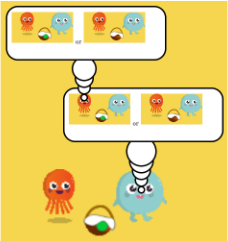
Finally, the tool has a pedagogical aim. It illustrates the concepts of Kripke models, modal formulas, model checking and satisfiability problem in a modal logic course. It also enables to explain easily how to model higher-order knowledge to other scientists.
2 Demonstration Outline
2.1 Already Implemented Examples
First, the user can run AI examples that illustrate important concepts:
- Agents can learn information frommessages of the form 'an agent does not know...': Muddy children puzzle, Consecutive numbers [van Ditmarsch and Kooi, 2015]
- False beliefs of agents: Sally and Anne [Wimmer and Perner, 1983]
- Public announcements that are secure in the sense that intruders of a system do not not learn relevant information: Russian cards [van Ditmarsch, 2003]
- Evolution of knowledge in asynchronous systems [Knight et al., 2017]
- Evolution of knowledge in agents that run knowledgebased programs over a QdecPOMDP [Saffidine et al., 2018].
- Simulation of cellular automata, for proving undecidability of epistemic planning [S´ebastien Lˆe Cong, 2018].
2.2 User Interaction
The tool adopts the point of view of Halpern and Vardi for modeling an epistemic situation: model checking is more suitable than theorem proving [Halpern and Vardi, 1991]. In other words, the current situation is modeled as a pointed Kripke model. By clicking on a given agent a, the interface opens a thought bubble that displays the possible worlds for agent a. Actually, the comic strips shows the unfolding of the current pointed Kripke model that represents the current situation.
On the left, the software shows buttons for possible actions (public announcement, public actions, private actions, etc.). Actions are modeled by pointed event models of Dynamic epistemic logic [Baltag et al., 1998]. By clicking on a button, the corresponding action is executed: the product of the pointed Kripke model and the pointed event model becomes the current pointed Kripke model.
2.3 Building New Examples
The tool also allows the final user to building their own examples. They are two ways to specify a new epistemic situation. First, the user can describe the pointed Kripke models in JavaScript, by giving the list of worlds, their valuations and the epistemic relations. Second, the user can specify the situation by a formula φ epistemic logic. The BNF is:
where p is an atomic proposition, a is an agent and G is a group of agents. E.g. 'p does not holds but agent a imagines that it is possible that p holds' (((Kpos a p) and (not p))), agent a and b commonly know that agent c does not know the value of p ((CK (a b) ((not (K b p)) and (not (K b (not p))))), etc. The user writes a set of formulas, one formula per line.
Then the system solves the satisfiability problem and generates a pointed epistemic model.
3 SystemDescription
3.1 Class Architecture
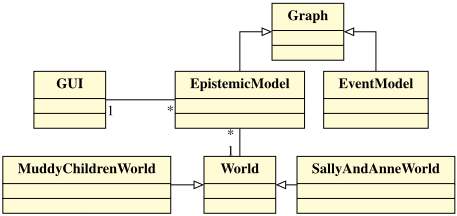
Figure 2 shows the main part of the architecture of Hintikka's world. The interesting part is the fact that the graphical user interface (GUI) is independent from the current example that is running (muddy children, Sally and Anne, etc.). In particular, adding a new example only requires to add a new class that inherits from World and to implement the method for drawing the scene from data (valuations, numbers, etc.) that are members of the class.
3.2 Model Checking
The tool highly rely on model checking. Indeed, for instance, performing the public announcement of φ requires to compute the subset of worlds in which φ holds and to prune the current Kripke model. We chose to write the model checking procedure in Javascript. Since model checking is in PTIME - thus is an easy task - and is used intensively, it suitable to run run it on the client-side for performance reasons.
3.3 Satisfiability Problem
By default, the system runs a tableau method for modal logic KD45n (logic for beliefs). Other logics, as Kn or S5n are available. Termination of the procedure is granted by a blocking rule that merges two possible worlds that contain the same subformulas (see p. 208 of [Horrocks et al., 2007]). The tableau method is implemented in the generic tableau prover MetTeL2 [Tishkovsky et al., 2012]. As the satisfiability problem of epistemic modal logic with common knowledge is EXPTIME-complete [Halpern and Moses, 1992], we require the use of an efficient tool although generic, which justify the use of MetTeL2. MetTeL2 runs on the server side for efficiency reasons.
4 FutureWork
Reasoning tool. The model checking is in P but actions correspond to a product update in DEL [Baltag et al., 1998] and the size of the Kripke model is exponential in the number of performed actions in worst case. That is why we plan to extend the tool with succinct Kripke models ([van Benthem et al., 2015], [Charrier and Schwarzentruber, 2015]). We also want to extend the tool by implementing algorithms for epistemic planning (even bounded epistemic planning because epistemic planning is undecidable in the general case ([Bolander and Andersen, 2011], [Aucher and Bolander, 2013], [S´ebastien Lˆe Cong, 2018])) and arbitrary public announcements ([Charrier and Schwarzentruber, 2015]).
Graphical user interface. By clicking on agents, the interface shows some posible worlds. We want to implement heuristics for displaying the most relevant epistemic worlds when there are too many possible worlds for a given agent.
Acknowledgments
The author thanks Tristan Charrier, S´ebastien Lˆe Cong, Sophie Pinchinat, and No¨el Plouzeau for their helpful comments. We thank Renate Schmidt and Dmitry Tishkovsky for their help to use MetTeL2. The author also thanks the art school LISAA Rennes, and especially Franc¸ois Camard, Florent Chamiot-Poncet, Anne-Laure Delacroix, Oriane Desfontaine and Cl´ementine Lucas for Hintikka's world artwork. We also thank the anonymous reviewers for their valuable comments.
@inproceedings{ijcai2018p862,
  title     = {Hintikka's World: Agents with Higher-order Knowledge},
  author    = {Schwarzentruber, François},
  booktitle = {Proceedings of the Twenty-Seventh International Joint Conference on
               Artificial Intelligence, {IJCAI-18}},
  publisher = {International Joint Conferences on Artificial Intelligence Organization},
  editor    = {Jérôme Lang},
  pages     = {5859--5861},
  year      = {2018},
  month     = {7},
  note      = {Demos},
  doi       = {10.24963/ijcai.2018/862},
  url       = {https://doi.org/10.24963/ijcai.2018/862},
}
TY - CPAPER TI - Hintikka's World: Agents with Higher-order Knowledge AU - Schwarzentruber, François T2 - Proceedings of the Twenty-Seventh International Joint Conference on Artificial Intelligence, IJCAI-18 PB - International Joint Conferences on Artificial Intelligence Organization PY - 2018 SP - 5859 EP - 5861 DO - 10.24963/ijcai.2018/862 UR - https://doi.org/10.24963/ijcai.2018/862 ER -Copied
Machine-readable versions of this paper, for tools and AI agents:





