
TuringBox: An Experimental Platform for the Evaluation of AI Systems
Proceedings of the Twenty-Seventh International Joint Conference on Artificial Intelligence. Demos. Pages 5826-5828.
https://doi.org/10.24963/ijcai.2018/851
Keywords
- Natural Language Processing: NLP Applications and Tools
- Multidisciplinary Topics and Applications: Human-Computer Interaction
- Multidisciplinary Topics and Applications: AI and Social Sciences
- Multidisciplinary Topics and Applications: Multidisciplinary Topics and Applications
Abstract
We introduce TuringBox, a platform to democratize the study of AI. On one side of the platform, AI contributors upload existing and novel algorithms to be studied scientifically by others. On the other side, AI examiners develop and post machine intelligence tasks to evaluate and characterize the outputs of algorithms. We outline the architecture of such a platform, and describe two interactive case studies of algorithmic auditing on the platform.
- [Blodgett et al., 2016] Su Lin Blodgett, Lisa Green, and Brendan T. O'Connor. Demographic dialectal variation in social media: A case study of african-american en- glish. In Proceedings of the 2016 Conference on Empirical Methods in Natural Language Processing, EMNLP 2016, Austin, Texas, USA, November 1-4, 2016, pages 1119- 1130, 2016.
- [Bolukbasi et al., 2016] Tolga Bolukbasi, Kai-Wei Chang, James Y Zou, Venkatesh Saligrama, and Adam T Kalai. Man is to computer programmer as woman is to home- maker? debiasing word embeddings. In Advances in Neu- ral Information Processing Systems, pages 4349-4357, 2016.
- [Buolamwini and Gebru, 2018] Joy Buolamwini and Timnit Gebru. Gender shades: Intersectional accuracy dispari- ties in commercial gender classification. In Conference on Fairness, Accountability and Transparency, pages 77-91, 2018.
- [Friedman and Nissenbaum, 1996] Batya Friedman and He- len Nissenbaum. Bias in computer systems. ACM Trans. Inf. Syst., 14(3):330-347, July 1996.
- [Hannak et al., 2014] Aniko Hannak, Gary Soeller, David Lazer, Alan Mislove, and Christo Wilson. Measuring Price Discrimination and Steering on E-commerce Web Sites. In Proceedings of the ACM Internet Measurement Confer- ence (IMC'14), Vancouver, Canada, Nov 2014.
- [Hutson, 2018] Matthew Hutson. Artificial intelligence faces reproducibility crisis, 2018.
- [Larson et al., 2016] J Larson, S Mattu, L Kirchner, and J Angwin. How we analyzed the compas recidivism al- gorithm. propublica, 2016.
- [Larson et al., 2017] J Larson, J Angwin, L Kirchner, and S Mattu. How we examined racial discrimination in auto insurance prices. propublica, 2017.
- [O'Neil, 2017] Cathy O'Neil. Weapons of math destruction: How big data increases inequality and threatens democ- racy. Broadway Books, 2017.
- [Sweeney, 2013] Latanya Sweeney. Discrimination in online ad delivery. Queue, 11(3):10, 2013.
- [Zhao et al., 2017] Jieyu Zhao, Tianlu Wang, Mark Yatskar, Vicente Ordonez, and Kai-Wei Chang. Men also like shop- ping: Reducing gender bias amplification using corpus- level constraints. In Proceedings of the 2017 Confer- ence on Empirical Methods in Natural Language Process- ing, pages 2979-2989, Copenhagen, Denmark, September 2017. Association for Computational Linguistics.
References were extracted automatically from the PDF and may contain errors.
Full text extracted automatically from the PDF; figures, tables and equations may differ. The PDF is the version of record.
1 Introduction andMotivation
As the proliferation of artificial intelligence continues, algorithmic bias within AI systems has become a popular topic of scientific study [O'Neil, 2017; Friedman and Nissenbaum, 1996; Sweeney, 2013; Hannak et al., 2014]. Despite growing interest in both the academic and public spheres, researchers who wish to study AI in general - and algorithmic bias in particular - face several challenges, which are outlined below:
- Reproducibility: The first challenge researchers face is the difficulty in replicating AI systems of interest. A recent study showed only 6% of 400 authors at two top AI conferences shared their new algorithm's code, implying most state of the art algorithms are unable to be replicated for further examination [Hutson, 2018].
- Accessibility: The second challenge researchers face is the increasing opacity of AI systems. Due to the use of proprietary training data or even the proprietary nature of many commercial algorithms, it is difficult or even impossible for computer scientists to access the underlying models of a system.
- Efficiency: The third challenge researchers face is a problem of inefficiency. Due to the difficulty to reproduce or access important AI systems, researchers who wish to audit AI systems are often relegated to studying a small number of systems (for example, one computer vision API) as opposed to a class of systems (such as all commercial computer vision APIs).
We introduce TuringBox as a mechanism to face these challenges by allowing researchers to evaluate the output of AI
∗Equal contribution.
algorithms in a controlled, procedural way. TuringBox also provides a standardized benchmarking tool in a cloud environment.
2 SystemOverview
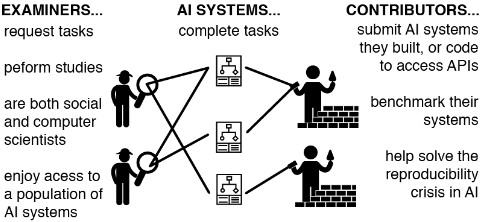
The schematic of the TuringBox framework is shown in Figure 1. On one side of the platform, AI contributors upload algorithms in various forms. First, they will upload implementations of existing AI systems. Second, they will upload their own novel AI systems. Third, contributors will upload scripts they developed which access APIs. To incentivize uploads, TuringBox eases the benchmarking process of conducting AI research by automatically comparing a contributor's uploaded algorithm to other algorithms on the platform with respect to accuracy, fairness, or other qualities determined by the examiners. For each upload, contributors will gain reputation points on the platform as a function of its performance in these categories.
On the other side of the platform, AI examiners investigate the output of AI systems. As with previous investigations, these AI system are studied agnostic to their underlying system architecture, and are thus represented only by their inputs and outputs [Larson et al., 2016; 2017; Buolamwini and Gebru, 2018].
These investigations may take one of two forms. First, an examiner can browse the platform for existing algorithms to be studied. An examiner will provide input data to the selected algorithms, which are specified by structured input and output, and then analyze the output of the algorithms. Second, an examiner can post a machine intelligence task, which calls for the creation of new algorithms by the contributor side of the platform. Examiners also receive reputation points as a function of the quality of their studies, as determined by their peers as well as other contributors.
2.1 Technical Architecture
Contributors upload Python or Javascript files to the platform, which integrates them into the codebase. The platform ensures the file represents a well-structured algorithm (defined as a canonical input output scheme) and is verified upon upload by feeding a dummy input data source (in the input data scheme) into the algorithm and making sure the code runs correctly.
Examiners interact with the platform via a intuitive GUI. Using the interface, they can specify the algorithms they want to access, and the dataset they wish to input. The request is then sent to the server, which returns results after server-side computation has terminated.
The system uses a virtualization technology to enforce a fine-grained security policy during computation. This ensures that the uploaded algorithms are performing the advertised computation and are not abusing the cloud computation environment.
3 Demonstration
In this demonstration, users will have the opportunity to perform two experiments on the TuringBox platform from both the contributor and examiner perspectives. These case studies have been carefully selected to represent two important domains in artificial intelligence: computer vision and natural language processing.
For each case study, we will provide the user with AI systems and datasets to complete the experiment. As a contributor, the user will be able to upload an AI system and use TuringBox's automatic benchmarking tool. As an examiner, users will be able to upload a customized dataset to the platform and select which algorithms to test. Users will then be able to see the output for each algorithm selected for the specified input data and have an opportunity to examine the results. We describe each case study below.
3.1 Case Study 1: Disparate Treatment by Body Type in Commercial Computer Vision APIs
Recently, computer vision systems have been shown to exhibit racial and gender biases [Buolamwini and Gebru, 2018]. In this demonstration, users will examine and quantify bias in commercial computer vision systems with respect to a previously unexamined source of bias: body type.
In order to quantify bias, users will be able to select which commercial computer vision algorithms they would like to test and what outputs (for example: text labels, not-safe-forwork scores, demographic information, etc.) each algorithm should return per image. The user will also specify which data set they would like to input to their selected algorithms. We will provide a dataset of images labeled for body type as a default input data set, but also provide functionality for the user to upload their own, or use the webcam in real time.
The user can then analyze each algorithm as well as the entire class of commercial computer vision algorithms for evidence of disparate treatment between body types.
3.2 Case Study 2: Sentiment Classification Bias by Gender, Ethnicity, and Age in NLP systems
Recent research has highlighted corpora and dataset biases learned by NLP models and the troubling potential impact of biased NLP systems [Bolukbasi et al., 2016; Zhao et al., 2017; Blodgett et al., 2016]. While most existing studies focus on characterizing and removing bias from subcomponents of NLP models, there has only been limited research of the degree to which end-to-end real-world systems exhibit problematic biases.
We provide a demonstration that allows users to easily investigate the biases of real-world systems for sentiment classification. Users enter keywords related to demographic attributes (e.g. gender, ethnicity, age) and examine the biases that arise across different APIs. Our demonstration quantifies the amount of bias related to the keywords by measuring differences in sentiment when doing keyword replacement (e.g. replacing 'white' with 'black'). The keyword replacements are done across a large text corpus to obtain robust measures of bias. Through this demonstration, users can easily test and characterize the output of black box NLP algorithms.
3.3 Demonstration of Algorithm Sandbox for Contributors
For both of the two case studies above, we will also demonstrate our system's ability to integrate new algorithms into the underlying codebase. This integration protocol will enforce the following constraints: first, that uploaded algorithms are well-structured for the tasks they claim to complete, and second, that the algorithms compute under the enforcement of a fine-grained security policy. For this demonstration, participants will upload local files corresponding to pre-trained neural networks. In real time, they will be able to visualize the system verifying and integrating the algorithm, as well as the system benchmarking it against other algorithms on the platform after it has been integrated.
4 Conclusion
Methods for comparing similar algorithms - both in the contexts of algorithmic auditing and benchmarking - has been stymied by a lack of tools and protocols. In this demonstration, we showcase a novel cloud-based framework that offers both methodological and technological contributions. TuringBox offers a standardized methodology of considering algorithms only by their inputs and outputs, thus allowing comparison across a broad class of models. TuringBox employs a virtualization environment that provides a robust solution to security concerns as well as cloud computation at scale. This methodology as well as the underlying technology address the challenges of reproducibility, accessibility, and efficiency. In addition to these technological and methodological contributions, our demonstration offers two novel and highly interactive case studies in the field of algorithmic bias.
@inproceedings{ijcai2018p851,
  title     = {TuringBox: An Experimental Platform for the Evaluation of AI Systems},
  author    = {Epstein, Ziv and Payne, Blakeley H. and Shen, Judy Hanwen and Hong, Casey Jisoo and Felbo, Bjarke and Dubey, Abhimanyu and Groh, Matthew and Obradovich, Nick and Cebrian, Manuel and Rahwan, Iyad},
  booktitle = {Proceedings of the Twenty-Seventh International Joint Conference on
               Artificial Intelligence, {IJCAI-18}},
  publisher = {International Joint Conferences on Artificial Intelligence Organization},
  editor    = {Jérôme Lang},
  pages     = {5826--5828},
  year      = {2018},
  month     = {7},
  note      = {Demos},
  doi       = {10.24963/ijcai.2018/851},
  url       = {https://doi.org/10.24963/ijcai.2018/851},
}
TY - CPAPER TI - TuringBox: An Experimental Platform for the Evaluation of AI Systems AU - Epstein, Ziv AU - Payne, Blakeley H. AU - Shen, Judy Hanwen AU - Hong, Casey Jisoo AU - Felbo, Bjarke AU - Dubey, Abhimanyu AU - Groh, Matthew AU - Obradovich, Nick AU - Cebrian, Manuel AU - Rahwan, Iyad T2 - Proceedings of the Twenty-Seventh International Joint Conference on Artificial Intelligence, IJCAI-18 PB - International Joint Conferences on Artificial Intelligence Organization PY - 2018 SP - 5826 EP - 5828 DO - 10.24963/ijcai.2018/851 UR - https://doi.org/10.24963/ijcai.2018/851 ER -Copied
Machine-readable versions of this paper, for tools and AI agents:





