
Visualizations for an Explainable Planning Agent
Proceedings of the Twenty-Seventh International Joint Conference on Artificial Intelligence. Demos. Pages 5820-5822.
https://doi.org/10.24963/ijcai.2018/849
Keywords
- Planning and Scheduling: Planning and Scheduling
- Multidisciplinary Topics and Applications: Intelligent User Interfaces
- Planning and Scheduling: Applications of Planning
- Planning and Scheduling: Activity and Plan Recognition
Abstract
In this demonstration, we report on the visualization capabilities of an Explainable AI Planning (XAIP) agent that can support human-in-the-loop decision-making. Imposing transparency and explainability requirements on such agents is crucial for establishing human trust and common ground with an end-to-end automated planning system. Visualizing the agent's internal decision making processes is a crucial step towards achieving this. This may include externalizing the "brain" of the agent: starting from its sensory inputs, to progressively higher order decisions made by it in order to drive its planning components. We demonstrate these functionalities in the context of a smart assistant in the Cognitive Environments Laboratory at IBM's T.J. Watson Research Center.
- [Chakraborti et al., 2017a] Tathagata Chakraborti, Kshitij P. Fadnis, Kartik Talamadupula, Mishal Dholakia, Biplav Srivastava, Jeffrey O. Kephart, and Rachel K. E. Bellamy. Visualizations for an explainable planning agent. CoRR, abs/1709.04517, 2017.
- [Chakraborti et al., 2017b] Tathagata Chakraborti, Sarath Sreedharan, Yu Zhang, and Subbarao Kambhampati. Plan Explanations as Model Reconciliation: Moving Beyond Explanation as Soliloquy. In IJCAI, 2017. IJCAI
- [Chakraborti et al., 2017c] Tathagata Chakraborti, Kartik Talamadupula, Mishal Dholakia, Biplav Srivastava, Jef- frey O Kephart, and Rachel KE Bellamy. Mr. Jones -To- wards a Proactive Smart Room Orchestrator. AAAI Fall Symposium on Human-Agent Groups, 2017.
- [Fox et al., 2017] Maria Fox, Derek Long, and Daniele Mag- azzeni. Explainable Planning. In First IJCAI Workshop on Explainable AI (XAI), 2017.
- [Katz et al., 2018] Michael Katz, Shirin Sohrabi, Octavian Udrea, and Dominik Winterer. A Novel Iterative Approach to Top-k Planning. In International Conference on Auto- mated Planning and Scheduling (ICAPS), 2018.
- [Langley et al., 2017] Pat Langley, Ben Meadows, Mohan Sridharan, and Dongkyu Choi. Explainable Agency for Intelligent Autonomous Systems. In AAAI/IAAI, 2017.
- [Manikonda et al., 2017] Lydia Manikonda, Tathagata Chakraborti, Kartik Talamadupula, and Subbarao Kamb- hampati. Herding the crowd: Using automated planning for better crowdsourced planning. Journal of Human Computation, 2017.
- [Ramirez and Geffner, 2010] Miquel Ramirez and Hector Geffner. Probabilistic plan recognition using off-the-shelf classical planners. In AAAI, 2010.
References were extracted automatically from the PDF and may contain errors.
Full text extracted automatically from the PDF; figures, tables and equations may differ. The PDF is the version of record.
Visualizations for an Explainable Planning Agent
Tathagata Chakraborti1 , Kshitij P. Fadnis2 , Kartik Talamadupula2 , Mishal Dholakia2 Biplav Srivastava2 , Jeffrey O. Kephart2 , Rachel K. E. Bellamy2
1 Computer Science Department, Arizona State University, Tempe, AZ 85281 USA
2 IBM T. J. Watson Research Center, Yorktown Heights, NY 10598 USA tchakra2@asu.edu, { kpfadnis, krtalamad, mdholak, biplavs, kephart, rachel } @ us.ibm.com
Abstract
In this demonstration, we report on the visualization capabilities of an Explainable AI Planning (XAIP) agent that can support human in the loop decision making. Imposing transparency and explainability requirements on such agents is crucial for establishing human trust and common ground with an end-to-end automated planning system. Visualizing the agent's internal decision making processes is a crucial step towards achieving this. This may include externalizing the "brain" of the agent: starting from its sensory inputs, to progressively higher order decisions made by it in order to drive its planning components. We demonstrate these functionalities in the context of a smart assistant in the Cognitive Environments Laboratory at IBM's T.J. Watson Research Center.
Recently, there have been concerted efforts towards making the outputs of planning processes more palatable to human decision makers - e.g. eXplainable AI Planning (XAIP) [Fox et al., 2017; Langley et al., 2017]. One of the key features that an XAIP agent must support is visualization. For an endto-end planning system - which goes from lower level sensory data (e.g. vision, speech) to progressively higher level decision-making capabilities (planning, plan recognition) - this becomes even more challenging. It is in this spirit that we present Mr.Jones, a set of visualization capabilities for an XAIP agent that assists with human-in-the-loop decisionmaking in an instrumented meeting space.
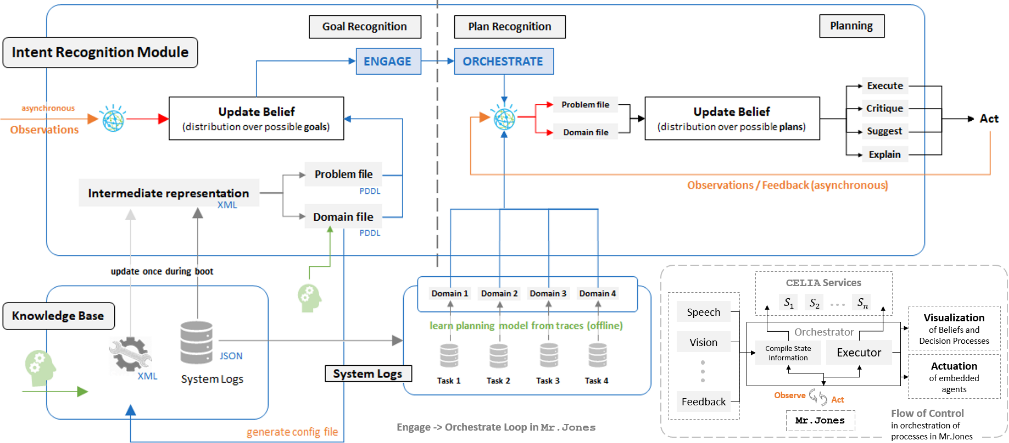
Introducing Mr.Jones - Mr.Jones [Chakraborti et al., 2017c], situated in the CEL - the Cognitive Environments Laboratory - at IBM's T.J. Watson Research Center is designed to embody the key properties of a proactive assistant while fulfilling the properties desired of an XAIP agent. Similar to [Manikonda et al., 2017], we divide the responsibilities of Mr.Jones into two processes (c.f. Figure 1) -- Engage, where plan recognition techniques are used to identify the task in progress; and Orchestrate, which involves active participation in the decision-making process via real-time plan generation, visualization, and monitoring.
Mind of Mr.Jones - The externalization of the "mind" of Mr.Jones - i.e. the various processes that feed the different capabilities of the agent (c.f. Figure 2) - consists of five widgets. The largest widget on the top represents the probability distribution that indicates the confidence of Mr.Jones in identifying the task being collaborated on, along with a button that displays the provenance of each such belief. The information used as provenance is generated directly from the plans used internally by the recognition module [Ramirez and Geffner, 2010] and justifies why, given the model of the underlying planning problems, these tasks look likely in terms of plans that achieve those tasks. The system is adept at handling uncertainty in its inputs (it is interesting to note that in coming up with an explanatory plan, it has announced likely assignments to unknown agents in its space).
Below this is a set of four widgets, each of which give users a peek into an internal component of Mr.Jones. The first of them (top left) presents a wordcloud representation of Mr.Jones's belief in each of the tasks; the size of the word representing that task corresponds to the probability associated with that task. The second widget (top right) shows the agents that are recognized as being in the environment currently - this information is used by the system to determine what kind of task is more likely. This information is obtained from four independent camera feeds that give Mr.Jones an omnispective view of the environment; this information is represented via snapshots (sampled at 10-20 Hz) in the third widget (bottom left). Finally, the fourth widget (bottom right) represents a wordcloud based summarization of the audio transcript of the environment. This transcript provides a succinct representation of the things that have been said in the environment in the recent past via the audio channels. The interface thus provides a (constantly updating) snapshot of the various sensory and cognitive organs associated with Mr.Jones - the eyes, ears, and mind of the CEL. This is organized at increasing levels of abstraction -
- Raw Inputs - These show the camera feeds and voice capture (speech to text outputs) as received by the system. These help in externalizing what information the system is working with at any point of time, and can be used in debugging at the input level if the system makes a mistake or in determining whether it is receiv-
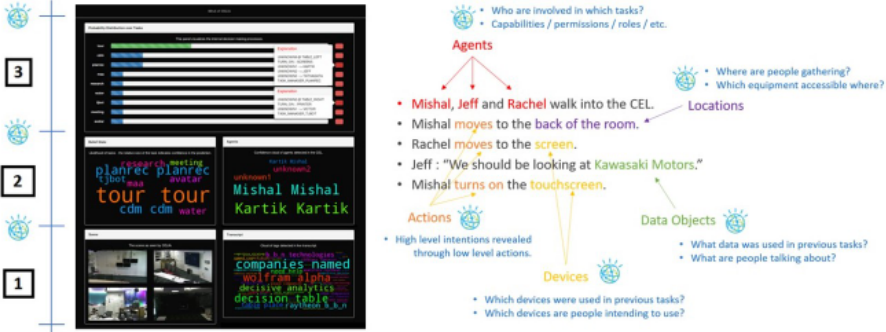
ing enough information to make the right decisions. It is especially useful for an agent like Mr.Jones, which is not embodied in a single robot or interface but is part of the environment as a whole; in such cases, it is difficult to attribute specific events and outcomes to the agent.
- Lower level reasoning - The next layer deals with the first stage of reasoning over the raw inputs - What are the topics being talked about? Who are the agents in the room? Where are they situated? This helps a user identify what knowledge is being extracted from the input layer and fed into the reasoning engines. It increases the situational awareness of agents by visually summarizing the contents of the scene at any point of time.
- Higher level reasoning - Finally, the top layer uses information extracted at the lower levels to reason about abstract tasks in the scene. It visualizes the outcome of
- the plan recognition process, along with the provenance of the information extracted from the lower levels. This layer puts into context the agent's current understanding of the processes in the scene.
In addition to this, we support a plan visualization tool Fresco [Chakraborti et al., 2017a], that builds on recent work in top-K planning [Katz et al., 2018] and model-based plan explanations [Chakraborti et al., 2017b] to provide a concise visualization of a plan. A detailed description of the system can be accessed at https://arxiv.org/abs/1709.04517.
Acknowledgments
A significant part of this work was completed while Tathagata Chakraborti was an intern at IBM's T. J. Watson Research Center. The continuation of his work at Arizona State University is supported by an IBM Ph.D. Fellowship.
@inproceedings{ijcai2018p849,
  title     = {Visualizations for an Explainable Planning Agent},
  author    = {Chakraborti, Tathagata and Fadnis, Kshitij P. and Talamadupula, Kartik and Dholakia, Mishal and Srivastava, Biplav and Kephart, Jeffrey O. and Bellamy, Rachel K. E.},
  booktitle = {Proceedings of the Twenty-Seventh International Joint Conference on
               Artificial Intelligence, {IJCAI-18}},
  publisher = {International Joint Conferences on Artificial Intelligence Organization},
  editor    = {Jérôme Lang},
  pages     = {5820--5822},
  year      = {2018},
  month     = {7},
  note      = {Demos},
  doi       = {10.24963/ijcai.2018/849},
  url       = {https://doi.org/10.24963/ijcai.2018/849},
}
TY - CPAPER TI - Visualizations for an Explainable Planning Agent AU - Chakraborti, Tathagata AU - Fadnis, Kshitij P. AU - Talamadupula, Kartik AU - Dholakia, Mishal AU - Srivastava, Biplav AU - Kephart, Jeffrey O. AU - Bellamy, Rachel K. E. T2 - Proceedings of the Twenty-Seventh International Joint Conference on Artificial Intelligence, IJCAI-18 PB - International Joint Conferences on Artificial Intelligence Organization PY - 2018 SP - 5820 EP - 5822 DO - 10.24963/ijcai.2018/849 UR - https://doi.org/10.24963/ijcai.2018/849 ER -Copied
Machine-readable versions of this paper, for tools and AI agents:
 Welcome
 Future Conferences
 AI Journal Division
 IJCAI Proceedings
 About IJCAI
 IJCAI Awards