
Extracting Action Sequences from Texts Based on Deep Reinforcement Learning
Proceedings of the Twenty-Seventh International Joint Conference on Artificial Intelligence. Main track. Pages 4064-4070.
https://doi.org/10.24963/ijcai.2018/565
Keywords
- Planning and Scheduling: Activity and Plan Recognition
- Planning and Scheduling: Planning with Incomplete information
- Machine Learning: Deep Learning
- Natural Language Processing: Natural Language Processing
Abstract
Extracting action sequences from texts is
challenging, as it requires commonsense inferences based on world
knowledge. Although there has been work on extracting action scripts,
instructions, navigation actions, etc., they require either the
set of candidate actions be provided in advance, or action
descriptions are restricted to a specific form, e.g., description
templates. In this paper we aim to extract action sequences from
texts in \emph{free} natural language, i.e., without any restricted
templates, provided the set of actions is unknown. We
propose to extract action sequences from texts based on the deep
reinforcement learning framework. Specifically, we view ``selecting''
or ``eliminating'' words from texts as ``actions'', and texts associated with actions as ``states''. We build Q-networks to learn policies of extracting actions and extract plans from the labeled texts. We demonstrate the effectiveness of our approach on several datasets with comparison to state-of-the-art approaches.
- [Branavan et al., 2009] S. R. K. Branavan, Harr Chen, Luke S. Zettlemoyer, and Regina Barzilay. Reinforcement learning for mapping instructions to actions. In ACL, 2009.
- [Chen and Mooney, 2011] David L. Chen and Raymond J. Mooney. Learning to interpret natural language navigation instructions from observations. In AAAI, 2011.
- [Cresswell et al., 2009] Stephen Cresswell, Thomas Leo McCluskey, and Margaret Mary West. Acquisition of object-centred domain models from planning examples. In ICAPS, 2009.
- [Daniele et al., 2017] Andrea F Daniele, Mohit Bansal, and Matthew R Walter. Navigational instruction generation as inverse reinforcement learning with neural machine trans- lation. In HRI, 2017.
- [Kim and Mooney, 2013] Joohyun Kim and Raymond J. Mooney. Unsupervised pcfg induction for grounded lan- guage learning with highly ambiguous supervision. In EMNLP, 2013.
- [Kim, 2014] Yoon Kim. Convolutional neural networks for sentence classification. In EMNLP, 2014.
- [Lindsay et al., 2017] Alan Lindsay, Jonathon Read, João F. Ferreira, Thomas Hayton, Julie Porteous, and Peter Gre- gory. Framer: Planning models from natural language ac- tion descriptions. In ICAPS, 2017.
- [Ma and Hovy, 2016] Xuezhe Ma and Eduard H. Hovy. End- to-end sequence labeling via bi-directional lstm-cnns-crf. In ACL, 2016.
- [Macmahon et al., 2006] Matt Macmahon, Brian Stankiewicz, and Benjamin Kuipers. Walk the talk: Connecting language, knowledge, and action in route instructions. In AAAI, 2006.
- [Mei et al., 2016] Hongyuan Mei, Mohit Bansal, and Matthew R. Walter. Listen, attend, and walk: neural mapping of navigational instructions to action sequences. In AAAI, 2016.
- [Mikolov et al., 2013] Tomas Mikolov, Ilya Sutskever, Kai Chen, Greg S Corrado, and Jeff Dean. Distributed rep- resentations of words and phrases and their composition- ality. In NIPS, 2013.
- [Mnih et al., 2015] V Mnih, K Kavukcuoglu, D Silver, A. A. Rusu, J Veness, M. G. Bellemare, A Graves, M Ried- miller, A. K. Fidjeland, and G Ostrovski. Human-level control through deep reinforcement learning. Nature, 518(7540):529-33, 2015.
- [Narasimhan et al., 2015] Karthik Narasimhan, Tejas D. Kulkarni, and Regina Barzilay. Language understanding for text-based games using deep reinforcement learning. In EMNLP, 2015.
- [Pomarlan et al., 2017] Mihai Pomarlan, Sebastian Ko- ralewski, and Michael Beetz. From natural language in- structions to structured robot plans. In KI, 2017.
- [Reimers and Gurevych, 2017] Nils Reimers and Iryna Gurevych. Reporting score distributions makes a differ- ence: Performance study of lstm-networks for sequence tagging. In EMNLP, 2017.
- [Sil and Yates, 2011] Avirup Sil and Alexander Yates. Ex- tracting STRIPS representations of actions and events. In RANLP, 2011.
- [Sil et al., 2010] Avirup Sil, Fei Huang, and Alexander Yates. Extracting action and event semantics from web text. In AAAI, 2010.
- [Wang et al., 2017] Jin Wang, Zhongyuan Wang, Dawei Zhang, and Jun Yan. Combining knowledge with deep convolutional neural networks for short text classification. In IJCAI, 2017. IJCAI
- [Zhang and Wallace, 2015] Ye Zhang and Byron C. Wal- lace. A sensitivity analysis of (and practitioners' guide to) convolutional neural networks for sentence classification. CoRR, abs/1510.03820, 2015.
- [Zhuo and Kambhampati, 2017] Hankz Hankui Zhuo and Subbarao Kambhampati. Model-lite planning: Case-based vs. model-based approaches. Artif. Intell., 246:1-21, 2017.
- [Zhuo and Yang, 2014] Hankz Hankui Zhuo and Qiang Yang. Action-model acquisition for planning via transfer learning. Artif. Intell., 212:80-103, 2014.
- [Zhuo et al., 2014] Hankz Hankui Zhuo, Héctor Muñoz- Avila, and Qiang Yang. Learning hierarchical task network domains from partially observed plan traces. Artif. Intell., 212:134-157, 2014.
References were extracted automatically from the PDF and may contain errors.
Full text extracted automatically from the PDF; figures, tables and equations may differ. The PDF is the version of record.
1 Introduction
AI agents will increasingly find assistive roles in homes, labs, factories and public places. The widespread adoption of conversational agents such as Alexa, Siri and Google Home demonstrate the natural demand for such assistive agents. To go beyond supporting the simplistic "what is the weather?" queries however, these agents need domain-specific knowledge such as the recipes and standard operating procedures. While it is possible to hand-code such knowledge (as is done by most of the "skills" used by Alexa-like agents), ultimately that is too labor intensive an option. One idea is to have these agents automatically "read" instructional texts, typically written for human workers, and convert them into action sequences and plans for later use (such as learning domain models [Zhuo et al., 2014; Zhuo and Yang, 2014] or model-lite planning [Zhuo and Kambhampati, 2017]). Extracting action sequences from natural language texts meant for human consumption is however challenging, as it requires agents to understand complex contexts of actions.
∗Corrsponding Author
For example, in Figure 1, given a document of action descriptions (the left part of Figure 1) such as "Cook the rice the day before, or use leftover rice in the refrigerator. The important thing to remember is not to heat up the rice, but keep it cold.", which addresses the procedure of making egg fired rice, an action sequence of "cook(rice), keep(rice, cold)" or "use(leftover rice), keep(rice, cold)" is expected to be extracted. This task is challenging. For the first sentence, the agent needs to learn to figure out that "cook" and "use" are exclusive (denoted by "EX" in the middle of Figure 1), meaning that we could extract only one of them; for the second sentence, we need to learn to understand that among the three verbs "remember", "heat" and "keep", the last one is the best because the goal of this step is to "keep the rice cold" (denoted by "ES" indicating this action is essential). There is also another action "Recycle" denoted by "OP" indicating this action can be extracted optionally. We also need to consider action arguments which can be either "EX" or "ES" as well (as shown in the middle of Figure 1). The possible action sequences extracted are shown in the right part of Figure 1. This extraction problem is different from sequence labeling and dependency parsing, since we aim to extract "meaningful" or "correct" action sequences (which suggests some actions should be ignored because they are exclusive), such as "cook(rice), keep(rice, cold)", instead of "cook(rice),use(leftover rice), remember(thing), heat(rice), keep(rice, cold)" as would be extracted by LSTMCRF models[Ma and Hovy, 2016] or external NLP tools.
There has been work on extracting action sequences from action descriptions. For example, [Branavan et al., 2009] propose to map instructions to sequences of executable actions using reinforcement learning. [Mei et al., 2016; Daniele et al., 2017] interpret natural instructions as action sequences or generate navigational action description using an encoderaligner-decoder structure. Despite the success of those approaches, they all require a limited set of action names given as input, which are mapped to action descriptions. Another approach, proposed by [Lindsay et al., 2017], builds action sequences from texts based on dependency parsers and then builds planning models, assuming texts are in restricted templates when describing actions.
In this paper, we aim to extract meaningful action sequences from texts in free natural language, i.e., without any restricted templates, even when the candidate set of actions
Input Training Text
Extracting Action Names and Action Arguments
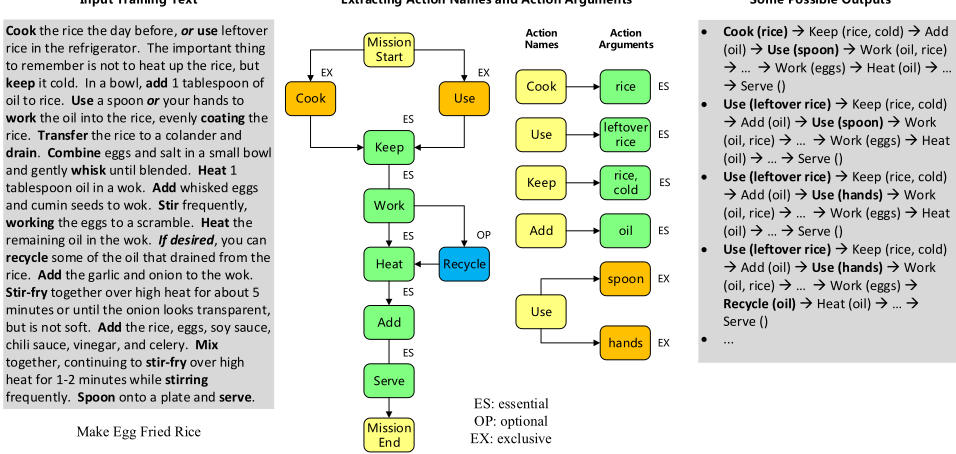
is unknown. We propose an approach called EASDRL, which stands for Extracting Action Sequences from texts based on Deep Reinforcement Learning. In EASDRL, we view texts associated with actions as "states", and associating words in texts with labels as "actions", and then build deep Q-networks to extract action sequences from texts. We capture complex relations among actions by considering previously extracted actions as parts of states for deciding the choice of next operations. In other words, once we know action "cook(rice)" has been extracted and included as parts of states, we will choose to extract next action "keep(rice, cold)" instead of "use(leftover rice)" in the above-mentioned example.
In the remainder of paper, we first review previous work related to our approach. After that we give a formal definition of our plan extraction problem and present EASDRL in detail. We then evaluate EASDRL with comparison to state-of-theart approaches and conclude the paper with future work.
2 RelatedWork
There have been approaches related to our work besides the ones we mentioned in the introduction section. Mapping route instructions [Macmahon et al., 2006] to action sequences has aroused great interest in natural language processing community. Early approaches, such as [Chen and Mooney, 2011; Kim and Mooney, 2013], largely depend on specialized resources, i.e. semantic parsers, learned lexicons and re-rankers. Recently, LSTM encoder-decoder structure [Mei et al., 2016] has been applied to this problem and gets decent performance in processing single-sentence instructions, however, it could not handle multi-sentence texts well.
There is also a lot of work on learning STRIPS representation actions [Pomarlan et al., 2017] from texts. [Sil et al., 2010; Sil and Yates, 2011] learn sentence patterns and lexicons or use off-the-shelf toolkits, i.e., OpenNLP 1 and Stanford CoreNLP 2 . [Lindsay et al., 2017] also build action models with the help of LOCM [Cresswell et al., 2009] after extracting action sequences by using NLP tools. These tools are trained for universal natural language processing tasks, they cannot solve the complex action sequence extraction problem well, and their performance will be greatly affected by POS-tagging and dependency parsing results. In this paper we aim to build a model that learns to directly extract action sequences without external tools.
3 ProblemDefinition
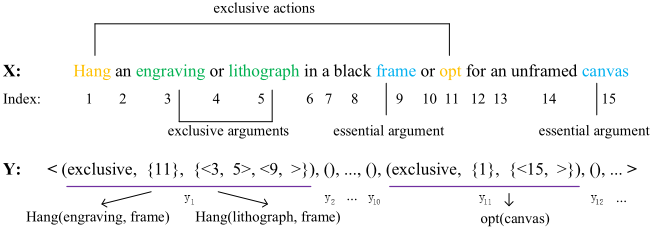
Our training data can be defined by Φ = {〈X, Y 〉}, where X = 〈w1,w2, . . . ,wN〉 is a sequence of words and Y = 〈y1, y2, . . . , yN〉 is a sequence of annotations. If wi is not an action name, yi is ∅. Otherwise, yi is a tuple (ActType, {ExActId}, {〈ArgId,ExArgId〉}) to describe type of the action name and its corresponding arguments. ActType indicates the type of action ai corresponding to wi, which can be one of essential, optional and exclusive. The type essential suggests the corresponding action ai to be extracted, optional suggests ai that can be "optionally" extracted, exclusive suggests ai that is "exclusive" with other actions indicated by the set {ExActId} (in other words, either ai or exactly one action in {ExActId} can be extracted). ExActId is the index of the action exclusive with ai. We denote the size of {ExActId} by M, i.e., |{ExActId}| =M.
1 https://opennlp.apache.org/
2 http://stanfordnlp.github.io/CoreNLP/
Some Possible Outputs
Note that "M = 0" indicates the type ActType of action ai is either essential or optional, and "M ̸= 0" indicates ActType is exclusive. ArgId is the index of the word composing arguments of ai, and ExArgId is the index of words exclusive with ArgId. For example, as shown in Figure 2, given a text denoted by X, its corresponding annotation is shown in the figure denoted by Y . In y1, "{11}" indicates the action exclusive with w1 (i.e., "Hang") is "opt" with index 11. "{〈3, 5〉, 〈9, 〉}" indicates the corresponding arguments "engraving" and "lithograph" are exclusive, and the other argument "frame" with index 9 is essential since it is exclusive with an empty index, likewise for y11. For y2, . . . , y10 and y12, . . . , y15, they are empty since their corresponding words are not action names. From Y , we can generate three possible actions as shown at the bottom of Figure 2.
As we can see from the training data, it is uneasy to build a supervised learning model to directly predict annotations for new texts X, since annotations yi is complex and the size |yi| varies with respect to different wi (different action names have different arguments with different lengths). We seek to build a unified framework to predict simple "labels" (corresponding to "actions" in reinforcement learning) for extracting action names and their arguments. We exploit the framework to learn two models to predict action names and arguments, respectively. Specifically, given a new text X, we would like to predict a sequence of operations O = 〈o1, o2, . . . , oN〉 (instead of annotations in Φ) on X, where oi is an operation that selects or eliminates word wi in X. In other words, when predicting action names (or arguments), oi = Select indicates wi is extracted as an action name (or argument), while oi = Eliminate indicates wi is not extracted as an action name (or argument).
In summary, our action sequence extraction problem can be defined by: given a set of training data Φ, we aim to learn two models (with the same framework) to predict action names and arguments for new texts X, respectively. The two models are
and
where θ1 and θ2 are parameters to be learnt for predicting action names and arguments, respectively. a is an action name extracted based on F 1Φ. We train F 2Φ for extracting arguments based on ground-truth action names. When testing, we extract arguments based on the action names extracted by F 1Φ. We will present the two models in detail in the following sections.
4 Our EASDRL Approach
In this section we present the details of EASDRL. As mentioned in the introduction section, our action sequence extraction problem can be viewed as a reinforcement learning problem. We thus first describe how to build states and operations given text X, and then present deep Q-networks to build the Q-functions. Finally we present the training procedure and give an overview of EASDRL. Note that we will use the term operation to represent the meaning of "action" in reinforcement learning since the term "action" has been used to represent an action name with arguments in this work.
4.1 Generating State Representations
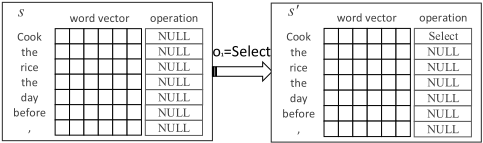
In this subsection we address how to generate state representations from texts. As defined in the problem definition section, the space of operations is {Select,Eliminate}. We view texts associated with operations as "states". Specifically, we represent a text X by a sequence of vectors 〈w1,w2, . . . ,wN〉, where wi ∈ RK1 is a K1-dimension real-valued vector [Mikolov et al., 2013], representing the ith word in X. Words of texts stay the same when we perform operations, so we embed operations in state representations to generate state transitions. We extend the set of operations to {NULL, Select, Eliminate} where "NULL" indicates a word has not been processed. We represent the operation sequence O corresponding to X by a sequence of vectors 〈o1, o2, . . . , oN〉, where oi ∈ RK2 is a K2-dimension real-valued vector. In order to balance the dimension of oi and wi, we generate each oi by a repeat-representation [·]K2 , i.e., if K2 = 1, oi ∈ {[0], [1], [2]}, and if K2 = 3, oi ∈ {[0, 0, 0], [1, 1, 1], [2, 2, 2]}, where {0, 1, 2} corresponds to {NULL, Select,Eliminate}, respectively. We define a state s as a tuple 〈X, O〉, where X is a matrix in RK1×N , O is a matrix in RK2×N . The ith row of s is denoted by [wi, oi]. The space of states is denoted by S. A state s is changed into a new state s′ after performing an operation o′i on s, such that s′ = 〈X, O′ 〉, where O′ = 〈o1, . . . , oi-1, o′i , oi+1, . . . , oN〉. For example, consider a text "Cook the rice the day before..." and a state s corresponding to it is shown in the left part of Figure 3. After performing an operation o1 = Select on s, a new state s′ (the right part) will be generated. In this way, we can learn θ1 in F 1Φ (Equation (1)) based on s with deep Q-networks as introduced in the next subsection.
After F 1Φ is learnt, we can use it to predict action names, and then exploit the predicted action names to extract arguments by training F 2Φ (Equation (2)). To do this, we would like to encode the predicted action names in states to generate a new state representation ˆ s for learning θ2 in F 2Φ. We denote by wa the word corresponding to the action name. We build ˆ s by appending the distance between wa and wj based on their indices, such that ˆ s = 〈X, D, O〉, where D = 〈d1, d2, . . . , dN〉, where dj = [dj]K3 and dj = |a-j|. Note that dj is a K3-dimension real-valued vector using repeatrepresentation [·]K3 . In this way we can learn F 2Φ based on ˆ s with the same deep Q-networks. Note that in our experiments, we found that the results were the best when we set K1 = K2 = K3, suggesting the impact of word vectors, distance vectors and operation vectors was generally identical.
4.2 Deep Q-networks for Operation Execution
Given the formulation of states and operations, we aim to extract action sequences from texts. We construct sequences by repeatedly choosing operations given current states, and applying operations on current states to achieve new states.
In Q-Learning, this process can be described by a Qfunction and updating the Q-function iteratively according to Bellman equation. In our action sequence extraction problem, actions are composed of action names and action arguments. We need to first extract action names from texts and use the extracted action names to further extract action arguments. Specifically, we define two Q-functions Q(s, o) and Q(ˆ s, o), where ˆ s contains the information of extracted action names, as defined in the last subsection. The update procedure based on Bellman equation and deep Q-networks can be defined by:
where Qi+1(s, o; θ1) and Qi+1(ˆ s, o; θ2) correspond to the deep Q-networks [Mnih et al., 2015] for extracting action names and arguments, respectively. As i → ∞, Qi → Q∗ . In this way, we can define F 1Φ = Q∗ (s, o; θ1) and F 2Φ = Q∗ (ˆ s, o; θ2) in Equations (1) and (2), and then use F 1Φ and F 2Φ to extract action names and arguments, respectively.
Since Convolutional Neural Networks (CNNs) are effective in natural language processing [Kim, 2014; Zhang and Wallace, 2015; Wang et al., 2017], we build CNN models to learn Q(s, o, θ1) and Q(ˆ s, o, θ2). We adopt the CNN Architecture of [Zhang and Wallace, 2015]. To build the kernels of our CNN models, we test from uni-gram context to ten-gram context and observe that five-word context works well in our task. We thus design four types of kernels, which correspond to bigram, trigram, four-gram and five-gram, respectively.
4.3 Computing Rewards
In this subsection we compute the reward r based on state s and operation o. Specifically, r is composed of two parts, i.e., basic reward and additional reward. For the basic reward at time step τ, denoted by rb,τ , if a word is not an item (we use item to represent action name or action argument when it is not confused), rb,τ is +50 when the operation is correct and -50 otherwise. If a word is an essential item, rb,τ = +100 when the operation is correct and rb,τ = -100 when it is incorrect. If the word is an optional item, rb,τ = +100 when the operation is correct and rb,τ = 0 when it is incorrect. If a word is an exclusive item, rb,τ = +150 when the operation is correct and rb,τ = -150 when it is incorrect. We denote that an operation is correct when it selects essential items, selects optional items, selects only one item of exclusive items or eliminates words that are not items.
Note that action names are key verbs of a text and action arguments are some nominal words, so the percentage of these words in a text is closely related to action sequence extraction process. We thus calculate the percentage, namely an item rate, denoted by δ = #Item #Word , where #Item indicates the amount of action names or action arguments in all the annotated texts and #Word indicates the total number of words of these texts. We define a real-time item rate as δτ to denote the percentage of words that have been selected as action names or action arguments in a text after τ training steps, and δ0 = 0. On one hand, when δτ-1 ≤ δ, a positive additional reward is added to rb,τ if rb,τ ≥ 0 (i.e., the operation is correct), otherwise a negative additional reward is added to rb,τ . On the other hand, when δτ > δ, which means that words selected as action names or action arguments are out of the expected number and it is more likely to be incorrect if subsequent words are selected, then a negative additional reward should be added to the basic reward. In this way, the reward rτ at time step τ can be obtained by Equation (5),
where c is a positive constant and 0 ≤ δτ-1 < 1.
4.4 Training Our Model
To learn the parameters θ1 and θ2 of our two DQNs, we store transitions 〈s, o, r, s′ 〉 and 〈ˆ s, o, r, ˆ s′ 〉 in replay memories Ω and ˆΩ, respectively, and exploit a mini-batch sampling strategy. As indicated in [Narasimhan et al., 2015], transitions that provide positive rewards can be used more often to learn optimal Q-values faster. We thus develop a positive-rate based experience replay instead of randomly sampling transitions from Ω (or ˆΩ), where positive-rate indicates the percentage of transitions with positive rewards. To do this, we set a positive rate ρ(0 < ρ < 1) and require the proportion of positive samples in each mini-batch be ρ.
We present the learning procedure of EASDRL in Algorithm 1, for building F 1Φ. We can simply replace s1, Ω and θ1 with ˆ s1, ˆΩ and θ2 for building F 2Φ. In Step 4 of Algorithm 1, we generate the initial state s1 (ˆ s1 for learning F 2Φ) for each training data Φ = {〈X, Y 〉} by setting all operations oi in s1 to be NULL. We perform N steps to execute one of the operations {Select,Eliminate} in Steps 6, 7 and 8. From Steps 10 and 11, we do a positive-rate based experience replay according to positive rate ρ. From Steps 12 and 13, we update parameters θ1 using gradient descent on the loss L(θ1) = (yj - Q(sj , oj ; θ1))2 as shown in Step 13.
With Algorithm 1, we are able to build Q(s, o; θ1) and execute operations {Select,Eliminate} to a new text by iteratively maximizing Q(s, o; θ1). Once we obtain operation sequences, we can generate action names and use them to build Q(ˆ s, o; θ2) with ˆΩ and the same framework of Algorithm 1. We then exploit the built Q(ˆ s, o; θ2) to extract action arguments. As a result, we can extract action sequences from texts using both of the built Q(s, o; θ1) and Q(ˆ s, o; θ2).
Algorithm 1 Our EASDRL algorithm
Input: a training set Φ, positive rate ρ, item rate δ
Output: the parameters θ1 1: Initialize Ω = ∅, CNNwith random values for θ1 2: for epoch = 1: H do 3: for each training data 〈X, Y 〉 ∈ Φ do 4: Generate the initial state s1 based on X 5: for τ = 1: N do 6: Perform an operation oτ with probability ϵ 7: Otherwise select oτ = max o Q(sτ , o; θ1) 8: Perform oτ on sτ to generate sτ+1 9: Calculate rτ based on sτ+1, oτ , Y and δ 10: Store transition (sτ , oτ , rτ , sτ+1) in Ω 11: Sample (sj , oj , rj , sj+1) from Ω based on ρ 12: Set yj = {rj for terminal sj+1 rj + γ max o′ Q(sj+1, o′ ; θ1) otherwise 13: Update θ1 based on loss function L(θ1) 14: end for 15: end for 16: end for 17: return The parameters θ15 Experiments
5.1 Datasets and EvaluationMetric
We conducted experiments on three datasets, i.e., "Microsoft Windows Help and Support" (WHS) documents [Branavan et al., 2009], and two datasets collected from "WikiHow Home and Garden" 3 (WHG) and "CookingTutorial" 4 (CT). Details are presented in Table 1. Supervised learning models require that training data are one-to-one pairs (i.e. each word has a unique label), so we generate input-texts-to-output-labels based on annotation Y (as defined in Section 3). In our task, a single text with n optional items or n exclusive pairs can generate more than 2n potential label sequences (i.e. each item of them can be extracted or not be extracted). Especially, we observe that n is larger than 30 in some texts of our datasets, which means more than 1 billion sequences will be generated. We thus restrict n ≤ 8 (no more than 28 label sequences) to generate reasonable number of sequences.
| WHS | CT | WHG | |
|---|---|---|---|
| Labeled texts | 154 | 116 | 150 |
| Input-output pairs | 1.5K | 134K | 34M |
| Action name rate (%) | 19.47 | 10.37 | 7.61 |
| Action argument rate (%) | 15.45 | 7.44 | 6.30 |
| Unlabeled texts | 0 | 0 | 80 |
For evaluation, we first feed test texts to each model to output sequences of labels or operations. We then extract action sequences based on these labels or operations. After that, we compare these action sequences to their corresponding annotations and calculate #TotalTruth (total ground truth items), #TotalTagged (total extracted items), #TotalRight (total correctly extracted items). Finally we compute metrics: precision = #TotalRight #TotalTagged , recall = #T otalRight #TotalTruth , and F1 = 2×precision×recall precision+recall . We randomly split each dataset into 10 folds, calculated an average of performance over 10 runs via 10-fold cross validation, and used the F1 metric to validate the performance in our experiments.
5.2 Experimental Results
We compare EASDRL to four baselines, as shown below:
- STFC: Stanford CoreNLP, an off-the-shelf tool, denoted by STFC, extracts action sequences by viewing root verbs as action names and objects as action arguments [Lindsay et al., 2017].
- BLCC: Bi-directional LSTM-CNNs-CRF model [Ma and Hovy, 2016; Reimers and Gurevych, 2017] is a state-of-the-art sequence labeling approach. We finetuned parameters of the approach, including character embedding, embedding size, dropout rate, etc., and denoted the resulting approach by BLCC.
- EAD: The Encoder-Aligner-Decoder approach maps instructions to action sequences proposed by [Mei et al., 2016], denoted by EAD.
- CMLP: We consider a Combined Multi-layer Perceptron (CMLP), which consists of N MLP classifiers. N = 500 for action names extraction and N = 100 for action arguments extraction. Each MLP classifier focuses on not only a single word but also the k-gram context.
3 https://www.wikihow.com/Category:Home-and-Garden
4 http://cookingtutorials.com/
| Action Names | Action Arguments | |||||
|---|---|---|---|---|---|---|
| Method | WHS | CT | WHG | WHS | CT | WHG |
| EAD-2 | 86.25 | 64.74 | 53.49 | 57.71 | 51.77 | 37.70 |
| EAD-8 | 85.32 | 61.66 | 48.67 | 57.71 | 51.77 | 37.70 |
| CMLP-2 | 83.15 | 83.00 | 67.36 | 47.29 | 34.14 | 32.54 |
| CMLP-8 | 80.14 | 73.10 | 53.50 | 47.29 | 34.14 | 32.54 |
| BLCC-2 | 90.16 | 80.50 | 69.46 | 93.30 | 76.33 | 70.32 |
| BLCC-8 | 89.95 | 72.87 | 59.63 | 93.30 | 76.33 | 70.32 |
| STFC | 62.66 | 67.39 | 62.75 | 38.79 | 43.31 | 42.75 |
| EASDRL | 93.46 | 84.18 | 75.40 | 95.07 | 74.80 | 75.02 |
When comparing with baselines, we adopt the settings used by [Zhang and Wallace, 2015] to build our CNN networks. We set the input dimension to be (500×100) for action names and (100×150) for action arguments, the number of featuremaps to be 32. We used 0.25 dropout on the concatenated max pooling outputs and exploited a 256 dimensional fullyconnected layer before the final two dimensional outputs. We set the replay memory Ω = 100000, discount factor γ = 0.9. We varied ρ from 0.05 to 0.95 with the interval of 0.05 and found the best value is 0.80 (that is why we set ρ = 0.80 in the experiment). We set δ = 0.10 for action names, δ = 0.07 for arguments according to Table 1, the constant c = 50, learning rate of adam to be 0.001, probability ϵ for ϵ-greedy decreasing from 1 to 0.1 over 1000 training steps.
Comparison with Baselines
We set the restriction n = 2 and n = 8 for EAD, CMLP and BLCC which need one-to-one sequence pairs, and no restriction for STFC and EASDRL. In all of our datasets, the arguments of an action are either all essential arguments or one exclusive argument pair together with all other essential arguments, which means at most 21 sequences can be generated. Therefore, the results of action arguments extraction are identical when n = 2 and n = 8. The experimental results are shown in Table 2. From Table 2, we can see that EASDRL performs the best on extracting both action names and action arguments in most datasets, except for CT dataset. We observe that the number of arguments in most texts of the CT dataset is very small, such that BLCC performs well on extracting arguments in the CT dataset. On the other hand, we can also observe that BLCC, EAD and CMLP get worse performance when relaxing the restriction on n (n = 2 and n = 8). The reason is that when given a single text with many possible output sequences, these models learn common parts (essential items) of outputs, neglecting the different parts (optional or exclusive items). We can also see that both sequence labeling method and encoder-decoder structure do not work well, which exhibits that, in this task, our reinforcement learning framework can indeed outperform traditional methods.
In order to test and verify whether or not our EASDRL method can deal with complex action types well, we compare with baselines in extracting exclusive action names and exclusive action arguments. Results are shown in Table 3. In this part, our EASDRL model outperforms all baselines and leads more than 5% absolutely, which demonstrates the effectiveness of our EASDRL model in this task.
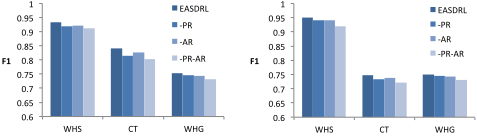
We would like to evaluate the impact of additional reward and positive-rate based experience replay. We test our EASDRL model by removing positive-rate based experience replay (denoted by "-PR") or additional reward (denoted by "-AR"). Results are shown in Figure 4. We observe that removing either positive-rate based experience replay or additional reward degrades the performance of our model.
| Action Names | Action Arguments | |||||
|---|---|---|---|---|---|---|
| Method | WHS | CT | WHG | WHS | CT | WHG |
| EAD-2 | 26.60 | 21.76 | 22.75 | 40.78 | 47.91 | 39.81 |
| EAD-8 | 22.12 | 17.01 | 23.12 | 40.78 | 47.91 | 39.81 |
| CMLP-2 | 31.54 | 54.75 | 51.29 | 35.52 | 25.07 | 29.78 |
| CMLP-8 | 26.90 | 51.80 | 41.03 | 35.52 | 25.07 | 29.78 |
| BLCC-2 | 16.35 | 38.27 | 54.34 | 12.50 | 13.45 | 18.57 |
| BLCC-8 | 19.55 | 35.01 | 41.27 | 12.50 | 13.45 | 18.57 |
| STFC | 46.40 | 50.28 | 44.32 | 50.00 | 46.40 | 50.32 |
| EASDRL | 56.19 | 66.37 | 68.29 | 66.67 | 54.24 | 55.67 |
Online Training Results
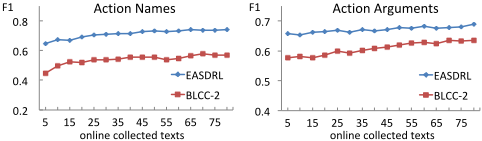
To further test the robustness and self-learning ability of our approach, we design a human-agent interaction environment to collect the feedback from humans. The environment takes a text as input and present the results of EASDRL to humans. Humans adjust the output results, and the environment updates the deep Q-networks of EASDRL based on humans' adjustment. Before online training, we pre-train an initial model of EASDRL by combining all labeled texts of WHS, CT and WHG, with 30 labeled texts of WHG for testing. The accuracy of this initial model is low since it is domainindependent. We then use the unlabeled texts in WHG (i.e., 80 texts as indicated in the last row in Table 1) for online training. We "invited" humans to provide feedbacks for these 80 texts (with an average of 5 texts for each human). When a human finishes the job assigned to him, we update our model (as well as the baseline model). We compare EASDRL to the best offline-trained baseline BLCC-2. Figure 5 shows the results of online training, where "online collected texts" indicates the number of texts on which humans provide feedbacks. We can see that EASDRL outperforms BLCC-2 significantly, which demonstrates the effectiveness of our reinforcement learning framework.
6 Conclusion
In this paper, we proposed a novel approach EASDRL to automatically extract action sequences from texts based on deep reinforcement learning. To the best of our knowledge, EASDRL is the first approach that explores deep reinforcement learning to extract action sequences from texts. We empirically demonstrated that our EASDRL model outperforms state-of-the-art baselines on three datasets. We showed that EASDRL could better handle complex action types and arguments. We also exhibited the effectiveness of EASDRL in an online learning environment. In the future, it would be interesting to explore the feasibility of learning more structured knowledge from texts such as state sequences or action models for supporting planning.
Acknowledgements
Zhuo thanks the National Key Research and Development Program of China (2016YFB0201900), National Natural Science Foundation of China (U1611262), Guangdong Natural Science Funds for Distinguished Young Scholar (2017A030306028), Pearl River Science and Technology New Star of Guangzhou, and Guangdong Province Key Laboratory of Big Data Analysis and Processing for the support of this research. Kambhampati's research is supported in part by the AFOSR grant FA9550-18-1-0067, ONR grants N00014161-2892, N00014-13-1-0176, N00014- 13-1-0519, N00014-15-1-2027, and the NASA grant NNX17AD06G.
@inproceedings{ijcai2018p565,
  title     = {Extracting Action Sequences from Texts Based on Deep Reinforcement Learning},
  author    = {Feng, Wenfeng and Zhuo, Hankz Hankui and Kambhampati, Subbarao},
  booktitle = {Proceedings of the Twenty-Seventh International Joint Conference on
               Artificial Intelligence, {IJCAI-18}},
  publisher = {International Joint Conferences on Artificial Intelligence Organization},
  editor    = {Jérôme Lang},
  pages     = {4064--4070},
  year      = {2018},
  month     = {7},
  note      = {Main track},
  doi       = {10.24963/ijcai.2018/565},
  url       = {https://doi.org/10.24963/ijcai.2018/565},
}
TY - CPAPER TI - Extracting Action Sequences from Texts Based on Deep Reinforcement Learning AU - Feng, Wenfeng AU - Zhuo, Hankz Hankui AU - Kambhampati, Subbarao T2 - Proceedings of the Twenty-Seventh International Joint Conference on Artificial Intelligence, IJCAI-18 PB - International Joint Conferences on Artificial Intelligence Organization PY - 2018 SP - 4064 EP - 4070 DO - 10.24963/ijcai.2018/565 UR - https://doi.org/10.24963/ijcai.2018/565 ER -Copied
Machine-readable versions of this paper, for tools and AI agents:





