
Medical Concept Embedding with Time-Aware Attention
Proceedings of the Twenty-Seventh International Joint Conference on Artificial Intelligence. Main track. Pages 3984-3990.
https://doi.org/10.24963/ijcai.2018/554
Keywords
- Natural Language Processing: Embeddings
- Machine Learning Applications: Bio;Medicine
Abstract
Embeddings of medical concepts such as medication, procedure and diagnosis codes in Electronic Medical Records (EMRs) are central to healthcare analytics. Previous work on medical concept embedding takes medical concepts and EMRs as words and documents respectively. Nevertheless, such models miss out the temporal nature of EMR data. On the one hand, two consecutive medical concepts do not indicate they are temporally close, but the correlations between them can be revealed by the time gap. On the other hand, the temporal scopes of medical concepts often vary greatly (e.g., common cold and diabetes). In this paper, we propose to incorporate the temporal information to embed medical codes. Based on the Continuous Bag-of-Words model, we employ the attention mechanism to learn a ``soft'' time-aware context window for each medical concept. Experiments on public and proprietary datasets through clustering and nearest neighbour search tasks demonstrate the effectiveness of our model, showing that it outperforms five state-of-the-art baselines.
- [Bengio et al., 2003] Yoshua Bengio, Réjean Ducharme, Pascal Vincent, and Christian Jauvin. A neural probabilis- tic language model. JMLR, 3(2):1137-1155, 2003.
- [Bojanowski et al., 2017] Piotr Bojanowski, Edouard Grave, Armand Joulin, and Tomas Mikolov. Enriching word vec- tors with subword information. ACL, 2017.
- [Che et al., 2017] Zhengping Che, Yu Cheng, Zhaonan Sun, and Yan Liu. Exploiting convolutional neural network for risk prediction with medical feature embedding. NIPS- ML4HC, 2017.
- [Chiang et al., 2014] Jane L Chiang, M Sue Kirkman, Lori MB Laffel, and Anne L Peters. Type 1 diabetes through the life span: a position statement of the ameri- can diabetes association. Diabetes care, 37(7):2034-2054, 2014.
- [Choi et al., 2016] Edward Choi, Mohammad Taha Ba- hadori, Elizabeth Searles, Catherine Coffey, and Jimeng Sun. Multi-layer representation learning for medical con- cepts. In SIGKDD, pages 1495-1504, 2016.
- [Choi et al., 2017] Edward Choi, Mohammad Taha Ba- hadori, Le Song, Walter F Stewart, and Jimeng Sun. Gram: Graph-based attention model for healthcare representation learning. In SIGKDD, pages 787-795. ACM, 2017.
- [Choi, 2016] Youngduck Choi. Learning low-dimensional representations of medical concepts. In Proceedings of the AMIA Summit on Clinical Research Informatics(CRI), pages 41-50, 2016.
- [Collobert and Weston, 2008] Ronan Collobert and Jason Weston. A unified architecture for natural language pro- cessing: Deep neural networks with multitask learning. In ICML, pages 160-167. ACM, 2008.
- [De Vine et al., 2014] Lance De Vine, Guido Zuccon, Bevan Koopman, Laurianne Sitbon, and Peter Bruza. Medical se- mantic similarity with a neural language model. In CIKM, pages 1819-1822. ACM, 2014.
- [Ghassemi et al., 2014] Marzyeh Ghassemi, Tristan Nau- mann, Finale Doshi-Velez, Nicole Brimmer, Rohit Joshi, Anna Rumshisky, and Peter Szolovits. Unfolding physio- logical state: Mortality modelling in intensive care units. In SIGKDD, pages 75-84, 2014.
- [Harris, 1954] Zellig S Harris. Distributional structure. Word, 10(2-3):146-162, 1954.
- [Hillestad et al., 2005] Richard Hillestad, James Bigelow, Anthony Bower, Federico Girosi, Robin Meili, Richard Scoville, and Roger Taylor. Can electronic medical record systems transform health care? potential health benefits, savings, and costs. Health affairs, 24(5):1103-1117, 2005.
- [Ling et al., 2015] Wang Ling, Lin Chu-Cheng, Yulia Tsvetkov, and Silvio Amir. Not all contexts are created equal: Better word representations with variable attention. In EMNLP, pages 1367-1372, 2015.
- [Liu et al., 2017] Liping Liu, Francisco Ruiz, Susan Athey, and David Blei. Context selection for embedding models. In NIPS, pages 4819-4828, 2017.
- [Melamud et al., 2016] Oren Melamud, David McClosky, Siddharth Patwardhan, and Mohit Bansal. The role of context types and dimensionality in learning word embed- dings. In NAACL, pages 1030-1040, 2016.
- [Mikolov et al., 2013a] Tomas Mikolov, Kai Chen, Greg Corrado, and Jeffrey Dean. Efficient estimation of word representations in vector space. 2013.
- [Mikolov et al., 2013b] Tomas Mikolov, Ilya Sutskever, Kai Chen, Gregory S. Corrado, and Jeffrey Dean. Distributed representations of words and phrases and their composi- tionality. In NIPS, pages 3111-3119, 2013.
- [Minarro-Giménez et al., 2014] José Antonio Minarro- Giménez, Oscar Marin-Alonso, and Matthias Samwald. Exploring the application of deep learning techniques on medical text corpora. Studies in health technology and informatics, 205:584-588, 2014.
- [Nguyen et al., 2017] Phuoc Nguyen, Truyen Tran, Nilmini Wickramasinghe, and Svetha Venkatesh. Deepr: A convo- lutional net for medical records. IEEE journal of biomed- ical and health informatics, 21(1):22-30, 2017.
- [Pennington et al., 2014] Jeffrey Pennington, Richard Socher, and Christopher D Manning. Glove: Global vectors for word representation. In EMNLP, volume 14, pages 1532-43, 2014.
- [Pham et al., 2016] Trang Pham, Truyen Tran, Dinh Phung, and Svetha Venkatesh. Deepcare: A deep dynamic mem- ory model for predictive medicine. In PAKDD, pages 30- 41. Springer, 2016.
- [Rudolph et al., 2016] Maja Rudolph, Francisco Ruiz, Stephan Mandt, and David Blei. Exponential family embeddings. In NIPS, pages 478-486, 2016.
- [Rumelhart et al., 1988] David E Rumelhart, Geoffrey E Hinton, and Ronald J Williams. Learning representations by back-propagating errors. Cognitive modeling, 5(3):1, 1988.
- [Sun et al., 2012] Jimeng Sun, Fei Wang, Jianying Hu, and Shahram Edabollahi. Supervised patient similarity mea- sure of heterogeneous patient records. ACM SIGKDD Ex- plorations Newsletter, 14(1):16-24, 2012.
- [Suo et al., 2017] Qiuling Suo, Fenglong Ma, Ye Yuan, Mengdi Huai, Weida Zhong, Aidong Zhang, and Jing Gao. Personalized disease prediction using a cnn-based similar- ity learning method. In BIBM, 2017.
- [Tran et al., 2015] Truyen Tran, Tu Dinh Nguyen, Dinh Phung, and Svetha Venkatesh. Learning vector repre- sentation of medical objects via EMR-driven nonnega- tive restricted boltzmann machines (eNRBM). Journal of biomedical informatics, 54:96-105, 2015.
- [Zhu et al., 2016] Zihao Zhu, Changchang Yin, Buyue Qian, Yu Cheng, Jishang Wei, and Fei Wang. Measuring patient similarities via a deep architecture with medical concept embedding. ICDM, pages 749-758, 2016.
References were extracted automatically from the PDF and may contain errors.
Full text extracted automatically from the PDF; figures, tables and equations may differ. The PDF is the version of record.
1 Introduction
The rapid growth in use of Electronic Medical Records (EMRs) offers promises for healthcare analytics [Hillestad et al., 2005], such as chronic disease management and personalized medicine. EMRs contain a wealth of healthcare information, including medication, procedure, diagnosis codes and lab test results. For clinical and educational purposes, these medical concepts have been standardized by well-organized ontologies such as the International Classification of Diseases (ICD) 1 and the National Drug Code (NDC) 2 .
Representations for such medical codes is at the heart of healthcare analytics. One way is to use one-hot vectors to represent medical codes. However, the one-hot vectors are naturally high-dimensional, sparse and can hardly represent the semantic relationships of medical concepts. There has also been some existing work that designs hand-crafted features for healthcare predictive models [Sun et al., 2012, Ghassemi et al., 2014]. Due to the requirement for expert knowledge, the scalability of these methods is limited.
∗The majority of this work was completed while the 1st author was visiting Naitional University of Singapore.
1 http://www.who.int/classification/icd/en 2 http://www.fda.gov
The use of distributed representations is motivated by the successful applications in natural language processing [Bengio et al., 2003, Collobert and Weston, 2008, Mikolov et al., 2013b, Pennington et al., 2014]. Recently, a variety of embedding approaches have emerged as effective methods to learn representations of medical concepts [Minarro-Giménez et al., 2014, De Vine et al., 2014, Tran et al., 2015, Choi, 2016, Choi et al., 2016, Choi et al., 2017]. They all treat medical concepts and EMRs as words and documents respectively. The basic idea behind these models is that similar
words (medical concepts) may share similar contexts [Har-
ris, 1954]. Hence, the key challenge of medical concept em-
bedding is how to represent the contexts of medical concepts
effectively without loss of information.
Medical concepts
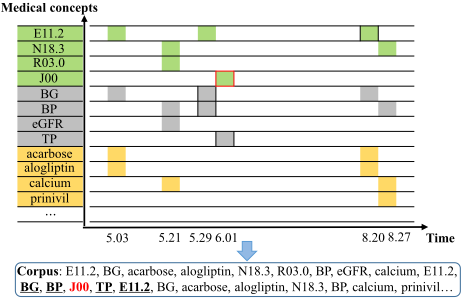
Nevertheless, current methods only consider code cooccurrences within a fixed-size window as indications of contexts. The temporal nature of EMRs has been ignored. Figure 1 illustrates a segment of a patient's EMR data. Given the window size to be 2, conventional methods equally take Blood Glucose (BG, May 29), Blood Pressure (BP, May 29), Temperature (TP, Jun 1) and Diabetes mellitus (E11.2, Aug 20) as the contexts of Common cold (J00, May 29). However, the time gap between J00 (Jun 1) and E11.2 (Aug 20) is more than two months, indicating that these two concepts may not be regarded as contexts of each other. Due to irregular visits of patients, this is very common in EMRs.
One straightforward solution is to define a fixed-size temporal scope to derive code co-occurrences. However, we observe that the scopes of medical codes often vary greatly. For example, common cold often lasts for weeks, while diabetes mellitus typically lasts for years [Chiang et al., 2014]. Therefore, a fixed-size temporal window can hardly satisfy all medical concepts. To tackle the aforementioned challenges, this paper proposes to learn the embeddings and temporal scopes of medical concepts simultaneously. Instead of directly learning a "hard" temporal scope for each medical concept, which is impractical due to the exponential complexity, we learn medical concept embeddings and relations between medical concepts and consecutive time periods simultaneously. Based on the Continuous Bag-of-Words model (CBOW) [Mikolov et al., 2013a], we build a time-aware attention model to learn such "soft" temporal scopes. Each attention weight describes the contribution of medical concepts within a certain time period to predict the central medical concept.
Generally, the contributions of this paper can be summarized as follows.
- We observe the temporal information in EMRs that benefits capturing co-occurred medical concepts. Furthermore, we also find that temporal scopes of medical concepts often vary greatly.
- We propose a time-aware attention model based on CBOW. The model learns representations and "soft" temporal scopes of medical concepts simultaneously.
- We evaluate the effectiveness of the proposed model on two datasets with clustering and nearest neighbor search tasks. The results show that our model outperforms five state-of-the-art models.
2 RelatedWork
The earliest idea of word embeddings dated back to 1988 [Rumelhart et al., 1988]. [Bengio et al., 2003] proposed a neural network model to learn word embeddings, followed by a surge of models [Collobert and Weston, 2008, Mikolov et al., 2013a, Mikolov et al., 2013b, Pennington et al., 2014, Bojanowski et al., 2017]. All of them shared the same principle that words appeared in similar contexts should be similar [Harris, 1954]. Recently, some work has explored the influence of context scopes for neural word embeddings. [Melamud et al., 2016] investigated the influences of context types for the Skip-gram model. [Liu et al., 2017] modeled the probability of the target word conditioned on a subset of the contexts based on the exponential-family embedding model (EF- EMB) [Rudolph et al., 2016]. Closest to our approach, [Ling et al., 2015] introduced an attention model to consider contextual words differently based on the CBOW model.
Following the same idea of word2vec models [Mikolov et al., 2013a, Mikolov et al., 2013b], recent work has applied the models directly to the healthcare domain. [MinarroGiménez et al., 2014] applied the Skip-gram model to medical texts collected from PubMed, Merck Mannuals, etc. [De Vine et al., 2014] took the same model to learn embeddings of UMLS concepts from medical notes and journal abstracts. [Choi, 2016] employed the Skip-gram model to learn the representations of medical concepts from medical journals, medical claims and clinical narratives separately. These work was very close to word embeddings, which was trained on documents. [Tran et al., 2015] embedded medical concepts with an non-negative restricted boltzmann machine in an EMR data set. [Choi et al., 2016] proposed med2vec to learn representations of both features and visits in EMR data based on the Skip-gram model. [Choi et al., 2017] learned task-oriented embeddings of medical concepts and proposed to incorporate well-organized ontologies. All these work treated EMRs in the same way as documents, ignoring the time information. None are aware of the various context scopes of medical concepts, which in return is a main challenge for medical concept embedding.
Medical concept embeddings have been shown to be beneficial to downstream applications, such as predicting diagnoses and patient status [Pham et al., 2016, Che et al., 2017], discovering clinical motifs [Nguyen et al., 2017] and identifying similar patients [Zhu et al., 2016, Suo et al., 2017].
3 Methodology
In this section, we first briefly review the CBOWmodel, and then describe our proposed method in detail.
3.1 CBOW
Given a training corpus, represented as a word sequence W = {w1,w2, . . . ,wN}, The CBOW model [Mikolov et al., 2013a] learns word representations by using the context words within a sliding window to predict the target word. This is achieved by maximizing the average log probability of the occurrences of target words given context words:
where L refers to the size of the context window and Hn = {wn-L, . . . ,wn-1,wn+1, . . . ,wn+L}. The CBOW model learns two vectors for each word. One input vector vwn represents wn as a context word, and one output vector v′wn represents wn as a target word. The hidden representation of context words is obtained by averaging their input vectors, i.e., hn = 1 2L ∑wj∈Hn vwj . The conditional probability in Equation (1) is modeled by a softmax function:
where the word vocabulary is V . To reduce the computational complexity of optimization, the CBOWmodel uses negative sampling to approximate the softmax formulation, which instead maximizes:
Ewx∼P (w)[log σ(-v′wx
⊤hn)] , (3)
where σ is the sigmoid function, and r is the number of negative samples. Each negative sampled context wx follows the unigram distribution raised to 3/4th power, i.e., P (w) = U(w) 34 /A (A is a constant) [Mikolov et al., 2013b]. The computational complexity is proportional to r, which is usually small, e.g., r = 5.
3.2 Medical Concept Embedding
Medical concepts in EMR data are associated with time stamps. As introduced in Section 1, the temporal information in EMR data can benefit medical concept embedding by improving the hidden representations of contexts. Considering the various scopes of medical concepts, we propose a time-
aware attention model to learn better embeddings of medical concepts based on the CBOW model.
Model Architecture
Given a longitudinal EMR data with a finite set of medical concepts C, medical concept embedding aims at learning distributed representations for medical concepts. An EMR sequence consists of several visits of a patient to the hospital, where the visits are ordered temporally and each of them is composed of multiple medical concepts. That is, an EMR sequence can be represented by a sequence of medical concept subsets, where each subset contains medical concepts with the same time stamps. Formally, by defining a time unit, such as a day, a week, a month, etc., an EMR sequence is denoted by E = (E1,E2, . . . ,ET ), where Et is a subset of medical concepts within the tth time unit (Et ⊂ C). We represent Et by Et = {ct,1, ct,2, . . . , ct,Kt }, ct,i ∈ C, where ct,i denotes the ith medical concept of Et and Kt the total number of medical concepts in Et.
Our medical concept embedding model, abbreviated as MCE, is based on the CBOW model. As shown in Figure 2, the MCE model predicts a target medical concept using its surrounding contexts within a sliding window. Similar to CBOW, a medical concept ct,i in MCE is represented by two vectors, one input vector to represent it as a context word, and one output vector to represent it as a target word, which are denoted by vct,i and v′ct,i respectively. TheMCEmodel takes advantage of negative sampling to approximate the following objective of each target-contexts pair:
where ct,i refers to the target medical concept and ht,i the hidden representation of the contexts of ct,i. The negative sample cx is obtained in the same way as the CBOWmodel.
Time-aware Attention
Considering the temporal nature of EMR data, we observe that the medical concepts vary greatly in terms of temporal scopes. One solution is to optimize the best temporal scope for each medical concept, which is impractical due to the exponential complexity. We notice that relations between medical concepts and time periods can be learned from the correlations between medical concepts. For example, common cold is usually related to medical codes that appears within one week from it, which indicates the common cold has larger influence on one week than the other far away periods. To this end, we build a time-aware attention model to learn nonuniform attention weights within a temporal context scope. The temporal context scope is defined as the largest number of time units between the contexts and the target medical concepts. The non-uniform attentions on different time periods are regards as "soft" context scopes in this paper.
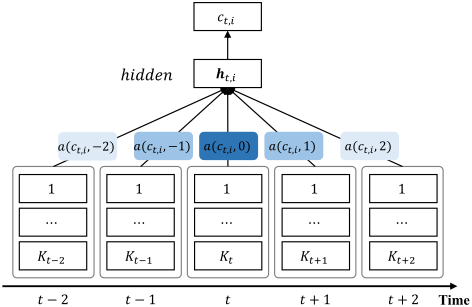
Specifically, we first split an EMR sequence by time units. Medical concepts within a time unit t are represented by Et. Given a temporal context scope S, the contexts of a medical concept ct,i is denoted by Ht,i = {Et-S,Et-S+1, . . . ,Et-1,E′t ,Et+1, . . . ,Et+S}, where S denotes the temporal scope and E′t = {ct,j|ct,j ∈ Et ∧ j ̸= i}. Moreover, we find that there could be large amounts of medical concepts within a visit. To avoid context explosion, which leads to highly computational costs, we limit the largest number of context medical concepts by a threshold Γ, i.e., |Ht,i| ≤ Γ. We will discuss the effects of the temporal window size S and the context threshold Γ in Section 4. The hidden representation is composed by non-uniform weighted context vectors, which incorporates the time-aware attention model:
where ∆q = q - t and a(ct,i,∆q) models an attention level given to contexts within E∆q for predicting the target medical concept ct,i. It is parameterized by the target medical concept and the time gap between each context and the target, i.e.,
where m ∈ R|C|×(2S+1) and b ∈ R2S+1 . Each mc,∆ determines the influence of the medical concept c on relative time period ∆. b is a bias, conditioning on the relative time period only. Taking common cold as an example again, the model finds most contexts within a week are related to common cold. Then the model learns to pay more attentions on this time period (one week), which could be used in next iteration to denoise the irrelevant contexts that are far behind common cold. Hence, our model can improve medical concept embeddings by identifying the related regions and capturing more accurate related target-context pairs.
Parameter Learning
The learning algorithm for our model is stochastic gradient descent. We compute gradients of the loss with regards to the parameters with back-propagation. The learning rate is decayed linearly, as the same for training CBOW.
Compared to the CBOWmodel, the overhead of our model is only the additional computation of attentions. Each operation of computing an attention weight is to fetch two parameters fromm and b. Hence, the complexity of computing the attentions is proportional to the number of contexts, which is limited by the context threshold Γ.
4 Experiments
In experiment, we evaluate the performance of the proposed model on public and proprietary datasets through clustering and nearest neighbour search tasks. The source code is available at https://github.com/XiangruiCAI/mce.
4.1 Datasets
We perform comparative experiments on both public and proprietary datasets listed as follows:
NUH2012 is a real-world dataset provided by National University Hospital of Singapore. This dataset contains EMR data spanning 2012. We extract diagnosis codes, medications, procedures and laboratory test results from this dataset to perform experiments. The diagnosis codes follows the 10th revision of the ICD (ICD-10). 3
DE-SynPUF 4 is a public dataset provided by Centers for Medicare and Medicaid Services (CMS). This dataset contains three years of data (2008-2010), providing inpatient, outpatient and carrier files, along with the beneficiary summary files. Although some variables have been synthesized to minimize the risk of re-identification, the sheer volume of EMR data can still provide useful insights for medical data processing. The diagnosis codes in this dataset follow the ICD-9 standard. 5
We present the statistics of both two datasets in Table 1. It can be observed that DE-SynPUF is a large-scale dataset with more patients, time stamps and unique medical concepts compared to NUH2012. Datasets with different scales are utilized to demonstrate the validity and compatibility of the proposed model.
3 http://www.icd10data.com/ICD10CM/Codes
4 https://www.cms.gov
5 http://www.icd9data.com
| Data set | NUH2012 | DE-SynPUF |
|---|---|---|
| #patients | 30758 | 1984582 |
| #time stamps | 801314 | 106477456 |
| #unique medical concepts | 13382 | 34491 |
| #time stamps / patient | 26.0522 | 53.6523 |
| #codes / time stamp | 6.4164 | 6.3908 |
| max #codes / time stamp | 127 | 78 |
| size after preprocessing | 237MB | 5.4GB |
4.2 Ground Truth
We perform the clustering and nearest neighbour search (NNS) tasks to evaluate the quality of our medical concept embeddings. The ground truth is derived from two wellorganized ontologies, i.e., the ICD standard and Clinic Classifications Software (CCS) 6 . The ICD standard has a hierarchical structure and we use the root-level nodes as the clustering labels. Medical concepts under the same root are expected to be clustered into the same group. For nearest neighbour search, we take medical concepts under the same subroot as near neighbours. We obtain 21 categories and 755,000 near neighbour pairs for NUH2012; we also derive 19 categories and 4,677,706 near neighbour pairs for DE-SynPUF. This set of ground truth is named by Hier in the following sections.
Considering that medical concepts in different ICD subtrees can be semantic related in some cases, we take CCS as complementary clinic classifications that involve expert knowledge. We note that in CCS, both ICD-9 and ICD10 standards have the same 285 categories, which are used to assess the quality of clustering for both datasets. Similar to Hier, medical concepts that appear in the same subcategory are regarded as near neighbors in CCS. Finally, we obtain 53,812 pairs of nearest neighbour for NUH2012 and 2,152,632 pairs for DE-SynPUF. We refer to this set of ground truth as CCS.
4.3 Baselines and Training Details
We compare our model against 5 state-of-the-art models, i.e., Skip-gram, CBOW [Mikolov et al., 2013a, Mikolov et al., 2013b], Glove [Pennington et al., 2014], wang2vec [Ling et al., 2015] and med2vec [Choi et al., 2016]. All these models have been trained with their source code.
For preprocessing the datasets, medical concepts occurred less than 5 times are discarded for all models. During training, the rejection threshold is 10-4 . We use the same negative sampling estimation for CBOW, Skip-gram, wang2vec and our model, and the number of negative samples is 5. The start learning rate is set as 0.05 and 0.025 for Skip-gram and the CBOW-based models respectively. For the proposed model, we set time unit as one week. We note that the maximum number of contexts in our model is set as twice as the context window size W in the baselines, within which the number of contexts is typically 2W. All models are trained with 30 epochs for NUH2012 and 5 epochs for DE-SynPUF. The dimension of medical concept vectors is 100 for all models.
6 https://www.hcup-us.ahrq.gov
| Model | NUH2012 | DE-SynPUF | ||
|---|---|---|---|---|
| Hier | CCS | Hier | CCS | |
| CBOW | 33.73 | 63.20 | 47.17 | 90.33 |
| Skip-gram | 33.22 | 63.96 | 50.12 | 90.36 |
| wang2vec | 28.35 | 59.35 | 53.71 | 91.66 |
| Glove | 17.41 | 55.34 | 45.27 | 87.57 |
| med2vec | 7.51 | 55.52 | - | - |
| MCE | 35.09 | 65.46 | 54.96 | 93.18 |
| Model | NUH2012 | DE-SynPUF | ||
|---|---|---|---|---|
| Hier | CCS | Hier | CCS | |
| CBOW | 14.69 | 29.91 | 31.87 | 88.35 |
| Skip-gram | 14.87 | 30.01 | 32.63 | 91.41 |
| wang2vec | 10.18 | 15.40 | 32.90 | 93.20 |
| Glove | 9.08 | 15.61 | 31.98 | 86.72 |
| med2vec | 3.09 | 4.86 | - | - |
| MCE | 17.74 | 32.85 | 33.88 | 94.84 |
4.4 Results
We perform comparative studies on both public and proprietary datasets through the clustering and nearest neighbour search tasks. To evaluate the performance on clustering, we apply k-means to the learned medical concept embeddings. As mentioned in section 4.3, we set the maximum number of contexts in our model to be 60, twice as large as the window size in the baselines. The temporal scope of our model is 20 (weeks). Two sets of ground truth, i.e., Hier and CCS, are both utilized to evaluate the performance of these models. We note that the results of med2vec on the DE-SynPUF dataset can not be obtained after two weeks of training.
Table 2 reports the normalized mutual information (NMI) for clustering, and Table 3 presents precision@1 (P@1) for NNS. The best results are bold-faced in these tables. From Table 2 and Table 3, we can come to a conclusion that the MCE model outperforms most state-of-the-art models on medical concept embedding. The performance gains of MCE over the other models indicate that, by incorporating the temporal information in EMR data, better medical concept representations can be learned. In addition, among all these models, CBOW and Skip-gram are still competitive to MCE, whereas the performance of med2vec is observed to be the worst on both tasks. For med2vec, we observe that medical concepts with low frequencies are assigned near-zero vectors in this model, which might explain for its poor performance.
Moreover, by comparing the results on two datasets and two sets of ground truth, more useful findings can be obtained from Table 2 and Table 3. First, with the same experimental settings, all listed models achieve better performance on CCS than Hier. Especially for Glove, there is a wide gap between the results on Hier and CCS. This trend might be explained by the expert knowledge involved in CCS. Second, we can observe that models trained with DE-SynPUF perform better than those trained with NUH2012. A possible reason could be that although containing synthesized variables, DE-SynPUF has a larger scale than NUH2012, which provides richer information for medical data processing than the small dataset.
Performance variance with different window sizes. To make fair comparisons, we investigate the performance of these models by varying the context window size. For there is no parameter for window size in med2vec, we only compare the proposed model against four baselines. Specifically, we vary the window size from 10 to 100 for each model. As mentioned in section 4.3, the context threshold for MCE is set twice as large as the window size in the baselines.
We summarize the results on the clustering task in Figure 3. Generally, we can observe that as the window size (context threshold) increases, most models decrease their performance due to the induced noise. Nevertheless, the MCE model always outperforms the rest models in terms of NMI. Specifically, as we increase the window size, the performance of CBOW and Skip-gram decreases significantly, while Glove achieves better performances with larger window size. A possible explanation is that Glove takes use of global cooccurrences, which might benefit from the large window size. The results of wang2vec also get worse as the window size increases. Compared to these models, it can be seen that although getting slightly worse on NUH2012, the MCE model achieves nearly stable performances on DE-SynPUF, which shows its scalability when trained with large-scale datasets.
Similar scenario can be found in Figure 4. The proposed MCE model outperforms the rest competitors, and achieves stable performance on a large-scale EMR dataset DE-SynPUF. The performance of the CBOW and Skip-gram model decreases significantly on DE-SynPUF as the window size increases, while Glove outperforms these two models when trained with a large window size.
4.5 Effects of the Temporal Scope
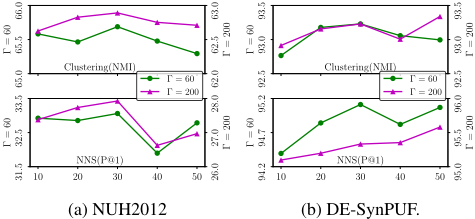
In this work, we propose a temporal scope, and learn attentions for time units within this scope. We investigate the effects of the temporal scope in this section. Figure 5 shows the results of MCE on two datasets with the temporal context scope from 10 to 50. In each sub-figure, we report the performance trained with two different context threshold, i.e., Γ = 60 and Γ = 200 respectively. We note that when Γ is 200, the number of contexts are mainly limited by the temporal scopes. Due to the different ranges of the results, We use two vertical axes for different values of Γ.
As shown in Figure 5a, on NUH2012, both NMI and P@1 get the highest values when the temporal scope is 30 (weeks). Considering that NUH2012 only contains EMR data spanning a year, a 30-week temporal scope is wide enough to cover most EMRs. Nevertheless, the performance decreases when the temporal scope is larger than 30, which could be for the reason of data sparsity. On the contrary, on DE-SynPUF, we observe that MCE achieves higher NMI and P@1 as the temporal context scope and Γ get larger, as shown in Figure 5b, which demonstrates its potentiality on large datasets.


4.6 Qualitative Examples and Visualization
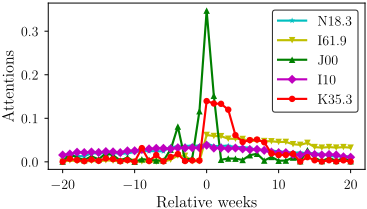
Figure 6 shows the time-aware attentions of sample medical concepts trained on NUH2012. The temporal scope spans 20 weeks before and after the appearance of the medical concepts. With the help of the doctor, we categorize the attention patterns into three types:
- Stable influence. Medical concepts such as chronic kidney disease and essential hypertension, which are associated with chronic diseases and complicated conditions, should have stable influence on every time period.
- Peak influence. Some medical concepts are associated with acute diseases that could be recovered in a short time, such as common cold and appendicitis. They only have a peak influence on a short time span.
- Sequela influence. Some diseases have rare portent, but they are severe, such as nontraumatic intracerebral hemorrhage. Such patients need a long time to recover. These medical concepts have notable influence on subsequently long-term periods.
5 Conclusions
We introduced a model that learned the embedding and a "soft" temporal scope for each medical concept simultaneously. Based on the CBOW model, our model takes advantage of attention mechanisms to learn such temporal scopes. The experimental results on two datasets and two tasks demonstrate the effectiveness of our models compared to state-of-the-art models. Our next plan is to utilize both medical concept embeddings and the "soft" context scopes for healthcare tasks such as missing value imputation.
Acknowledgments
This research is supported by National Natural Science Foundation of China (No. 61772289) and National Research Foundation, Prime Ministers Office, Singapore under CRP Award (No. NRF-CRP8-2011-08). We thank the four anonymous reviewers for their valuable comments on our manuscript. We also thank Sihan Xu for her suggestions on the organization of this paper.
@inproceedings{ijcai2018p554,
  title     = {Medical Concept Embedding with Time-Aware Attention},
  author    = {Cai, Xiangrui and Gao, Jinyang and Ngiam, Kee Yuan and Ooi, Beng Chin and Zhang, Ying and Yuan, Xiaojie},
  booktitle = {Proceedings of the Twenty-Seventh International Joint Conference on
               Artificial Intelligence, {IJCAI-18}},
  publisher = {International Joint Conferences on Artificial Intelligence Organization},
  editor    = {Jérôme Lang},
  pages     = {3984--3990},
  year      = {2018},
  month     = {7},
  note      = {Main track},
  doi       = {10.24963/ijcai.2018/554},
  url       = {https://doi.org/10.24963/ijcai.2018/554},
}
TY - CPAPER TI - Medical Concept Embedding with Time-Aware Attention AU - Cai, Xiangrui AU - Gao, Jinyang AU - Ngiam, Kee Yuan AU - Ooi, Beng Chin AU - Zhang, Ying AU - Yuan, Xiaojie T2 - Proceedings of the Twenty-Seventh International Joint Conference on Artificial Intelligence, IJCAI-18 PB - International Joint Conferences on Artificial Intelligence Organization PY - 2018 SP - 3984 EP - 3990 DO - 10.24963/ijcai.2018/554 UR - https://doi.org/10.24963/ijcai.2018/554 ER -Copied
Machine-readable versions of this paper, for tools and AI agents:





