
Curriculum Adversarial Training
Proceedings of the Twenty-Seventh International Joint Conference on Artificial Intelligence. Main track. Pages 3740-3747.
https://doi.org/10.24963/ijcai.2018/520
Keywords
- Machine Learning: Deep Learning
- Multidisciplinary Topics and Applications: Security and Privacy
Abstract
Recently, deep learning has been applied to many security-sensitive applications, such as facial authentication. The existence of adversarial examples hinders such applications. The state-of-the-art result on defense shows that adversarial training can be applied to train a robust model on MNIST against adversarial examples; but it fails to achieve a high empirical worst-case accuracy on a more complex task, such as CIFAR-10 and SVHN.
In our work, we propose curriculum adversarial training (CAT) to resolve this issue. The basic idea is to develop a curriculum of adversarial examples generated by attacks with a wide range of strengths. With two techniques to mitigate the catastrophic forgetting and the generalization issues, we demonstrate that CAT can improve the prior art's empirical worst-case accuracy by a large margin of 25% on CIFAR-10 and 35% on SVHN. At the same, the model's performance on non-adversarial inputs is comparable to the state-of-the-art models.
- [Aditi Raghunathan, 2018] Percy Liang Aditi Raghunathan, Jacob Steinhardt. Certified defenses against adversarial ex- amples. Proc. of ICLR, 2018.
- [Aman Sinha, 2018] John Duchi Aman Sinha, Hongseok Namkoong. Certifiable distributional ro- bustness with principled adversarial training. Proc. of ICLR, 2018.
- [Anish Athalye, 2018] David Wagner Anish Athalye, Nicholas Carlini. Obfuscated gradients give a false sense of security. Proc. of ICML, 2018.
- [Buckman et al., 2018] Jacob Buckman, Aurko Roy, Colin Raffel, and Ian Goodfellow. Thermometer encoding: One hot way to resist adversarial examples. In Submissions to International Conference on Learning Representations, 2018.
- [Carlini and Wagner, 2017a] Nicholas Carlini and David Wagner. Adversarial examples are not easily detected: By- passing ten detection methods. In Proc. of ACM Workshop on Artificial Intelligence and Security, pages 3-14, 2017.
- [Carlini and Wagner, 2017b] Nicholas Carlini and David Wagner. Towards evaluating the robustness of neural net- works. In Proc. of Euro S & P, pages 39-57, 2017.
- [Chen et al., 2015] Chenyi Chen, Ari Seff, Alain Korn- hauser, and Jianxiong Xiao. Deepdriving: Learning af- fordance for direct perception in autonomous driving. In Proc. of ICCV, pages 2722-2730, 2015.
- [Goodfellow et al., 2015] Ian J Goodfellow, Jonathon Shlens, and Christian Szegedy. Explaining and harnessing adversarial examples. Proc. of ICLR, 2015.
- [He et al., 2016] Kaiming He, Xiangyu Zhang, Shaoqing Ren, and Jian Sun. Deep residual learning for image recog- nition. In Proc. of CVPR, pages 770-778, 2016.
- [He et al., 2017] Warren He, James Wei, Xinyun Chen, Nicholas Carlini, and Dawn Song. Adversarial example defense: Ensembles of weak defenses are not strong. In Proc. of WOOT, 2017.
- [Hinton et al., 2012] Geoffrey Hinton, Li Deng, Dong Yu, George E Dahl, Abdel-rahman Mohamed, Navdeep Jaitly, Andrew Senior, Vincent Vanhoucke, Patrick Nguyen, Tara N Sainath, et al. Deep neural networks for acous- tic modeling in speech recognition: The shared views of four research groups. IEEE Signal Processing Magazine, pages 82-97, 2012.
- [Huang et al., 2017] Gao Huang, Zhuang Liu, Laurens van der Maaten, and Kilian Q Weinberger. Densely con- nected convolutional networks. In Proc. of CVPR, pages 2261-2269, 2017.
- [Kolter and Wong, 2017] J Zico Kolter and Eric Wong. Prov- able defenses against adversarial examples via the convex outer adversarial polytope. arXiv preprint, 2017.
- [Krizhevsky, 2009] Alex Krizhevsky. Learning multiple lay- ers of features from tiny images. 2009.
- [Kurakin et al., 2017] Alexey Kurakin, Ian Goodfellow, and Samy Bengio. Adversarial machine learning at scale. Proc. of ICLR, 2017.
- [LeCun, 1998] Yann LeCun. The mnist database of hand- written digits. 1998.
- [Li et al., 2016] Bo Li, Yevgeniy Vorobeychik, and Xinyun Chen. A general retraining framework for scalable adver- sarial classification. arXiv preprint, 2016.
- [Liu et al., 2017] Yanpei Liu, Xinyun Chen, Chang Liu, and Dawn Song. Delving into transferable adversarial exam- ples and black-box attacks. Proc. of ICLR, 2017.
- [Madry et al., 2018] Aleksander Madry, Aleksandar Makelov, Ludwig Schmidt, Dimitris Tsipras, and Adrian Vladu. Towards deep learning models resistant to adversarial attacks. Proc. of ICLR, 2018.
- [Moosavi-Dezfooli et al., 2017] Seyed-Mohsen Moosavi- Dezfooli, Alhussein Fawzi, Omar Fawzi, and Pascal Frossard. Universal adversarial perturbations. In Proc. of CVPR, pages 86-94, 2017.
- [Netzer et al., 2011] Yuval Netzer, Tao Wang, Adam Coates, Alessandro Bissacco, Bo Wu, and Andrew Y Ng. Reading digits in natural images with unsupervised feature learn- ing. 2011.
- [Papernot et al., 2016a] Nicolas Papernot, Patrick Mc- Daniel, Ian Goodfellow, Somesh Jha, Z Berkay Celik, and Ananthram Swami. Practical black-box attacks against deep learning systems using adversarial examples. arXiv preprint, 2016.
- [Papernot et al., 2016b] Nicolas Papernot, Patrick Mc- Daniel, Xi Wu, Somesh Jha, and Ananthram Swami. Distillation as a defense to adversarial perturbations against deep neural networks. In Proc. of Euro S & P, 2016 IEEE Symposium on, pages 582-597, 2016.
- [Sharma and Chen, 2018] Yash Sharma and Pin-Yu Chen. Attacking the madry defense model with l 1-based adver- sarial examples. Proc. of AAAI, 2018.
- [Silver et al., 2016] David Silver, Aja Huang, Chris J Maddi- son, Arthur Guez, Laurent Sifre, George Van Den Driess- che, Julian Schrittwieser, Ioannis Antonoglou, Veda Pan- neershelvam, Marc Lanctot, et al. Mastering the game of go with deep neural networks and tree search. nature, pages 484-489, 2016.
- [Sun et al., 2014] Yi Sun, Xiaogang Wang, and Xiaoou Tang. Deep learning face representation from predicting 10,000 classes. In Proc. of CVPR, pages 1891-1898, 2014.
- [Szegedy et al., 2013] Christian Szegedy, Wojciech Zaremba, Ilya Sutskever, Joan Bruna, Dumitru Erhan, Ian Goodfellow, and Rob Fergus. Intriguing properties of neural networks. arXiv preprint, 2013.
- [Xu et al., 2018] Weilin Xu, David Evans, and Yanjun Qi. Feature squeezing: Detecting adversarial examples in deep neural networks. Proc. of NDSS, 2018.
References were extracted automatically from the PDF and may contain errors.
Full text extracted automatically from the PDF; figures, tables and equations may differ. The PDF is the version of record.
1 Introduction
Recently, deep learning has achieved the state-of-the-art performance on many tasks, such as images classification [He et al., 2016], game playing [Silver et al., 2016], and speech recognition [Hinton et al., 2012], and has been applied to many security- and safety-sensitive applications, such as autonomous driving [Chen et al., 2015] and facial authentication [Sun et al., 2014]. However, the existence of adversarial examples severely hinders the application of deep learning to these problems [Szegedy et al., 2013; Goodfellow et al., 2015].
Since [Szegedy et al., 2013], many efforts have been devoted to investigate different attacks leveraging adversarial examples [Papernot et al., 2016a; Goodfellow et al., 2015; Liu et al., 2017; Carlini and Wagner, 2017b; MoosaviDezfooli et al., 2017] and defenses [Papernot et al., 2016b; Kurakin et al., 2017; Madry et al., 2018; Buckman et al., 2018; Xu et al., 2018]. Although many defense strategies have been proposed, almost all of them are shown to be broken when the attacker can adapt the attack to take the defense into consideration [Carlini and Wagner, 2017b; 2017a; He et al., 2017]. It has been several years that the community is unclear whether building a robust model is even possible.
∗The work is done at UC Berkeley
A recent work from [Madry et al., 2018] provides the first positive answer. The idea is straightforward: during training, the model is trained with not only standard training data, but also adversarial examples generated from an attack. Such an approach is referred to as adversarial training, and has been exploited by many existing works [Goodfellow et al., 2015; Kurakin et al., 2017; Li et al., 2016]. [Madry et al., 2018] provide two insights on why previous adversarial training approaches cannot train a robust model: (1) the model should have a sufficiently large capacity; and (2) strong attacks should be used to generate the adversarial examples during training. In doing so, [Madry et al., 2018] show that, slightly imprecisely speaking, adversarial training can result in a robust model for MNIST [LeCun, 1998] with an empricial worst-case test accuracy of around 90%. That is, for around 90% of the test data, no known attacks can generate effective adversarial examples. Although this result is encouraging, the approach does not generalize well to a slightly more difficult task, such as CIFAR-10 [Krizhevsky, 2009]. In particular, [Madry et al., 2018] can only achieve an empirical worstcase test accuracy of around 45% on CIFAR-10 and 40% on SVHN.
In this work, we follow the line of research on the adversarial training framework, and design a training technique, called curriculum adversarial training (CAT). Compared with [Madry et al., 2018], CAT is both more effective and more efficient. We offer two novel insights on adversarial training: (1) although [Madry et al., 2018] show that strong attacks should be used in an adversarial training framework, we show that weak attacks are also useful to mitigate a catastrophic forgetting issue; and (2) quantization can effectively help our CAT technique to achieve better generalization. Note that, quantization has been exploited in existing works as a defense [Xu et al., 2018; Buckman et al., 2018]; however, [He et al., 2017] and [Anish Athalye, 2018] show that quantization alone can be easily broken. Our work is the first to demonstrate that quantization can significantly improve the robustness of a model against adversarial examples using the CAT approach.
We evaluate our approach on CIFAR-10 and SVHN [Netzer et al., 2011], and compare our approach against the stateof-the-art approach from [Madry et al., 2018]. We observe that our approach can consistently improve the empirical worst-case accuracy: from 46.18% to 69.27% on CIFAR10, and from 40.38% to 75.66% on SVHN. Also, on nonadversarial test data, the accuracy of models trained using our approach decreases the performance of the state-of-theart models by at most 6%. Therefore, CAT has potentials to be deployed in practice to achieve a robust model.
Related Work. Since adversarial examples were first demonstrated [Szegedy et al., 2013; Goodfellow et al., 2015], it has been several years that researchers are forming an army race to propose attacks [Papernot et al., 2016a; Liu et al., 2017; Carlini and Wagner, 2017b; Moosavi-Dezfooli et al., 2017] and defenses [Papernot et al., 2016b; Kurakin et al., 2017; Madry et al., 2018; Buckman et al., 2018; Xu et al., 2018]. To date, most defenses have been shown to be broken [Carlini and Wagner, 2017b; 2017a; He et al., 2017].
Despite such a negative result, [Madry et al., 2018] propose an adversarial training approach, and no one has shown any effective attacks to break the MNIST model trained using this approach so far. However, [Madry et al., 2018] have not shown that the approach can be extended to handle a more complex task such as CIFAR-10 or SVHN. Our work follows this direction to improve the adversarial training framework on these harder tasks in terms of both efficiency and empirical worst-case accuracy against adversarial examples.
It is worth mentioning that, since [Madry et al., 2018], researchers also consider an alternative line to construct a model that is provably secure by construction [Kolter and Wong, 2017; Aditi Raghunathan, 2018; Aman Sinha, 2018]. These approaches exploit the structure of the neural network, and thus heavily rely on the choice of the neural network architecture. Due to this limitation, these approaches are only shown to be provably robust on MNIST, and it is unclear how to apply them to more complex tasks such as CIFAR-10.
2 Adversarial Examples And Adversarial Training
In this section, we first present the problem of finding adversarial examples, and then present the generic framework of adversarial training to train a robust model against adversarial examples.
2.1 Adversarial Examples
Given a network fθ(·) and an input x, whose ground truth label is y, an adversarial example x⋆ is an input such that
Here, d(·, ·) is a distance metric to quantify the semantic distance between the two inputs x and x⋆ is small enough, so that they share the same ground truth.
As in most existing works, we focus on adversarial examples to the image domain. That is, the input space contains all images of the same size. Therefore, the two images x and x⋆
can be represented as two vectors. There have been some distance metrics considered in the literature, such as Lp norm of x-x⋆ for p = 0 [Carlini and Wagner, 2017b], p = 1 [Sharma and Chen, 2018], p = 2 [Moosavi-Dezfooli et al., 2017; Carlini and Wagner, 2017b], and p = ∞ [Madry et al., 2018; Goodfellow et al., 2015]. In this work, we follow [Madry et al., 2018] to consider d(x, x′ ) = L∞(x - x⋆ ). However, we emphasize that our approach can be easily adapted to other distance metrics.
2.2 Adversarial Example Attacks
Finding an adversarial example is equivalent to solving the satisfiability problem of (1). However, directly solving it is hard. Most existing adversarial example attacks convert (1) into the following optimization problem:
Here, L is a loss function between a prediction fθ(x⋆ ) and the ground truth y. Intuitively, once the loss function is maximized, it is more likely that fθ(x⋆ ) ̸= y.
Different approaches have been proposed to solve the above optimization problem. For the L∞ norm distance metric, we explain two state-of-the-art approaches below, Iterative optimization attack [Carlini and Wagner, 2017b] and Projected Gradient Descent (PGD) [Madry et al., 2018]. We will also explain the strength of attacks, and the idea of black-box attacks, which are effective at bypassing many defenses.
Iterative optimization attack. The Carlini and Wagner's L∞ attack optimizes the following term
where ξ is a hyper-parameter to be empirically determined, and τ is initialized with ϵ, and decreased by a factor of 0.9× when the second term becomes zero.
Intuitively, minimizing the first term is equivalent to maximizing (2), while when second term is minimized, i.e., to be 0, then the constraint (3) is satisfied. ξ is a hyper-parameter to balance the two terms in the objective. The iterative optimization attack is generally regarded as the state-of-the-art attack.
ProjectedGradient Descent (PGD). APGD(k) algorithm is parameterized with k, indicating the number of iterations. The basic idea is to optimize (2) using an iterative gradient descent algorithm:
where x0 is set with x, and sgn(·) converts each dimension of a vector to its sign (i.e., {-1, 0,+1}). Ω(·) is a projection function to ensure that each dimension of the input is projected to be in a valid range (i.e., [0, 1]): Ω(v)i = clip(vi, 0, 1). Since ||sgn(·)||∞ ≤ 1 holds for any input, it is easy to show that ||xi - x0 ||∞ ≤ iϵ/k. Therefore, the final output x⋆ = xk satisfies ||x⋆ - x||∞ ≤ ϵ, which is constraint (3). It is worth noting that an earlier approach called Fast Gradient Sign (FGS) [Goodfellow et al., 2015] is a special instance of PGD(1).
Attack strength. Now we take a detour to introduce the concepts of weak attacks versus strong attacks. Intuitively, weak attacks refer to those attacks that are easy to defend against, while strong attacks are hard. For example, FGS [Goodfellow et al., 2015] is generally regarded as a weak attack, and many defenses [Papernot et al., 2016b; Kurakin et al., 2017] have been demonstrated effective against FGS attacks. On the other hand, the iterative optimization attack is considered strong, and it is shown to be effective at breaking many defenses against FGS.
Mathematically, all attacks can be viewed as an approximation to the optimum of Objective (2) under Constraint (3). Thus, the strength of an attack can be measured by how close it can approximate the true optimum. From this point of view, PGD(k) can be viewed as a class of attacks whose strength is parameterized by k. That is, the larger the value of k is, a finer-grained approximation the result is, and thus a stronger attack it is.
Our curriculum adversarial training framework relies on the existence of an attack class whose strength can be parameterized. Clearly, by parameterizing the number of iterations used to generate an adversarial example, we can easily create different attack classes for other distance metrics as well. Therefore, although we focus on L∞ norm distance, our approach can be adapted to other distance metrics as well.
Black-box attacks. All above discussed attacks assume that the parameters of the model θ is known, so that a derivation of L can be computed. We refer to such an attack as white-box attacks. When an attack does not rely on the knowledge of θ, we call them black-box attacks. There have been several approaches to show black-box attacks are possible due to transferability [Papernot et al., 2016a; Liu et al., 2017]. The basic idea is that, the attacker can train a substitute model f ′θ′ on the same task and generates adversarial examples against f ′θ′ ; then these adversarial examples will also be misclassified by the target model fθ even though the model f ′θ′ may be very different from the target fθ. Such a black-box attack can bypass many defenses that rely on making the model non-differentiable to prevent gradientbased attacks.
2.3 Adversarial Training
A natural idea for building a robust model is to minimize the upper bound of (2) for all inputs. That is, finding the saddle point of the following objective [Madry et al., 2018]:
where D is a dataset (e.g., a training set or a test set). The basic idea for adversarial retraining is to solve (4) using an alternative optimization approach. That is, the algorithm iteratively does the following two steps:
- Fixing all x⋆ , optimize θ for the outer minimization problem; and
- Fixing θ, finding the worst-case adversarial examples x⋆ for the inner maximization problem.
This procedure is called an adversarial training algorithm, and summarized in Algorithm 1.
Algorithm 1 Adversarial Training (AT(D, N, η, G))
Input: Training data D; Total iterations N; Learning rate η
Input: An attack G
Output: θ
- 1: Randomly initialize network θ
- 2: for i ← 0 to N do
- 3: Sample a batch (xi, yi) ∼ D
- 4: Generate adversarial examples x⋆i ←G(xi, yi)
- 5: θ ← θ - η ∑i ∇θL(fθ(x⋆i ), yi) // This is standard SGD; it can be replaced by
other training algorithms such as Adam
6: end for
Albeit its conceptual simplicity, earlier attempts instantiating the algorithm using FGS as G do not result in a robust model [Kurakin et al., 2017]. Only until recently, [Madry et al., 2018] shows that adversarial training can be used to obtain a robust MNIST model. That is, the worst-case accuracy on MNIST test data can be no lower than 88% even though the attacker knows all parameters of the model. The two key observations fromMadry et al. are (1) strong attacks should be used in the second step to obtain a robust model; and (2) the model should have a sufficiently large capacity (e.g., the number of parameters). In particular, [Madry et al., 2018] instantiates G with PGD(40) to achieve a robust MNIST model.
Although their results are encouraging, when the algorithm is extended to handle more complex tasks, such as CIFAR10 or SVNH, the vanilla adversarial training algorithm from [Madry et al., 2018] cannot achieve an empirical worst-case accuracy higher than 46% on CIFAR-10 and 40% on SVHN.
3 CurriculumAdversarial Training
In this section, we present our optimized adversarial training approach, called curriculum adversarial training (CAT). In the following, we first present the basic idea of curriculum adversarial training (Section 3.1), and then present two optimizations, including batch mixing (Section 3.2) and quantization (Section 3.3), for better performance.
3.1 Basic CurriculumAdversarial Training
The problem with Madry et al.'s adversarial training algorithm is that it starts training the model from a strong attack generated by PGD(k), (i.e., k = 40 for MNIST and k = 7 for CIFAR-10). In each training iteration, since it always finds the "worst-case" input using a strong attack, adversarial training seems to overfit to the attack in use and does not generalize to test data. As a result, Madry et al.'s approach is hard to achieve a high test accuracy on test data.
Our basic idea to mitigate these issues is to design a training curriculum. That is, the model is first trained with a weak attack; once the model can achieve a high accuracy against attacks at some strength, the attack strength is increased. This process continues until the attack strength reaches an upper bound specified by the defender.
The entire procedure is described in Algorithm 2. In this algorithm, A(k) denotes an attack class parameterized with k indicating the attack strength. In our work, we instantiate A with PGD. We use AT to denote the standard adversarial
Algorithm 2 Curriculum Adversarial Training (Basic)
Input: Training data D; Validation data V; Epoch iterations n; Learning rate η; Maximal attack strength K;
Input: An class of attacks, denoted as A(k) whose strength is parameterized by k.
Output: θ
- 1: Randomly initialize network θ
- 2: for l ← 0 to K do
- 3: repeat
- 4: θ ← AT(D, n, η, A(l))
- 5: // One epoch of adversarial training using A(l)
- 6: until ˜l-accuracy on V not increased for 10 epochs
- 7: end for
training algorithm (Algorithm 1). The parameter n is set to be |D|/batch - size, so that each adversarial training call on line 4 is doing one epoch of adversarial training over D.
Each iteration of the main loop (line 3-6) is called a lesson l in the curriculum. In the first lesson l = 0, the model is trained with A(0), which indicates that the training data is directly fed into the training algorithm without generating any adversarial examples. After each epoch, we evaluate the ˜laccuracy on V and if it is not increased for the last 10 epoches, we increase the attack strength l. Here, we use ˜ k-accuracy to denote the percentage of examples in the validation set that no attacks in A(i) for i = 0, ..., l can generate successful adversarial examples. Formally, we have
When the model's validation ˜ k-accuracy has not been updated in the last 10 epochs, we reset the parameters of the model to be the best ones (i.e., 10 epochs ago) on the validation set before increasing k.
The basic idea is that, while training adversarially with attacks A(k) at a certain strength k, we evaluate all attacks no stronger than A(k) on the validation set to moniter whether the model is overfitting. Once the model achieves the best validation performance using the current attack strength, we increase the attack strength to supervise the model with more challenging tasks. In doing so, we adversarially train the model with a designed curriculum from weaker attacks to stronger attacks.
3.2 BatchMixing
Although the basic curriculum training can achieve a significantly reduction on the training time, it does not increase the robustness. We observe that one issue is forgetting: when the model is trained with a stronger attack (i.e., for a larger l), it will forget the adversarial examples generated for a smaller l. As a result, the basic curriculum training cannot achieve a high empirical worst-case accuracy.
To mitigate this problem, when training with a strong attack, we also need to make the model remember the adversarial examples generated by weaker attacks. That is, to form a batch, instead of generating all adversarial examples using PGD(l), we generate some adversarial examples using PGD(i) for each i ∈ {0, 1, ..., l}, and combine them to form a batch. We refer to such a technique as batch mixing.
As a result, the loss function to compute its gradient (line 5 Algorithm 1) is
where αi are the hyper-parameters such that ∀i.αi ∈ [0, 1] and ∑li=0 αi = 1. In practice, we observe that setting αi = 1 l+1 and generating the same amount of adversarial examples for each attack strength are effective enough. With batch mixing, we observe that the model trained with a strong attack can also remember most adversarial examples for weaker attacks, and thus yield a better overall accuracy.
3.3 Quantization
Another problem with curriculum adversarial training is attack generalization. That is, the model trained with CAT may not defend against attacks that are stronger than the strongest attack used during training. We mitigate this problem by employing quantization. Intuitively, each input x is a vector of real values from [0, 1]. However, we can restrict each input dimension to be a b-bit integer rather than a real value. This technique is referred to as quantization.
In particular, quantization is an inference time technique to reduce the space of adversarial examples. Given any test input, the model will first convert each pixel value into a bbit integer, before feeding it into the neural network. Without quantization, the difference of x⋆ - x can take any real value from [-ϵ,+ϵ]m, where m is the input dimension. This is an infinite space. In contrast, when the inputs are quantized to be b-bit integer vectors, 2bx⋆ can only take an integer value from [⌈2b (x - ϵ)⌉, ⌈2b (x + ϵ)⌉]m, which is a finite space. We refer to this space as the adversarial example space. Therefore, the smaller b is, the smaller the adversarial example space is but the less effective the model may be, since the input may contain too little information. Therefore, the choice of b is a trade-off between resilience against adversarial examples, and the effectiveness of the model. In our evaluation, we observe that choosing b = 4 is the best choice.
Quantiziation has been proposed by [Xu et al., 2018] as one of the feature squeezing techniques. However, this technique alone is not shown to provide resilience against strong white-box attacks. When used in the adversarial training framework, in contrast, CAT can effectively train the model to remember as many instances in the adversarial example space as possible, with a reasonably weak attack. That is, although a stronger attack can better optimize the loss function, the adversarial examples that it generates are highly likely to coincide with those generated by a weaker attack, because the entire adversarial example space is small. In our evaluation, we observe that quantiziation can effectively improve the accuracy against stronger attacks than the model is observed during training.
4 Evaluation Setup
In this work, we evaluate our approach against the stateof-the-art approach [Madry et al., 2018] on CIFAR-10, and For both datasets, we use two state-of-the-art image classification architectures: ResNet-50 [He et al., 2016] and DenseNet-161 [Huang et al., 2017]. Mini-batch size is set to be 200 for all our approaches.
| CIFAR-10 | SVHN | |||
|---|---|---|---|---|
| ResNet-50 | DenseNet-161 | ResNet-50 | DenseNet-161 | |
| Ours | 65.93% | 69.27% | 75.66% | 74.58% |
| [Madry et al., 2018] | 45.39% | 46.18% | 19.59% | 40.38% |
| Dataset | Bound | K | used in |
|---|---|---|---|
| CIFAR-10 | 8/255 | 7 | [Madry et al., 2018] |
| SVHN | 12/255 | 10 | [Buckman et al., 2018] |
Empirical worst-case accuracy. Although we have mentioned it several times, we formally define empirical worstcase accuracy now. In particular, for each test input x, we generate adversarial examples using different algorithms; if one of these adversarial examples can mislead the evaluated model, we mark input x as failed. Then empirical worst-case accuracy is evaluated as the percentage of test cases that do not fail. Note that this approach does not guarantee to find real worst case adversarial example; however, it empirically approximates the worst case when a wide range of attacks are employed. In particular, we include the following attacks.
- The iterative optimization attack [Carlini and Wagner, 2017b];
- PGD(k) for k ∈ {1, 2, 3, 4, 5, 6, 7, 8, 9, 10, 20, 50, 100};
- Black-box attacks.
We also refer to empirical worst-case accuracy as resilience for short, and use the two terms interchangably.
5 Evaluation Results
In this section, we first present the evaluation results to show that our curriculum adversarial training approach can improve the resilience over [Madry et al., 2018] on different tasks and different models. Then, we will perform ablation studies to study the effectiveness of each component. We will also document the forgetting phenomenon and the attack generalization issue which motivate the design of quantization and batch mixing respectively.
5.1 Resilience Comparison
In this subsection, we first compare our curriculum adversarial training strategy against [Madry et al., 2018]. The results are presented in Table 1. We can observe that on all datasets, our CAT approah can outperform the prior-art. Especially, on CIFAR-10 and SVHN, the margin ranges from 25% to 35%. Note that on CIFAR-10, the best model reported in [Madry et al., 2018] is WideResNet, which can achieve 47% empirical worst-case accuracy. Comparing with this result, applying our CAT technique to DenseNet-161 can still improve it by 24%.
On SVHN, we observe that ResNet-50 trained with [Madry et al., 2018] is unexpectedly bad at defending against adversarial examples. We observe that its training accuracy is not improving over a long period of time. We conduct sanity checks of our implementation, and find no obvious bugs. One potential reason is that ResNet-50 may not be sufficiently large.
We notice that our replication of [Madry et al., 2018] using DenseNet-161 can achieve an accuracy as high as 88% under attack PGD(10), which is used during adversarial training. However, we observe that the model achieving 88% under PGD(10) performs poorly on stronger attacks: the accuracy drops to 9% for PGD(50) and 5% for PGD(100). As a result, the empirical worst-case accuracy of this model, which overfits to PGD(10), is lower than 5%. In light of this issue, we obtain the model achieving the best empirical worst-case accuracy on the validation set during training, rather than the model overfitting to PGD(10). In doing so, we observe that this model's accuracy under all strong attacks (i.e., PGD(k) with k ≥ 3) is 40% to 50%; and as a result, the empirical worst-case accuracy is 40.38% as reported in Table 1. With respect to this result, our evaluation shows that our CAT approach can improve [Madry et al., 2018] by a margin of 35%.
The only other independent replication of [Madry et al., 2018] is from [Buckman et al., 2018], who report an accuracy of [Madry et al., 2018] under PGD(10) to be 59.63%. One may wonder whether [Buckman et al., 2018] achieve better resilience on SVHN. While they claim they achieve a better performance under white-box attacks (i.e., 94.77%), [Buckman et al., 2018]'s accuracy against black-box attacks is very low (i.e., 48.67%). Thus, based on our metric, their approach's empirical worst-case accuracy is at most 48.67%; and our approach outperforms [Buckman et al., 2018] by at least, i.e., 27%.
It is worth to mention that, on SVHN, a concurrent work, [Kolter and Wong, 2017], provides a model with provable resilience of at least 59.33%. The empirical worst case accuracy of their approach is at most 65.48%; thus our approach outperforms it by a margin of at least 10%.
5.2 Detailed Analysis
In this section, we present some detailed analysis of the proposed techniques over previous approach. Most of the discussion will be based on ablation study results presented in Table 2. In the following, we will discuss the results with respect to various questions.
CIFAR-10
| AT | AT+Quant | Basic | Basic+Quant | MIX | MIX+Quant | Basic+MIX | CAT | |
|---|---|---|---|---|---|---|---|---|
| ResNet-50 | 45.39% | 46.27% | 41.09% | 62.78% | 38.69% | 39.90% | 2.85% | 65.93% |
| DenseNet-161 | 46.18% | 47.04% | 41.40% | 61.25% | 33.82% | 35.33% | 1.20% | 69.27% |
SVHN
| AT | AT+Quant | Basic | Basic+Quant | MIX | MIX+Quant | Basic+MIX | CAT | |
|---|---|---|---|---|---|---|---|---|
| ResNet-50 | 19.59% | 19.59% | 0.00% | 62.39% | 32.65% | 72.67% | 0.43% | 75.66% |
| DenseNet-161 | 40.38% | 61.86% | 0.01% | 67.79% | 29.03% | 41.88% | 0.25% | 74.58% |
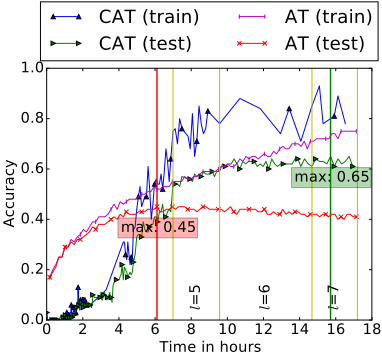
The effectiveness of CAT. We first document the effectiveness of basic curriculum adversarial training to overcome the overfitting problem of [Madry et al., 2018]. In particular, we show the validation and test empirical worst-case accuracy over time of both our approach and [Madry et al., 2018].
In Figure 1, we plot the empirical worst-case accuracy on the test data (i.e., test resilience) of both our CAT approach and [Madry et al., 2018]'s approach. The validation resilience's figure is similar, and thus we omit it. From the figure, we can observe that AT soon achieves a better test resilience, because from the very beginning, the model sees adversarial examples generated from strong attacks; but it hits the peak at around 45% and then starts dropping. At the same time, we observe that the training resilience curve of AT continues increasing. Therefore, AT overfits to the training data, and does not generalize to the test data.
On the other hand, we observe that CAT's test resilience bypasses AT about the same time as AT hits the peak after simpler lessons (i.e., l = 4) are finished, and continues to increase to above 60%. Therefore, we conclude that our CAT technique can effectively overcome the overfitting problem of AT.
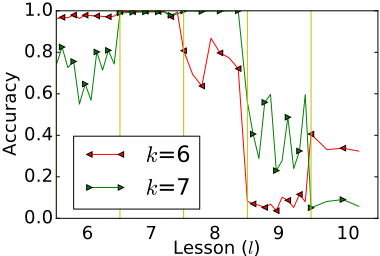
The forgetting phenomenon. During basic curriculum adversarial training, we observe that when the model finishes lesson l, the model achieves the highest accuracy under attack k = l. However, when continuing to train with harder lessons, the accuracy under attack PGD(k) may drop significantly. Figure 2 illustrates such an example on ResNet-50 models on SVHN dataset. We can observe that the accuracy against PGD(6) and PGD(7) increases to almost 100% after lesson l = 7; but when training with lesson l = 9, the accuracy of attack PGD(6) drops to below 10%. This illustrate that the model entirely forgets its training on lesson l = 6, and thus we refer to this as a catastrophic forgetting phenomenon. The same phenomenon can be observed with PGD(7) attack as well.
The effectiveness of batch mixing. We now show that batch mixing can effectively mitigate the issue caused by forgetting. We present the ˜l-accuracy defined by (5) using basic curriculum adversarial training (Basic) and basic curriculum adversarial training enhanced with batch mixing (Basic+MIX) in Table 3 for comparison. We can observe that Basic+MIX can consistently improve the performance over Basic by a margin ranging from 5.88% to 68.3%. Especially, on SVHN, the reason why the empirical worst-case accuracy of Basic is as low as around 10% is because of the forgetting phenomenon as documented above. Therefore, our batch mixing technique can effectively mitigate this issue. Also, we can observe from Table 3 that Basic+MIX can outperform AT on ˜l-accuracy as well. These results demonstrate the effectiveness of batch mixing.
However, if we examine the empirical worst-case accuracy in Table 2, we observe that the performance of Basic+MIX is extremely bad, i.e., less than 6%. This is mainly because of the attack generalization issue that will be discussed next. By including quantization (+Quant) to mitigate this issue, we again observe that Basic+MIX+Quant, which is equivalent to the full CAT approach can outperform all other baselines.
| CIFAR-10 | SVHN | |||
|---|---|---|---|---|
| ResNet | DenseNet | ResNet | DenseNet | |
| AT | 45.78% | 46.67% | 19.59% | 55.98% |
| Basic | 67.48% | 63.85% | 10.72% | 8.25% |
| Basic+MIX | 73.36% | 73.05% | 79.02% | 65.16% |
The attack generalization issue. As we have discussed above, by using curriculum adversarial training with batch mixing, the ˜K-accuracy is high, which indicates that the model can effectively defend against all attacks weaker than PGD(K). However, we observe in various places that for attacks stronger than PGD(K), the accuracy may drop significantly. Therefore, a model trained with weaker attacks may not generalize to stronger attacks. We refer to this effect as the attack generalization issue.
One naive idea to mitigate this issue is to increase the upper bound on K; however, this idea clearly cannot solve the problem since we cannot train with an infinitely large K. Therefore, no matter how large we choose K, there may always be stronger attacks than PGD(K) that can break the defense.
The effectiveness of quantization. Since quantization is an inference time defense, it can be used by any combinations of models, datasets, and training techniques. In Table 2, we observe that quantization (+Quant) improves the performance on almost all such combinations. The reason is because quantization can effectively reduce the attack space, so that even stronger attacks cannot find more sub-optimal solutions to the attack optimization problem (2) than weaker attacks when the input pixel values are quantized to a few bits. From Table 2, we also observe that quantization also helps to improve the resilience of AT from [Madry et al., 2018]. Therefore, we confirm that quantization is a generic defense tool to work with a wide range of other defense techniques.
Does batchmixing replace the role of curriculum? From above, we have observed that batch mixing can help curriculum adversarial training. A natural question is that whether the curriculum is helpful or not? In fact, since it makes the model be supervised with both adversarial examples generated from weaker attacks and from stronger ones, batch mixing may potentially replace the role of the curriculum. To answer this, in Table 2, we report this comparison by showing the resilience by using the curriculum (i.e., Basic) or not. The most significant phenomenon is that CAT, which is equivalent to Basic+MIX+Quant, outperforms batch mixing with quantization but without curriculum (MIX+Quant) by a large margin in most cases. This clearly demonstrates that the curriculum is important to achieve a high resilience.
However, we also observe that compared with MIX only, Basic+MIX's performance is much worse. The reason has been explained above: the model trained with Basic+MIX is overfitting to PGD(k) attacks for k ≤ K, but is not resilient at all to stronger attacks. In comparison, the model trained with MIX sacrifices some resilience against with weaker attacks to trade for more resilience against stronger attacks. When quantization is deployed to effectively mitigate stronger attacks, and thus the trade-off made by MIX is less necessary. This is why we can observe a better overall resilience of CAT. In summary, we conclude that the curriculum is a useful procedure to achieve high resilience, but it is better to be used with batch mixing and quantization together.
| CIFAR-10 | SVHN | |||
|---|---|---|---|---|
| ResNet | DenseNet | ResNet | DenseNet | |
| Regular | 94.31% | 95.70% | 95.66% | 96.65% |
| CAT | 88.49% | 90.36% | 95.30% | 95.20% |
Does CAT hurt regular accuracy? The last question is whether adversarial training hurts the accuracy on non-attack inputs. We conduct experiments to compare our CAT's accuracy with the same model trained using their standard routine on the same dataset. The results are presented in Table 4.
For SVHN, the accuracy drops around 1%; for CIFAR-10, the drops are higher, but still within the range of 5% to 6%. We attribute this to the fact that our training curriculum and batch mixing consider non-adversarial inputs during training. Such a performance loss is acceptable in many practical scenarios in trade of a better resilience.
6 Conclusion
In this work, we present curriculum adversarial training as a defense mechanism to defend against adversarial example attacks. It follows the adversarial training framework, which has recently been shown effective by [Madry et al., 2018]. We make several innovations to significantly improve the algorithm's resilience. In particular, we propose a technique of adversarial training to follow a curriculum containing adversarial examples generated by attacks with various strength; and we also show two effective optimizations called batch mixing and quantization. By combining all the techniques, we demonstrate that we can improve over previous state-ofthe-art by a margin ranging from 25% to 35%. Our work sheds new light on further investigation directions on adversarial training frameworks.
Acknowledgements
We greatly appreciate Min Du's significant contribution to the final version of this paper, which warrants her to be an author of this work. We acknowledge her work, though the conference policy does not allow us to change the author list after Feb 2nd, 2018. This material is in part based upon work supported by DARPA award under no. FA8750-17-2-0091, Center for Long-Term Cybersecurity, and Berkeley Deep Drive.
@inproceedings{ijcai2018p520,
  title     = {Curriculum Adversarial Training},
  author    = {Cai, Qi-Zhi and Liu, Chang and Song, Dawn},
  booktitle = {Proceedings of the Twenty-Seventh International Joint Conference on
               Artificial Intelligence, {IJCAI-18}},
  publisher = {International Joint Conferences on Artificial Intelligence Organization},
  editor    = {Jérôme Lang},
  pages     = {3740--3747},
  year      = {2018},
  month     = {7},
  note      = {Main track},
  doi       = {10.24963/ijcai.2018/520},
  url       = {https://doi.org/10.24963/ijcai.2018/520},
}
TY - CPAPER TI - Curriculum Adversarial Training AU - Cai, Qi-Zhi AU - Liu, Chang AU - Song, Dawn T2 - Proceedings of the Twenty-Seventh International Joint Conference on Artificial Intelligence, IJCAI-18 PB - International Joint Conferences on Artificial Intelligence Organization PY - 2018 SP - 3740 EP - 3747 DO - 10.24963/ijcai.2018/520 UR - https://doi.org/10.24963/ijcai.2018/520 ER -Copied
Machine-readable versions of this paper, for tools and AI agents:





