
Discrete Factorization Machines for Fast Feature-based Recommendation
Proceedings of the Twenty-Seventh International Joint Conference on Artificial Intelligence. Main track. Pages 3449-3455.
https://doi.org/10.24963/ijcai.2018/479
Keywords
- Machine Learning: Machine Learning
- Machine Learning: Recommender Systems
Abstract
User and item features of side information are crucial for accurate recommendation. However, the large number of feature dimensions, e.g., usually larger than 107, results in expensive storage and computational cost. This prohibits fast recommendation especially on mobile applications where the computational resource is very limited. In this paper, we develop a generic feature-based recommendation model, called Discrete Factorization Machine (DFM), for fast and accurate recommendation. DFM binarizes the real-valued model parameters (e.g., float32) of every feature embedding into binary codes (e.g., boolean), and thus supports efficient storage and fast user-item score computation. To avoid the severe quantization loss of the binarization, we propose a convergent updating rule that resolves the challenging discrete optimization of DFM. Through extensive experiments on two real-world datasets, we show that 1) DFM consistently outperforms state-of-the-art binarized recommendation models, and 2) DFM shows very competitive performance compared to its real-valued version (FM), demonstrating the minimized quantization loss.
- [Bai et al., 2017] Ting Bai, Ji-Rong Wen, Jun Zhang, and Wayne Xin Zhao. A neural collaborative filtering mod- el with interaction-based neighborhood. In CIKM, pages 1979-1982, 2017.
- [Bayer et al., 2017] Immanuel Bayer, Xiangnan He, Bhargav Kanagal, and Steffen Rendle. A generic coordinate de- scent framework for learning from implicit feedback. In WWW, pages 1341-1350, 2017.
- [Chen et al., 2017] Jingyuan Chen, Hanwang Zhang, Xiang- nan He, Liqiang Nie, Wei Liu, and Tat-Seng Chua. Atten- tive collaborative filtering: Multimedia recommendation with item-and component-level attention. In SIGIR, pages 335-344, 2017.
- [Das et al., 2007] Abhinandan S. Das, Mayur Datar, Ashutosh Garg, and Shyam Rajaram. Google news personalization: scalable online collaborative filtering. In WWW, pages 271-280, 2007.
- [Feng et al., 2018] Fuli Feng, Xiangnan He, Yiqun Liu, Liqiang Nie, and Tat-Seng Chua. Learning on partial-order hypergraphs. In WWW, pages 1523-1532, 2018.
- [Gionis et al., 1999] Aristides Gionis, Piotr Indyk, and Ra- jeev Motwani. Similarity search in high dimensions via hashing. In VLDB, pages 518-529, 1999.
- [Gong and Lazebnik, 2011] Yunchao Gong and Svetlana Lazebnik. Iterative quantization: A procrustean approach to learning binary codes. In CVPR, pages 817-824, 2011.
- [He and Chua, 2017] Xiangnan He and Tat-Seng Chua. Neu- ral factorization machines for sparse predictive analytics. In SIGIR, pages 355-364, 2017.
- [He et al., 2016] Xiangnan He, Hanwang Zhang, Min-Yen Kan, and Tat-Seng Chua. Fast matrix factorization for on- line recommendation with implicit feedback. In SIGIR, pages 549-558, 2016.
- [He et al., 2017] Xiangnan He, Lizi Liao, Hanwang Zhang, Liqiang Nie, Xia Hu, and Tat-Seng Chua. Neural collabo- rative filtering. In WWW, pages 173-182, 2017.
- [Karatzoglou et al., 2010] Alexandros Karatzoglou, Alexan- der J. Smola, and Markus Weimer. Collaborative filtering on a budget. pages 389-396, 2010.
- [Li et al., 2017] Jing Li, Pengjie Ren, Zhumin Chen, Zhaochun Ren, Tao Lian, and Jun Ma. Neural attentive session-based recommendation. In CIKM, pages 1419- 1428, 2017.
- [Lian et al., 2017] Defu Lian, Rui Liu, Yong Ge, Kai Zheng, Xing Xie, and Longbing Cao. Discrete content-aware ma- trix factorization. In SIGKDD, pages 325-334, 2017.
- [Liu et al., 2014] Xianglong Liu, Junfeng He, Cheng Deng, and Bo Lang. Collaborative hashing. In CVPR, pages 2147-2154, 2014.
- [Liu et al., 2017] An-An Liu, Yu-Ting Su, Wei-Zhi Nie, and Mohan Kankanhalli. Hierarchical clustering multi-task learning for joint human action grouping and recognition. IEEE Transactions on Pattern Analysis and Machine In- telligence, 39(1):102-114, 2017.
- [Luo et al., 2018] Xin Luo, Liqiang Nie, Xiangnan He, Ye Wu, Chen Zhen-Duo, and Xin-Shun Xu. Fast scalable supervised hashing. In SIGIR, 2018.
- [McAuley et al., 2015] Julian McAuley, Rahul Pandey, and Jure Leskovec. Inferring networks of substitutable and complementary products. In SIGKDD, pages 785-794, 2015.
- [Rendle et al., 2011] Steffen Rendle, Zeno Gantner, Christoph Freudenthaler, and Lars Schmidt-Thieme. Fast context-aware recommendations with factorization machines. In SIGIR, pages 635-644, 2011.
- [Rendle, 2011] Steffen Rendle. Factorization machines. In ICDM, pages 995-1000, 2011.
- [Stad, 2001] Johan Stad. Some optimal inapproximability re- sults. ACM, 2001.
- [Wang et al., 2017] Xiang Wang, Xiangnan He, Liqiang Nie, and Tat-Seng Chua. Item silk road: Recommending items from information domains to social users. In SIGIR, pages 185-194, 2017.
- [Wang et al., 2018] Zihan Wang, Ziheng Jiang, Zhaochun Ren, Jiliang Tang, and Dawei Yin. A path-constrained framework for discriminating substitutable and comple- mentary products in e-commerce. In WSDM, pages 619- 627, 2018.
- [Xiao et al., 2017] Jun Xiao, Hao Ye, Xiangnan He, Han- wang Zhang, Fei Wu, and Tat-Seng Chua. Attentional fac- torization machines: Learning the weight of feature inter- actions via attention networks. IJCAI, pages 3119-3125, 2017. IJCAI
- [Yu et al., 2018] Wenhui Yu, Huidi Zhang, Xiangnan He, X- u Chen, Li Xiong, and Zheng Qin. Aesthetic-based cloth- ing recommendation. In WWW, pages 649-658, 2018.
- [Zhang et al., 2014] Zhiwei Zhang, Qifan Wang, Lingyun Ruan, and Luo Si. Preference preserving hashing for effi- cient recommendation. In SIGIR, pages 183-192, 2014.
- [Zhang et al., 2016] Hanwang Zhang, Wei Liu, Wei Liu, X- iangnan He, Huanbo Luan, and Tat Seng Chua. Discrete collaborative filtering. In SIGIR, pages 325-334, 2016.
- [Zhou and Zha, 2012] Ke Zhou and Hongyuan Zha. Learn- ing binary codes for collaborative filtering. In SIGKDD, pages 498-506, 2012.
References were extracted automatically from the PDF and may contain errors.
Full text extracted automatically from the PDF; figures, tables and equations may differ. The PDF is the version of record.
1 Introduction
Recommendation is ubiquitous in today's cyber-world - almost every one of your Web activities can be viewed as a recommendation, such as news or music feeds, car or restaurant booking, and online shopping. Therefore, accurate recommender system is not only essential for the quality of service, but also the profit of the service provider. One such system should exploit the rich side information beyond user-item interactions, such as content-based (e.g., user attributes [Wang et al., 2017] and product image features [Yu et al., 2018]), context-based (e.g., where and when a purchase is made [Rendle et al., 2011; He and Chua, 2017]), and sessionbased (e.g., the recent browsing history of users [Li et al.,
∗The corresponding authors are Liqiang Nie and Hanwang Zhang.
2017; Bayer et al., 2017]). However, existing collaborative filtering (CF) based systems merely rely on user and item features (e.g., matrix factorization based [He et al., 2016] and the recently proposed neural collaborative filtering methods [He et al., 2017; Bai et al., 2017]), which are far from sufficient to capture the complex decision psychology of the setting and the mood of a user behavior [Chen et al., 2017].
Factorization Machine (FM) [Rendle, 2011] is one of the prevalent feature-based recommendation model that leverages rich features of users and items for accurate recommendation. FM can incorporate any side features by concatenating them into a high-dimensional and sparse feature vector. The key advantage of it is to learn k-dimensional latent vectors , i.e., the embedding parameters V ∈ Rk×n , for all the n feature dimensions. They are then used to model pairwise interactions between features in the embedding space. However, since n is large (e.g. practical recommender systems typically need to deal with over millions of items and other features where n is at least 107 [Wang et al., 2018]), it is impossible on-device storage of V. Moreover, it requires large-scale multiplications of the feature interaction vT i vj for user-item score, even linear time-complexity is prohibitively slow for float operations. Therefore, existing FM framework is not suitable for fast recommendation, especially for mobile users.
In this paper, we propose a novel feature-based recommendation framework, named Discrete Factorization Machine (DFM), for fast recommendation. In a nutshell, DFM replaces the real-valued FM parameters V by binary-valued B ∈ {±1}k×n . In this way, we can easily store a bit matrix and perform XOR bit operations instead of float multiplications, making fast recommendation on-the-fly possible. However, it is well-known that the binarization of real-valued parameters will lead to significant performance drop due to the quantization loss [Zhang et al., 2016]. To this end, we propose to directly optimize the binary parameters in an end-toend fashion, which is fundamentally different from the widely adopted two-stage approach that first learns real-valued parameters and then applies round-off binarization [Zhang et al., 2014]. Our algorithm jointly optimize the two challenging objectives: 1) to tailor the binary codes B to fit the original loss function of FM, and 2) imposing the binary constraint that is balanced and decorrelated, to encode compact information. In particular, we develop an alternating optimization algorithm to iteratively solve the mixed-integer programming problems. We evaluate DFM on two real-world datasets Yelp and Amazon, the results demonstrate that 1) DFM consistently outperforms state-of-the-art binarized recommendation models, and 2) DFM shows very competitive performance compared to its real-valued version (FM), demonstrating the minimized quantization loss.
Our contributions are summarized as follows:
- We propose to binarize FM, a dominant feature-based recommender model, to enable fast recommendation. To our knowledge, this is the first generic solution for fast recommendation that learns a binary embedding for each feature.
- We develop an efficient algorithm to address the challenging optimization problem of DFM that involves discrete, balanced, and de-correlated constraints.
- Through extensive experiments on two real-world datasets, we demonstrate that DFM outperforms state-of-the-art hash-based recommendation algorithms.
2 RelatedWork
We first review efficient recommendation algorithms using latent factor models, and then discuss recent advance in discrete hashing techniques.
2.1 Efficient Recommendation
As pioneer work, [Das et al., 2007] used Locality-Sensitive Hashing (LSH) [Gionis et al., 1999] to generate hash codes for Google new users based on their item-sharing history similarity. Following the work, [Karatzoglou et al., 2010] applied random projection for mapping learned user-item latent factors from traditional CF into the Hamming space to acquire hash codes for users and items. Similar to the idea of projection, [Zhou and Zha, 2012] generate binary code from rotated continuous user-item latent factors by running ITQ [Gong and Lazebnik, 2011]. In order to derive more compact binary codes, [Liu et al., 2014] imposed the de-correlation constraint of different binary codes on continuous user-item latent factors and then rounded them to produce binary codes. However, [Zhang et al., 2014] argued that hashing only preserves similarity between user and item rather than inner product based preference, so subsequent hashing may harm the accuracy of preference predictions, thus they imposed a Constant Feature Norm(CFN) constraint on user-item continuous latent factors, and then quantized similarities by respectively thresholding their magnitudes and phases.
The aforementioned work can be easily summarized as two independents stages: relaxed user-item latent factors learning with some specific constraints and binary quantization. However, such a two-stage relaxation is well-known to suffer from a large quantization loss according to [Zhang et al., 2016].
2.2 Binary Codes Learning
Direct binary code learning by discrete optimization - is becoming popular recently in order to decrease quantization loss aforementioned. Supervised hashing [Luo et al., 2018]
improve on joint optimizations of quantization losses and intrinsic objective functions, whose significant performance gain over the above two-stage approaches.
In the recommendation area, [Zhang et al., 2016] is the first work that proposes to learn binary codes for users and items by directly optimizing the recommendation task. The proposed method Discrete Collaborative Filtering (DCF) demonstrates superior performance over aforementioned two-stage efficient recommendation methods. To learn informative and compact codes, DCF proposes to enforce balanced and de-correlated constraints on the discrete optimization. Despite its effectiveness, DCF models only user-item interactions and cannot be trivially extended to incorporate side features. As such, it suffers from the cold-start problem and can not be used as a generic recommendation solution, e.g., for context-aware [Rendle, 2011] and session-based recommendation [Bayer et al., 2017]. Same as the relationship between FM and MF, our DFM method can be seen as a generalization of DCF that can be used for generic feature-based recommendation. Specifically, feeding only ID features of users and items to DFM will recover the DCF method. In addition, our DFM can learn binary codes for each feature, allowing it to be used for resource-limited recommendation scenarios, such as context-aware recommendation in mobile devices. This binary representation learning approach for feature-based recommendation, to the best of knowledge, has never been developed before.
The work that is most relevant with this paper is [Lian et al., 2017], which develops a discrete optimization algorithm named Discrete Content-aware Matrix Factorization (DCMF), to learn binary codes for users and items at the presence of their respective content information. It is worth noting that DCMF can only learn binary codes for each user ID and item ID, rather than their content features. Since its prediction model is still MF (i.e.,, the dot product of user codes and item codes only), it is rather limited in leveraging side features for accurate recommendation. As such, DCMF only demonstrates minor improvements over DCF for feature-based collaborative recommendation (cf. Figure 2(a) for their original paper). Going beyond learning user codes and item codes, our DFM can learn codes for any side feature and model the pairwise interactions between feature codes. As such, our method has much stronger representation ability than DCMF, demonstrating significant improvements over DCMF in feature-based collaborative recommendation.
3 Preliminaries
We use bold uppercase and lowercase letters as matrices and vectors, respectively. In particular, we use ai as the a-th column vector of matrix A. We denote ∥ · ∥F as the Frobenius norm of a matrix and tr(·) as the matrix trace. We denote sgn(·) : R → {±1} as the round-off function, i.e., sgn(x) = +1 if x ≥ 0 and sgn(x) = -1 otherwise.
Factorization Machine (FM) is essentially a score prediction function for a (user, item) pair feature x:
where x ∈ Rn is a high-dimensional feature representation of the rich side-information, concatenated by one-hot user ID and item ID, user and item content features, location features, etc. w ∈ Rn is the model bias parameter: wo is the global bias and wi is the feature bias. V ∈ Rk×n is the latent feature vector, and every ⟨vi, vj ⟩ models the interaction between the i-th and j-th feature dimensions. Therefore, V is the key reason why FM is an effective feature-based recommendation model, as it captures the rich side-information interaction. However, on-the-fly storing V and computing ⟨vi, vj⟩ are prohibitively expensive when n is large. For example, a practical recommender system for Yelp 1 needs to provide recommendation for over 1, 300, 000 users with about 174, 000 business, which have more than 1, 200, 000 attributes (here, n = 1, 300, 000 + 174, 000 + 1, 200, 000 = 2, 674, 000).
To this end, we want to use binary codes B ∈ {±1}k×n instead of V, to formulated our proposed framework: Discrete Factorization Machines (DFM):
However, directly obtain B = sgn(V) will lead to large quantization loss and thus degrade the recommendation accuracy significantly [Zhang et al., 2016]. In the next section, we will introduce our proposed DFM learning model and discrete optimization that tackles the quantization loss.
4 Discrete FactorizationMachines
We first present the learning objective of DFM and then elaborate the optimization process of DFM, which is the key technical difficulty of the paper. At last, we shed some lights on model initialization, which is known to have a large impact on a discrete model.
4.1 Model Formulation
Given a training pair (x, y) ∈ V, where y is the groundtruth score of feature vector x and V denotes the set of all training instances, the problem of DFM is formulated as:
Due to the discrete constraint in DFM, the regularization ∥B∥2F becomes an constant and hence is removed. Additionally, DFM imposes balanced and de-correlated constraints on the binary codes in order to maximize the information each bit carries and to make binary codes compact [Zhou and Zha, 2012]. However, optimizing the objective function in Eq.(3) is a highly challenging task, since it is generally NP-hard. To be specific, finding the global optimum solution needs to involve O(2kn ) combinatorial search for the binary codes [Stad, 2001].
1 https://www.yelp.ca/dataset
Next, we introduce a new learning objective that allows DFM to be solved in a computationally tractable way. The basic idea is to soften the balanced and de-correlated constraints. To achieve this, let us first introduce a delegate continuous variable D ∈ D, where D = {D ∈ Rk×n |D1 = 0,DDT = nI}. Then the balanced and de-correlated constraints can be softened by minD∈D ∥B-D∥F . As such, we can get the softened learning objective for DFM as:
-
where we use 2tr(BT D) instead of ∥B-D∥F for the ease of optimization (note that the two terms are identical since BT B and DT D are constant). β is tunable hyperparameter controlling the strength of the softened de-correlation constraint. As the above Eq.(4) allows a certain discrepancy between B and D, it makes the binarized optimization problem computationally tractable. Note that if there are feasible solution in Eq.(3), we can impose a very large β to enforce B to be close to D.
The above Eq.(4) presents the objective function to be optimized for DFM. It is worth noting that we do not discard the discrete constraint and we still perform a direct optimization on discrete B. Furthermore, through joint optimization for the binary codes and the delegate real variables, we can obtain nearly balanced and uncorrelated binary codes. Next, we introduce an efficient solution to solve the mixed-integer optimization problem in Eq.(4).
4.2 Optimization
We employ alternating optimization strategy [Liu et al., 2017] to solve the problem. Specifically, we alternatively solve three subproblems for DFMmodel in Eq.(4), taking turns to update each of B, D, w, given others fixed. Next we elaborate on how to solve each of the subproblems.
B-subproblem. In this subproblem, we aim to optimize B with fixed D and w. To achieve this, we can update B by updating each vector br according to
where Vr = {(x, y) ∈ V|xr ̸= 0} is the training set for r, vector ˆx is equal to x excluding element xr, U excludes the column br of matrix B, and ui is a column in U.
Due to the discrete constraints, the optimization is generally NP-hard. To this end, we use Discrete Coordinate Descent (DCD) [Zhang et al., 2016] to take turns to update each bit of binary codes br. Denote brt as the t-th bit of br and br¯ t as the rest codes excluding brt, DCD will update brt by fixing br¯ t. Thus, we update brt based on the following rule:
where Z = UT , zt is the t-th column of the matrix Z while Z¯ t excludes the t-th column from Z, and K(x, y) is a function that K(x, y) = x if x ̸= 0 and K(x, y) = y otherwise. Through this way, we can control that when ˆbrt = 0, we do not update brt.
D-subproblem. WhenB andw are fixed in Eq.(4), the optimization subproblem for D is:
It can be solved with the aid of a centering matrix J = I - 1n 11T . Specifically, by Singular Value Decomposition (SVD), we have BJ = B = PΣQT , where P ∈ Rk×k′ and Q ∈ Rn×k′ are left and right singular vectors corresponding to the r′ (≤ r) positive singular values in the diagonal matrix Σ. We first apply eigendecomposition for the small k × k matrix B BT = [P ̂P] [Σ2 0 0 0] [P ̂P]T , where
̂P are the eigenvectors of the zero eigenvalues. Therefore, by the definition of SVD, we have Q = BT PΣ-1 . In order to satisfy the constraint D1 = 0, we further obtain additional ̂Q ∈ Rn×(k-k′ ) by Gram-Schmidt orthogonalization based on [Q 1]. As such, we have ̂QT 1 = 0. Then we can get the closed-form update rule for the D-subproblem in Eq.(6) as:
w-subproblem. When B and D are fixed in Eq.(4), the subproblem is for optimizing w is:
Since w is a real-valued vector, it is the standard multivariate linear regression problem. Thus we can use coordinate descent algorithm provided in the original FM [Rendle, 2011] to find the optimal value of w and the global bias w0.
4.3 Initialization
Since DFM deals with mixed-integer non-convex optimization, the initialization of model parameters plays an important role for faster convergence and for finding better local optimum solution. Here we suggest an efficient initialization strategy inspired by DCF [Zhang et al., 2016]. It first solves a relaxed optimization problem in Eq.(4) by discarding the discrete constraints as:
To solve the problem, we can initialize real-valued V and w randomly and find feasible initializations for D by solving Dsubproblem. The optimization can be done alternatively by solving V by traditional FM, solving D by D-subproblem, and solving w by gradient descent. Assuming the solution is (V∗ ,D∗ ,w∗ ,w∗ 0 ), we can then initialize the parameters in Eq.(4) as:
5 Experiments
As the key contribution of this work is the design of DFM for fast feature-based recommendation, we conduct experiments to answer the following research questions:
RQ1. How does DFM perform as compared to existing hash-based recommendation methods?
RQ2. How does the key hyper-parameter of DFM impact its recommendation performance?
RQ3. How efficient is DFM as compared to the real-valued version of FM?
5.1 Experimental Settings
Datasets. We experiment on two publicly available datasets with explicit feedbacks from different real-world websites: Yelp and Amazon. Note that we assume each user has only one rating for an item and average the scores if an item has multiple ratings from the same user.
- Yelp. This dataset [Lian et al., 2017] originally contains 409,117 users, 85,539 items (points of interest on Yelp such as restaurants and hotels), and 2,685,066 ratings with integer scores ranging from 1 to 5. Besides, each item has a set of textual reviews posted by the users.
b) Amazon. This book rating dataset [McAuley et al., 2015] originally includes 12,886,488 ratings of 929,264 items (books on Amazon from 2,588,991 users. In this dataset, an item also has a set of integer rating scores in [1, 5] and a set of textual reviews.
Considering the extreme sparsity of the original Yelp and Amazon datasets, we remove users with less than 20 ratings and items rated by less than 20 users. After the filtering, there are 13,679 users, 12,922 items, and 640,143 ratings left in the Yelp dataset. For the Amazon dataset, we remain 35,151 users, 33,195 items, and 1,732,060 ratings. For fair comparison with DCMF, we leave out the side information from the user field and represent an item with the bag-of-words encoding of its textual contents after aggregating all review contents of the item. Note that we remove stopping words and truncate the vocabulary by selecting the top 8,000 words regarding their Term FrequencyInverse Document Frequency. By concatenating the bag-of-words encoding (side information of the item) and one-hot encoding of user and item ID, we obtain a feature vector of dimensionality 34,601 and 76,346 for a rating (use-item pair) for Yelp and Amazon, respectively.
Baselines. We implement our proposed DFM method using Matlab 2 and compare it with its real-valued version and stateof-the-art binarized methods for Collaborative Filtering:
2 Codes are available: https://github.com/hanliu95/DFM
- libFM. This is the original implementation 3 of FM which has achieved great performance for feature-based recommendation with explicit feedbacks. Note that we adopt l2 regularization on the parameters to prevent overfitting and use the SGD learner to optimize it.
- DCF. This is the first binarized CF method that can directly optimize the binary codes [Zhang et al., 2016].
- DCMF. This is the state-of-the-art binarized method for CF with side information [Lian et al., 2017]. It extends DCF by encoding the side features as the constraints for user codes and item codes.
- BCCF. This is a two-stage binarized CF method [Zhou and Zha, 2012] with a relaxation stage and a quantization stage. At these two stages, it successively solves MF with balanced code regularization and applies orthogonal rotation to obtain user codes and item codes.
Note that for DCF and DCMF, we use the original implementation as released by the authors. For BCCF, we reimplement it due to the unavailability.
Evaluation Protocols. We first randomly split the ratings from each user into training (50%) and testing (50%). As practical recommender systems typically recommend a list of items for a user, we rank the testing items of a user and evaluate the ranked list with Normalized Discounted Cumulative Gain (NDCG), which has been widely used for evaluating ranking tasks like recommendation [He et al., 2017]. To evaluate the efficiency of DFM and real-valued FM, we use Testing Time Cost (TTC) [Zhang et al., 2016], where a lower cost indicates better efficiency.
Parameter Settings. As we exactly follow the experimental settings of [Lian et al., 2017], we refer to their optimal settings for hyper-parameters of DCMF, DCF, and BCCF.
3 http://www.libfm.org/
For libFM, we test the l2 regularization on feature embeddings V of {10-i |i = -4,-3,-2,-1, 0, 1, 2}. Under the same range, we test the de-correlation constraint (i.e., β in Eq. (3)) of DFM. Besides, we test the code length in the range of [8, 16, 32, 64]. It is worth mentioning that we conduct all the experiments on a computer equipped with an Intel(R) Core(TM) i7-7700k 4 cores CPU at 4.20GHZ, 32GB RAM, and 64-bit Windows 7 operating system.
5.2 Performance Comparison (RQ1)
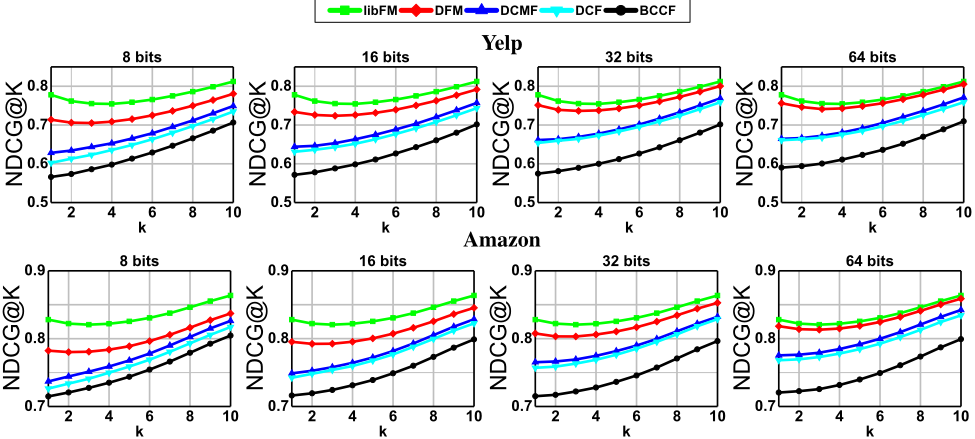
In Figure 1, we show the recommendation performance (NDCG@1 to NDCG@10) of DFM and the baseline methods on the two datasets. The code length varies from 8 to 64. From the figure, we have the following observations:
- DFM demonstrates consistent improvements over stateof-the-art binarized recommendation methods across code lengths (the average improvement is 7.95% and 2.38% on Yelp and Amazon, respectively). The performance improvements are attributed to the benefits of learning binary codes for features and modeling their interactions.
- Besides, DFM shows very competitive performance compared to libFM, its real-valued version, with an average performance drop of only 3.24% and 2.40% on the two datasets. By increasing the code length, the performance gap continuously shrinks from 5.68% and 4.76% to 1.46% and 1.19% on Yelp and Amazon, respectively. One possible reason is that libFM suffers from overfitting as the increase of its representative capability (i.e., larger code length) [He and Chua, 2017], whereas binarizing the parameters can alleviate the overfitting problem. This finding again verifies the effectiveness of the proposed DFM.
- Between baseline methods, DCF consistently outperforms BCCF, while slightly underperforms DCMF with an average performance decrease of 1.58% and 0.76% on the two datasets, respectively. This is consistent with the findings in [Liu et al., 2014] that the direct discrete optimization is
stronger than two-stage approaches and that side information makes the user codes and item codes more representative, which can boost the performance of recommendation. However, the rather small performance gap between DCF and DCMF indicates that DCMF fails to make full use of the side information. The main reason is because that DCMF performs prediction only based on user codes and item codes (which is same as DCF). This inevitably limits the representation ability of DCMF.
5.3 Impact of Hyper-parameter (RQ2)
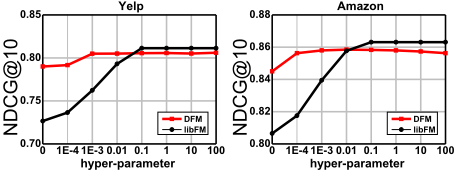
Figure 2 shows the recommendation performance of libFM and DFM on NDCG@10 regarding l2 regularization of libFM and de-correlation constraint, respectively. We omit the results on different values of K and code length other than K = 10 and code length = 64 since they shown the same trend. First, we can see that the performance of libFM continuously drops as we decrease the l2 regularization. One reason is that libFM could easily suffer from overfitting [Xiao et al., 2017]. Second, we observe that DFM performs slightly worse as decreasing the de-correlation constraint. By setting the de-correlation constraint and l2 regularization to be zero, both of DFM and libFM exhibit significant performance decrease in NDCG@10. Specifically, the performance of DFM drops with a 1.91% and 2.05% margin on Yelp and Amazon, respectively, while libFM encounters a 10.44% and 6.56% one. The above findings again demonstrate the overfitting problem of libFM, which leads to libFM to be very sensitive to the l2 regularization hyper-parameter, while the proposed DFM is relatively insensitive to its de-correlation constraint hyper-parameter.
5.4 Efficiency Study (RQ3)
As libFM is implemented based on C++, we re-implement the testing algorithm of DFM with C++ and compile it with the same C++ compiler (gcc-4.9.3) for a fair comparison. Table 1 shows the efficiency comparison between DFM and libFM regarding TTC on the two datasets. We have the following observations:
- DFM achieves significant speedups on both datasets regarding TTC, significantly accelerating the libFM by a large amplitude (on average, the acceleration ratio over libFM is 15.99 and 16.04, respectively). This demonstrates the great advantage of binarizing the real-valued parameters of FM.
- The acceleration ratio of DFM based on libFM is stable around 16 times on both the datasets when the code length increases from 8 to 64.
| Code Length | 8 | 16 | 32 | 64 |
|---|---|---|---|---|
| libFM (TTC) | 27.18 | 56.77 | 114.10 | 217.64 |
| DFM (TTC) | 2.06 | 3.56 | 6.60 | 12.43 |
| Acceleration Ratio | 13.19 | 15.95 | 17.29 | 17.51 |
| Amazon | ||||
|---|---|---|---|---|
| Code Length | 8 | 16 | 32 | 64 |
| libFM (TTC) | 177.03 | 357.46 | 716.83 | 1, 414.67 |
| DFM (TTC) | 12.67 | 22.50 | 42.56 | 81.04 |
| Acceleration Ratio | 13.97 | 15.89 | 16.84 | 17.46 |
Along with the comparable recommendation performance of DFM and libFM, the above findings indicate that DFM is an operable solution for many large-scale Web services, such as Facebook, Instagram, and Youtube, to substantially reduce the computation cost of their recommendation systems.
6 Conclusions
In this paper, we presented DFM, the first binary representation learning method for generic feature-based recommendation. In contrast to existing hash-based recommendation methods that can only learn binary codes for users and items, our DFM is capable of learning a vector of binary codes for each feature. As a benefit of such a compact binarized model, the predictions of DFM can be done efficiently in the binary space. Through extensive experiments on two real-world datasets, we demonstrate that DFM outperforms state-of-theart hash-based recommender systems by a large margin, and achieves a recommendation accuracy rather close to that of the original real-valued FM.
This work moves the first step towards developing efficient and compact recommender models, which are particularly useful for large-scale and resource-limited scenarios. In future, we will explore the potential of DFM for context-aware recommendation in mobile devices, a typical application scenario that requires fast and compact models. Moreover, we will develop pairwise learning method for DFM, which might be more suitable for personalized ranking task. With the fast developments of neural recommendation methods recently [He and Chua, 2017], we will develop binarized neural recommender models in the next step to further boost the performance of hash-based recommendation. Besides, we are interested in deploying DFM for online recommendation scenarios, and explore how to integrate bandit-based and reinforcement learning strategies into DFM. Lastly, we will explore the potential of DFM in other tasks such as popularity prediction of online content [Feng et al., 2018].
Acknowledgments
This work is supported by the National Basic Research Program of China (973 Program), No.: 2015CB352502; National Natural Science Foundation of China, No.: 61772310, No.:
- 61702300, and No.: 61702302; and the Project of Thousand Youth Talents 2016. This work is also part of NExT research, supported by the National Research Foundation, Prime Minister's Office, Singapore under its IRC@SG Funding Initiative.
@inproceedings{ijcai2018p479,
  title     = {Discrete Factorization Machines for Fast Feature-based Recommendation},
  author    = {Liu, Han and He, Xiangnan and Feng, Fuli and Nie, Liqiang and Liu, Rui and Zhang, Hanwang},
  booktitle = {Proceedings of the Twenty-Seventh International Joint Conference on
               Artificial Intelligence, {IJCAI-18}},
  publisher = {International Joint Conferences on Artificial Intelligence Organization},
  editor    = {Jérôme Lang},
  pages     = {3449--3455},
  year      = {2018},
  month     = {7},
  note      = {Main track},
  doi       = {10.24963/ijcai.2018/479},
  url       = {https://doi.org/10.24963/ijcai.2018/479},
}
TY - CPAPER TI - Discrete Factorization Machines for Fast Feature-based Recommendation AU - Liu, Han AU - He, Xiangnan AU - Feng, Fuli AU - Nie, Liqiang AU - Liu, Rui AU - Zhang, Hanwang T2 - Proceedings of the Twenty-Seventh International Joint Conference on Artificial Intelligence, IJCAI-18 PB - International Joint Conferences on Artificial Intelligence Organization PY - 2018 SP - 3449 EP - 3455 DO - 10.24963/ijcai.2018/479 UR - https://doi.org/10.24963/ijcai.2018/479 ER -Copied
Machine-readable versions of this paper, for tools and AI agents:





