
Experimental Design under the Bradley-Terry Model
Proceedings of the Twenty-Seventh International Joint Conference on Artificial Intelligence. Main track. Pages 2198-2204.
https://doi.org/10.24963/ijcai.2018/304
Keywords
- Machine Learning: Active Learning
- Machine Learning: Classification
Abstract
Labels generated by human experts via comparisons exhibit smaller variance compared to traditional sample labels. Collecting comparison labels is challenging over large datasets, as the number of comparisons grows quadratically with the dataset size. We study the following experimental design problem: given a budget of expert comparisons, and a set of existing sample labels, we determine the comparison labels to collect that lead to the highest classification improvement. We study several experimental design objectives motivated by the Bradley-Terry model. The resulting optimization problems amount to maximizing submodular functions. We experimentally evaluate the performance of these methods over synthetic and real-life datasets.
- [Boyd and Vandenberghe, 2004] S. Boyd and L. Vandenberghe. Convex optimization. Cambridge university press, 2004.
- [Bradley and Terry, 1952] R. A. Bradley and M. E. Terry. Rank analysis of incomplete block designs: I. the method of paired comparisons. Biometrika, pages 324-345, 1952.
- [Busetto et al., 2013] A. G. Busetto, A. Hauser, G. Krummenacher, M. Sunnåker, S. Dimopoulos, C. S. Ong, Jö. Stelling, and J. M Buhmann. Near-optimal experimental design for model selection in systems biology. Bioinformatics, pages 2625-2632, 2013.
- [Cavagnaro et al., 2010] D. R. Cavagnaro, J. I. Myung, M. A. Pitt, and J. V. Kujala. Adaptive design optimization: A mutual information-based approach to model discrimination in cognitive science. Neural computation, pages 887-905, 2010.
- [Chaloner and Verdinelli, 1995] K. Chaloner and I. Verdinelli. Bayesian experimental design: A review. Statistical Science, pages 273-304, 1995.
- [Chen et al., 2015] L. Chen, P. Zhang, and B. Li. Fusing pointwise and pairwise labels for supporting user-adaptive image retrieval. In ICMR, pages 67-74, 2015.
- [Cohn et al., 1996] D. A. Cohn, Z. Ghahramani, and M. I. Jordan. Active learning with statistical models. JAIR, pages 129-145, 1996.
- [Delzell et al., 2012] D. A. Delzell, R. F. Gunst, et al. Key properties of d-optimal designs for event-related functional MRI experiments with application to nonlinear models. Statistics in medicine, 2012.
- [Drovandi and Pettitt, 2013] C. C. Drovandi and A. N. Pettitt. Bayesian experimental design for models with intractable likeli- hoods. Biometrics, pages 937-948, 2013.
- [Drovandi et al., 2014] C.C. Drovandi, J.M. McGree, and A.N. Pet- titt. A sequential monte carlo algorithm to incorporate model uncertainty in bayesian sequential design. J. C. Graph. Stat, 2014.
- [Elo, 1978] A. E. Elo. The rating of chessplayers, past and present. Arco Pub., 1978.
- [Flaherty et al., 2006] P. Flaherty, A. Arkin, and M. I. Jordan. Ro- bust design of biological experiments. In NIPS, pages 363-370, 2006.
- [Glickman and Jensen, 2005] Mark E Glickman and Shane T Jensen. Adaptive paired comparison design. Journal of statistical planning and inference, pages 279-293, 2005.
- [Graßhoff and Schwabe, 2008] U. Graßhoff and R. Schwabe. Opti- mal design for the bradley-terry paired comparison model. Statis- tical Methods and Applications, pages 275-289, 2008.
- [Grasshoff et al., 2003] Ulrike Grasshoff, Heiko Großmann, Heinz Holling, and Rainer Schwabe. Optimal paired comparison designs for first-order interactions. Statistics, pages 373-386, 2003.
- [Guillory and Bilmes, 2011] A. Guillory and J. Bilmes. Active semi- supervised learning using submodular functions. In UAI, pages 274-282, 2011.
- [Guo et al., 2018] Y. Guo, P. Tian, J. Kalpathy-Cramer, S. Ostmo, J. P. Campbell, M. F Chiang, D. Erdogmus, Jennifer Dy, and S. Ioannidis. Experimental design under the Bradley-Terry model. Spiral tech. rep, 2018. https://bit.ly/2rqCCzi. Link
- [Harville, 1997] D. A. Harville. Matrix algebra from a statistician's perspective, volume 1. Springer, 1997.
- [Hoi et al., 2006] S. C. Hoi, R. Jin, J. Zhu, and M. R. Lyu. Batch mode active learning and its application to medical image classifi- cation. In ICML, pages 417-424, 2006.
- [Horel et al., 2014] T. Horel, S. Ioannidis, and S. Muthukrishnan. Budget feasible mechanisms for experimental design. In LATIN, pages 719-730, 2014.
- [Huan and Marzouk, 2013] X. Huan and Y. M. Marzouk. Simu- lation based optimal bayesian experimental design for nonlinear systems. Journal of Computational Physics, pages 288-317, 2013.
- [Jordan et al., 1999] M. I. Jordan, Z. Ghahramani, T. S. Jaakkola, and L. K. Saul. An introduction to variational methods for graphi- cal models. Machine learning, pages 183-233, 1999.
- [Kalpathy-Cramer et al., 2016] J. Kalpathy-Cramer, J. P. Campbell, D. Erdogmus, et al. Plus disease in retinopathy of prematurity: improving diagnosis by ranking disease severity and using quanti- tative image analysis. Ophthalmology, pages 2345-2351, 2016.
- [Kamishima et al., 2009] T. Kamishima, M. Hamasaki, and S. Akaho. A simple transfer learning method and its applica- tion to personalization in collaborative tagging. In ICDM, pages 219-228, 2009.
- [Krause and Guestrin, 2012] A. Krause and C. E Guestrin. Near- optimal nonmyopic value of information in graphical models. arXiv preprint arXiv:1207.1394, 2012.
- [Lewis and Gale, 1994] D. D. Lewis and W. A. Gale. A sequential algorithm for training text classifiers. In SIGIR, pages 3-12, 1994.
- [Liepe et al., 2013] J. Liepe, S. Filippi, M. Komorowski, and M. P. Stumpf. Maximizing the information content of experiments in systems biology. PLOS Comput. Biol, page e1002888, 2013.
- [Myerson, 1981] R. B. Myerson. Optimal auction design. Mathe- matics of operations research, pages 58-73, 1981.
- [Nemhauser et al., 1978] G. L. Nemhauser, L. A. Wolsey, and M. L Fisher. An analysis of approximations for maximizing submodular set functions. Mathematical Programming, pages 265-294, 1978.
- [Rao, 1992] C Radhakrishna Rao. Information and the accuracy attainable in the estimation of statistical parameters. In Break- throughs in statistics, pages 235-247. Springer, 1992.
- [Robert, 2014] Christian Robert. Machine learning, a probabilistic perspective, 2014.
- [Ryan, 2003] K. J. Ryan. Estimating expected information gains for experimental designs with application to the random fatigue-limit model. J. Comput. Graph. Stat, pages 585-603, 2003.
- [Sculley, 2010] D. Sculley. Combined regression and ranking. In SIGKDD, pages 979-988, 2010.
- [Sharma and Bilgic, 2017] M. Sharma and M. Bilgic. Evidence- based uncertainty sampling for active learning. DMKDFD, pages 164-202, 2017.
- [Takahama et al., 2016] R. Takahama, T. Kamishima, and H. Kashima. Progressive comparison for ranking estimation. In IJCAI, pages 3882-3888, 2016. IJCAI
- [Tsilifis et al., 2017] P. Tsilifis, R. G. Ghanem, and P. Hajali. Ef- ficient bayesian experimentation using an expected information gain lower bound. SIAM/ASA JUQ, pages 30-62, 2017.
- [Wang et al., 2016] Y. Wang, S. Wang, J. Tang, H. Liu, and B. Li. PPP: Joint pointwise and pairwise image label prediction. In CVPR, pages 6005-6013, 2016.
- [Wei et al., 2015] Kai Wei, R. Iyer, and J. Bilmes. Submodularity in data subset selection and active learning. In ICML, pages 1954-1963, 2015.
- [Zhang and Oles, 2000] T. Zhang and F. Oles. The value of unla- beled data for classification problems. In ICML, pages 1191-1198, 2000.
References were extracted automatically from the PDF and may contain errors.
Full text extracted automatically from the PDF; figures, tables and equations may differ. The PDF is the version of record.
1 Introduction
In many supervised learning settings, labels generated by human experts while comparing pairs of samples exhibit smaller variance compared to traditional (i.e., pointwise) sample labels. For example, doctors assessing the presence of a disease in a patient often produce highly variable diagnostic outcomes; in contrast, their answers are less variable when assessing two patients w.r.t. relative severity of the disease [KalpathyCramer et al., 2016]. In this setting, a learner may only have access to diagnostic labels generated by doctors, who are noisy/subjective, and produce a diagnosis correlated with disease severity. The same severity drives diagnoses as well as comparison outcomes. Similar observations hold for many settings (e.g., recommendation systems) in which humans can easily rank samples but may find direct labeling difficult [Takahama et al., 2016].
Asking an expert to produce, e.g., pairwise comparisons between samples, poses a significant challenge in large datasets. This is precisely because the number of comparisons grows quadratically with the dataset size. Motivated by this observation, we study a scenario in which an experimenter wishes to collect K comparison (i.e., pairwise) labels by querying one or more experts. We assume that, in making this decision, the experimenter has access to absolute (i.e., pointwise) labels for some of the samples in her dataset, which she wishes to augment with the collected K comparison labels.
We make the following contributions:
- We propose a generative model for both absolute and comparison labels, allowing us to take a probabilistic approach to the comparison selection problem. Our probabilistic assumptions are motivated by the so-called Bradley-Terry model [Bradley and Terry, 1952].
- We study several experimental design (a.k.a. batch active learning) objectives, and apply them to our specific generative model. All four are monotone and submodular, and three of them can be efficiently optimized by a greedy approximation algorithm. We also assess computational issues arising from these objectives under greedy optimization.
- Finally, we extensively evaluate these objectives over both synthetic and real-life datasets. We show that as few as 15 comparison labels collected via our proposed algorithms can improve classification measured via AUC by as much as 13%, and that our proposed methods outperform random selection under several different noise settings.
The remainder of this paper is organized as follows. We discuss related work in Sec. 2. Our problem formulation and a discussion of different experimental design objectives is in Sec. 3 and 4, respectively. Our numerical evaluations are in Sec. 5, and we conclude in Sec. 6.
2 RelatedWork
Integrating regression labels with ranking information was proposed in [Sculley, 2010] as a means to improve regression outcomes in label-imbalanced datasets, and similar approaches have been used to incorporate both "pointwise" and "pairwise" labels in image classification tasks [Chen et al., 2015; Wang et al., 2016]. The generative model we describe in Sec. 3.1 naturally relates to the penalty introduced by Sculley via MAP estimation (see also Sec. 3.4). None of these works deal with the experimental design problem, namely, how to collect comparison (i.e., pairwise) labels.
Experimental design, a.k.a. batch active learning, is a rich and extensively studied area [Chaloner and Verdinelli, 1995; Myerson, 1981; Delzell et al., 2012; Flaherty et al., 2006; Tsilifis et al., 2017; Huan and Marzouk, 2013]. A generative model based on logistic regression and a Fisher informationbased objective is introduced in [Zhang and Oles, 2000; Hoi et al., 2006]; we build upon this work to construct our Fisher information criterion. Mutual information (a.k.a, information gain) is also a commonly used objective [Ryan, 2003; Liepe et al., 2013; Cavagnaro et al., 2010], which is monotone submodular under certain conditions [Krause and Guestrin, 2012; Wei et al., 2015; Guillory and Bilmes, 2011]. Applying this objective to our generative model retains submodularity but, as in other settings [Busetto et al., 2013], both (a) computing the posterior of the model, as well as (b) evaluating the function when having access to this posterior, are intractable. Approximation methods via Monte Carlo sampling have been proposed in [Drovandi and Pettitt, 2013; Drovandi et al., 2014]; we apply these techniques along with variational inference to produce an estimate without directly calculating the posterior.
Finally, [Grasshoff et al., 2003] and [Glickman and Jensen, 2005] study experimental design on the Bradley-Terry model focusing on a single parameter (one-dimensional) learning setting. They use D-Optimal design [Graßhoff and Schwabe, 2008] and KL-divergence [Glickman and Jensen, 2005] as optimization objectives. We depart by studying experimental design over multi-dimensional features, and considering a broader array of objective functions.
3 ProblemFormulation
We consider a setting in which data samples are labeled by an expert. Given an individual sample to label, the expert produces a binary absolute label indicating a classification result. Given two different samples, the expert produces a comparison label. The comparison label is also binary and indicates precedence with respect to the classification outcome. For example, if the sample is a medical diagnosis, the absolute labels indicate the existence of disease, while the comparison label indicates the relative severity between two samples. An experimenter has access to a dataset of noisy absolute labels generated by this expert. At the same time, the experimenter wishes to augment the dataset by adding comparison labels. As comparison labels are numerous and their acquisition is time-consuming, the experimenter only collects a subset of all possible comparison labels.
Formally, the experimenter has access to N samples, indexed by i ∈ N ≡ {1, 2, · · · ,N}. Every sample has a feature vector xi ∈ Rd , which is known to the experimenter. For each sample i ∈ N, there is a noisy binary absolute label Yi ∈ {+1,-1} generated by the expert. We define C ≡ {(i, j) : i, j ∈ N, i < j} to be the set of possible comparisons. For pair (i, j) ∈ C, the experimenter may collect comparison label Yi,j ∈ {+1, -1} by querying the expert. We use A ⊆ N to represent the subset of absolute labels observed by the experimenter. In the process of augmentation, the experimenter collects K comparison labels. We use S ⊆ C, where
|S| =K, to represent the set of collected comparisons.
3.1 Generative Model
We assume that labels are generated according to the following probabilistic model. First, there exists a parameter vector β ∈ Rd , sampled from a Gaussian prior N(0, σ2I), such that for all i ∈ N and all (i, j) ∈ C the absolute labels Yi and comparison labels Yi,j are independent conditioned on β. Second, the conditional distribution of Yi given xi and β is given by a logistic model, i.e.,
Finally, the conditional distribution of Yi,j given xi, xj and β is given by the Bradley-Terry model [Bradley and Terry, 1952]. The Bradley-Terry model assumes that every item i ∈ N is associated with a parameter si ∈ R+ s.t. P(Yi,j = +1) = si (si+sj) for all (i, j) ∈ C. We extend this model to incorporate
Although the discussion focuses on a single expert, the probabilistic nature of our model allows incorporating multiple experts generating independent labels over the same pairs.
3.2 Experimental Design
As mentioned above, the experimenter augments the dataset by adding comparison labels. It is expensive and time consuming to collect all |C| = N(N-1) 2 comparison labels. The experimenter thus collects K labels in a subset S ⊆ C, |S| = K. In the experimental design problem, we seek a strategy for determining S. To do so, we introduce objective functions f : 2|C| →R, that capture how informative samples in S are. Given such a function, the optimal subset S ∗ is a solution to the following problem:
We present several candidate objective functions f in Sec. 3.5.
3.3 Greedy Optimization
Unfortunately, for many objective functions of interest, the problem of selecting the most informative subset S is NP hard. However, we can maximize the objective function by leveraging the theory of submodular functions. A function f : 2Ω → R is submodular if f(T ∪ {z}) - f(T ) ⩾ f(D ∪ {z}) - f(D) for all T ⊆ D ⊆ Ω and z ∈ Ω. Function f is called monotone if f(D ∪ {z}) - f(D) ⩾ 0 for all D ⊆ Ω and z ∈ Ω. For a monotone submodular objective function, the greedy algorithm, described by Alg. 1, iteratively adds elements to the solution and satisfies the following:
Theorem 3.1. [Nemhauser et al., 1978]. If f is monotone submodular and f(∅) = 0, the greedy algorithm produces a solution SK such that f(SK) ⩾ (1-1/e)f(S ∗ ), where S ∗ is the optimal solution of Eq. (3).
Note that Alg. 1 is a polynomial time algorithm in the socalled value-oracle model, i.e., presuming access to an oracle evaluating objective f for any argument S ⊆ Ω. Indeed, it requires O(KN 2 ) accesses to such an oracle. Hence, if oracle f(S) is poly-time in |S| and |Ω|, so is Alg. 1.
Algorithm 1 Greedy Algorithm
1: Initialize S = ∅ 2: while |S| ⩽K do 3: r∗ = argmax (i,j)/∈S, (i,j)∈Cf(S ∪ (i, j)) - f(S) 4: S = S ∪ r∗ 5: end while 6: return S3.4 Maximum a Posteriori Estimation
After the collection of comparison labels, the dataset available to the experimenter consists of absolute labels in subset A ⊆ N and comparison labels in subset S ⊆ C. The experimenter can train a classifier through maximum a posteriori estimation (MAP) over the generative model presented in Section 3.1. Then, the estimation of parameter vector β amounts to minimizing the following negative log-likelihood function:
where the penalty coefficient λ equals 1/σ2 , and in practice is determined through cross-validation.
3.5 Experimental Design Objectives
In what follows, we use the notation YE = {ye}e∈E ∈ {-1,+1}E , to denote the vector of labels (absolute or comparison) restricted to set E ⊆ N ∪ C. Following the usual convention, we denote by YE the random variable and by yE a respective sample. Finally, we use the abbreviation (·|yE) to indicate (·|YE = yE) as in p(·|yE), I(·|yE), etc.
Mutual Information. Recall that the prior distribution is β ∼ N(0, σ2 Id). Our first objective function is to maximize the mutual information between the parameter vector β and selected comparison labels YS, conditioned on the observed absolute labels, i.e:
where I(·|YA = yA) denotes the mutual information conditioned on the observed absolute labels and H(·|YA = yA) denotes the entropy conditioned on the observed absolute labels. We compute the quantities in Eq. (5) using the Bradley-Terry generative model described in Sec. 3.1.
Information Entropy. Recall that given some observed absolute labels yA, we can estimate the parameter vector ˆ β by:
where the negative log-likelihood function L(β; A, S) is given by Eq. (4). Assuming that the experimenter estimates the parameter vector ˆ β, thus we can use information entropy to measure the unpredictability of YS [Lewis and Gale, 1994; Cohn et al., 1996; Sharma and Bilgic, 2017]. This can be seen as a "point" estimate of the mutual information. Under our generative model, unlabeled samples are independent given ˆ β; hence, the information entropy objective can be written as:
Covariance Matrix/D-Optimal Design. Our third objective is motivated by D-optimal design [Boyd and Vandenberghe, 2004; Horel et al., 2014]. The D-optimal objective is the negative log entropy of a linear regression model under Gaussian noise. We can apply this to our model by treating both logistic models (1) and (2) as regressions; this yields the objective:
where xi,j = xi - xj, c is a positive value, Id is the d-dimensional identity matrix, and F(A, S) = cId + ∑i∈A xixTi + ∑(i,j)∈S xi,jxTi,j .
Fisher Information. The Fisher information measures the amount of information that an observable random feature x carries about an unknown parameter β upon which the probability of x depends. The Fisher information matrix can be written as [Zhang and Oles, 2000; Hoi et al., 2006]:
Let p(x) be the feature distribution of all unlabeled examples in set C and q(x) be the distribution of unlabeled examples in set S that are chosen for manual labeling. With the generative model in Section 3.1 and the estimation of parameter vector ˆ β by Eq. (6), the Fisher information matrices for these two distributions can be written as:
where δ ≪ 1 is to avoid having a singular matrix, π(xi,j) = 1 1+exp(-βT xi,j) , for (i, j) ∈ C, and xi,j = xi - xj. The matrices above relate to variance of the parameter estimate via the so-called Cramer-Rao bound [Rao, 1992]: maximizing
minimizes the Cramer-Rao bound of the respective ˆ β.
4 Optimization of Different Objectives
In this section, we discuss how to optimize different objectives through the greedy algorithm.
Mutual Information. Objective function f1 is submodular. This follows from a more general statement for graphical models [Krause and Guestrin, 2012]. We provide the proof in Appendix.A of our technical report [Guo et al., 2018]. Despite its submodularity, function f1 is hard to compute analytically for two reasons. First, the posterior of β is intractable [Robert, 2014], and as such the entropy H(YS, Yi,j|yA) and H(Yi,j|β, yA) are hard to compute. Second, even assuming that the posterior is available, computing these entropies involves a summation over all possible values yS of YS.
We use variational inference and a Monte-Carlo method to overcome the first challenge. Variational inference can be used to approximate the posterior distribution p(β|yA) via a Gaussian distribution [Jordan et al., 1999]. We describe how to accomplish this in Appendix B of our technical report [Guo et al., 2018]. Using this we can sample M pseudo random feature vectors b1, . . . , bM ∈ Rd from N(µA,ΣA), and construct the following estimator:
and ˆ pyS = ∑Mm=1 p(yS|bm)/M. The estimator ˆIS;β|yA (b1, . . . , bM) is also a monotone submodular function of S. Hence, we can still use the greedy algorithm to optimize it. Despite this approximation, computing the mutual information is still very computationally expensive, as it requires computation over all values yS, yielding a complexity of Alg. 1 is O (MN 2 (K2K + d)).
Information Entropy. Recall that, given the parameter estimation ˆ β, labels are independent. As a result, the objective function f2 is in fact modular. A consequence of this is that Alg. 1 is, in this case, optimal.
Line 3 on Alg. 1 involves the following equation:
Note that this does not depend on set S. As a result, Alg. 1 admits the following simple implementation: compute quantity H(Yi,j|β = ˆ β), for all (i, j) ∈ C, and select the top K values. Each evaluation of (11) is O(d); this yields a complexity of O(N 2 (K+d)) for Alg. 1 under a naïve implementation of topK selection; this can be further reduced to O(N 2 (logK+d)) by using an appropriate data strucure (e.g., a heap).
Covariance Matrix/D-Optimal Design. The monotonicity and submodularity of f3 is classic (see, e.g., [Horel et al., 2014]). Note that f3(∅) = logdetF(A, ∅) is finite but nonzero; as a result, the guarantee provided by Thm. 3.1 applies to the recentered function f3(S) - f3(∅).
We can avoid computing the determinant using the matrix determinant lemma [Harville, 1997], we have that:
Moreover, to compute this quantity, it is not necessary to perform a matrix inversion: by the Sherman-Morrison formula
i.e., F(A, S)-1 is computed in O(d2 ) time via matrix-vector multiplications, using the inverse from the previous iteration. This yields an overall complexity of O(N 2Kd2 ) for Alg. 1.
Fisher Information. Objective f4 is not submodular. Several approximations that lead to a submodular function are proposed in [Hoi et al., 2006] under the assumption that feature vectors are normalized. Applying these approximations to our generative model, we get the following objective:
As ˆ f4(∅) = -∞, the greedy algorithm does not necessarily attain the approximation guarantee of Theorem 3.1. Nevertheless, we still use Alg. 1 to optimize this objective in our evaluations. Reusing computations as in the case of covariance, the algorithm has O(N 4d +N 2K) complexity.
5 Evaluation
We use both synthetic and real datasets to evaluate the performance of our experimental design algorithms.
5.1 Datasets
Synthetic Dataset. In our synthetic dataset, N = 110 absolute feature vectors xi ∈ Rd , i ∈ N, are sampled from a Gaussian distribution N(0, σxId). We also sample a parameter vector ˜ β from Gaussian distribution N(0, σβId). We set σx = σβ = 0.8 in all our experiments. We generate absolute labels yi, i ∈ N, using Eq. (1) with β = ˜ β/Ca, where Ca is a positive scalar. Finally, we generate |C| = 5995 comparison labels via Eq. (2), with β = ˜ β. Adjusting parameter Ca allows us to change the variance of absolute labels, and to assess the effect of different noise levels between absolute and comparison labels.
Real Datasets. We use two real-life datasets to verify our algorithms, ROP and SUSHI.
ROP Dataset. Our first dataset consists of 100 images of retinas, labeled by experts w.r.t. the presence of a disease called Retinopathy of Prematurity (ROP) [Kalpathy-Cramer et al., 2016]. We represent each image through a vector xi ∈ Rd where d = 156, using the feature extraction procedure of [Kalpathy-Cramer et al., 2016], comprising statistics of several indices such as blood vessel curvature, dilation, and tortuosity. Five experts provide diagnostic labels for all 100 images, categorizing them as Plus, Preplus and Normal. We convert these to absolute labels yi by mapping Plus and Preplus as +1 and Normal to -1. These five experts also provide |C| = 29705 comparison labels for 4950 pairs of images in this dataset 1 .
It is known that diagnostic labels exhibit a higher variance than comparison labels in this dataset [Kalpathy-Cramer et al., 2016]. Beyond these labels, we also have Reference Standard Diagnosis (RSD) labels for each of these images, which are created via a consensus reached by a committee of 3 experts [Kalpathy-Cramer et al., 2016]. We use these additional labels for testing purposes, as described below in Section 5.3.
SUSHI Dataset. The SUSHI Preference dataset [Kamishima et al., 2009] consists of rankings of N = 100 sushi food items by 5000 customers. Each customer ranks 10 items according to her preferences. Each sushi item is associated with a feature vector xi ∈ Rd where d = 20, comprising features such as style, group, oiliness in taste, frequency, and normalized price.
1 Some experts observe and rate the same pair more than once.
We generate comparison labels as follows. For any pair of items i, j ∈ N in a customer's ranked list, if i precedes j in the list, we set yi,j = +1, otherwise, yi,j = -1. We also produce absolute labels via the Elo ranking algorithm [Elo, 1978]. This gives us an individual score for each item; we convert the individual score to an absolute label yi ∈ {-1, +1} by setting items above (below) the median score to +1 (-1).
5.2 Algorithms
We select comparison labels by optimizing, via Alg. 1, the Mutual Information (MI), Covariance (Cov), Information Entropy (Ent), and Fisher Information Method (Fisher) objectives, as described in Section 3.5. We also implement a Random (Ran) strategy, whereby set S is selected uniformly at random from C. We repeat each execution of the random strategy 10 times, and report the average performance. Each of the four algorithms listed above have a hyperparameter that needs to be tuned: σ0 for MI, c for Cov, λe for Ent, and λf for Fisher. We tune these parameters on a validation set, as described in Section 5.3. We run all algorithm with K ranging from 0 to 100, with the exception of MI, that is the most computation intensive: we execute this for K = 0 to 15. We make our code publicly available. 2
5.3 Experimental Setting
In each experiment, we partition the dataset N into three datasets: a training set Ntrn, a test set Ntst, and a validation set Nval. We denote by Ctrn, Ctst, and Cval the corresponding subsets of C, restricted to pairs of objects in Ntrn, Ntst, and Nval, respectively. We ignore comparisons across items in different sets; as a result Ctrn∪Ctst∪Cval ⊂ C. To evaluate an experimental design algorithm, we select a random subset A from Ntrn. We then execute the design algorithm to select K comparison labels yS, S ⊂ Ctrn, where |S| = K. We train a model β ∈ Rd using the labels in A and S via MAP estimation (4). We test the performance of the trained model in terms of label prediction on both the test set and the validation set with AUC of both absolute and comparison labels. For ROP, we also measure the performance of RSD label prediction.
For each dataset, we perform 3-fold cross validation, repeating the partition to training and test datasets keeping the validation set fixed. Each 3-fold cross validation is repeated 30 times, i.e., over 30 different random data shuffles. We set each algorithm's hyperparameters as well as λ to be the values that maximize the average AUC on the validation sets. In our result below, we report AUC on test sets.
5.4 Evaluation on Synthetic Data
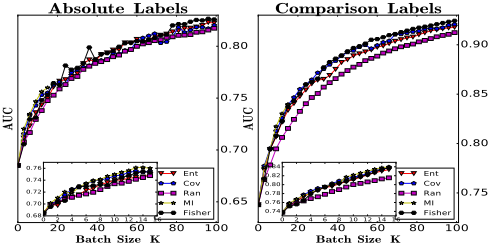
In the synthetic dataset, the experimenter initially has access to |A| = 20 absolute labels, where A ⊂ Ntrn. These are augmented from Ctrn via one of our candidate selection algorithms. Fig. 1 shows the average AUC on the test set, assuming that d = 20 and that absolute labels have variance 0.65 achieved by setting Ca = 2. Fig. 2 shows the same result for a lower variance 0.41(Ca = 1). We observe that (a) (less noisy) comparison labels are easier to predict, and that (b) decreasing the noise increases AUC across the board, while also leading to larger differentiation between different methods. MI, which is most computationally intensive, outperforms other methods, followed closely by Cov, while Ran is the worst across all regimes.
2 https://github.com/neu-spiral/Experimental_Design
| Var(Ca) | Model | K=15 | K=30 | K=50 | K=100 |
|---|---|---|---|---|---|
| Classification 0.41(1) | Ran Ent Cov Fisher MI | 0.828 ± 0.006 0.849 ± 0.006 0.857 ± 0.005 0.849 ± 0.006 0.862 ± 0.005 | 0.861 ± 0.005 0.878 ± 0.005 0.879 ± 0.005 0.872 ± 0.005 | 0.884 ± 0.004 0.902 ± 0.004 0.899 ± 0.004 0.897 ± 0.004 | 0.916 ± 0.003 0.923 ± 0.003 0.923 ± 0.003 0.921 ± 0.003 |
| 0.55(1.5) | Ran Ent Cov Fisher MI | 0.814 ± 0.008 0.817 ± 0.008 0.834 ± 0.007 0.831 ± 0.008 0.841 ± 0.008 | 0.848 ± 0.007 0.86 ± 0.006 0.868 ± 0.006 0.868 ± 0.007 | 0.877 ± 0.005 0.884 ± 0.005 0.895 ± 0.005 0.891 ± 0.005 | 0.909 ± 0.004 0.908 ± 0.004 0.919 ± 0.004 0.916 ± 0.004 |
| Label 0.65(2) | Ran Ent Cov Fisher MI | 0.815 ± 0.007 0.834 ± 0.007 0.839 ± 0.006 0.837 ± 0.006 0.84 ± 0.007 | 0.851 ± 0.006 0.864 ± 0.007 0.872 ± 0.005 0.866 ± 0.006 | 0.88 ± 0.005 0.891 ± 0.005 0.897 ± 0.004 0.897 ± 0.005 | 0.912 ± 0.004 0.918 ± 0.003 0.921 ± 0.003 0.925 ± 0.003 |
| Comparison 0.72(2.5) | Ran Ent Cov Fisher MI | 0.789 ± 0.008 0.8 ± 0.008 0.817 ± 0.007 0.807 ± 0.007 0.811 ± 0.007 | 0.833 ± 0.006 0.843 ± 0.006 0.852 ± 0.006 0.853 ± 0.006 | 0.865 ± 0.005 0.872 ± 0.005 0.879 ± 0.005 0.882 ± 0.004 | 0.905 ± 0.004 0.905 ± 0.004 0.909 ± 0.004 0.914 ± 0.003 |
| 0.78(3) | Ran Ent Cov Fisher MI | 0.791 ± 0.008 0.797 ± 0.008 0.809 ± 0.007 0.804 ± 0.008 0.818 ± 0.008 | 0.839 ± 0.006 0.844 ± 0.007 0.856 ± 0.006 0.858 ± 0.007 | 0.877 ± 0.005 0.883 ± 0.005 0.887 ± 0.005 0.886 ± 0.005 | 0.917 ± 0.003 0.911 ± 0.004 0.917 ± 0.004 0.923 ± 0.003 |
In Tables 1 and 2, we illustrate how the AUC of comparison prediction on the test set is affected by an increase of noise in the absolute labels, for different values of K. We observe that adding comparison labels improves prediction compared to absolute labels alone, and the benefit becomes more pronounced in the high-noise regime. We again observe starker differentiation from Ran in the low-noise regime.
| Var(Ca) | Model | K=15 | K=30 | K=50 | K=100 |
|---|---|---|---|---|---|
| Classification 0.41(1) | Ran Ent Cov Fisher MI | 0.806 ± 0.01 0.817 ± 0.009 0.835 ± 0.009 0.823 ± 0.009 0.832 ± 0.009 | 0.839 ± 0.008 0.857 ± 0.008 0.858 ± 0.008 0.858 ± 0.008 | 0.863 ± 0.008 0.863 ± 0.008 0.88 ± 0.007 0.87 ± 0.007 | 0.891 ± 0.007 0.887 ± 0.007 0.894 ± 0.006 0.89 ± 0.007 |
| 0.55(1.5) | Ran Ent Cov Fisher MI | 0.762 ± 0.011 0.762 ± 0.012 0.78 ± 0.011 0.777 ± 0.011 0.788 ± 0.011 | 0.791 ± 0.01 0.793 ± 0.01 0.812 ± 0.009 0.806 ± 0.01 | 0.814 ± 0.01 0.813 ± 0.01 0.831 ± 0.009 0.816 ± 0.008 | 0.842 ± 0.009 0.832 ± 0.009 0.85 ± 0.008 0.834 ± 0.009 |
| Label 0.65(2) | Ran Ent Cov Fisher MI | 0.748 ± 0.011 0.75 ± 0.011 0.755 ± 0.011 0.753 ± 0.011 0.76 ± 0.011 | 0.771 ± 0.011 0.774 ± 0.01 0.777 ± 0.01 0.779 ± 0.011 | 0.79 ± 0.01 0.795 ± 0.01 0.792 ± 0.009 0.797 ± 0.01 | 0.817 ± 0.009 0.822 ± 0.009 0.818 ± 0.009 0.826 ± 0.009 |
| Absolute 0.72(2.5) | Ran Ent Cov Fisher MI | 0.706 ± 0.011 0.712 ± 0.01 0.719 ± 0.01 0.714 ± 0.011 0.718 ± 0.01 | 0.73 ± 0.01 0.741 ± 0.011 0.735 ± 0.009 0.733 ± 0.01 | 0.746 ± 0.01 0.761 ± 0.01 0.754 ± 0.009 0.761 ± 0.01 | 0.768 ± 0.01 0.768 ± 0.01 0.767 ± 0.01 0.774 ± 0.01 |
| 0.78(3) | Ran Ent Cov Fisher MI | 0.686 ± 0.012 0.686 ± 0.011 0.703 ± 0.012 0.698 ± 0.011 0.696 ± 0.011 | 0.719 ± 0.011 0.723 ± 0.01 0.724 ± 0.011 0.727 ± 0.011 | 0.74 ± 0.011 0.738 ± 0.01 0.746 ± 0.01 0.755 ± 0.01 | 0.766 ± 0.01 0.764 ± 0.01 0.757 ± 0.01 0.775 ± 0.009 |
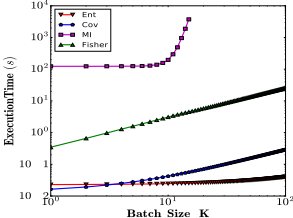
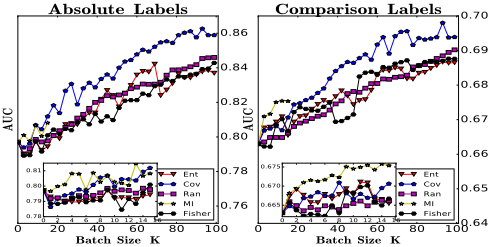
We also illustrate how the AUC of comparison prediction on the test set is affected by an increase of feature dimensionality in Tables 3 and 4 in Appendix C of our technical report [Guo et al., 2018]. In Fig. 3, we plot the execution time to compute SK of different algorithms as a function of K. As expected, Ent is the fastest, with Covariance trailing as second. The slope of the log-log plot indicates that, with the exception of MI that grows exponentially, the remaining algorithms grow almost linearly with K.
5.5 Evaluation on Real Datasets
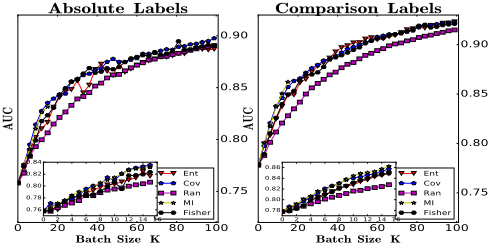
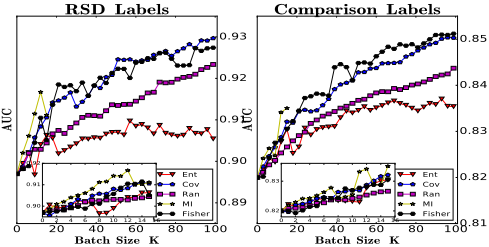
We repeat the above process in the ROP dataset, reporting the AUC for Reference Standard Diagnosis (RSD) in Ntst and comparison labels in Ctst. Fig. 4 shows the corresponding AUC's, as a function of |S| = K, when the experimenter augments |A| = 40 initial absolute labels from Ntrn. We observe a clear differentiation between policies. Using 100 comparison labels, we can improve AUC by as much as 3.4% (3.8%) for RSD (comparison) prediction by using the Cov (Fisher) method. MI outperforms other methods within the range that we can execute it. Ent significantly underperforms random, especially in RSD label prediction. We repeat the same experiment in the Sushi dataset, giving the experimenter access to |A| = 20 initial labels. We again observe that MI outperforms other methods in the K = 0 to 15 range, while the covariance method performs well across the board. The remaining two methods are only marginally better than random in comparison prediction, but not on absolute label prediction.
6 Conclusion
We present several methods for collecting comparison labels with the purpose of augmenting a dataset of absolute labels. Several of the objectives we study in modeling experimental design are submodular, and the optimizations involved can be attacked through a greedy algorithm.
We observed in both synthetic and real-life datasets that Mutual Information almost universally outperforms other objectives. On the other hand, it is computationally expensive, even when the posterior of the model is approximated via variational inference. Hence, identifying tractable approximations that yield good estimates is an important open problem. The covariance method performs well-if not optimally in comparison to MI-in terms of prediction, striking a good balance between efficiency and prediction quality. Both for this and alternative methods, greedy selection can grow quadratically in the dataset size N, because of the quadratic nature of set C. Exploiting the underlying geometry of C to produce sub-quadratic algorithms is also an important open research direction.
Acknowledgements
Our work is supported by NIH (R01EY019474, P30EY10572), NSF (SCH-1622542 at MGH; SCH-1622536 at Northeastern; SCH-1622679 at OHSU), and by unrestricted departmental funding from Research to Prevent Blindness (OHSU).
@inproceedings{ijcai2018p304,
  title     = {Experimental Design under the Bradley-Terry Model},
  author    = {Guo, Yuan and Tian, Peng and Kalpathy-Cramer, Jayashree and Ostmo, Susan and Campbell, J.Peter and F.Chiang, Michael and Erdogmus, Deniz and Dy, Jennifer and Ioannidis, Stratis},
  booktitle = {Proceedings of the Twenty-Seventh International Joint Conference on
               Artificial Intelligence, {IJCAI-18}},
  publisher = {International Joint Conferences on Artificial Intelligence Organization},
  editor    = {Jérôme Lang},
  pages     = {2198--2204},
  year      = {2018},
  month     = {7},
  note      = {Main track},
  doi       = {10.24963/ijcai.2018/304},
  url       = {https://doi.org/10.24963/ijcai.2018/304},
}
TY - CPAPER TI - Experimental Design under the Bradley-Terry Model AU - Guo, Yuan AU - Tian, Peng AU - Kalpathy-Cramer, Jayashree AU - Ostmo, Susan AU - Campbell, J.Peter AU - F.Chiang, Michael AU - Erdogmus, Deniz AU - Dy, Jennifer AU - Ioannidis, Stratis T2 - Proceedings of the Twenty-Seventh International Joint Conference on Artificial Intelligence, IJCAI-18 PB - International Joint Conferences on Artificial Intelligence Organization PY - 2018 SP - 2198 EP - 2204 DO - 10.24963/ijcai.2018/304 UR - https://doi.org/10.24963/ijcai.2018/304 ER -Copied
Machine-readable versions of this paper, for tools and AI agents:





