
A Fast Local Search Algorithm for Minimum Weight Dominating Set Problem on Massive Graphs
Proceedings of the Twenty-Seventh International Joint Conference on Artificial Intelligence. Main track. Pages 1514-1522.
https://doi.org/10.24963/ijcai.2018/210
Keywords
- Heuristic Search and Game Playing: Combinatorial Search and Optimisation
- Heuristic Search and Game Playing: Heuristic Search
Abstract
The minimum weight dominating set (MWDS) problem is NP-hard and also important in many applications. Recent heuristic MWDS algorithms can hardly solve massive real world graphs effectively. In this paper, we design a fast local search algorithm called FastMWDS for the MWDS problem, which aims to obtain a good solution on massive graphs within a short time. In this novel local search framework, we propose two ideas to make it effective. Firstly, we design a new fast construction procedure with four reduction rules to cut down the size of massive graphs. Secondly, we propose the three-valued two-level configuration checking strategy to improve local search, which is interestingly a variant of configuration checking (CC) with two levels and multiple values. Experiment results on a broad range of massive real world graphs show that FastMWDS finds much better solutions than state of the art MWDS algorithms.
- [Abramé et al., 2017] André Abramé, Djamal Habet, and Donia Toumi. Improving configuration checking for satisfiable ran- dom k-sat instances. Annals of Mathematics and Artificial In- telligence, 79(1-3):5-24, 2017.
- [Ansótegui et al., 2013] Carlos Ansótegui, Maria Luisa Bonet, and Jordi Levy. Sat-based maxsat algorithms. Artificial Intelligence, 196:77-105, 2013.
- [Ansótegui et al., 2015] Carlos Ansótegui, Frederic Didier, and Joel Gabàs. Exploiting the structure of unsatisfiable cores in maxsat. In Proceedings of the Twenty-Fourth International Joint Conference on Artificial Intelligence, pages 283-289, 2015. IJCAI
- [Aoun et al., 2006] Bassam Aoun, Raouf Boutaba, Youssef Iraqi, and Gary Kenward. Gateway placement optimization in wireless mesh networks with QoS constraints. IEEE Journal on Selected Areas in Communications, 24(11):2127-2136, 2006.
- [Bacchus, 2017] Fahiem Bacchus. Maxhs v3.0 in the 2017 maxsat evaluation. MaxSAT Evaluation 2017, page 8, 2017.
- [Bautista and Pereira, 2006] Joaquín Bautista and Jordi Pereira. Modeling the problem of locating collection areas for urban waste management. an application to the metropolitan area of barcelona. Omega, 34(6):617-629, 2006.
- [Bertsimas et al., 1993] Dimitris Bertsimas, John Tsitsiklis, et al. Simulated annealing. Statistical science, 8(1):10-15, 1993.
- [Bouamama and Blum, 2016] Salim Bouamama and Christian Blum. A hybrid algorithmic model for the minimum weight dom- inating set problem. Simulation Modelling Practice and Theory, 64:57-68, 2016.
- [Cai et al., 2011] Shaowei Cai, Kaile Su, and Abdul Sattar. Local search with edge weighting and configuration checking heuristics for minimum vertex cover. Artificial Intelligence, 175(9):1672- 1696, 2011.
- [Cai et al., 2013] Shaowei Cai, Kaile Su, Chuan Luo, and Abdul Sattar. NuMVC: An efficient local search algorithm for minimum vertex cover. Journal of Artificial Intelligence Research, 46:687- 716, 2013.
- [Cai et al., 2017] Shaowei Cai, Jinkun Lin, and Chuan Luo. Find- ing a small vertex cover in massive sparse graphs: Construct, local search, and preprocess. Journal of Artificial Intelligence Research, 59:463-494, 2017.
- [Caprara et al., 1997] Alberto Caprara, Matteo Fischetti, Paolo Toth, Daniele Vigo, and Pier Luigi Guida. Algorithms for railway crew management. Mathematical programming, 79(1-3):125- 141, 1997.
- [Ceria et al., 1998] Sebastián Ceria, Paolo Nobili, and Antonio Sas- sano. A lagrangian-based heuristic for large-scale set covering problems. Mathematical Programming, 81(2):215-228, 1998.
- [Chalupa, 2018] David Chalupa. An order-based algorithm for minimum dominating set with application in graph mining. In- formation Sciences, 426(1):101-116, 2018.
- [Chaurasia and Singh, 2015] Sachchida Nand Chaurasia and Alok Singh. A hybrid evolutionary algorithm with guided muta- tion for minimum weight dominating set. Applied Intelligence, 43(3):512-529, 2015.
- [Davies, 2013] Jessica Davies. Solving MAXSAT by Decoupling Optimization and Satisfaction. PhD thesis, PhD thesis, Universi- ty of Toronto, 2013.
- [Eubank et al., 2004] Stephen Eubank, V. S. Anil Kumar, Mad- hav V. Marathe, Aravind Srinivasan, and Nan Wang. Structural and algorithmic aspects of massive social networks. In Proceed- ings of the Fifteenth Annual ACM-SIAM Symposium on Discrete Algorithms, pages 718-727, 2004.
- [Fomin et al., 2009] Fedor V Fomin, Fabrizio Grandoni, and Dieter Kratsch. A measure & conquer approach for the analysis of exact algorithms. Journal of the ACM, 56(5):25, 2009.
- [Gao et al., 2014] Chao Gao, Thomas Weise, and Jinlong Li. A weighting-based local search heuristic algorithm for the set cov- ering problem. In Proceedings of the IEEE Congress on Evolu- tionary Computation, pages 826-831, 2014.
- [Gao et al., 2017] Wanru Gao, Tobias Friedrich, Timo Kötzing, and Frank Neumann. Scaling up local search for minimum vertex cover in large graphs by parallel kernelization. In Australasian Joint Conference on Artificial Intelligence, pages 131-143, 2017.
- [Hedetniemi et al., 2003] Sandra M Hedetniemi, Stephen T Hedet- niemi, David P Jacobs, and Pradip K Srimani. Self-stabilizing al- gorithms for minimal dominating sets and maximal independent sets. Computers & Mathematics with Applications, 46(5):805- 811, 2003.
- [Jiang et al., 2017] Hua Jiang, Chu-Min Li, and Felip Manya. An exact algorithm for the maximum weight clique problem in large graphs. In Proceedings of the Thirty-First AAAI Conference on Artificial Intelligence, pages 830-838, 2017.
- [Jovanovic et al., 2010] Raka Jovanovic, Milan Tuba, and Dana Simian. Ant colony optimization applied to minimum weight dominating set problem. In Proceedings of the 12th WSEAS in- ternational conference on Automatic control, modelling & simu- lation, pages 322-326, 2010.
- [Lin et al., 2016] Geng Lin, Wenxing Zhu, and Montaz M Ali. An effective hybrid memetic algorithm for the minimum weight dominating set problem. IEEE Transactions on Evolutionary Computation, 20(6):892-907, 2016.
- [Lin et al., 2017] Jinkun Lin, Shaowei Cai, Chuan Luo, and Kaile Su. A reduction based method for coloring very large graphs. In Proceedings of the Twenty-Sixth International Joint Conference on Artificial Intelligence, pages 517-523, 2017. IJCAI
- [Luo et al., 2015] Chuan Luo, Shaowei Cai, Wei Wu, Zhong Jie, and Kaile Su. CCLS: an efficient local search algorithm for weighted maximum satisfiability. IEEE Transactions on Com- puters, 64(7):1830-1843, 2015.
- [Martins et al., 2014] Ruben Martins, Vasco Manquinho, and Inês Lynce. Open-wbo: A modular maxsat solver. In International Conference on Theory and Applications of Satisfiability Testing, pages 438-445, 2014.
- [Martins et al., 2017] Ruben Martins, Miguel Terra-Neves, Saurab- h Joshi, Mikoláš Janota, Vasco Manquinho, and Inês Lynce. Open-wbo in maxsat evaluation 2017. MaxSAT Evaluation 2017, page 17, 2017.
- [Nitash and Singh, 2014] CG Nitash and Alok Singh. An artificial bee colony algorithm for minimum weight dominating set. In IEEE Symposium on Swarm Intelligence, pages 1-7, 2014.
- [Potluri and Singh, 2013] Anupama Potluri and Alok Singh. Hy- brid metaheuristic algorithms for minimum weight dominating set. Applied Soft Computing, 13(1):76-88, 2013.
- [Qian et al., 2015] Chao Qian, Yang Yu, and Zhi-Hua Zhou. Subset selection by pareto optimization. In Advances in Neural Informa- tion Processing Systems, pages 1774-1782, 2015.
- [Rossi and Ahmed, 2015] Ryan A. Rossi and Nesreen K. Ahmed. The network data repository with interactive graph analytics and visualization. In Proceedings of the Twenty-Ninth AAAI Confer- ence on Artificial Intelligence, pages 4292-4293, 2015.
- [Shen and Li, 2010] Chao Shen and Tao Li. Multi-document sum- marization via the minimum dominating set. In Proceedings of the 23rd International Conference on Computational Linguistics, pages 984-992, 2010.
- [Subhadrabandhu et al., 2004] Dhanant Subhadrabandhu, Saswati Sarkar, and Farooq Anjum. Efficacy of misuse detection in ad hoc networks. In Proceedings of the First Annual IEEE Communica- tions Society Conference on Sensor and Ad Hoc Communications and Networks, pages 97-107, 2004.
- [Wang et al., 2016] Yiyuan Wang, Shaowei Cai, and Minghao Yin. Two efficient local search algorithms for maximum weight clique problem. In Proceedings of the Thirtieth AAAI Conference on Artificial Intelligence, pages 805-811, 2016.
- [Wang et al., 2017a] Yiyuan Wang, Shaowei Cai, and Minghao Yin. Local search for minimum weight dominating set with two- level configuration checking and frequency based scoring func- tion. Journal of Artificial Intelligence Research, 58:267-295, 2017.
- [Wang et al., 2017b] Yiyuan Wang, Dantong Ouyang, Liming Zhang, and Minghao Yin. A novel local search for unicost set covering problem using hyperedge configuration checking and weight diversity. Science China Information Sciences, 60(6):062103, 2017.
- [Wu et al., 2006] Ping Wu, Ji-Rong Wen, Huan Liu, and Wei-Ying Ma. Query selection techniques for efficient crawling of struc- tured web sources. In Proceedings of the 22nd International Con- ference on Data Engineering, pages 47-47. IEEE, 2006.
- [Zhu et al., 2012] Xu Zhu, Wei Wang, Shan Shan, Zhong Wang, and Weili Wu. A PTAS for the minimum weighted dominating set problem with smooth weights on unit disk graphs. Journal of combinatorial optimization, 23(4):443-450, 2012.
References were extracted automatically from the PDF and may contain errors.
Full text extracted automatically from the PDF; figures, tables and equations may differ. The PDF is the version of record.
1 Introduction
Given a graph G = (V, E), a dominating set is to find a subset D of vertices V such that every vertex belongs to D or is adjacent to at least one vertex in D. The minimum dominating set (MDS) problem aims to identify the dominating set with the smallest size in a graph. An important generalization of MDS is the minimumweight dominating set (MWDS) problem, in which each vertex is associated with a positive integer, and the goal is to find a dominating set with the smallest weight. MWDS is an important combinatorial optimization problem with lots of valuable applications in many fields [Hedetniemi et al., 2003; Subhadrabandhu et al., 2004; Aoun et al., 2006; Chalupa, 2018]. For example, Wu et al. [2006] try to select good queries to rapidly harvest data records from Web databases, which has been proved to be equivalent to finding an MWDS of the corresponding database graph. Also, Shen and Li [2010] solve the multi-document problem by encoding this problem to the MWDS problem.
∗Corresponding author
The MWDS problem can be encoded into the weighted partial maximum satisfiability (WPMS) problem and effectively solved by WPMS algorithms. MWDS is a special class of the subset selection problem [Qian et al., 2015] and the minimum weight set covering (MWSC) problem [Gao et al., 2014] which has many applications, such as service location and information retrieval [Caprara et al., 1997; Ceria et al., 1998; Bautista and Pereira, 2006].
MWDS is a classical NP-hard problem, which means there are no polynomial-time algorithms for the MWDS problem, unless NP=P. Approximation algorithms with good approximation ratios have been designed for special subclass of the MWDS problem. For example, an approximation scheme achieves a (1+ε)-approximation ratio (ε > 0) [Zhu et al., 2012] for unit disk graphs with smooth weights. Nevertheless, the general problem of MWDS remains hard to approximate, and approximation algorithms usually have poor performance in practice, especially for massive data sets.
1.1 RelatedWork
Because of its NP-hardness, many researchers on solving the MWDS problem focus on heuristic algorithms for obtaining a good weighted dominating set within a reasonable time. In the recent decade, various heuristic algorithms have been developed for solving the MWDS problem. A classical ant colony optimization ACO was proposed for solving the MWDS problem, by using the weight of each covered vertices as the scoring function [Jovanovic et al., 2010]. The ACO algorithm was further improved by taking into account the pheromone deposit on every vertex, resulting in the ACO-PP-LS algorithm [Potluri and Singh, 2013]. A local search MWSC algorithm which was used to solve the MWDS problem was proposed to perturb the candidate solution by a weighting scheme and tabu strategy [Gao et al., 2014]. A swarm intelligence algorithm named ABC applied an artificial bee colony method for tackling the MWDS problem [Nitash and Singh, 2014]. Chaurasia and Singh designed a hybrid MWDS algorithm called EA/G-IR by using an evolutionary algorithm and a guided mutation [Chaurasia and Singh, 2015]. An effective hybrid memetic MWDS algorithm HMA which was formulated as a constrained 0-1 programming problem was proposed and a memetic algorithm was introduced to solve the resulting problem [Lin et al., 2016]. A randomized population-based iterated greedy MWDS algorithm R-PBIG was presented, which applied the iterated greedy algorithm to update each population [Bouamama and Blum, 2016]. Chalupa [2018] designed a multi-start variant of order-based randomised local search MSRLSo to solve MWDS. According to the literature, the current best heuristic algorithm for the MWDS problem is called CC2FS, which is based on two-level configuration checking and frequency based scoring function, and has better performance on a wide range of benchmarks than other MWDS algorithms [Wang et al., 2017a]. Moreover, CC2FS firstly tries to solve massive graphs and obtains some promising results.
1.2 Contributions and Paper Organization
Massive data sets [Rossi and Ahmed, 2015] can be modelled as massive graphs, and extensive studies have been carried out recently to tackle NP-hard problems on massive graphs [Wang et al., 2016; Jiang et al., 2017; Gao et al., 2017; Lin et al., 2017; Cai et al., 2017]. Although recent works have made great progress in solving the MWDS problem on some standard benchmarks, the improvements are limited on massive graphs. Therefore, we focus on solving massive graphs. We develop a fast local search algorithm for the MWDS problem called FastMWDS, which includes two phases, i.e., construction phase and local search phase. We are dedicated to reducing the time complexity of each phase. To improve the performance of FastMWDS on massive graphs, we design two heuristics, which are important in each phase of FastMWDS.
Firstly, we design a fast heuristic called ConstructDS for constructing a weighted dominating set. This heuristic can be divided into three parts: reducing, constructing, shrinking. Four reduction rules are proposed for the MWDS problem and used in ConstructDS procedure. The obtained solution will be used as the initial solution for the local search phase.
Secondly, we propose a three-valued two-level configuration checking strategy (CC2V3) to deal with the cycling problem in local search. The configuration checking strategy was firstly proposed by Cai [2011] and has been already used in many problems, including clique problem [Wang et al., 2016], vertex cover [Cai et al., 2013], dominating set [Wang et al., 2017a], boolean satisfiability [Abram´e et al., 2017], maximum satisfiability [Luo et al., 2015], and set covering [Wang et al., 2017b]. Recently, the two-level configuration checking (CC2 ) [Wang et al., 2017a] was designed to solve the MWDS problem. Our CC2V3 strategy can be viewed as a multiple-value version of CC2 . While CC2 only considers whether a vertex is configuration changed or not, CC2V3 distinguishes configuration changed vertices by different values.
We also apply a variant of the probabilistic heuristic "best from multiple selection" (BMS) [Cai et al., 2017] that combines random walk into FastMWDS. For massive graphs, when selecting the removal vertices from the solution, there exist too many candidate vertices. Therefore, this heuristic can decrease the time complexity of this part.
We carry out experiments to compare FastMWDS with four state of the art MWDS algorithms on a broad range of massive graphs from [Rossi and Ahmed, 2015]. Experiment results show that FastMWDS performs significantly better than the competitors, indicating the effectiveness of the proposed heuristics.
In the next section, we introduce some preliminary knowledge, including some definitions and notations. In Sections 3 and 4, we describe ConstructDS and CC2V3. After that, we present the FastMWDS algorithm. Then, we carry out our experiments to evaluate FastMWDS. Finally, we give some concluding marks.
2 Preliminaries
2.1 Definitions and Notations
An undirected graph G = (V,E) consists of a vertex set V and an edge set E ⊆ V × V in which each edge is a 2element subset of V . For an edge e = {u, v}, vertices u and v are the endpoints of the edge e. A vertex weighted undirected graph is an undirected graph in which each vertex v ∈ V is associated with a positive weight w(v). We use G = (V,E,w) to denote a vertex weighted graph. Two vertices are neighbors if and only if they both belong to one edge. N(v) = {u ∈ V |{u, v} ∈ E} is the set of neighbors of a vertex v. The degree of vertex v is defined as deg(v) = |N(v)|. dist(u, v) is used to denote the number of edges in the shortest path from u to v, i.e., the distance between these two vertices. We define its ith level neighborhood as Ni(v) = {u|dist(u, v) = i}, as well as we denote N k (v) = ⋃ki=1 Ni(v) and Ni[v] = Ni(v)∪{v}. We can easily find that N1(v) = N(v) and N1[v] = N[v]. For a vertex set S ⊆ V , we use N[S] = ⋃v∈S N[v] to denote the closed neighborhood of S.
Given a vertex weighted graph G = (V, E, w), a candidate solution for the MWDS problem is a subset of vertices. A vertex v ∈ V is dominated by a candidate solution D if v ∈ N[D], and is non-dominated otherwise. During the search procedure, FastMWDS always maintains a current candidate solution. For convenience, we use D to denote the current candidate solution, i.e., the set of vertices currently selected for dominating. The age of a vertex is the number of steps since its state was last changed.
2.2 Preliminaries of Scoring Function for MWDS
Recently, the frequency based scoring function [Wang et al., 2017a] is proposed to decide which vertex should be added or removed, which can further improve the performance of the local search phase. The main idea of this new scoring function is as follow: Each vertex v ∈ V has an additional property: frequency, denoted by freq[v]. In the beginning, the freq of each vertex is set to 1. Then, at the end of local search, the freq of each non-dominated vertex is increased by one. We use scoref to denote the frequency based scoring function: If u ∈ D, scoref(u) = - ∑v∈C1 freq[v]/w(u) where C1 is the set of dominated vertices that would become non-dominated by removing u from D; otherwise, if u /∈ D, then scoref (u) = ∑v∈C2 freq[v]/w(u) where C2 is the set of non-dominated vertices that would become dominated by adding u into D.
3 ANewConstruction with Reduction Rules
In this section, we propose a new fast construction procedure ConstructDS, which includes three parts: reducing, constructing, shrinking. Firstly, we introduce four rules to reduce the size of the MWDS problem and then show how to construct a dominating set quickly. Finally, redundant vertices will be removed. The resulting solution will serve as an initial candidate solution for subsequent local search.
3.1 Reduction Rules
Below are four reduction rules used in ConstructDS.
Weighted-Degree-0 Rule. An isolated vertex u with deg(u) = 0 must be in an optimal solution. Thus, u is fixed as a dominating vertex in D.
Weighted-Degree-1 Rule1. If G includes v s.t. N(v) = {u} and w(v) > w(u), then u is fixed as a dominating vertex in D and G is simplified by deleting v and its incident edges.
Weighted-Degree-1 Rule2. If G contains v1, v2, . . . vt s.t. N(v1) = N(v2) = · · · = N(vt) = {u} and w(v1)+w(v2)+ · · · + w(vt) > w(u), then u is fixed as a dominating vertex in D and G is simplified by deleting v1, v2, . . . vt and their incident edges.
Weighted-Degree-2 Rule. If G includes v1, v2, u s.t. N(v1) = {v2, u}, N(v2) = {v1, u}, w(v1) > w(u) and w(v2) > w(u), then u is fixed as a dominating vertex in D and G is simplified by deleting v1, v2 and their incident edges.
Although these weighted reduction rules are inspired by the dominance rule [Fomin et al., 2009], these rules for the MWDS problem contain additionally a weighted constraint for handling the weights, and thus extend the original reduction rules for unweighted graphs. Moreover, these rules have never been applied into heuristic MWDS algorithms.
3.2 The ConstructDS Procedure
The ConstructDS procedure is presented in Algorithm 1. ConstructDS consists three parts: reducing (Line 1-5), constructing (Line 6-9), and shrinking (Line 10-11).
In the reducing part, we apply four reduction rules into G. If these exist some vertices which must be in an optimal solution, then these vertices are fixed as dominating vertices and we add these vertices into the candidate solution. In the subsequent local search phase, these fixed vertices are forbidden to be removed from the candidate solution.
In the constructing part, during each step, ConstructDS randomly picks a non-dominated vertex v. Afterwards, among all closed neighborhood of v, the vertex u with the biggest scoref value is picked. Finally, we put u into the candidate solution D.
In the shrinking part, ConstructDS will remove one of the vertices whose scoref value is 0 at each step. Assuming that when removing vertex v with scoref(v) = 0, for ∀u ∈ N 2 [v], scoref (u) will be updated and then for the previous vertices whose scoref value is 0, these scoref values may be changed. Therefore, ConstructDS removes only one redundant vertex at each step.
Most massive graphs with power-law degree distribution [Eubank et al., 2004] can be reduced considerably by using
Algorithm 1: the ConstructDS procedure
Input: a weighted graph G = (V, E, w)
Output: an initial weighted dominating set D
- 1 while any reduction rules are satisfied do
- 2 repeatedly apply Weighted-Degree-0 Rule into G until it is not satisfied;
- 3 repeatedly apply Weighted-Degree-1 Rule1 into G until it is not satisfied;
- 4 repeatedly apply Weighted-Degree-1 Rule2 into G until it is not satisfied;
- 5 repeatedly apply Weighted-Degree-2 Rule into G until it is not satisfied;
- 6 while there exist non-dominated vertices do
- 7 randomly select a vertex v from all non-dominated vertices;
- 8 select a vertex u ∈ N[v] with the biggest scoref value; 9 D :=D∪ {u};
10 while there exists vertex v with scoref (v) = 0 do
- 11 D :=D \ {v};
12 return D;
some strategies. In this case, removing some redundant vertices by our reduction rules will benefit the subsequent construction procedure. Also, we try to reduce the complexity of the constructing and shrinking parts since the remaining reduction massive graphs still have vertices with the large size. In our algorithm, the complexity of the ConstructDS procedure is O(|V |∗Nmax+|D|∗Nmax+|D|) = O(|V |∗Nmax), where Nmax is the maximum number of deg(v), for ∀v ∈ V .
In our experiments, after the reducing part, an initial solution has already dominated on average 59.07% vertices of all massive graphs. Also, the run time of ConstructDS on all massive graphs but 9 is less than 10 seconds.
4 ANewConfiguration Checking Strategy
The CC strategy has been used successfully in local search algorithms for many NP-hard combinatorial problems, and several variants of CC have been proposed. Among these, the two-level configuration checking (CC2 ) has been shown to be promising for the MWDS problem, with experiment results supporting its superiority over other CC strategies.
4.1 Review of CC2 Strategy
The two-level configuration checking (CC2 ) was proposed to improve a local search algorithm for MWDS [Wang et al., 2017a]. CC2 is implemented with a Boolean array ConfChange whose size equals the number of vertices in the given graph. In CC2 , the configuration of a vertex is defined to be a vector consists of its neighbors and its neighbors' neighbors. The vertex is considered configuration-changed, if the value of any bit of the vector has changed. The CC2 strategy forbids any vertex to be added into the candidate solution if it is not configuration-changed since its last removal from the candidate solution.
The CC2 strategy works as follows.
Updating rules: (1) At the beginning of local search, for each vertex v, ConfChange[v] is set to 1; (2) When vertex v is removed, ConfChange[v] is reset to 0 , and ConfChange[u] is set to 1 for all u ∈ N 2 (v); (3) When vertex v is added, ConfChange[u] is set to 1 for all u ∈ N 2 (v).
Using rule: When choosing an added vertex v, CC2 forbids any vertex to be added into the candidate solution if its configuration has not been changed, i.e., ConfChange[v] = 0.
4.2 Intuition and Data Structure of CC2V3
For the MWDS problem, local search algorithms usually modify the candidate solution by adding or removing a vertex. Although CC2 leads to more candidate added vertices than the original configuration checking, it does not distinguish the vertices that are allowed to be added. That is, any vertex only has two states, either forbidden (0) or allowed (1).
In fact, for such CC strategy with two levels, we can further exploit the different levels to distinguish the priority of the allowed vertices. Based on this consideration, we propose a new version of configuration checking, that is, a three-valued two-level configuration checking denoted by CC2V3.
To implement CC2V3, we employ an integer array conf, whose size equals the number of vertices in the input graph. For each vertex v, the conf[v] value has three possibilities, and their meanings are explained below.
- conf[v] = 0 means that vertex v should be forbidden to be added;
- conf[v] = 1 means that v is clearly dominated by the current selected vertex.
- conf[v] = 2 means that the dominated state of v is not changed by the current selected vertex or is possibly become to "non-dominated" by the current selected vertex.
4.3 Updating Rules of CC2V3
In this subsection, we will explain the different configuration values of each vertex for the removing process and adding process of local search as below.
At the start of local search, since an initial solution is already a dominating set, each vertex in the given graph must be dominated by some vertices of the candidate solution. Thus, conf[v] should be initialized to 1, for ∀v ∈ V .
When adding a vertex v into the candidate solution, for ∀u1 ∈ N1(v), u1 is dominated by vertex v and conf[u1] is set to 1. But, the added vertex v cannot change the dominated or non-dominated state of u2, for ∀u2 ∈ N2(v). Thus, we mark conf[u2] as 2.
When removing a vertex v from the candidate solution, no matter whether u1 ∈ N1(v) or u2 ∈ N2(v), they both have the chance to be still dominated by the candidate solution, since other vertices in the candidate solution maybe dominate them. Therefore, the conf[u1] and conf[u2] need to be set to 2. For the removal vertex v, we should forbid this vertex to be added back to the candidate solution until its configuration has been changed. For this reason, we set conf[v] to 0.
For these considerations, we formally give the configuration updating rules as below.
CC2V3 Rule1. In the beginning, for ∀v ∈ V , conf[v] is initialized to 1.
CC2V3 Rule2. When vertex v is added into candidate solution D, for ∀u1 ∈ N1(v), conf[u1] is set to 1, and for ∀u2 ∈ N2(v), conf[u2] is set to 2.
CC2V3 Rule3. When vertex v is removed from candidate solution D, for ∀u ∈ (N1(v) ∪ N2(v)), conf[u] is set to 2 and conf[v] should be reset to 0.
4.4 Using Rule of CC2V3
We apply the CC2V3 strategy into the added vertex selection procedure. The resulting adding rule is described as below.
Adding Rule. When adding one vertex into the candidate solution D, select a vertex v with the biggest scoref (v) value and conf [v] ̸= 0, breaking ties by picking one vertex with the highest conf[v] value.
When selecting an added vertex v, if there is more than one vertex with the same biggest score value, then we have to select one vertex among these vertices. Although these vertices have the same biggest values, the configuration values of these vertices may be different. Assuming that both of vertex u with conf [u] = 2 and vertex v with conf [v] = 1 have the same biggest score value. Compared with vertex v that has already dominated by the candidate solution, we prefer to choose vertex u with the uncertain dominated state, which may decrease the number of non-dominated vertices as much as possible. Further ties are broken randomly if more than one vertex has the biggest score value and the highest configuration value.
In fact, the scoring function seen as the global view strategy selects an added vertex, while the CC2V3 strategy mainly reflects the relevant information of the local added vertex. Therefore, the reasonable selection vertex strategy should take both of them into account.
5 The FastMWDS Algorithm
In this section, we propose a local search algorithm for the MWDS problem named FastMWDS, which is outlined in Algorithm 2. FastMWDS can be divided into two parts: construction (Line 3) and local search (Line 5-22). After constructing an initial candidate solution, the algorithm works iteratively by removing some vertices and adding some other vertices until time limit is reached. At last, the best found solution is returned (Line 23).
At the beginning of each step in local search phase, a current candidate solution D is already a weighted dominating set. If there exist some vertices whose scoref value is 0, then among these vertices the algorithm randomly removes a vertex u from D (Line 6-9), which means that the candidate solution is still a weighted dominating set after removing this vertex. Otherwise, the algorithm turns to check whether the current candidate solution D is better than the best solution D∗ , and if so, D∗ is updated by D (Line 10). Afterwards, the algorithm selects two removal vertices, according to two different situations.
The first situation (Line 11-13): the current candidate solution D remains a weighted dominating set. In this case, the algorithm tries to find the best move to update D. When some vertices have the same highest score value, the algorithm selects the oldest vertex u1 to remove. The favour towards the oldest vertex introduces diversification into this greedy move.
The second situation (Line 14-16): the current candidate solution D is not a weighted dominating set. In this case, we consider the algorithm should do some perturbations. On the other hand, pure randomized strategies would lose the information during the search. Also, after a long period, the algorithm still cannot find a better solution, and thus the strong random walk should be brought into the algorithm. Based on the above considerations, we propose a new variant of "best from multiple selection" (BMS) heuristic [Cai et al., 2017]. We formalize the BMS heuristic with some random walks in Algorithm 3 as below. In our BMS heuristic, we use nonimpr-step to denote the number of non-improvement step, which is initialized as 0 (Line 2). It is increased by one after each step (Line 22), and is reset to 0 when obtaining a better weighted dominating set (Line 10). The parameter k is used to control the greediness and a large k value usually indicates a great greediness and more computation time. Inspired by Metropolis algorithm [Bertsimas et al., 1993] used in Simulate Anneal, we allow the algorithm to accept k = 1024 with the probability of e-step , otherwise k = 50 + rand(10) with the probability of 1-e-step . At first, the algorithm dedicates to accurately finding a vertex with the highest score value, rather than a random vertex in D. Therefore, the algorithm has a high probability to assign k as 1024, and has a low probability to assign k as 50 + rand(10). After many steps, more random walks will be added into the algorithm, i.e having a high probability to assign k as 50 + rand(10), leading to explore many different spaces. After updating the value of k, the algorithm randomly picks k vertices and among these vertices the best move will be selected.
After removing two vertices from D, the algorithm adds some vertices into D until D becomes a dominating set (Line 17-21). The algorithm chooses the added vertices from N 2 (u1)∪N 2 (u2) rather than V -D, and thus the number of the candidate added vertices is very small. During the adding procedure, the algorithm prefers to pick a vertex v with the biggest score value and the highest configuration value.
For each step in the local search phase (Line 5-22), the complexity is O(max{|D|, 2∗N 3max }), where |D| is the size of D and Nmax is the maximum number of deg(v), for ∀v ∈ V .
6 Experimental Results
In this section, we carry out extensive experiments to test the performance of FastMWDS on a broad range of massive real world graphs, compared against a state of the art local search algorithm for MWDS, as well as three state of the art WPMS solvers because MWDS can be easily translated into WPMS. The WPMS solvers include MaxHS [Davies, 2013; Bacchus, 2017], OpenWBO [Martins et al., 2014; 2017], and WPM3-2015-in [Ans´otegui et al., 2013; 2015], where MaxHS and OpenWBO are the complete versions submitted to the MaxSAT Evaluations 2017 and WPM3-2015-in as a recently incomplete algorithm is submitted to the MaxSAT Evaluations 2016. We consider 187 massive real world graphs from the Network Data Repository [Rossi and Ahmed, 2015]. There are a few bipartite graphs in the benchmark, and we choose to ignore them. For the sake of space, we do not re-
Algorithm 2: the FastMWDS algorithm
Input: a weighted graph G = (V, E, w), the cutoff time Output: a weighted dominating set of G 1 initialize conf according to the CC2V3 Rule1; 2 non-impr-step := 0; 3 D := ConstructDS(G); 4 D∗ :=D; 5 while elapsed time < cutoff do 6 if there exists vertex u with scoref (u) = 0 then 7 select a random vertex u with scoref (u) = 0; 8 D := D \ {u}; 9 continue; 10 if w(D) < w(D∗ ) then D∗ :=D and non-impr-step := 0; 11 select vertex u1 ∈ D with the biggest scoref value, breaking ties by the oldest one; 12 D :=D \ {u1}; 13 update conf according to the CC2V3 Rule3; 14 select vertex u2 ∈ D by BMS(non-impr-step); 15 D :=D \ {u2}; 16 update conf according to the CC2V3 Rule3; 17 repeat 18 select a vertex v ∈ (N 2 (u1) ∪ N 2 (u2)) according to the Adding Rule; 19 D := D ∪ {v}; 20 update conf according to CC2V3 Rule2; 21 until D is a weighted dominating set; 22 non-impr-step := non-impr-step+1;23 return D∗ ;
Algorithm 3: the BMS heuristic with some random walks
Input: the number of non-improvement step step Output: a removal vertex u∗ 1 if with probability q < e-step then 2 k := 1024; 3 else 4 k := 50+rand(10); 5 pick a random vertex u2 ∈ D; 6 score∗f := scoref(u2) and u∗ := u2; 7 for i = 0;i < k;i++ do 8 pick a random vertex u2 ∈ D; 9 if (scoref (u2) > score∗f ) then 10 score∗f := scoref(u2) and u∗ := u2; 11 return u∗ ;port the results on graphs with less than 110,000 vertices and less than 1,000,000 edges in which the performance of our algorithm is always best. In total, 63 instances are reported in this section. To obtain the corresponding MWDS instances, we use the same method as in [Wang et al., 2017a], i.e., for the ith vertex vi, w(vi)=(i mod 200)+1.
FastMWDS is implemented in C++ and compiled using GNU g++ -O3. All experiments are performed on Ubuntu Linux, with 3.1 GHZ CPU and 16GB memory. For both of them, 10 independent runs with different seeds are performed for each instance. The time limit of all algorithms is 1000 seconds. For each instance, wmin is the weight of the best dominating set found, and time is the average run time when algorithms obtain the minimal solution values. The bold value indicates the best value between FastMWDS and its competitors. For some instances, four competitors fail to obtain a weighted dominating set within the given time limit, then we use "N/A" to mark it. If an algorithm proves the optimal solution, the corresponding column is marked with ⋆ .
| Instance | MaxHS | OpenWBO | WPM3-2015-in | CC2FS | FastMWDS | ||
|---|---|---|---|---|---|---|---|
| wmin | wmin | wmin | wmin | time | wmin | time | |
| bn-human-BNU 1 00 25865 session 1-bg | 119567023 | 119829952 | 119864215 | N/A | N/A | 119322667 | 997.15 |
| bn-human-BNU 1 00 25865 session 2-bg | 155868115 | 156089311 | 156101609 | N/A | N/A | 155703082 | 764.47 |
| ca-coauthors-dblp | 3203654 | 2621360 | 4010227 | 2584027 | 991.65 | 2539457 | 971.04 |
| ca-dblp-2012 | 4048614 | 3898186 | 4756639 | 3757029 | 999.62 | 3681795 | 933.59 |
| ca-hollywood-2009 | 5507112 | 4368759 | 6986234 | 3732085 | 380.06 | 3654205 | 998.27 |
| channel-500x 100x100-b050 | 52436338 | 45639579 | 52592043 | N/A | N/A | 27826097 | 918.87 |
| dbpedia-link | 154591900 | 154526642 | 154526642 | N/A | N/A | 133739180 | 5.97 |
| delaunay n22 | 83035082 | 83774141 | 88465848 | N/A | N/A | 55243217 | 919.21 |
| delaunay n23 | 165834069 | 171803113 | 176359228 | N/A | N/A | 112013949 | 989.98 |
| delaunay n24 | 331967826 | 345763164 | 354066023 | N/A | N/A | 226251102 | 990.91 |
| friendster | 66264132 | 66275673 | 66275673 | N/A | N/A | 55506341 | 18.94 |
| hugebubbles-00020 | 708625717 | 747989696 | 755304622 | N/A | N/A | 516458602 | 999.87 |
| hugetrace-00010 | 406897159 | 444315493 | 450388589 | N/A | N/A | 307261619 | 929.92 |
| hugetrace-00020 | 535479596 | 573230746 | 579039050 | N/A | N/A | 400022798 | 946.93 |
| inf-europe osm | N/A | N/A | N/A | N/A | N/A | 1820445787 | 914.77 |
| inf-germany osm | 409829603 | 399549008 | 400775441 | N/A | N/A | 403783914 | 993.99 |
| inf-roadNet-CA | 64889764 | 63935632 | 65769717 | N/A | N/A | 53077217 | 997.59 |
| inf-roadNet-PA | 36000505 | 34776092 | 36446447 | N/A | N/A | 28919193 | 990.95 |
| inf-road-usa | 852776450 | 899703836 | 903206743 | N/A | N/A | 646087601 | 978.8 |
| rec-dating | 913220 | 875523 | 909326 | 853349 | 996.64 | 851783 | 824.91 |
| rec-epinions | 815003 | 756642* | 982297 | 760187 | 997.83 | 757593 | 804.92 |
| rec-libimeseti-dir | 1012517 | 956296 | 1345525 | 932442 | 996.46 | 928802 | 964.5 |
| rgg n 2 23 s0 | 72025903 | 41476129 | 72223302 | N/A | N/A | 19032060 | 969.93 |
| rgg n 2 24 s0 | 139001281 | 92187644 | 139417747 | N/A | N/A | 35956171 | 987.98 |
| Rt-retweet-crawl | 7642932 | 9241645 | 9241645 | 7337141 | 998.98 | 7124971 | 776.26 |
Experiment results on the massive graphs are shown in Tables 1 and 2. CC2FS under the time limit (1000 seconds) are essentially worse than FastMWDS under the same time limit. Especially, there are 37 graphs for which CC2FS cannot find weighted dominating sets within the time limit (i.e., failing to finish its initialization phase within the time limit), while FastMWDS finds weighted dominating sets for all graphs.
The WPMS algorithms MaxHS, OpenWBO and WPM3-
| MaxHS | OpenWBO | WPM3-2015-in | CC2FS | FastMWDS | |||
|---|---|---|---|---|---|---|---|
| Instance | wmin | wmin | wmin | ||||
| sc-ldoor sc-msdoor sc-pwtk sc-rel9 sc-shipsec1 sc-shipsec5 soc-delicious soc-digg soc-dogster soc-flickr soc-flickr-und soc-flixster soc-FourSquare soc-lastfm soc-livejournal soc-livejournal -user-groups soc-ljournal-2008 soc-orkut soc-orkut-dir soc-pokec soc-sinaweibo soc-twitter-higgs | 6305998 1991510 415218 17250188 975929 1354538 5632727 6650265 2081739 9889280 29827231 9142886 6127205 6746555 81529479 108356093 102894556 13759507 11040456 22716203 N/A | 5799129 1639855 311361 16591326 664599 810243 5647129 6758798 1894341 9937487 29831830 9142886 6151890 6981300 79826229 108211843 122980315 13767087 10934518 20864032 N/A | 6777213 2218936 450291 16746750 1019460 1430233 5647129 6758798 2725541 9937487 29831830 9142886 6151890 6981300 81818399 108211843 124862057 13767087 10934518 22779370 N/A | wmin 5459575 1578611 278128 N/A 389617 516034 4929139 5500630 1909172 7945690 N/A 8743064 5416484 6079423 N/A N/A N/A N/A N/A N/A | time 922.24 972.83 963.3 N/A 776.63 935.94 998.69 995.02 995.17 237.05 N/A 986.35 594.87 329.57 N/A N/A N/A N/A N/A N/A N/A | wmin 5442220 1562389 274527 11912921 380343 503750 4896072 5439126 1893048 7874744 24592651 8602570 5390875 6058609 60672724 86247425 92171228 7164654 6374315 14731523 20002246 906236 6905158 | time 980.49 993.82 914.19 993.71 742.31 783.93 844.12 866.09 987.54 862.02 963.27 918.18 986.52 913.03 106.55 209.41 201.53 998.03 996.4 993.91 947.87 893.13 |
| 927158 8743841 21492126 | |||||||
| socfb-A-anon socfb-B-anon | 21492126 20452282 18875391 N/A | N/A N/A | 980.68 N/A N/A | 17041237 16103964 | 997.91 981.02 | ||
| soc-youtube socfb-uci-uni | N/A 909896 | 84054669 | |||||
| tech-as-skitter | N/A 19822652 | 19822631 | N/A N/A | N/A | 2321 | 982.69 998.68 | |
| twitter mpi | 57042991 1637957 | 57032003 1625020 | 57032003 2114247 | 2427 N/A 1580428 | 744.53 N/A | 50521218 | 13.5 10.47 |
| web-arabic-2005 web-baidu-baike web-it-2004 web-uk-2005 | 28300817 | 993.98 | |||||
| web-wikipedia link web-wikipedia2009 | 2747602 93183* 34761238 | 28245789 2619362 93183* 36041177 37674803 | 28274603 4653739 93183* 37120690 37674803 | 6993952 17291372 N/A 2621892 93183 N/A | N/A 998.21 1.28 N/A N/A | 1572856 23785438 2582786 93183 29162579 | 998.04 989.66 0.53 155.11 |
| it web-wikipedia-growth | 35830702 | 11404055 | 12509126 | 27120007 | 967.74 | ||
| 13975 | |||||||
| tech-ip | |||||||
| 997.5 | 974.85 | ||||||
| wikipedia link en | 20440160 18866563 | 18875391 N/A 19771180 3510 | 9224143 | ||||
| 21504191 | 20452282 | 3123822 | 16760036 | ||||
| 1124102 9147519 | 970.03 | ||||||
| soc-youtube-snap | 206.26 | ||||||
| N/A | N/A | N/A | 988.61 | ||||
| 2808 | |||||||
| 13173037 | |||||||
| N/A | |||||||
| 12498617 | N/A | ||||||
| N/A | |||||||
| 8301996 | 948.26 | ||||||
| N/A | N/A | N/A | 982.71 | ||||
| 2408988048 | |||||||
2015-in fail on 4 graphs, and FastMWDS finds better solutions than MaxHS, OpenWBO and WPM3-2015-in on the remaining massive graphs, except two instances infgermany osm and rec-epinions.
6.1 The Effectiveness of ConstructDS
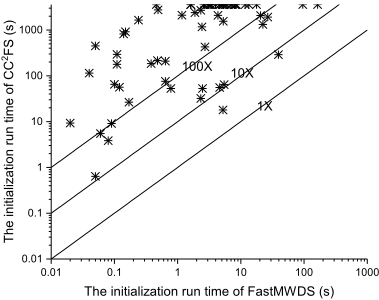
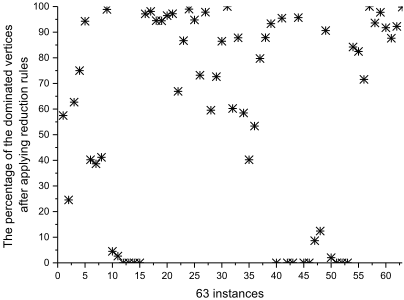
Figure 1 plots the initialization run time of CC2FS versus FastMWDS, clearly showing the superiority of FastMWDS. For all massive graphs, the initialization run time of FastMWDS is always shorter than that of CC2FS. Especially, for 37 graphs, the initialization of FastMWDS is 1000 × faster than CC2FS. For only 9 instances, the initialization run time of FastMWDS is larger than 10 seconds. Figure 2 shows the percentage of the vertices dominated by the candidate solution after applying four reduction rules into the FastMWDS algorithm. For 41 massive instances, the percentage of the dominated vertices is more than 50%. Figures 1 and 2 intuitively display the effectiveness of our construction procedure.
6.2 The Effectiveness of the CC2V3 Strategy
In this subsection, to further study the effectiveness of the CC2V3 strategy, we compare FastMWDS with its alternative version named FastMWDS+CC2 , which uses the CC2 strategy instead of our CC2V3 strategy. We select 26 instances where CC2FS fails to obtain the solutions within the time limit (3600 seconds). Table 3 shows that FastMWDS finds better solutions than FastMWDS+CC2 on these instances, except for one instance soc-ljournal-2008. Experimental results indicate that the CC2V3 strategy makes an important role in the FastMWDS algorithm.
7 Conclusion and FutureWork
In this paper, we develop a local search algorithm for the MWDS problem called FastMWDS, which can solve massive graphs within a short time. Two new ideas are used to improve FastMWDS. Firstly, a new fast construction procedure with four reduction rules is proposed, which includes three parts: reducing, constructing, shrinking. After this construction procedure, the size of massive graphs is reduced. Secondly, we design a new configuration checking with multiple values named CC2V3, which can exploit the relevant information of the current solution and is better than previous CC strategies. Experiments on massive graphs show that FastMWDS finds better solutions than the state of the art algorithms. Also, FastMWDS obtains a good weighted dominating set for all massive graphs within a reasonable time limit (1000 seconds), while CC2FS and three WPMS algorithms fail to find a weighted dominating set on a considerable portion of massive graphs. As for future work, we will try to further improve our FastMWDS algorithm by some other ideas, and try to solve other massive instances.
| Instance | FastMWDS+CC2 wmin | FastMWDS wmin | δmin |
|---|---|---|---|
| bn-human-BNU 1 00 25865 session 1-bg bn-human-BNU 1 00 25865 session 2-bg | 119322869 155703116 | 119322667 155703082 | 202 34 |
| channel-500x 100x100-b050 | 28262180 | 27826097 | 436083 |
| dbpedia-link delaunay n22 delaunay n23 delaunay n24 | 133741307 55587000 112278364 226368604 | 133739180 55243217 112013949 226251102 | 2127 343783 264415 117502 |
| friendster | 55513437 | 55506341 | 7096 |
| hugebubbles-00020 hugetrace-00010 | 516502746 307418821 | 44144 | |
| hugetrace-00020 inf-europe osm inf-germany osm | 400194448 1820450708 403925678 | 516458602 307261619 400022798 1820445787 403783914 | 157202 171650 4921 141764 |
| inf-roadNet-CA inf-road-usa rgg n 2 23 s0 rgg n 2 24 s0 | 53130369 646193278 19086086 | 53077217 646087601 19032060 35956171 | 53152 105677 54026 55884 |
| 36012055 | |||
| sc-rel9 | 11985406 | 11912921 | 72485 |
| socfb-uci-uni | 84055494 | 84054669 | 825 |
| soc-livejournal soc-livejournal | 60694863 86250344 | 60672724 86247425 | 22139 2919 |
| -user-groups soc-ljournal-2008 soc-sinaweibo | 92169964 20002259 | 92171228 20002246 | -1264 13 |
| twitter mpi | 50524864 | 50521218 | 3646 |
| web-wikipedia link it | 29164627 | 29162579 | 2048 |
| wikipedia link en | 2408988216 | 2408988048 | 168 |
Acknowledgments
This work is supported by the Fundamental Research Funds for the Central Universities 2412018QD022, NSFC (under Grant Nos. 61370156, 61502464, 61503074), China National 973 Program 2014CB340301. Shaowei Cai is also supported
- by Youth Innovation Promotion Association, Chinese Academy of Sciences.
@inproceedings{ijcai2018p210,
  title     = {A Fast Local Search Algorithm for Minimum Weight Dominating Set Problem on Massive Graphs},
  author    = {Wang, Yiyuan and Cai, Shaowei and Chen, Jiejiang and Yin, Minghao},
  booktitle = {Proceedings of the Twenty-Seventh International Joint Conference on
               Artificial Intelligence, {IJCAI-18}},
  publisher = {International Joint Conferences on Artificial Intelligence Organization},
  editor    = {Jérôme Lang},
  pages     = {1514--1522},
  year      = {2018},
  month     = {7},
  note      = {Main track},
  doi       = {10.24963/ijcai.2018/210},
  url       = {https://doi.org/10.24963/ijcai.2018/210},
}
TY - CPAPER TI - A Fast Local Search Algorithm for Minimum Weight Dominating Set Problem on Massive Graphs AU - Wang, Yiyuan AU - Cai, Shaowei AU - Chen, Jiejiang AU - Yin, Minghao T2 - Proceedings of the Twenty-Seventh International Joint Conference on Artificial Intelligence, IJCAI-18 PB - International Joint Conferences on Artificial Intelligence Organization PY - 2018 SP - 1514 EP - 1522 DO - 10.24963/ijcai.2018/210 UR - https://doi.org/10.24963/ijcai.2018/210 ER -Copied
Machine-readable versions of this paper, for tools and AI agents:





