
Efficient Resource Allocation for Protecting Coral Reef Ecosystems
Proceedings of the Twenty-Fifth International Joint Conference on Artificial Intelligence. Pages 531-536.
© 2016 International Joint Conferences on Artificial Intelligence
Abstract
Coral reefs are valuable and fragile ecosystems which are under threat from human activities like coral mining. Many countries have built marine protected areas (MPAs) and protect their ecosystems through boat patrol. However, it remains a significant challenge to efficiently patrol the MPAs given the limited patrol resources of the protection agency and potential destructors' strategic actions. In this paper, we view the problem of efficiently patrolling for protecting coral reef ecosystems from a game-theoretic perspective and propose 1) a new Stackelberg game model to formulate the problem of protecting MPAs, 2) two algorithms to compute the efficient protection agency's strategies: CLP in which the protection agency's strategies are compactly represented as fractional flows in a network, and CDOG which combines the techniques of compactly representing defender strategies and incrementally generating strategies. Experimental results show that our approach leads to significantly better solution quality than that of previous works.
- [Alpern et al., 2011] Steve Alpern, Alec Morton, and Kate- rina Papadaki. Patrolling games. Operations research, 59(5):1246-1257, 2011.
- [An et al., 2013] Bo An, Matthew Brown, Yevgeniy Vorob- eychik, and Milind Tambe. Security games with surveil- lance cost and optimal timing of attack execution. In Proceedings of The 12th International Conference on Au- tonomous Agents and Multiagent Systems (AAMAS), pages 223-230, 2013.
- [Basilico et al., 2009] Nicola Basilico, Nicola Gatti, and Francesco Amigoni. Leader-follower strategies for robotic patrolling in environments with arbitrary topologies. In Proceedings of The 8th International Conference on Au- tonomous Agents and Multiagent Systems (AAMAS), pages 57-64, 2009.
- [Bellwood et al., 2004] David R Bellwood, Terry P Hughes, C Folke, and M Nyström. Confronting the coral reef crisis. Nature, 429(6994):827-833, 2004.
- [Bosansk et al., 2015] Branislav Bosansk, Albert Xin Jiang, Milind Tambe, and Christopher Kiekintveld. Combin- ing compact representation and incremental generation in large games with sequential strategies. In Proceedings of the 29th Conference on Artificial Intelligence (AAAI), pages 812-818, 2015.
- [Carwardine et al., 2009] Josie Carwardine, Carissa J Klein, Kerrie A Wilson, Robert L Pressey, and Hugh P Possing- ham. Hitting the target and missing the point: Target-based conservation planning in context. Conservation Letters, 2(1):4-11, 2009.
- [Fang et al., 2013] Fei Fang, Albert Xin Jiang, and Milind Tambe. Optimal patrol strategy for protecting moving tar- gets with multiple mobile resources. In Proceedings of the 12th international conference on Autonomous agents and Multiagent systems (AAMAS), pages 957-964, 2013.
- [Fang et al., 2015] Fei Fang, Peter Stone, and Milind Tambe. When security games go green: Designing defender strate- gies to prevent poaching and illegal fishing. In Proceed- ings of the 24th International Joint Conference on Artifi- cial Intelligence (IJCAI), pages 2589-2595, 2015. IJCAI
- [Gan et al., 2015] Jiarui Gan, Bo An, and Yevgeniy Vorob- eychik. Security games with protection externality. In Pro- ceedings of the 29th Conference on Artificial Intelligence (AAAI), pages 914-920, 2015.
- [Jain et al., 2011] Manish Jain, Dmytro Korzhyk, Ondrej Vanek, Vincent Conitzer, Michal Pechoucek, and Milind Tambe. A double oracle algorithm for zero-sum security games on graphs. In Proceedings of The 10th Interna- tional Conference on Autonomous Agents and Multiagent Systems (AAMAS), pages 327-334, 2011.
- [Jain et al., 2013] Manish Jain, Vincent Conitzer, and Milind Tambe. Security scheduling for real-world networks. In Proceedings of the 12th international conference on Au- tonomous agents and multi-agent systems (AAMAS), pages 215-222, 2013.
- [Kiekintveld et al., 2009] Christopher Kiekintveld, Manish Jain, Jason Tsai, James Pita, Fernando Ordóñez, and Milind Tambe. Computing optimal randomized resource allocations for massive security games. In Proceedings of The 8th International Conference on Autonomous Agents and Multiagent Systems (AAMAS), pages 689-696, 2009.
- [Letchford and Conitzer, 2013] Joshua Letchford and Vin- cent Conitzer. Solving security games on graphs via marginal probabilities. In Proceedings of the 27th AAAI Conference on Artificial Intelligence (AAAI), pages 591- 597, 2013.
- [Mcmahan et al., 2003] H. Brendan Mcmahan, Geoffrey J. Gordon, and Avrim Blum. Planning in the presence of cost functions controlled by an adversary. In Proceedings of the 20th International Conference on Machine Learning (ICML), pages 536-543, 2003.
- [Pandolfi et al., 2003] John M Pandolfi, Roger H Brad- bury, Enric Sala, Terence P Hughes, Karen A Bjorn- dal, Richard G Cooke, Deborah McArdle, Loren Mc- Clenachan, Marah JH Newman, Gustavo Paredes, et al. Global trajectories of the long-term decline of coral reef ecosystems. Science, 301(5635):955-958, 2003.
- [Shieh et al., 2012] Eric Anyung Shieh, Bo An, Rong Yang, Milind Tambe, Craig Baldwin, Joseph DiRenzo, Ben Maule, and Garrett Meyer. PROTECT: An application of computational game theory for the security of the ports of the United States. In Proceedings of the 27th AAAI Confer- ence on Artificial Intelligence (AAAI), pages 2173-2179, 2012.
- [Tambe, 2011] Milind Tambe. Security and Game Theory: Algorithms, Deployed Systems, Lessons Learned. Cam- bridge University Press, 2011.
- [Wang et al., 2016] Zhen Wang, Yue Yin, and Bo An. Com- puting optimal monitoring strategy for detecting terrorist plots. In Proceedings of the 30th Conference on Artificial Intelligence (AAAI), 2016.
- [Watts et al., 2009] Matthew E Watts, Ian R Ball, Romola S Stewart, Carissa J Klein, Kerrie Wilson, Charles Stein- back, Reinaldo Lourival, Lindsay Kircher, and Hugh P Possingham. Marxan with zones: Software for optimal conservation based land-and sea-use zoning. Environmen- tal Modelling & Software, 24(12):1513-1521, 2009.
- [Yin et al., 2012] Zhengyu Yin, Albert Xin Jiang, Matthew P. Johnson, and Milind Tambe. TRUSTS: Scheduling randomized patrols for fare inspection in transit systems. AI Magazine, 33(4):59-72, 2012.
- [Yin et al., 2014] Yue Yin, Bo An, and Manish Jain. Game- theoretic resource allocation for protecting large public events. In Proceedings of the 28th Conference on Artifi- cial Intelligence (AAAI), pages 826-834, 2014.
- [Yin et al., 2015] Yue Yin, Haifeng Xu, Jiarui Gan, Bo An, and Albert Xin Jiang. Computing optimal mixed strategies for security games with dynamic payoffs. In Proceedings of the 24th International Joint Conference on Artificial In- telligence (IJCAI), pages 681-687, 2015. IJCAI
References were extracted automatically from the PDF and may contain errors.
Full text extracted automatically from the PDF; figures, tables and equations may differ. The PDF is the version of record.
1 Introduction
Coral reefs are precious natural resources, which form some of the world's most productive ecosystems, providing complex marine habitats that support a wide range of other organisms. However, some human activities, like coral mining, can severely damage the coral reef ecosystems. Once coral reefs are destroyed, it may take tens of years for them to restore. Therefore, many countries have built marine protected areas (MPAs) to restrict potentially damaging activities by patrolling in the MPAs [Bellwood et al., 2004]. It is a great challenge to efficiently protect the MPAs through patrolling since protection agencies usually have to protect a large open water area using very limited resources (e.g., the protection agency in the Yalongwan MPA in China protects an 85 square kilometers area with 3 patrol boats). In addition, potential destructors can learn the protection agency's strategies through surveillance, then choose the most undetectable time and the most covert path in the open water to arrive at a specific area to perform illegal activities. We aim at developing efficient patrol strategies for protecting the coral reef ecosystems.
Though the crisis faced by coral reefs has been investigated by many researchers [Bellwood et al., 2004; Pandolfi et al., 2003], most previous works focus on conservation planning instead of detecting and deferring potential damage [Carwardine et al., 2009]. Meanwhile, there has been significant progress on applying game theoretic approaches to security domains like protection of infrastructures [Tambe, 2011; Letchford and Conitzer, 2013; An et al., 2013; Yin et al., 2014; 2015; Wang et al., 2016; Shieh et al., 2012]. In our scenario, the interaction between the protection agency (defender) and the potential destructor (attacker) can also be modeled as a game, but previous work cannot be directly used here due to two new challenges. First, the playfield is a large open water area, both players' strategies are time-dependent paths, i.e., the defender patrols while the attacker chooses some time to sail to his target area. Second, unlike activities such as igniting a bomb which can be done quickly, damaging activities at an MPA (e.g., coral mining) only succeed if they last for a relatively long time. Most previous works assume that at most one player takes paths [Fang et al., 2015; Basilico et al., 2009], or that time is irrelevant [Jain et al., 2013] and attack can be done immediately [Gan et al., 2015]. For previous works that considered attack duration, they either consider time duration of attacks as external parameters but not part of the attacker's strategy [Alpern et al., 2011], or have different goals from us [Yin et al., 2012; Bosansk et al., 2015]. The two new challenges make the strategy spaces of the players larger and more complicated, which leads to great challenge in computation.
This paper makes four key contributions. First, we propose a defender-attacker Stackelberg game model to formulate the problem of protecting MPAs, in which both game players take time-dependent paths, and payoffs of players are affected by the time duration of the attack. Second, we propose a compact linear program to solve the game, in which we compactly represent defender strategies as fractional flows on graphs to reduce the number of variables in the game. To further scale up the algorithm, our third contribution is a compact-strategy double-oracle algorithm on graphs (CDOG) which combines the techniques of compactly representing defender strategies and incrementally generating strategies. Finally, extensive experimental results show that our algorithms lead to significantly better solution quality than that of other algorithms in the literature and CDOG scales up well.
2 Motivating Scenario
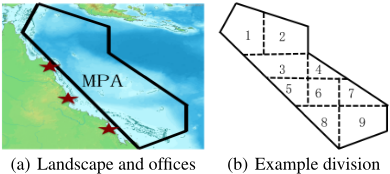
Figure 1(a) shows the landscape of the Great Barrier Reef Marine Park in Australia. There is an authority (defender) responsible for the protection of the park, with offices located on the coast, shown as red stars in Figure 1(a). The defender, can divide the MPA into several zones to design patrol strategies. Figure 1(b) shows an example division. The defender can stay at a zone or take a path among zones. Each zone is a potential attack target. The effect of damaging different zones can be different and time-dependent. The attacker enters the park at some time, takes a path to his target zone and determines how long to perform activities at this zone. Both agents may be limited to start and finish the path at certain zones, e.g., office locations, peripheral zones in the park (zones except 6 in Figure 1(b)). Strategic attackers can observe the defender's patrol strategies, then act considering both defender's strategies and attractiveness of zones. Since performing activities at a zone needs time-consuming preparation (e.g., equipment setup), we assume that the attacker targets a single zone. We did not consider how the attacker escapes after attacking since the coral reefs are damaged anyway after the attack. In addition, before the attacker finishes the attack, he needs to look for a location and operate the equipment, which can make him suspicious; while after the attack, he can easily camouflage himself and flee fast, which makes it difficult to catch him.
3 Model
We model the problem as a Stackelberg game [Tambe, 2011], where the defender commits to a randomized strategy first, then the attacker conducts surveillance and chooses the optimal strategy to respond to the defender's strategy. We first construct a transition graph with a timeline. Denote an MPA as a collection of n zones Z = ¶1↪ 2↪ · · · ↪ n♦. We evenly discretize a day as a sequence of ⌧ time points t = ht1↪ · · · ↪ t⌧ i with interval δ. Assume that the time needed to travel between two adjacent zones is a multiplier of δ (this assumption holds as long as δ is small enough). Assume that the defender and the attacker travel at the same speed and they only move at time points tk 2 t. Let D = hdij 2 ¶1↪ 2↪ · · · ♦i with dij representing that the time needed to move from zone i to adjacent zone j is dij · δ. To represent players' strategies, we construct a directed transition graph G = hV↪ Ei where a vertex v = hi↪ tki corresponds to zone i and time tk. There is an edge e = hv = hi↪ tki↪ v0 = hj↪ tk0ii if one of the following two conditions holds:
- j = i, k0 = k +1. We call such edges stay edges.
- i and j are adjacent zones and k0 = k + dij. We call such edges moving edges.
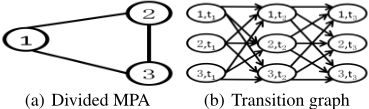
Consider a simple MPA graph in Figure 2(a) which includes 3 zones. Let t = ht1↪ t2↪ t3i and dij = 1↪ 8i↪ j 2 ¶1↪ 2↪ 3♦↪ i 6= j. We can get a transition graph in Figure 2(b). The edge between h1↪ t1i and h1↪ t2i indicates that the defender can patrol in zone 1 and the attacker can perform activities in zone 1 during (t1↪ t2). An edge connecting h1↪ t1i and h2↪ t2i indicates that if a player moves from zone 1 at time t1, he will arrive at zone 2 at time t2.
Defender strategies. Assume that the defender has m resources, i.e., m patrol boats, and each resource can keep patrolling for time duration ✓δ. Let Z d ⇢ Z be zones that the defender can start and end her patrol 1 . Since the patrol can start at any time before t⌧-✓, we add a collection of virtual source vertices to the transition graph, i.e., S = hS1↪ S2↪ · · · ↪ S⌧-✓i. For Sk 2 S, we add an edge from Sk to vertex hi↪ tki(8i 2 Z d ). Similarly, we add a collection of virtual terminal vertices T = hT1↪ T2↪ · · · ↪ T⌧-✓i such that 8Tk 2 T, there is an edge from vertex hi↪ tk+✓i(8i 2 Z d ) to Tk. Therefore, a patrol strategy Pr of a resource r is a flow from Sk to Tk. A pure strategy of the defender is a set of m 'patrol strategy flows', i.e., P = ¶Pr : r 2 ¶1↪ · · · ↪m♦♦. A mixed strategy of the defender is a distribution over pure strategies, i.e., x = hxP i where xP represents the probability of P being used.
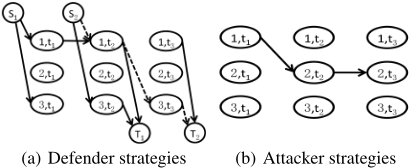
Consider the example in Figure 2(b). Assume that Z d = ¶1↪ 3♦ and ✓ = 1, thus the source vertices and terminal vertices can be added as is shown in Figure 3(a), i.e., S1 is connected to h1↪ t1i and h3↪ t1i, meaning that the defender can start the patrol from zone 1 or 3 at time t1, while T1 is connected to h1↪ t2i and h3↪ t2i, meaning that patrols starting from S1 should end in zone 1 or 3 at time t2. Any flow from Sk to Tk is a feasible patrol strategy, e.g., S2 ! h1↪ t2i ! h3↪ t2i ! T2 represents that the defender patrols on the way from zone 1 to zone 3.
Attacker strategies. Assume that the attacker can also start at a subset of the zones Z a ⇢ Z. An attacker's strategy includes two parts: a path in the transition graph to go to his target zone, and how long he attacks at the target zone. We assume that the attack duration is a multiplier of δ (this holds when δ is small enough) and denote an attacker's strategy as Y = hHY ↪ AY i, where HY is a path leading to his target vertex hi↪ tki and AY is a path consisting of l adjacent stay edges, representing that the attacker performs activity at zone i from time tk to time tk+l. Consider the previous 3-zones example. Assume that Z a = ¶1♦. Figure 3(b) shows a feasible attacker strategy where the attacker enters the MPA from zone 1 at t1, arrives at his target zone 2 at t2, then attacks zone 2 till t3. As previous work in security games, we restrict attacker strategies to pure strategies [Kiekintveld et al., 2009].
1 Our model can be easily expanded to handle cases in which the defender starts from and finishes at different sets of zones.
Utilities and equilibrium. We assume that each stay edge e = hhi↪ tki↪ hi↪ tk+1ii in the transition graph has a value of Ve, representing the attacker's payoff of succesfuly performing activities in zone i during time (tk↪ tk+1). If an attacker successfully plays strategy Y = hHY ↪ AY i, he gains a utility of U(Y ) = Pe2AY Ve, while the defender gets a utility of -U(Y ). If the attacker is detected by the defender, he fails and both agents get a utility of 0. The attacker may be detected by the defender if their strategies share same edges. Specifically, if their paths share a stay edge, the attacker may be detected when he is staying at some zone; if their paths share a moving edge, the attacker may be detected when he is moving from one zone to another. Naturally, the defender may not be able to perform detection every time she meets a boat which could be a potential attacker. To describe the probability that the defender detects a boat, we make the following two assumptions, which are realistic enough to describe most real world scenarios.
Assumption 1. If the defender and the attacker first meet on edge e, the probability that the defender detects the attacker, i.e., the detecting factor of edge e, is fe 2 [0↪ 1].
The next assumption is about the probability that the defender detects the attacker after they meet for the first time. Since patrol areas are usually somewhere prone to be maliciously damaged but not popular travel sites, a boat appearing in such areas frequently is very suspicious. Therefore, if the defender has met a boat for many times on her way before she arrives at edge e, then the boat seems more suspicious than a boat which is seen for the first time on edge e, thus should be detected with a higher probability than fe.
Assumption 2. Assume that the defender and the attacker have been on same edges e1↪ e2↪ · · · ↪ ek-1 2 and the attacker has not been detected. If they meet on edge ek, the probability that the defender detects the attacker is min¶1↪ fek 1-Pk-1 i=1 fei ♦.
The probability shown in Assumption 2 ranges in [fek ↪ 1], which satisfies the intuition that more suspicious boat should be detected with a higher probability. Based on Assumption 2, if the defender's strategy and the attacker's strategy share same edges e1↪ e2↪ · · · ↪ ek-1↪ ek, let Fk-1 represent the probability that the attacker is detected on any edge in e1↪ · · · ↪ ek-1, then the total probability that the attacker is detected given the defender strategy is Fk-1 + (1 - Fk-1) min¶1↪ fek 1-Pk-1 i=1 fei ♦. Note that when k = 2, F1 = fe1 . Simple recursion results in that given a patrol strategy Pr of a resource r and an attacker strategy Y , assume that the overlapping edges of Pr and Y are Pr\Y = he1↪ e2↪ · · · ↪ eki, then the probability that the attacker is detected by this resource is min¶1↪ Pki=1 fek ♦▷
2 The subscripts are indexes of edges in the players' path.
We also assume that when several security resources and the attacker are at the same edge, the security resources can cooperate with each other to come up with a detection probability which is the sum of their respective detection probability capped by 1. 3 Therefore, given a pure strategy of the defender P = ¶Pr♦ and a pure strategy of the attacker Y , the overall detection probability for the attacker is:
Based on Eq.(1), given a pair of strategies hP↪ Y i, the expected utility of the attacker is U a (P↪ Y ) = (1 - dp(P↪ Y ))U(Y ). Given a mixed strategy x = hxP i of the defender and a pure strategy Y of the attacker, the attacker's expected utility is U a (x↪ Y ) = PP xPU a (P↪ Y ), while the expected utility of the defender is U d (x↪ Y ) = -U a (x↪ Y ).
Our goal is to compute the Stackelberg equilibrium of the game, hence the optimal strategy for the defender. Given the zero sum assumption, the Stackelberg equilibrium is equivalent to maximizing the defender's utility when the attacker responds the best. Technically, let X, Y be the defender's and attacker's strategy space respectively. Let the attacker's optimal response function be f(x) = ¶Y 2 Y♦. A pair of strategies (x↪ Y ) form an equilibrium if they satisfy the following:
4 CLP Based on Compact Representation
The number of defender's pure strategies increases exponentially as the game size increases. To address this challenge, we compactly represent mixed patrol strategies by marginal coverage ce on edges e in the transition graph G, i.e., the expected number of patrollers that will be on the edges. Given a mixed strategy x, we have
where P(e) represents the number of patrols in pure strategy P which go through edge e. Therefore, based on Eq.(2), given a mixed strategy x and its corresponding coverage vector c = hce : e 2 Ei, and given a pure strategy Y of the attacker, the expected attacker utility can be represented as
3 If the security resources work independently, the overall detection probability will be higher than that is computed by Eq. (1). In this case, the defender strategies computed based on Eq. (1) will lead to a utility which is a lower bound of the defender.
Our problem now lies in computing the marginal coverage which corresponds to the optimal mixed strategy of the defender. First, we need to construct marginal coverages corresponding to feasible mixed strategies. One challenge of the construction lies in that a mixed defender strategy consists of pure strategies starting from different time points. Yin et al. [2012] have proven that the problem can be solved by constructing an extended version EG of the transition graph G, and considering the marginal coverage as the sum of several flows on EG. Technically, EG is composed of multiple restricted copies of G (i.e., subgraphs of G), corresponding to different possible starting time points for the defender. For the copy corresponding to starting time points tk, we only keep the subgraph Gk on vertices hSk↪ Tk↪ v = hi↪ tk0i : i 2 Z↪ k0 2 ¶k↪ · · · ↪ k+✓♦i. Therefore, any defender patrol strategy starting at tk can be represented as an Sk - Tk flow in subgraph Gk. Let zk(e) represent the expected number of patrollers on edge e which come from patrol strategies starting at time point tk (zk(e) ≥ 0). Let Γ(e) represent the set of subgraphs which include edge e. Let ce = Pk:Gk2Γ(e) zk(e). Yin et al. [2012] show that if zk(e) satisfies conservation of flow, a defender mixed strategy which leads to the same utility as corresponding c = hce : e 2 Gi can be constructed in polynomial time. Now we present a compact linear program CLP to compute the optimal marginal coverage.
Constraint (7) enforces conservation of flow, which is clearly satisfied by any mixed patrol strategy. Constraints (8) and (9) bound the total flow entering and exiting the transition graph by m, the number of patrollers. Constraint (5) indicates that the attacker will best respond by choosing the strategy Y which leads to the best utility, or equivalently, the least utility for the defender -(1 - min¶1↪ Pe2Y cefe♦)U(Y ). This is an overestimate of the defender's utility since the expression 1 - min¶1↪ Pe2Y cefe♦ is an overestimate of the probability that the attacker is detected. This is because min¶1↪ Pe2Y cefe♦ only caps the expectation (over its pure strategies) of the detection probability at 1, but allows a pure strategy P = hPri in its support to achieve Pmr=1 Pe2Pr\Y fe > 1, whereas according to Eq.(1), the detection probability of each pure strategy should be at most 1. As a result, the solution of this LP provides an upper bound of the optimal defender utility. Fortunately, once we generate
Algorithm 1: CDOG
1 Initialize with a subgraph G0 of G and a subset Y0 ⇢Y; 2 repeat 3 (c↪ y) CLP(G0 ↪Y0 ); 4 P DO(y), Y AO(c) ; 5 G0 G0 [ ¶P♦↪Y0 Y0 [ ¶Y ♦; 6 until G0 and Y0 are not expanded; 7 return (c↪ y)the patrols from the marginals we are able to compute the actual best-response utilities of the attacker. Our experiments show that the differences between the actual utilities and the upper-bounds given by the LP formulation are small.
5 CDOGAlgorithm
The number of constraints in Eq.(5), being the same as the number of attacker strategies, increases exponentially with the game size. This leads to the poor scalability of the LP formulation. To deal with the scalability issue, we propose CDOG, a compact-strategy double-oracle algorithm on graphs. CDOG is based on the widely used double oracle framework (e.g., [Jain et al., 2011]). The main idea is to find an equivalent small-size sub-game to avoid solving the original exponentially large game. Specifically, the framework starts from solving a sub-game involving only a very small subset of each player's pure strategy set. The solution obtained, being an equilibrium of the sub-game, is not necessarily an equilibrium of the original game since the players may have incentive to deviate by choosing strategies not in the current sub strategy sets. Thus the framework expands the players' strategy sets based on the current equilibrium and gets a larger sub-game. The process is repeated until no player can benefit from expanding their strategy sets. It usually ends with a sub-game with reasonable (instead of exponential) size, and the final solution is provably also an equilibrium to the original game (McMahan et al. 2003).
A traditional double oracle framework can take a long time to converge for large games, since sub-game is expanded slowly, while once it gets large, solving a sub-game is also very time-consuming. For example, Jain et al's algorithm [Jain et al., 2013] solves games with around 200 vertices, corresponding to a 10 zones, 20 time points case in our model, in around 9 hours. To scale it up, CDOG exploits the graph structure of our problem, uses a subgraph of the transition graph (instead of a pure strategy set) to characterize the defender's strategy space, and solves each sub-game through compactly representing defender strategies as coverage on edges in the subgraph. The main structure of CDOG is depicted in Algorithm 1. Here Line 1 initializes the subgame with a random subgraph G0 of G and a random subset Y0 of attacker's pure strategies. Using the LP formulation, Line 3 computes the equilibrium of the sub-game, where defender patrols on G0 and attacker plays with strategies in Y0 . Notably, c = hcei is the solution to LP, while y is an attacker mixed strategy over pure strategies in Y0 , which is obtained from the dual variable associated with Constraints in Eq.(5). Then through Lines 4-6, CDOG implements the core of double oracle framework by calling two oracles-defender oracle (DO) and attacker oracle (AO)-to obtain the players' best responses for expanding the sub-game. Next, we present in detail how these two oracles are implemented.
Defender oracle. The defender's best response is an munit flow on G, which maximizes her utility against the current attacker strategy y. DO computes a compact representation of the best response pure strategy with the following MILP.
Constraint (11) ensures that the coverages on edges are integers, so that coverage vector c corresponds to a pure strategy P . Constraints (6) - (9) can be directly used here since the conservation of flow is the same for pure strategies as that for mixed strategies in CLP. The objective of DO is to maximize the defender's expected utility given attacker's mixed strategy y = hYii where Yi indicates the probability that the ith attacker pure strategy in Y0 is used. The value of Yi comes from the dual variable of the ith inequality corresponding to Constraint (5) of CLP(G0 ↪Y0 ). If the pure defender strategy corresponding to c computed by DO goes through edges not in G0 , we expand G0 by including these edges and associated vertices.
Attacker oracle. The attacker oracle cannot be efficiently solved by an MILP since we cannot compactly represent the attacker strategies. AO computes the attacker's best response through three steps: First, for each v 2 V , we compute the attacker's optimal path H(v) to v. Following H(v), the attacker is the least likely to be detected among all paths leading to v. Second, based on H(v), we compute the optimal time duration for the attacker to perform activities if he starts the activity at v. Finally, choose the vertex, path, and time duration which together lead to the optimal attacker utility. We now introduce the details of the three steps.
For step (1), let γ(v) = Pe2H(v) ce represent the probability of being detected if the attacker sails through path H(v). Apparently, if v = hi↪ tki and i 2 Z a , then the attacker can directly enter the transition graph at vertex v. Thus H(v) only consists of vertex v and γ(v) = 0. If i ◁2 Z a , let ⇤(v) represent the set of vertices v0 2 G such that hv0 ↪ vi is an edge in G, then the attacker has to arrive at some v0 and take edge hv0 ↪ vi to arrive at vertex v. Therefore, we have
Let vpre = argminv02⇤¶H(v0 ) + chv0 ↪vi♦, thus H(v) = H(vpre)[hvpre↪ vi, and H(v) can be computed by the recursive function shown in Algorithm 2. Note that to find H(v) for all vertices, every edge in the transition graph only needs to be visited at most once, thus the time complexity of step (1) is O(♣E♣).
For step (2), if the attacker starts to perform activity at vertex v = hi↪ tki and chooses a time duration l, the total probability of being detected depends on γ(v) and the probability of being deleted when performing the activity, i.e.,
Algorithm 2: Find optimal path (c↪ v)
1 Input: c↪ v; Output: H(v)↪ γ(v)); 2 if i 2 Z a then H(v) = v↪ γ(v) = 0 ; 3 else 4 ⇤(v) predecessors of v, pre -1, min 1; 5 for v0 2 ⇤(v) do 6 if H(v0 ) + chv0↪vifhv0↪vi < min then 7 min = H(v0 ) + chv0 ↪vifhv0 ↪vi↪ pre = v0 ; 8 H(pre)↪ γ(pre) Find optimal path (c↪ pre); 9 H(v) H(pre) [ hpre↪ vi↪ γ(v) min;◆(v↪ l) = min¶1↪ 1 - γ(v) - Pj2¶1↪2↪···l♦ cej fej ♦. Here ej = hhi↪ tk+j-1i↪ hi↪ tk+jii. The value of performing the activity is the sum of values of edges ej, i.e., `(v↪ l) = Pj2¶1↪2↪···l♦ Vej . Thus the expected utility is U(v↪ l) = (1 - ◆(v↪ l)) · `(v↪ l). Therefore, the optimal time duration for vertex v is lopt v = argmaxl2¶1↪··· ↪⌧-k♦ U(v↪ l).
To find the optimal time duration for each vertex v = hi↪ tki, we need to iterate all possible time durations for v, i.e., ¶1↪ · · · ↪ ⌧ - k♦. Thus the time complexity of Step (2) is O(n⌧ 2 ). The third step is to straightforwardly choose the vertex v leading to the optimal attacker utility, i.e., v = argmaxv02V U(v0 ↪ lopt v0 ), and construct the attacker strategy Y based on H(v) and l. If strategy Y is not in the current set Y0 , we expand Y0 by adding Y .
6 Experimental Evaluation
We evaluate the proposed algorithms in terms of (1) solution quality, (2) scalability, and (3) robustness. The CLP is solved by Knitro 9.0.0. Each point in the figures is the average value over 30 sample games. We test the algorithms on graphs based on the geology of the Great Barrier Reef Marine Park as is shown in Figure 1. Given that the MPA can be divided differently due to different purposes [Watts et al., 2009], in each game in the experiments, we generate an MPA graph based on a random division of the park. We randomly generate the time needed to move between adjacent zones, i.e., dij, in [1↪ ♣t♣ 2 ], where ♣t♣ is the number of time points in the game. Transition graphs are then constructed based on the MPA graphs and dijs, in which each zone has ♣t♣ copies. We randomly choose the value of each stay edge in (0, 100].
Solution quality. Solution quality of algorithms is measured by attacker utility. Given the zero sum assumption, higher attacker utility indicates lower defender utility. We compare our algorithms with two baseline algorithms ANP and AND. ANP assumes that the attacker does not take paths, but directly attacks anywhere at any time instantaneously, which is similar as in Fang et al [2013]. AND assumes that the attacker can take paths in the graph to arrive at a target, but still attacks instantaneously, which is similar as in Yin et al [2012]. The baseline algorithms are under extra assumptions since no previous algorithms can exactly solve our problems. We assume 3 patrollers, 9 zones and divide the timeline into 12 points unless otherwise specified.
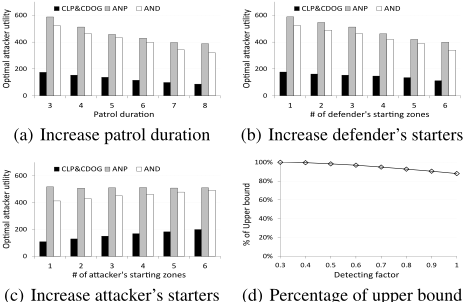
In Figures 4(a), 4(b) and 4(c), the y-axis indicates the attacker utility, while the x-axis indicates the patrol duration of a defender's resource (i.e., the value of ✓), the number of starting zones for the defender, and the number of starting zones for the attacker respectively. Since CLP and CDOG lead to the same attacker utility, their results are represented by one single bar. The solution quality of CLP and CDOG is significantly better than that of ANP and AND despite the value of the three parameters. It is unsurprising that as the patrol duration increases (Figure 4(a)) or the number of defender's starting zones increases (Figure 4(b)), the attacker utilities computed by all algorithms decrease. As the number of attacker's starting zones increases (Figure 4(c)), ANP's performance is not affected since it does not consider attacker's paths, while other algorithms show an increasing trend in attacker utilities.
Figure 4(d) depicts the percentage of the true optimal defender utility v.s. the theoretical upper bound returned by CLP and CDOG. The x-axis indicates the maximum value of the detecting factor fe, i.e., 0.3 indicates that fe is randomly chosen in (0↪ 0▷3]. Eq.(1) indicates that with smaller fe, CLP and CDOG are less likely to overestimate the detection probability. Figure 4(d) shows a decreasing trend in the percentage of the true defender utility v.s. CLP and CDOG's results. Fortunately, even when fe = 1, the percentage is still around 90%, indicating that the upper bound computed by CLP and CDOG is very close to the true utilities.
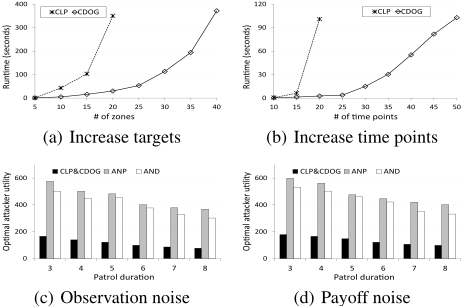
Scalability. In Figures 5(a) and 5(b), the y-axis indicates runtime while the x-axis respectively indicates the number of zones and time points. In both figures, the runtime of CLP shows a much more obvious increasing trend. Actually, CLP cannot solve games with more than 20 targets and 20 time points due to the RAM limit, while CDOG can solve games with 40 targets in around 6 minutes and games with 50 time points in less than 2 minutes. We also evaluate the runtime of the defender oracle, attacker oracle, and CLP in CDOG in detail. Figure 6 shows an example of the runtime of the three parts in the CDOG algorithm, which solves a game after 10 iterations. The runtime of the CLP shows an increasing trend. The size of the DO and the AO is barely affected by the iteration, thus their runtime does not change much.
Robustness. We first consider observation noise of the attacker. We add 0-mean Gaussian noise with standard deviations chosen randomly from U[0↪ 0▷5] to the coverage on each edge observed by the attacker. Figure 5(c) shows the attacker utilities considering observation noise for the same class of games considered in Figure 4(a). Compared with Figure 4(a), all algorithms lead to lower attacker utilities in Figure 5(c) since the observation noise prevents the attacker from responding the best. CLP and CDOG still significantly outperform ANP and AND. We also consider payoff noise of the defender. For each stay edge in the transition graph, we add the same Gaussian noise as the previous setting to the defender's knowledge on the value of the edge. Figure 5(d) considers the class of games in Figure 4(a) with payoff uncertainties. Compared with Figure 4(a), all algorithms lead to higher attacker utilities in Figure 5(d) since the payoff noise affects the defender's judgement on the attacker's action. The advantage of CLP and CDOG over ANP and AND is still significant.
| Iteration | ||||||||||
|---|---|---|---|---|---|---|---|---|---|---|
| 1 | 2 | 3 | 4 | 5 | 6 | 7 | 8 | 9 | 10 | |
| CLP | 4301 | 5172 | 5637 | 6131 | 6151 | 6231 | 6332 | 6300 | 6449 | 6547 |
| DO | 1626 | 1620 | 1650 | 1652 | 1648 | 1715 | 1639 | 1620 | 1640 | 1634 |
| AO | 328 | 352 | 322 | 323 | 326 | 319 | 320 | 334 | 318 | 320 |
7 Conclusion
This paper models the problem of patrolling MPAs to protect coral reef ecosystems as a defender-attacker Stackelberg game, in which both players' strategies are time-dependent paths, and the payoffs are affected by the duration of the attack. We propose a linear program (CLP) to solve the game, in which defender strategies are compactly represented as flows on graphs. We also propose a more scalable algorithm, CDOG, which combines techniques of compactly representing defender strategies and incrementally generating strategies. Experimental results show that our algorithms lead to significantly better solution quality than that of baseline algorithms, and the CDOG algorithm can scale up.
@inproceedings{ijcai2016p82,
  title     = {Efficient Resource Allocation for Protecting Coral Reef Ecosystems},
  author    = {Yin, Yue and An, Bo},
  booktitle = {Proceedings of the Twenty-Fifth International Joint Conference on
               Artificial Intelligence, {IJCAI-16}},
  publisher = {AAAI Press / International Joint Conferences on Artificial Intelligence},
  editor    = {Subbarao Kambhampati},
  pages     = {531--536},
  year      = {2016},
  month     = {7},
  url       = {https://ijcai.org/proceedings/2016/82},
}
TY - CPAPER TI - Efficient Resource Allocation for Protecting Coral Reef Ecosystems AU - Yin, Yue AU - An, Bo T2 - Proceedings of the Twenty-Fifth International Joint Conference on Artificial Intelligence, IJCAI-16 PB - AAAI Press / International Joint Conferences on Artificial Intelligence PY - 2016 SP - 531 EP - 536 UR - https://ijcai.org/proceedings/2016/82 ER -Copied
Machine-readable versions of this paper, for tools and AI agents:





