
Incorporating Knowledge into Structural Equation Models Using Auxiliary Variables
Proceedings of the Twenty-Fifth International Joint Conference on Artificial Intelligence. Pages 3577-3582.
© 2016 International Joint Conferences on Artificial Intelligence
Abstract
In this paper, we extend graph-based identification methods by allowing background knowledge in the form of non-zero parameter values. Such information could be obtained, for example, from a previously conducted randomized experiment, from substantive understanding of the domain, or even an identification technique. To incorporate such information systematically, we propose the addition of auxiliary variables to the model, which are constructed so that certain paths will be conveniently cancelled. This cancellation allows the auxiliary variables to help conventional methods of identification (e.g., single-door criterion, instrumental variables, half-trek criterion), as well as model testing (e.g., d-separation, over-identification). Moreover, by iteratively alternating steps of identification and adding auxiliary variables, we can improve the power of existing identification methods via a bootstrapping approach that does not require external knowledge. We operationalize this method for simple instrumental sets (a generalization of instrumental variables) and show that the resulting method is able to identify at least as many models as the most general identification method for linear systems known to date. We further discuss the application of auxiliary variables to the tasks of model testing and z-identification.
- [Bareinboim and Pearl, 2012] E. Bareinboim and J. Pearl. Causal inference by surrogate experiments: z- identifiability. In Nando de Freitas and Kevin Murphy, editors, Proceedings of the Twenty-Eighth Conference on Uncertainty in Artificial Intelligence, pages 113-120, Corvallis, OR, 2012. AUAI Press.
- [Bareinboim and Pearl, 2015] E. Bareinboim and J. Pearl. Causal inference from big data: Theoretical founda- tions and the data-fusion problem. Technical Report R- 450, <http://ftp.cs.ucla.edu/pub/stat ser/r450.pdf>, De- partment of Computer Science, University of California, Los Angeles, CA, 2015. Written for the Proceedings of the National Academy of Sciences. Link
- [Bollen and Pearl, 2013] K.A. Bollen and J. Pearl. Eight myths about causality and structural equation models. In S.L. Morgan, editor, Handbook of Causal Analysis for So- cial Research, pages 301-328. Springer, 2013.
- [Brito and Pearl, 2002] C. Brito and J Pearl. Generalized in- strumental variables. In A. Darwiche and N. Friedman, editors, Uncertainty in Artificial Intelligence, Proceedings of the Eighteenth Conference, pages 85-93.
- Morgan Kauf- mann, San Francisco, 2002.
- [Brito, 2004] C. Brito. Graphical methods for identification in structural equation models. PhD thesis, Computer Sci- ence Department, University of California, Los Angeles, CA, January 2004.
- [Chan and Kuroki, 2010] Hei Chan and Manabu Kuroki. Us- ing descendants as instrumental variables for the identifi- cation of direct causal effects in linear sems. In Proceed- ings of the Thirteenth International Conference on Arti- ficial Intelligence and Statistics (AISTATS), pages 73-80, 2010.
- [Chen and Pearl, 2014] B. Chen and J. Pearl. Graphical tools for linear structural equation modeling. Technical Report R-432, <http://ftp.cs.ucla.edu/pub/stat ser/r432.pdf>, Department of Computer Science, University of Califor- nia, Los Angeles, CA, 2014. Forthcoming, Psychometrika. Link
- [Chen et al., 2014] B. Chen, J. Tian, and J. Pearl. Testable implications of linear structual equation models. In Carla E. Brodley and Peter Stone, editors, Proceedings of the Twenty-eighth AAAI Conference on Artificial Intelli- gence, pages 2424-2430, Palo, CA, 2014. AAAI Press. <http://ftp.cs.ucla.edu/pub/stat ser/r428-reprint.pdf>. Link
- [Chen et al., 2016] B. Chen, J. Pearl, and E. Barein- boim. Incorporating new knowledge into linear structural equation models using auxiliary variables (supplementary material). Technical Report R-461, <http://ftp.cs.ucla.edu/pub/stat ser/r461sup.pdf>, De- partment of Computer Science, University of California, Los Angeles, CA, 2016. Link
- [Chen, 2015] Bryant Chen. Decomposition and identifi- cation of linear structural equation models. CoRR, abs/1508.01834, 2015.
- [Fisher, 1966] F.M. Fisher. The Identification Problem in Econometrics. McGraw-Hill, New York, 1966.
- [Foygel et al., 2012] Rina Foygel, Jan Draisma, and Mathias Drton. Half-trek criterion for generic identifiability of lin- ear structural equation models. The Annals of Statistics, 40(3):1682-1713, 2012.
- [Pearl and Bareinboim, 2011] J. Pearl and E. Bareinboim. Transportability of causal and statistical relations: A for- mal approach. In Proceedings of the Twenty-Fifth Con- ference on Artificial Intelligence (AAAI-11), pages 247- 254, Menlo Park, CA, August 7-11 2011. Available at: <http://ftp.cs.ucla.edu/pub/stat ser/r372a.pdf>. Link
- [Pearl, 1995] J. Pearl. Causal diagrams for empirical re- search. Biometrika, 82(4):669-710, 1995.
- [Pearl, 2000] J. Pearl. Causality: Models, Reasoning, and Inference. Cambridge University Press, New York, 2000. 2nd edition, 2009.
- [Pearl, 2004] J. Pearl. Robustness of causal claims. In M. Chickering and J. Halpern, editors, Proceedings of the Twentieth Conference Uncertainty in Artificial Intelli- gence, pages 446-453. AUAI Press, Arlington, VA, 2004.
- [Pearl, 2009] J. Pearl. Causality: Models, Reasoning, and Inference. Cambridge University Press, New York, 2nd edition, 2009.
- [Shardell, 2015] Michelle Shardell. Methods to overcome violations of an instrumental variable assumption: Con- verting a confounder into an instrument. Computational statistics & data analysis, 56(7):2317-2333, 2015.
- [Wright, 1921] S. Wright. Correlation and causation. Jour- nal of Agricultural Research, 20:557-585, 1921.
- [Wright, 1925] S. Wright. Corn and hog correlations. Tech- nical Report 1300, U.S. Department of Agriculture, 1925.
- [Wright, 1928] P.G. Wright. The Tariff on Animal and Veg- etable Oils. The MacMillan Company, New York, NY, 1928.
References were extracted automatically from the PDF and may contain errors.
Full text extracted automatically from the PDF; figures, tables and equations may differ. The PDF is the version of record.
1 Introduction
Many researchers, particularly in economics, psychology, epidemiology, and the social sciences, use linear structural equation models (SEMs) to describe the causal and statistical relationships between a set of variables, predict the effects of interventions and policies, and to estimate parameters of interest [Bollen and Pearl, 2013]. A linear SEM consists of a set of equations of the form,
where X = [x1↪ ▷▷▷↪ xn]t is a vector containing the model variables, ⇤ is a matrix containing the coefficients of the model, which convey the strength of the causal relationships, and U = [u1↪ ▷▷▷↪ un]t is a vector of error terms, which represents omitted or latent variables and are assumed to be normally distributed. The matrix ⇤ contains zeroes on the diagonal, and ⇤ij = 0 whenever xi is not a cause of xj. The covariance matrix of X will be denoted by ⌃ and the covariance matrix over the error terms, U, by ⌦. The entries of ⇤ and ⌦ are the model parameters. In this paper, we will restrict our attention to semi-Markovian models [Pearl, 2000], models where the rows of ⇤ can be arranged so that it is lower triangular.
When the coefficients are known, then total effects, direct effects, and counterfactuals can be computed from them directly [Pearl, 2009; Chen and Pearl, 2014]. However, in order to be able to compute these coefficients, we must utilize domain knowledge in the form of exclusion and independence restrictions [Pearl, 1995, p. 704]. Exclusion restrictions represent assumptions that a given variable is not a direct cause of another, while independence restrictions represent assumptions that no latent confounders exists between two variables. Algebraically, these assumptions translate into restrictions on entries in the coefficient matrix, ⇤, and error term covariance matrix, ⌦, to zero.
Determining whether model parameters can be expressed in terms of the probability distribution, which is necessary to be able to estimate them from data, is the problem of identification. When it is not possible to uniquely express the value of a model parameter in terms of the probability distribution, we will say that the parameter is not identifiable. 1 In linear systems, this generally takes the form of expressing a parameter in terms of the covariance matrix over the observable variables.
To our knowledge, the most general method for determining model identification is the half-trek criterion [Foygel et al., 2012]. Identifying individual structural coefficients can be accomplished using the single-door criterion (i.e. identification using regression) [Pearl, 2009; Chen and Pearl, 2014], instrumental variables [Wright, 1925; 1928] (see [Brito and Pearl, 2002], [Pearl, 2009], or [Chen and Pearl, 2014] for a graphical characterization), instrumental sets [Brito and Pearl, 2002], and the general half-trek criterion [Chen, 2015], which generalizes the half-trek criterion for individual coefficients rather than entire models. Finally, d-separation [Pearl, 2009] and overidentification [Pearl, 2004; Chen et al., 2014] provide the means to enumerate testable implications of the model, which can be used to test it against data.
1 We will also use the term "identifiable" with respect to the model as a whole. When the model contains an unidentified coefficient, the model is not identified.
Each of these methods only utilize restrictions on the entries of ⇤ and ⌦ to zero. In this paper, we introduce auxiliary variables, which can be used to incorporate knowledge of non-zero coefficient values into existing methods of identification and model testing. The intuition behind auxiliary variables is simple: if the coefficient from variable w to z is known, then we would like to remove the direct effect of w on z by subtracting it from z. We do this by creating a variable z⇤ = z - ↵w and using it as a proxy for z. In some cases, z⇤ may allow the identification of parameters or testable implications using the aforementioned methods when z could not.
While intuitively simple, auxiliary variables are able to greatly increase the power of existing identification methods, even without external knowledge of coefficient values. We propose a bootstrapping procedure whereby coefficients are iteratively identified using simple instrumental sets and then used to generate auxiliary variables, which enable the identification of previously unidentifiable coefficients. We prove that this method enhances the instrumental set method to the extent that it is able to subsume the relatively more complex general half-trek criterion (henceforth, g-HTC).
The notion of "subtracting out a direct effect" in order to turn a variable into an instrument was first noted by [Shardell, 2015] when attemping to identify the total effect of x on y. It was noticed that in certain cases, the violation of the independence restriction of a potential instrument z (i.e. z is not independent of the error term of y) could be remedied by identifying, using ordinary least squares regression, and then subtracting out the necessary direct effects on y. In this paper, we generalize and operationalize this notion so that it can be used on arbitrary sets of known coefficient values and be utilized in conjunction with graphical methods for identification and enumeration of testable implications.
The paper is organized as follows: Sec. 2 reviews notation and graphical notions that will be used in the paper. In sec. 3, we introduce and formalize auxiliary variables and auxiliary instrumental sets. Additionally, we give a sufficient graphical condition for the identification of a set of coefficients using auxiliary instrumental sets. In sec. 4, we show that auxiliary instrumental sets subsume the g-HTC. Finally, in sec. 5, we discuss additional applications of auxiliary variables, including identifying testable implications and z-identification [Bareinboim and Pearl, 2012].
2 Preliminaries
The causal graph or path diagram of a SEM is a graph, G = (V↪D↪B), where V are nodes or vertices, D directed edges, and B bidirected edges. The nodes represent model variables. Directed eges encode the direction of causality, and for each coefficient ⇤ij 6= 0, an edge is drawn from xi to xj. Each directed edge, therefore, is associated with a coefficient in the SEM, which we will often refer to as its structural coefficient. The error terms, ui, are not shown explicitly in the graph.
However, a bidirected edge between two nodes indicates that their corresponding error terms may be statistically dependent while the lack of a bidirected edge indicates that the error terms are independent.
If a directed edge, called (x↪ y), exists from x to y then x is a parent of y. The set of parents of y is denoted Pa(y). Additionally, we call y the head of (x↪ y) and x the tail. The set of tails for a set of directed edges, E, is denoted Ta(E) while the set of heads is denoted He(E). For a node, v, the set of edges for which He(E) = v is denoted Inc(v). Finally, the set of nodes connected to y by a bidirected arc are called the siblings of y or Sib(y).
A path from x to y is a sequence of edges connecting the two nodes. A path may go either along or against the direction of the edges. A non-endpoint node w on a path is said to be a collider if the edges preceding and following w both point to w.
A path between x and y is said to be unblocked given a set Z, with x↪ y ◁2 Z if every noncollider on the path is not in Z and every collider on the path is in An(Z) [Pearl, 2009], where An(Z) are the ancestors of Z. Unblocked paths of the form a ! ▷▷▷ ! b or a ▷▷▷ b are directed paths. Any unblocked path that is not a directed path is a divergent path.
σ(x↪ y) denotes the covariance between two random variables, x and y, and σM(x↪ y) is the covariance between random variables x and y induced by the model M. (x ♣= y) denotes that x is independent of y, and similarly, (x ♣= y)M denotes that x is independent of y according to the model, M. We will assume without loss of generality that the model variables have been standardized to mean 0 and variance 1.
We will also utilize a number of definitions around halftreks [Foygel et al., 2012].
Definition 1. A half-trek, ⇡, from x to y is an unblocked path from x to y that either begins with a bidirected arc and then continues with directed edges towards y or is simply a directed path from x to y.
We will denote the set of nodes connected to a node, v, via half-treks htr(v). For example, in Figure 3a, w $ z ! x ! y and w ! z ! x ! y are both half-treks from w to y. However, z⇤ w ! z in Figure 3b is not a half-trek from z⇤ to z because it begins with an arrow pointing to z⇤ .
Definition 2. For a given path, ⇡, from x to y, Left(⇡) is the set of nodes, if any, that has a directed edge leaving it in the direction of x in addition to x. Right(⇡) is the set of nodes, if any, that has a directed edge leaving it in the direction of y in addition to y.
For example, consider the path ⇡ = x vL 1 ▷▷▷ vL k vT ! vR j ! ▷▷▷ ! vR 1 ! y. In this case, Left(⇡) = [ki=1 vL i [ ¶x↪ vT ♦ and Right(⇡) = [ji=1 vR i [ ¶y↪ vT ♦. vT is a member of both Right(⇡) and Left(⇡).
Definition 3. A set of paths, ⇡1↪ ▷▷▷↪ ⇡n, has no sided intersection if for all ⇡i↪ ⇡j 2 ¶⇡1↪ ▷▷▷↪ ⇡n♦ such that ⇡i 6= ⇡j, Left(⇡i)\Left(⇡j )=Right(⇡i)\Right(⇡j ) = ;.
Consider the set of paths ¶⇡1 = x ! y↪ ⇡2 = z $ x ! w♦. This set has no sided intersection, even though both paths contain x, because Left(⇡1) = ¶x♦, Left(⇡2) = ¶z♦, Right(⇡1) = ¶y♦, and Right(⇡2) = ¶x↪w♦. In contrast,
¶⇡1 = x ! y↪ ⇡2 = z ! x ! w♦ does have a sided intersection because x is in both Right(⇡1) and Right(⇡2).
Wright's rules [Wright, 1921] allows us to equate the model-implied covariance, σM(x↪ y), between any pair of variables, x and y, to the sum of products of parameters along unblocked paths between x and y. 2 Let ⇧ = ¶⇡1↪ ⇡2↪ ▷▷▷↪ ⇡k♦ denote the unblocked paths between x and y, and let pi be the product of structural coefficients along path ⇡i. Then the covariance between variables x and y is Pi pi. We will denote the expression that Wright's rules gives for σ(x↪ y) in graph G, WG(x↪ y).
Instrumental variables (IVs) is one of the most common methods of identifying parameters in linear models. The ability to use an instrumental set to identify a set of parameters when none of those parameters are identifiable individually using IVs was first proposed by [Brito and Pearl, 2002].
Definition 4 (Simple Instrumental Set). Z is a simple instrumental set for the coefficients associated with edges E = ¶x1 ! y↪ ▷▷▷↪ xk ! y♦ if the following conditions are satisfied.
- (ii) Let GE be the graph obtained from G by deleting edges
2 Wright's rules characterize the relationship between the covariance matrix and model parameters. Therefore, any question about identification using the covariance matrix can be decided by studying the solutions for this system of equations. However, since these equations are polynomials and not linear, it can be very difficult to analyze identification of models using Wright's rules [Brito, 2004].
(iii) There exist unblocked paths ⇧ = ¶⇡1↪ ⇡2↪ ▷▷▷↪ ⇡k♦ such that ⇡i is an unblocked path from zi to xi and ⇧ has no sided intersection.
If Z is a simple instrumental set for E, then we can use Wright's rules to obtain a set of ♣k♣ linearly independent equations in terms of the coefficients, enabling us to solve for the coefficients [Brito and Pearl, 2002].
3 Auxiliary Variables
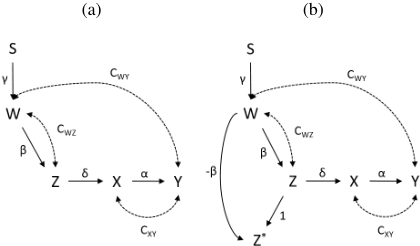
We start this section by motivating auxiliary variables through an example. Consider the structural system depicted in Figure 1a. In this system, the structural coefficient ↵ is not identifiable using instrumental variables or instrumental sets. To witness, note that z, w, and s all fail to qualify as instruments due to the spurious paths, z w $ y, w $ y, and s $ y, respectively 4 . If the coefficient β is known, 5 we can add an auxiliary variable, z⇤ = z - βw, to the model. Subtracting βw from z cancels the effect of w on z so that w has no effect on z⇤ = (βw + uw) - βw = uw. Now, z⇤ is an instrument for ↵. The sum of products of parameters along back-door paths from z⇤ to y is equal to 0 and ↵ = σ(z⇤ ↪y) σ(z⇤ ↪x) .
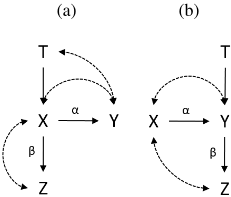
Surprisingly, auxiliary variables can even be used to generate instruments from effects of x and y. For example, consider Figures 2a and 2b. In both examples, z is clearly not an instrument for ↵. However, in both cases, β is identifiable using t as an instrument, allowing us to construct the auxiliary variable, z⇤ = z - ↵x, which does qualify as an instrument for ↵ (see Theorem 1 below).
3 This condition can also be satisfied by conditioning on a set of covariates without changing the results below, but for simplicity we will not consider this case. When conditioning on a set of covariates, Z is called a generalized instrumental set.
4 Note that even if we consider conditional instruments [Brito and Pearl, 2002], these paths cannot be blocked, and identification is not possible.
5 The coefficient β may be available through different means, for instance, from a smaller randomized experiment, pilot study, or substantive knowledge, just to cite a few. In this specific case, however, β can be identified directly without invoking external information by simply using S as an instrument.

The following definition establishes the β-augmented model, which incorporates the z⇤ variable into the model. 6
Definition 5. Let M be a structural causal model with associated graph G and a set of directed edges E such that their coefficient values are known. The E-augmented model, M E+, includes all variables and structural equations of M in addition to new auxiliary variables, y⇤ 1 ↪ ▷▷▷y⇤ k , one for each variable in He(E) = ¶y1↪ ▷▷▷↪ yk♦ such that the structural equation for y⇤ i is y⇤ i = yi - ⇤Xiyi Xt i , where Xi = Ta(E) \ Pa(yi), for all i 2 ¶1↪ ▷▷▷↪ k♦. The corresponding graph is denoted GE+.
For example, let M and G be the model and graph depicted in Figure 1a. The β-augmented model is obtained by adding a new variable z⇤ = z - βw to M. The corresponding graph, Gβ+, is shown in Figure 1b. The following lemma establishes that the covariance between any two variables in V ⇤ = V [ He⇤ (E) can be obtained using Wright's rules on GE+, where V is the set of variables in M and He⇤ (E) is the set of variables added to the augmented model. 7
Lemma 1. Given a linear structural model, M, with induced graph G, and a set of directed edges E with known coefficient values, σ(w↪ v) = WGE+(w↪ v), where w↪ v 2 V ⇤ and w 6= v. 8
The above lemma guarantees that the covariance between variables implied by the augmented graph is correct, and Wright's rules can be used to identify coefficients in the model M. For example, using Wright's rules on Gβ+, depicted in Figure 1b, yields
and
so that ↵ = σ(z⇤ ↪y) σ(z⇤ ↪x) . As a result, z⇤ can be used as an instrumental variable for ↵ when z clearly could not.
6 [Chan and Kuroki, 2010] also gave a graphical criterion for identification of a coefficient using descendants of x. ↵ in Figure 2a can also be identified using their method.
7 Note that auxiliary variables may not have a variance of 1. We will see that this does not affect the results of the paper since the covariance between model variables implied by the graph is correct, even after the addition of auxiliary variables.
8 See [Chen et al., 2016] for proofs of all lemmas and theorems.
Definition 6 (Auxiliary Instrumental Set). Given a semiMarkovian linear SEM with graph G and a set of directed edges EZ whose coefficient values are known, we will say that a set of nodes, Z, in G is an auxiliary instrumental set or aux-IS for E if Z ⇤ = (Z ∩ A) [ A⇤ is an instrumental set for E in GEZ+, where A is the set of variables in Z that have auxiliary variables in GEZ+.
The following lemma characterizes when an auxiliary variable will be independent of a model variable and is used to prove Theorem 1.
Lemma 2. Given a semi-Markovian linear SEM with graph G, (z⇤ ♣= y)GEz+ if and only if z is d-separated from y in GEz , where Ez ✓ Inc(z) and GEz is the graph obtained when Ez is removed from G.
The following theorem provides a simple method for recognizing auxiliary instrumental sets using the graph, G.
Theorem 1. Let EZ be a set of directed edges whose coefficient values are known. A set of directed edges, E = ¶(x1↪ y)↪ ▷▷▷↪ (xk↪ y)♦, in a graph, G, is identified if there exists Z such that:
- ♣Z♣ = k,
- for all zi 2 Z, (zi ♣= y)GE[Ezi , where Ezi = EZ \ Inc(zi) and GE[Ezi is the graph obtained by removing the edges in E [Ezi fromG, and
- there exists unblocked paths ⇧ = ¶⇡1↪ ⇡2↪ ▷▷▷↪ ⇡k♦ such that ⇡i is a path from zi to xi and ⇧ has no sided intersection.
If the above conditions are satisfied then Z is an auxiliary instrumental set for E.
Proof. We will show that Z ⇤ is an instrumental set in GEZ+. First, note that if EZ = ;, then Z is an instrumental set in G and we are done. We now consider the case when EZ 6= ;. Since ♣Z ⇤ ♣ = ♣Z♣ - ♣A♣ + ♣A ⇤ ♣ = ♣Z♣ - ♣A♣ + ♣A♣ = ♣Z♣, ♣Z ⇤ ♣ = ♣E♣, IS-(i) is satisfied. Now, we show that IS-(iii) is satisfied. For each zi 2 Z, let ⇡zi 2 ⇧ be the path in ⇧ from zi to Ta(E). Now, for each a⇤i 2 A⇤ , let ⇡a⇤i be the concatenation of path a⇤ a with ⇡ai . It should be clear that ⇧ ∩ ¶⇡ai ♦ [ ¶⇡a⇤i ♦ satisfies IS-(iii) in GEZy+. Lastly, we need to show that IS-(ii) is also satisfied.
First, if zi 2 Z ∩ A, then (zi ♣= y)GE . It follows that (zi ♣= y)GEZ+ E since no new paths from zi to y can be generated by adding the auxiliary nodes (see Lemma 8 in [Chen et al., 2016]). Now, we know that (a⇤i ♣= y)GEai + E from (ii)
and Lemma 2. Finally, since adding auxiliary variables cannot generate new paths between the existing nodes, we know that (a⇤i ♣= y)GEZ+, and we are done.
(a⇤i ♣= y)GEZ+ E for all ai 2 A follows from (ii), Lemma 2, and the fact that no new paths from ai to y can be generated by adding auxiliary nodes, proving the theorem.
To see how Theorem 1 can be used to identify auxiliary instrumental sets, consider Figure 3a. Using instrumental sets, we are able to identify b, but no other coefficients. Once b is identified, d can be identified using v⇤ 3 as an instrument in Gb+ since v3 qualifies as an instrument for d when the edge for b is removed (see Figure 3b). 9 Now, the identification of d allows us to identify a and c using v⇤ 5 in Gd+, since v5 is an instrument for a and c when the edge for d is removed (see Figure 3c).
The above example also demonstrates that certain coefficients are identified only after using auxiliary instrumental sets iteratively. We now define aux-IS identifiability, which characterizes when a set of coefficients is identifiable using auxiliary instrumental sets.
Definition 7 (Aux-IS Identifiability). Given a graph G, a set of directed edges E is aux-IS identifiable if there exists a sequence of sets of directed edges (E1↪ E2↪ ▷▷▷Ek) s.t.
- (i) E1 is identified using instrumental sets in G,
- (ii) Ei is identified using auxiliary instrumental sets for all i 2 ¶2↪ 3↪ ▷▷▷↪ k♦ in GE0 + where E0 ✓ E1 [ E2 [ ▷▷▷ [ Ei-1,
- (iii) and E is identified using auxiliary instrumental sets in GER+, where ER ✓ (E1 [ E2 [ ▷▷▷ [ Ek).
4 Auxiliary Instrumental Sets and the Half-Trek Criterion
In this section, we explore the power of auxiliary instrumental sets, ultimately showing that they are at least as powerful as the g-HTC. Having defined auxiliary instrumental sets, we now briefly describe the g-HTC. The g-HTC is a generalization of the half-trek criterion that allows the identification of arbitrary coefficients rather than the whole model [Chen, 2015]. 10 First, we give the definition for the general half-trek criterion, then we will discuss how it can be used to identify coefficients before showing that any g-HTC identifiable coefficient is also aux-IS identifiable.
Definition 8 (General Half-Trek Criterion). Let E be a set of directed edges sharing a single head y. A set of variables Z satisfies the general half-trek criterion with respect to E, if
- (i) ♣Z♣ = ♣E♣,
- (ii) Z \ (y [Sib(y)) = ;,
- (iii) There is a system of half-treks with no sided intersection from Z to Ta(E), and
9 Note that if ♣Z♣ = 1, then the conditions of Theorem 1 are satisfied if Z is an instrumental set in GE[Ez .
10 If any coefficient is not identified, then the half-trek criterion algorithmwill simply output that the model is not identified.
A set of directed edges, E, sharing a head y is identifiable if there exists a set, ZE, that satisfies the general half-trek criterion (g-HTC) with respect to E, and ZE consists only of "allowed" nodes. Intuitively, a node z is allowed if Ezy is identified or empty, where Ezy is the set of edges that
- (i) lie on half-treks from y to z or
- (ii) lie on paths between z and Pa(y) ∩ Ta(E).
We will continue to use the EZy notation and allow Z to be a set of nodes. When Z satisfies the g-HTC and consists only of allowed nodes for E, we say that Z is a g-HT admissible set for E. If a g-HT admissible set exists for E, then the coefficients in E are g-HT identifiable. The lemma below characterizes when a set of parameters is g-HT identifiable. This characterization parallels Definition 7 and will prove useful in the proofs to follow.
Lemma 3. If a set of directed edges, E, is g-HT identifiable, then there exists sequences of sets of nodes, (Z1↪ ▷▷▷Zk), and sets of edges, (E1↪ ▷▷▷↪Ek), such that
- Zi satisfies the g-HTC with respect to Ei for all i 2 ¶1↪ ▷▷▷↪ k♦,
- EZ1y1 = ;, where yi = He(Ei) for all i 2 ¶1↪ ▷▷▷↪ k♦, and
- EZiyi ✓ (E1 [ ▷▷▷ [Ei-1) for all i 2 ¶1↪ ▷▷▷k♦.
Proof. The lemma follows from Theorem 1 in [Chen, 2015].
To see how the g-HTC can be used to identify coefficients, consider again Figure 3a. Initially, only b is identifiable. We are able to use ¶v2♦ or ¶v1♦ as a g-HT admissible set for b since Ev2v3 and Ev1v3 are equal to ;. All other nodes are half-trek reachable from v2 and their edges on the half-trek from v2 are not identified. Once b is identified, we can use ¶v3♦ as a g-HT admissible set to identify d. Similarly, once d is identified, we can use v5 as a g-HT admissible set to identify a and c.
The following lemma connects g-HT-admissibility with auxiliary instrumental sets.
Lemma 4. If Z is a g-HT-admissible set for a set of directed edges E with head y, then E is identified using instrumental sets in GEZy+.
Now, we are ready to show that aux-IS identifiability subsumes g-HT identifiability.
Theorem 2. Given a semi-Markovian linear SEM with graph G, if a set of edges, E, with head y, is g-HTC identifiable, then it is aux-IS identifiable.
Proof. Since E is g-HTC identifiable, there exists sequences of sets of nodes, (Z1↪ ▷▷▷Zk), and sets of edges, (E1↪ ▷▷▷↪Ek), such that
- Zi satisfies the g-HTC with respect to Ei for all i 2 ¶1↪ ▷▷▷↪ k♦,
- EZ1y1 = ;, where yi = He(Ei) for all i 2 ¶1↪ ▷▷▷↪ k♦, and
- EZiyi ✓ (E1 [ ▷▷▷ [ Ei-1) for all i 2 ¶2↪ ▷▷▷↪ k♦.
Now, using Lemma 4, we see that there Z1 is an instrumental set for E1 in GEZ1y1 + = G and Ei is identified using instrumental sets and Lemma 3 in GEZiyi + with EZiyi ✓ (E1 [ ▷▷▷ [ Ei-1) for all i 2 ¶2↪ ▷▷▷↪ k♦. As a result, E is Aux-IS identifiable.
5 Further Applications
We have formalized auxiliary variables and demonstrated their ability to increase the identification power of instrumental sets. In this section, we discuss additional applications of auxiliary variables as alluded to in the introduction, namely, incorporating external knowledge of coefficients values and deriving new constraints over the covariance matrix.
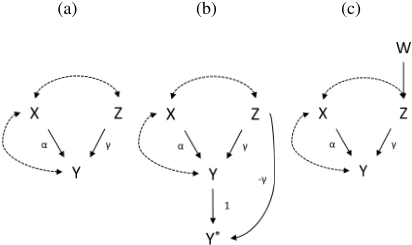
When the causal effect of x on y is not identifiable and performing randomized experiments on x is not possible (due to cost, ethical, or other considerations), we may nevertheless be able to identify the causal effect of x on y using knowledge gained from experiments on another set of variables Z. The task of determining whether causal effects can be computed using surrogate experiments generalizes the problem of identification and was named z-identification in [Bareinboim and Pearl, 2012]. They provided necessary and sufficient conditions for this task in the non-parametric setting. Considering Figure 4a, one can immediately see that the effect of x on y is not identifiable, given the unblockable back-door path. Additionally, using BP's z-identification condition, one can see that the effect of x on y is not identifiable, even with experiments over z. Remarkably, if one is willing to assume that the system is linear, more can be said. The experiment over z would yield γ, allowing us to create an auxiliary variable, y⇤ , which is represented by Figure 4b. Now, ↵ can be easily identified using auxiliary variables. To witness, note that σ(z↪ y⇤ ) = Cxz↵ + γ - γ and σ(z↪ x) = Cxz so that ↵ = σ(z↪y⇤ ) σ(z↪x) .
While z is not technically an instrument for ↵ in Gγ+, it behaves like one. When z allows the identification of ↵ by using an auxiliary variable y⇤ , we will call z a quasi-instrument.
The question naturally arises whether we can improve auxIS identifiability (Def. 7) by using quasi-instruments. However, aux-IS identifiability requires that we learn the value of γ from the model, not externally. In order to identify γ from the model, we would require an instrument. If such an instrument, w, existed, as in Figure 4c, then both γ and ↵ could have been identified together using ¶z↪ w♦ as an instrumental set. As a result, quasi-instruments are not necessary. However, if γ could only be evaluated externally, then quasiinstruments are necessary to identify ↵.
In some cases, the cancellation of paths due to auxiliary variables may generate new vanishing correlation constraints. For example, in Figure 1b, we have that σ(z⇤ ↪ s) = βγ - βγ = 0. Thus, we see that auxiliary variables allows us to identify additional testable implications of the model. Moreover, if certain coefficients are evaluated externally, that information can also be used to generate testable implications. Lemma 2 can be used to identify independences involving auxiliary variables from the graph, G.
Besides z-identification and model testing, these new constraints can also be used to prune the space of compatible models in the task of structural learning. Additionally, it is natural to envision that auxiliary variables can be useful to answer evaluation questions in different, but somewhat related domains, such as in the transportability problem [Pearl and Bareinboim, 2011], or more broadly, the data-fusion problem [Bareinboim and Pearl, 2015], where datasets collected under heterogenous conditions need to be combined to answer a query in a target domain.
6 Conclusion
In this paper, we tackle the fundamental problem of identification in linear system as articulated by [Fisher, 1966]. We move towards a general solution of the problem, enriching graph-based identification and model testing methods by introducing auxiliary variables. Auxiliary variables allows existing identification and model testing methods to incorporate knowledge of non-zero parameter values. We proved independence properties of auxiliary variables and demonstrated that by iteratively identifying parameters using auxiliary instrumental sets, we are able to greatly increase the power of instrumental sets, to the extent that it subsumes the most general criterion for identification of linear SEMs known to date. We further discussed how auxiliary variables can be useful for the general tasks of testing and z-identification.
7 Acknowledgments
This research was supported in parts by grants from NSF #IIS-1302448 and #IIS-1527490 and ONR #N00014-13-10153 and #N00014-13-1-0153.
@inproceedings{ijcai2016p504,
  title     = {Incorporating Knowledge into Structural Equation Models Using Auxiliary Variables},
  author    = {Chen, Bryant and Pearl, Judea and Bareinboim, Elias},
  booktitle = {Proceedings of the Twenty-Fifth International Joint Conference on
               Artificial Intelligence, {IJCAI-16}},
  publisher = {AAAI Press / International Joint Conferences on Artificial Intelligence},
  editor    = {Subbarao Kambhampati},
  pages     = {3577--3582},
  year      = {2016},
  month     = {7},
  url       = {https://ijcai.org/proceedings/2016/504},
}
TY - CPAPER TI - Incorporating Knowledge into Structural Equation Models Using Auxiliary Variables AU - Chen, Bryant AU - Pearl, Judea AU - Bareinboim, Elias T2 - Proceedings of the Twenty-Fifth International Joint Conference on Artificial Intelligence, IJCAI-16 PB - AAAI Press / International Joint Conferences on Artificial Intelligence PY - 2016 SP - 3577 EP - 3582 UR - https://ijcai.org/proceedings/2016/504 ER -Copied
Machine-readable versions of this paper, for tools and AI agents:





