
Modularity Based Community Detection with Deep Learning
Proceedings of the Twenty-Fifth International Joint Conference on Artificial Intelligence. Pages 2252-2257.
© 2016 International Joint Conferences on Artificial Intelligence
Abstract
Identification of module or community structures is important for characterizing and understanding complex systems. While designed with different objectives, i.e., stochastic models for regeneration and modularity maximization models for discrimination, both these two types of model look for low-rank embedding to best represent and reconstruct network topology. However, the mapping through such embedding is linear, whereas real networks have various nonlinear features, making these models less effective in practice. Inspired by the strong representation power of deep neural networks, we propose a novel nonlinear reconstruction method by adopting deep neural networks for representation. We then extend the method to a semi-supervised community detection algorithm by incorporating pairwise constraints among graph nodes. Extensive experimental results on synthetic and real networks show that the new methods are effective, outperforming most state-of-the-art methods for community detection.
- [Adamic and Glance, 2005] Lada A Adamic and Natalie Glance. The political blogosphere and the 2004 us election: divided they blog. In Proceedings of the 3rd international workshop on Link discovery, pages 36-43. ACM, 2005.
- [Blondel et al., 2008] Vincent D Blondel, Jean-Loup Guillaume, Re- naud Lambiotte, and Etienne Lefebvre. Fast unfolding of commu- nities in large networks. Journal of statistical mechanics: theory and experiment, 2008(10):P10008, 2008.
- [Bourlard and Kamp, 1988] Hervé Bourlard and Yves Kamp. Auto- association by multilayer perceptrons and singular value decom- position. Biological cybernetics, 59(4-5):291-294, 1988.
- [Duch and Arenas, 2005] Jordi Duch and Alex Arenas. Community detection in complex networks using extremal optimization. Phys. Rev. E, 72:027104, Aug 2005.
- [Eckart and Young, 1936] Carl Eckart and Gale Young. The approx- imation of one matrix by another of lower rank. Psychometrika, 1(3):211-218, 1936.
- [Fortunato and Barthelemy, 2007] Santo Fortunato and Marc Barthelemy. Resolution limit in community detection. Pro- ceedings of the National Academy of Sciences, 104(1):36-41, 2007.
- [Girvan and Newman, 2002] Michelle Girvan and Mark EJ New- man. Community structure in social and biological networks. Proceedings of the National Academy of Sciences, 99(12):7821- 7826, 2002.
- [Good et al., 2010] Benjamin H Good, Yves-Alexandre de Mon- tjoye, and Aaron Clauset. Performance of modularity maximiza- tion in practical contexts. Physical Review E, 81(4):046106, 2010.
- [He et al., 2012] Dongxiao He, Jie Liu, Bo Yang, Yuxiao Huang, Dayou Liu, and Di Jin. An ant-based algorithm with local opti- mization for community detection in large-scale networks. Ad- vances in Complex Systems, 15(08):1250036, 2012.
- [He et al., 2015] Dongxiao He, Dayou Liu, Di Jin, and Weixiong Zhang. A stochastic model for detecting heterogeneous link com- munities in complex networks. In AAAI Conference on Artificial Intelligence, 2015.
- [Hinton and Zemel, 1994] Geoffrey E Hinton and Richard S Zemel. Autoencoders, minimum description length, and helmholtz free energy. Advances in neural information processing systems, pages 3-3, 1994.
- [Jin et al., 2015] Di Jin, Zheng Chen, Dongxiao He, and Weixiong Zhang. Modeling with node degree preservation can accurately find communities. In AAAI Conference on Artificial Intelligence, 2015.
- [Lancichinetti et al., 2008] Andrea Lancichinetti, Santo Fortunato, and Filippo Radicchi. Benchmark graphs for testing community detection algorithms. Physical Review E, 78(4):046110, 2008.
- [Liang et al., 2015] Xiaodan Liang, Si Liu, Xiaohui Shen, Jianchao Yang, Luoqi Liu, Jian Dong, Liang Lin, and Shuicheng Yan. Deep human parsing with active template regression. Pattern Analysis and Machine Intelligence, IEEE Transactions on, 37(12):2402- 2414, 2015.
- [Liu et al., 2015] S. Liu, X. Liang, L. Liu, X. Shen, J. Yang, C. Xu, L. Lin, Xiaochun Cao, and S. Yan. Matching-cnn meets knn: Quasi-parametric human parsing. In CVPR 2015, pages 1419- 1427, June 2015.
- [Lusseau and Newman, 2004] David Lusseau and Mark EJ New- man. Identifying the role that animals play in their social networks. Proceedings of the Royal Society of London. Series B: Biological Sciences, 271(Suppl 6):S477-S481, 2004.
- [Newman, 2004] Mark EJ Newman. Fast algorithm for detect- ing community structure in networks. Physical Review E, 69(6):066133, 2004.
- [Newman, 2006] Mark EJ Newman. Modularity and community structure in networks. Proceedings of the National Academy of Sciences, 103(23):8577-8582, 2006.
- [Psorakis et al., 2011] Ioannis Psorakis, Stephen Roberts, Mark Ebden, and Ben Sheldon. Overlapping community detection using bayesian non-negative matrix factorization. Physical Review E, 83(6):066114, 2011.
- [Rosvall and Bergstrom, 2008] Martin Rosvall and Carl T Bergstrom. Maps of random walks on complex networks reveal community structure. Proceedings of the National Academy of Sciences, 105(4):1118-1123, 2008.
- [Vincent et al., 2010] Pascal Vincent, Hugo Larochelle, Isabelle La- joie, Yoshua Bengio, and Pierre-Antoine Manzagol. Stacked denoising autoencodernmfs: Learning useful representations in a deep network with a local denoising criterion. The Journal of Machine Learning Research, 11:3371-3408, 2010.
- [Wang et al., 2008] Rui-Sheng Wang, Shihua Zhang, Yong Wang, Xiang-Sun Zhang, and Luonan Chen. Clustering complex net- works and biological networks by nonnegative matrix factorization with various similarity measures. Neurocomputing, 72(1):134- 141, 2008.
- [Xie et al., 2013] Jierui Xie, Stephen Kelley, and Boleslaw K Szy- manski. Overlapping community detection in networks: The state-of-the-art and comparative study. ACM Computing Surveys (CSUR), 45(4):43, 2013.
- [Yang et al., 2007] Bo Yang, William K Cheung, and Jiming Liu. Community mining from signed social networks. Knowledge and Data Engineering, IEEE Transactions on, 19(10):1333-1348, 2007.
- [Yang et al., 2009] Tianbao Yang, Rong Jin, Yun Chi, and Shenghuo Zhu. Combining link and content for community detection: A dis- criminative approach. In Proceedings of the 15th ACM SIGKDD '09, pages 927-936, 2009.
- [Yang et al., 2015] Liang Yang, Xiaochun Cao, Di Jin, Xiao Wang, and Dan Meng. A unified semi-supervised community detection framework using latent space graph regularization. Cybernetics, IEEE Transactions on, 45(11):2585-2598, Nov 2015.
- [Zachary, 1977] W Zachary. An information flow modelfor conflict and fission in small groups. Journal of anthropological research, 33(4):452-473, 1977.
- [Zhang et al., 2007] Shihua Zhang, Rui-Sheng Wang, and Xiang- Sun Zhang. Uncovering fuzzy community structure in complex networks. Physical Review E, 76(4):046103, 2007.
- [Zhang, 2013] Zhong-Yuan Zhang. Community structure detection in complex networks with partial background information. EPL (Europhysics Letters), 101(4):48005, 2013.
References were extracted automatically from the PDF and may contain errors.
Full text extracted automatically from the PDF; figures, tables and equations may differ. The PDF is the version of record.
1 Introduction
Real-world systems often appear in networks, e.g., social networks in Facebook media, protein interaction networks, power grids and the Internet. Real-world networks often consist of functional units, which manifest in the form of network modules or communities, subnetworks with nodes more tightly connected with respect to the rest of the networks. Finding network communities is, therefore, critical for characterizing the organizational structures and understanding complex systems.
A great deal of effort has been devoted to developing network community finding methods, among which, two are widely adopted and thus worth mentioning. The stochastic model [Psorakis et al., 2011] focuses on deriving generative models of networks. Such a generative model in essence maps a network to an embedding in a low-dimensional latent space. The mapping can be done by, e.g., nonnegative matrix factorization (NMF) [Wang et al., 2008]. Unlike the stochastic model, the modularity maximization model [Newman, 2006], as the name suggests, attempts to maximize a modularity function on network substructures. The optimization can be done by eigenvalue decomposition (EVD), which is equivalent to reconstructing a low-rank modularity matrix.
⇤Corresponding author.
In short, while appeared in different forms, the stochastic model and modularity maximization model share an essential commonality, i.e., mapping a network to a low-dimensional, latent space embedding. Motivated by the strong discrimination power of the modularity maximization model and the relationship between maximizing modularity and reconstructing modularity matrix by finding low-dimensional embedding, we aim to seek a more effective reconstruction algorithm for modularity optimization. However, all these types of embedding adopted in the two popular models are linear, e.g., NMF in the stochastic model and EVD in the modularity maximization model. This is in sharp contrast to the fact that real-world networks are full of nonlinear properties, e.g., a relationship (e.g., distance) among nodes may not necessarily be linear. As a result, the representation power of these linear mapping based models is limited on real-world networks.
Neural networks, particularly that with deep structures, are well known to provide nonlinear low-dimensional representations [Bourlard and Kamp, 1988]. They have been successfully applied to complex problems and systems in practice, such as image classification, speech recognition, and playing an ancient strategic board game of Go. To the best of our knowledge, however, deep neural networks have not yet been successfully applied to community detection.
Taking advantage of the nonlinear representation power of deep neural networks, we propose in this paper a nonlinear reconstruction (DNR) algorithm for community detection using deep neural networks.
It is known that information beyond network topology can greatly aid network community identification [Zhang, 2013; Yang et al., 2015]. Examples of such information include semantics on nodes, e.g., names and labels, and constraints on relationships among nodes, e.g., community membership constraints between adjacent nodes (pairwise constraints). In the current study, we extend our DNR method to a semisupervised DNR (semi-DNR) algorithm to explicitly incorporates pairwise constraints among nodes to further improve community detection.
2 Reconstruction based Community Detection
We consider an undirected and unweighted graph G = (V↪ E), where V = ¶v1↪ v2↪ ▷▷▷↪ vN♦ is the set of N vertices, and E = ¶eij♦ the set of edges each of which connects two vertices in V . The adjacency matrix of G is a nonnegative symmetric matrix A = [aij ] 2 RN⇥N + where aij = 1 if there is an edge between vertices i and j, or aij = 0 otherwise, and aii = 0 for all 1 i N. The degree of vertex i is defined as ki = Pj aij . The problem of community detection is to find K modules or communities ¶Vi♦Ki=1 that are subgraphs whose vertices are more tightly connected with one another than with outside vertices. Here, we consider disjoint communities, i.e., Vi \ Vj = ; for i 6= j.
2.1 Stochastic Model
In stochastic model [Psorakis et al., 2011; He et al., 2015; Jin et al., 2015], aij can be viewed as the probability that vertices i and j are connected. This probability can be further considered to be determined by the probabilities that vertices i and j generate edges belonging to the same community. We introduce latent variables H = [hik] 2 RN⇥K + with hik representing the probability that node i generates an edge belonging to community k. This latent variable also captures the probability that node i belongs to community k, and each row of H can be considered as a community membership distribution of a vertex. The probability that vertices i and j is connected by a link belonging to community k is then hikhjk, and the probability that they are connected is:
As a result, the community detection problem can be formulated as a nonnegative matrix factorization A ⇡ ˆA = HHT . The NMF-based community detection approaches [Psorakis et al., 2011] aim to find a nonnegative membership matrix H to reconstruct adjacency matrix A. There are two common objective (loss) functions to quantify the reconstruction error. The first is based on the square loss function [Wang et al., 2008; Zhang et al., 2007] which is equivalent to the square of the Frobenius norm of the difference between two matrices
The second is based on the Kullback-Leibleer divergence (KLdivergence) between two matrices
The index of the largest element in the ith row of H indicates the community that node i belongs to.
There are many variations to the stochastic model, such as nonnegative matrix tri-factorization and stochastic block model. Nearly all of these models can be intuitively viewed as finding new representations in a low-dimensional space that can best represent and reconstruct the adjacency matrix.
2.2 ModularityMaximizationModel
This model was introduced by Newman [Newman, 2006] to maximize a modularity function Q, which is defined as the difference between the number of edges within communities and the expected number of such edges over all pairs of vertices. For example, consider a network with two communities, then
where hi equals to 1 (or -1) if vertex i belongs to the first (or second) group, kikj 2m is the expected number of edges between vertices i and j if edges are placed randomly, ki is the degree of vertex i and m = 12 Pi ki is the total number of edges in the network. By defining modularity matrix B = [bij ] 2 RN⇥N whose element is bij = aij - kikj 2m , modularity Q can be written as
where h = [hi] 2 RN is a community membership indicator vector. Maximizing Eq. (1) is NP-hard, for which many optimization algorithms have been proposed, such as extremal optimization [Duch and Arenas, 2005]. In practice, we can relax the problem by allowing variable hi to take any real value and hT h = N. To generalize Eq. (1) to K > 2 communities, we can define an indicator matrix H = [hij] 2 RN⇥K and obtain
where Tr(▷) is the trace of a matrix. Based on Rayleigh Quotient, the solution to this problem is the largest K eigenvectors of the modularity matrix B. Each row of matrix H can be regarded as a new representation of the corresponding vertex in the latent space, and clustering algorithms, such as k-means, can be used to classify the nodes into disjoint groups in the latent space.
The Eckart-Young-Mirsky Theorem [Eckart and Young, 1936] explores the relationship between the reconstruction and singular value decomposition (SVD).
Theorem 1. [Eckart and Young, 1936] For a matrix D 2 Rm⇥n (m> n), if D=U⌃VT is the singular value decomposition of D, and U, V, ⌃ = diag(σ1↪ σ2↪ ▷▷▷↪ σm) where σ1 > σ2 > ▷▷▷ > σm are as follows:
where ⌃1 is r ⇥ r, U1 is m⇥ r and V1 is n ⇥ r, then the optimal solution to the following problem
The above theorem means that the matrix reconstruction from the singular vectors corresponding to the K largest singular values is the best rank-K approximation to the original matrix under the Frobenuis norm. Since modularity matrix B is symmetric, there exists orthogonal decomposition B = U⇤UT , where ⇤ is diagonal matrix with the eigenvalues of B as the diagonal elements and UTU = I. Thus, the matrix reconstructed by the eigenvectors corresponding to the K largest eigenvalues is also the best approximation to the input matrix B with rank K. Therefore, the modularity maximization problem can be regarded as reconstructing the modularity matrix using a low-rank approximation.
Put together, stochastic model and modularity maximization can be intuitively interpreted as to find low-dimensional representations to best reconstruct given network structures. It is important to note that both of them only reconstruct original networks by linear reconstruction, using, e.g., NMF or SVD, and ignore nonlinear properties of the networks. It is unclear how NMF and SVD based approaches can be extended to accommodate nonlinear low-dimensional embedding. We aim to overcome this difficulty by using deep neural networks, the focus of the current paper.
3 Deep Nonlinear ReconstructionModel
We now present a novel deep nonlinear reconstruction (DNR) model for community detection. We first introduce an AutoEncoder, which is a key building block of the model, and then describe a stacked Auto-Encoder. While in the following discussion we focus on finding a nonlinear embedding that best reconstructs the modularity matrix B, as inspired by the SVDbased modularity maximization (Section 2.2), our method can be readily applied to other network input forms, such as adjacency and Laplacian matrices.
3.1 Reconstruction based on Auto-Encoder
Auto-Encoder is a special neural network that is used to learn a new representation that can best approximate the original data [Bourlard and Kamp, 1988; Hinton and Zemel, 1994]. We adopt modularity matrix B = [bij ] 2 RN⇥N as the input to the Auto-Encoder. Here, the elements of B are bij = aij - kikj 2m , and the ith column bi of B represents vertex i. The Auto-Encoder consists of two key components: encoder and decoder. The encoder maps the original data B to a lowdimensional embedding H = [hij] 2 Rd⇥N where d < N and the ith column of H, i.e., hi, represents vertex i in the latent spacehi = f(bi) = s(WHbi + dH)↪ (2)
where WH 2 Rd⇥N ↪ dH 2 Rd⇥1 are the parameters to be learned in the encoder, and s(▷) is an element-wise nonlinear mapping, such as sigmoid function ssigmoid(x) = 1 1+e-x or tanh function stanh(x) = ex-e-x ex+e-x . The decoder maps the latent representation H back into the original data space, i.e., reconstructs the original data from the latent representation:
where WM 2 RN⇥d ↪ dM 2 RN⇥1 are the parameters to be learned in the decoder and g(▷) is another element-wise nonlinear mapping similar to s(▷). Auto-Encoder aims at learning a low-dimensional nonlinear representation H that can best reconstruct the original data B, i.e. minimize the difference between the original data B and reconstruction data M under parameters ✓ = ¶WH↪ dH↪WM↪ dM♦
where L✓(bi↪mi) is a distance function that measures the reconstruction error. Here we adopt the Euclidean distance and sigmoid cross-entropy distance as distance functions. The sigmoid cross-entropy distance maps elements in bi = [bji] 2 RN⇥1 and mi = [mji] 2 RN⇥1 to [0↪ 1] using sigmoid function σ(x) = 1 1+e-x , and then computes the cross-entropy of them as
After training the Auto-Encoder, WH and dH are obtained and Eq. (2) can be used to generate the new representations for all vertices.
3.2 Optimization
Eq. (3) can be solved by back-propagation with stochastic gradient descent. In each iteration, the parameters ✓ = ¶WH↪ dH↪WM↪ dM♦ are updated as follows
where ↵ 2 ¶H↪ M♦. By defining z↵ = W↵x + d↵, we have
where δj↵ = @ @zj↵ L✓(xi↪ g(f(xi))) denotes the contribution of a node to the overall reconstruction error. For Euclidean distance based L✓(B↪M),
where s0 (x) is the derivative of s(x).
3.3 Stacked Auto-Encoder
Recently, deep learning has been successful on various problems in many fields, such as image classification, semantic segmentation [Liu et al., 2015; Liang et al., 2015]. However, as the number of layers increases, the space of parameters grows exponentially, making optimization inefficient. A compromising strategy is to train the network layer by layer [Vincent et al., 2010].
To take advantage of a deep architecture, we stack a series of Auto-Encoders to form a DNR model. For a deep AutoEncoder network, we train the first Auto-Encoder by reconstructing the original data, i.e., the modularity matrix B and obtain a new representation H1 2 RN⇥t1 . We then train the ith Auto-Encoder by reconstructing the output of the (i-1)th Auto-Encoder and obtain a representation Hi 2 RN⇥ti , where ti < ti-1. The number of Auto-Encoders we stack and the dimensions of new representations, i.e., tis', are discussed in Section 5.2.
4 Pairwise Constrained Semi-supervised Community Detection
We now incorporate pairwise constraints on vertices into the proposed DNR model and introduce a novel reconstruction space graph regularization for semi-supervised DNR (semiDNR). If we have a priori knowledge that vertices i and j belong to the same community, we can make use of this knowledge in two different ways. First, to classify two nodes into the same community, the new representations of nodes i and j, i.e., hi and hj, should be similar, since the new representations are used to cluster the two vertices after encoding. Second, this a priori information should also be encoded into the DNR model to further affect the embedding of other vertices. Therefore, instead of just modifying the embedding representation, we incorporate the pairwise constraints into the loss function of the Auto-Encoder in Eq. (3).
To measure the similarity of their latent representations, we can adopt either Euclidean distance or Kullback-Leibleer divergence (KL-divergence), i.e.
If nodes i and j are known to belong to the same community, we then try to minimize the difference between their new representations DLSE(hi↪ hj) . We define a pairwise constraint matrix O = [oij ] 2 RN⇥N + , where oij = 1 if nodes i and j are known to be in the same community, or oij = 0 otherwise. Thus, we can write the pairwise constraints as
where Tr(▷) is the trace of a matrix, D = [dij] 2 RN⇥N + a diagonal matrix whose entries are row summation of O, i.e., dii = PNj=1 oij , and L = D - O the graph regularization matrix (Laplacian matrix) of a priori information O. Similarly, the KL-divergence based constraints can be written as:
which takes into account the asymmetry of KL-divergence and averages DKL(hi♣♣hj) and DKL(hj♣♣hi). By minimizing RLSE(O↪H) or RKL(O↪H), we expect the new representations of two nodes i and j are similar if we have some information indicating that these two nodes belong to the same community, i.e., the corresponding element oij = 1 .
By incorporating the pairwise constraints in Eq (4) with the reconstruction error function in Eq (3), we obtain the overall loss function for semi-supervised DNR (semi-DNR) as
where λ is a parameter for making a tradeoff between the reconstruction error (the first term L(B↪M)) and the consistency of the new representations with a priori information (the second term Tr(HT LH)). For semi-DNR, we can impose a graph regularization term on the reconstruction layers of all Auto-Encoders, and then evaluate the performance improvement as discussed in Section 5.3.
Eq. (4) can also be solved using back-propagation. Since the reconstruction space graph regularization term Tr(HT LH) is independent of reconstruction of M, it does not affect the update of WM and bM. Therefore, we only need to modify δiH as δiH(semi) = δiH + δigraph , where
denote how much a node is responsible for the inconsistency of the derived representation and the pairwise constraints based on the Euclidean distance and KL-divergence, respectively. Here ⊙ and ÷ denote the element-wise multiplication and division, respectively.
5 Experimental Analysis
To evaluate the proposed DNR and semi-DNR methods, we analyzed their performance on widely used synthetic benchmarks and real-world networks. We first compared DNR with seven state-of-the-art approaches, which are divided into two categories based on whether they are based on modularity maximization. The modularity based methods include the spectral (SP) algorithm [Newman, 2006], the external optimization
| Datasets | N | M | K | SP | EO | FN | FUA | DNR L2 | DNR CE |
|---|---|---|---|---|---|---|---|---|---|
| Karate [Zachary, 1977] | 34 | 78 | 2 | 1.000 | 0.587 | 0.692 | 0.587 | 1.000 | 1.000 |
| Dolphins [Lusseau and Newman, 2004] | 62 | 159 | 2 | 0.753 | 0.579 | 0.572 | 0.516 | 0.889 | 0.818 |
| Friendship6 [Xie et al., 2013] | 68 | 220 | 6 | 0.418 | 0.952 | 0.727 | 0.852 | 0.888 | 0.924 |
| Friendship7 [Xie et al., 2013] | 68 | 220 | 7 | 0.477 | 0.910 | 0.762 | 0.878 | 0.907 | 0.932 |
| Football [Girvan and Newman, 2002] | 115 | 613 | 12 | 0.334 | 0.885 | 0.698 | 0.890 | 0.927 | 0.914 |
| Polbooks [Newman, 2006] | 105 | 441 | 3 | 0.561 | 0.557 | 0.531 | 0.574 | 0.552 | 0.582 |
| Polblogs [Adamic and Glance, 2005] | 1,490 | 16,718 | 2 | 0.511 | 0.501 | 0.499 | 0.375 | 0.389 | 0.517 |
| Cora [Yang et al., 2009] | 2,708 | 5,429 | 7 | 0.295 | 0.441 | 0.459 | 0.260 | 0.463 | 0.421 |
(EO) algorithm [Duch and Arenas, 2005], the FUA algorithm [Blondel et al., 2008], the MABA algorithm [He et al., 2012] and the (FN) algorithm [Newman, 2004]. The remaining methods include the (FEC) algorithm [Yang et al., 2007] and the Infomap algorithm [Rosvall and Bergstrom, 2008].
To assess the effectiveness of using pairwise constraints, we compared semi-DNR with two existing semi-supervised community detection algorithms, ModLink [Zhang, 2013] and GraphNMF [Yang et al., 2015]. The former transforms pairwise constraints into information of network topology, modifies the adjacency matrix and uses a conventional algorithm to find communities on new label-refined networks. The latter incorporates the labels by constraining the nodes belonging to the same community to have similar membership representations. We adopted the Normalized Mutual Information (NMI) for performance measure.
5.1 Experiment Setup
| Datasets | N | Layers Configuration |
|---|---|---|
| Karate | 34 | 34-32-16 |
| Dolphins | 62 | 62-32-16 |
| Friendship6 | 68 | 68-32-16 |
| Friendship7 | 68 | 68-32-16 |
| Football | 115 | 115-64-32-16 |
| Polbooks | 105 | 105-64-32-16 |
| Polblogs | 1,490 | 1,490-256-128-64 |
| Cora | 2,708 | 2,708-512-256-128 |
| GN Network | 128 | 126-64-32-16 |
| LFR Network | 1,000 | 1,000-512-256-128 |
The layer configurations of the deep neural networks for different problems tested are shown in Table 2. The networks have at most 3 stacked Auto-Encoder, and the dimension of each latent space is less than that of its input and output spaces. For example, the stacked Auto-Encoder network for the LFR network consists of three Auto-Encoders, where the first is 1,000-512-1,000, the second 512-256-512 and the third 256128-256. All Auto-Encoders were trained separately. We took a modularity matrix as the input to the first Auto-Encoder, and trained the it to minimize the reconstruction error, then took the embedding result as the input to the second AutoEncoder, and so on. We set the training batch to the size of the network and ran at most 100,000 iterations. For each network we trained a DNR model with 10 random initializations, and took the latent representations from three Auto-Encoders for clustering. Here, we adopted the k-means for clustering and returned the results with the maximum modularity.
5.2 Community Detection Results
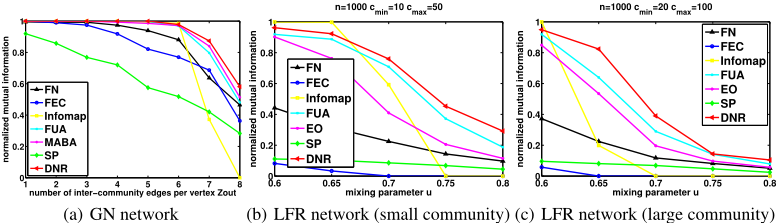
We considered two types of synthetic networks, GirvanNewman (GN) networks [Girvan and Newman, 2002] and Lancichinetti-Fortunato-Radicchi (LFR) networks [Lancichinetti et al., 2008]. Each GN network consists of 128 nodes divided into 4 communities of 32 nodes each. Each node has on average 16 edges, among which Zout edges are intercommunity edges. The results are shown in Figure 1(a). As shown, DNR outperforms all competing methods, especially when Zout > 6.
The LFR networks are more complicated than the GN networks. As suggested in [Lancichinetti et al., 2008], we set the number of nodes to 1000, the average degree to 20, the exponent of a vertex degree and the community size to -2
(a) GN newtwork with Zout=7
(b) GN newtwork with Zout=8
(c) LFR network with θ = 0▷75
(d) LFR network with θ = 0▷8
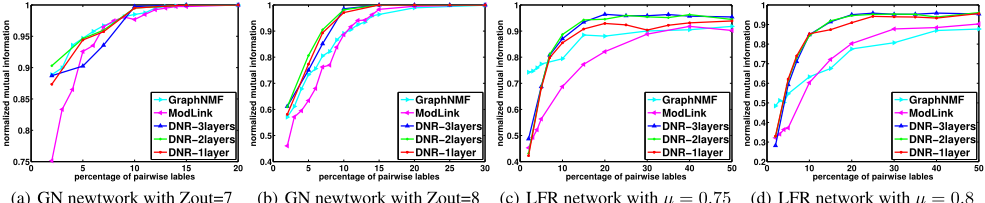
Figure 2: Comparison of semi-DNR and two competing methods on GN and LFR networks.
and -1 respectively, and varied the mixing parameter θ from 0.6 to 0.8. To fully evaluate the performance on networks with different community sizes, we generated two groups of networks: one with community sizes from 10 to 50 while the other from 20 to 100. The results on these two groups of networks are shown in Figs 1(b) and 1(c). As shown, DNR can successfully detect small and large communities. It achieves the best performance when θ > 0▷65 on networks with small community size (middle figure, Figure 1) and θ > 0▷6 on networks with large community sizes (right figure, Figure 1). While Infomap performs slightly better than DNR when is small, it completely fails when θ > 0▷75.
In summary, the experimental results on synthetic networks showed that the deep nonlinear model is more effective on difficult networks with vague community structures and is competitive on easy networks with clear community structures. While the factors for such a superb performance compared with other modularity-based methods remains to be further investigated, it may be partially attributed to the nonlinear structure of our new model, which helps to mitigate the resolution limit [Fortunato and Barthelemy, 2007] and the extreme degeneracy [Good et al., 2010] problems, both of which are often suffered from modularity optimization.
Nine widely-used real networks, listed in Table 1, were used for evaluation. As shown in previous work [Psorakis et al., 2011], no single unified loss function seemed to exist that can successfully detect communities in all networks. In our experiments, we also adopted the Euclidean distance and sigmoid cross-entropy as error functions. We used sigmoid crossentropy instead of KL-divergence because the former can be integrated with the sigmoid function for back-propagation.
The results are shown in Table 1. Here, we compared DNR with other well-known modularity-based community detection methods. As shown in the table, DNR with the L2 norm (DNR L2) and with the cross-entropy distance (DNR CE) outperforms most of the competing modularity-based optimization algorithms.
5.3 Semi-supervised Community Detection Results
To evaluate the new semi-supervised deep nonlinear reconstruction (semi-DNR) method, we used networks on which it is difficult to find satisfactory community structures without label information. As shown in Figure 2, the performance is mediocre on GN network with Zout = 8 and LFR network with θ = 0▷75 and 0▷8. Besides, we chose GN network with Zout = 7 where the methods without labels can also achieve better results for comparison. Here, we set the balancing parameter λ = 1000. We also verifed the effects of pairwise constraints on more than one layer i.e., only the bottom layer, both bottom and middle layers and all the three layers.
The results are shown in Figure 2. On the GN with Zout = 7, all the methods have similar improvements by enforcing the same percent of labels. On the networks where unsupervised methods cannot obtain satisfactory results, in comparison, the semi-DNR achieves much better performance with the same number of labels. For example, with 20% pairwise constraints, the NMI of semi-DNR achieves 0.95 while that of GraphNMF and ModLink only achieve 0.76 and 0.79, respectively, on LFR network with θ = 0▷8 (right figure in Figure 2). This means the semi-DNR is much more efficient on the use of pairwise constraints than other methods. Furthermore, the performance of enforcing pairwise constraints on multi-layers has similar improvements. It illustrates that semi-DNR can fully explore pairwise constraints by only one layer graph regularization.
6 Conclusion
In order to overcome the serious drawback of linear low-rank embedding used by the widely adopted stochastic model and modularity maximization model for network community identification, we proposed a nonlinear model in deep neural networks to gain representation power for large complex networks; developed an algorithm using the model for network community detection; and further extended this method to a semi-supervised deep nonlinear reconstruction algorithm by incorporating pairwise constraints. Extensive experimental results on synthetic and real networks illustrate that our new methods outperform the existing state-of-the-art methods for network community identification. In the future, we plan to study model selection using the latent space embedding from DNR to make the model and methods more robust.
7 Acknowledgments
This work was supported by National Natural Science Foundation of China (No. 61503281, 61502334, 61303110, 61422213), "Strategic Priority Research Program" of the Chinese Academy of Sciences (XDA06010701), Open Funding Project of Tianjin Key Laboratory of Cognitive Computing and Application, Foundation for the Young Scholars by Tianjin University of Commerce (150113), the Talent Development Program of Wuhan, the municipal government of Wuhan, Hubei, China (2014070504020241), and an internal research grant of Jianghan University, Wuhan, China, as well as by United States National Institutes of Health (R01GM100364).
@inproceedings{ijcai2016p321,
  title     = {Modularity Based Community Detection with Deep Learning},
  author    = {Yang, Liang and Cao, Xiaochun and He, Dongxiao and Wang, Chuan and Wang, Xiao and Zhang, Weixiong},
  booktitle = {Proceedings of the Twenty-Fifth International Joint Conference on
               Artificial Intelligence, {IJCAI-16}},
  publisher = {AAAI Press / International Joint Conferences on Artificial Intelligence},
  editor    = {Subbarao Kambhampati},
  pages     = {2252--2257},
  year      = {2016},
  month     = {7},
  url       = {https://ijcai.org/proceedings/2016/321},
}
TY - CPAPER TI - Modularity Based Community Detection with Deep Learning AU - Yang, Liang AU - Cao, Xiaochun AU - He, Dongxiao AU - Wang, Chuan AU - Wang, Xiao AU - Zhang, Weixiong T2 - Proceedings of the Twenty-Fifth International Joint Conference on Artificial Intelligence, IJCAI-16 PB - AAAI Press / International Joint Conferences on Artificial Intelligence PY - 2016 SP - 2252 EP - 2257 UR - https://ijcai.org/proceedings/2016/321 ER -Copied
Machine-readable versions of this paper, for tools and AI agents:





