
Expressivity of Datalog Variants - Completing the Picture
Proceedings of the Twenty-Fifth International Joint Conference on Artificial Intelligence. Pages 1230-1235.
© 2016 International Joint Conferences on Artificial Intelligence
Abstract
Computational and model-theoretic properties of logical languages constitute a central field of research in logic-based knowledge representation. Datalog is a very popular formalism, a de-facto standard for expressing and querying knowledge. Diverse results exist regarding the expressivity of Datalog and its extension by input negation (semipositive Datalog) and/or a linear order (order-invariant Datalog). When classifying the expressivity of logical formalisms by their model-theoretic properties, a very natural and prominent such property is preservation under homomorphisms. This paper solves the remaining open questions needed to arrive at a complete picture regarding the interrelationships between the class of homomorphism-closed queries and the query classes related to the four versions of Datalog. Most notably, we exhibit a query that is both homomorphism-closed and computable in polynomial time but cannot be expressed in order-invariant Datalog.
- [Abiteboul, Hull, and Vianu, 1994] Abiteboul, S.; Hull, R.; and Vianu, V. 1994. Foundations of Databases. Addi- son Wesley. [Afrati, Cosmadakis, and Yannakakis, 1995]
- Afrati, F. N.; Cosmadakis, S. S.; and Yannakakis, M. 1995. On datalog vs. polynomial time. J. Comput. Syst. Sci. 51(2):177-196.
- [Bourhis, Krötzsch, and Rudolph, 2014] Bourhis, P.; Krötzsch, M.; and Rudolph, S. 2014. How to best nest regular path queries. In Bienvenu, M.; Ortiz, M.; Rosati, R.; and Simkus, M., eds., Informal Proc. 27th International Workshop on Description Logics (DL2014), volume 1193 of CEUR Workshop Proceedings, 404-415. CEUR-WS.org.
- [Bourhis, Krötzsch, and Rudolph, 2015] Bourhis, P.; Krötzsch, M.; and Rudolph, S. 2015. Reasonable highly expressive query languages. In Yang, Q., and Wooldridge, M., eds., Proc. 24th International Joint Con- ference on Artificial Intelligence (IJCAI'15), 2826-2832. AAAI Press.
- [Chandra and Harel, 1980] Chandra, A. K., and Harel, D. 1980. Computable queries for relational data bases. J. Comput. Syst. Sci. 21(2):156-178.
- [Chang and Keisler, 1989] Chang, C. C., and Keisler, H. J. 1989. Model Theory. North Holland, Amsterdam, third edition.
- [Cuenca Grau et al., 2013] Cuenca Grau, B.; Motik, B.; Stoi- los, G.; and Horrocks, I. 2013. Computing Datalog rewrit- ings beyond Horn ontologies. In Rossi, F., ed., Proc. 23rd International Joint Conference on Artificial Intelligence (IJCAI'13). IJCAI/AAAI. IJCAI
- [Dawar and Kreutzer, 2008] Dawar, A., and Kreutzer, S. 2008. On datalog vs. LFP. In Aceto, L.; Damgård, I.;
- Goldberg, L. A.; Halldúrsson, M. M.; Ingólfsdóttir, A.; and Walukiewicz, I., eds., Proc. 35th International Colloquium on Automata, Languages and Programming (ICALP'08), 160-171.
- [Edmonds, 1965] Edmonds, J. 1965. Paths, trees and flow- ers. Canad. J. Math. 17:449-467.
- [Feder and Vardi, 2003] Feder, T., and Vardi, M. Y. 2003. Homomorphism closed vs. existential positive. In Proc. 18th IEEE Symposium on Logic in Computer Science (LICS 2003), 311-320.
- [Gottlob and Schwentick, 2012] Gottlob, G., and Schwentick, T. 2012. Rewriting ontological queries into small nonrecursive Datalog programs. In Brewka, G.; Eiter, T.; and McIlraith, S. A., eds., Proc. 13th International Conference on Principles of Knowledge Representation and Reasoning (KR'12). AAAI Press.
- [Gottlob, Rudolph, and Simkus, 2014] Gottlob, G.; Rudolph, S.; and Simkus, M. 2014. Expressiveness of guarded existential rule languages. In Hull, R., and Grohe, M., eds., Proc. 33rd Symposium on Principles of Database Systems (PODS'14), 27-38.
- [Immerman, 1999] Immerman, N. 1999. Descriptive com- plexity. Graduate texts in computer science. Springer.
- [Kaminski, Nenov, and Cuenca Grau, 2014] Kaminski, M.; Nenov, Y.; and Cuenca Grau, B. 2014. Datalog rewritabil- ity of disjunctive Datalog programs and its applications to ontology reasoning. In Brodley, C. E., and Stone, P., eds., Proc. 28th AAAI Conference on Artificial Intelligence (AAAI'14), 1077-1083. AAAI Press.
- [Ortiz, Rudolph, and Simkus, 2010] Ortiz, M.; Rudolph, S.; and Simkus, M. 2010. Worst-case optimal reasoning for the Horn-DL fragments of OWL 1 and 2. In Lin, F.; Sat- tler, U.; and Truszczynski, M., eds., Proc. 12th Interna- tional Conference on Principles of Knowledge Represen- tation and Reasoning (KR'10). AAAI Press.
- [Razborov, 1985] Razborov, A. 1985. Lower bounds for the monotone complexity of some boolean functions. Dokl. Akad. Nauk SSSR 281(4):798-801.
- [Rudolph and Thomazo, 2015] Rudolph, S., and Thomazo, M. 2015. Characterization of the expressivity of existen- tial rule queries. In Yang, Q., and Wooldridge, M., eds., Proc. 24th International Joint Conference on Artificial In- telligence (IJCAI'15). AAAI Press. IJCAI
- [Rudolph and Thomazo, 2016] Rudolph, S., and Thomazo, M. 2016. Expressivity of datalog variants -completing the picture. Technical Report hal-01302832.
References were extracted automatically from the PDF and may contain errors.
Full text extracted automatically from the PDF; figures, tables and equations may differ. The PDF is the version of record.
1 Introduction
Various logical languages have been defined to formalize and query knowledge. A central topic of logic-based knowledge representation (KR) is to analyze and compare these languages regarding expressivity and computational properties.
Among the most prominent KR formalisms is Datalog. Even in its plain form, Datalog serves as basis for KR languages (such as the popular OWL 2 RL profile of the Web Ontology Language) and also is seen as a common subsumer for a variety of very expressive query languages (cf. [Bourhis, Kr¨otzsch, and Rudolph, 2014; 2015]). Moreover, it is quite often used as a target for knowledge compilation from much more expressive KR languages (for instance, a recent topic of research has been to show how tractable description logics or classes of existential rules can be reformulated by using Datalog for query answering purposes [Ortiz, Rudolph, and Simkus, 2010; Gottlob and Schwentick, 2012; Cuenca Grau et al., 2013; Kaminski, Nenov, and Cuenca Grau, 2014; Gottlob, Rudolph, and Simkus, 2014]).
Several moderate extensions of plain Datalog have been introduced, in order to enhance its expressivity. In this pa-
Micha¨el Thomazo
Inria, France michael.thomazo@inria.fr
per, we focus on two notorious extensions: the ability to use negation for the database predicates (also referred to as input negation, resulting in so-called semipositive Datalog) and the availability of a linear order on the domain elements (giving rise to order-invariant Datalog). This leads to four distinct versions of Datalog-based languages. A very natural question is to study and compare the relative and absolute expressivities of these query languages.
One of the seminal results in that respect is that a query can be computed in polynomial time (PTIME) exactly if it can be expressed using semipositive Datalog whenever a linear order on the domain individuals is present and can be accessed by the Datalog program [Abiteboul, Hull, and Vianu, 1994]. Such a clear-cut characterization in the spirit of descriptive complexity [Immerman, 1999] is not available for the other languages, but one can get further insights by restricting the focus to queries satisfying certain model-theoretic properties.
Clearly, by disabling input negation altogether, one loses the capability of detecting the absence of database information, which restricts the expressivity of the formalism to queries satisfying some monotonicity property. For semipositive Datalog without the additional assumption of a linear order, this property has been precisely characterized: removing negation makes one lose exactly those queries not closed under homomorphism. Put positively: any homomorphismclosed query expressible in semipositive Datalog can be expressed in plain Datalog [Feder and Vardi, 2003]. Intuitively, a query (language) is homomorphism-closed if every answer remains valid if more domain elements or relationships are added or if domain elements are identified with each other.
In view of these results, a plausible conjecture would be that any homomorphism-closed PTIME computable query can be expressed in plain Datalog. Unfortunately, this conjecture was refuted by Dawar and Kreuzer [Dawar and Kreutzer, 2008] exhibiting such a query but using a pumping argument to show that it cannot be expressed in Datalog. Thus required to revise the conjecture we might suppose that the presence of a linear order is the (only) missing ingredient to make sure that (at least) all homomorphism-closed PTIME-computable queries are captured. This assumption is corroborated by the fact that we can show that the query exhibited by Dawar and Kreuzer [Dawar and Kreutzer, 2008] indeed can be expressed by Datalog when such a linear order is present.
Despite these indications in favor of the conjecture, we show in this paper that, perhaps surprisingly, there exists a PTIME-computable query that is closed under homomorphisms and that cannot be expressed by an order-invariant Datalog query. We first define this query, prove that it has the claimed properties, and then show that an order-invariant Datalog program encoding this query would allow us to build a polynomial family of monotone Boolean circuits that decide the existence of a perfect matching in a graph. This is known to be impossible thanks to a deep result by Razborov.
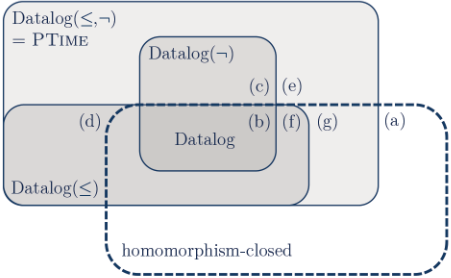
Combining all the known and newly established findings, we arrive at a complete map of the interrelationships of the five query classes defined by the four Datalog variants plus the class of homomorphism-closed queries. The result of this analysis is summarized by the diagram in Fig. 1.
We proceed as follows: we first recall basic definitions about queries, Datalog and the variants we study. Then, preparing the paper's main result, we introduce the notion of perfect matching in a graph as well as the result regarding the size of Boolean circuit deciding the existence of a perfect matching. Our main technical contribution follows: we introduce a polynomial query, closed under homomorphism, that is not equivalent to a Datalog query on ordered structures. We the summarize known and easy relationships between the four variants we consider. We finally describe some future work. Detailed proofs are to be found in the associated report [Rudolph and Thomazo, 2016].
2 Preliminaries
We consider two countable disjoint sets V and ∆u of variables and universal domain elements, respectively. Elements of V [∆u are also called terms. We consider two finite disjoint sets Pi and Pe of intensional predicates and extensional predicates. Each predicate is either intensional or extensional and possesses an arity n 2 N.
For a set P of predicates, a P-database (or just database, if P is clear from the context) over some finite domain ∆ ✓ ∆u is a finite set D of atoms with terms from ∆ and predi-
An atom is an expression a of the form p(x1↪ ▷ ▷ ▷ ↪ xn) where p is a predicate of arity n and x1↪ ▷ ▷ ▷ ↪ xn are terms. The terms of a are denoted by terms(a). The terms of a set of atoms A are defined by Sa2A terms(a).
cates from P. 1 For a fixed P, given a database D with domain ∆ and a database D0 with domain ∆0 , a homomorphism from D to D0 is a mapping ⇡ from ∆ to ∆0 such that if p(x1↪ ▷ ▷ ▷ ↪ xn) 2 D, then p(⇡(x1)↪ ▷ ▷ ▷ ↪ ⇡(xn)) 2 D0 for every p 2 P. A strong homomorphism 2 from D to D0 is a homomorphism ⇡ from D to D0 such that for any p(y1↪ ▷ ▷ ▷ ↪ yn) 2 D0 , there exists p(x1↪ ▷ ▷ ▷ ↪ xn) 2 D such that ⇡(xi) = yi for all 1 i n. An isomorphism from D to D0 is a bijective homomorphism ⇡ from D to D0 for which ⇡-1 is also a homomorphism.
Given a set of extensional predicates Pe, a (Boolean) query q is a set of Pe-databases that is closed under isomorphisms. 3 For D 2 q we say D belongs to q or q matches D. A query q is said to be preserved under homomorphisms or homomorphism-closed if for all D 2 q, the existence of a homomorphism fromD to D0 implies D0 2 q.
A semipositive Datalog program is a set of first-order logic formulae, also called rule, of the shape
where x and y are sequences of variables from V , and B is a conjunction of
- ÷ extensional atoms of the form r(z) with r 2 Pe and z ✓ x [ y,
- ÷ intensional atoms of the form s(z) with s 2 Pi and z ✓ x [ y,
- ÷ negated extensional atoms of the form ≻r(z) with r 2 Pe and z ✓ x [ y, and
and where p(y) is an atom of an intensional predicate whose variables belong to y. Note that x, y, and z are sequences of variables from V ; in particular, the semipositive Datalog programs considered by us do not contain constants. For brevity, the leading universal quantifiers are usually omitted. A semipositive Datalog query is a semipositive Datalog program containing a special nullary predicate goal. If P is a semipositive Datalog query, the Pe-database D with domain ∆ belongs to P if and only if comp(D)[P ♣= goal according to first-order logic semantics, where comp(D) := D[¶≻p(a) ♣ p(a) 62 D↪ p 2 Pe↪ a 2 ∆n ♦.
Semipositive Datalog programs (queries) without negated extensional atoms are called Datalog programs (queries).
Given a Pe-database D over ∆ and a linear order over ∆, we define the Pe[¶initial↪ final↪ succ♦-database D as D extended by the atoms
- ÷ initial(a) for the -minimal element a of ∆,
1 Since Datalog originated from databases, we employ database terminology in this paper. In KR or logical terms, D could be also seen as a finite interpretation over Pe.
2 We consider the definition from Chang and Keisler [Chang and Keisler, 1989].
3 This definition reflects the common understanding of a query that it "[...] should be independent of the representation of the data in a data base and should treat the elements of the data base as uninterpreted objects" [Chandra and Harel, 1980]. This understanding also justifies why we do not distinguish the domain elements into constants and labeled nulls, as it sometimes done in the literature, and why we do not allow for constants in our query languages.
- ÷ final(b) for the -maximal element b of ∆,
- ÷ succ(c↪ d) for any two -consecutive elements c and d of ∆, that is, c d and for no e 2 ∆ ∩ ¶c↪ d♦, it holds that c e d.
We now define the following classes of queries:
An order-invariant (semipositive) Datalog query is a (semipositive) Datalog query P making use of initial, final, and succ) (besides predicates in Pe and Pi) whose result (match or no match) is independent of the particular choice of the linear order . We then let D belong to P iff comp(D) [ P ♣= goal for some (or, equivalently, every) linear order .
- ÷ Datalog(↪ ≻): the class of queries expressible by an order-invariant semipositive Datalog query,
- ÷ Datalog(): the class of queries expressible by an order-invariant Datalog query,
- ÷ Datalog(≻): the class of queries expressible by a semipositive Datalog query,
- ÷ Datalog: the class of queries expressible by a Datalog query, and
- ÷ HC: the class of homomorphism-closed queries.
3 Perfect Matchings and Razborov's Result
As usual, a directed finite graph (in the following just graph) is a pair G = (VG↪EG), where VG is a finite set, called vertices and EG ✓ VG ⇥ VG is a binary relation on VG, called edges. For any (v↪ v0 ) = e 2 EG, the vertices v and v0 are called the ends of e. Two edges are adjacent if they share an end. A matching for G is a set M of pairwise nonadjacent edges. A perfect matching for G is a matching M such that every vertex of VG belongs to an edge of M. It is well-known (but not immediate to see) that the existence of a perfect matching in a graph can be checked in polynomial time [Edmonds, 1965].
We use two different encodings to represent graphs. Let G = (VG↪ EG) be a graph, such that VG = ¶1↪ ▷ ▷ ▷ ↪ n♦. The relational representation of G is a finite relational structure whose domain is VG and whose unique relation is the binary relation edge. For each edge (u↪ v) 2 EG, the relation edge contains the pair (u↪ v). We may also represent the same graph by an n2 -tuple (g0↪ ▷ ▷ ▷ ↪ gn2-1) 2 ¶0↪ 1♦n2 such that g(i-1)⇤n+(j-1) = 1 if and only if (i↪ j) 2 EG.
A k-ary Boolean function (for k ≥ 1) is a function f : ¶0↪ 1♦k ! ¶0↪ 1♦. A k-input Boolean circuit C (for k ≥ 1)
is a directed acyclic graph with k distinguished nodes (labeled from 0 to k - 1), called sources (inputs) which have no incoming edges, and with one distinguished node called sink (output) which has no outgoing edges. Every non-source node of C is called a gate; it is labeled with either one of ^↪ _, in which case is has two incoming edges 4 , or with ≻, in which case there is one incoming edge. Given a vector x 2 ¶0↪ 1♦k , the value of source i on x is the ith bit of x. The value of a gate x labeled by ^ (resp. _, resp. ≻) is the conjunction of the values of its incoming gates (resp. disjunction, resp. negation). The value of the sink on x is denoted by C(x). The number of nodes in C is its size, denoted by ♣C♣. C is said to compute a Boolean function f if for any tuple x 2 ¶0↪ 1♦k , C(x) = f(x). A Boolean circuit is monotone if no gate is labeled with ≻.
A family of circuits for the perfect matching problem is a sequence of circuits (Ci) where Ci has i2 inputs, 0↪ ▷ ▷ ▷ ↪ i2 -1, such that the output of Ci is 1 if and only if its input is the representation of a graph with i vertices that contains a perfect matching, and 0 otherwise. Razborov showed the following.
Theorem 1 ([Razborov, 1985], Th. 3). There exists a constant c > 0 such that the size of the circuits in an arbitrary family of monotone circuits for the perfect matching function on bipartite graphs is greater than nc log n .
We will use a weaker statement, following from this theorem: there can be no family of monotone circuits for the perfect matching function (for arbitrary graphs) of polynomial size. Such a family could be easily transformed into one violating Theorem 1 by removing nodes and edges.
4 AHomomorphism-Closed PTIME Query not Expressible in Datalog()
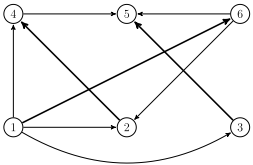
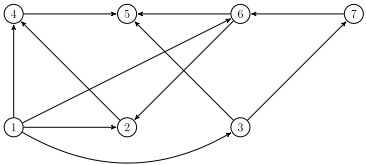
In this section, we present a homomorphism-closed, PTIMEcomputable query that is not expressible by a Datalog query on a linearly ordered database. The key idea is that the existence of a Datalog program (independent of the database) expressing this query implies the existence of a polynomial circuit for the perfect matching query, which would contradict Theorem 1. A similar argument has been used to show that some monotonic PTIME queries are not expressible by some variant of Datalog [Afrati, Cosmadakis, and Yannakakis, 1995]. 5 The challenge here is to craft a suitable query which checks for perfect matchings and is homomorphism-closed at the same time. Indeed, we cannot directly use "D encodes a graph containing a perfect matching" as our query, as this query would not be preserved under homomorphism, as can be seen in Fig. 3: there is a homomorphism from graph G1 from Fig. 2 to G2, but there is no perfect matching in G2.
4 In fact, we will consider circuits with arbitrarily many ingoing edges for ^ and _ gates (straightforwardly generalizing the definition). Since we are only interested in size-polynomiality, this is not a problem as for every such circuit there is a circuit with gates ^ and _ having only two ingoing edges and of polynomial size with respect to the original circuit.
However, there is some reminiscence of this property: adding an edge to a graph containing a perfect matching results in a graph that also contains a perfect matching. The following proposition formalize this intuition.
Proposition 2. Let G be a graph containing a perfect matching, H be a graph. If there exists a bijective homomorphism h from G to H, then H contains a perfect matching.
Proof. Let M be a matching of G. Let us consider h(M). Since no edges of M share an end and h is injective, no edges of h(M) share an edge. Moreover, since every vertex of G appears once in M and h is surjective, every vertex of H appears once in h(M).
The idea to arrive at a homomorphism-closed query is to add additional information to the database about which vertices are considered when looking for a perfect matching.
Thus, beyond a binary predicate edge that describes the edges of the graph, we use the additional predicates first (unary), last (unary), and next (binary) which, intuitively, we will use to merge elements of the database attempting to obtain a linear order so we have a better control over the graph vertices when looking for a perfect matching. We call ⌃ the set of these four predicates.
The idea to construct a query that is homomorphism-closed but still can be used to solve the perfect matching problem is as follows: for the class of databases where first, last, and next happen to encode a linear order (let us call them well-behaved databases) on the database's domain, the query should match exactly if edge encodes a graph containing a perfect matching. Note that within the class of well-behaved databases, every homomorphism is necessarily bijective, thus Proposition 2 ensures homomorphism-closedness within this class. Then, in order to define query membership for all other databases and still ensure homomorphism-closedness we proceed as follows:
- ÷ the query does not match any database where there is no next-connected component containing both a firstindividual and a last-individual (as it is clear that no database with first, last, and next forming a linear order - and hence no well-behaved database - can be homomorphically mapped into such a database, so it is safe to let these databases not be matched by the query)
- ÷ the query matches all databases which - even after removal of all elements not contained in any first- and
5 More precisely, monotonic queries as defined in that work correspond to queries preserved under injective homomorphisms. This defines a larger class of queries than the homomorphism-closed queries considered here. In particular the monotonic queries described there are not homomorphism-closed.
last-containing next-connected component - cannot be homomorphically mapped into any structure where first, last, and next constitute a linear order (obviously, these databases can never send but at best receive homomorphisms from well-behaved databases, so it is safe to let these databases be matched by the query)
- ÷ any non-well-behaved database D not falling in any of the two previous categories can be turned into a wellbehaved database D0 in a deterministic fashion (by iteratively merging domain elements and finally removing unconnected domain elements) with the following two properties: (i) any well-behaved database receiving a homomorphism from D also receives a homomorphism from D0 ; (ii) any well-behaved database having a homomorphism into D also has a homomorphism into D0 . Therefore, we need to have D satisfy the query if and only if D0 does, i.e., iff edge in D0 encodes a graph that contains a perfect matching.
In the following, we formally elaborate the above intuition.
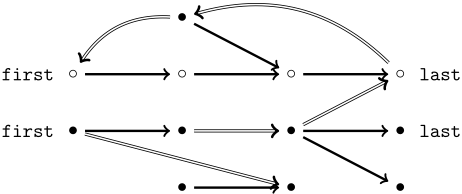
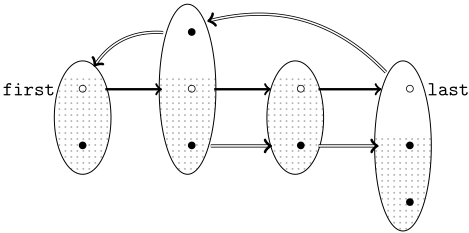
Definition 3 (Enlisted element). Let D be a ⌃-database over the domain ∆. An element d 2 ∆ is called enlisted if it is contained in a sequence d1↪ ▷ ▷ ▷ ↪ dn of domain elements with first(d1) 2 D and last(dn) 2 D and next(di↪ di+1) 2 D for every i 2 ¶1↪ ▷ ▷ ▷ ↪ n - 1♦.
Fig. 4 illustrates the notion of enlisted elements.
Attempting to merge elements such that first, last, and next describe a linear order on enlisted elements, we next consider an equivalence relation on the database elements.
Definition 4 (Congruence). Given a ⌃-database D over ∆, let ⇠= be the smallest equivalence relation on the database elements satisfying the following:
- ÷ for all d1↪ d2 2 ∆ with first(d1) 2 D and first(d2) 2 D, d1 ⇠= d2 holds
- ÷ for all d1↪ d2 2 ∆ with last(d1) 2 D and last(d2) 2 D, d1 ⇠= d2 holds
- ÷ for all d1↪ d2↪ d01 ↪ d02 2 ∆ with d1 ⇠= d2 and next(d1↪ d01 ) 2 D as well as next(d2↪ d02 ) 2 D, d01 ⇠= d02 holds
- ÷ for all d1↪ d2↪ d01 ↪ d02 2 ∆ with d01 ⇠= d02 and next(d1↪ d01 ) 2 D as well as next(d2↪ d02 ) 2 D, d1 ⇠= d2 holds.
The ⇠=-equivalence class of d is denoted by [d]⇠=.
In the next step, we define a new database by merging elements of the database which are ⇠=-equivalent.
Definition 5 (Compression of D). The compression of a ⌃-database D is the ⌃-database D0 over ∆0 := ¶[d]⇠= ♣ d enlisted♦ such that:
- ÷ first([d]⇠=) iff there exists d0 2 ∆ such that d0 ⇠= d and first(d0 )
- ÷ last([d]⇠=) iff there exists d0 2 ∆ such that d0 ⇠= d and last(d0 )
- ÷ next([d1]⇠=↪ [d2]⇠=) iff there exists d01 ↪ d02 2 ∆ such that d01 ⇠= d1↪ d02 ⇠= d2 and next(d01 ↪ d02 )
÷
÷
÷
Figure 4: Example of a ⌃-database. Simple edges represent next, double edges represent edge. Enlisted elements are drawn with empty circles.
- ÷ edge([d1]⇠=↪ [d2]⇠=) iff there exists d01 ↪ d02 2 ∆ such that d01 ⇠= d1↪ d02 ⇠= d2 and edge(d01 ↪ d02 ).
Fig. 5 displays the database obtained by compressing the database from Fig. 4.
We now have the required tools to define our query. Intuitively, there are two reasons why the query might match a database after the compression operation: (1) contradictory encoding of the linear order or (2) correct encoding and existence of a perfect matching.
Definition 6 (The query q). We define q such that D 2 q if and only if one of the following holds:
- ÷ there are d↪ d0 2 ∆0 such that ¶next(d↪ d0 )↪ first(d0 )♦ ✓ D0 or
- ÷ there are d↪ d0 2 ∆0 such that ¶last(d)↪ next(d↪ d0 )♦ ✓ D0 or
- ÷ ∆ contains enlisted elements and the graph encoded by D0 (via the edge relation) contains a perfect matching.
We can now establish, that the defined query has the claimed properties. PTime computability follows from PTIME preprocessing and PTIME checking for a perfect matching.
Proposition 7. q is computable in polynomial time.
Preservation under homomorphisms is obtained by construction, as explained above.
Proposition 8. q is preserved under homomorphisms.
Finally, the general argument of q non-expressibility in order-invariant Datalog is an indirect one: Suppose there were an order-invariant Datalog program P computing q. Given this program and a natural number n, we show how to construct a polynomial-size monotone Boolean circuit over n2 input variables recognizing the existence of a perfect matching in a graph with n vertices. However, this contradicts Theorem 1, hence the initial assumption must be wrong.
Theorem 9. The query q defined above is not expressible in order-invariant Datalog.
5 Expressivities - Known and Easy Cases
In this section, we provide the justification of the complete picture about the relationships of the considered query classes depicted in Fig. 1, for which the query established in the preceding section constitutes the final building block. We first note that by syntactic inclusion of the query languages the following semantic inclusions hold: Datalog ✓ Datalog(), Datalog ✓ Datalog(≻), Datalog() ✓ Datalog(↪ ≻), and Datalog(≻) ✓ Datalog(↪ ≻). Furthermore, it is wellknown that Datalog queries are homomorphism-closed: Datalog ✓ HC. The following theorem, which ensures Datalog(≻) \ HC ✓ Datalog has been established by Feder and Vardi [Feder and Vardi, 2003].
Theorem 10. Every Datalog(≻) query that is preserved under homomorphisms is expressible in Datalog.
In order to further clarify the relationship between the classes of queries considered here, the following two propositions - which establish model-theoretic properties of Datalog() and Datalog(≻) - come handy:
Proposition 11. Every Datalog() query is preserved under bijective homomorphisms.
Proposition 12. Every Datalog(≻) query is preserved under strong homomorphisms.
We will use these propositions below to show nonexpressibility of certain queries. Furthermore, they can be employed to obtain the following result:
Theorem 13. Every query that is expressible both in Datalog() and Datalog(≻) can be expressed in Datalog.
To ensure that no further inclusion relationships than the ones noted above (and their consequences) hold, we provide examples of queries for all the remaining admissible combinations of memberships and non-memberships. These combinations correspond to the regions in the Venn diagram depicted in Fig. 1, labeled by letters. If not specified otherwise, we assume just one binary database predicate edge, allowing us to interpret databases as directed graphs.
- (a) Regarding homomorphism-closed queries not contained in any of the Datalog classes, consider the class of existential rules queries, which has been shown to precisely capture all homomorphism-closed recursively enumerable queries [Rudolph and Thomazo, 2015]. In particular this class contains all homomorphism-closed EXPTIMEhard queries, which cannot be expressed in Datalog( ↪ ≻), since PTIME ( EXPTIME.
edge(x↪ y) ! path(x↪ y) (1) edge(x↪ y) ^ path(y↪ z) ! path(x↪ z) (2) path(x↪ x) ! goal (3) ! eqdist(x↪ x↪ y↪ y) (4) eqdist(x↪ x0 ↪ y↪ y0 ) ^ succ(x0 ↪ x00 ) ^^succ(y0 ↪ y00 ) ! eqdist(x↪ x00 ↪ y↪ y00 ) (5) initial(x) ! sqr(x↪ x) (6) initial(x) ^ succ(x↪ y) ! sqr(y↪ y) (7) succ(x↪ y) ^ succ(y↪ z) ^ sqr(x↪ x0 ) ^ sqr(y↪ y0 ) ^ eqdist(x0 ↪ y0 ↪ y0 ↪ z0 ) ^ succ(z0 ↪ z00 ) ^ succ(z00 ↪ z000 ) ! sqr(z↪ z000 ) (8) initial(x) ^ succ(x↪ y) ! dualpower(x↪ y) (9) initial(x) ^ dualpower(y↪ z) ^ succ(y↪ y0 ) ^ eqdist(x↪ z↪ z↪w) ! dualpower(y0 ↪w) (10) square(x↪ y) ^ dualpower(y↪ z) ^ dualpower(z↪w) ! goodlength(w) (11) source(x) ^ initial(y) ! distance(x↪ y) (12) distance(x↪ y) ^ edge(x↪ x0 ) ^ succ(y↪ y0 ) ! distance(x0 ↪ y0 ) (13) distance(x↪ y) ^ final(x) ^ goodlength(y) ! goal (14)- (b) A query that checks if a graph contains at least one edge is homomorphism-closed and expressible in all the Datalog variants.
- (c) A query checking if a graph is not symmetric (i.e., there exists an edge (a↪ b) but no edge (b↪ a)) is expressible in Datalog(≻) (and hence in Datalog(↪ ≻)) via the onerule program edge(x↪ y) ^ ≻edge(y↪ x) ! goal, but not in Datalog() (nor Datalog) since it is not closed under bijective homomorphisms. Consequently it is also not homomorphism-closed.
- (d) A query checking if a graph contains an even number of vertices is expressible in Datalog() (and hence in Datalog(↪ ≻)) as follows:
initial(x) ! odd(x) odd(x) ^ succ(x↪ y) ! even(y) even(x) ^ succ(x↪ y) ! odd(y) final(x) ^ even(x) ! goalHowever the query cannot be expressed in Datalog(≻) (nor Datalog) since it is not closed under strong homomorphisms. It is thus also not homomorphism-closed.
- (e) A query that checks for acyclicity of a graph is not homomorphism-closed, while it is in Datalog(↪ ≻) (as it clearly is in PTIME) but in none of its subclasses (the query is neither closed under bijective homomorphisms nor under strong homomorphisms).
- (f) For a query that is homomorphism-closed and expressible in Datalog() (and hence in Datalog(↪ ≻)) but not in Datalog (and therefore, via Theorem 10 also not in Datalog(≻)) we refer to Dawar and Kreutzer (2008), where the following query is defined: given unary predicates source and target and a binary predicate edge, the query checks if the relation edge contains a cycle or there is a natural number n such that there is an edgepath of length 2(2n2 ) from some s 2 ∆ with source(s)
to some t 2 ∆ with target(t). It was shown that this query is homomorphism-closed and in PTIME, but not in Datalog (this was shown via some pumping argument). It remains to be shown that this query is in Datalog(). To see this, consider the Datalog() query displayed in Fig. 6.
Rules (1)-(3) ensure that the query matches whenever there is an edge-cycle. Now assume w.l.o.g. ∆ = ¶0↪ ▷ ▷ ▷ ↪m♦ such that the the element i is the (i + 1)th element in the linear order encoded by . Then, rules (4) and (5) ensure that equidist(i↪ j↪ k↪ `) is entailed whenever j - i = ` - k ≥ 0. Consequently rules (6)- (8) ensure that sqr(i↪ j) is entailed exactly if j = i2 , while rules (9) and (10) make sure that dualpower(i↪ j) is entailed whenever j = 2i . Then, Rule (11) delivers goodlength(i) as a consequence whenever i = 2(2n2 ) for some n. Rules (12) and (13) make sure that distance(i↪ j) is a consequence, if the domain element i can be reached by an edge-path of length j from some individual a with source(a) 2 D, consequently Rule (14) makes the query match if there is an edge-path of length 2(2n2 ) from some a with source(a) 2 D to some b with target(b) 2 D.
- (g) Finally, a query that is homomorphism-closed and expressible in Datalog(↪ ≻) but in none of the others has been exposed in the preceding section.
6 Conclusion and FutureWork
We have compared the expressive power of four variants of Datalog, where input negation and a linear order may or may not be used. For completing the picture, we had to show that there exists a PTIME homomorphism-closed query that is not expressible in order-invariant Datalog without input negation (while it is by a classical result when allowing for input negation). This is in strong contrast with the classical result by Feder and Vardi [Feder and Vardi, 2003] showing that in the absence of a linear order, input negation is dispensable for expressing homomorphism-closed queries. We are somewhat baffled by this result: in order to express queries which satisfy the strongest notion of monotonicity, one cannot dispense with negation, the epitome of non-monotonicity.
In future work, we plan to characterize further variants of Datalog by model-theoretic and computational properties.
7 Acknowledgement
M. Thomazo acknowledges support from the ANR project ContentCheck, ANR-15-CE23-0025-01.
@inproceedings{ijcai2016p178,
  title     = {Expressivity of Datalog Variants - Completing the Picture},
  author    = {Rudolph, Sebastian and Thomazo, Michael},
  booktitle = {Proceedings of the Twenty-Fifth International Joint Conference on
               Artificial Intelligence, {IJCAI-16}},
  publisher = {AAAI Press / International Joint Conferences on Artificial Intelligence},
  editor    = {Subbarao Kambhampati},
  pages     = {1230--1235},
  year      = {2016},
  month     = {7},
  url       = {https://ijcai.org/proceedings/2016/178},
}
TY - CPAPER TI - Expressivity of Datalog Variants - Completing the Picture AU - Rudolph, Sebastian AU - Thomazo, Michael T2 - Proceedings of the Twenty-Fifth International Joint Conference on Artificial Intelligence, IJCAI-16 PB - AAAI Press / International Joint Conferences on Artificial Intelligence PY - 2016 SP - 1230 EP - 1235 UR - https://ijcai.org/proceedings/2016/178 ER -Copied
Machine-readable versions of this paper, for tools and AI agents:





