
Norms as a Basis for Governing Sociotechnical Systems: Extended Abstract
Proceedings of the Twenty-Fourth International Joint Conference on Artificial Intelligence. Journal Track. Pages 4207-4210.
© 2015 International Joint Conferences on Artificial Intelligence
Abstract
We understand a sociotechnical system as a microsociety in which autonomous parties interact with and about technical objects. We define governance as the administration of such a system by its participants. We develop an approach for governance based on a computational representation of norms. Our approach has the benefit of capturing stakeholder needs precisely while yielding adaptive resource allocation in the face of changes both in stakeholder needs and the environment. We are currently extending this approach to address the problem of secure collaboration and to contribute to the emerging science of cybersecurity.
- [Arrott et al., 2009] Matthew Arrott, Alan D. Chave, Claudiu Farcas, Emilia Farcas, Jack E. Kleinert, Ingolf Krueger, Michael Meisinger, John A. Orcutt, Cheryl Peach, Oscar Schofield, Munindar P. Singh, and Frank L. Vernon. Integrating marine observatories into a system- of-systems: Messaging in the US Ocean Observatories Initiative. In Proceedings of Oceans, the MTS-IEEE Conference on Marine Technology for our Future: Global and Local Challenges, pages 1-9, Biloxi, Mississippi, October 2009. IEEE Computer Society.
- [Baldoni et al., 2010] Matteo Baldoni, Cristina Baroglio, and Elisa Marengo. Behavior-oriented commitment-based protocols. In Proceedings of the 19th European Confer- ence on Artificial Intelligence (ECAI), pages 137-142, Au- gust 2010.
- [Bresciani et al., 2004] Paolo Bresciani, Anna Perini, Paolo Giorgini, Fausto Giunchiglia, and John Mylopoulos. Tro- pos: An agent-oriented software development methodol- ogy. Journal of Autonomous Agents and Multi-Agent Sys- tems (JAAMAS), 8(3):203-236, May 2004.
- [Chopra and Singh, 2015] Amit K. Chopra and Munindar P. Singh. Cupid: Commitments in relational algebra. In Pro- ceedings of the 23rd Conference on Artificial Intelligence (AAAI), pages 2052-2059, Austin, Texas, January 2015. AAAI Press.
- [Chopra et al., 2014] Amit K. Chopra, Fabiano Dalpiaz, F. Bas ¸ak Aydemir, Paolo Giorgini, John Mylopoulos, and Munindar P. Singh. Protos: Foundations for engineering innovative sociotechnical systems. In Proceedings of the 18th IEEE International Requirements Engineering Con- ference (RE), pages 53-62, Karlskrona, Sweden, August 2014. IEEE Computer Society.
- [Du et al., 2015] Hongying Du, Bennett Y. Narron, Nirav Ajmeri, Emily Berglund, Jon Doyle, and Munindar P. Singh. Understanding sanction under variable observabil- ity in a secure, collaborative environment. In Proceedings of the International Symposium and Bootcamp on the Sci- ence of Security (HotSoS), pages 1-10, Urbana, Illinois, April 2015. ACM.
- [Haeberlen, 2010] Andreas Haeberlen. A case for the ac- countable cloud. ACM SIGOPS Operating Systems Re- view, 44(2):52-57, April 2010.
- [Hohfeld, 1919] Wesley Newcomb Hohfeld. Fundamental Legal Conceptions as Applied in Judicial Reasoning and other Legal Essays. Yale University Press, New Haven, Connecticut, 1919. A 1919 printing of articles from 1913.
- [Jones and Sergot, 1996] Andrew J. I. Jones and Marek J. Sergot. A formal characterisation of institutionalised power. Logic Journal of the IGPL, 4(3):427-443, June 1996.
- [Savarimuthu et al., 2009] Bastin Tony Roy Savarimuthu, Stephen Cranefield, Martin K. Purvis, and Maryam A. Purvis. Norm emergence in agent societies formed by dy- namically changing networks. Web Intelligence and Agent Systems, 7(3):223-232, September 2009.
- [Singh et al., 2009] Munindar P. Singh, Amit K. Chopra, and Nirmit Desai. Commitment-based service-oriented archi- tecture. IEEE Computer, 42(11):72-79, November 2009.
- [Singh, 2013] Munindar P. Singh. Norms as a basis for gov- erning sociotechnical systems. ACM Transactions on In- telligent Systems and Technology (TIST), 5(1):21:1-21:23, December 2013.
- [Singh, 2015] Munindar P. Singh. Cybersecurity as an appli- cation domain for multiagent systems. In Proceedings of the 14th International Conference on Autonomous Agents and MultiAgent Systems (AAMAS), pages 1-6, Istanbul, May 2015. IFAAMAS. Blue Sky Ideas Track. In press.
- [Telang and Singh, 2012] Pankaj R. Telang and Munindar P. Singh. Specifying and verifying cross-organizational busi- ness models: An agent-oriented approach. IEEE Trans- actions on Services Computing, 5(3):305-318, July 2012. Appendix pages 1-5.
- [Williams et al., 2015] Laurie Williams, William Scherlis, William Sanders, David M. Nicol, Jonathan Katz, and Munindar P. Singh. Collaborating on the science of secu- rity: Active research partnership through the Lablet model. Unpublished manuscript; available from the authors, 2015.
References were extracted automatically from the PDF and may contain errors.
Full text extracted automatically from the PDF; figures, tables and equations may differ. The PDF is the version of record.
1 Challenges in Sociotechnical Systems
We define a sociotechnical system (STS) as a microsociety in which autonomous stakeholders interact. How can these stakeholders collaborate effectively even though their interests may only be imperfectly aligned? Complexity and change in interactions among stakeholders and in their environment make administering STSs nontrivial. We address the challenge of enabling stakeholders to administer or (self)govern such systems in a manner that respects their autonomy. A particular benefit are the resulting gains in adaptability in accommodating any exceptions and opportunities.
The Ocean Observatories Initiative (OOI) [Arrott et al., 2009], which facilitates scientists and research institutions in acquiring, storing, analyzing, and sharing information from the world's oceans, is a paradigmatic STS. Its stakeholders include oceanographers, educators, and members of the public as well as research laboratories and universities. The OOI has three key features. One, autonomy: the stakeholders own and share resources such as Underwater Autonomous Vehicles (UAVs), buoys, ocean sensors, and research databases. Thus, the OOI would support collaborations in which it would not own all resources involved. Two, lifetime: a requirement for the OOI was to sustain operation for decades. Thus we must accommodate changes in stakeholder needs without relying How can we accommodate continually changing stakeholder needs? How can multiple stakeholders collaborate in a sustainable, efficient manner? How can individual ownership and control be respected as autonomous parties interoperate? How can resources be added or dropped dynamically at runtime? How can coalitions be constructed and enacted to dynamically share resources while entertaining challenges such the stakeholders' needs changing unexpectedly, as in an emergency? How may we accomplish all of the above adaptations over a wide range of resource granularities and timescales?
∗ c© ACM. Reproduced with permission. This paper is an extended abstract of [Singh, 2013], which appears in the ACM Transactions on Intelligent Systems and Technology.
1.1 Governance: Norms and Organizations
We term dealing with the above challenges governance. Governance contrasts with traditional management, which presumes authority (superior to subordinate) relationships. In STSs, the collaborating parties are autonomous peers. Today, governance is carried out "by phone call"-by ad hoc negotiations among humans. However, modern STSs require decision making at fast timescales, so manual negotiations would simply not be feasible.
From the perspective of governance, the stakeholders of an STS are themselves participants. Recognizing their autonomy, we observe that we cannot prescribe a decision-making strategy for each participant. Instead, each STS can prescribe its rules of encounter via a set of norms. Informally, a norm characterizes sound or "normal" interactions among members of a social group, reflecting their mutual expectations. We emphasize interactions: behavior that has no effect on others is irrelevant for our purposes. Two examples of norms in a scientific setting are putting an instrument in power-save mode at the end of an experiment and closing unneeded data streams from sensors. Norms may arise through top-down legislation or bottom-up conventions emerging from norms implicit in participant strategies [Savarimuthu et al., 2009]. We restrict ourselves to norms that carry sufficiently strong expectations (as in contracts), so that their satisfaction or violation is significant to at least one of the interacting parties.
Based on the above intuition, we formalize an STS as an Org (inspired by organizations) that involves two or more roles, each specified in terms of the norms applying to it. To this end, we formalize norms not as amorphous properties of the "system"-whatever that might be-but as directed normative relationships between participants in the context of an Org. Our formal model reflects this essential duality of Orgs and norms: an Org is defined via norms and a norm is defined in an Org. Importantly, our approach accommodates open settings: a party may participate in two or more STSs and the norms defined in one STS may apply to actions performed on resources outside the scope of that STS.
1.2 Adaptation in Sociotechnical Systems
Our approach seeks to engineer a sociotechnical system in such a manner as to support adaptation, both (1) in its configuration and implementation and (2) in its enactments, as realized through the interactions of its participants. The twin challenges of ensuring adaptation and achieving rigor lead us to adopt the following main principles.
The first principle is the Centrality of Norms: A normative, as opposed to an operational, characterization of acceptable interactions is minimally constraining and thus essential for capturing the "invariants" of a long-lived system. The second principle is Autonomy and Policies: The participants are autonomous, though subject to applicable norms. Each participant applies its internal policies to decide how to interact given the norms; its policies reflect its autonomy.
The foregoing emphasis on autonomy and adaptation suggests that our computational systemmust incorporate agents: active computational entities that represent individual participants and organizations, and whose interactions (subject to norms) are relevant to governance. The agents are only partially regimented. Where appropriate, we prefer to develop agents that respect the applicable norms, but the autonomy of the participants means that any agent may violate a norm. Therefore, norms provide a rigorous basis for coherence, which we view as a relaxed notion of correctness that accommodates restoring a "good" state after a violation.
1.3 Contributions and Claims
We develop a novel approach for governance that is computationally realized and deals well with complexity and dynamism. Our first contribution is a formal model for governance that incorporates a rich set of normative clauses promoting adaptability and reuse. This model provides a natural mapping to computations and provides a standard of correctness over those computations. In addition, it supports analyzing particular organizations and norms, e.g., with regard to consistency. Our second contribution is an architecture that realizes the above model. We claim that our approach (1) enables the construction of a flexible STS that can both adapt in (2) its configuration to accommodate changes in stakeholder needs by reconstituting its rules of encounter and (3) its operations to accommodate changes in its environment.
2 Modeling a Sociotechnical System
A normative approach helps address two requirements for modeling STSs: to be adaptive (to accommodate change) and to be rigorous (to provide assurance of appropriate outcomes despite complexity). Our technical development proceeds as follows. We begin from a general organizational model for STSs. We refine this model to introduce a small set of norm types. (This abstract elides a corresponding vocabulary for expressing norms and an agent architecture based on policies expressed using the vocabulary and additional predicates.)
2.1 Conceptual Model of a Sociotechnical System
Figure 1 shows our conceptual model. An STS maps to an Org; its participants to members of the Org, i.e., principals who play roles in the Org. An Org is crucial in formulating interactions in terms of norms. All norms arise with an Org as a backdrop. An Org is recursively constructed: its members are principals that could themselves be Orgs. A principal may be a member of more than one Org: thus Orgs can have overlapping memberships. We assume that the membership relation between Orgs and principals is well-founded.
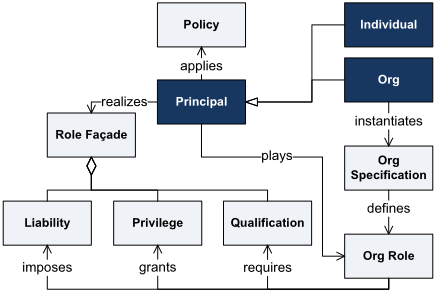
Principals collaborate within the scope of an Org of which they are members. An Org systematizes the norms among its members and potentially provides an authority to which the members may complain regarding norm violations by others. An Org may apply appropriate sanctions on its members; such sanctions typically include canceling the membership of, or further escalating a complaint against, a principal it judges malfeasant.
Orgs are finely structured through the notion of a role, which codifies a set of related interactions that a member of an Org may enact. To be a member of an Org means to play at least one role in that Org. A principal may concurrently play more than one role in the same or different Orgs. Each Org is specified by defining rules of encounter for each of its roles: we can think of these rules as forming a multiparty contract. For each role, we collect the elements that concern it directly into the role's fac¸ade. Each fac¸ade comprises three major components.
Qualification A prerequisite or eligibility requirement for a principal to play the specified role. Example: Only a credentialed and currently employed teacher may participate as an educator in a continuing education Org for school teachers.
Privilege A liberty, broadly understood, accorded to a principal who plays the specified role. Example: A teacher admitted as an educator to a summer camp Org is authorized to access all camp datasets and is empowered to admit a student as a pupil in the camp.
Liability A demand imposed on a principal who plays the specified role. Example: A teacher who becomes an educator must entertain help requests from a student who is a pupil. A pupil who introduces a virus into the camp's computers risks sanctions, including expulsion.
Importantly, privileges and liabilities map to the normative relationships that the principals enter into, some of which accord liberties and some of which impose demands on the principal who adopts the specified role. Adopting a role in an Org is thus a path for a principal to enter into norms with other principals. Although principals may negotiate additional norms through negotiation, such norms are governed by the Org. For example, a teacher as an educator gains access to datasets but not to instruments. To use an instrument owned by a scientist, a teacher may agree on additional terms and conditions, such as that he would not reboot the instrument. Such agreements would arise in the scope of the same Org, and their violation could have consequences such as the imposition of sanctions based on the educator fac¸ade.
The model of Figure 1 posits that an Org is a principal and can thus play a role in another Org. We further posit that an Org qua principal may interact with, and enter into norms with, its own members. For example, when researcher Ryzard joins OOI, not only is he subject to OOI's norms but he may also expect OOI to keep his private information safe. We capture the above intuition by postulating a distinct self role for each Org to be played by exactly one principal, the Org itself, and to be instantiated along with the Org. An Org as self interacts with all its members, handles their requests to discover other members and resources, entertains their complaints about each other, adjudicates on the norms between them, and enforces any applicable sanctions upon them.
2.2 Normative Concepts
Based on an analysis of STSs, we postulate the following normative concepts as the key elements of a role fac¸ade. We expect their familiarity to people would facilitate eliciting requirements and explaining how principals interact.
A norm codifies desired properties of interactions among principals: it captures how an interaction ought to proceed and thus regulates the interactions of the principals involved. By providing a rich set of constructs with which to express the norms, we enable encoding the essential properties of interactions in a manner that is flexible (any enactment that satisfies the norms is acceptable) yet rigorous (there is a precise computational notion of when a norm is violated). The flexibility helps ensure correctness while supporting adaptation in configuration (to accommodate changes in stakeholder requirements) and during enactment by the principals. The norms progress because of the principals' interactions and may be activated, satisfied, or violated as an enactment proceeds. A snapshot of the norms taken together constitutes the social state of the STS, in Baldoni et al.'s [2010] terminology.
Each norm involves a subject (the principal on whom the norm is focused), an object (the principal with respect to whom the norm arises), a context (the Org within whose scope the norm arises), an antecedent (expressing the conditions under which the norm is fully activated and brought into force), and a consequent (expressing the conditions under which the norm is fully satisfied and deactivated). An antecedent of true indicates an unconditional norm. Further, the context could be distinct from or the same as the subject or the object, whereas the subject and object are always distinct.
The norm representation enhances modularity by supporting patterns over norms that have interrelated conditions or where one norm references whether another norm is satisfied, violated, and so on. Examples of these are reciprocal commitments and sanctions for violations of prohibitions. By placing norms in an organizational context and supporting their manipulation, we combine the benefits of (1) a precise declarative characterization of social state with (2) a clear statement of institutional actions. We consider five types of norms.
Commitment The subject (i.e., debtor) commits to the object (i.e., creditor) that if the antecedent holds, the debtor will bring about the consequent [Singh et al., 2009]. When the consequent holds, the commitment is satisfied and deactivated. Example: A researcher who borrows an instrument commits to returning it within one hour of being requested to do so.
Authorization The object authorizes (i.e., permits) the subject to bring about the consequent when the antecedent holds. Bringing about the consequent if the antecedent is false is a violation. Example: An instrument owner authorizes a colleague to use it between 7:00PM and 9:00PM today.
Prohibition The object prohibits (i.e., forbids) the subject from bringing about the consequent provided the antecedent holds. Bringing about the consequent if the antecedent holds is a violation. Examples: An instrument owner prohibits a borrower from changing the firmware on the instrument. A dataset curator prohibits a reader from publishing any of the data on an external web site.
Sanction The object would sanction the subject by bringing about the consequent provided the antecedent holds. Examples: An instrument owner sanctions a borrower who illicitly changes the firmware on a borrowed instrument by giving the borrower a poor rating. A dataset curator sanctions a reader who publishes any of the data externally by complaining to the relevant resource sharing Org. The Org sanctions a reader who publishes any of the data externally by ejecting him from the Org.
Power The object empowers the subject to bring about the consequent by bringing about the antecedent. A power is the ability to alter the norms between two or more principals [Hohfeld, 1919], usually those playing specific roles. In addition, a power exemplifies the counts-as relation between a low-level (physical) ability and a highlevel (institutional) action [Jones and Sergot, 1996]. In our setting, each physical action is a communication: thus when the antecedent holds, the subject need only "say so" to bring about the consequent. A principal may be empowered to do something while being prohibited from exercising that power. Examples: The Chesapeake Bay Org is empowered to admit or eject its members by declaring so. A system administrator is empowered to admit new people into OOI by creating their accounts, but is-crucially-prohibited from creating accounts (and thus effectively admitting members) without approval from the membership department. However, because the administrator has the power, her creation of a new account succeeds, though it might later be deemed illicit and revoked and the administrator sanctioned for exercising the power illicitly. Here, the power is misused and the prohibition is violated.
A commitment, prohibition, or sanction is a liability for its subject since it can only lead to the subject investing effort or having its freedom curtailed or suffering a penalty. In the same spirit, an authorization or a power is a privilege for its subject since the subject obtains an option to perform additional actions without being required to do so. Liability and privilege are two faces of the same coin: a norm that is a liability for its subject is a privilege for its object and vice versa. Qualifications do not feature as privileges or liabilities because they are formed of credentials of the principals, such as their participation in specified Orgs in specified roles.
An STS is inherently open in that its autonomous participants have an external existence. No Org can regiment all the actions of its participants. In general, a principal ought to perform only those actions for which it is authorized and not prohibited. We adopt the following "organizational design" pattern. Authorizations apply exclusively to interactions that are architecturally regimented and never occur unless authorized. Prohibitions apply exclusively to interactions that are socially regulated: a principal can perform a prohibited action but may invite sanctions by doing so.
2.3 OngoingWork: Norms for Cybersecurity
Although the conception of Orgs and norms introduced above has broad applicability, we particularly focus on cybersecurity as an ideal setting for the exploration of normative concepts [Singh, 2015]. Of the challenges in cybersecurity, some of the most insidious ones arise in how people interact with each other and how their actions undermine security by creating and exploiting vulnerabilities through careless or malicious behavior. Such actions can arise in how software modules are developed and maintained and how inadequate governance in the social architecture leads to vulnerabilities by letting users acquire privileges they should not hold and providing insufficient incentives for good behavior or ineffective sanctions for bad behavior. The proposed approach can help in dealing with the challenges of human behavior and secure collaboration [Williams et al., 2015], in particular.
One ongoing theme is a normative approach for accountability that captures accountability as a relationship between autonomous parties: the first is accountable to the second and the second has standing to hold the first accountable. Current approaches, e.g., [Haeberlen, 2010], confuse accountability with traceability, which is merely a possible mechanism for enforcement. For example, if Alice and Bob perform some actions in the reverse of some desired order (Alice goes first), we would not be able to determine who is accountable for violating the ordering requirement. It could be that Alice was late or that Bob was early, or both. Perfect traceability would not solve this problem because the performance of the actions is not contested.
Given scenarios such as the above, it is important to show how the social state of an STS can be captured in information stores and queried as the participants enact their interactions. For commitments, Chopra and Singh [2015] propose an approach, Cupid, that maps commitment specifications to the relational algebra. Cupid relates the specification and progress of commitments to underlying events. In essence, the social state can be computed from event logs. Although Cupid's language is limited (e.g., it does not support aggregation), with greater expressiveness and coverage of other types of norms, such an approach could be used to help capture and improve accountability in an STS.
Another ongoing direction is the study of norms related to security-related actions, such as keeping one's computer up to date with patches and antivirus software [Du et al., 2015]. How can such norms emerge in an organization? And, given different forms of monitoring and sanctioning, how effectively can an organization maintain a secure state while enabling its members to progress efficiently on their main (nonsecurity) tasks? If some members violate these norms, how difficult is it for an adversary to compromise the organization and how easily does it revert to its ideal functioning state?
2.4 Directions for FutureWork
We need rich methodologies for building STSs that accommodate stakeholders' goals [Bresciani et al., 2004]. Chopra et al. [2014] propose a design process for STSs that produces a normative specification (just commitments, in their case). Challenges include (1) developing systematic approaches for handling conflicts among stakeholders while eliciting norms and (2) handling conflicts among principals while enacting an STS: a well-designed Org should handle these, but how?
How can a principal decide whether to participate in an Org? In one approach, a principal would compute the utility derived from participation including the risk-to be determined from the norms defined in an Org and the enforcement and conflict adjudication that Org offers.
How can we verify if a set of norms is consistent, whether for one role (at design time) or for multiple roles (at time of adoption)? How can we author policies and verify them with respect to norms? A related challenge is model checking an operational description such as a sequence diagram to determine whether it supports specified norms, as Telang and Singh [2012] do for commitments.
Acknowledgments
The original work was partially supported by NSF contracts OCE-0957938 and OCE-0964093. This extended abstract and the work on cybersecurity are supported by the US Department of Defense through a Science of Security Lablet.
@inproceedings{ijcai2015p597,
  title     = {Norms as a Basis for Governing Sociotechnical Systems: Extended Abstract},
  author    = {Singh, Munindar P.},
  booktitle = {Proceedings of the Twenty-Fourth International Joint Conference on
               Artificial Intelligence, {IJCAI-15}},
  publisher = {International Joint Conferences on Artificial Intelligence},
  editor    = {Qiang Yang and Michael Wooldridge},
  pages     = {4207--4210},
  year      = {2015},
  month     = {7},
  note      = {Journal Track},
  url       = {https://ijcai.org/proceedings/2015/597},
}
TY - CPAPER TI - Norms as a Basis for Governing Sociotechnical Systems: Extended Abstract AU - Singh, Munindar P. T2 - Proceedings of the Twenty-Fourth International Joint Conference on Artificial Intelligence, IJCAI-15 PB - International Joint Conferences on Artificial Intelligence PY - 2015 SP - 4207 EP - 4210 UR - https://ijcai.org/proceedings/2015/597 ER -Copied
Machine-readable versions of this paper, for tools and AI agents:





