
Modelling the Persuadee in Asymmetric Argumentation Dialogues for Persuasion
Proceedings of the Twenty-Fourth International Joint Conference on Artificial Intelligence. Special Track on Knowledge Representation and Reasoning. Pages 3055-3060.
© 2015 International Joint Conferences on Artificial Intelligence
Abstract
Computational models of argument could play a valuable role in persuasion technologies for behaviour change (e.g. persuading a user to eat a more healthy diet, or to drink less, or to take more exercise, or to study more conscientiously, etc). For this, the system (the persuader) could present arguments to convince the user (the persuadee). In this paper, we consider asymmetric dialogues where only the system presents arguments, and the system maintains a model of the user to determine the best choice of arguments to present (including counterarguments to key arguments believed to be held by the user). The focus of the paper is on the user model, including how we update it as the dialogue progresses, and how we use it to make optimal choices for dialogue moves.
- [Amgoud and Cayrol, 2002] L Amgoud and C Cayrol. A reasoning model based on the production of acceptable arguments. Annals of Mathematics and Artificial Intelli- gence, 34:197-216, 2002.
- [Baroni et al., 2014] P. Baroni, M. Giacomin, and P. Vicig. On rationality conditions for epistemic probabilities in ab- stract argumentation. In Computational Models of Argu- ment (COMMA'14), pages 121-132, 2014.
- [Caminada and Podlaszewski, 2012] M. Caminada and M. Podlaszewski. Grounded semantics as persua- sion dialogue. In Computational Models of Argument (COMMA'12), pages 478-485, 2012.
- [Cerutti et al., 2014] F. Cerutti, N. Tintarev, and N. Oren. Formal arguments, preferences, and natural language in- terfaces to humans: An empirical evaluation. In Proceed- ings of ECAI, pages 207-212, 2014.
- [Dung, 1995] P. Dung. On the acceptability of arguments and its fundamental role in nonmonotonic reasoning, logic programming, and n-person games. Artificial Intelligence, 77:321-357, 1995.
- [Fan and Toni, 2011] X. Fan and F. Toni. Assumption-based argumentation dialogues. In Proceedings of International Joint Conference on Artificial Intelligence (IJCAI'11), pages 198-203, 2011. IJCAI
- [Fan and Toni, 2012] X Fan and F Toni. Mechanism design for argumentation-based persuasion. In Computational Models of Argument (COMMA'12), pages 322-333, 2012.
- [Fogg, 1998] B. Fogg. Persuasive computers. In Proceedings of the SIGCHI Conference on Human Factors in Comput- ings Systems, pages 225-232. CHI, 1998.
- [Hadjinikolis et al., 2013] C. Hadjinikolis, Y. Siantos, S. Modgil, E. Black, and P. McBurney. Opponent mod- elling in persuasion dialogues. In Proceedings of IJCAI, pages 164-170, 2013. IJCAI
- [Hunter and Thimm, 2014a] A. Hunter and M. Thimm. Probabilistic argument graphs for argumentation lotteries. In Computational Models of Argument, pages 313-324, 2014.
- [Hunter and Thimm, 2014b] A. Hunter and M. Thimm. Probabilistic argumentation with incomplete information. In Proceedings of ECAI, pages 1033-1034, 2014.
- [Hunter, 2012] A. Hunter. Some foundations for proba- bilistic argumentation. In Proceedings of the Interna- tional Comference on Computational Models of Argument (COMMA'12), pages 117-128, 2012.
- [Hunter, 2013] A. Hunter. A probabilistic approach to mod- elling uncertain logical arguments. International Journal of Approximate Reasoning, 54(1):47-81, 2013.
- [Hunter, 2014] A. Hunter. Opportunities for argument- centric persuasion in behaviour change. In Proceedings of the 14th European Conference on Logics in Artificial In- telligence (JELIA'14), volume 8761, pages 48-151, 2014.
- [Li et al., 2011] H. Li, N. Oren, and T. Norman. Probabilistic argumentation frameworks. In Proceedings of the First International Workshop on the Theory and Applications of Formal Argumentation (TAFA'11), pages 1-16, 2011.
- [Matt and Toni, 2008] P. Matt and F. Toni. A game-theoretic measure of argument strength for abstract argumentation. In Logics in A.I., vol. 5293 of LNCS, pages 285-297, 2008.
- [Oren and Norman, 2009] N. Oren and T. Norman. Arguing using opponent models. In Argumentation in Multi-agent Systems, volume 6057 of LNCS, pages 160-174, 2009.
- [Oren et al., 2012] N. Oren, K. Atkinson, and H. Li. Group persuasion through uncertain audience modelling. In Com- putational Models of Argument (COMMA'12), pages 350- 357, 2012.
- J. Paris. The Uncertain Reasoner's Compan- ion: A Methematical Perspective. Cambridge University Press, 1994.
- [Prakken, 2005] H. Prakken. Coherence and flexibility in di- alogue games for argumentation. Journal of Logic and Computation, 15(6):1009-1040, 2005.
- [Prakken, 2006] H. Prakken. Formal sytems for persuasion dialogue. Knowledge Engineering Review, 21(2):163- 188, 2006.
- [Rahwan and Larson, 2008a] I. Rahwan and K. Larson. Mechanism design for abstract argumentation. In Proceed- ings of AAMAS, pages 1031-1038, 2008.
- [Rahwan and Larson, 2008b] I. Rahwan and K. Larson. Pareto optimality in abstract argumentation. In Proceed- ings of AAAI, pages 150-155. AAAI Press, 2008.
- [Rahwan et al., 2010] I. Rahwan, M. Madakkatel, J. Bonne- fon, R. Awan, and S. Abdallah. Behavioural experiments for assessing the abstract argumentation semantics of rein- statement. Cognitive Science, 34(8):14831502, 2010.
- [Rienstra et al., 2013] T. Rienstra, M. Thimm, and N. Oren. Opponent models with uncertainty for strategic argumen- tation. In Proceedings of IJCAI'13, pages 332-338. IJ- CAI/AAAI, 2013. IJCAI
- [Riveret et al., 2008] R. Riveret, H. Prakken, A. Rotolo, and G. Sartor. Heuristics in argumentation: A game theory in- vestigation. In Computational Models of Argument, pages 324-335. IOS Press, 2008.
- [Rosenfeld and Kraus, 2015] A. Rosenfeld and S. Kraus. Providing arguments in discussions based on the predic- tion of human argumentative behavior. In Proceedings of AAAI'15, 2015.
- [Thimm, 2012] M. Thimm. A probabilistic semantics for abstract argumentation. In Proceedings of the European Conference on Artificial Intelligence (ECAI'12), pages 750-755, 2012.
- [Thimm, 2014] M. Thimm. Strategic argumentation in multi-agent systems. Kunstliche Intelligenz, 28(3):159- 168, 2014.
References were extracted automatically from the PDF and may contain errors.
Full text extracted automatically from the PDF; figures, tables and equations may differ. The PDF is the version of record.
1 Introduction
Persuasion is an activity that involves one party trying to induce another party to believe something or to do something. It is an important and multifaceted human facility. Persuasion technologies [Fogg, 1998] are being developed with an emphasis on building systems to help people make positive changes to their behaviour, particularly for healthcare and healthy life styles. Interestingly, argumentation is not central to the current manifestations of persuasion technologies [Hunter, 2014]. Rather there is an emphasis on either helping users to explore their issues (e.g. game playing) or helping users once they are persuaded to do something (e.g. diaries for recording calorie intake for weight management).
To address the lack of explicit argumentation in persuasion technologies, we propose a framework for argumentation dialogues. A system (the persuader running for example as an app) enters into a dialogue with a user (the persuadee using the app) to persuade them to believe an argument (for some action such as eating some fruit, or for not doing some action such as texting while driving, etc).
A key challenge for building a dialogical argumentation system is getting arguments from the user as we are unable (in the short term) to build a system to automatically understand natural language arguments from the user. Our solution to this problem is to have asymmetric dialogues where the kinds of move available to the system are different to those available to the user. In this paper, we allow the system to posit arguments but the user is unable to posit arguments.
Example 1. The system moves are starred: (1*) You believe that a cup cake is preferable to a banana? (2) Yes. (3*) It is late afternoon, and you think a cup cake will give you a sugar rush to help you work? (4) Yes. (5*) The sugar rush from a cup cake is brief, and therefore it won't help you work. (6*) A banana gives a longer lasting energy supply, and so a banana is preferable to a cup cake.
Using asymmetric dialogues creates a challenge for the system to choose appropriate arguments to present in order to maximize the likelihood that the system is successful in persuading the user. To address this, the system uses a model of the user. In this paper, we investigate a probabilistic user model, including how the system updates the model at each step of the dialogue, how it uses the model to choose moves, and how it can query the user to improve the model.
2 Asymmetric dialogues
We base our paper on abstract argumentation [Dung, 1995]. We assume our dialogues concern an argument graph G without self-attacks where Args(G) is the set of arguments in G, and Attacks(G) is the set of attack relations in G.
We focus on the following kinds of move in this paper: (1) Posit of an argument A by the system, denoted A!; (2) Query by the system to the user about an argument, denoted A?; (3) Reply by the user of yes (denoted Y ) or no (denoted N) to a query; And (4) termination of the dialogue by the system (denoted ⊥).
A dialogue is a sequence of moves D = [m1, . . . ,mk]. Equivalently, we use D as a function with an index position i to return the move at that index (i.e. D(i) = mi). We impose the following constraints on the dialogues in this paper.
- if 1 ≤ i < k, then D(i) ̸= ⊥.
- if 1 ≤ i < k, then D(i) = A? iff D(i +1) ∈ {Y,N}.
So a query in a dialogue is followed by the user answering, and a dialogue does not continue after the system has terminated. An example of a terminated dialogue is [A!,B!,⊥] and examples of unterminated dialogues are [A!,C!,D!,A!,C!,D!,A!] and [A?, Y,B?,N]. Any unterminated dialogue may be extended by adding further moves, and it may be terminated by adding ⊥. A dialogue may be infinite, but in this paper, we focus on finite dialogues.

For a dialogue D = [m1, . . . ,mk], let Length(D) = k and let Set(D) = {m1, . . . ,mk}. For dialogues D′ and D, the subsequence relation, denoted D′ ⊑ D, holds iff for all i′ , j ′ ∈ {1, . . . , Length(D′ )}, if i′ < j ′ then there are i, j ∈ {1, . . . , Length(D)} such that i < j and D′ (i′ ) = D(i) and D′ (j ′ ) = D(j). For example, [B!,D!] ⊑ [A!, B!, C!, D!, E!].
3 Probabilistic user models
We use epistemic probabilities [Thimm, 2012; Hunter, 2013; Hunter and Thimm, 2014b; Baroni et al., 2014].
Definition 1. A mass distribution P over Args(G) is such that ∑X⊆Args(G) P(X) = 1. The probability of an argument A is P (A) = ∑X⊆Args(G) s.t. A∈X P (X).
For a mass distribution P, and A ∈ Args(G), P(A) is the belief that an agent has in A (i.e. the degree to which the agent believes the premises and the conclusion drawn from those premises). When P(A) > 0.5, then the agent believes the argument to some degree, whereas when P(A) < 0.5, then the agent disbelieves the argument to some degree.
We may wish to impose rationality (defined below) on our mass distributions [Hunter, 2013]. It forces the mass distribution to respect the structure of the graph, but it does not force an unattacked argument to be believed.
Definition 2. A mass distribution P is rational for G iff ∀(A, B) ∈ Attacks(G), if P(A) > 0.5, then P(B) ≤ 0.5.
Example 2. Consider Figure 1. Mass distribution P1(A) = 0.6, P1(B) = 0.9, and P1(C) = 0.9 is not rational, whereas P2(A) = 0.6, P2(B) = 0.3, and P2(C) = 0.9 is rational, and P3(A) = 0, P3(B) = 1, and P3(C) = 0.3 is rational.
In this paper, the system uses a mass distribution P as a model of the user, and so the systemmaintains P to represent the belief that the user has in each argument. The system can update the model at each stage of the dialogue depending on the move. We investigate how this can be done in the rest of the paper. Next is a non-exhaustive list of optional dynamic properties for when a mass Pi-1 is updated to mass Pi.
- (Credulous) If D(i) = A!, then Pi(A) ≥ 0.5.
- (Minimal) If D(i) ̸= A!, then Pi(A) = Pi-1(A).
- (Rational+) For G, if Pi-1 is rational, then Pi is rational.
- (Binary) If Pi-1(A) ̸= Pi(A), then Pi(A) ∈ {0, 1}.
- (Restricted) If Pi-1(A) ≤ 0.5, and Pi(A) > 0.5, and (B, A) ∈ Attacks(G), then Pi-1(B) ≤ 0.5.
These properties capture assumptions about the user, and we explain them as follows: (Credulous) A persuadee always believes an argument when it is posited by the persuader; (Minimal) A persuadee does not change belief in an argument that is unposited; (Rational) A rational distribution is only updated to a rational distribution; (Binary) Any update to belief in an argument is binary; (Restricted) Belief in an argument is only updated when the attackers of it are disbelieved.
The epistemic approach is useful for asymmetric dialogues where the user is not allowed to posit arguments or counterarguments. So the only way the user can treat arguments that s/he does not accept is by disbelieving them. In contrast, in symmetric dialogues, the user could be allowed to posit counterarguments to an argument that s/he does not accept. For example, suppose the user believes A, and the system posits B where B attacks A, then the user may disbelieve B and continue to believe A, and this could be modelled by a rational mass distribution.
4 Persuasion goals
A persuasion goal is a Boolean combination of arguments. If A ∈ Arg(G), then A is a positive literal, and ¬A is a negative literal. Let Formulae(G) denote all the formulae that can be formed from the arguments in G using ∧, ∨, and ¬ as connectives in the usual way.
Informally, for an argument A, the goal A means that the persuader aims to persuade the persuadee to accept A, and the goal ¬A means that the persuader aims to persuade the persuadee to not accept A. The goal A ∧ B means that the persuader aims to persuade the persuadee to accept A and to accept B, and the goal A∨B means that the persuader aims to persuade the persuadee to accept A or to accept B.
In order to formalize the satisfaction of persuasion goals, we treat each subset of Args(G) as a model.
Definition 3. The satisfaction relation is defined as follows where X ⊆ Args(G), A ∈ Args(G), and α, β ∈ Formulae(G).
- X |= A when A ∈ X
- X |= α ∧ β iff X |= α and X |= β
- X |= α ∨ β iff X |= α or X |= β
- X |= ¬α iff X ̸|= α
Essentially |= is a classical satisfaction relation. So if α is a classical tautology, then X |= α for all X ⊆ Args(G), and if α is a classical contradiction, then X ̸|= α for all X ⊆ Args(G). For α ∈ Formulae(G), let Models(α) = {X ⊆ Args(G) | X |= α}.
For each graph G, we assume an ordering over the arguments A1, ..., An so that we can encode each model by a binary number: For a model X, if the ith argument is in X, then the ith digit is 1, otherwise it is 0. For example, for A,B,C, the model {A, C} is represented by 101.
For a user model P, the probability that a user believes a persuasion goal φ is the sum of the probability of each model that satisfies the goal. This definition (below) is adapted from [Paris, 1994] where a probability distribution is defined over models of a propositional language.
Definition 4. The probability of the goal φ ∈ Formulae(G) is P(φ) = ∑X⊆Args(G) s.t. X|=φ P(X).
Suppose α ∈ Formulae(G) and P is a mass distribution. If α is a contradiction of classical logic, then P(α) = 0, and if
| AB | P | H1A(P) | H1¬A(P) | H0.75 A (P) | H1B (P) |
| 11 | 0.6 | 0.7 | 0.0 | 0.675 | 0.8 |
| 10 | 0.2 | 0.3 | 0.0 | 0.275 | 0.0 |
| 01 | 0.1 | 0.0 | 0.7 | 0.025 | 0.2 |
| 00 | 0.1 | 0.0 | 0.3 | 0.025 | 0.0 |
α is a tautology of classical logic, then P(α) = 1. Also, if {α} ⊢ β, then P(α) ≤ P(β), and if ¬(α ∧ β) is a classical tautology, then P (α ∨ β) = P (α) + P (β).
We will use persuasion goals as outcomes in a lottery. For this, we need the following subsidiary definitions. Persuasion goals φ and ψ are disjoint iff Models(φ) ∩ Models(ψ) = ∅. A set of persuasion goals Φ is pairwise disjoint iff for each φ, ψ ∈ Φ are disjoint. A set of persuasion goals Φ is exhaustive iff ⋃φ∈Φ Models(φ) = Args(G).
Example 3. Let Args(G) = {A,B,C}. Consider the persuasion goals Φ = {φ1, φ2, φ3} where φ1 = A ∧ B ∧ ¬C, φ2 = ((A∧¬B)∨(¬A∧B))∧¬C, and φ3 = (¬A∧¬B)∨C. Since Models(φ1) = {110}, Models(φ2) = {100, 010}, and Models(φ3) = {111, 101, 011, 001, 000}. Hence, Φ is pairwise disjoint and exhaustive.
Proposition 1. If Φ = {φ1, . . . , φn} is a set of persuasion goals such that Φ is exhaustive and pairwise disjoint, then P(φ1 ∨ . . . ∨ φn) = 1.
For a persuasion goal φ, and a mass distribution P (i.e. the user model), P(φ) is the probability that φ is believed. If P(φ) is low at the start of the dialogue, then the system aims to terminate the dialogue with P(φ) > 0.5 (i.e. according to the user model, the user believes φ).
5 Redistributing mass
To update a user model during a dialogue, we need to redistribute mass. A mass redistribution function takes a probability distribution and formula α, and returns a revised probability distribution. There are many possibilities for this. In this paper, we focus on refinement which redistributes mass from models not satisfying α to models satisfying α.
Definition 5. Let α ∈ Formulae(G) be a literal, let P be a mass distribution, and let k ∈ [0, 1]. A refinement function, denoted Hkα (P), returns the mass distribution P ′ as follows where X ∈ Models(G)
and where hα(X) = X \ {A} when α is of the form A and hα(X) = X ∪ {A} when α is of the form ¬A.
See Table 1 for examples of redistribution. For redistribution, hα returns the model closest to X but with α no longer satisfied. If k = 1, then all the mass is transferred from the models not satisfying α to models satisfying α. If k < 1, then only a proportion is transferred. We use k < 1 in the next section to give finer grained modelling of users.
For each α, we can partition Models(G) into the set of models that satisfy α, i.e. Sat(α) = {X ∈ Models(G) | X |=
α}, and the set of models that do not satisfy α, i.e. Unsat(α) = {X ∈ Models(G) | X ̸|= α}.
Proposition 2. For each α ∈ Formulae(G), the function hα is a bijection from Sat(α) to Unsat(α).
Proposition 3. If α ∈ Formulae(G), and k = 0, and Hkα (P) = P ′ , then P = P ′ .
Proposition 4. If α ∈ Formulae(G), H1α(H1α(P)) = H1α(P ).
Proposition 5. If A ∈ Args(G), P(A) = 1 iff H1A(P) = P. Proposition 6. Let Args(G) = {A1, . . . ,An}. If H1A1 (. . .H1An (P)..) = P ′ , then there is a model X ∈ Models(G) such that X = {A1, . . . , An} and P(X) = 1.
Note, the refinement update is not reversible. In other words, given an update Hkα , there is no k′ and β such that Hk′ β (Hkα (P)) = P. We illustrate this in the next example.
Example 4. Consider P3 in the table. From P3, we can identify many distributions P such that H1A(P) = P3. We give two distributions P1 and P2, such that H1A(P1) = P3 and H1A(P2) = P3. So knowing α and k is insufficient to identify β and k′ such that Hk′ β (Hkα (P)) = P holds.
| AB | hA | P1 | P2 | P3 |
| 11 | 01 | 0.4 | 0.25 | 0.5 |
| 10 | 00 | 0.1 | 0.25 | 0.5 |
| 01 | 01 | 0.1 | 0.25 | 0 |
| 00 | 00 | 0.4 | 0.25 | 0 |
The following property shows that the only argument with a changed assignment is the one being explicitly updated where Atom(A) = A and Atom(¬A) = A for A ∈ Args(G). Proposition 7. For literal α ∈ Formulae(G), & k ∈ [0, 1], let Hkα (P) = P ′ . If B ̸= Atom(α), then P ′ (B) = P(B).
Refinement is associative for multiple updates as shown in the following result.
Proposition 8. If α, β are literals, s.t. α is not the complement of β (i.e. α ̸⊢ ¬β), and P is a mass distribution, and k, k′ ∈ [0, 1], then Hkα (Hk′ β (P)) =Hk′ β (Hkα (P)).
Next, we introduce notation for a set of updates Φ.
Definition 6. Let Φ ⊆ Formulae(G) be a set of literals, let P be a mass distribution, and let k ∈ [0, 1]. A compound refinement function, denoted HkΦ, is defined as follows: (1) HkΦ(P) = P when Φ = ∅; and (2) HkΦ(P) = Hkα (HkΦ′ (P)) when Φ′ = Φ \ {α} for some α ∈ Φ.
Because of its useful properties, we use the refinement function for updating user models in the next section.
6 Updating user models
Given a mass distribution P, representing a user's beliefs at the current state of the dialogue, we want to update the model depending on the move made. For this, we introduce the notion of an update method which generates a mass distribution Pi from Pi-1 based on the move D(i). Each method is defined as a rule with a condition (defined in terms of the current state of the dialogue, the current mass distribution, and the structure of the graph), and a consequent that specifies the redistribution.
Definition 7. For step i in the dialogue, the naive method generates Pi from Pi-1 as follows.
Example 5. For Figure 1 with dialogue [A!,B!,⊥] and the naive method. Let the initial mass be P0(011) = 0.3, P0(010) = 0.2, P0(001) = 0.3, & P0(000) = 0.2. After A!, P1(111) = 0.3, P1(110) = 0.2, P1(101) = 0.3, & P1(100) = 0.2. After B!, P2(111) = 0.6, & P2(110) = 0.4. Note, P2 is not rational.
The naive method fails the rational+ property. The trusting method (defined next) satisfies the rational+ property by lowering belief in attackers and attackees of the posit.
Definition 8. For step i in the dialogue, the trusting method generates Pi from Pi-1 as follows, where Φ = {¬C | (A, C) ∈ Attacks(G) or (C, A) ∈ Attacks(G)}.
Example 6. Consider Figure 1 with dialogue [A!,⊥] and the trusting method. Let the initial mass be P0(011) = 0.3, P0(010) = 0.2, P0(001) = 0.3, & P0(000) = 0.2. After A!, P1(101) = 0.6, & P1(100) = 0.4.
The strict method (defined next) only allows a posit to update the belief to 1 when there is no attacker of the posit that is believed.
Definition 9. For step i in the dialogue, the strict method generates Pi from Pi-1 as follows, where Φ = {¬C | (A, C) ∈ Attacks(G)}.
If D(i) = A!, and for all (B, A) ∈ Attacks(G), Pi-1(B) ≤ 0.5, then Pi = H1Φ(H1A(Pi-1)), else Pi = Pi-1
Example 7. Consider Figure 1 with dialogue [A!, C!, A!, ⊥] and the strict method. Let the initial mass be P0(111) = 0.2, P0(110) = 0.3, P0(011) = 0.3, & P0(010) = 0.2. After A!, P1(111) = 0.2, P1(110) = 0.3, P1(011) = 0.3, & P1(010) = 0.2. After C!, P2(101) = 0.5, & P2(001) = 0.5. After A!, P3(101) = 1.0.
The ambivalent method is motivated by the idea that people do not entirely believe what they are told (unless corroborated), and as shown in [Rahwan et al., 2010] they do not entirely disbelieve an argument when defeated.
Definition 10. For step i in the dialogue, the ambivalent method generates Pi from Pi-1 as follows, where Φ = {¬C | (C, A) ∈ Attacks(G)}.
Example 8. Consider Figure 1 with the dialogue [C!,A!,⊥] with the ambivalent method. Let the initial mass be P0(111) = P0(110) = P0(011) = P0(010) = 1/4. After C!, P1(111) = 7/64, P1(101) = 21/64, P1(110) = 1/64, P1(100) = 3/64, P1(011) = 7/64, P1(001) = 21/64 P1(010) = 1/64 & P1(000) = 3/64. After A!, P2(111) = 49/256, P2(101) = 147/256, P0(110) = 7/256, P2(100) = 21/256, P0(011) = 7/256, P2(001) = 21/256 P0(010) = 1/256 & P2(000) = 3/256. Hence, at the dialogue termination, P2(A) = 224/256, P2(B) = 64/256, and P2(C) = 224/256.
| Naive | Trusting | Strict | Ambivalent | |
|---|---|---|---|---|
| Credulous | ✓ | ✓ | × | × |
| Minimal | ✓ | × | × | × |
| Rational+ | × | ✓ | ✓ | ✓ |
| Binary | ✓ | ✓ | ✓ | × |
| Restricted | × | × | ✓ | ✓ |
Proposition 9. If P is a mass distribution, and P ′ is generated from P by the naive, trusting, strict or ambivalent method, then P ′ is a mass distribution.
Definition 11. Let σ be an update method (such as naive, trusting, strict, or ambivalent), let D = [m1, . . . ,mn] be a dialogue, and let [P0, P1, . . . , Pn] be a sequence of user models such that for each i ∈ {1, . . . , n}, Pi is obtained from Pi-1 by the σ update method. We call P0 the initial mass, and Pn the final mass obtained from D with respect to P0 and σ, which we denote by σ(P0, D) = Pn.
The update methods given in this section are meant to illustrate a range of methods. We give the satisfaction of dynamic properties in Table 2. Further options for update methods can use alternatives to Definition 5 or take meta-level criteria into account (e.g. preferences [Amgoud and Cayrol, 2002] and values [Oren et al., 2012]).
7 Maximizing expected utility
We start by briefly reviewing the notion of a lottery. A lottery L is a probability distribution over a set of possible outcomes. A lottery with possible outcomes π1,..,πn that are pairwise disjoint and that is exhaustive (i.e. one of them is guaranteed to occur), that occur with probabilities p1, .., pn respectively, is written as [p1, π1; ....; pn, πn]. For a utility function U, the expected utility of a lottery L is ∑ni=1 pi × U(πi).
We adapt the notion of a lottery in a straightforward way for our purposes.
Definition 12. Let D be a dialogue, let S = {φ1, . . . , φn} be a set of disjoint and exhaustive outcomes, let P0 be the initial mass, let σ be an update method, and let σ(P0, D) = P , and let U be a utility function. The lottery for P, U, S is the following:
A dialogue D is optimal with respect to an initial mass P0, update method σ, utility function U, and σ(P0, D) = P , when EU(P, U, S) is maximized.
Example 9. Let Args(G) = {A,B} and Attacks(G) = {(B, A)}. For the naive method σ(P0, D) = P where P0(11) = 0, P0(10) = 0.6, P0(01) = 0.2, P0(00) = 0.2, U(A) = 1 and U(¬A) = -1, D1, D2 and D4 are optimal.
| D | EU(P, U, S) | |
|---|---|---|
| D1 | [A!,B!,⊥] | (1 × 1) + (0 × -1) = 1 |
| D2 | [A!, ⊥] | (1 × 1) + (0 × -1) = 1 |
| D3 | [B!, ⊥] | (0.6 × 1) + (0.4 × -1) = 0.2 |
| D4 | [B!,A!,⊥] | (1 × 1) + (0 × -1) = 1 |
Proposition 10. Let σ be the naive or trusting method, A ∈ Args(G) be the persuasion goal and P0 is the initial mass. If (B,A) ∈ Attacks(G) and there is an i such that D(i) = B, then there is a D′ ⊑ D such that EU(P ′ , U, S) = EU(P, U, S) where σ(P0, D) = P and σ(P0, D′ ) = P ′ .
Given the above result, the next example only considers dialogues without positing of attackers of the goal.
Example 10. Consider Figure 1 with the persuasion goal A and the trusting method. If P0(111) = P0(110) = P0(011) = P0(010) = 0.25, then D1, D2 and D4 are optimal.
| D | EU(P, U, S) | |
|---|---|---|
| D1 | [A!,C!,⊥] | (1 × 1) + (0 × -1) = 1 |
| D2 | [A!, ⊥] | (1 × 1) + (0 × -1) = 1 |
| D3 | [C!, ⊥] | (0.5 × 1) + (0.5 × -1) = 0 |
| D4 | [C!,A!,⊥] | (1 × 1) + (0 × -1) = 1 |
The next result shows attackers cannot improve the utility of a dialogue with the strict/ambivalent methods.
Proposition 11. Let σ be the strict or ambivalent method. Let A ∈ Args(G) be the persuasion goal. If (B,A) ∈ Attacks(G) and there is an i such that D(i) = B, then there is a D′ ⊑ D such that EU(P ′ , U, S) ≥ EU(P, U, S) where σ(P0, D) = P and σ(P0, D′ ) = P ′ .
We now turn to whether repeating a move can have a benefit under any of the assumed update methods.
Definition 13. For dialogues D and D′ , D′ is a maximal non-repeating subsequence of D iff the following conditions hold: (1) D′ ⊑ D; (2) Set(D′ ) = Set(D); and (3) if D′′ ⊏ D′ , then Set(D′′ ) ̸= Set(D).
Example 11. Consider D = [A!,B!,A!,C!,D!]. There are two maximal non-repeating subsequences D1 = [A!, B!, C!, D!] and D2 = [B!, A!, C!, D!].
Proposition 12. Let P0 be the initial mass, and σ is the naive or trusting method. For all dialogues D, if D′ is a maximal non-repeating subsequence of D, and σ(P0,D) = P and σ(P0, D′ ) = P ′ , then EU(P, U, S) = EU(P ′ , U, S).
With naive and trusting methods, we can reduce a repeating sequence to a non-repeating sequence by deleting the repeated arguments. This is sufficient for the utility of the two sequences to be the same. However, with the strict and ambivalent methods, all we can ensure is that for every dialogue, there exists another dialogue that is non-repeating and with the same utility. To show this, we require the following.
Definition 14. An update tree T for A ∈ Args(G), and a mass distribution P, is the smallest tree such that
- T has a finite number of nodes and A is the root
- for each Ai at an odd level in T, if P(Aj) > 0.5, and (Aj,Ai) ∈ Attackers(G), then Aj is a child of Ai in T,
- for each Ai at an even level in T, if (Aj,Ai) ∈ Attackers(G), then Aj is a child of Ai in T,
- for each Ai at an odd level in T, there is no Aj at an odd level in T such that (Aj,Ai) ∈ Attackers(G),
and where the root is at level 1, and for each node at level i, its children are at level i + 1.
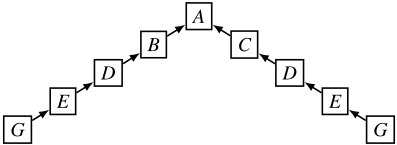
In an update tree, all the odd level arguments are disbelieved, and all the even level arguments are believed. Furthermore, we can regard the odd level arguments as "defenders" of the root argument, and the even level arguments as direct or indirect "attackers" of the root argument. When every leaf is at an odd level, then we can use this tree to design a dialogue for a successful persuasion (as illustrated in Example 12), but as we illustrate in Example 13, not every graph and mass distribution has an update tree.
Example 12. Consider the following graph where A is the persuasion goal.
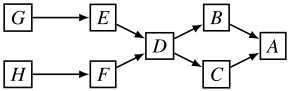
Let P(A) = 0.5, P(B) = 0.9, P(C) = 0.9, P(D) = 0.1, P(E) = 0.9, P(F) = 0.5, P(G) = 0.5, and P(H) = 0.5. For the update tree below, A, D, and G are defenders, and B, C and E are attackers. For this, the sequence G!,D!,A! will result in A being believed using the strict update method.
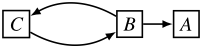
Example 13. Consider the following graph where A is the persuasion goal. Let P(A) = 0.1, P(B) = 0.9, and P(C) = 0.1. For this graph and persuasion goal, with this mass distribution, there is no update tree.
Proposition 13. If T is an update tree for A ∈ Arg(G), and mass distribution P, the set Ω = {B ∈ Args(G) | B is a node in level i and i is odd} is conflictfree (i.e. there are no arguments (B, C) ∈ Attacks(G) s.t. {B, C} ⊆ Ω).
Given an update tree, the defenders in a branch can be posited in sequence starting from the leaf. Doing this leads to the following results.
Proposition 14. For persuasion goal A ∈ Args(G), with initial mass P0, where P0(A) ≤ 0.5, there is an update tree for A and G, where every leaf is at an odd level, iff there is a dialogue D = [B1!, . . . , Bx!, ⊥] such that P(A) > 0.5, where σ is the strict or ambivalent method and σ(P0, D) = P .
Proposition 15. For any dialogue D1, there is a dialogue D2 such that D2 is non-repeating, and EU(P1,U, S) = EU(P2, U, S), where P0 is the initial mass, and σ is the strict or ambivalent method and σ(P0, D1) = P1 and σ(P0, D2) = P2 and U is the utility function.
In general, shorter dialogues are preferable to longer dialogues if we want to decrease the risk of the user disengaging (because they become bored with the dialogue). We can take this into account in the expected utility assignment by normalizing it by the length of the dialogue (e.g. by dividing EU(P, U, S) by the number of posits in D). Returning to Example 10, the revised expected utilities could be such that D1 is 0.5, D2 is 1, D3 is 0, and D4 is 0.5, and therefore, the optimal dialogue would be D2.
8 Accuracy of the user model
At each step i of the dialogue, the user model Pi is an estimate of the user's actual mass distribution ̂ Pi. This raises the question of how to compare Pi and ̂ Pi. We use the total variation distance (defined below) because of simplicity. Alternatives include the Kullback-Leiber divergence or an f-divergence.
Definition 15. The total variation distance between mass distributions Pi and Pj, denoted Distance(Pi, Pj), is 1/2 × ∑A∈Args(G) |Pi(A) - Pj (A)|.
In order to decrease the distance between the user model and the user's actual mass distribution, we can use queries. For instance, a dialogue can start with a sequence of queries before giving posits. So we have a sequence of queries/answers [Q1,R1, . . . ,Qx,Rx] where each Qi is a query and each Ri is the response by the user and is either Y or N. Note, we can use a finer grained scale for the user reply to A? (e.g. from 0 to 10 where 10 denotes completely believes A, 9 denotes strongly believes A, etc.) instead of Y and N. The user model is updated as follows.
Example 15. Consider the dialogue [A?, Y,B?,N] where Args(G) = {A,B,C}. Suppose the initial mass P0 is a uniform distribution. Then P2(111) = P2(110) = P2(101) = P2(100) = 1/4, and P4(101) = P4(100) = 1/2.
A user is categorical in dialogue D iff for all i ∈ {1, . . . , Length(D)}, if D(i) = A?, then Pi+1(A) = ̂ Pi+1(A). The following results show that querying the user when s/he is categorical improves the user model.
Proposition 16. Assume that the user is categorical in dialogue D. For each i, if D(i) = A?, then Distance(Pi, ̂ Pi) ≥ Distance(Pi+1, ̂ Pi+1)
Proposition 17. If [Q1,R1, . . . ,Qm,Rm] is the initial sequence of moves of dialogue D where each Qi is a query and each Ri is a reply, and for every A ∈ Args(G), there is a query Qi = A?, then Pm = ̂ Pm.
If queries are at no cost, then we can query the user about all arguments in the graph. However, in practice, it may be inappropriate to query the user about every argument as asking the user more than a few queries raises the risk of the user disengaging. We will investigate this trade-off in future work.
9 Comparison with the literature
There are a number of proposals that formalize aspects of persuasion. Most are aimed at providing protocols for dialogues (e.g. [Prakken, 2005; 2006; Fan and Toni, 2011;
Caminada and Podlaszewski, 2012]), but strategies for persuasion, in particular taking into account beliefs of the opponent are under-developed. See [Thimm, 2014] for a review of strategies in multi-agent argumentation.
There are a number of proposals for using probability theory in argumentation including the epistemic approach (e.g. [Thimm, 2012; Hunter, 2013]) and the constellations approach (e.g. [Li et al., 2011; Hunter, 2012]) but these do not consider dialogues.
Persuasion has been considered through uncertainty modelling of the audience [Oren et al., 2012], but this uncertainty is with respect to the structure of the graph rather than beliefs, and there is no consideration of dialogues or strategies. A probabilistic model of the opponent has been used in a dialogue strategy allowing the selection of moves for an agent based on what it believes the other agent believes [Rienstra et al., 2013]. But this assumes symmetric dialogues, and the uncertainty concerns what the opposing agent is aware of rather than what it believes. In another approach to a probabilistic opponent model, the history of previous dialogues is used to estimate the arguments that an agent might put forward [Hadjinikolis et al., 2013]. But this assumes symmetric dialogues, with a method for updating the opponent model that is of exponential complexity, and there is no consideration of how utility theory could be employed.
Utility theory has been considered previously in argumentation (for example [Rahwan and Larson, 2008b; Riveret et al., 2008; Matt and Toni, 2008; Oren and Norman, 2009]) though none of these represent the uncertainty of moves made by each agent in argumentation. There is an approach that combines probability theory and utility theory to identify outcomes with maximum expected utility where outcomes are specified as particular arguments being included or excluded from extensions [Hunter and Thimm, 2014a], but it is based on the constellations approach to uncertainty in argumentation (i.e. uncertainty about what the structure of the graph is) as opposed to the epistemic approach considered in this paper, and there is no consideration of updates to the model. Strategies in argumentation have also been analyzed using game theory [Rahwan and Larson, 2008a; Fan and Toni, 2012], though these are more concerned with issues of manipulation, rather than persuasion.
10 Discussion
In this paper, we have considered a framework for asymmetric dialogues, with a general definition for probabilistic user models, and a general definition for updating user models in terms of mass redistributions. The type of dialogue is a persuasion dialogue. However, the persuader uses the user model to determine whether the persuasion goal is believed, and so it is an indirect judgment since the persuadee has not declared whether or not they are persuaded when the dialogue has terminated. Nonetheless, the user model may be a good representative of the persuadee as it can either be generated by querying the user, or by learning from previous interactions with the user or similar users. Some recent studies indicate the potential viability of an empirical approach [Cerutti et al., 2014; Rosenfeld and Kraus, 2015].
@inproceedings{ijcai2015p431,
  title     = {Modelling the Persuadee in Asymmetric Argumentation Dialogues for Persuasion},
  author    = {Hunter, Anthony},
  booktitle = {Proceedings of the Twenty-Fourth International Joint Conference on
               Artificial Intelligence, {IJCAI-15}},
  publisher = {International Joint Conferences on Artificial Intelligence},
  editor    = {Qiang Yang and Michael Wooldridge},
  pages     = {3055--3060},
  year      = {2015},
  month     = {7},
  note      = {Special Track on Knowledge Representation and Reasoning},
  url       = {https://ijcai.org/proceedings/2015/431},
}
TY - CPAPER TI - Modelling the Persuadee in Asymmetric Argumentation Dialogues for Persuasion AU - Hunter, Anthony T2 - Proceedings of the Twenty-Fourth International Joint Conference on Artificial Intelligence, IJCAI-15 PB - International Joint Conferences on Artificial Intelligence PY - 2015 SP - 3055 EP - 3060 UR - https://ijcai.org/proceedings/2015/431 ER -Copied
Machine-readable versions of this paper, for tools and AI agents:





