
The Cube of Opposition: A Structure Underlying Many Knowledge Representation Formalisms
Proceedings of the Twenty-Fourth International Joint Conference on Artificial Intelligence. Special Track on Knowledge Representation and Reasoning. Pages 2933-2938.
© 2015 International Joint Conferences on Artificial Intelligence
Abstract
The square of opposition is a structure involving two involutive negations and relating quantified statements, invented in Aristotle time. Rediscovered in the second half of the XXth century, and advocated as being of interest for understanding conceptual structures and solving problems in paraconsistent logics, the square of opposition has been recently completed into a cube, which corresponds to the introduction of a third negation. Such a cube can be encountered in very different knowledge representation formalisms, such as modal logic, possibility theory in its all-or-nothing version, formal concept analysis, rough set theory and abstract argumentation. After restating these results in a unified perspective, the paper proposes a graded extension of the cube and shows that several qualitative, as well as quantitative formalisms, such as Sugeno integrals used in multiple criteria aggregation and qualitative decision theory, or yet belief functions and Choquet integrals, are amenable to transformations that form graded cubes of opposition. This discovery leads to a new perspective on many knowledge representation formalisms, laying bare their underlying common features. The cube of opposition exhibits fruitful parallelisms between different formalisms, which leads to highlight some missing components present in one formalism and currently absent from another.
- [Amgoud and Prade, 2012] L. Amgoud and H. Prade. Can AI models capture natural language argumentation? Int. J. Cognit. Inform. and Natural Intellig., 6(3):19-32, 2012.
- [Amgoud and Prade, 2013] L. Amgoud and H. Prade. A for- mal concept view of abstract argumentation. In Proc. 12th ECSQARU, LNCS 7958, pages 1-12. Springer, 2013.
- [Belohlavek, 2002] R. Belohlavek. Fuzzy Relational Sys- tems: Foundations and Principles. Kluwer Aca. Pu., 2002.
- [Béziau, 2003] J.-Y. Béziau. New light on the square of op- positions and its nameless corner. Logical Investigations, 10:218-233, 2003.
- [Béziau, 2012] J.-Y. Béziau. The power of the hexagon. Log- ica Universalis, 6 (1-2):1-43, 2012.
- [Blanché, 1953] R. Blanché. Sur l'opposition des concepts. Theoria, 19:89-130, 1953.
- [Blanché, 1966] R. Blanché. Structures Intellectuelles. Es- sai sur l'Organisation Systématique des Concepts. Vrin, Paris, 1966.
- [Chellas, 1980] B. F. Chellas. Modal Logic, an Introduction. Cambridge University Press, Cambridge, 1980.
- [Ciucci et al., 2014] D. Ciucci, D. Dubois, and H. Prade. The structure of oppositions in rough set theory and formal concept analysis -Toward a new bridge between the two settings. In Proc. 8th FoIKS, volume 8367 of LNCS, pages 154-173. Springer, 2014.
- [Dubois and Prade, 1986a] D. Dubois and H. Prade. A set- theoretic view of belief functions. Logical operations and approximation by fuzzy sets. Int. J. of General Systems, 12(3):193-226, 1986.
- [Dubois and Prade, 1986b] D. Dubois and H. Prade. Weighted minimum and maximum operations. An adden- dum to 'A review of fuzzy set aggregation connectives'. Information Sciences, 39:205-210, 1986.
- [Dubois and Prade, 1998] D. Dubois and H. Prade. Possibil- ity theory: Qualitative and quantitative aspects. In D. M. Gabbay and Ph. Smets, editors, Quantified Representation of Uncertainty and Imprecision, volume 1 of Handbook of Defeasible Reasoning and Uncertainty Management Sys- tems, pages 169-226. Kluwer Acad. Publ., 1998.
- [Dubois and Prade, 2012a] D. Dubois and H. Prade. From Blanché's hexagonal organization of concepts to formal concept analysis and possibility theory. Logica Univers., 6:149-169, 2012.
- [Dubois and Prade, 2012b] D. Dubois and H. Prade. Possi- bility theory and formal concept analysis: Characterizing independent sub-contexts. Fuzzy Sets and Systems, 196:4- 16, 2012.
- [Dubois et al., 2000] D. Dubois, P. Hájek, and H. Prade. Knowledge-driven versus data-driven logics. J. of Logic, Language and Information, 9(1):65-89, 2000.
- [Dubois et al., 2012] D. Dubois, H. Prade, and A. Rico. Qualitative integrals and desintegrals: How to handle posi- tive and negative scales in evaluation. In Proc. 14th IPMU, volume 299 of CCIS, pages 306-316. Springer, 2012.
- [Dubois et al., 2013] D. Dubois, E. Lorini, and H. Prade. Bipolar possibility theory as a basis for a logic of de- sires and beliefs. In Proc. 7th Int. Conf. on Scalable Un- certainty Management -SUM'13, volume 8078 of LNCS, pages 204-218. Springer, 2013.
- [Dung, 1995] Phan Minh Dung. On the acceptability of ar- guments and its fundamental role in nonmonotonic rea- soning, logic programming and n-person games. Artificial Intelligence, 77(2):321-358, 1995.
- [Dunne et al., 2011] P. E. Dunne, A. Hunter, P. McBurney, S. Parsons, and M. Wooldridge. Weighted argument sys- tems: Basic definitions, algorithms, and complexity re- sults. Artifificial Intelligence, 175(2):457-486, 2011.
- [Euler, 1768] L. Euler. Lettres cii-cviii. In Lettres à une Princesse d'Allemagne sur Divers Sujets de Physique & de Philosophie, vol. 2. 1768.
- [Faris, 1955] J. A. Faris. The Gergonne relations. J. of Sym- bolic Logic, 20 (3):207-231, 1955.
- [Ganter and Wille, 1999] B. Ganter and R. Wille. Formal Concept Analysis: Mathematical Foundations. Springer- Verlag, Berlin, Heidelberg, 1999.
- [Gergonne, 1816] J. D. Gergonne. Essai de dialectique ra- tionnelle. Annales de Mathématiques Pures et Appliquées, 7:189-228, 1816.
- [Grabisch and Labreuche, 2010] M. Grabisch and Ch. Labreuche. A decade of application of the Choquet and Sugeno integrals in multi-criteria decision aid. Annals of Oper. Res., 175:247-286, 2010.
- [Levesque, 1990] H. J. Levesque. All I know: A study in au- toepistemic logic. Artif. Intellig., 42(2-3):263-309, 1990.
- [Marquis et al., 2014] P. Marquis, O. Papini, and H. Prade. Some elements for a prehistory of artificial intelligence in the last four centuries. In Proc. 21st ECAI, pages 609-614. IOS Press, 2014.
- [Parsons, 2008] T. Parsons. The traditional square of oppo- sition. In E. N. Zalta, editor, The Stanford Encyclopedia of Philosophy. 2008.
- [Pawlak, 1991] Z. Pawlak. Rough Sets. Theoretical Aspects of Reasoning about Data. Kluwer, 1991.
- [Piaget, 1953] J. Piaget. Logic and Psychology. Manchester Univ. Press, 1953.
- [Shafer, 1976] G. Shafer. A Mathematical Theory of Evi- dence. Princeton University Press, 1976.
- [Sugeno, 1977] M. Sugeno. Fuzzy measures and fuzzy inte- grals: a survey. In M. M. Gupta, G. N. Saridis, and B. R. Gaines, editors, Fuzzy Automata and Decision Processes, pages 89-102. North-Holland, 1977.
References were extracted automatically from the PDF and may contain errors.
Full text extracted automatically from the PDF; figures, tables and equations may differ. The PDF is the version of record.
1 Introduction
One may consider that the first attempt at modeling reasoning tasks was the study of syllogisms, which started in Greek Antiquity, and was pursued across centuries, until Euler [1768] and Gergonne [1816] [Faris, 1955] provided results establishing those syllogisms that are valid, and those ones that are not on a rigorouds basis [Marquis et al., 2014]. This happened long before the advent of artificial intelligence (AI). At the same time, Aristotle and his school also introduced the square of opposition [Parsons, 2008], a device that exhibits different forms of opposition between universally or existentially quantified statements that may serve as premises of syllogisms. The oppositions in the square are the result of the interplay between an "external" negation and an "internal" negation, both being involutive. The interest for this square seems to vanish with the advent of modern logic at the end of the XIXth century. A revival of interest for opposition structures began to take place in the 1950's when a French logician, Robert Blanch´e [1953] discovered that the square could be completed into a hexagon containing three squares, which was echoing the organization of many conceptual structures, such as, e.g., mathematical comparators, or deontic modalities [Blanch´e, 1966]. This interest was confirmed later, when the square and hexagon structures were found useful for solving questions, in particular in paraconsistent modal logic [B´eziau, 2003; 2012] .
More recently, it was pointed out that a particular cubic extension of the square of opposition, involving a third negation, can be encountered in different knowledge representation formalisms used in AI, namely modal logic, possibility theory in its all-or-nothing version, formal concept analysis, rough set theory and abstract argumentation [Dubois and Prade, 2012a; Amgoud and Prade, 2013; Ciucci et al., 2014]. This state of facts is quite striking since these formalisms have been developed independently of each other, and often with the goal of addressing very different aspects or problems in knowledge representation. The expected benefits of discovering such analogies between formalisms that have different concerns, are twofold. The discovery of this cubic structure of opposition at work inside a formalism may shed new light in its understanding, and more importantly this may help discover new components, neglected so far, in a formalism, while their counterparts in another formalism are well-known and play an important role.
The square and then the cube of opposition are structures where the vertices are traditionally associated with statements which are true or false or which exhibit binary-valued modalities. In the following we shall show that it makes sense to extend the square and the cube to graded structures. Then we can envisage to study more formalisms from the cube of opposition point of view, such as (graded) possibility theory, qualitative multiple criteria aggregation operations, and more generally Sugeno integrals; or more quantitative notions such as belief functions or Choquet integrals.
The paper is organized as follows. Section 2 provides a brief refresher on the square, hexagon, and cube of opposition. In Section 3, we exhibit a basic reading of the cube in terms of set indicators, closely related to Boolean possibility theory, and we show how complementary are the different pieces of information displayed on the cube. In Section 4, another basic reading in terms of relational composition is recalled, which explains why modal logic, formal concept analysis, rough set theory and abstract argumentation are underlain by the cubic structure of opposition. Section 5 discusses how the cube naturally extends to graded structures. This is exemplified in Section 6 with multiple criteria aggregation and Sugeno integrals, and in Section 7 with belief functions and Choquet integrals.
2 Square and cube
The traditional square of opposition [Parsons, 2008] is built with universally and existentially quantified statements in the following way. Consider a statement (A) of the form "all P's are Q's", which is negated by the statement (O) "at least a P is not a Q", together with the statement (E) "no P is a Q", which is clearly in even stronger opposition to the first statement (A). These three statements, together with the negation of the last statement, namely (I) "at least a P is a Q" can be displayed on a square whose vertices are traditionally denoted by the letters A, I (affirmative half) and E, O (negative half), as pictured in Figure 1 (where Q stands for "not Q").
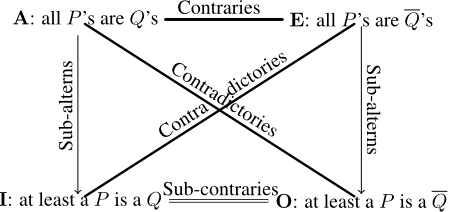
As can be checked, noticeable relations hold in the square:
- (i) A and O (resp. E and I) are the negation of each other;
- (ii) A entails I, and E entails O (it is assumed that there is at least a P for avoiding existential import problems);
- (iii) together A and E cannot be true, but may be false ;
- (iv) together I and O cannot be false, but may be true.
Blanch´e [1953; 1966] noticed that adding two vertices U and Y defined respectively as the disjunction of A and E, and as the conjunction of I and O, leads to a hexagon AUEOYI that includes 3 squares of opposition, AEOI, YAUO, YEUI each of them exhibiting the four types of relation above. Such a hexagon is obtained each time we start with 3 mutually exclusive statements, such as A, E, and Y [Dubois and Prade, 2012a]. Hexagons may be clearly of interest in AI for argumentation, rough set and formal concept analysis theories [Amgoud and Prade, 2012; Ciucci et al., 2014]. However, we leave them out of the scope of this study, due to space limitation, for focusing on another extension of the square, namely the cube of opposition.
Switching to first order logic notations, and negating the predicates, i.e., changing P into ¬P , and Q in ¬Q leads to another similar square of opposition aeoi, where we also assume that the set of "not-P's" is non-empty. Then the 8 statements, A, I, E, O, a, i, e, o may be organized in what may be called a cube of opposition [Dubois and Prade, 2012a] as in Figure 2. The front facet and the back facet of the cube are traditional squares of opposition, where the thick non-directed segment relates the contraries, the double thin non-directed segments the sub-contraries, the diagonal dotted non-directed lines the contradictories, and the vertical uni-directed segments point to subalterns, and express entailments.
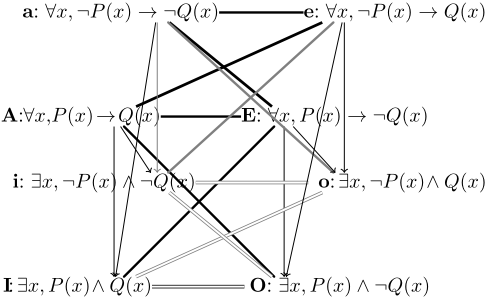
Assuming that there are at least a P's and at least a notP's entails that there are at least a Q's and at least a not-Q's. Then, we have that A entails i, a entails I, e entails O, and E entails o. Note also that vertices a and E, as well as A and e cannot be true together (e.g., having both A and e true would contradict that ∃x, ¬Q(x)), while vertices i and O, as well as I and o cannot be false together. Lastly note that there is no logical link between A and a, E and e, I and i, or O and o.
Interestingly enough, it can be checked that Piaget's group of transformations I, N, R, C [Piaget, 1953] is at work in the diagonal plans of the cube pictured in Figure 2. This group applies to any statement Φ(p, q, · · · ) mappings N(Φ(p, q, · · · )) = ¬Φ(p, q, · · · ), R(Φ(p, q, · · · )) = Φ(¬p, ¬q, · · · ), C(Φ(p, q, · · · )) = ¬Φ(¬p, ¬q, · · · ), where p, q denote literals, and I is the identity. Indeed, we have a = R(A), o = N(a), o = C(a), and N ◦ R ◦ C = I. In this view, two involutive negations are involved, an external one N, an internal one R. Still considering the initial square, the "internal" negation only pertains to Q, while a second "internal" negation pertains to P only, when moving from the square to the cube. This is made clearer with the relational view of the cube. Clearly the involution property of negation is crucial for getting the cube properties, as well as the contrapositive property of the implication.
3 The relational cube
It has been recently noticed [Ciucci et al., 2014] that any binary relation R on a Cartesian product X ×Y (one may have Y = X) gives birth to a cube of opposition, when applied to a subset. We assume R ̸= ∅. Let xR = {y ∈ Y | (x, y) ∈ R}. R denotes the complementary relation (xRy iff (x, y) ̸∈ R), and Rt the transposed relation (xRt y if and only if yRx); yRt is equivalently denoted Ry = {x ∈ X | (x, y) ∈ R}. Moreover, it is assumed that ∀x, xR ̸= ∅, which means that the relation R is serial, namely ∀x, ∃y such that (x, y) ∈ R. Similarly Rt is also supposed to be serial, i.e., ∀y, Ry ̸= ∅, as well as R and its transpose, i.e. ∀x, xR ̸= Y and ∀y, Ry ̸= X.
Let T be a subset of Y and T its complement. We assume T ̸= ∅ and T ̸= Y . The composition is defined in the usual way R(T) = {x∈X | ∃t∈T, (x, t) ∈ R}. From the relation R and the subset T , one can define the four following subsets of X (and their complements):
These 4 subsets and their complements can be nicely organized into a cube of opposition (Fig.3). It can be checked that set counterparts of the relations existing between the logical statements of the vertices of the cube in Fig. 2 still hold:
i) diagonals in front and back facets link complements ;
- ii) R(T) ⊆ R(T), R(T) ⊆ R(T), R(T) ⊆ R(T), and R(T) ⊆ R(T) as well as R(T) ⊆ R(T), R(T) ⊆ R(T), R(T)⊆R(T), and R(T)⊆R(T) thanks to the seriality hypotheses; these inclusions are pictured by arrows in Fig. 3;
- iii) R(T ) ∩R(T ) = ∅, R(T ) ∩R(T ) = ∅, R(T ) ∩R(T ) = ∅, and R(T) ∩ R(S) = ∅; these empty intersections correspond to the thick lines in Fig. 3; moreover one may have R(T ) ∪ R(T ) ̸= Y , etc.;
iv) R(T) ∪ R(T) = X, R(T) ∪ R(T) = X, R(T) ∪ R(T ) = X, and R(T ) ∪R(T ) = X; moreover one may have R(T) ∩R(T) ̸= ∅, etc.; these full unions corresponds to the double thin lines in Fig. 3.
Conditions (iii)-(iv) hold also thanks to seriality.
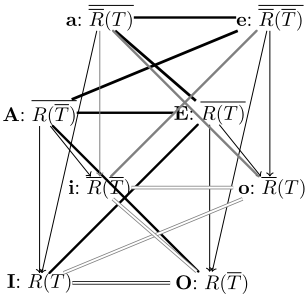
The front facet of the cube fits well with the modal logic reading of the square where R is viewed as an accessibility relation defined on X × X, and T as the set of models of a proposition p. Indeed, ✷p (resp. ✸p) is true in world x means that p is true at every (resp. at some) possible world accessible from x; this corresponds to R(T) (resp. R(T))
which is the set of worlds where ✷p (resp. ✸p) is true. Moreover, A entails I is axiom (D) of modal logic, known to require serial accessibility relations [Chellas, 1980]. Building a modal logic including all modalities appearing as vertices of the whole cube makes sense in epistemic logic. Then there are two distinct modalities, one expressing what is known at least (R(T)) and the other what is known at most (R(T)) [Dubois et al., 2000]. The conjunction of these two modalities is the basis for expressing "only knowing" [Levesque, 1990]. These two modalities also appear when modeling both beliefs and desires [Dubois et al., 2013].
Other than the semantics of modal logics, there are a number of AI formalisms that exploit a relation: formal concept analysis [Ganter and Wille, 1999], where the relation is a formal context R ⊆ X × Y linking objects and their properties, rough sets [Pawlak, 1991] that are induced by an indiscernibility relation, or abstract argumentation based on an attack relation between arguments [Dung, 1995]. Formal concepts are defined as pairs (S, T) ⊆ X × Y such as R(T) = S and Rt (S) = T, which corresponds to the use of Eq. (3). However, putting formal concept analysis in the cube perspective, leads to consider the operators defined by the three other equations as, well, which turns to be fruitful [Dubois and Prade, 2012a; Ciucci et al., 2014; Dubois and Prade, 2012b], e.g., Eq. (2) is at the basis of the definition of independent sub-contexts [Dubois and Prade, 2012b]. Rough set upper and lower approximations are defined from a relation R on X ×X by means of Eq. (1) and Eq. (2), where xR is the set of elements that are indiscernible from x w.r.t. R; see [Ciucci et al., 2014] for a preliminary discussion of the interest of considering the other equations as well in settings extending rough sets beyond the starting case where R is an equivalence relation. For abstract argumentation, it is beneficial to consider the complement of the attack relation between arguments, since then the counterpart of a formal concept is a stable extension, and the different subsets of arguments associated to the vertices of the cube are worth of interest [Amgoud and Prade, 2012].
4 Cube of indicators. All-or-nothing possibility
Another simple, non relational, reading of the cube in terms of set indicators, not considered until now, is also of interest. Going back to the cube of Fig. 2 the entailments of the top facet may be rewritten in terms of empty intersections of sets of objects A, B, and their complements A, B, while the bottom facets refer to non empty intersections. See Fig.4. Note that we assume A ̸= ∅, A ̸= ∅, B ̸= ∅, and B ̸= ∅ here, for avoiding the counterpart of the existential import problems, since now the sets A and B play symmetric roles in the statements associated to the vertices of the cube.
It is worth noticing that the side facets of the cube of Fig. 4 exhibit the four basic comparison indicators between existing between two sets A and B, namely what they have in common positively (S = A ∩ B), or negatively (T = A ∩ B), how A differs from B (U = A ∩ B), and how B differs from A (V = A ∩ B). When comparing two subsets, considering that a set indicator can be empty or not, we have 24 = 16 configurations that are summarized in Table 1.
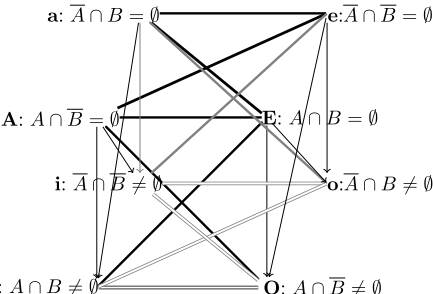
I: A ∩ B ̸= ∅
O: A ∩ B ̸= ∅
| configuration | S = A∩B ̸= ∅ | U = A∩B ̸= ∅ | V = A∩B ̸= ∅ | T = A∩B ̸= ∅ | |
|---|---|---|---|---|---|
| 1 | A∩B ̸= ∅,A ̸⊆ B; B ̸⊆ A; A ∪ B ̸= U | 1 | 1 | 1 | 1 |
| 2 | A∩B ̸= ∅,A ̸⊆ B; B ̸⊆ A; A ∪ B = U | 1 | 1 | 1 | 0 |
| 3 | B ⊂ A ⊂ U | 1 | 1 | 0 | 1 |
| 4 | B ⊂ A; A = U | 1 | 1 | 0 | 0 |
| 5 | A ⊂ B ⊂ U | 1 | 0 | 1 | 1 |
| 6 | A ⊂ B; B = U | 1 | 0 | 1 | 0 |
| 7 | A = B ⊂ U | 1 | 0 | 0 | 1 |
| 8 | A = B = U | 1 | 0 | 0 | 0 |
| 9 | A∩B = ∅;A∪B ̸= U | 0 | 1 | 1 | 1 |
| 10 | A∩B = ∅;A∪B = U | 0 | 1 | 1 | 0 |
| 11 | A ⊂ U; B = ∅; | 0 | 1 | 0 | 1 |
| 12 | A = U; B = ∅ | 0 | 1 | 0 | 0 |
| 13 | A = ∅; B ⊂ U | 0 | 0 | 1 | 1 |
| 14 | A = ∅; B = U | 0 | 0 | 1 | 0 |
| 15 | A = B = ∅; U ̸= ∅ | 0 | 0 | 0 | 1 |
| 16 | A = B = ∅ = U | 0 | 0 | 0 | 0 |
Table 1: Respective configurations of two subsets
As can be seen in Table 1, lines 1 and 2 correspond to situations of overlapping without inclusion, with coverage (A ∪ B = U) or not. Lines 3, 4, 5 and 6 correspond to situations of inclusion, with coverage or not. Lines 7 and 8 correspond to situations of equality, with coverage or not. Lines 9 and 10 correspond to situations of non overlapping, with coverage or not. The last 6 lines correspond to pathological situations where A or B are empty, with coverage or not. This shows that the four tests (indicators) in Table 1are jointly necessary for describing all the possible situations pertaining to the relative position of two subsets A and B, possibly empty, in a referential U. Moreover, the following properties can also be checked in Table 1.
This means that the 4 sets cannot be simultaneously empty, except if referential U is empty which is line 16 in Table 1.
This corresponds to lines 1, 2, 3, 5, 7, 9, 10 in Table 1. This also corresponds to the 5 possible configurations of two non-empty subsets A and B (lines 1, 3, 5, 7, 9), first identified by Gergonne [Gergonne, 1816; Faris, 1955] when discussing syllogisms, plus two configurations (lines 2, 10) where A ∪ B = U (but where A ̸= U, B ̸= U).
One merit of the cube of Fig. 4 is that it becomes obvious that the cube of opposition encompasses an all-or-nothing version of possibility theory, as noticed in a different way in
[Dubois and Prade, 2012a]. Indeed, let B = E (E ̸= ∅, E ̸= U) represents the available evidence, namely, we know that real world is in E. Then considering an event A, the vertices A, I, a and i respectively corresponds exactly to N(A) = 1 (defined by N(A) = 1 if A ⊆ E, and N(A) = 0 otherwise), Π(A) = 1 (defined by Π(A) = 1 if A ∩ E ̸= ∅, and Π(A) = 0 otherwise), ∆(A) = 1 (defined by ∆(A) = 1 if E ⊆ A, and ∆(A) = 0 otherwise), ∇(A) = 1 (defined by ∇(A) = 1 if A ∪ E ̸= U, and ∇(A) = 0 otherwise), where N, Π, ∆, and ∇ are respectively strong necessity, weak possibility, strong possibility, and weak necessity set functions. Moreover the following property holds max(N(A),∆(A)) ≤ min(Π(A),∇) which just expresses that if an event is strongly necessary, or strongly possible, it should be both weakly possible and weakly necessary.
5 The graded cube and possibility theory
There are notions that are naturally a matter of degree like uncertainty, similarity, satisfaction, or attack in argumentation. In the previous sections, everything was binary in the square and in the cube of opposition. But it makes sense to have graded modalities, graded possibility theory, more generally to have graded relations or fuzzy subsets in the previous views. It would enable us to encompass graded extensions of rough set theory, of formal concept analysis (like, e.g., the one proposed in [Belohlavek, 2002]), or of abstract argumentation [Dunne et al., 2011]. In the following, we define a graded extension of the cube of opposition, and then to show how it applies to graded possibility theory, but also to other graded settings such as multiple criteria aggregation and Sugeno integrals on the one hand, and belief functions in evidence theory on the other hand, leaving for further works the detailed study of the other above-mentioned graded extensions.
Graded extensions for the cube should satisfy a multiplevalued version of the square of opposition constraints (i)-(iv) in Section 2 for the front and back facets, as well the entailment constraints of the side facets, the mutual exclusiveness constraints of the top facet, and the dual constraints of the bottom facet. Let α, ι, ϵ, o, and α′ , ι′ , ϵ′ , o′ be the grades in [0, 1] associated to vertices A, I, E, O and a, i, e, o. Then, given an involutive negation n, a symmetrical conjunction ∗, and interpreting entailment in the many-valued case by the inequality ≤ (conclusion being at least as true a premise), the constraints for the front and back facets of the cube write
Then, the constraints associated with the side facets are
and for the top and bottom facets, we have:
The standard choice for an involutive negation is n(γ) = 1-γ. Several choices may be considered for the conjunction operator ∗. Two choices of particular interest are ∗ = min, such that min(γ, δ) = 0 iff γ = 0 or δ = 0, and Łukasiewicz conjunction ∗ = max(0, · + · - 1), such that max(0, γ + δ - 1) = 0 iff γ ≤ n(δ) (and then min(γ, δ) ≤ 0.5).
Note that if ∗ is Łukasiewicz conjunction, then the top and bottom conditions (vi-vii) are equivalent to the side ones (v). Indeed, from α′ ∗ ϵ = 0, we get α′ ∗ n(ι) = 0 which holds iff α′ ≤ ι. The other conditions are obtained in a similar way. Only weaker results can be proved for ∗ = min: conditions (v) are weaker than conditions (vi-vii). Indeed, min(α′ , ϵ) = 0 implies α′ = 0 or ϵ = 0 and consequently α′ ≤ ι = n(ϵ). On the other hand, α′ can be less or equal to ι with α ̸= 0 and ι ̸= 1.
Such a graded cube can receive different instantiations. One is in terms of (graded) possibility theory [Dubois and Prade, 1998], as briefly indicated below. Assuming that the normalized possibility distribution π : Ω → [0, 1], is also such that 1 - π is normalized (i.e., ∃ω ∈ Ω, π(ω) = 0), let us denote by ∆(A) = minω∈A π(ω) the strong possibility degree of a proposition with set of models A, and by ∇(A) = 1 - ∆(A) its conjugate degree. We can instantiate the gradual square of opposition by letting α′ = ∆(A), ϵ′ = ∆(A), ι′ = ∇(A), o′ = ∇(A). Thanks to the duality between ∆ and ∇, and normalization of 1 - π, it can be checked that valuations α′ , ϵ′ , ι′ , o′ form a square of opposition for ∗ = min, and n(γ) = 1 - γ. In particular, since ∆(A) ≤ Π(A) and ∇(A) ≤ N(A), the constraints of the side facets hold under the form (v). In agreement with epis-
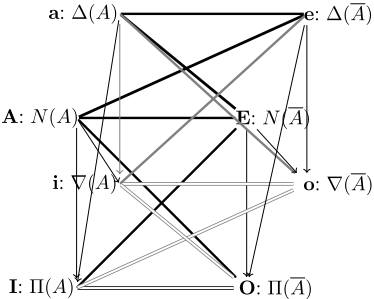
temic logic, we can express that at least C is sure to a certain extent (i.e., all elements out of C are somewhat impossible), which is represented by the constraint N(C) ≥ γ > 0; and that no statement more precise than D is sure (i.e., all elements in D are still possible to a certain extent), which is represented by the constraint ∆(D) ≥ δ > 0. Note that Nπ(C) = ∆1-π(C); however, the quantities Nπ(A) and ∆π(A) are fully independent of each other.
6 Weighted aggregations. Sugeno integrals
As already mentioned, apart from uncertainty, satisfaction is usually a matter of degree. It is the case in multiple criteria aggregation where objects are evaluated by means of a set C of criteria i (where 1 ≤ i ≤ n). Let us denote by fi the evaluation of a given object for criterion i, and f = (f1, · · · , fi, · · · , fn). We assume here that ∀i, fi ∈ [0, 1]. fi = 1 means that the object fully satisfies criterion i, while fi = 0 expresses a total absence of satisfaction. Let πi ∈ [0, 1] represents the level of importance of criterion i. The larger πi the more important the criterion. A double normalization is assumed ∃i, πi = 1, and ∃j, πj = 0.
Simple qualitative aggregation operators are the weighted min and the weighted max [Dubois and Prade, 1986b]. The first one measures the extent to which all important criteria are satisfied and corresponds to the expression ∧ni=1 πi ⇒ fi, while the second one ∨ni=1 πi ∧ fi is optimistic and only requires that at least an important criterion be highly satisfied. Weighted min and weighted max correspond to vertices A and I of the cube of Fig. 6. Then condition (i) of the front square implies that s ⇒ t = (1 - s) ∨ t is the strong implication associated with ∧ = min. As can be easily seen, the cube of Fig. 6 is just a multiple-valued counterpart of the initial cube of Fig. 2. While MINπ(f) = ∧ni=1 πi ⇒ fi is all the larger as all important criteria are more satisfied, MIN neg π (f)) = ∧ni=1 (1 - πi) ⇒ (1 - fi) tolerates poor evaluations (1 - fi high) when criteria have low importance. The aggregations of the front facet of the cube of Fig. 6 are positive evaluations that focus on the high satisfaction of important criteria, while the aggregations of the back facet of the cube are negative in the sense that they build their estimates in terms of the lack of defect with respect to important criteria. This constitutes two complementary points of view, recently proposed in multiple criteria aggregation [Dubois et al., 2012]. The cube of Fig. 6 satisfies all the properties (ivii) of a graded cube of opposition if ∗ = max(0, · + · - 1) is Łukasiewicz conjunction.
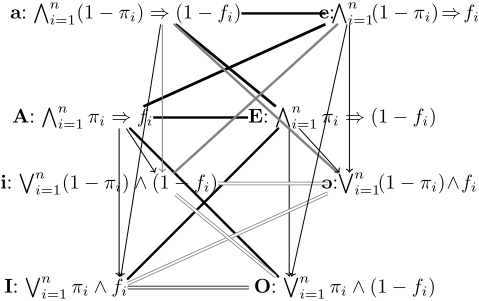
Sugeno integrals [1977] [Grabisch and Labreuche, 2010] constitute an important family of qualitative aggregation operators, which includes weighted minimum and maximum as particular cases, and where subsets of criteria can be weighted (and not only single criteria) in order to express synergy inside these subsets of criteria.A Sugeno integral is defined by
where importance levels are assigned to subsets A of criteria by means of a set function, called capacity, which is a mapping γ : 2C → L such that γ(∅) = 0, γ(C) = 1, and if A ⊆ B then γ(A) ≤ γ(B). Possibility measures Π, or necessity measures N are examples of capacities. Note also that if f is the characteristic function of a subset F ⊆ C, then ∮γ (f ) = γ(F ).
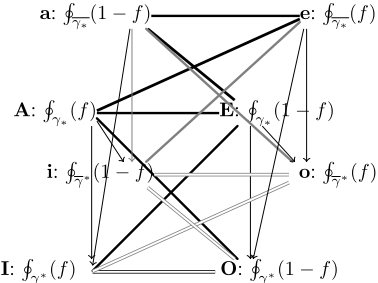
The entailment from A to I in cube 5, which expresses that N(A) ≤ Π(A) for any A, reflects the fact that N provides a pessimistic evaluation, while Π(A) is an optimistic evaluation. In order to generalize this situation to any capacity γ, we need to introduce the pessimistic part γ∗ and the optimistic γ ∗ part of γ. For doing this, we need to define the conjugate γ c (A) of capacity γ, that is the capacity γ c (A) = 1 - γ(A), ∀A ⊆ C, where A is the complement of subset A. Due to the duality N(A) = 1 - Π(A), N and Π are conjugate of each other. Then, let γ∗(A) = min(γ(A), γ c (A)) and γ ∗ (A) = max(γ(A), γ c (A)), which ensures that γ∗(A) ≤ γ ∗ (A). Note that γ∗(A) = 1 - γ ∗ (A) (γ∗ and γ ∗ are conjugate). We can now build the front facet of the cube of Fig. 7, where γ∗ is used in vertices A and E, while γ ∗ appears in vertices I and O. It can be checked that this facet satisfies all the properties (i)-(iv) of a graded square of opposition for Łukasiewicz conjunction ∗ = max(0, ·+·-1).
The back facet of the cube of Fig. 7 is obtained by changing the integral operator ∮γ into a so-called desintegral operator [Dubois et al., 2012] ∮ ↓ ν (f) = ∮1-ν c(1 - f), where ν is called an anti-capacity, since it is a decreasing set function (then 1 - ν c is a capacity, where ν c (A) = 1 - ν(A)). Given a pessimistic capacity γ, the associated anti-capacity ν is defined as ν(A) = γ(A) from the complement (pessimistic) capacity γ, itself defined in the following way. First, we need to recall the inner qualitative Moebius transform γ♯ of a capacity γ defined as γ♯(E) = γ(E) if γ(E) > maxB⊊E γ(B) and γ♯(E) = 0 otherwise. Then γ(A) = maxE⊆A γ♯(E) (this is the qualitative counterpart of the definition of a belief function from a mass function). We can now define the complement γ♯ of γ♯ as γ♯(E) = γ♯(E) for all E. From which we can define γ(A) = maxE⊆A γ♯(E) = maxE⊆A γ♯(E), which makes it clear that γ(A) generalizes ∆(A) in possibility theory (indeed γ(A) = maxA⊆E γ♯(E)). Then ∮ ↓ ν (f) = ∮1-ν c(1-f) = ∮γ (1-f) since 1-ν c (A) = ν(A) = γ(A). When γ is a necessity measure, ν(A) reduces to ∆(A) = N1-π(A). Desintegrals generalize the qualitative aggregation operator MIN neg π which focuses on the defects of the objects in the evaluation process. Then it can be checked that all the properties (i)-(vii) of a graded cube of opposition for Łukasiewicz conjunction ∗ = max(0, · + · - 1) are satisfied in the cube of Fig. 7, which generalizes cube 6.
7 Cube of belief functions
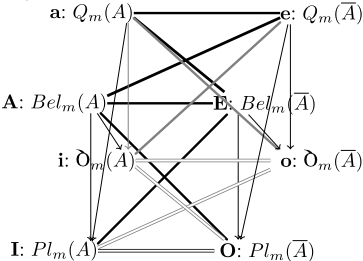
In Shafer [1976]'s evidence theory, a belief function is defined from a mass function m as Belm(A) = ∑E⊆A m(E) for A ⊆ U together with a dual plausibility function Plm(A) = 1 - Belm(A) = ∑E∩A̸=∅ m(E). It is assumed that m(∅) = 0 and ∑E m(E) = 1. The complement mass function m is defined as m(E) = m(E) [Dubois and Prade, 1986a]. The normalization m(∅) = 0 forces m(U) = 0. The commonality function Q and its dual Q are then defined by Qm(A) = ∑A⊆E m(E) = Belm(A) while Q m(A) = ∑E∩A̸=∅ m(E) = 1 - Qm(A) = P lm(A). It is easy to check that the transformation m → m reduces to π → 1-π in case of nested focal elements (i.e. the subsets E such as m(E) > 0). This indicates the perfect parallel with possibility theory, and cube 8 is the exact counterpart of cube 5. Moreover, belief functions extend to many-valued characteristic functions (fuzzy events) µA as Belm(A) = ∑E m(E) · minu∈E µA(u), which is a particular case of a Choquet integral, just as the necessity of a fuzzy event MINπ(f) is a particular case of a Sugeno integral. It is clear that in cube 8, the set functions extend to fuzzy events, and more generally one may consider its extension to general Choquet integrals.
8 Conclusion
We have seen that the cube of opposition makes sense in a large variety of situations including qualitative graded and quantitative settings. The 4 notions appearing in side facets are only weakly related and are necessary for properly describing or evaluating a situation. The existence of the back facet complements in a reversed manner what is going on in the front square of opposition. Becoming aware of the existence of a cube of opposition in a given setting, may help introducing new useful notions for having a complete cube with four basic entities. It then makes a complete picture of the considered theory, while many settings (modal logic, formal concept analysis, rough sets, Sugeno integrals, ...) have been considering only one or two of these entities until recently. The cube of opposition may also help to make fruitful parallels between theories, or to hybridize them.
The auto-duality of probability (P rob(A) = 1-P rob(A)) prevents its direct association with the square and the cube of opposition; the handling of upper and lower probabilities (beyond belief functions) in this setting is an open question.
@inproceedings{ijcai2015p415,
  title     = {The Cube of Opposition: A Structure Underlying Many Knowledge Representation Formalisms},
  author    = {Dubois, Didier and Prade, Henri and Rico, Agnès},
  booktitle = {Proceedings of the Twenty-Fourth International Joint Conference on
               Artificial Intelligence, {IJCAI-15}},
  publisher = {International Joint Conferences on Artificial Intelligence},
  editor    = {Qiang Yang and Michael Wooldridge},
  pages     = {2933--2938},
  year      = {2015},
  month     = {7},
  note      = {Special Track on Knowledge Representation and Reasoning},
  url       = {https://ijcai.org/proceedings/2015/415},
}
TY - CPAPER TI - The Cube of Opposition: A Structure Underlying Many Knowledge Representation Formalisms AU - Dubois, Didier AU - Prade, Henri AU - Rico, Agnès T2 - Proceedings of the Twenty-Fourth International Joint Conference on Artificial Intelligence, IJCAI-15 PB - International Joint Conferences on Artificial Intelligence PY - 2015 SP - 2933 EP - 2938 UR - https://ijcai.org/proceedings/2015/415 ER -Copied
Machine-readable versions of this paper, for tools and AI agents:





