
A Crowdfunding Model for Green Energy Investment
Proceedings of the Twenty-Fourth International Joint Conference on Artificial Intelligence. Special Track on Computational Sustainability. Pages 2669-2675.
© 2015 International Joint Conferences on Artificial Intelligence
Abstract
This paper studies a new renewable energy investment model through crowdfunding, which is motivated by emerging community solar farms. In this paper we develop a sequential game theory model to capture the interactions among crowdfunders, the solar farm owner, and an electricity company who purchases renewable energy generated by the solar farm in a multi-period framework. By characterizing a unique subgame-perfect equilibrium, andcomparing it with a benchmark model without crowdfunding, we find that under crowdfunding although the farm owner reduces its investment level, the overall green energy investment level is increased due to the contribution of crowdfunders. We also find that crowdfunding can increase the penetration of green energy in consumption and thus reduce the energy procurement cost of the electricity company. Finally, the numerical results based on real data indicates crowdfunding is a simple but effective way to boost green generation.
- [Association, 2013] Solar Energy Industries Association. Solar energy facts: 2012 Year-in-review. pages 2013- 2015, 2013.
- [Belleflamme et al., 2014] Paul Belleflamme, Thomas Lam- bert, and Armin Schwienbacher. Crowdfunding: Tapping the right crowd. Journal of Business Venturing, 29(5):585- 609, 2014.
- [Choi et al., 2007] Syngjoo Choi, Raymond Fisman, Dou- glas Gale, and Shachar Kariv. Consistency and heterogeneity of individual behavior under uncertainty. The American Economic Review, 97(5):1921-1938, 2007.
- [Coughlin et al., 2012] Jason Coughlin, Jennifer Grove, Linda Irvine, Janet F Jacobs, Sarah Johnson Phillips, Alexandra Sawyer, and Joseph Wiedman. A Guide to Community Shared Solar : Utility , Private , and Nonprofit Project Development. Technical report, U.S. Department of Energy, 2012.
- [Couture and Gagnon, 2010] Toby Couture and Yves Gagnon. An analysis of feed-in tariff remuneration models: Implications for renewable energy investment. Energy Policy, 38(2):955-965, February 2010.
- [Fleten et al., 2007] S Fleten, K Maribu, and I Wangensteen. Optimal investment strategies in decentralized renewable power generation under uncertainty. Energy, 32(5):803- 815, May 2007.
- [Gerber and Hui, 2013] Elizabeth M Gerber and Julie Hui. Crowdfunding : Motivations and Deterrents for Participa- tion. 20(6), 2013.
- [Global Justice Now, 2014] Global Justice Now. Rays of hope: Clean and democratically controlled energy for everyone. (December), 2014.
- [Haubrich, 1994] Joseph G Haubrich. Risk aversion, perfor- mance pay, and the principal-agent problem. Journal of Political Economy, pages 258-276, 1994.
- [Hellwig, 1980] Martin F Hellwig. On the aggregation of information in competitive markets. Journal of economic theory, 22(3):477-498, 1980.
- [Hu et al., 2014] Ming Hu, Xi Li, and Mengze Shi. Product and pricing decisions in crowdfunding. Rotman School of Management Working Paper, (2405552), 2014.
- [Palmer and Burtraw, 2005] Karen Palmer and Dallas Bur- traw. Cost-effectiveness of renewable electricity policies. Energy Economics, 27(6):873-894, November 2005.
- [Reuter et al., 2012] Wolf Heinrich Reuter, Jana Szolgayová, Sabine Fuss, and Michael Obersteiner. Renewable energy investment: Policy and market impacts. Applied Energy, 97:249-254, September 2012.
- [Robu et al., 2012] Valentin Robu, Ramachandra Kota, Georgios Chalkiadakis, Alex Rogers, and Nicholas R Jennings. Cooperative virtual power plant formation using scoring rules. In Proceedings of the 11th International Conference on Autonomous Agents and Multiagent Systems-Volume 3, pages 1165-1166. International Foundation for Autonomous Agents and Multiagent Systems, 2012.
- [Tirole, 1988] Jean Tirole. The theory of industrial organization. MIT press, 1988.
- [Vinyals et al., 2014] Meritxell Vinyals, Valentin Robu, Alex Rogers, and Nicholas R Jennings. Prediction-of- use games: a cooperative game theoryapproach to sustainable energy tariffs. In Proceedings of the 2014 international conference on Autonomous agents and multi- agent systems, pages 829-836. International Foundation for Autonomous Agents and Multiagent Systems, 2014.
- [Wiser et al., 1998] Ryan Wiser, Steven Pickle, and Charles Goldman. Renewable energy policy and electricity restructuring: a california case study. Energy Policy, 26(6):465-475, 1998.
- [Wüstenhagen and Menichetti, 2012] R Wüstenhagen and Emanuela Menichetti. Strategic choices for renewable en- ergy investment: Conceptual framework and opportunities for further research. Energy Policy, 40:1-10, 2012.
- [Zhou et al., 2011] Ying Zhou, Lizhi Wang, and James D. McCalley. Designing effective and efficient incentive policies for renewable energy in generation expansion planning. Applied Energy, 88(6):2201-2209, June 2011.
References were extracted automatically from the PDF and may contain errors.
Full text extracted automatically from the PDF; figures, tables and equations may differ. The PDF is the version of record.
1 Introduction
One of the most prevalent ways to boost investment in renewable energy generation is to motivate individuals to participate into green energy investment and generation. However, not all individuals are willing or able to install on-site renewable energy generation at their homes. Therefore, a special crowdfunding green energy investment has been recently introduced in the form of community shared renewable energy projects. A typical example can be found in three community shared solar projects launched by Clean Energy Collective (CEC) in Colorado[Coughlin et al., 2012], and other examples include Westmill Solar in UK and Som Energia in Spain[Global Justice Now, 2014]. By joining in such a community shared solar project, individual investors can acquire the ownership of solar panels which may be installed on a solar farm remotely located from the individual's home. Due to the distance, the solar energy generated by the solar panels are not directly consumed by the owners of the panels; instead, the generated energy are sold by the owner of the solar farm (e.g., the CEC), as an agent for all the individual investors, to an electricity company through a long-term power purchase agreement (PPA). Then, the solar farm owner allocates the payoff to the individual investors depending on the amount of the electricity generated by the panels they invested.
The newly emerging investment pattern in green energycrowdfunding, can benefit all stakeholders (e.g., individual investors, the solar farm owner who represents traditional investors, electricity company). From the perspective of individual investors who are unable to install green generation system at home due to geometry/physical/time restrictions, the new crowdfunding pattern provides a bridge for them to access the renewable energy investment. 1 For the solar farm owner, crowdfunding helps expand investment participation and hence pools investment risk. Moreover, the electricity company also benefits from the increased green energy investment level in that the potential increment in green energy penetration can lower its energy procurement cost.
Despite the various merits, to our knowledge few researchers have studied this new business model and thus its impact on green energy investment is unclear. Most papers on renewable energy investment focus on evaluating the effectiveness and efficiency of these renewable energy policies such as feed-in tariffs, tax credits, and certificate systems[W¨ustenhagen and Menichetti, 2012]. They often conduct the examination through case study[Wiser et al., 1998], literature review[Couture and Gagnon, 2010] or numerical simulation[Palmer and Burtraw, 2005]. [Zhou et al., 2011] is the only paper that aims to design an incentive policy by taking into account of the investors' response but not in the framework of crowdfunding. [Reuter et al., 2012] and [Fleten et al., 2007] are among a few exceptions which quantitatively estimate the risk and return associated with renewable energy investment from the perspective of investors, but not crowdfunders. Our paper aims to fill the gap through answering the following questions: First, we are interested in the crowdfunding mechanism; i.e., how should a farm owner allocate the cost and returns among crowdfunders to maximize its own utility? Second, how will the presence of crowdfunding affects the green energy investment of the farm owner? Thirdly, from the perspective of electricity company, how should the electricity company adjust its procurement strategy as a response to the new investment pattern? Most importantly, how would the emergence of crowdfunding affect the overall green energy investment level and also the penetration of green energy in the total energy consumption?
1 [Gerber and Hui, 2013] study the incentive of participants of crowdfunding platforms based on interviews, and find the primary motivation of project creators is raising fund and sharing risk, while that of fund providers is collecting reward.
To answer these questions, inspired by practice examples of community shared solar projects (e.g., CEC in Colorado), we develop a sequential game model to represent the strategic interaction between three players: a group of individual crowdfunders, the owner of a solar farm who initiates the crowdfunding, and an electricity company who purchases green energy generated by the farm through a wholesale contract. The electricity company chooses the wholesale price, based on which the solar farm chooses its own solar panel investment level and designs the crowdfunding mechanism to raise funds from the investor group. Accordingly, each crowdfunder makes their individual investment decision. The decision process is characterized by a three-player sequential game, in contrast to current crowdfunding models only involving two parties: crowdfunders and fund raisers (e.g., [Belleflamme et al., 2014], [Hu et al., 2014]) or current mechanism design models on green energy (e.g., [Vinyals et al., 2014], [Robu et al., 2012]). We prove that the game has a unique subgame perfect equilibrium. Our model is applicable to any investment structure that involves 3 players whose investment decisions are inter-dependent.
To further study the impact of the crowdfunding model, we also consider a benchmark model without crowdfunding. By comparing the results of the two game we have the following findings: (i) under crowdfunding, the farm owner gains more utility by taking advantage of crowdfunding to shift the investment risk. In particular, under crowdfunding the farm owner gains the same sales revenue at a lower investment cost; (ii) though crowdfunding reduces the farm owner's investment level, it does increase the overall green energy investment level as well as the penetration of green energy in consumption due to the contribution of crowdfunder; (iii) due to increased green energy penetration, crowdfunding reduces the procurement cost of the electricity company, which also increases the total welfare of energy consumers. The analytical results are proved by solving first order conditions for each corresponding optimization problem. The detailed algebras are omitted due to space limitation. At last, we numerically estimate the practical impact of crowdfunding through simulations based on real data and find that crowdfunding is a simple but effective way to increase green generation.
2 ProblemFormulation
We consider a solar farm that needs long-term investment on renewable energy. There are multiple players in the model: the owner of the farm, a group of crowdfunders and the electricity company. Based on the behavior of investors while exposed to uncertainty to attempt to reduce that uncertainty, we assume that both the farm owner and the crowdfunders are risk-averse. As the electricity company is an organization, we assume the electricity company is risk-neutral following most economic literature on industry organization[Tirole, 1988].
In practice, the electricity company often has a much stronger bargaining power which allows him to make a whole sale price offer to the green farm. The owner of the farm then decides its own investment and can also attract funding from crowdfunders by offering a crowdfunding contract. Given the contract, the crowdfunders decide how much to invest in the solar farm. As can be seen, the optimal decisions of those players depend on each other's decision. Similar sequence of events is also true for other crowdfunding settings[Hu et al., 2014]. Therefore, we model this problem as an sequential game with continuous decision space.
We consider a time horizon of T periods. In each period t = 1, 2, · · · , T, the electricity company needs to provide energy to a group of consumers with aggregate demand ˜Dt with mean Dt. In order to fulfill the demand in each period t, the electricity company buys electricity from the green farm at a wholesale price wt and from the electricity market at a market price ˜ qt with mean qt. In practice the electricity company may receive energy from various sources such as conventional energy generations. Here we use the electricity market to represent all energy sources other than the renewable ones. The wholesale price w ≡ (w1,w2, · · · ,wT ) ∈ RT is determined in a contract offered by the electricity company, which also states that the electricity company will buy all electricity generated by the green farm. Therefore, the electricity company only purchases electricity from the market to satisfy the demand that cannot be satisfied by green generation. Let ˜Gt denote the supply of the green farm in period t, then the electricity company's expected total procurement cost is:
The electricity company's action is choosing the wholesale price of the green generation, w ∈ RT , and its objective is to minimize its expected energy procurement cost.
The total green energy supply ˜Gt depends on the total investment level of the green farm. The investment level is represented by the total number of solar panels installed on the farm, N. Let f (N) denote the total cost of investing N units of solar panels (including purchasing, installation and maintenance during the period, as well as tax credits reduction). For tractability, we assume that the cost is linear in N, i.e., f (N) = BN where B represents the cost of one unit of solar panel and b ≡ BT is the allocated cost per period. Each unit of solar panel generates an uncertain amount of green energy supply in each period, which is denoted by ˜ gt, which satisfies normal distribution 2 with mean of µg and standard deviation of σg. The total green energy supply is ˜Gt = N˜ gt in period t. To make the problem nontrivial, we assume that over the whole horizon the average investment cost for per unit green energy generation b/µg is lower than the overall average market price q ≡ ∑Tt=1 qt T , i.e., q > b/µg.
2 The annual output of one unit panel is uncertain, due to variations in sunshine, manufacturing, installation and maintenance among solar panels. This deviation cannot be ignored given risk aversion of the players. Because the deviation is small, there is no heavy tail for the distribution, so normal distribution is the best a priori assumption in absence of large data samples to fit.
The green farm owner not only invests in the solar panels by itself, but also attracts funding from other investors. Specifically, we consider that the owner offers a crowdfunding contract to risk averse crowdfunders. The investment contract designed by the farm is as follows: crowdfunders pay the farm c for per unit solar panel in the beginning of period 1, and receives rt for per unit of electricity generation from the invested solar panels in period t. Let N0 denote the number of solar panels invested by the green farm itself. Let NC denote the total number of solar panels invested by the crowdfunders. The total green energy investment is the sum of investment by both the farm owner and the crowdfunders, i.e, N = N0 +NC. Therefore, the total profit of the farm is:
where (c - ∑Tt=1 rt˜ gt) NC represents the payoff from crowdfunding. We assume the utility function of risk-averse farm owner follows Constant Absolute Risk Aversion (CARA) utility. Correspondingly, the utility of the riskaverse farm owner is:u0 (π0) = -e- π0 ρ , (3)
where ρ > 0 is the degree of risk tolerance of the farm owner. The farm owner's action is choosing its own investment N0 ∈ R+ and setting the crowdfunding contract (c, r) ∈ R1+T , and its objective is to maximize its expected utility E[u0 (π0)].
Given the crowdfunding contract offered by the farm owner (c, r), each crowdfunder chooses his/her investment level. The population of crowdfunders is large, while the investment level of an individual crowdfunder is often insignificant compared with that of the farm owner. Therefore, we follow the modeling methodology in the economic literature ([Hellwig, 1980] when small individual investors cannot significantly affect the aggregate investment, and use continuous index in [0,1] with the Lebesgue measure for crowdfunders. In other words, the crowdfunders are indexed by i ∈ I = [0, 1] with the Lebesgue measure. A crowdfunder i's payoff πi under investment level ni given the crowdfunding contract offered by the farm owner (c, r) is:
We also assume the utility function of risk-averse crowdfunders follows Constant Absolute Risk Aversion (CARA) utility. Specifically, each crowd-funder i is uniquely characterized by its degree of risk-tolerance βi. Therefore, the utility of crowd-funder i is:
Crowd-funder i's action is choosing investment level 3 ni ∈ R+, and its objective is to maximize its expected utility E[ui (πi)]. By the definition of the aggregate investment level of crowdfunders, NC, we have NC = ∑i∈I n∗i .
3 For flexibility, we allow the crowdfunders to invest a fraction of a solar panel.
The sequence of events is as below: 1) The electricity company offers the wholesale price of the green generation, w = (w1,w2, · · · ,wT ) ∈ RT ; 2) The firm offers a contract to the crowdfunders, which specifies the unit panel investment cost c and the return r = (r1, r2, · · · , rT ) for per unit green energy generation, and also determines its own investment level N0 ∈ R+; 3) Based on the contract, the crowdfunders determines their investment levels ni ∈ R+; 4) In each period, the green generation is realized, the electricity company purchases from the market to satisfy the demand that cannot be satisfied by green generation.
3 EquilibriumAnalysis
In this section we first consider a benchmark model without crowdfunding, then solve the equilibrium in the crowdfunding model, finally compare the two models to show the effects of the adoption of crowdfunding on the green energy investment and the welfare of the stakeholders. In both models, we solve the sub-game perfect equilibrium through backward induction.
3.1 Benchmark: No Crowdfunding
In the benchmark model without crowdfunding, the electricity company determines the wholesale price and then the green farm owner chooses the investment level. Using backward induction, we first characterize the farm's optimal investment decision N ♯ 0 (w) for a given wholesale price w, then derive the optimal wholesale price w♯ set by the electricity company anticipating the optimal investment strategy of the firm owner, N ♯ 0 (w).
Green farm owner: investment decision
Without crowdfunding, NC = 0, the total investment level is equivalent to the direct investment by the farm owner, i.e., N = N0. The risk-averse green farm owner chooses its investment level N0 to maximize its utility. Substituting NC = 0 and N = N0 into (2), the total profit of the farm owner is: π0 = (∑Tt=1 wt˜ gt -B) N0. So the farm's expected utility is:
Thus, the farm owner's optimal investment problem can be characterized as maximizing the certainty equivalent:
By solving ∂CE0(N0,w) ∂N0 = 0, we derive the optimal investment strategy of the farm owner N ♯ 0 (w) in Lemma 1.
Lemma 1. Without crowdfunding, the optimal investment strategy of the farm owner given the whole sale price offered by the electricity company w is:
Electricity company: wholesale price decision
Anticipating the farm owner's optimal investment strategy N ♯ 0 (w) in equation (7), the electricity company chooses the wholesale price to minimize the total expected procurement cost defined in equation (1), which is:
Then the optimal wholesale price w♯ is determined by:
Solving the equation system ∇wE[C0(w)] = 0 to derive the optimal wholesale price w♯ and substituting w♯ to the farm owner's optimal investment strategy N ♯ 0 (w), we achieve the sub-game perfect equilibrium in the benchmark model without crowdfunding in Proposition 1.
Proposition 1. In the traditional business model without crowdfunding, there is a unique sub-game perfect equilibrium, in which the total investment by the green farm is:
the wholesale price of electricity offered by the electricity company is:
the expected procurement cost is:
Proposition 1 has several implications. First, the whole sale price, which is between the average unit cost of renewable energy generated by solar panels b/µg and the average market price q, remains the same over the whole horizon. The rationale is that it is optimal for the electricity company not shifting risk to the farm owner as the electricity company is risk neutral while the farm owner is risk averse. Second, from (11) we observe that the equilibrium wholesale price increases in (a) the average market price q and (b) the average unit cost of renewable energy generated by solar panels b/µg. The rationale is as follows: on one hand, the higher the average market price q is, the higher the wholesale price the electricity company is willing to pay; on the other hand, the higher the average unit cost of renewable energy, the higher the wholesale price the electricity company has to pay in order to encourage the farm owner to invest in solar panels. Thirdly, Proposition 1 indicates the equilibrium solar investment increases in the degree of risk tolerance ρ and the average market price q, but decreases in the generation variance and the average unit cost of renewable energy b/µg.
3.2 CrowdfundingModel
In the crowdfunding model, in addition to the direct investment by the farm owner, the farm also raises funding from crowdfunders. Using backward induction, we first solve the investment decision of individual small investors n∗i (c, r) given the contract offered by the farm owner, (c, r), then derive the farm owner's optimal crowdfunding contract (c∗ (w), r∗ (w)) and investment decision N ∗ 0 (w) given the wholesale price offered by the electricity company, w, finally we analyze the electricity company's optimal decision on wholesale price, i.e., w∗ .
Crowdfunders: investment decision
Given the contract offered by the green farm, (c, r), which claims that crowdfunders pay the farm c for per unit solar panel in the beginning of period 1, and receives rt for per unit of electricity generation from the invested solar panels in period t, each investor's payoff under investment decision ni, is: πi = (∑Tt=1 rt˜ gt - c) ni. Therefore, the optimal investment problem for crowd-funder i is equivalent to:
Therefore, the optimal investment level n∗i is determined by
The aggregate investment by crowdfunders is NC = ∫ 1 0 nidi, as we assume crowdfunders are indexed by i ∈ I = [0, 1] with the Lebesgue measure. From (14), the optimal aggregate investment level by crowdfunders given contract (c, r) is:
where β = ∫ 1 0 βidi denotes the mean of the risk-tolerance degree of crowdfunders.
The green farm: contract design and investment decision Anticipating the optimal aggregate investment level by the crowdfunders N ∗C (c, r), the green farm owner decides his own optimal investment and crowdfunding by maximizing the following certainty equivalent:
Lemma 2. Given the wholesale price w, in the optimal contract offered by the green farm, we have:
under which the optimal number of solar panel invested by the green farm is:
Lemma 2 states the optimal decision of the farm owner given wholesale prices w offered by the electricity company. The optimal values, N ∗ 0 (w), c∗ (w), r∗ (w), are derived by solving the following equation system: ∂CEc(N0,c,r) ∂N0 = 0, ∂CEc(N0,c,r) ∂c = 0,∇rCEc (N0, c, r) = 0. These optimal values indicate that for crowd-funders, the unit reward for per unit generation of invested solar panels r∗ t increases in the wholesale price wt offered by the electricity company, and the unit investment charge c∗ is the same as the purchasing and maintenance cost paid by the farm B, irrespective of other parameters. Under the optimal values, the overall number of solar panel is: N ∗ (w) = ρ µg ∑Tt=1 wt-B ∑Tt=1 w2 t σ2 g (1+ β 2ρ ) .
The electricity company: wholesale price
Anticipating the total solar panels investment by the farm and the crowdfunders, the electricity company chooses the wholesale price to minimize its total procurement cost:
Solving the equation system ∇wE[Cc(w)] = 0 to derive the optimal wholesale price w∗ and substituting w∗ to the farm owner's optimal strategy N ∗ 0 (w), c∗ (w), r∗ (w), we achieve the sub-game perfect equilibrium in the model with crowdfunding in Proposition 2.
Proposition 2. There is a unique subgame perfect equilibrium, which satisfies:
- (a) The wholesale price of electricity offered by the electricity company is w∗ t = w∗ ≡ 2 1 b/µg + 1 q , t = 1, 2, · · · , T;
- (b) The contract offered by the green farm in equilibrium is:
- (c) The number of solar panels invested by crowdfunder i is n∗i = βi(qµg-b)(b+3qµg) 16bq2 σ2 g and the number of solar panels invested by green farm is:
The overall number of solar panel is:
- (d) In the equilibrium, the total expected procurement is:
Proposition 2(a) shows that the optimal wholesale price determined by the electricity company with crowdfunding, is the same as the optimal wholesale price without crowdfunding. Proposition 2(b) shows how the farm designs the crowdfunding contract. First, c∗ = B, meaning that for per unit solar panel the farm charges the crowdfunders the same as the purchasing and maintenance cost paid by the farm, irrespective of other parameters. In other words, all the investment costs are fairly allocated among investors and there is no extra charge for each investor. Second, under the assumption q > b/µg, comparing the crowdfunding return r∗ with the wholesale price w∗ in each period in equilibrium, we find that r∗ < w∗ , which indicates that the farm owner only returns a portion of investment return to the crowdfunders. The crowdfunding return r∗ increases in the average market price q and the average cost of green energy generation b/µg.
3.3 Comparison
Now we look at the impact of the crowdfunding through comparing the sub-game perfect equilibrium with crowdfunding with the sub-game perfect equilibrium without crowdfunding.
Proposition 3. After introducing crowdfunding, we have
- (a) the farmowner's sales revenue fromgreen energy generation stays the same, but the investment cost is reduced by β(qµg-b) 4ρ(qµg+b) ;
- (b) the overall investment in solar panel increases by β 2ρ (i.e., N ∗ N ♯ 0 = 1+ β 2ρ );
- (c) the procurement cost saving from green energy procurement increases by β 2ρ .
Proposition 3(a) suggests that by setting the return of crowdfunding lower than the wholesale price, the farm owner achieves the same revenue while reducing his own investment cost in solar panels. Proposition 3(b) shows that the overall investment in solar panels is always larger than that under the traditional investment setting without crowdfunding. This indicates that crowdfunding does help ramp up the green energy generation. The increase in the overall solar panel investment is mainly contributed by the crowdfunders. Since the ratio increases in the average risk tolerance of crowdfunders β and decreases in the risk tolerance of the farm owner ρ, it is implied that the farm owner uses crowdfunding as a leverage to shift the investment risk. Proposition 3(c) indicates that the electricity company also benefits from crowdfunding, which is driven by the penetration of green energy increased by crowdfunding. Since the average cost of green energy generation is lower than the average market price, the wholesale price is lower than the market price. Therefore, more green energy supply implies more procurement cost saving for the electricity company, which also increases the welfare of energy consumers.
4 Simulation
In the previous section we have analytically proved that crowdfunding can help increase renewable energy investment. In this section we aim to show the practical impact through simulations with real data. We aim to compare the effect of government policies and technology improvement in solar panels without crowdfunding with the benefit of crowdfunding in increasing green energy generations.
| Year | 2008 | 2009 | 2010 | 2011 | 2012 |
| Capacity | 31 | 30.5 | 29.6 | 30.7 | 30.9 |
We use real data to determine the parameters in our model. For the average market price q, we use the daily average price in Southern California of 2013 based on the data provided by U.S. Energy Information Administration (EIA) 4 , which is $48.45 per MWh. According to the report by solar energy industry association, in 2013 the installation cost for solar photovoltaic (PV) with capacity of 1 Watt is $2.59[Association, 2013]. Since the majority of manufacturers offer the 25-year standard solar panel warranty, we assume that the lifespan of a solar panel is 25 years, so the annual investment cost for solar photovoltaic (PV) with capacity of 1 Watt is b = $0.1036 per Year. As for the generation parameter of solar farms, we calculate the statistics of solar generation based on a 5-year solar farm's annual average capacity factor. Capacity factor is the ratio of the system's actual energy output during a fixed period to the potential output if the system ran at full capacity for the entire period[U.S. Department of Energy, 2011]. Capacity factor of solar photovoltaic (PV) is primarily determined by solar insolation, so it varies with locations, weather and time of day, etc. during 2008-2012 (Table 1), which suggest that the mean and variance of energy generation of solar panel with capacity of 1 Watt is µg = 0.0027 MWh per year and σg = 4.9 × 10⁻⁵ MWh per year.
There are no standard and well accepted values for the risk tolerance degree of the farm owner ρ and the average risk tolerance degree of the crowdfunders β. According to the values of absolute risk aversion of managers used in [Haubrich, 1994], we choose the risk tolerance of the farm owner ρ to be 5. Similarly, we let the average risk tolerance of the crowdfunders β to be 20 following [Choi et al., 2007].
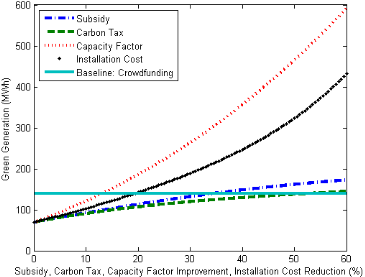
We compare the impact of crowdfunding with that of government policies and technology improvement aiming to boost green generation. For government policies, we consider government subsidy and carbon tax. Subsidy is characterized by θ, meaning that for $1 collected by the green farm, $θ is from government subsidy, and $(1-θ) is from the electricity company. In other words, under the government subsidy of θ, if the wholesale price is w for per unit green energy the green farm still receive w per unit but the electricity company only needs to pay (1 - θ)w per unit. The carbon tax results in an increase in the average market price q. Specifically, a carbon tax τ results in the average market price increasing by τ. For technology improvement, we consider both increasing capacity factor and reducing installation cost. Figure 1 plots the green generations in five scenarios: (1) no crowdfunding with subsidy, (2) no crowdfunding with carbon tax, (3) no crowdfunding with increased capacity factor, (4) no crowdfunding with reduced installation coast, and (5) crowdfunding only. Figure 1 shows that crowdfunding can achieve the same green generation as that under 34% of government subsidy, i.e., θ = 34%, or under 51% of carbon tax, i.e., τ = 51% or with 13% increased in capacity factor, or with 19% decreased in installation cost. The result indicates that crowdfunding is a simple but effective way to boost green generation compared with government policies and technology improvement.
4 See http://www.eia.gov/electricity/wholesale/
5 Conclusion and FutureWork
In this paper, we studied an emerging investment pattern in green energy-crowdfunding, which is motivated by emerging community shared renewable energy projects represented by community solar farms. The pattern of crowdfunding investment for renewable energy has various merits but calls little attentions from (quantitative) researchers. Our paper filled the gap and made the following contributions. First, we developed a sequential game model to capture the strategic interactions during crowdfunding and derived a unique subgame-perfect equilibrium to the three-player sequential game. Second, from the equilibrium we obtained the optimal cost and reward allocation rule in crowdfunding. Thirdly, by comparing with a benchmark model without crowdfunding we analytically showed how crowdfunding benefits the stakeholders and increases the overall renewable energy investment level and hence the green energy penetration in consumption. Finally, we numerically estimate the potential impact of crowdfunding in practice through simulations based on real data and find that crowdfunding is a simple but effective way to boost green generation compared with government policies and technology improvement.
@inproceedings{ijcai2015p378,
  title     = {A Crowdfunding Model for Green Energy Investment},
  author    = {Zheng, Ronghuo and Xu, Ying and Chakraborty, Nilanjan and Sycara, Katia P.},
  booktitle = {Proceedings of the Twenty-Fourth International Joint Conference on
               Artificial Intelligence, {IJCAI-15}},
  publisher = {International Joint Conferences on Artificial Intelligence},
  editor    = {Qiang Yang and Michael Wooldridge},
  pages     = {2669--2675},
  year      = {2015},
  month     = {7},
  note      = {Special Track on Computational Sustainability},
  url       = {https://ijcai.org/proceedings/2015/378},
}
TY - CPAPER TI - A Crowdfunding Model for Green Energy Investment AU - Zheng, Ronghuo AU - Xu, Ying AU - Chakraborty, Nilanjan AU - Sycara, Katia P. T2 - Proceedings of the Twenty-Fourth International Joint Conference on Artificial Intelligence, IJCAI-15 PB - International Joint Conferences on Artificial Intelligence PY - 2015 SP - 2669 EP - 2675 UR - https://ijcai.org/proceedings/2015/378 ER -Copied
Machine-readable versions of this paper, for tools and AI agents:





