
The Scaffolded Sound Beehive
Proceedings of the Twenty-Fourth International Joint Conference on Artificial Intelligence. Special Track on Artificial Intelligence and the Arts. Pages 2480-2480.
© 2015 International Joint Conferences on Artificial Intelligence
Abstract
The Scaffolded Sound Beehive is an immersive multi-media installation which provides viewers an artistic visual and audio experience of activities in a beehive. Data were recorded in urban beehives and processed using sophisticated pattern recognition, AI technologies, and sonification and computer graphics software. The installation includes an experiment in using Deep Learning to interpret the activities in the hive based on sound and microclimate recording.
- [Maes, 2013] AnneMarie Maes. The Transparent Beehive. OKNO Publications, Brussels, 2013.
References were extracted automatically from the PDF and may contain errors.
Full text extracted automatically from the PDF; figures, tables and equations may differ. The PDF is the version of record.
1 Description of the work
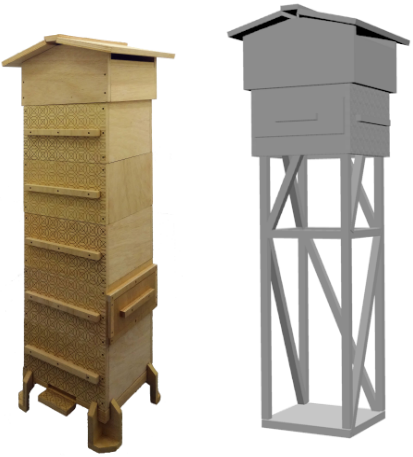
This paper describes an artistic installation, shown in the IJCAI-2015 exhibition, centering around the theme of bee monitoring. The centerpiece of the installation is the top of a Warr´e beehive constructed using open source digital fabrication and mounted on scaffolds. A Warr´e hive is a sustainable beehive originally designed by the Warr´e around 1920. The hive is 2.5 m high so that visitors can put their head inside it and experience a visual and auditory artistic interpretation of hive activity, making this an interactive immersive installation. The Scaffolded Hive will be a very visible beautiful landmark (Figure 1).
Three further components are added:
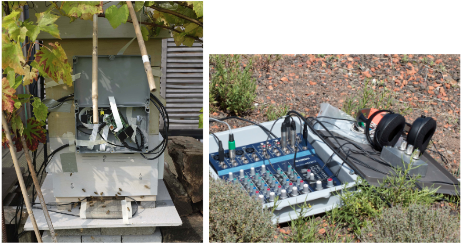
- An 8-channel sound installation plays continuously inside the hive. This sound installation is based on recordings of actual bee and environmental sounds in the broodnest of an urban beehive installed on the roof top of the Brussels Urban Bee Laboratory for a complete season (Fig. 2, right). It started with recordings on June 21st 2014, the longest day/shortest night, processed using sophisticated pattern recognition algorithms, and artificial intelligence analysis software, and edited into a 15 minute-piece using Max/MSP by adding swirling electronic sound clusters to sonify the increase and decrease of swarm activity in the hive.
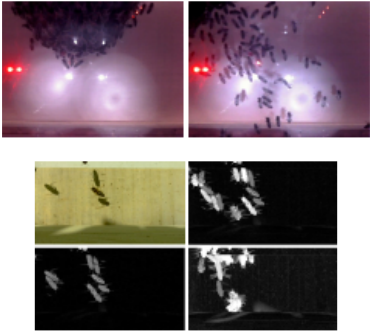
- A video shows 365 days of activity inside a real observation beehive, played back at higher speed. The images were recorded with an infrared camera inside the hive (Fig. 2, left) and processed using pattern recognition, AI and computer graphics algorithms (Fig. 3). These
- images give a stunning visual experience of a colony in action.
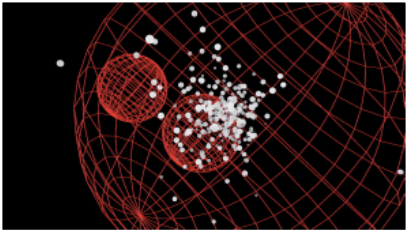
- A second video shows a graphical rendering of AI analysis of colony behavior combining real audio data with measurements of microclimate inside the hive: temperature, CO2 and humidity and using DEEP LEARNING to detect patterns in the data (Fig. 4).
2 Artistic goals and production
The Scaffolded Sound Beehive is part of a series of ecological instrumented beehives leading towards a fully biocompatible intelligent beehive [Maes, 2013]. These beehives allow me to study the tight interaction between city honeybees and urban ecosystems, using artistic research practices and in collaboration with scientists. My preoccupations with bees come partly from a fascination with these amazing insects: Bees exhibit very original solutions to the challenges that social insects face, e.g. on the level of communication and collective decision making. They are an endless source of visually stunning images and sounds and their remarkable collective behavior provides inspiration and metaphors for the functioning of human society. But in many industrialised nations, bee colonies are now threatened. So I work also towards an improvement of the environment of bees with the creation of urban gardens and guerilla planting and I use bees as bio-indicators to make citizens aware of the increasingly negative effects of our life styles and methods of industrial production.
3 Relationship to AI
The Scaffolded Sound Beehive uses a broad range of pattern recognition and AI techniques. As a special contribution to IJCAI, a project was carried out to use Deep Learning techniques using massive data from sound and microclimate in order to get an interpretation of hive activity. The data were transformed into a multi-dimensional feature space, and presented to a Deep Learning network to extract categories capturing patterns of activity through unsupervised learning. An original visualisation was developed (see Figure 4) which represents categories as attractors in a projected 3d space, with the size of the attractor reflecting the strength of the category.
4 Context of the work
The Brussels Urban Bee Lab [BUBL] is an independent international collective of artists, scientists, beekeepers, technicians and creative people. It was founded by AnneMarie Maes in 2009. BUBL uses artistic, scientific and technological research approaches to tackle challenges related to sustainability and the monitoring and survival of city honeybees. An extensive rooftop garden in the centre of Brussels hosts the headquarters of the BUBL laboratory. It is giving place to several experimental beehives and instrumentation equipment. From this laboratory, data is continuously being broadcast through streaming technology.
The Brussels Urban Bee Lab operates mainly through artistic installations and workshops. The group has produced several very original beehives and produced art works shown in international exhibitions. The installations explore highly experimental technologies, such as microbial fuel cells, digital and organic fabrication using OpenStructures, biomimicry, spatialised sonification, web-based continuous data streaming, data mining based on Artificial Intelligence, organic electronics, solar energy for powering low-energy computing, etc.
5 Acknowledgement
Members of the Brussels Urban Bee Lab that helped to realize the current installation include Balthazar de Tonnac, Yacine Sebti, Vincent Malstaf, Lennert De Taye, Billy Bultheel, Joeri Bultheel Bob Mott`e. Funding was received from the Flemisch Ministry of Culture and the Flemish Community Commission of the Brussels-Capital Region, as well as the Culture Program of the European Community (ALOTOF project).
@inproceedings{ijcai2015p351,
  title     = {The Scaffolded Sound Beehive},
  author    = {Maes, AnneMarie},
  booktitle = {Proceedings of the Twenty-Fourth International Joint Conference on
               Artificial Intelligence, {IJCAI-15}},
  publisher = {International Joint Conferences on Artificial Intelligence},
  editor    = {Qiang Yang and Michael Wooldridge},
  pages     = {2480--2480},
  year      = {2015},
  month     = {7},
  note      = {Special Track on Artificial Intelligence and the Arts},
  url       = {https://ijcai.org/proceedings/2015/351},
}
TY - CPAPER TI - The Scaffolded Sound Beehive AU - Maes, AnneMarie T2 - Proceedings of the Twenty-Fourth International Joint Conference on Artificial Intelligence, IJCAI-15 PB - International Joint Conferences on Artificial Intelligence PY - 2015 SP - 2480 EP - 2480 UR - https://ijcai.org/proceedings/2015/351 ER -Copied
Machine-readable versions of this paper, for tools and AI agents:





