
Unsupervised Learning of an IS-A Taxonomy from a Limited Domain-Specific Corpus
Proceedings of the Twenty-Fourth International Joint Conference on Artificial Intelligence. Main Track. Pages 1434-1440.
© 2015 International Joint Conferences on Artificial Intelligence
Abstract
Taxonomies hierarchically organize concepts in a domain. Building and maintaining them by hand is a tedious and time-consuming task. This paper proposes a novel, unsupervised algorithm for automatically learning an IS-A taxonomy from scratch by analyzing a given text corpus. Our approach is designed to deal with infrequently occurring concepts, so it can effectively induce taxonomies even from small corpora. Algorithmically, the approach makes two important contributions. First, it performs inference based on clustering and the distributional semantics, which can capture links among concepts never mentioned together. Second, it uses a novel graph-based algorithm to detect and remove incorrect is-a relations from a taxonomy. An empirical evaluation on five corpora demonstrates the utility of our proposed approach.
- [Carlson et al., 2010] Andrew Carlson, Justin Betteridge, Bryan Kisiel, Burr Settles, Estevam R Hruschka Jr, and Tom M Mitchell. Toward an architecture for never-ending language learning. In Proc. of the 24th AAAI, 2010.
- [Cederberg and Widdows, 2003] Scott Cederberg and Dominic Widdows. Using lsa and noun coordination information to im- prove the precision and recall of automatic hyponymy extraction. In Proc. of the 7th HLT-NAACL, pages 111-118, 2003.
- [Davidov and Rappoport, 2006] Dmitry Davidov and Ari Rap- poport. Efficient unsupervised discovery of word categories us- ing symmetric patterns and high frequency words. In Proc. of the 44th ACL, pages 297-304. ACL, 2006.
- [Fader et al., 2011] Anthony Fader, Stephen Soderland, and Oren Etzioni. Identifying relations for open information extraction. In Proc. of the 2011 EMNLP Conference, pages 1535-1545, 2011.
- [Harris, 1968] Z. S. Harris. Mathematical structures of language. Wiley, 1968.
- [Healy, 1979] M Healy. Outliers in clinical chemistry quality- control schemes. Clin. Chem., 25(5):675-677, 1979.
- Marti A Hearst. Automatic acquisition of hyponyms from large text corpora. In Proc. of the 14th Conference on Com- putational Linguistics, pages 539-545. ACL, 1992.
- [Kozareva and Hovy, 2010] Zornitsa Kozareva and Eduard Hovy. A semi-supervised method to learn and construct taxonomies using the web. In Proc. of the 2010 EMNLP Conference, pages 1110- 1118. ACL, 2010.
- [Liu et al., 2005] Tao Liu, XL Wang, Y Guan, ZM Xu, et al. Domain-specific term extraction and its application in text classi- fication. In 8th Joint Conference on Information Sciences, pages 1481-1484, 2005.
- [Michel et al., 2011] Jean-Baptiste Michel, Yuan Kui Shen, Aviva Presser Aiden, et al. Quantitative analysis of culture using millions of digitized books. Science, 331(6014):176-182, 2011.
- [Navigli et al., 2011] Roberto Navigli, Paola Velardi, and Stefano Faralli. A graph-based algorithm for inducing lexical taxonomies from scratch. In Proc. of the 22nd International Joint Conference on Artificial Intelligence, pages 1872-1877, 2011. IJCAI
- [Ponzetto and Strube, 2011] Simone Paolo Ponzetto and Michael Strube. Taxonomy induction based on a collaboratively built knowledge repository. Artificial Intelligence, 175(9):1737-1756, 2011.
- [Ravichandran and Hovy, 2002] Deepak Ravichandran and Eduard Hovy. Learning surface text patterns for a question answering system. In Proc. of the 40th Annual Meeting of ACL, pages 41- 47. ACL, 2002.
- [Schoenmackers et al., 2010] Stefan Schoenmackers, Oren Etzioni, Daniel S Weld, and Jesse Davis. Learning first-order horn clauses from web text. In Proc. of the 2010 Conference on Empiri- cal Methods in Natural Language Processing, pages 1088-1098. ACL, 2010.
- [Snow et al., 2004] Rion Snow, Daniel Jurafsky, and Andrew Y Ng. Learning syntactic patterns for automatic hypernym discovery. Advances in Neural Information Processing Systems 17, 2004.
- [Snow et al., 2006] Rion Snow, Daniel Jurafsky, and Andrew Y Ng. Semantic taxonomy induction from heterogenous evidence. In Proc. of the 44th ACL, pages 801-808. ACL, 2006.
- [Turney, 2005] Peter D. Turney. Measuring semantic similarity by latent relational analysis. In Proc. of the 19th International Joint Conference on Artificial Intelligence, pages 1136-1141, 2005. IJCAI
- [Velardi et al., 2012] Paola Velardi, Roberto Navigli, Stefano Far- alli, and Juana Ruiz Martinez. A new method for evaluating au- tomatically learned terminological taxonomies. In Proc. of the 8th Conference on International Language Resources and Eval- uation, 2012.
- [Velardi et al., 2013] Paola Velardi, Stefano Faralli, and Roberto Navigli. OntoLearn Reloaded: A Graph-Based Algorithm for Taxonomy Induction. Computational Linguistics, 39(3):665- 707, 2013.
- [Washtell and Markert, 2009] Justin Washtell and Katja Markert. A comparison of windowless and window-based computational as- sociation measures as predictors of syntagmatic human associa- tions. In Proc. of the 2009 EMNLP Conference, pages 628-637, 2009.
- [Widdows, 2003] Dominic Widdows. Unsupervised methods for developing taxonomies by combining syntactic and statistical in- formation. In Proc. of the 2003 HLT-NAACL Conference, pages 197-204, 2003.
- [Wu et al., 2012] Wentao Wu, Hongsong Li, Haixun Wang, and Kenny Q Zhu. Probase: A probabilistic taxonomy for text un- derstanding. In Proc. of the 2012 International Conference on Management of Data, pages 481-492, 2012.
- [Yang, 2012] Hui Yang. Constructing task-specific taxonomies for document collection browsing. In Proc. of the 2012 Joint Confer- ence on Empirical Methods in Natural Language Processing and Computational Natural Language Learning, pages 1278-1289. ACL, 2012.
- [Zavitsanos et al., 2011] Elias Zavitsanos, Georgios Paliouras, and George A Vouros. Gold standard evaluation of ontology learning methods through ontology transformation and alignment. IEEE Trans. on Knowledge and Data Engineering, 23(11):1635-1648, 2011.
References were extracted automatically from the PDF and may contain errors.
Full text extracted automatically from the PDF; figures, tables and equations may differ. The PDF is the version of record.
1 Introduction
Domain ontologies play an important role in many NLP tasks, such as Question Answering, Semantic Search, and Textual Entailment. Taxonomies are considered the backbone of ontologies, as they organize all domain concepts hierarchically through is-a relations, which enables sharing of information among related concepts.
Many handcrafted taxonomies have been built that capture both open-domain (e.g., WordNet) and domain-specific (e.g., MeSH, for the medical domain) knowledge. Yet, our knowledge is constantly evolving and expanding. Consequently, even domain-specific, handcrafted taxonomies inevitably lack coverage, and are expensive to keep up-todate. This has motivated the interest in automatically learning taxonomies from text. Initially, systems focused on extending existing taxonomies [Widdows, 2003; Snow et al., 2006]. Recently, there has been growing interest in automatically constructing entire taxonomies from scratch. Existing approaches learn taxonomies by analyzing either documents on the Web [Kozareva and Hovy, 2010; Wu et al., 2012] or a combination of a domain-specific corpus and the Web [Velardi et al., 2013; Yang, 2012].
This paper presents TAXIFY, a novel domain-independent, unsupervised approach that learns a taxonomy solely from a domain-specific corpus. This helps focus a learned taxonomy on the most important concepts in a specific corpus and minimizes the risk of including unrelated concepts extracted from irrelevant documents. TAXIFY learns accurate taxonomies that include infrequently observed concepts and relations that frequentist approaches typically discard [Kozareva and Hovy, 2010; Yang, 2012]. Specifically, instead of discarding single-source edges, TAXIFY propagates evidence from multi-source edges to single-source edges extracted from the same context.
Algorithmically, we make two important contributions. First, we use a clustering-based inference strategy that exploits distributional semantics to improve a taxonomy's coverage. In contrast, previous approaches improved coverage by either only considering pairwise concept similarities [Snow et al., 2004] or performing purely syntactic inference [Velardi et al., 2013]. Second, we propose a novel graph-based algorithm to detect and remove incorrect edges from a taxonomy in order to improve its precision. In contrast, existing pruning techniques [Kozareva and Hovy, 2010; Velardi et al., 2013] attempt to maximize a taxonomy's connectivity, and only specifically search for incorrect edges in special cases (e.g., breaking a cycle). Furthermore, they typically assume that edges covered by multiple paths are more likely to be correct. However, we argue and show empirically that in certain cases removing edges that appear in many paths can significantly improve a learned taxonomy's precision.
Empirically, we compare TAXIFY to two state-of-theart approaches, Kozareva and Hovy [2010] and Velardi et al. [2013], on five different domains. We find that TAXIFY outperforms them on the tested corpora. Additionally, an ablation study shows that (i) our clustering-based inference increases the number of correct edges by between 25.9% and 68.6%, and (ii) our pruning strategy increases precision by between 8.0% and 15.0% on average. Finally, TAXIFY's source code, data, and a demo are publicly available at http://dtai.cs.kuleuven.be/software/taxify.
2 Taxonomy Learning
We first introduce some basic terminology. A concept is an entity (either abstract or concrete) relevant for a certain domain, expressed as a simple noun (e.g., dolphin) or a noun phrase (e.g., Siberian tiger). When two concepts appear in an is-a relation (e.g., mammal → fox), we refer to the mostspecific concept (e.g., fox) as the subtype, and to the broader one as the supertype (e.g., mammal).
Given a plain-text domain-specific corpus, TAXIFY learns an is-a taxonomy. The taxonomy is modeled as a directed acyclic graph G = (C, E), where C is a set of vertices, each denoting a concept, and E is a set of edges, each denoting an is-a relationship. An edge (x, y) ∈ E, written as x → y, denotes that subtype y ∈ C has supertype x ∈ C. Using a graph instead of a tree allows a concept to have multiple supertypes, which reflects how humans classify objects.
At a high level, TAXIFY works in four phases. First, an initial set of is-a relations is identified, validated and added to the taxonomy. Second, coverage is increased through a clustering-based inference procedure. Third, precision is improved by identifying and discarding incorrect edges. Fourth, a confidence value is computed for each fact.
2.1 Constructing the initial taxonomy
TAXIFY builds the initial taxonomy as follows.
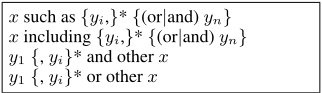
Identify seed set of is-a relations. To identify an initial set of is-a relations, TAXIFY applies the Hearst patterns [Hearst, 1992] shown in Table 1 to the corpus. However, Hearst patterns often overspecify is-a relations, by including generic words (e.g., "large") in a concept. As a handcrafted blacklist of modifiers may not generalize well across different corpora, TAXIFY computes a TF-IDF-like domain-specificity score for each word w:
where the first part models the term frequency normalized by its overall frequency in English [Liu et al., 2005], while the second part favors rare terms. nEng(w) and fEng(w) are the absolute and relative frequency of w in English as approximated by the Google Ngram frequency [Michel et al., 2011].
Next, TAXIFY canonicalizes each concept by processing the concept modifiers from left to right until it encounters the first modifier w such that ds(w) > α1, where α1 is a userdefined parameter. All modifiers before w are discarded from the concept. After canonicalizing both a subtype y and its supertype x, the edge x → y is added to G.
Increase connectivity and coverage by syntactic inference.
TAXIFY identifies additional relationships to include in the taxonomy by performing syntactic inference on concepts containing modifiers (e.g., whale shark) as these represent a specialization of another concept. Concretely, whenever TAXIFY adds a multi-word concept to the taxonomy, it also adds its linguistic head as direct supertype (e.g., shark → whale shark). Then, TAXIFY expands the coverage of the taxonomy by, for each non-leaf concept x, scanning the corpus to (i) find all noun phrases (NPs) appearing at least twice whose head is x and (ii) add these NPs to the taxonomy as subtypes of x.
Improve precision by domain-specific filtering. Domainspecific filtering [Liu et al., 2005; Velardi et al., 2013] is one way to increase the precision of a taxonomy. Given a domain-specificity threshold α2, TAXIFY removes all singleword concepts c from the taxonomy for which ds(c) < α2, where ds is computed by Equation (1).
2.2 Inferring novel facts
Since Hearst patterns occur infrequently, many interesting concepts will not be extracted. One way to improve coverage is to search for semantically-related concepts within the corpus. A well-studied solution is to exploit concepts that cooccur in lists [Cederberg and Widdows, 2003; Snow et al., 2004; Davidov and Rappoport, 2006]. This approach suffers from two main drawbacks.
First, it can only capture links between concepts that explicitly co-occur. To overcome this limitation, TAXIFY adopts an approach based on distributional semantics [Harris, 1968]. To identify similar concepts, our approach extracts relations from the corpus. Two concepts are similar if they often appear in the same argument position of similar relations. For example, knowing that cows chew grass and deer chew grass provide some evidence that cows and deer are related concepts, as they share a common property. This allows TAXIFY to capture links between concepts that appear in separate sentences, or even documents.
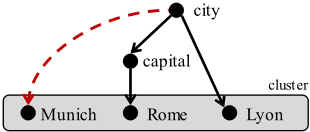
Second, explicit co-occurrence does not necessarily imply that two concepts have the same immediate supertype. For example, knowing capital →Rome and that Rome is similar to Munich, may lead to the erroneous inference capital → Munich. To address this problem, TAXIFY clusters related concepts, searches for their most specific common ancestor, and assigns it as supertype for the new concepts. As illustrated in Figure 1, clustering Munich with Rome and the known concept Lyon, TAXIFY finds city as common ancestor, and thus infers that Munich is a city, and not a capital.
Computing pairwise similarity. TAXIFY runs a state-ofthe-art OpenIE relation extractor [Fader et al., 2011] on the entire corpus to obtain a list of triples of the form r(csub, cobj) (e.g., chew(cow,grass)), where csub, cobj ∈
Ccand are candidate concepts, and r ∈ R is a relation. To reduce noise, TAXIFY removes from Ccand all concepts that appear in only one triple. Then, it creates a matrix mfeat = |Ccand| × 2|R| where:
- each row represents a concept c ∈ Ccand;
- each column is a pair (r, pos) with pos ∈ {subject, object};
- each cell value (c, rpos) is computed as log(1 + x), where x is the number of times c was extracted in position pos for relation r.
Each cell is then weighted by the negative entropy of the column vector that contains the cell, in order to reward features that are more discriminative in terms of a concept's semantics [Turney, 2005]. Intuitively, mfeat uses the list of triples where the concept appears as a set of features that capture contextual information about the concept.
Finally, TAXIFY creates a symmetric similarity matrix msim = |Ccand| × |Ccand| by defining the following pairwise concept similarity:
The first term is the cosine similarity between concepts ⃗ c1 and ⃗ c2 in mfeat. The second term weights the similarity based on the number of relations that a concept appears in, which gives higher weight to similarities backed by more evidence.
Clustering concepts. TAXIFY then infers new is-a relations in the following way. First, it uses K-Medoids to cluster the concepts based on the pairwise similarity values defined in msim. For each cluster that contains at least two known concepts (i.e., already in the taxonomy) and at least one new concept (i.e., found in a relational triple), it searches for the lowest common ancestor (LCA) among the known concepts (i.e., their most-specific common abstraction) and, if it exists, assigns it as the supertype to all new concepts in the cluster. Requiring each cluster to have two known concepts helps avoid incorrect inferences such as the one in our example with Rome and Munich. This procedure is repeated several times to minimize the impact of the initial random seed selection in K-Medoids. At the end of this iterative procedure, all edges inferred at least once are added to G.
Since this procedure needs to walk the graph, before executing it we break all present cycles.
2.3 Detecting incorrect edges
Learned taxonomies contain incorrect edges. TAXIFY attempts to detect incorrect edges in an unsupervised fashion by exploiting the following insight: when people provide illustrative examples of a subtype, they tend to use closely related supertypes [Kozareva and Hovy, 2010]. That is, we are more likely to write "mammals such as bottlenose dolphins" than "organisms such as bottlenose dolphins", even though both are true. Based on this observation, we postulate that it is unlikely for a taxonomy to contain a long path connecting x and y, if x → y was extracted by a Hearst pattern. If it does, it increases the chance that one of the edges in this long path is incorrect. Thus, the odds that an edge is incorrect increase each time it appears in such a path.
Figure 2 illustrates this on a portion of our learned animal taxonomy, where the red edge is the best candidate for exclusion from the taxonomy, as it appears in three long paths covered by three is-a relations extracted by a Hearst pattern, represented by dashed edges.
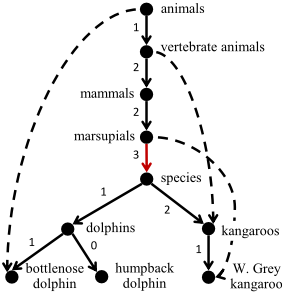
Algorithm 1 outlines our procedure for detecting incorrect edges. As input, it receives the taxonomy G and a threshold β that discriminates between short and long paths. The procedure loops through the following steps until there is no edge covered by a long path. First, it counts how often each edge appears in a path longer than β that is covered by an edge extracted by a Hearst pattern. Second, it removes the highestcount edge from the taxonomy as well as all edges extracted by the same Hearst pattern in the same sentence, as their probabilities of being incorrect are correlated.
TAXIFY computes β for each corpus separately by using a standard outlier detection technique and sets β = avg(L) + 2.5 · std(L) [Healy, 1979], where L is a list of integers. L contains one integer for each edge (x, y) ∈ E extracted by a Hearst pattern representing the length of the shortest path connecting x to y that does not include the edge itself.
Finally, since this procedure creates disconnected components in the graph, TAXIFY retains only the largest component, as the smaller ones typically diverge from the central topic of the corpus.
2.4 Assigning confidences to edges
Finally, TAXIFY assigns a confidence value to each edge, differentiating among edges: (i) directly extracted by a Hearst pattern, (ii) derived by syntactic inferences, and (iii) derived by clustering-based inferences. While not strictly necessary, confidence values provide richer output as they allow ranking edges by the strength of their evidence.
Algorithm 1: DETECTINCORRECTEDGES(G, β)
m ← empty map of < edge, counter > 1 Eext ← getHearstExtractedEdges(E, G) 2 foreach edge e ∈ Eext do 3 P ← getAllP athsCoveredBy(e, G) 4 foreach path p ∈ P s.t. length(p) > β do 5 foreach edge ecovered ∈ p do 6 inc. counter in m at key ecovered 7 8 9 10 e∗ ← getHighestCountEdge(m) 11 if exists e∗ with count > 0 then 12 remove e∗ fromG 13 Econtext ← getContextualEdges(e∗ ) 14 remove all edges in Econtext fromG 15 DETECTINCORRECTEDGES(G, β) 16 else 17 remove smaller components fromG 18 19Extracted edges. The initial confidence value of each extracted edge is:
where n(0) e is the number of times e was extracted by a Hearst pattern, as in NELL [Carlson et al., 2010]. This models the fact that the more times an edge is extracted, the more likely it is to be correct. However, in smaller corpora many relevant relationships will only be extracted once, 1 thus a mere frequency count is unsatisfactory.
To motivate our solution, consider the following example. Assume that mammal → deer, mammal → otter, and mammal → fox are extracted by the same Hearst pattern from the same sentence. The first two edges are observed only once, while mammal → fox is extracted several times. Intuitively, the additional observations of mammal → fox give further evidence that the first two extractions are correct.
To capture this intuition, we iteratively update ne by incorporating evidence from other edges as follows:
where p(e′ ) is given by Equation 3 and i is the iteration. In the first iteration, Context(e) returns the set of edges extracted from the same sentence as e that have a higher confidence than e. In subsequent iterations, Context(e) only returns those edges whose confidence became higher than e as an effect of the previous iteration. Since p(e′ )i2 is always less than 1, propagated evidence has always a weaker impact than a direct extraction. Furthermore, the effect of propagated evidence diminishes exponentially to model the intuition that each iteration increases the probability of introducing errors. The final confidence is obtained by using the final value of ne instead of n(0) e in Equation 3.
1 92% - 98% of all edges in the analyzed corpora.
As concrete example, suppose n(0) e (mammal →deer) = 1 and n(0) e (mammal → fox) = 3, and thus initially p(mammal → deer) = 0.5 and p(mammal → fox) = 0.875. Assume that in iteration 1 Context(mammal → deer) = {mammal → fox}, then n(1) e (mammal → deer) = 1 + p(mammal → fox) = 1.875. Assuming that in iteration 2 Context(mammal → deer ) = ∅, then the final value for p(mammal → deer ) = 1 - 0.51.875 which is approximately 0.727.
Syntactically-inferred edges. The confidence of a syntactic inference should be functional to the strength of the tie between a modifier and its head. For instance, we expect p(shark → whale shark) > p(shark → aggressive shark), as aggressive is a modifier that applies to more concepts and is thus less informative. To capture this intuition, TAXIFY computes a variant of the pointwise mutual information that accounts for statistical significance (PMIsig) [Washtell and Markert, 2009] between the subtype modifier and its head:
where f(m) and f(h) are respectively the corpus frequencies of the modifier and the head, f(m, h) is their joint frequency, and W is the total number of words in the corpus. To get the final confidence value for an edge, TAXIFY applies a log transformation to PMIsig and then normalizes it to be in [0, 0.8]. This rescaling supports the intuition that an inferred edge should have a lower confidence than an edge observed several times in text because (i) if an extracted concept is incorrect, anything syntactically inferred from it would likely be incorrect too, (ii) even if an extracted concept is correct, a syntactic inference from it may be incorrect.
Edges inferred by clustering. Each edge lca → c inferred through clustering receives as confidence value:
where i ranges over the clustering iterations where lca → c was inferred, and pi is defined as:
where lca is the lowest common ancestor of the known concepts {c1, . . . , cn} that appear in the same cluster as c in iteration i, sim(·) is defined by Equation 2, and Plca⇒ck is the product of the edge confidences on the path from lca to ck. Intuitively, pi(lca → c) is a similarity-weighted average over paths connecting each known concept ck to lca. This is similar in spirit to how Snow et al. [2004] update an edge's confidence based on concepts that share a common ancestor in the graph.
As an example, we would calculate p(city → Munich) for the clustering shown in Figure 1 as:
where R stands for Rome, L for Lyon, and M for Munich.
3 Evaluation
The goal of the empirical evaluation is to address the following two questions:
- How does our approach compare to state-of-the-art algorithms on this task?
- What is the effect of each of the system's components on its overall performance?
Taxonomy evaluation is a hard task, as significantly different taxonomies can be equally correct in modeling a domain. Moreover, domains can be modeled at various levels of specificity. As a consequence, evaluation methods based on a comparison to a reference taxonomy (e.g., Zavitsanos, Paliouras, and Vouros 2011; Velardi et al. 2012) provide a meaningful comparison only when the set of concepts is fixed, as they penalize the introduction of new correct concepts. For these reasons, to fully compare systems that learn taxonomies from scratch we proceed in two steps. First, we manually inspect the learned taxonomies to assess the correctness of concepts and edges independently from their presence in a particular reference taxonomy. Second, given a reference taxonomy, we check how many of its concepts and edges are covered by the learned taxonomies.
To address the first question, we compare TAXIFY with two systems that can learn domain-specific taxonomies entirely from scratch, namely K&H [Kozareva and Hovy, 2010] and OntoLearn [Velardi et al., 2013]. We implemented our own version of K&H. Since their bootstrapping approach terminates immediately in limited corpora, we relaxed some constraints to obtain a more meaningful comparison. Specifically, (i) we provided ten seed terms instead of one, (ii) we relaxed their patterns to match more than two subtypes, and (iii) we included basic syntactic inference. All comparisons with OntoLearn are made against their best run (DAG[0,99]), provided by its authors.
We use five real-world, plain-text corpora from different domains to evaluate and compare learned taxonomies, whose statistics are shown in Table 2. The first two are biomedical corpora, DDI 2 and PMC. 3 We also created three new corpora fromWikipedia, which we call ANIMALS, PLANTS and VEHICLES, by selecting all article abstracts that contain the words animals, plants, and vehicles, respectively.
To address the second question, we use a subset of these corpora to study the effect of each of TAXIFY's components on its overall performance.
3.1 Manual evaluation
Methodology. To assess the quality of the learned taxonomies, we report two evaluation metrics: precision and the number of correct facts. We use the number of correct facts or number of true positives instead of the recall because computing the recall requires a gold standard, which we lack.
Our taxonomies are too large to label each learned is-a relation manually. Therefore, we labelled 400 edges from each learned taxonomy to assess its accuracy. For K&H and OntoLearn, we randomly sampled and labelled 400 edges for each taxonomy. For TAXIFY, we divided all is-a relations into ten, equal-width bins based on their confidence (e.g., as done in Schoenmackers et al., 2010). Then we estimated a bin's precision and number of correct facts by labeling a random sample of 40 edges from the bin. An edge x → y is only labeled as correct if both (i) "y is an x" is a valid statement, and (ii) y and x are relevant concepts for the given domain. For example, the edge tree → oak would be labeled as incorrect when evaluating an animal taxonomy.
2 http://www.cs.york.ac.uk/semeval-2013/task9/
3 http://www.ncbi.nlm.nih.gov/pmc/
| #Documents | #Sentences per document | #Words | |
|---|---|---|---|
| ANIMALS | 25,016 | 10.5 | 5,656,301 |
| PLANTS | 64,545 | 7.7 | 9,370,609 |
| VEHICLES | 20,540 | 9.7 | 4,446,830 |
| DDI | 714 | 8.6 | 137,882 |
| PMC | 42,928 | 11.8 | 11,756,503 |
Since K&H requires root concepts as input, we picked drug, medication, agent for DDI, and disease, gene, protein, cell for PMC. We evaluated both the taxonomies rooted at these concepts and the unrooted taxonomies, since TAXIFY and OntoLearn do not need domain-specific inputs. For the Wikipedia corpora, we rooted all taxonomies at animal, plant, vehicle and their WordNet synonyms.
Parameter setting. We set TAXIFY's parameters as follows. For domain-specific filtering, we set α1 = 0.4 and α2 = 1.7 by assessing the accuracy of different filtering thresholds on approximately 500 manually labeled words on validation data from the PMC domain and an AI domain which was only used for algorithm development. α2 is stricter than α1 because many words are valid as concept modifiers (e.g., white shark), but not as a single-word concept (e.g., white). For the clustering-based inference, we set the number of clusters k for each corpus as the number of concepts to cluster divided by a parameter ψ. In each iteration, we randomly sampled ψ from the interval [3,7]. Randomizing ψ helps vary cluster compositions across iterations which improves the chance of finding an LCA. We did not try any other intervals for ψ.
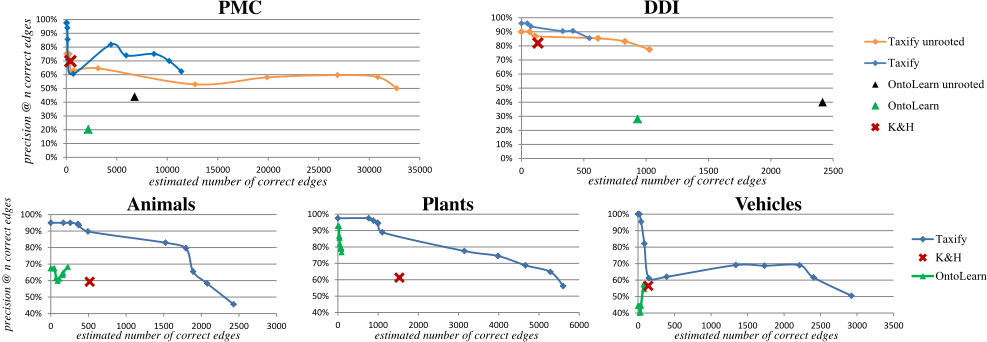
Results. Figure 3 reports the results. In general, TAXIFY outperforms both competing systems. An exception is the large number of correct edges of OntoLearn on the unrooted DDI taxonomy, which comes at the cost of very low precision, mainly due to the extraction of several vague or generic concepts (e.g., time, cause, rate). Occasionally, K&H achieves precision comparable to TAXIFY, but totalling one order of magnitude fewer correct edges. K&H's approach is indeed very conservative, as it is conceived for working at Web scale. Additionally, we found that TAXIFY's lower precision on PMC arises as a few incorrect edges link many irrelevant concepts to the taxonomy. TAXIFY's incorrect edge detection algorithm mitigates this problem, but it is slightly less effective due to the size and breadth of PMC.
3.2 Comparison with reference taxonomies
To assess the ability of taxonomy learners to cover reference concepts and edges, we compare the three taxonomies learned on the Wikipedia corpora to the corresponding WordNet subhierarchies rooted at animal#n#1, plant#n#2, and vehicle#n#1. We say that a learned concept c "covers" WordNet (i.e., c ∈ CWN) if it appears in the target WordNet subhierarchy, while an edge x → y covers WordNet if x appears as a direct or indirect supertype of y in the subhierarchy. Table 3 shows that TAXIFY is able to cover a significantly higher number of concepts and edges compared to the competing systems on all three domains. However, the absolute numbers remain low, suggesting that larger corpora are needed to achieve a higher coverage of WordNet. We did not replicate Kozareva and Hovy [2010]'s WordNet experiment because it is not suitable for evaluating systems that learn taxonomies from scratch, as previously discussed [Navigli et al., 2011; Velardi et al., 2012; 2013].
Additionally, we compared the taxonomy learned from the DDI corpus to the handcrafted biomedical MeSH taxonomy. 4 Table 4 shows that out of 545 correct edges extracted by TAXIFY, 170 appear in the MeSH taxonomy. The remaining correct edges can be classified into those that refine MeSH, and those that extend it. We say that two edges x → x′ and x′ → y refine the MeSH taxonomy if the edge x → y appears in MeSH as x′ increases the MeSH's level of detail. All other correct edges extend MeSH by either introducing a new concept or assigning an additional supertype to a known concept.
3.3 Evaluation of TAXIFY's subcomponents
We performed an ablation study on DDI, ANIMALS and VEHICLES to analyze the impact of TAXIFY's components on its overall performance. We compare the full TAXIFY system to three variants: TAXIFY without syntactic inference, TAXIFY without clustering-based inference and TAXIFY without pruning. The results are shown in Figure 4.
4 http://www.ncbi.nlm.nih.gov/mesh
| ANIMALS | PLANTS | VEHICLES | ||||
|---|---|---|---|---|---|---|
| |CWN| | |EWN| | |CWN| | |EWN| | |CWN| | |EWN| | |
| TAXIFY | 532 | 314 | 1016 | 612 | 120 | 89 |
| OntoLearn | 180 | 144 | 81 | 30 | 63 | 52 |
| K&H | 275 | 182 | 468 | 211 | 63 | 16 |
| WordNet totals | 3999 | 4356 | 4487 | 4699 | 520 | 585 |
First, syntactic inference significantly increases the number of correct edges in the learned taxonomies. Syntacticallyinferred edges play two important roles in taxonomy learning. One, they ensure the connectivity of the taxonomy. Two, they add additional concepts as leaf nodes in the taxonomy, by capturing relations that are infrequently observed in text.
Second, including the clustering-based inference results in more correct edges in all domains. Specifically, it increases the number of correct edges by 25.9% on ANIMALS, 68.6% on VEHICLES, and 27.0% on DDI compared to the no clustering-based inference baseline. The inference adds 2110, 2495, and 84 new concepts, respectively, to the taxonomies.
Third, TAXIFY's pruning strategy consistently improves precision across all confidence levels. Averaged over all confidence levels, the edge removal improves precision by 8.0% on ANIMALS and 15.0% on VEHICLES. On DDI the improvement (0.7%) is marginal, as the unpruned taxonomy is already highly precise. Averaged across the three corpora, 81% of the edges removed by our pruning strategy were incorrect.
Finally, we evaluated the benefit that clustering-based inference provides over pairwise inference. We created a variant of TAXIFY that replaces our clustering method with a pairwise approach that assigns each new concept the supertype of the most similar concept in the taxonomy. Compared to the pairwise strategy, our clustering approach increased the number of estimated correct edges by 23.8% on VEHICLES
| Evaluation | Count | Examples |
|---|---|---|
| Already in MeSH | 170 (31.2%) | non-steroidal anti-inflammatory drugs →aspirin, psychotropic agents → tranquilizers |
| Refines MeSH | 118 (21.7%) | highly protein-bound drugs →captopril, oral anticoagulants →warfarin |
| Extends MeSH | 257 (47.1%) | drugs →Tiagabine, TNF-blocking agents →HUMIRA |

and 11.9% on DDI, but resulted in a decrease of 3.2% on ANIMALS. The clustering approach also improved precision on average by 6.2% on ANIMALS, 11.7% on VEHICLES and 0.2% on DDI compared to pairwise inference. 5
These results demonstrate that, in general, the full TAXIFY performs better than any of its variants. In particular, our two main innovations of using a clustering-based inference approach and our novel pruning strategy substantially contribute to TAXIFY's performance.
4 RelatedWork
The task of taxonomy learning can be divided into concept extraction and concept organization. While earlier systems focused on the first task only [Ravichandran and Hovy, 2002; Liu et al., 2005], more recent efforts, like TAXIFY, tackle both tasks simultaneously.
Taxonomy learners typically aim to build either a general, open-domain taxonomy, or domain-specific taxonomies. These settings pose different challenges. Open-domain taxonomy learning (e.g., Ponzetto and Strube 2011; Wu et al. 2012) faces challenges such as analyzing very large textual corpora and coping with lexical ambiguity, but can leverage the massive redundancy in large corpora. Domain-specific taxonomies are typically induced from smaller corpora and thus cannot exploit high data density.
The most relevant related work are the domain-specific taxonomy learners [Kozareva and Hovy, 2010; Velardi et al., 2013]. Kozareva and Hovy [2010] build an initial taxonomy by iteratively issuing Hearst-like patterns on the Web starting from seed terms, and then prune it to only retain the longest paths. Velardi et al. [2013] extract is-a relations from definition sentences using both a domain corpus and the Web. In our experiments, we found that definition sentences tend to extract generic supertypes, creating long chains of irrelevant concepts that limit the system's overall precision. Similar to Kozareva and Hovy, their pruning strategy optimizes the trade-off between retaining long paths and maximizing the connectivity of the traversed nodes. In contrast, TAXIFY can automatically discern if a long path is justified by the domain, or only caused by the presence of an incorrect edge, whose detection and removal significantly improves precision.
5 Graphs for this experiment are available in the online supplement at http://dtai.cs.kuleuven.be/software/taxify
Regardless of the learning setting, several approaches have explored how to increase the coverage beyond Hearst pattern extractions, typically by searching for concepts similar to those already in the taxonomy. One line of work uses coordination patterns [Cederberg and Widdows, 2003; Snow et al., 2004], which requires explicit concept co-occurrence. More recent work looks at distributional similarity (e.g., [Snow et al., 2006]). However, these approaches require massive corpora. In contrast, TAXIFY can capture distributional similarity from a single smaller corpus. Furthermore, prior work (e.g., Cederberg and Widdows, 2003; Snow et al., 2004) tends to focus on similarities between pairs of concepts, whereas we show how a taxonomy learner can benefit from concept clustering.
5 Conclusions
We presented TAXIFY, an unsupervised approach for learning an is-a taxonomy from scratch from a domain-specific corpus. TAXIFY makes two key contributions. First, it uses an approach based on the distributional semantics and clustering to introduce additional edges in the taxonomy. Second, it proposes a novel mechanism for identifying and removing potentially incorrect edges. Empirically, these two contributions substantially improve the system's performance. Furthermore, we found that TAXIFY outperformed two stateof-the-art systems on five corpora. Our corpora varied in size from small to medium, and each setting provides different challenges. The smaller domains were more focused and dense, but had more implicit information whereas the larger domains were sparser and noisier, but had more explicit information. Our evaluation indicates that TAXIFY performs well in these settings, while Web-scale corpora (not tied to a specific domain) would pose different challenges and require a different approach.
In the future, we would like to integrate our system into tasks such as inference rule learning and question answering. Additionally, we would like to modify TAXIFY to work with a combination of a domain-specific corpus and the Web.
Acknowledgements
We thank Steven Schockaert for his helpful feedback. This work was partially supported by the Research Fund KU Leuven (OT/11/051), EU FP7 Marie Curie Career Integration Grant (#294068) and FWO-Vlaanderen (G.0356.12).
@inproceedings{ijcai2015p206,
  title     = {Unsupervised Learning of an IS-A Taxonomy from a Limited Domain-Specific Corpus},
  author    = {Alfarone, Daniele and Davis, Jesse},
  booktitle = {Proceedings of the Twenty-Fourth International Joint Conference on
               Artificial Intelligence, {IJCAI-15}},
  publisher = {International Joint Conferences on Artificial Intelligence},
  editor    = {Qiang Yang and Michael Wooldridge},
  pages     = {1434--1440},
  year      = {2015},
  month     = {7},
  note      = {Main Track},
  url       = {https://ijcai.org/proceedings/2015/206},
}
TY - CPAPER TI - Unsupervised Learning of an IS-A Taxonomy from a Limited Domain-Specific Corpus AU - Alfarone, Daniele AU - Davis, Jesse T2 - Proceedings of the Twenty-Fourth International Joint Conference on Artificial Intelligence, IJCAI-15 PB - International Joint Conferences on Artificial Intelligence PY - 2015 SP - 1434 EP - 1440 UR - https://ijcai.org/proceedings/2015/206 ER -Copied
Machine-readable versions of this paper, for tools and AI agents:





