
User Modeling with Neural Network for Review Rating Prediction
Proceedings of the Twenty-Fourth International Joint Conference on Artificial Intelligence. Main Track. Pages 1340-1345.
© 2015 International Joint Conferences on Artificial Intelligence
Abstract
We present a neural network method for review rating prediction in this paper. Existing neural network methods for sentiment prediction typically only capture the semantics of texts, but ignore the user who expresses the sentiment.This is not desirable for review rating prediction as each user has an influence on how to interpret the textual content of a review.For example, the same word (e.g. good) might indicate different sentiment strengths when written by different users. We address this issue by developing a new neural network that takes user information into account. The intuition is to factor in user-specific modification to the meaning of a certain word.Specifically, we extend the lexical semantic composition models and introduce a user-word composition vector model (UWCVM), which effectively captures how user acts as a function affecting the continuous word representation. We integrate UWCVM into a supervised learning framework for review rating prediction, andconduct experiments on two benchmark review datasets.Experimental results demonstrate the effectiveness of our method. It shows superior performances over several strong baseline methods.
- [Baroni and Zamparelli, 2010] Marco Baroni and Roberto Zamparelli. Nouns are vectors, adjectives are matri- ces: Representing adjective-noun constructions in seman- tic space. In Proceedings of EMNLP, 2010.
- [Bengio et al., 2013] Yoshua Bengio, Aaron Courville, and Pascal Vincent. Representation learning: A review and new perspectives. IEEE Trans. PAMI, 2013.
- [Clark et al., 2008] Stephen Clark, Bob Coecke, and Mehrnoosh Sadrzadeh. A compositional distributional model of meaning. In Quantum Interaction, 2008.
- [Diao et al., 2014] Qiming Diao, Minghui Qiu, Chao-Yuan Wu, Alexander J Smola, Jing Jiang, and Chong Wang. Jointly modeling aspects, ratings and sentiments for movie recommendation (jmars). In SIGKDD. ACM, 2014.
- [Fan et al., 2008] Rong-En Fan, Kai-Wei Chang, Cho-Jui Hsieh, Xiang-Rui Wang, and Chih-Jen Lin. Liblinear: A library for large linear classification. JMLR, 2008.
- [Gao et al., 2013] Wenliang Gao, Naoki Yoshinaga, Nobuhiro Kaji, and Masaru Kitsuregawa. Modeling user leniency and product popularity for sentiment classification. Proceedings of IJCNLP, 2013.
- [Glorot et al., 2011] Xavier Glorot, Antoine Bordes, and Yoshua Bengio. domain adaptation for large-scale senti- ment classification:a deep learning approach. ICML, 2011.
- [Hermann and Blunsom, 2014] Karl Moritz Hermann and Phil Blunsom. Multilingual models for compositional dis- tributed semantics. In Proceedings of ACL, 2014.
- [Kalchbrenner et al., 2014] Nal Kalchbrenner, Edward Grefenstette, and Phil Blunsom. A sentence model based on convolutional neural networks. In ACL. 2014.
- [Kim, 2014] Yoon Kim. Convolutional neural networks for sentence classification. In Conference on EMNLP, pages 1746-1751, 2014.
- [Kiros et al., 2014] Ryan Kiros, Richard Zemel, and Rus- lan R Salakhutdinov. A multiplicative model for learning distributed text-based attribute representations. In NIPS, pages 2348-2356, 2014.
- [Le and Mikolov, 2014] Quoc Le and Tomas Mikolov. Dis- tributed representations of sentences and documents. Pro- ceeding of ICML, 2014.
- [Li et al., 2014] Fangtao Li, Sheng Wang, Shenghua Liu, and Ming Zhang. Suit: A supervised user-item based topic model for sentiment analysis. In AAAI, 2014.
- [Li et al., 2015] Jiwei Li, Dan Jurafsky, and Eudard Hovy. When are tree structures necessary for deep learning of representations? arXiv preprint:1503.00185, 2015.
- [Li, 2014] Jiwei Li. Feature weight tuning for recursive neu- ral networks. Arxiv preprint, 1412.3714, 2014.
- [Liu, 2012] Bing Liu. Sentiment analysis and opinion min- ing. Synthesis Lectures on Human Language Technolo- gies, 5(1):1-167, 2012.
- [Maas et al., 2011] Andrew L Maas, Raymond E Daly, Pe- ter T Pham, Dan Huang, Andrew Y Ng, and Christopher Potts. Learning word vectors for sentiment analysis. In Proceedings of the ACL, 2011.
- [Mikolov et al., 2013] Tomas Mikolov, Ilya Sutskever, Kai Chen, Greg Corrado, and Jeffrey Dean. Distributed rep- resentations of words and phrases and their composition- ality. The Conference on NIPS, 2013.
- [Mitchell and Lapata, 2010] Jeff Mitchell and Mirella Lap- ata. Composition in distributional models of semantics. Cognitive Science, 34(8):1388-1429, 2010.
- [Pang and Lee, 2005] Bo Pang and Lillian Lee. Seeing stars: Exploiting class relationships for sentiment categorization with respect to rating scales. In ACL, 2005.
- [Pang and Lee, 2008] Bo Pang and Lillian Lee. Opinion mining and sentiment analysis. Foundations and trends in information retrieval, 2(1-2):1-135, 2008.
- [Pang et al., 2002] Bo Pang, Lillian Lee, and Shivakumar Vaithyanathan. Thumbs up?: sentiment classification us- ing machine learning techniques. In EMNLP, 2002.
- [Pennington et al., 2014] Jeffrey Pennington, Richard Socher, and Christopher D Manning. Glove: Global vectors for word representation. In EMNLP, 2014.
- [Perozzi et al., 2014] Bryan Perozzi, Rami Al-Rfou, and Steven Skiena. Deepwalk: Online learning of social rep- resentations. In SIGKDD, pages 701-710. ACM, 2014.
- [Qu et al., 2010] Lizhen Qu, Georgiana Ifrim, and Gerhard Weikum. The bag-of-opinions method for review rating prediction from sparse text patterns. In COLING, 2010.
- [Socher et al., 2012] Richard Socher, Brody Huval, Christo- pher D. Manning, and Andrew Y. Ng. Semantic Compo- sitionality Through Recursive Matrix-Vector Spaces. In Proceedings of EMNLP, 2012.
- [Socher et al., 2013] Richard Socher, Alex Perelygin, Jean Wu, Jason Chuang, Christopher D. Manning, Andrew Ng, and Christopher Potts. Recursive deep models for seman- tic compositionality over a sentiment treebank. In Confer- ence on EMNLP, pages 1631-1642, 2013.
- [Srivastava et al., 2014] Nitish Srivastava, Geoffrey Hinton, Alex Krizhevsky, Ilya Sutskever, and Ruslan Salakhutdi- nov. Dropout: A simple way to prevent neural networks from overfitting. JMLR, 15, 2014.
- [Tan et al., 2011] Chenhao Tan, Lillian Lee, Jie Tang, Long Jiang, Ming Zhou, and Ping Li. User-level sentiment anal- ysis incorporating social networks. In SIGKDD, 2011.
- [Tang et al., 2014a] Duyu Tang, Furu Wei, Bing Qin, Ming Zhou, and Ting Liu. Building large-scale twitter-specific sentiment lexicon: A representation learning approach. In COLING, pages 172-182, 2014.
- [Tang et al., 2014b] Duyu Tang, Furu Wei, Nan Yang, Ming Zhou, Ting Liu, and Bing Qin. Learning sentiment- specific word embedding for twitter sentiment classifica- tion. In ACL, pages 1555-1565, 2014.
- [Wilson et al., 2005] Theresa Wilson, Janyce Wiebe, and Paul Hoffmann. Recognizing contextual polarity in phrase-level sentiment analysis. In EMNLP, 2005.
- [Wu and Ester, 2015] Yao Wu and Martin Ester. Flame: A probabilistic model combining aspect based opinion min- ing and collaborative filtering. In WSDM, pages 199-208. ACM, 2015.
- [Xu et al., 2014] Liheng Xu, Kang Liu, and Jun Zhao. Joint opinion relation detection using one-class deep neural net- work. In COLING, pages 677-687, 2014.
- [Zhang et al., 2014] Yongfeng Zhang, Haochen Zhang, Min Zhang, Yiqun Liu, and Shaoping Ma. Do users rate or re- view?: boost phrase-level sentiment labeling with review- level sentiment classification. In SIGIR, pages 1027-1030. ACM, 2014.
References were extracted automatically from the PDF and may contain errors.
Full text extracted automatically from the PDF; figures, tables and equations may differ. The PDF is the version of record.
1 Introduction
Sentiment analysis and opinion mining [Pang and Lee, 2008; Liu, 2012] has attracted a lot of attentions from both industry and research communities in recent years. A fundamental problem in sentiment analysis is to inference the sentiment polarity (e.g. "thumbs up" or "thumbs down") of a document [Pang et al., 2002]. In this paper, we target at a finer grained document-level problem, known as review rating prediction [Pang and Lee, 2005]. Given a review written by a user as input, it calls for inferring the author's evaluation with respect to a numeric ratings (e.g. one to five stars). Majority of existing studies follow Pang and Lee [2005] and cast this problem as a multiclass classification/regression task. They typically employ machine learning algorithms in a supervised learning manner, and build the rating predictor from reviews with accompanying ratings. Under this direction, most studies focus on designing effective context-level [Qu et al., 2010] and user-level features [Gao et al., 2013] for obtaining a better prediction performance.
∗Corresponding author.
Feature engineering is important but labor intensive. It is therefore desirable to extract and organize discriminative features (or representations) automatically from data [Bengio et al., 2013]. For document-level sentiment prediction, an effective way is to learn continuous text representation with neural network. Existing neural network method typically learn continuous word representations (also known as word embeddings) from text corpus [Mikolov et al., 2013; Pennington et al., 2014], and then use them to calculate the representation of a document with semantic composition [Socher et al., 2013; Kalchbrenner et al., 2014; Kim, 2014; Li et al., 2015]. Despite the apparent success of existing neural network methods, they are not effective enough if directly used for review rating prediction. The reason lies in that they typically only use textual semantics of words, but ignore the review author who expresses the sentiment. It is not desirable because different users may use different words to express sentiment, and the same word might indicate different meanings when it is written by different users. For example, a critical user might use "good" to express an excellent attitude, but a lenient user may use "good" to evaluate an ordinary product.
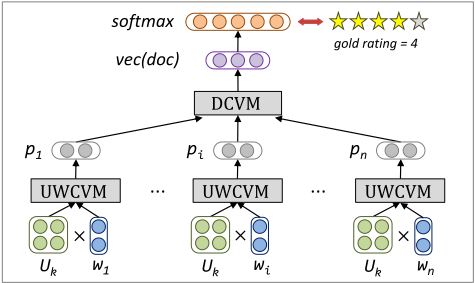
In this paper, we introduce a novel neural network method for review rating prediction by taking user information into account. The intuitive idea is to factor in user-specific modification to the meaning of a certain word. To this end, we extend existing lexical semantic composition methods [Clark et al., 2008; Baroni and Zamparelli, 2010], and introduce a user-word composition vector model (UWCVM) to effectively incorporate user information. Specifically, we employ matrix-vector multiplication as the basic composition function of UWCVM. We represent each word as a continuous vector and each user as a matrix which maps the original word vector to the modified representation. Matrix-vector multiplication is tailored for this scenario, since it can be thought of as a matrix modifying a vector in the field of vector-based compositional semantics [Mitchell and Lapata, 2010]. We integrate UWCVM into a feed-forward neural network for review rating prediction, as illustrated in Figure 1. As is shown, a document composition vector model (DCVM) takes the modified word vector as input and produces the representation of a review. The result of DCVM is leveraged as features to build the rating predictor without any feature engineering. The user representation and parameters of neural networks are trained in an end-to-end fashion with back propagation.
We conduct experiments to evaluate the effectiveness of the proposed method for review rating prediction. We use two benchmark datasets: one from movie reviews in Rotten Tomatoes and another from restaurant reviews in Yelp Dataset Challenge 2013. Extensive experimental results show that (1) the proposed method outperforms several strong baseline methods which only use textual semantics; (2) for the task of review rating prediction, matrix-vector multiplication is more effective to model user-word composition than vector concatenation or addition methods. The main contributions presented in this work are listed as follows:
- We represent user-word composition as matrix-vector multiplication, regarding each user as a matrix that modifies the meaning of a certain word.
- To our knowledge, this is the first neural network method that incorporates user information for review rating prediction.
- We report empirical results on two benchmark datasets. The proposed method performs better than strong baseline methods on the Yelp dataset.
2 RelatedWork
2.1 ReviewRating Prediction
Review rating prediction is a fundamental task in sentiment analysis. It goes beyond the binary sentiment classification (thumbs up or thumbs down) and targets at predicting the numeric rating (e.g 1∼5 stars) of a given review. Pang and Lee [2005] pioneer this field by regarding review rating prediction as a classification/regression problem. They build the rating predictor with machine learning method under a supervised metric labeling framework. Following Pang and Lee [2005]'s work, most studies focus on designing effective textural features of reviews, since the performance of a rating predictor is heavily dependent on the choice of feature representation of data. For example, Qu et al. [2010] introduce the bag-of-opinion feature, which consists of sentiment, modification and negation words.
Beyond textural features, user information is also investigated in the literature of sentiment analysis. For review rating prediction, Gao et al. [2013] develop user-specific features to capture the user leniency; Li et al. [2014] incorporate textual topic and user-word factors through topic modeling. [Wu and Ester, 2015] leverage user information with a combination between collaborative filtering and aspect based opinion mining. Tan et al. [2011] use user information for Twitter sentiment analysis. Unlike most previous studies that use handcrafted textual or user-relevant features, we learn explanatory features automatically from data for review rating prediction. Unlike Li et al. [2014] and Diao et al. [Diao et al., 2014] that models user information via topic modeling, we integrate user-word composition in a neural network approach.
2.2 Deep Learning for Sentiment Prediction
Deep learning has been proven to be effective for many sentiment analysis tasks [Socher et al., 2013; Tang et al., 2014a; Xu et al., 2014]. For sentence/document sentiment prediction, the magic of deep learning is to learn continuous representations of texts with different grains (e.g. word, phrase, sentence and document). Existing neural network methods typically include two stages. They first learn word embedding 1 from text corpora, and then utilize semantic composition models [Mitchell and Lapata, 2010] to compose the representation of a document based on the representations of the words it contains. For learning word embedding, Mikolov et al. [2013] introduce a context-prediction method resulting in word2vec. Pennington et al. [2014] take consideration of global word-word co-occurrence. Maas et a. [2011] and Tang et al. [2014b] propose to learn sentiment-specific word vectors with topic modeling and neural networks, respectively. For learning semantic composition, Glorot et al. [2011] use stacked denoising autoencoder; Socher et al. [2013] introduce a family of recursive deep neural networks (RNN); Li [2014] extend Recursive Neural Network by using feature weight tuning to control how much one specific unit contributes to the higher-level representation; [Kalchbrenner et al., 2014; Kim, 2014] use convolution neural networks; Le and Mikolov [2014] introduce Paragraph Vector. Li et al. [2015] compare the effectiveness of recursive neural network and recurrent neural network on five NLP tasks including sentiment classification.
Unlike most previous deep learning approaches that only consider the semantics of texts, we take user information into account. Our approach of modeling user-word composition via matrix-vector multiplication is inspired by the lexical composition models of [Clark et al., 2008; Baroni and Zamparelli, 2010; Socher et al., 2012]. They regard the compositional modifier as a matrix, and use matrix-vector multiplication as the composition function. For example, Clark et al. [2008] learn adjective-noun composition. They represent words by vectors and adjectives by matrices which map the original noun representation to the modified representation. Continuous user representation is also exploited in [Kiros et al., 2014; Perozzi et al., 2014].
1 Word embedding is a continuous word representation that encodes each word in a low-dimensional and real valued vector.
3 Methodology
In this section, we describe the proposed neural network method for review rating prediction. We give an overview of our method before presenting the details of two semantic composition models, UWCVM and DCVM. We then describe the use of our method for review rating prediction in a supervised metric labeling framework.
3.1 An Overview of the Neural NetworkMethod
Given a review rkj comprised of n words {w1,w2 ... wn} written by user uk as the input, review rating prediction aims at inferring the numeric rating (1∼4 or 1∼5 stars) of rkj. We cast review rating prediction as a multi-class classification problem by inferring a discrete rating score.
An overview of the proposed neural network method is illustrated in Figure 1. As is shown, our method includes two composition models, the user-word composition vector model (UWCVM) and the document composition vector model (DCVM). UWCVM aims at modifying the original word vectors with user information. DCVM takes the modified word vectors as input, and produces review representation which is regarded as the feature for predicting review rating. We utilize existing machine learning algorithms to train the rating predictor in a supervised metric labeling framework [Pang and Lee, 2005].
3.2 User-Word Composition Vector Model
We describe UWCVM which models user-specific modification to the continuous representation of a word. To this end, a first attempt might consider learning user-specific word embeddings only from the texts expressed by a certain user. However, it is impractical as the parameter space is as huge as Rd×|Vw|×|Vu| , where d is the dimension of each word vector, |Vw| and |Vu| are the sizes of the word vocabulary and user vocabulary, respectively. Another downside is that there might be not enough contexts to effectively train the userspecific word embeddings for inactive users.
We explore vector-based compositional semantics and model user modification to word meaning with a computational composition approach in this paper. Under this perspective, additive and multiplicative composition functions are representative solutions [Mitchell and Lapata, 2010]. Given two vectors v1 and v2 as the input, additive composition assumes that the output vector p is a linear function of Cartesian product of v1 and v2, as described below.
where A and B are the matrices parameters that encode the contributes of v1 and v2 to p. Weighted sum p = αv1 +
βv2 and addition p = v1 + v2 are simpler cases of additive composition functions. Multiplicative composition assumes that the output p is a linear function of the tensor product of v1 and v2, as shown below.
where T is a tensor of rank 3 that projects the tensor product of v1 and v2 to p. The partial product of T with v1 can be considered as producing a matrix U1.
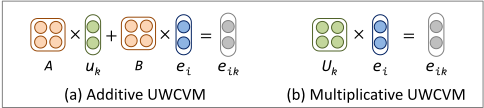
In this paper, we exploit multiplicative composition function as the user-word composition model 2 , as illustrated in Figure 2(b). The reason is that multiplicative composition can be regarded as one component U1 modifying another v2, which exactly meet our needs of user modifying word meaning. It has been successfully leveraged to model adjectivenoun composition [Clark et al., 2008; Baroni and Zamparelli, 2010] and adverb-adjective composition [Socher et al., 2012].
Formally, we represent each word wi as a continuous vector ei ∈ Rd , and each user uk as a matrix Uk ∈ Rd×d , where d is the dimension of continuous vector. In practice, the number of the parameters is still too large if we encode each user by a d × d matrix for the common vector length d = 50 or 100. To reduce the parameter size, we represent user representation by a low-rank plus diagonal approximation: Uk = Uk1 × Uk2 + diag(u′ ), where Uk1 ∈ Rd×r , Uk2 ∈ Rr×d , u′ ∈ Rd . We regard u′ as a shared background representation for each user. It is tailored for the Out-Of-Vocabulary situation, where a user in testing process is never seen in the training data. After conducting matrix-vector multiplication, we append an activation layer (e.g. tanh) for adding the non-linearity property. Accordingly, the final modified word vector pi for the original word vector ei is calculated as:
3.3 Document Composition Vector Model
Document composition vector model (DCVM) takes the usermodified word vectors as input, and produces the representation for each review/document. Document-level semantic composition is an important research topic in sentiment analysis, and many neural models have been proposed in the literature [Socher et al., 2013; Kalchbrenner et al., 2014]. However, it is out of the scope of this work to compare them. In this paper, we exploit a simple and effective approach [Hermann and Blunsom, 2014], which recursively uses biTanh function to produce the document representation.
2 We also tried additive composition functions by representing both words and users as vectors, as shown in Figure 2(a).
Specifically, we first use biTanh to calculate the vector for each sentence by regarding the user-modified word vectors as input. We then feed the sentence vectors to biTanh for generating the document vector vec(doc). Essentially, the recursive use of biTanh can be viewed as two pairs of bagof-word convolutional neural network, whose window size is two and parameters are clamped as addition and tanh.
3.4 Rating Prediction withMetric Labeling
We apply the learned review representation to review rating prediction in a supervised metric labeling framework [Pang and Lee, 2005]. It consists of two cascaded stages. In the first stage, we train an initial predictor by only using the representation of a certain user-review pair. In the experiment, we use softmax to predict the probabilities for classes (e.g. one to five stars). It is calculated as softmaxi = exp(zi) ∑i′ exp(zi′ ) , where z ∈ RC is a linear vector transformed from the user-enhanced review representation vec(doc).
where W ∈ RC×d and b ∈ RC are the parameters, C is the number of the rating classes. We define f(r, l) as the probability of predicting review r as rating l. For each review r, we use cross-entropy as the training objective function:
where Ls is the set of possible rating classes, f g is the gold rating distribution 3 and f is the predicted rating distribution. |θ|2F = ∑i θ2 i is a Frobenius norm regularization term and θ = [Uk1; Uk2; u′ ;W; b] stands for the parameters.
In the second stage, we apply the initial classifier and explicitly encode the idea of "similar items, similar labels" with metric labeling [Pang and Lee, 2005]. Let dist(l1, l2) = |l1 - l2| be a distance metric between labels l1 and l2, and let nn(rkj) be the M nearest neighbors of rkj according to a review similarity function sim. The objective of metric labeling is to minimize the following equation:
where T is the dev dataset of user-review pairs and λnn is the trade-off parameter. We use cosine similarity between the learned review representations as sim.
An advantage of our method is that: the learned review representation can be not only regarded as the feature of rkj to build the initial predictor, but also leveraged to calculate the similarity between reviews sim(rkj, r′ ) without using any hand-crafted features.
3 The gold rating distribution of a review has a 1-of-K coding scheme. It has the same dimension as the number of rating classes, and only the dimension corresponding to the ground truth is 1, with all others being 0.
3.5 Model Training
We train the rating predictor in a supervised learning framework from the reviews with accompanying ratings. We take the derivative of the loss with respect to the whole set of parameters through back-propagation, and use stochastic gradient descent with mini-batch to update the parameters. Word vectors are learned with word2vec 4 . We empirically set the vector dimension d as 100, the rank of user matrix r as 3. The values of W, b and u′ are randomly initialized with the fan-in trick. We use dropout [Srivastava et al., 2014] to avoid the neural network being over-fitting. Hyper parameters are tuned on the development dataset.
4 Experiment
We conduct experiments for review rating prediction to empirically evaluate the proposed method. We describe the experiment setting and the results in this section.
4.1 Experiment Setting
We conduct experiments on two benchmark datasets, Yelp13 and RT05. Yelp13 is a large-scale dataset consisting of restaurant reviews from Yelp. It is released by the third round of the Yelp Dataset Challenge in 2013. RT05 is a movie review dataset downloaded from Rotten Tomatoes. The statistical information of Yelp13 and RT05 are detailed in Table 1. For Yelp13 dataset, human labeled ratings are regarded as gold standards for model training 5 .
| Dataset | #users | #reviews | scale | lenavg | |V | |
|---|---|---|---|---|---|
| Yelp13 | 70,817 | 335,018 | 1∼5 | 75.1 | 137,816 |
| RT05 | 4 | 5,006 | 1∼4 | 429.1 | 55,449 |
We conduct experiments in a supervised learning framework. On Yelp13, we split the original corpus into train, dev and test sets with a 80:10:10 split. We train the rating predictor on the training set, tune parameters on the dev set and evaluate on the test set. On RT05, we use 10-fold cross-validation as in previous studies. We conduct multi-label classification on these two datasets. Since rating scores stand for sentiment intensities, we use mean absolute error (MAE) and root mean squared error (RMSE) as the evaluation metrics (as in other work like [Li et al., 2014]) to measure the divergences between predicted ratings and gold ratings.
4 https://code.google.com/p/word2vec/
5 We do not consider the cases that rating does not match with review texts [Zhang et al., 2014].
4.2 Baseline Methods
We compare our method with the following baseline methods for review rating prediction:
- Majority: It is a heuristic method that assigns the majority rating score in the training set to each review in the test dataset.
- BOW: We represent each review with bag-of-words (BOW) [Pang and Lee, 2005], and build the rating predictor with Supported Vector Machine 6 .
- BOW+BOO: Qu et al. [2010] propose to represent each document with bag-of-opinion (BOO). We use the concatenation of BOW and BOO as features. The sentiment lexicons are from BingLiu 7 and MPQA [Wilson et al., 2005]. The modifier and negation words come from the Sentiment Symposium Tutorial. We train the rating predictor with SVM.
- VecAvg: We calculate the representation of a review by averaging the vectors of the words it contains. We use the word vectors learned from word2vec, and build the classifier with SVM [Fan et al., 2008].
- RAE: Recursive AutoEncoder (RAE) has proven effective to learn compositionality for sentiment analysis. We train RAE using the word vectors pre-trained with word2vec. We do not compare with RNTN [Socher et al., 2013] because it depends on a parsed tree structure, which cannot be accurately obtained for the document-level reviews.
- PVDM: Le and Mikolov [2014] propose the Distributed Memory Model of Paragraph Vectors (PVDM), which is a state-of-the-art performer on several sentiment analysis benchmark datasets. We set the window size of PVDM as 9 in the experiments.
- CNN: Convolution neural network is a state-of-the-art performer on sentence-level sentiment analysis tasks [Kalchbrenner et al., 2014; Kim, 2014].
4.3 Results and Analysis
Table 2 shows the experimental results of the baseline methods as well as our method on two datasets. Our neural network method that uses user-word composition is abbreviated as UWRL. UWRL† stands for our neural network method plus metric labeling.
From Table 2, we can see that the performances of these methods are consistent on two datasets. Majority performs very poor as it does not capture any text-level or user-level information. BOW only uses the surface form of words in the review. However, it loses the ordering of words and it also ignores the semantics of words. BOW+BOO performs slightly better than BOW because BOO benefits from the sentiment, negation and modifier words from external resources. We also run standard collective filtering baseline on Yelp dataset. However, its performance is poor and comparable with bagof-word baseline.
VecAvg is a straight-forward method that uses word embeddings as the features without any feature engineering. From Table 2, we find that VecAvg does not yield obvious improvement over the traditional BOW. The reason is that the average function loses the word orders and does not well capture the complex linguistic phenomena in sentiment analysis. We also compare with several sophisticated composition methods including RAE, CNN and PVDM, and find that all of them outperform the VecAvg baseline. CNN is the strongest baseline on both datasets. The results indicate the importance of semantic composition for review rating prediction. The proposed method UWRL slightly outperforms text-based neural network algorithms as we simultaneously capture text-level and user-level semantics (p-value < 0.05 with t-test on Yelp13 between CNN and UWRL). After incorporating metric labeling, UWRL† captures the idea of "similar items, similar labels" and thus obtains further improvements.
6 In this experiment, we use SVM as baseline because the it performs better than the discretized regression [Pang and Lee, 2005] with a set of fixed decision thresholds {e.g. 0.5, 1.5, 2.5, ...}.
7 http://www.cs.uic.edu/liub/FBS/sentiment-analysis.html
| Method | Yelp13 | RT05 | ||
|---|---|---|---|---|
| MAE | RMSE | MAE | RMSE | |
| Majority | 1.232 | 1.626 | 0.724 | 0.984 |
| BOW | 0.787 | 1.218 | 0.562 | 0.833 |
| BOW+ BOO | 0.731 | 1.124 | 0.553 | 0.819 |
| VecAvg | 0.759 | 1.176 | 0.561 | 0.826 |
| RAE | 0.700 | 1.104 | 0.521 | 0.798 |
| PVDM | 0.698 | 1.098 | 0.516 | 0.793 |
| CNN | 0.644 | 0.986 | 0.483 | 0.759 |
| UWRL | 0.626 | 0.973 | 0.469 | 0.752 |
| UWRL† | 0.618 | 0.962 | 0.464 | 0.748 |
4.4 The Effect of User-Word Composition
We investigate the effect of different user-word composition functions for review rating prediction. We compare the matrix-vector multiplication function (mvMultip) with the following strategies: No-User: p = ei , Concat: p = [ei; uk], Average: p = 1/2 · (ei + uk) , ElemMultip: p = ei ⊙ uk, WAdd: p = A × ei + B × uk, where ei and uk stand for the word vector and user vector, respectively. We conduct experiments on the development set of Yelp13. The results are given in Figure 3.
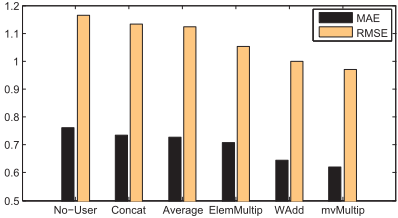
We can find that capturing user information always outperforms No-User, which shows the effectiveness of user information for review rating prediction. The performances of Concat and Average are relatively low because they do not well exploit the interaction between the user vector and word vector. Among all these composition functions, matrix-vector multiplication yields the best performance.
4.5 The Effect of User Activity
We explore the effect of the user activity for review rating prediction on the development set of Yelp13. We use the entire training dataset to train the model, and test on several subsets of the development dataset that correspond to different user activities. For example, the tick "100" on x-axis means that we only test on the users that have posted no less than 100 reviews.
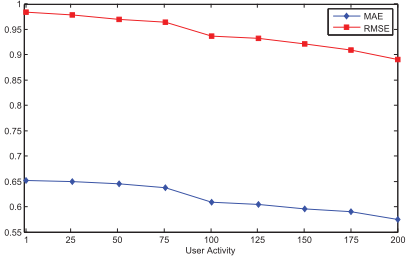
The results are illustrated in Figure 4. We can see that the performance of rating prediction consistently improves when larger user activity threshold is considered. This is because the user representations can be better estimated when more user-relevant reviews are utilized.
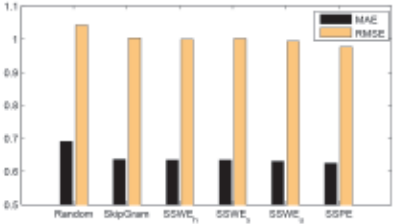
4.6 The Effect of Word Embedding
We investigate the effect of word embedding on review rating prediction. We try the randomly initialized word vectors (Random), the word vectors learned from SkipGram and the sentiment-specific word embeddings learned from SSWE [Tang et al., 2014b] and SSPE [Tang et al., 2014a].
From Figure 5, we find that all pre-trained word vectors outperform randomly initialized word vectors. Compared with SkipGram, three SSWE methods do not yield significant improvements. This is caused by the fact that SSWE assign the document polarity to each word sequence it contains for training the word vectors. The assumption is reasonable for tweets as they are short, but it is unsuitable for the document-level reviews where negation and contrast phenomenons are frequently appeared. SSPE performs slightly better than others, as it optimizes the word vectors by using a global document vector to predict the sentiment of a review. However, sentiment embeddings do not obtain significant performance boost than word2vec in this experiment. This calls for more powerful algorithms to learn sentiment embeddings from document level corpus.
5 Conclusion
We introduce a neural network method that incorporates user information for review rating prediction in this paper. We model user-specific modification to the meaning of a certain word with a user-word composition vector model (UWCVM), and investigate both additive and multiplicative composition functions for UWCVM. We show that matrixvector multiplication is more effective than vector concatenation or addition methods for review rating prediction. We conduct experiments on two benchmark datasets, and compare against multiple baseline methods. Experimental results show that, the proposed method performs better than several strong baseline methods which only use textural semantics.
Acknowledgments
We gratefully acknowledge the fruitful discussions with Yaming Sun, Jing Liu, Nan Yang, Yongfeng Zhang and Wei Song. We thank the anonymous reviewers for their helpful feedbacks. This work was partly supported by National Natural Science Foundation of China (No. 61133012 and No. 61273321), the National High Technology Development 863 Program of China (No. 2015AA015407). Duyu Tang also thanks Baidu Fellowship and IBM Ph.D. Fellowship programs for their supports.
@inproceedings{ijcai2015p193,
  title     = {User Modeling with Neural Network for Review Rating Prediction},
  author    = {Tang, Duyu and Qin, Bing and Liu, Ting and Yang, Yuekui},
  booktitle = {Proceedings of the Twenty-Fourth International Joint Conference on
               Artificial Intelligence, {IJCAI-15}},
  publisher = {International Joint Conferences on Artificial Intelligence},
  editor    = {Qiang Yang and Michael Wooldridge},
  pages     = {1340--1345},
  year      = {2015},
  month     = {7},
  note      = {Main Track},
  url       = {https://ijcai.org/proceedings/2015/193},
}
TY - CPAPER TI - User Modeling with Neural Network for Review Rating Prediction AU - Tang, Duyu AU - Qin, Bing AU - Liu, Ting AU - Yang, Yuekui T2 - Proceedings of the Twenty-Fourth International Joint Conference on Artificial Intelligence, IJCAI-15 PB - International Joint Conferences on Artificial Intelligence PY - 2015 SP - 1340 EP - 1345 UR - https://ijcai.org/proceedings/2015/193 ER -Copied
Machine-readable versions of this paper, for tools and AI agents:





