
Integrating Importance, Non-Redundancy and Coherence in Graph-Based Extractive Summarization
Proceedings of the Twenty-Fourth International Joint Conference on Artificial Intelligence. Main Track. Pages 1298-1303.
© 2015 International Joint Conferences on Artificial Intelligence
Abstract
We propose a graph-based method for extractive single-document summarization which considers importance, non-redundancy and local coherence simultaneously. We represent input documents by means of a bipartite graph consisting of sentence and entity nodes. We rank sentences on the basis of importance by applying a graph-based ranking algorithm to this graph and ensure non-redundancy and local coherence of the summary by means of an optimization step. Our graph based method is applied to scientific articles from the journal PLOS Medicine. We use human judgements to evaluate the coherence of our summaries. We compare ROUGE scores and human judgements for coherence of different systems on scientific articles. Our method performs considerably better than other systems on this data. Also, our graph-based summarization technique achieves state-of-the-art results on DUC 2002 data. Incorporating our local coherence measure always achieves the best results.
- [Abu-Jbara and Radev, 2011] Amjad Abu-Jbara and Dragomir Radev. Coherent citation-based summa- rization of scientific papers. In Proceedings of the 49th Annual Meeting of the Association for Computational Linguistics (Volume 1: Long Papers), Portland, Oreg., 19-24 June 2011, pages 500-509, 2011.
- [Amini and Gallinari, 2002] Massih-Reza Amini and Patrick Gallinari. The use of unlabeled data to improve super- vised learning for text summarization. In Proceedings of the 25th Annual International ACM SIGIR Conference on Research and Development in Information Retrieval Tam- pere, Finland, 11-15 August 2002, pages 105-112, 2002.
- [Barzilay and Lapata, 2008] Regina Barzilay and Mirella Lapata. Modeling local coherence: An entity-based ap- proach. Computational Linguistics, 34(1):1-34, 2008.
- [Berg-Kirkpatrick et al., 2011] Taylor Berg-Kirkpatrick, Dan Gillick, and Dan Klein. Jointly learning to extract and compress. In Proceedings of the 49th Annual Meeting of the Association for Computational Linguistics (Volume 1: Long Papers), Portland, Oreg., 19-24 June 2011, pages 481-490, 2011.
- [Carbonell and Goldstein, 1998] Jaime G. Carbonell and Jade Goldstein. The use of MMR, diversity-based rerank- ing for reordering documents and producing summaries. In Proceedings of the 21st Annual International ACM- SIGIR Conference on Research and Development in In- formation Retrieval, Melbourne, Australia, 24-28 August 1998, pages 335-336, 1998.
- [Clarke and Lapata, 2007] James Clarke and Mirella Lapata. Modelling compression with discourse constraints. In Pro- ceedings of the 2007 Joint Conference on Empirical Meth- ods in Natural Language Processing and Computational Language Learning, Prague, Czech Republic, 28-30 June 2007, pages 1-11, 2007.
- [Conroy and O'Leary, 2001] John M. Conroy and Dianne P. O'Leary. Text summarization via hidden markov models. In Proceedings of the 24th Annual International ACM SI- GIR Conference on Research and Development in Infor- mation Retrieval New Orleans, Louis., 9-12 September 2001, pages 406-407, 2001.
- [Conroy et al., 2004] John M. Conroy, Judith D. Schlesinger, Jade Goldstein, and Dianne P. O'Leary. Left-brain/right- brain multi-document summarization. In Proceedings of the 2004 Document Understanding Conference held at the Human Language Technology Conference of the North American Chapter of the Association for Computational Linguistics, Boston, Mass., 6-7 May 2004, 2004.
- [Elsner and Charniak, 2011] Micha Elsner and Eugene Charniak. Extending the entity grid with entity-specific features. In Proceedings of the 49th Annual Meeting of the Association for Computational Linguistics (Volume 2: Short Papers), Portland, Oreg., 19-24 June 2011, pages 125-129, 2011.
- [Erkan and Radev, 2004] Günes ¸Erkan and Dragomir R. Radev. LexRank: Graph-based lexical centrality as salience in text summarization. Journal of Artificial In- telligence Research, 22:457-479, 2004.
- [Galanis et al., 2012] Dimitrios Galanis, Gerasimos Lam- pouras, and Ion Androutsopoulos. Extractive multi- document summarization with integer linear programming and support vector regression. In Proceedings of the 24th International Conference on Computational Linguistics, Mumbai, India, 8-15 December 2012, pages 911-926, 2012.
- [Guinaudeau and Strube, 2013] Camille Guinaudeau and Michael Strube. Graph-based local coherence modeling. In Proceedings of the 51st Annual Meeting of the Asso- ciation for Computational Linguistics (Volume 1: Long Papers), Sofia, Bulgaria, 4-9 August 2013, pages 93-103, 2013.
- [Hirao et al., 2013] Tsutomu Hirao, Yasuhisa Yoshida, Masaaki Nishino, Norihito Yasuda, and Masaaki Nagata. Single-document summarization as a tree knapsack prob- lem. In Proceedings of the 2013 Conference on Empirical Methods in Natural Language Processing, Seattle, Wash., 18-21 October 2013, pages 1515-1520, 2013.
- [Klein and Manning, 2003] Dan Klein and Christopher D. Manning. Accurate unlexicalized parsing. In Proceedings of the 41st Annual Meeting of the Association for Com- putational Linguistics, Sapporo, Japan, 7-12 July 2003, pages 423-430, 2003.
- [Kleinberg, 1999] Jon M. Kleinberg. Authoritative sources in a hyperlinked environment. Journal of the ACM, 46(5):604-632, 1999.
- [Lin, 2004] Chin-Yew Lin. ROUGE: A package for auto- matic evaluation of summaries. In Proceedings of the Text Summarization Branches Out Workshop at ACL '04, Barcelona, Spain, 25-26 July 2004, pages 74-81, 2004.
- [Louis et al., 2010] Annie Louis, Aravind Joshi, and Ani Nenkova. Discourse indicators for content selection in summarization. In Proceedings of the SIGdial 2010 Con- ference: The 11th Annual Meeting of the Special Interest Group on Discourse and Dialogue, Tokyo, Japan, 24-25 September 2010, pages 147-156, 2010.
- [Marcu, 2000] Daniel Marcu. The Theory and Practice of Discourse Parsing and Summarization. Cambridge, Mass.: The MIT Press, 2000.
- [Martschat, 2013] Sebastian Martschat. Multigraph cluster- ing for unsupervised coreference resolution. In 51st An- nual Meeting of the Association for Computational Lin- guistics: Proceedings of the Student Research Workshop, Sofia, Bulgaria, 5-7 August 2013, pages 81-88, 2013.
- [McDonald, 2007] Ryan McDonald. A study of global in- ference algorithms in multi-document summarization. In Proceedings of the European Conference on Information Retrieval, Rome, Italy, 2-5 April 2007, 2007.
- [Mihalcea and Tarau, 2004] Rada Mihalcea and Paul Tarau. TextRank: Bringing order into texts. In Proceedings of the 2004 Conference on Empirical Methods in Natural Language Processing, Barcelona, Spain, 25-26 July 2004, pages 404-411, 2004.
- [Nenkova and McKeown, 2011] Ani Nenkova and Kathleen McKeown. Automatic summarization. Foundations and Trends in Information Retrieval, 5(2-3), 2011.
- [Nomoto and Matsumoto, 2001] Tadashi Nomoto and Yuji Matsumoto. A new approach to unsupervised text summa- rization. In Proceedings of the 24th Annual International ACM SIGIR Conference on Research and Development in Information Retrieval New Orleans, Louis., 9-12 Septem- ber 2001, pages 26-34, 2001.
- [Parveen and Strube, 2014] Daraksha Parveen and Michael Strube. Multi-document summarization using bipartite graphs. In Proceedings of TextGraphs-9: Graph-based Methods for Natural Language Processing, Workshop at EMNLP 2014, Doha, Qatar, 29 October 2014, pages 15- 24, 2014.
- [Qazvinian and Radev, 2008] Vahed Qazvinian and Dragomir R. Radev. Scientific paper summarization using citation summary networks. In Proceedings of the 22nd International Conference on Computational Linguistics, Manchester, U.K., 18-22 August 2008, pages 689-696, 2008.
- [Radev et al., 2004] Dragomir Radev, Timothy Allison, Sasha Blair-Goldensohn, John Blitzer, Arda Celibi, Stanko Dimitrov, Elliott Drabek, Ali Hakim, Wai Lam, Danyu Liu, Jahna Otterbacher, Hong Qi, Horacio Saggion, Si- mone Teufel, Michael Topper, Adam Winkel, and Zhu Zhang. MEAD -a platform for multidocument multilin- gual text summarization. In Proceedings of the 4th Inter- national Conference on Language Resources and Evalua- tion, Lisbon, Portugal, 26-28 May 2004, 2004.
- [Shen et al., 2007] Dou Shen, Jian-Tao Sun, Hua Li, Qiang Yang, and Zheng Chen. Document summarization us- ing conditional random fields. In Proceedings of the 20th International Joint Conference on Artificial Intelligence, Hyderabad, India, 6-12 January 2007, pages 2862-2867, 2007. IJCAI
- [Siegel and Castellan, 1988] Sidney Siegel and N. John Castellan. Nonparametric Statistics for the Behavioral Sciences. McGraw-Hill, New York, 2nd edition, 1988.
- [Teufel and Moens, 2002] Simone Teufel and Marc Moens. Summarizing scientific articles: Experiments with rele- vance and rhetorical status. Computational Linguistics, 28(4):409-445, 2002.
- [Teufel et al., 2006] Simone Teufel, Advaith Siddharthan, and Dan Tidhar. Automatic classification of citation func- tion. In Proceedings of the 2006 Conference on Empirical Methods in Natural Language Processing, Sydney, Aus- tralia, 22-23 July 2006, pages 103-110, 2006.
- [Wan and Xiao, 2010] Xiaojun Wan and Jianguo Xiao. Ex- ploiting neighborhood knowledge for single document summarization and keyphrase extraction. ACM Transac- tions on Information Systems, 28(2):8 pages, 2010.
References were extracted automatically from the PDF and may contain errors.
Full text extracted automatically from the PDF; figures, tables and equations may differ. The PDF is the version of record.
1 Introduction
Summaries should contain the most important information from input documents. Summaries should not contain redundant information. Finally, summaries should be readable, hence they should be grammatical and coherent. Many summarization approaches focus on extracting important sentences from input documents while ensuring that the extracted information is non-redundant (e.g., methods based on maximum marginal relevance [Carbonell and Goldstein, 1998]). Grammaticality does not concern extractive summarization as complete sentences, which are assumed to be grammatical, are extracted from input documents. However, there has been surprisingly little research on including discourse processing techniques into extractive summarization. When relating discourse processing techniques to automatic summarization, [Nenkova and McKeown, 2011] mention only work based on discourse relations [Marcu, 2000; Louis et al., 2010] which has been used for selecting important infomation, but which has not been applied to improve the coherence of the summaries. [Clarke and Lapata, 2007] use discourse constraints for sentence compression.
[Barzilay and Lapata, 2008] apply their local coherence model, the entity grid, to summary coherence evaluation. However, to our knowledge, the entity grid has not been used directly in extractive summarization to ensure summary coherence. Our work is based on the graph-based extractive summarization technique developed by [Parveen and Strube, 2014]. It is intuitively plausible to extend this technique by the entity graph [Guinaudeau and Strube, 2013]. Therefore, in our work, computing importance, non-redundancy and coherence is tightly integrated and taken care of simultaneously. Our graph-based summarization technique has the further advantage of being completely unsupervised.
We apply our graph-based summarization technique to scientific articles from the journal PLOS Medicine 1 , a highimpact open-access journal from the medical domain. Articles in this journal are not only accompanied by authors' abstracts but also by a summary written by an editor. We propose to use editors' summaries as gold-standard for our evaluation. PLOS Medicine has the further advantage of being available in XML-format, which saves us the expense of noisily extracting information from PDF documents and the ambiguities of HTML parsing. PLOS Medicine is distributed by means of a Creative Commons Attribution License allowing us to publish the dataset. On the PLOS Medicine data our graph-based approach outperforms several baselines and the graph-based method TextRank [Mihalcea and Tarau, 2004]. We also show that our technique works significantly better than a version without the coherence constraint. We do not only report ROUGE scores, but also evaluate the coherence by having our summaries judged by human subjects. Finally, we also apply our technique to the DUC 2002 data, where the input documents are shorter by an order of magnitude compared to the scientific articles. On these data, our technique reaches a performance comparable to the state-of-the-art despite being unsupervised.
In Section 2, we discuss related work in the field of summarization. Section 3 provides a detailed description of our method. The datasets used, the experimental setup and the results are described in Section 4 and discussed in Section 5.
1 http://journals.plos.org/plosmedicine/
2 RelatedWork
We focus on extractive summarization of scientific articles. Extractive summarization involves computing the importance of sentences which is used for deciding whether to include a sentence in the summary. The importance of sentences may depend on different factors: term frequency, position in text, cue words, and lexical chains among other factors. The importance of sentences may also depend on the document representation. In a graph-based document representation [Mihalcea and Tarau, 2004; Erkan and Radev, 2004; Parveen and Strube, 2014], nodes, i.e. sentences, are ranked by means of ranking algorithms. The importance of sentences can also be determined by supervised classification [Amini and Gallinari, 2002], unsupervised clustering [Nomoto and Matsumoto, 2001], HMM and CRF based methods [Conroy and O'Leary, 2001; Shen et al., 2007], and support vector regression based methods [Galanis et al., 2012]. [Carbonell and Goldstein, 1998] use a greedy method to select sentences for the final summary. The system MEAD [Radev et al., 2004] uses a clustering method to find a centroid. It considers the centroid as words which are highly similar to the topic. Ranking using centroids and redundancy are taken care of simultaneously. Similarly, the CLASSY system [Conroy et al., 2004], the best performing system at DUC 2004, uses the tf-idf score to calculate the importance of sentences. However, these systems do not consider the global frame of reference. Therefore, [McDonald, 2007] has proposed an optimization method based on integer linear programming (ILP) which considers text summarization as a knapsack problem. Similarly, [Berg-Kirkpatrick et al., 2011], [Galanis et al., 2012] also used ILP optimization methods for their tasks. [Wan and Xiao, 2010] assume that nearest neighbour documents provide additional knowledge and improve singledocument summarization and keyphrase extraction. [Hirao et al., 2013] consider coherence by using the rhetorical structure for single-document summarization.
For summarizing scientific articles, [Teufel and Moens, 2002] present an algorithm based on rhetorical status. More recently, citation-based summarization received a great deal of attention [Teufel et al., 2006; Qazvinian and Radev, 2008]. [Abu-Jbara and Radev, 2011] provide a method based on sentence clustering and ranking, which also takes care of the coherence in the citation based summary.
3 Our Method
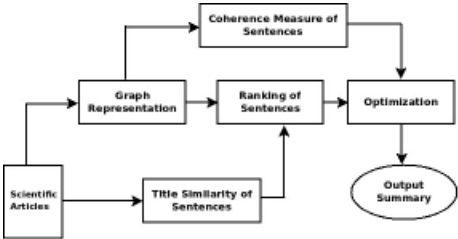
The control flow of our method is shown in Figure 1.
3.1 Document Representation
[Erkan and Radev, 2004] and [Mihalcea and Tarau, 2004] employ graphs where nodes are sentences which are connected by weighted edges. The weights represent sentence similarity. While these graphs are of one mode type, we here build on [Parveen and Strube, 2014] who represent documents by a graph G of two mode type, i.e. a bipartite graph, where G = (Vs, Ve, Ee,s). G has two different sets of nodes Vs and Ve. There are no edges connecting nodes within the same set. Edges Ee,s connect only nodes from different sets. Here, e represents an entity, and s represents a sentence in the document. This bipartite graph, the entity graph, has been introduced by [Guinaudeau and Strube, 2013] as an alternative, graph-based representation of the entity grid [Barzilay and Lapata, 2008]. While [Guinaudeau and Strube, 2013] employ the entity graph for computing local coherence of documents, we use it here additionally for determining the importance of sentences. In Figure 2 we show an abstract from a PLOS Medicine article, its representation in an entity grid, and its transformation into a bipartite entity graph.
3.2 Sentence Ranking
We use the HITS [Kleinberg, 1999, Hyperlink Induced Topic Search] algorithm to rank nodes in bipartite graphs. In HITS, webpages are divided into a set of hub pages and set of authority pages. We represent each document as a bipartite graph. Hence, we follow [Parveen and Strube, 2014] in using the HITS algorithm for sentence ranking.
The HITS algorithm requires to associate nodes in the graph with an initial rank. [Parveen and Strube, 2014] apply the HITS algorithm to rank sentences in topic-based multidocument summarization. For initialization they rank entities based on the basis of their presence in the topic. In our work, we instead provide initial ranks for sentences and entities. Because we do not have topics (neither the DUC 2002 data nor the PLOS Medicine articles have topics) we use the document title. Initial ranks for sentences are based on the similarity between sentences and the title. Initial ranks for entities are based on their presence in the title. So the initial rank of entity ei is Rankei = 1 + tf(ei, article) + occurrence(ei, title). Here, tf(ei, article) is the term frequency of ei in the document. occurrence(ei, title) shows the occurrence of ei in the document title. Hence, if ei is not present in the title then occurrence(ei, title) = 0. If it is present then occurrence(ei, title) = 1. We also initialize the sentence rank by considering its similarity to the document title. So, Ranksi = 1+sim(si, title) is an initialization of sentences. sim(si, title) is the cosine similarity between sentence si and the document title. After initialization, we apply the HITS algorithm on the bipartite graph.
3.3 Coherence Measure
[Barzilay and Lapata, 2008] introduce the entity grid which operationalizes the linguistic intuition that entities shared by
- S1 Haemorrhage is a common cause of death in trauma patients.
- S2 Although transfusions are extensively used in the care of bleeding trauma patients, there is uncertainty about the balance of risks and benefits and how this balance depends on the baseline risk of death.
- S3 Our objective was to evaluate the association of red blood cell (RBC) transfusion with mortality according to the predicted risk of death.
- S4 A secondary analysis of the CRASH-2 trial (which originally evaluated the effect of tranexamic acid on mortality in trauma patients) was conducted.
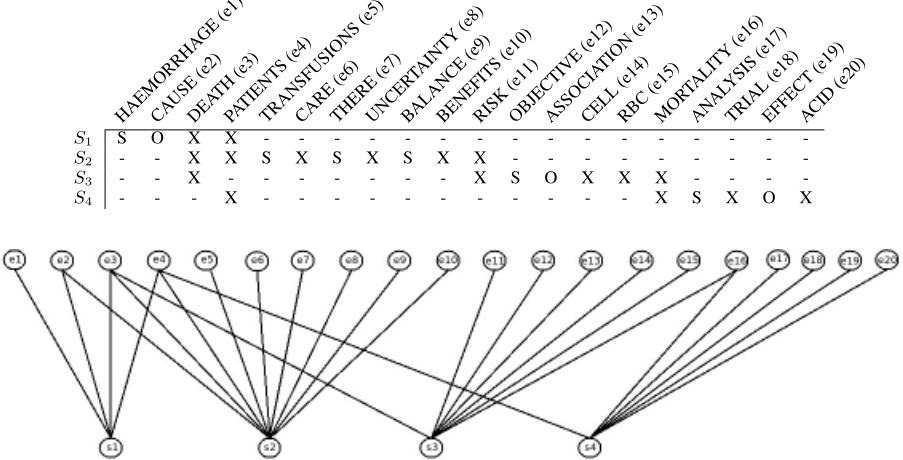
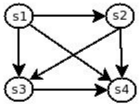
subsequent sentences contribute to the text's local coherence. They compute probabilities of entity transitions and use this by means of supervised learning for several applications including summary coherence rating. [Guinaudeau and Strube, 2013] transfrom the entity grid into a bipartite graph, the entity graph, and compute the local coherence of a text based on this graph in an unsupervised fashion with results similar to [Barzilay and Lapata, 2008]. This method is computationally very efficient and also overcomes data sparsity problems of the entity grid. [Guinaudeau and Strube, 2013] represent documents as a bipartite graph, perform a one mode projection on the sentence nodes and compute the local coherence of the document as average outdegree of this projection graph (Equation 1) where P is the projection graph. The higher the average outdegree, the more coherent is a text. The one mode projection has only sentences as nodes. They are connected if they have common entities. We here use the unweighted entity graph [Guinaudeau and Strube, 2013]. This is a directed graph, where the direction follows sentence order. The one mode projection of the bipartite graph from Figure 2 is shown in Figure 3.
Until now entity grid and entity graph have been used only to evaluate summaries according to their coherence. Since we represent the input documents also by means of the bipartite entity graph, we can incorporate the coherence measure by performing the one mode projection directly in our summarization system. This provides additional guidance in selecting sentences for the summary.
Equation 2 calculates the outdegree of every sentence from the projection graph. Then in Equation 3 the coherence value of a sentence is penalized according to its position in a document. If we want to use only the coherence then position(si) = 1 in Equation 3, and if we want to use the position only then coherence(si, P ) = 1 in Equation 3.
We use this coherence value while selecting sentences for a summary in the optimization phase. Only sentences maximizing the coherence value will be selected.
3.4 Optimization
[McDonald, 2007] views summarization as optimization task, since a summarization system has to consider the tradeoff between importance and redundancy. Our system selects information by importance. Because the scientific articles we deal with are very long and redundant information is spread out over several sections, we have to deal with redundancy. In addition, we take into account the coherence value of a sentence. Hence, we optimize importance, non-redundancy and coherence simultaneously. The importance of a sentence is a rank calculated by applying the HITS algorithm as discussed in Section 3.2. The coherence value of sentences is calculated using their outdegree in a projection graph as explained in Section 3.3. For computing non-redundancy we consider entities in a document. If more new entities are included in the final summary, the least redundant the final summary will be [Parveen and Strube, 2014]. The objective function shown in Equation 5 contains three measures: importance, coherence value and redundancy.
Variables:
Objective function:
Constraints:
xi and yj are Boolean variables associated with sentences and entities, respectively. i ranges from 0 to n and j ranges from 0 to m where n and m are the number of sentences and the number of entities, respectively.
The constraint in Equation 6 restricts the length of the summary. DUC 2002 imposes a 100 word limit for the final summary. For the PLOS Medicine summaries we restrict the length in terms of the number of sentences. In the experiments reported in Section 4, we will discuss results with a 5 sentence limit for the final summary (different limits are possible by modifying this constraint).
Equation 7 tells us that if sentence xi is selected for the final summary then entities present in that sentence will also be selected, so xi = 1 and Ei = Entitiesxi . The constraint holds because ∑ j∈Ei yj = Entitiesxi . On the other
hand, if the sentence xi = 0 or not selected then there must be some entities which are present in already selected sentences. ∑ j∈Ei yj ≥ 0, hence the constraint holds.
| PLOS | DUC 2002 | |
|---|---|---|
| no. of docs. | 50 | 567 |
| avg. no. of sents. per doc. | 154 | 25 |
| avg. no. of words per doc. | 4756 | 627 |
The last constraint in Equation 8 provides us with information about the entities. If entity yj = 1 then at least one sentence containing this entity must be selected. ∑ i∈Sj xi ≥ 1,
hence the constraint holds. If entity yj is not selected then none of the sentences containing that entity may also not be selected, yj = 0 and ∑ i∈Sj xi = 0.
4 Experiments
Experiments are performed on the PLOS Medicine dataset and the DUC 2002 single-document summarization dataset.
4.1 Datasets
We introduce a new dataset for summarizing scientific articles. It consists of 50 articles from the high impact open access journal PLOS Medicine. Articles in this journal are much longer than documents in most standard datasets used in research on automatic summarization (see Table 1). Articles in PLOS Medicine can be as long as the whole set of documents related to one query in multi-document summarization.
PLOS Medicine publishes 10-15 articles per month since 2004. We chose PLOS Medicine as source for our experiments, because articles are accompanied not only by an abstract written by the authors but also by a summary written by an editor of the journal. We report experiments using both editors' summaries and authors' abstracts as gold standard for evaluation. The editor's summary consists usually of 15 to 20 sentences whereas the abstract consist of 10 to 15 sentences. Hence both editor's summary and authors' abstract are relatively long compared to summaries usually used in research on automatic summarizaion. When applying our summarization system we remove editor's summary, abstract, figures, tables and references from the paper.
As a second point of reference we also perform experiments on the single-document summarization data from DUC 2002 which contains rather short news articles.
4.2 Experimental Setup
We use the XML formatted scientific articles from PLOS Medicine. We extract the content of a paper excluding figures, table and references. After this, editor's summary and authors' abstract are separated from the content for evaluation. The PLOS Medicine XML provides explicit full forms when abbreviations are introduced. We replace abbreviations with this full form in the final summary. We then remove non-alphabetical characters. After this we parse articles using the Stanford parser [Klein and Manning, 2003]. We perform pronoun resolution using the coreference resolution system by [Martschat, 2013] 2 . We apply the Brown coherence toolkit [Elsner and Charniak, 2011] 3 to the articles to convert the document into an entity grid which then is transformed into the bipartite entity graph [Guinaudeau and Strube, 2013]. Entities in the bipartite graph are the head nouns of noun phrases. Afterwards, the HITS algorithm is applied on the bipartite graph for computing the importance of sentences. We calculate the coherence values of sentences using the one mode projection. The importance and coherence of a sentence is used in the optimization phase 4 . The optimization phase returns a binary value associated with each sentence. The sentence is included in the summary if its value is 1.
2 http://www.smartschat.de/software/
4.3 Human Coherence Judgements
Automatic summarization has frequently been evaluated by computing ROUGE scores [Lin, 2004]. Beyond n-grams ROUGE does not have a notion of order, and therefore does not account for coherence. In order to complement ROUGE scores which we report in Section 4.4, we perform an evaluation with human judgements for coherence. We asked five PhD. students in Natural Language Processing (the authors were not among them) to comparatively rank the output of our system on the basis of coherence. We randomly selected ten scientific articles from PLOS medicine. We used three different systems to generate summaries: the Lead baseline (S1) , Our System + Coh. + Pos. (S2) and TextRank (S3). Our human judges were asked to assign rank 1 to the best summary, rank 2 to the second best, rank 3 to the worst. By computing the average over the ranks given by all five judges we compute an overall rank: S1 gets an overall rank of 1.34, 2 gets 1.82, and S3 gets 2.84.
Unsurprisingly S1 performed best among the three systems. S1 is the Lead baseline which consists of the first five sentences from the article. Since these five sentences are extracted en bloc, they are as coherent as the original authors intended them to be. Still, the difference in average rank between S1 and S2 is not very substantial. In three of our ten documents S2 was ranked higher than S1 on average. The difference between S2 and S3 however is substantial.
We apply the Kendall concordance coefficient (W) [Siegel and Castellan, 1988] to measure whether our human subjects agree in ranking the three systems. With W = 0.64 the correlation between the human subjects is relatively high. Applying the χ2 test shows that W is significant at the 95% level. Hence, we interpret the rankings provided by our human subjects reliable and informative.
4.4 Results
Results on PLOS Medicine data are shown in Tables 2 and 3. Evaluation metrics are ROUGE-SU4 and ROUGE-2 [Lin, 2004]. ROUGE-SU4 calculates the co-occurrence of skip bigrams between system summary and human summary. ROUGE-2 calculates bigram co-occurrence. We limit the summaries to five sentences. We compare our system with four different baselines. Lead selects the top five sentences, Random selects five sentences randomly from the scientific article. MMR is an implementation of maximal marginal relevance [Carbonell and Goldstein, 1998]. TextRank is the graph based system by [Mihalcea and Tarau, 2004] 5 .
3 http://www.ling.ohio-state.edu/∼melsner/#software
4 We use Gurobi, http://www.gurobi.com
| Systems | R-SU4 | R-2 |
|---|---|---|
| Lead | 0.067 | 0.055 |
| Random | 0.048 | 0.031 |
| MMR | 0.069 | 0.048 |
| TextRank | 0.068 | 0.048 |
| Our System | 0.121 | 0.090 |
| Our System + Coh. | 0.130 | 0.096 |
| Our System + Pos. | 0.129 | 0.093 |
| Our System + Coh. + Pos. | 0.131 | 0.098 |
| Systems | R-SU4 | R-2 |
|---|---|---|
| Lead | 0.105 | 0.077 |
| Random | 0.093 | 0.589 |
| MMR | 0.118 | 0.098 |
| TextRank | 0.134 | 0.101 |
| Our System | 0.200 | 0.170 |
| Our System + Coh. | 0.219 | 0.175 |
| Our System + Pos. | 0.218 | 0.174 |
| Our System + Coh. + Pos. | 0.224 | 0.189 |
Our system outperforms all baselines substantially as shown in Tables 2 and 3. In the experiments reported in Table 2 we use the editor's summary as a gold summary, in Table 3 the authors' abstracts. We observe improvements when including coherence and taking position of the extracted sentences into account. We obtain best results when combining our system with coherence and position. The improvements of our system are consistent across the editors' summaries vs. the authors' abstracts conditions. In the latter case the absolute numbers returned by ROUGE are higher, because the abstracts are shorter than the editors' summaries.
For editors' summaries the difference between Our System and Our System + Coh. + Pos. is statistically significant at the 0.01-level for ROUGE-SU4 and at the 0.05-level for ROUGE-2. For abstracts the difference between Our System and Our System + Coh. + Pos. is statistically significant at the 0.01-level for both metrics. The difference between TextRank and Our System is statistically significant at the 0.01-level for both editors' summaries and abststracts for both metrics. Differences between Our System + Coh. + Pos. and Our System + Coh. or Our System + Pos. are not statistically significant.
We also compare results on DUC 2002 to check against the state-of-the-art on a well-known dataset (Table 4, some cells are empty, because ROUGE-SU4 was not reported by all systems). Lead selects the first few sentences from the document with a length of up to a 100 words. The Lead baseline performs very well on the DUC 2002 data which are composed of news articles, because it exploits characteristics of the news genre. DUC 2002 Best is the result reported by the top performing system at DUC 2002. This system actually obtained better results than TextRank [Mihalcea and Tarau, 2004] and the more recent system UniformLink [Wan and Xiao, 2010]. Our System + Coh. + Pos. is the only system which outperforms DUC 2002 Best.
5 https://kenai.com/projects/textsummarizer/sources/mercurialtextsummarizer
| Systems | R-1 | R-2 | R-SU4 |
|---|---|---|---|
| Lead | 0.459 | 0.180 | 0.201 |
| DUC 2002 Best | 0.480 | 0.228 | |
| TextRank | 0.470 | 0.195 | 0.217 |
| UniformLink (k = 10) | 0.471 | 0.201 | |
| Our System + Coh. + Pos. | 0.485 | 0.230 | 0.253 |
5 Discussion
Our system including coherence works well across different domains, genres, and compression rates. It does not depend on any parameters and training data. Hence it is fully unsupervised. We compared results of different system versions on PLOS Medicine data. We also did experiments with more than 5 sentences, e.g. with 10, 15 and 20. ROUGE scores increase with summary length. The system with coherence works always better than the system without and performs best when combined with positional information.
6 Conclusions and FutureWork
While previous work uses a measure of local coherence only to evaluate the coherence of summaries, we integrate it closely with determining importance and avoiding redundancy in an unsupervised graph-based method for extractive single-document summarization. We evaluate our method on long scientific articles from the journal PLOS Medicine and short news articles from the DUC 2002 single-document summarization data. On both datasets our system obtains good results. Including coherence always improves results. We also used human subjects to judge our system's readability among three given systems. These judgements show that our system takes care of coherence. We publish the PLOS Medicine dataset, which conveniently contains editors' summaries which we propose to use as gold summaries for evaluation. In future work we would like to include more linguistic information into the entity graph. We plan to obtain judgements by domain experts to see whether the editors' summaries in fact can be used as gold summaries.
Acknowledgments
This work has been funded by the Klaus Tschira Foundation, Heidelberg, Germany. The first author has been supported by a Heidelberg Institute for Theoretical Studies Ph.D. scholarship. This work has been supported by the German Research Foundation as part of the Research Training Group "Adaptive Preparation of Information from Heterogeneous Sources" (AIPHES) under grant No. GRK 1994/1. We would like to thank our colleagues Benjamin Heinzerling, Yufang Hou, Sebastian Martschat, Alex Judea, Nafise Moosavi and Mohsen Mesgar who became human subjects and commented on earlier drafts.
@inproceedings{ijcai2015p187,
  title     = {Integrating Importance, Non-Redundancy and Coherence in Graph-Based Extractive Summarization},
  author    = {Parveen, Daraksha and Strube, Michael},
  booktitle = {Proceedings of the Twenty-Fourth International Joint Conference on
               Artificial Intelligence, {IJCAI-15}},
  publisher = {International Joint Conferences on Artificial Intelligence},
  editor    = {Qiang Yang and Michael Wooldridge},
  pages     = {1298--1303},
  year      = {2015},
  month     = {7},
  note      = {Main Track},
  url       = {https://ijcai.org/proceedings/2015/187},
}
TY - CPAPER TI - Integrating Importance, Non-Redundancy and Coherence in Graph-Based Extractive Summarization AU - Parveen, Daraksha AU - Strube, Michael T2 - Proceedings of the Twenty-Fourth International Joint Conference on Artificial Intelligence, IJCAI-15 PB - International Joint Conferences on Artificial Intelligence PY - 2015 SP - 1298 EP - 1303 UR - https://ijcai.org/proceedings/2015/187 ER -Copied
Machine-readable versions of this paper, for tools and AI agents:





