
A New Input Method for Human Translators: Integrating Machine Translation Effectively and Imperceptibly
Proceedings of the Twenty-Fourth International Joint Conference on Artificial Intelligence. Main Track. Pages 1163-1168.
© 2015 International Joint Conferences on Artificial Intelligence
Abstract
Computer-aided translation (CAT) system is the most popular tool which helps human translators perform language translation efficiently. To further improve the efficiency, there is an increasing interest in applying the machine translation (MT) technology to upgrade CAT. Post-editing is a standard approach: human translators generate the translation by correcting MT outputs. In this paper, we propose a novel approach deeply integrating MT into CAT systems: a well-designed input method which makes full use of the knowledge adopted by MT systems, such as translation rules, decoding hypotheses and n-best translation lists. Our proposed approach allows human translators to focus on choosing better translation results with less time rather than just complete translation themselves. The extensive experiments demonstrate that our method saves more than 14% time and over 33% keystrokes, and it improves the translation quality as well by more than 3 absolute BLEU scores compared with the strong baseline, i.e., post-editing using Google Pinyin.
- [Barrachina et al., 2009] Statistical Approaches to Computer- Assisted Translation. Computational Linguistics, 35(1): 3-28, 2009.
- [Carl et al., 2011] The Process of Post-editing: A Pilot Study. Copenhagen Studies in Language, 41:131-142, 2011.
- [Fang, 2013] Research and Implementation on Aided Translation Tools Based on Input Method. Xiamen University. 2013.
- [Foster and Lapalme, 2002] Text Prediction for Translators. Université de Montréal, 2002.
- [Garay-Vitoria and Abascal, 2006] Text Prediction Systems: a Survey. Universal Access in the Information Society, 4(3): 188-203, 2006.
- [Green et al., 2014] Human Effort and Machine Learnability in Computer Aided Translation. In Proceedings of the EMNLP 2014.
- [Li, 2012] A Pinyin Input Method Editor with English- Chinese Aided Translation Function. In 2012 International Conference on Computer Science and Services System.
- [Kasami, 1965] An Efficient Recognition and Syntax Analysis Algorithm for Context-free Languages. Technical Report AFCRL-65-758. Air Force Cambridge Research Laboratory, Bedford, MA, 1965.
- [Koehn, 2004] Statistical Significance Tests for Machine Translation Evaluation. In Proceedings of the EMNLP 2004.
- [Koehn, 2009a] A Process Study of Computer-Aided Transltion. Machine Translation Journal, 23(4):241-263, 2009.
- [Koehn, 2009b] A Web-Based Interactive Computer Aided Translation Tool. In Proceedings of the ACL-IJCNLP 2009.
- [Koehn, 2012] Computer-added Trasnlation. Machine Translation Marathon. 2012.
- [Koehn et al., 2014] Refinements to Interactive Translation Prediction Based on Search Graphs. In Proceedings of the ACL 2014.
- [Papineni et al., 2002] BLEU: A Method for Automatic Evaluation of Machine Translation. In Proceedings of the ACL 2002.
- [Snover et al., 2006] A Study of Translation Edit Rate with Targeted Human Annotation. In Proceedings of Association for Machine Translation in the Americas 2006.
- [Xiong et al., 2006] Maximum Entropy Based Phrase Reordering Model for Statistical Machine Translation. In proceedings of COLING-ACL 2006.
- [Younger, 1967] Recognition and Parsing of Context-free Languages in Time n 3 . Information and Control, 10(2):189-208, 1967.
- [Zaidan, 2009] Z-MERT: A Fully Configurable Open Source Tool for Minimum Error Rate Training of Machine Translation Systems. The Prague Bulletin of Mathematical Linguistics. 91:79-88, 2009.
- [Zhechev et al., 2012] Machine Translation Infrastructure and Post-editing Performance at Autodesk. In AMTA 2012 Workshop on Post-Editing Technology and Practice.
References were extracted automatically from the PDF and may contain errors.
Full text extracted automatically from the PDF; figures, tables and equations may differ. The PDF is the version of record.
1 Introduction
Computer-aided translation (CAT) is a form of language translation in which a human translator uses a software to perform and facilitate the translation process. To further improve the translation efficiency, incorporating the technology of machine translation (MT), especially statistical machine translation (SMT), into the CAT tools has drawn more and more attention. Researchers have proposed many approaches, which can be divided into two types. One aims at developing interactive machine translation (IMT) systems (Foster, 2002; Barrachina et al., 2009). The other focuses on designing good post-editing (PE) systems (Koehn, 2009a, 2009b, 2012a; Carl et al., 2011; Zhechev, 2012; Green et al., 2014; Koehn et al., 2014).
In IMT, the core idea is to help an MT system dynamically generate the acceptable translation in a left to right manner through a series of timely interactions between human translators and the MT system. Human translators are required to observe the MT output and carefully revise the output if necessary. As far as we know, IMT is not accepted and used in any commercial CAT tools because of the high workload of the translation process.
In practice, post-editing is a standard and widely-used approach to apply the MT technology to upgrade the CAT system: human translators generate the translation by correcting the MT outputs. If the raw MT output is good enough, it will take little time for human translators to achieve the final acceptable translation. Considerable evidence has shown that human translators are more productive and the translation results are more accurate when post-editing is adopted (Carl et al., 2011; Koehn, 2012; Zhechev, 2012). In the real world, there are a number of CAT tools supporting post-editing, such as SDL Trados and MemoQ.
However, post-editing is far from perfect. There are two main challenges for post-editing in practice. For one thing, the low-quality of the MT results often makes a human translator puzzled and headachy to edit, and he/she would rather ignore the MT results and start translating from scratch. For another, many target languages (e.g., Chinese and Japanese) are written in complex character sets. In order to type these complex characters into the computer, human translators have to use a specially developed input method, such as Google Pinyin, which allows the users to input Chinese characters by entering phonetic spellings. In Chinese, a phonetic spelling usually matches dozens of Chinese characters. It leads to many more editing operations.
Fortunately, even if the MT output translation is terrible and is ignored by human translators in post-editing, it contains some perfect fragments. Therefore, it raises the question of how to take advantage of such fragments. Moreover, it is a fact that all the human translators translating other language texts into Chinese (or other languages with complex characters) need an input method. It inspires us to think why not integrate the MT technology into the input method so as to speed up the human translation process? Why not avoid the intensive interaction between human translators and the low-quality MT outputs by applying only the reliable information of the MT system imperceptibly into the input method?
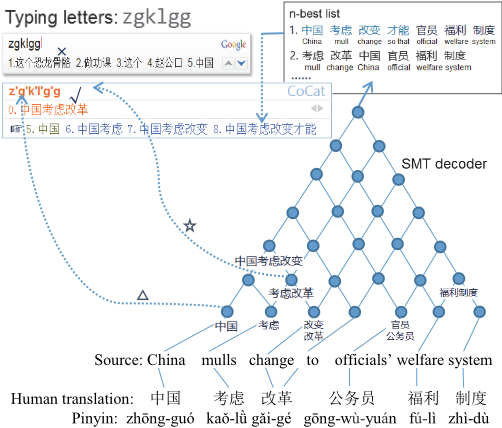
To achieve these goals, we propose in this paper a novel approach deeply integrating MT into the CAT system: a welldesigned input method named CoCat which makes full use of the knowledge adopted by the MT systems, such as translation rules, decoding hypotheses and n-best translation lists. First, we analyze and extract the useful information of the MT system, and transform them into features. Then, we extend the standard input method and design a log-linear model to incorporate multiple sources of features. Finally, we design an n-gram prediction model for the input method to further facilitate the human translators. Our proposed input method CoCat works well in both scenarios: translating from scratch and post-editing. Figure 1 demonstrates how the approach works in translation from English to Chinese. If the human translator adopts the standard Google Pinyin to perform translation from scratch, the abbreviated Chinese typing letters "zgklgg" (the acronym in Chinese Pinyin) cannot elicit the correct translation (left-top in Figure 1). Instead, our proposed input method CoCat can correctly decode the abbreviated letters "zgklgg" into the desired translation which is provided by the SMT system (right part in Figure 1).
In the experiments, our proposed input method has achieved remarkable results on professional human translation test. This paper makes the following contributions:
- The well designed input method CoCat can take full advantage of the useful information of the MT system. CoCat is the first input method to exploit depth information used by MT, such as translation rules and decoding hypotheses.
- CoCat can not only help human translators significantly save time and keystrokes, but also substantially improve the final translation quality.
- CoCat can collaborate with other CAT technologies, for example, post-editing. When CoCat is integrated with post-editing, it can further speed up the translation process.
2 CoCat Input Method
In this paper, we focus on English-to-Chinese translation, which is a typical case for translating texts into languages with non-alphabetic characters.
For a human translator, the translation process using CAT tools can be divided into three steps: (1) the human translator generates the initial translation in mind after analyzing the source sentence; (2) he/she uses an input method to type the initial translation ("Human translation" in Figure 1) into the text input box; (3) the translator repeatedly revises the entered target sentence until the translation is satisfactory.
After applying MT to CAT tools, the MT result will be evaluated and used in three ways according to its quality: (1) the MT output is perfect, and it happens to be the one the human translator expects; (2) the MT output is good but not perfect, and the human translator needs to do some minor modifications with post-editing; (3) the MT output is too bad, and the human translator will ignore it.
Usually, MT results greatly facilitate human translators when using post-editing. However, in most cases, the MT output is not good enough. There are only a few perfect fragments, and tedious modifications are required.
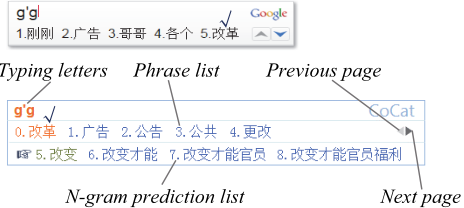
Based on the analysis above, we propose a well-designed input method called CoCat that provides a novel interactive approach by making full use of those perfect fragments. The interface of the CoCat is shown in Figure 2 with five phrases per page. This CoCat input method includes two novel CAToriented models: phrase generation model and n-gram prediction model. Figure 1 and Figure 2 illustrate the superiority of the two models compared with traditional input methods in three ways: (1) the phrase generation model generates new target phrases which the existing input methods cannot obtain. For example, typing letters "zgklgg" using Google Pinyin cannot lead to the correct phrase "ѝഭ 㘳㲁᭩䶙(China mulls to change)" as shown in Figure 1. (2) the phrase generation model can re-rank the target phrase list with additional features induced from the MT systems. For example, "᭩䶙(change)" is ranked first by CoCat among all the candidates for the typing letters "gg", while Google Pinyin will not bring the desired result as shown in Figure 2. (3) the n-gram prediction model can offer a list of translation suggestions. For example, it provides four potential phrases from index 5 "᭩ਈ(change)" to 8 "᭩ਈ㜭ᇈઈ⾿࡙" as shown in Figure 2.
(b) The key sequence with n-gram prediction model
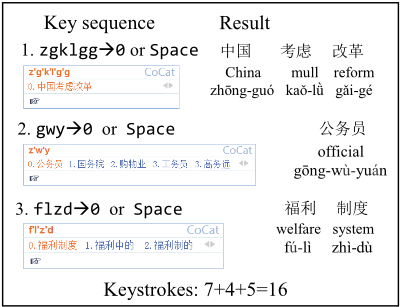
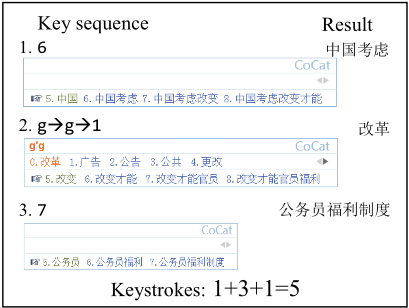
Figure 3: The comparison of key sequences without/with n-gram prediction model. The text is broken into chunks with the hypothesis that human translators prefer to directly select longer correct predictions.
As a summary, the proposed CoCat input method will improve the human translation process in two aspects: (1) human translators do not need to evaluate the MT output; (2) the new input method automatically speeds up the translation process by providing suggestions in a friendly way.
2.1 Phrase Generation Model
The user types phonetic spellings, which are called typing letters in this paper, to input a Chinese phrase. For example, to enter the target phrase "ѝഭ㘳㲁᭩䶙(China mulls to change)", the translator usually types Chinese Pinyin "zhongguokaolvgaige". The input method automatically segments the typing letters into "zhong'guo'kao'lv'gai'ge" and finally converts it into a large candidate set of Chinese character strings, including "ѝഭ㘳㲁᭩䶙", whose scores may rank low among other candidates. In Chinese, a phonetic spelling usually matches dozens of characters. So, it is very difficult for input methods to select the correct corresponding Chinese characters automatically.
Our CoCat input method tries to reduce the number of the typing letters and make the expected phrase rank as high as possible. For example, if we type the shorter "zgklgg", the correct result "ѝഭ㘳㲁᭩䶙" can still rank first according to the context with the aid of the MT system in Figure 1. The smaller number of the typing letters, the faster the translating, the more time left for human translators to think, and the better the translation. However, all the existing Pinyin input methods, such as Google Pinyin, cannot decode "zgklgg" correctly.
of goal the ,ݕǥ ଶݕଵݕ ൌ ଵݕ For a given segmented Pinyin conversion from Pinyin to Chinese characters is to find the the from ݄ǥ ଶ݄ଵ݄ ൌ ଵ݄ most probable Chinese characters and ݕ Usually, ሻ. ଵݕȁ ଵ݄ሺ � maximizing by ܪ candidates set character, Chinese a of syllable a is ݕ length, same the have ݄ better To to. responds ݕ that characters the of one is ݄ and integrate MT system, we design a new phrase generation model for CoCat using the log-linear model:
feature, corresponding the of weight the denotes ߣ in which, feature The functions. feature of number the denotes ܯ and em- features typical includes ሻ} ଵݕ ǡ ଵ݄ሺ݂{ function set ployed by the input methods, such as the word frequency, lan- the and ሻ ଵ݄ȁ ଵݕሺ log-probabilities for the typing model � features three following the addition, In ሻ. ଵ݄ሺ guage model � which are induced from the MT systems are employed by the log-linear model:
- The feature function indicating whether the candidate is included in the translation rules corresponding to the current source sentence.
- The feature function indicating whether the candidate is included in the hypotheses during MT decoding.
- The feature function indicating whether the candidate is included in the n-best list of the MT result.
Decoding is performed by the CYK algorithm (Kasami, 1965; Younger, 1967), and a beam-search algorithm is employed to speed up the decoding.
To complete the translation task using CoCat, we need to type the key sequence as shown in Figure 3(a). We can get the correct result by typing letters "zgklgg" when we translate the sentence in Figure 1. It is because that the candidate substring "ѝഭ" is included in the MT translation rules (∆ in Figure 1) and another candidate substring "㘳㲁᭩䶙" is contained in the MT translation hypotheses (� in Figure 1). "ѝ ഭ㘳㲁᭩䶙" will be rewarded during pruning and re-ranking just as the step 1 in Figure 3(a) shows. We can achieve the same effect on other languages in a similar way.
2.2 N-gram Prediction Model
To further reduce the number of keystrokes during the whole human translation process, we propose an n-gram prediction model for the input method CoCat.
may ܹ Consider the number of predictions, W. A bigger save more keystrokes, but too many predictions will impose an additional burden on translators' decision-making and selecting through a numeric key (plus 5 phrases). So, we setting. default the as Ͷ ൌ ܹ choose ma- i-th the ,ሽȁܱȁ ݅ ൏ ȁͲ ܱሼ ൌ ܱ Given an MT n-best list denotes |O| , ȁȁǥଶଵ ൌ chine translation candidate is , of number word the denotes ȁȁ the size of the n-best list, hu- desired the Suppose . in word j-th the denotes and generat- of algorithm The .ݐǥ ଶݐଵݐ ൌ ଵݐ man translation is ing n-gram predictions is given as follows:
- ൌ ȁ{ predictions n-gram ܹ (1) Generate the initial MT best the on based } ሻܹ ݈ ሺͳ ଵǥ ଵଵ typing. before ଵ candidate
- The translator can press a certain numeric key to select the corresponding prediction, or ignore all the predictions and just continue typing his own translation.
- of ݐ (3) Once the translator completes typing the word prefix current the get we ,ଵݐ the human translation find we then ,ݐǥଶݐଵݐ ൌ ଵݐ of the human translation n-best MT the in , its maximum suffix matching, list using the maximum suffix matching algorithm.
- use to continue we (3), step the in (4) If there exists ݇ the maximum suffix matching algorithm to find dynamically will system The .ݐ ൌ that satisfies ሻାሺǥ ሻଶାሺሻଵାሺ ൌ ȁሼ update predictions the , such no is there If . on based ሽሻܹ ݈ ሺͳ n-gram prediction list is empty.
- Go to step (2) until the translator completes the whole translation process.
If we enable the n-gram prediction model, the key sequence would be further optimized as shown in Figure 3(b). In step 1, the correct initial prediction "ѝഭ㘳㲁(China mulls)" is produced when we start translating as shown in Figure 3, and we can press the numeric key 6 to choose it directly. In step 3, the n-gram prediction model generates the sys- welfare 'slaiciffo(ᓖࡦ࡙⾿ઈ࣑ޜ" correct prediction tem)", and we can press the numeric key 7 to select the suitable prediction. As shown in Figure 3, using the model, we can save the keystrokes by:
In this way, CoCat input method provides effective interactions and reduces the keystrokes as many as possible even if the MT results are not good enough.
3 Experiments
We conduct the experiments to test the performance of our CoCat input method in improving the productivity of the human translators. To have a comprehensive understanding, we measure the human productivity from three perspectives: translation time, keystrokes and translation quality.
3.1 Experimental Setup
All the experiments are conducted on our CoTrans Translator platform, which is an in-house developed CAT tool integrated with a typical phrase-based MT system (Xiong et al., 2006). This CAT tool supports translation among many languages. We test our method on English-to-Chinese translation. The integrated MT system is trained on about 10,000,000 parallel sentence pairs of English-Chinese news, and it is tuned on 1,000 parallel sentence pairs using ZMERT (Zaidan, 2009) with the objective to optimize TER (Snover and Dorr, 2006). This tuning set, which was translated into Chinese by professional translators, was chosen from Chinese news (prior to March 2014) of China Daily. All the knowledge contained in this MT system is utilized in our proposed CoCat input method. The statistical significance test is performed by the re-sampling approach (Koehn 2004).
| #translators male/female | English-Chinese 12 6/6 | |
|---|---|---|
| Total | #source words time (sec/word) | 3,918 3.10 |
| M1 | #source words time (sec/word) | 990 3.56 |
| M2 | #source words time (sec/word) | 983 2.95 |
| M3 | #source words time (sec/word) | 969 2.8 |
| M4 | #source words time (sec/word) | 976 3.07 |
| A | B | C | D | |
|---|---|---|---|---|
| M1 | M4 | M3 | M2 | |
| CoCat | M2 | M1 | M4 | M3 |
| PE+Google | M3 | M2 | M1 | M4 |
| PE+CoCat | M4 | M3 | M2 | M1 |
CoTrans Translator platform tracks every key stroke and mouse click of the user and generates user interaction log which allows us to analyze the users' translation time, keystrokes and translation quality in detail afterwards.
Next, we will introduce the participanting practationers and the experimental data.
Professional Translation Practitioners
Following the convention, we recruited 12 professional translators for our study. We divided the 12 translators into 4 groups evenly (A/B/C/D). Each translator translated the same set of sentences from English to Chinese. All of the professional translators are Chinese native speakers.
Experimental Data
from , ǥǡͳͲሽ ͳǡʹǡ ൌ ݅ȁݏሼ ൌ ܵ We choose 160 sentences, China news (prior to December 2014) of China Daily as the test set for human translators. This test set contains 3,918 English words. Each sentence ranges from 23 to 26 words.
The professional translators were asked to translate the text with four different assistant tools: (1) Google Pinyin ("Google"); (2) CoCat input method ("CoCat"); (3)postediting with Google Pinyin ("PE+Google"); (4) post-editing with CoCat input method ("PE+CoCat"). Naturally, for each human translator, he/she should translate different sentences when using different assistant tools. Thus, we splitted the test data into four subsets randomly and evenly. Table 1 shows the details about the statistics of the 4 groups of test subset data. Table 2 shows the details about the permutation of assignments inspired by the previous works (Koehn, 2009a; Green et al., 2014).
| A | B | C | D | total | |||||||||||
|---|---|---|---|---|---|---|---|---|---|---|---|---|---|---|---|
| time (s) | keystrokes | quality (BLEU) | time (s) | keystrokes | quality (BLEU) | time (s) | keystrokes | quality (BLEU) | time (s) | keystrokes | quality (BLEU) | time (s) | keystrokes | quality (BLEU) | |
| 114.68 | 209.83 | 68.17 | 110.67 | 236.78 | 72.25 | 80.39 | 168.65 | 75.96 | 100.30 | 184.30 | 71.57 | 102.38 | 204.26 | 72.12 | |
| CoCat | 89.61** (21.86%�) | 138.41** (34.04%�) | 76.31** (8.14�) | 98.05** (11.40%�) | 168.13** (28.99%�) | 80.42** (8.17�) | 68.05** (15.35%�) | 93.94** (44.30%�) | 86.06** (10.10�) | 71.56** (28.65%�) | 124.33** (32.50%�) | 82.84** (11.27�) | 84.03** (17.89%�) | 134.85** (33.98%�) | 81.29** (9.17�) |
| PE+Google | 64.7 | 100.66 | 78.49 | 52.93 | 92.24 | 80.74 | 83.25 | 158.13 | 77.02 | 71.78 | 121.81 | 77.72 | 66.59 | 115.75 | 78.79 |
| PE+CoCat | 52.03** (19.58%�) | 59.36** (41.03%�) | 81.53** (3.04�) | 48.34** (8.68%�) | 63.44** (31.22%�) | 85.32** (4.58�) | 65.43** (21.41%�) | 80.77** (48.92%�) | 84.05** (7.03�) | 66.90** (6.80%�) | 82.11** (32.60%�) | 72.76 (4.96�) | 56.63** (14.97%�) | 69.865** (39.64%�) | 81.98** (3.19�) |
In the real world, there are many factors which may influence our experimental results, such as the different difficulties of the sentences to be translated, the tolerance of the long period of translation test and different levels of translators. To eliminate the irrelevant effects, we use the permutation of assignments in Table 2 based on the following assumptions: (1) the minor discrepancy of difficulty degrees of four test subsets can be negligible; (2) the fatigue degree difference of a particular translator in different time in one day can be negligible.
3.2 Data Cleaning
To exclude the translation irrelevant factors, such as the time spent on searching for terms and the moments of rest, we process the user interaction log as follows:
- Remove all the interactions which are irrelevant to the assistant tools from the timeline, such as looking up the dictionary online and searching information online.
- Exclude all of the time intervals lasting longer than 10 seconds between two adjacent interactions.
- Select the best four from the 12 human translations as references for each source sentence, and average the scores of human translations using BLEU-4 evaluation metric (Papineni et al., 2002).
3.3 Results and Analysis
We analyze the human productivity in terms of translation time, keystrokes and translation quality. To improve the robustness, we average the result values of repeated measurements. Let's take the "translation time" for example. According to the permutation of assignments in Table 2, the sentence si in subset M1 has been translated by three translators in group A under the assistance of "Google". For the instance si, we average the three values of "translation ௦݁݉݅ݐ time" given by the system and get the value ீ . We compute the average translation time of a subset under the assistance of "Google" as follows:
Then we calculate the average translation time of all sentences under the assistance of "Google" using the following formula:
For keystrokes and translation quality, they are calculated in the same way.
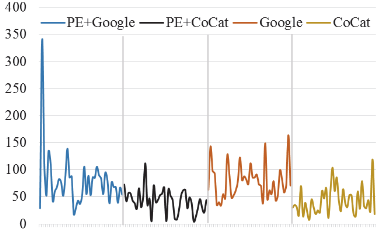
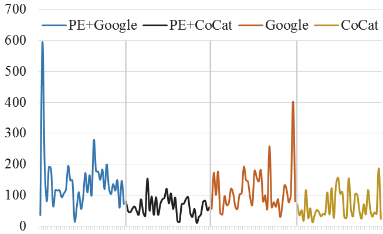
For example, translation time and keystroke consumption on each sentence of a specific translator in group C are reported in Figure 4 and Figure 5. As we can see in the figures, CoCat helps her save about 46% time and about 41% keystrokes in the scratch mode, and save about 45% time and about 54% keystrokes in the post-editing mode.
The detailed results of all the human translators are reported in Table 3. On average, all human translators are faster and also achieve better translation quality using any of types of assistance offered. What's more, human translators are faster and also achieve better translation quality using CoCat (translating from scratch or post-editing).
For translation time and keystrokes, the figures in Table 3 show that our proposed CoCat always helps human translators significantly (with p < 0.01), saving more than 14% time and over 33% keystrokes compared with the strong baseline, i.e., post-editing using Google Pinyin (line 4 vs. line 3 and line 6 vs. line 5).
For translation quality, the figures in Table 3 show that CoCat can help human translators improve the translation quality significantly as well (with p < 0.01) by more than 3 absolute BLEU scores over the strong baseline.
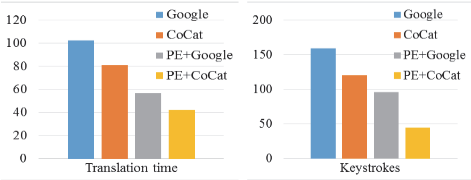
Take a specific sentence as an example, such as "CPC's discipline agency announced on Jan. 16 that Huo has been placed under investigation for suspected serious violation of party discip-lines and laws", the comparison statistics of translation time and keystrokes are reported in Figure 6. CoCat can save about 21% time and about 24% keystrokes in the scratch mode, and save about 26% time and about 53% keystrokes in the post-editing mode.
Overall, the results in Table 3 indicate that post-editing consistently outperform unassisted translation. It is in line with the findings reported by Koehn (2012). Meanwhile, the post-editing well integrated with our proposed CoCat input method further improves the translation productivity.
What's more, if we focus on the comparison between "CoCat" and "PE+Google", we can find that the difference of the translation quality is very small. In the industrial world, the poor performance of the automatic translation engine is often a headache for human translators to edit the MT results. The comparison between "CoCat" and "PE+Google" tells us that we can make human translators generate better translation in less time with the aid of MT without headache.
In summary, we can draw the conclusion that the proposed new input method makes it easier for human translators to interact with MT systems effectively and imperceptibly.
4 Related Work
The goal of this paper is to improve the productivity and efficiency of human translators by fully exploiting the MT technology. The core idea is to provide human translators translation candidates effectively and friendly. There are two kinds of related work focusing on offering translation suggestions.
Koehn (2009a; Koehn et al., 2014) developed the tool Caitra which aims at providing translation suggestions to complete the target language sentence. Based on MT postediting, their method can offer word and phrase translation candidates through interative machine translation. Green et al. (2014) made extensive modifications for the MT system and designed a new CAT interface. Their methods are tightly coupled with statistical machine translation in which only left-to-right decoding is allowed and dynamic decoding in interactive machine translation is usually time-consuming. In contrast, we integrate most of the useful knowledge of the MT system into a well designed CoCat input method that provides the translation suggestions more friendly and imperceptibly without forcing the human translators to take a view of the MT outputs. Besides using MT outputs, we are the first to exploit depth information used by MT, such as translation rules and decoding hypotheses.
Recently, Li (2012) and Fang (2013) also attempted to incorporate the SMT information into the Chinese Pinyin input method. In their approaches, when they developed their input methods, only the MT model scores and the fuzzy word alignment between the MT output and the human translation output are employed. However, there are two disadvantages in their approaches. On the one hand, the dynamic MT model scores are difficult to calculate and these model scores are not compatible with other features in input methods. On the other hand, the fuzzy word alignment contains much noise which would not benefit much to the input method. Instead, we design the log-linear model for the input method CoCat and integrate the translation rules, decoding hypotheses and the n-best translation list of the MT system. In addition, we propose the n-gram prediction model to further improve the efficiency of human translators.
5 Conclusion
In this paper, we have presented a novel input method CoCat which deeply integrates MT into CAT effectively and imperceptibly. This well-designed input method is modeled with a log-linear framework, and takes as features most of the useful knowledge of the MT system, such as translation rules, decoding hypotheses and n-best translation lists. Furthermore, we have proposed an n-gram prediction model that further speeds up the translation typing process.
The human translation experiments on English-to-Chinese have shown that the proposed approach can not only help human translators significantly save the time and keystrokes, but also substantially improve the final translation quality. The experiments have also shown that post-editing well integrated with our proposed approach further improves the translation productivity.
Acknowledgement
We thank anonymous reviewers for their valuable comments. The research work has been partially funded by the Natural Science Foundation of China under Grant No. 61333018 and No. 61403379 and supported by the West Light Foundation of Chinese Academy of Sciences under Grant No. LHXZ201301.
@inproceedings{ijcai2015p168,
  title     = {A New Input Method for Human Translators: Integrating Machine Translation Effectively and Imperceptibly},
  author    = {Huang, Guoping and Zhang, Jiajun and Zhou, Yu and Zong, Chengqing},
  booktitle = {Proceedings of the Twenty-Fourth International Joint Conference on
               Artificial Intelligence, {IJCAI-15}},
  publisher = {International Joint Conferences on Artificial Intelligence},
  editor    = {Qiang Yang and Michael Wooldridge},
  pages     = {1163--1168},
  year      = {2015},
  month     = {7},
  note      = {Main Track},
  url       = {https://ijcai.org/proceedings/2015/168},
}
TY - CPAPER TI - A New Input Method for Human Translators: Integrating Machine Translation Effectively and Imperceptibly AU - Huang, Guoping AU - Zhang, Jiajun AU - Zhou, Yu AU - Zong, Chengqing T2 - Proceedings of the Twenty-Fourth International Joint Conference on Artificial Intelligence, IJCAI-15 PB - International Joint Conferences on Artificial Intelligence PY - 2015 SP - 1163 EP - 1168 UR - https://ijcai.org/proceedings/2015/168 ER -Copied
Machine-readable versions of this paper, for tools and AI agents:





