
Spectrum-Based Fault Localisation for Multi-Agent Systems
Proceedings of the Twenty-Fourth International Joint Conference on Artificial Intelligence. Main Track. Pages 1134-1139.
© 2015 International Joint Conferences on Artificial Intelligence
Abstract
Diagnosing unwanted behaviour in Multi-Agent Systems (MASs) is crucial to ascertain agents' correct operation. However, generation of MAS models is both error-prone and time intense, as it exponentially increases with the number of agents and their interactions. In this paper, we propose a light-weight, automatic debugging-based technique, coined ESFL-MAS, which shortens the diagnostic process, while only relying on minimal information about the system. ESFL-MAS uses a heuristic that quantifies the suspiciousness of an agent to be faulty; therefore, different heuristics may have different impact on the diagnostic quality. Our experimental evaluation shows that 10 out of 42 heuristics yield the best diagnostic accuracy (96.26% on average).
- [Abreu et al., 2009] Rui Abreu, Peter Zoeteweij, Rob Golsteijn, and Arjan J.C. van Gemund. A practical evaluation of spectrum- based fault localization. Journal of Systems and Software, 82(11):1780 -1792, 2009.
- [Bordini et al., 2007] Rafael H. Bordini, Jomi Fred Hubner, and Michael Wooldridge. Programming Multi-Agent Systems in AgentSpeak using Jason. John Wiley & Sons, Ltd, 2007.
- [Campos et al., 2013] José. Campos, Rui. Abreu, Gordon Fraser, and Marcelo d'Amorim. Entropy-based test generation for im- proved fault localization. In Proc. of ASE'13, pages 257-267, Nov 2013.
- [Dastani et al., 2007] Mehdi Dastani, Jrgen Dix, and Peter Novk. The second contest on multi-agent systems based on computa- tional logic. In Computational Logic in Multi-Agent Systems, volume 4371 of LNCS, pages 266-283. Springer, 2007.
- [de Kleer and Williams, 1987] Johan de Kleer and Brian C. Williams. Diagnosing multiple faults. Artificial Intelligence, 32(1):97 -130, 1987.
- [Dellarocas and Klein, 2000] Chrysanthos Dellarocas and Mark Klein. An experimental evaluation of domain-independent fault handling services in open multi-agent systems. In Proc. of IC- MAS'2000, pages 95 -102, 2000.
- [Fischer et al., 1996] Klaus Fischer, JoRG P. Muller, and Markus Pischel. Cooperative transportation scheduling: An application domain for dai. Applied Artificial Intelligence, 10(1):1-34, 1996.
- [Fisher et al., 2007] Michael Fisher, Rafael H. Bordini, Benjamin Hirsch, and Paolo Torroni. Computational logics and agents: A road map of current technologies and future trends. Computa- tional Intelligence, 23(1):61-91, 2007.
- [Hofer et al., 2015] Birgit Hofer, Alexandre Perez, Rui Abreu, and Franz Wotawa. On the empirical evaluation of similarity coef- ficients for spreadsheets fault localization. Automated Software Engineering, 22(1):47-74, 2015.
- [Horling and Lesser, 2004] Bryan Horling and Victor Lesser. A sur- vey of multi-agent organizational paradigms. Knowl. Eng. Rev., 19(4):281-316, December 2004.
- [Huang et al., 2014] Zhan Huang, Rob Alexander, and John Clark. Mutation testing for jason agents. In Engineering Multi-Agent Systems, volume 8758 of LNCS, pages 309-327. Springer Inter- national Publishing, 2014.
- [Kalech, 2012] Meir Kalech. Diagnosis of coordination failures: a matrix-based approach. Auton. Agent Multi-Agent Syst., 24(1):69-103, 2012.
- [Le et al., 2013] Tien-Duy B. Le, Ferdian Thung, and David Lo. Theory and practice, do they match? a case with spectrum-based fault localization. In Proc. of ICSM'13, pages 380-383, Sept 2013.
- [Micalizio, 2013] Roberto Micalizio. Action failure recovery via model-based diagnosis and conformant planning. Computational Intelligence, 29(2):233-280, 2013.
- [Nguyen et al., 2011] CuD. Nguyen, Anna Perini, Carole Bernon, Juan Pavón, and John Thangarajah. Testing in multi-agent sys- tems. In AOSE X, volume 6038 of LNCS, pages 180-190. Springer Berlin Heidelberg, 2011.
- [Passos et al., 2014] Lúcio S. Passos, Rui Abreu, and Rosaldo J. F. Rossetti. Sensitivity analysis of spectrum-based fault localisation for multi-agent systems. In Proc. of DX'14, Sep 2014.
- [Passos et al., 2015a] Lúcio S. Passos, Rosaldo J. F. Rossetti, and Joaquim Gabriel. Advances in fault-tolerant multi-agent systems. In Encyclopedia of Information Science and Technology, 3rd ed., pages 7006-7017. 2015.
- [Passos et al., 2015b] Lúcio S. Passos, Rosaldo J.F. Rossetti, and Joaquim Gabriel. An agent methodology for processes, the envi- ronment, and services. In Advances in Artificial Transportation Systems and Simulation, pages 37 -53. Academic Press, Boston, 2015.
- [Platon et al., 2007] Eric Platon, Nicolas Sabouret, and Shinichi Honiden. A definition of exceptions in agent-oriented computing. In Proc. of ESAW'06, pages 161-174. Springer-Verlag, 2007.
- [Rossetti et al., 2002] Rosaldo J.F Rossetti, Rafael H. Bordini, Ana L.C Bazzan, Sergio Bampi, Ronghui Liu, and Dirck V. Vliet. Using bdi agents to improve driver modelling in a commuter sce- nario. Transportation Research Part C: Emerging Technologies, 10(56):373 -398, 2002.
- [Savelsbergh and Sol, 1995] Martin W. P. Savelsbergh and Marc Sol. The general pickup and delivery problem. Transportation Science, 29(1):17-29, 1995.
- [Steimann et al., 2013] Friedrich Steimann, Marcus Frenkel, and Rui Abreu. Threats to the validity and value of empirical as- sessments of the accuracy of coverage-based fault locators. In Proc. of ISSTA'13, pages 314-324. ACM, 2013.
- [Yoo et al., 2014] Shin Yoo, Xiaoyuan Xie, Fei-Ching Kuo, Tsong Yueh Chen, , and Mark Harman. No pot of gold at the end of program spectrum rainbow: Greatest risk evaluation formula does not exist. Technical Report Tech. Rep. RN/14/14, University College London, 2014.
- [Zamir et al., 2014] Tom Zamir, Roni Stern, and Meir Kalech. Us- ing model-based diagnosis to improve software testing. In Proc. of AAAI'14, 2014.
References were extracted automatically from the PDF and may contain errors.
Full text extracted automatically from the PDF; figures, tables and equations may differ. The PDF is the version of record.
1 Introduction
Previous approaches to ascertain nominal behaviour of MultiAgent Systems (MASs) (see [Nguyen et al., 2011; Fisher et al., 2007]) assume a priori knowledge (i.e., model) to diagnose observed failures. This knowledge can be appropriately built when designers fully understand the environment upon which agents act as well as agents' state space.
However, in practice, due to (i) the complexity of MASs, (ii) dynamism of the environment, and (iii) presence of legacy systems, MAS and/or agent models are rather laborious to build. As a consequence, building the model is an error-prone task. Any knowledge not included in the built model by designers may therefore prevent the capability of model-based fault diagnosis to effectively recognise faults.
To address this issue, this paper considers a model-less approach to pinpoint behavioural faults in MASs. Spectrumbased Fault Localisation (SFL) is a promising technique that does not rely on an explicit model of the system under analysis and has been shown to yield good diagnostic accuracy for software systems [Hofer et al., 2015; Abreu et al., 2009].
The diagnosis process in SFL is based on the analysis of the differences in the so-called program spectra (abstraction over program traces) for passed and failed runs. SFL isolates the faulty component, using a similarity coefficient as heuristic, whose activity most correlates with observed failures. More importantly, SFL can be applied to resourceconstrained environments due to its relatively low computational overhead [Abreu et al., 2009]. Such properties suggest that SFL is a well-suited technique for MASs.
Literature has shown that there is no standard similarity coefficient that yields the best result for SFL [Yoo et al., 2014; Hofer et al., 2015; Le et al., 2013]. Empirical evaluation is therefore essential to establish which set of heuristics excels for the specific context to which SFL is being applied. To the best of our knowledge, SFL has not as yet been applied to diagnose behavioural faults in MASs; there is hence the need to empirically evaluate different formulae using known faults to compare the performance yielded by several coefficients.
This paper makes the following contributions:
- We discuss the limitations of applying SFL with commonly used block hit spectra for time-persistent entities such as agents;
- We describe the Extended Spectrum-based Fault Localisation for Multi-Agent Systems (ESFL-MAS) to diagnose agent behavioural faults when testing the system as a whole;
- We present an experimental study on the impact of 42 heuristics in the ESFL-MAS diagnostic accuracy using the well-known and real-world representative Pickup and Delivery Problem as test suite;
- We show that for ESFL-MAS the Accuracy, Coverage, Jaccard, Laplace, Least Contradiction, Ochiai, Rogers and Tanimoto, Simple-Matching, Sorensen-Dice, and Support outperform the remainder coefficients across the entire quantity and quality data space (yielding 96.26% accuracy) in the specific conditions of our test suite.
2 RelatedWork
There is a wide set of approaches to increase the reliability in MASs. Formal verification, with model checking and theorem proving (see [Fisher et al., 2007]), has received great attention by the community. Albeit exhaustive and automated, such approaches are computationally costly, despite employing reduction techniques, as well as rely solely on the model of the system under test to certify correct functioning.
As for diagnosis in the scope of MASs, Dellarocas and Klein [2000] propose a diagnosis based on a fault-model of agents. Fault-based diagnosis is not recommended for MASs due to agents interactions. Micalizio [2013] proposes a diagnostic system that pinpoint the set of erroneous actions integrated with recovery processes. Plan-diagnosis techniques depend on given agents' plans curbing their usage at systemlevel testing. Concerned with determining coordination failures within team of agents Kalech [2012] proposes the social diagnosis. These works are robust and scale well in collaborative MASs; however, they focus only on the coordination failures, neglecting their influence on MAS overall performance. We refer the interested reader to Passos et al.'s [2015a] work for further analysis.
Therefore, to the best of our knowledge, all state-of-the-art approaches to ensure MAS correct behaviour rely on a priori model of the system to identify flaws. This work goes further and extends the use of SFL for MASs, collecting system dynamics information rather than using predefined models.
3 Preliminaries
Spectrum-based Fault Localisation
SFL is a dynamic program analysis technique, which requires minimal information about the system to be diagnosed. The SFL abstracts the system in terms of two general concepts: components and transaction. The former is an element of the system that, for diagnosis purposes, is considered to be atomic. Such entities could be individual statements, blocks, and so forth. The latter is a set of component information, whose correctness of output can be verified.
SFL relies on a set of test to produce a sequence of component activities that results in a particular output. The result of a process is either nominal ("pass") or an error ("fail"). These fail and pass sets are also known as spectra, and originate from the collection of transactions. Additionally, the overall results of tests are called error vector. Given the hypothesis that closely correlated components are more likely to be relevant to an observed failure, the basic idea of SFL is that comparing the transactions over multiple runs and then computing the suspiciousness values of components can indicate which of these is the most likely to be the faulty one.
Several SFL methods use different formulae of similarity coefficients to compute such suspiciousness values. In this paper, an exhaustive list of 42 heuristics [Hofer et al., 2015] has been studied focusing on the context of fault localisation in software agents. These coefficients are: Accuracy (C1), Added Value (C2), Anderberg (C3), Certainty Factor (C4), Collective Strength (C5), Confidence (C6), Conviction (C7), Coverage (C8), Example and Counterexample (C9), Gini Index (C10), Goodman and Kruskal (C11), Information Gain (C12), Interest (C13), Interestingness Weighting Dependency (C14), J-Measure (C15), Jaccard (C16), Kappa (C17), Klosgen (C18), Laplace (C19), Least Contradiction (C20), Leverage (C21), Loevinger (C22), Normalized Mutual Information (C23), Ochiai (C24), Ochiai II (C25), Odd Multiplier (C26), Odds Ratio (C27), One-way Support (C28), Piatetsky-Shapiro (C29), Relative Risk (C30), Rogers and Tanimoto (C31), Sebag-Schoenauer (C32), Simple-Matching (C33), Sorensen-Dice (C34), Support (C35), Tarantula (C36), Two-way Support (C37), Two-way Support Variation (C38), Yule's Q (C39), Yule's Y (C40), Zhang (C41), φ-coefficient (C42). For the sake of organisation, we refer the interested reader to Hofer et al.'s [2015] work for further details regarding these formulae.
Concepts and Definitions
In this paper we consider that faults in agents' behaviour depend on a given context, i.e. on how each agent interprets that particular situation; and, mainly, these faults are a systemic matter as it might affect the overall performance [Platon et al., 2007]. More specifically, the term "faulty agent" is used to refer that the agent either is unhealthy and needs to be repaired or has been induced to a failure state (known as cascading effect).
Diagnosis is the task of pinpointing the faulty component that led to symptoms (failure/error). In software, the set of components can be defined at any level of granularity: a class, a function, or a block. The lower the level of granularity gets, the more focused is the diagnosis, even though such low granularity requires more computational effort [Zamir et al., 2014]. The diagnosis problem for MASs can be defined as follows.
Definition 1 (Multi-Agent Diagnosis Problem) Given a multi-agent system MAS that has a set of agents AGS and a set of observations OBS for a test case, then the diagnosis problem is to find the faulty agent which is responsible for the mismatch between the expected MAS performance and the observed one.
The multi-agent diagnosis problem is defined with granularity at the agent level and thus considers agents as black boxes. This is a fair assumption when different parties implement agents reasoning and do not completely share their knowledge and/or architecture. On the one hand, the proposed technique is not able to identify the specific bug inside the code of the faulty agent; on the other hand, however, it has the advantage of not being either programming language or agent architecture specific.
4 ESFL-MAS
In this section we describe our approach, called Extended Spectrum-based Fault Localization for MAS (ESFL-MAS). The first step is to map concepts of MASs into the aforementioned elements of SFL. As stated by Definition 1, this work deals with agent-level diagnosis and therefore components of the system are the agents themselves. As for transactions, since MASs must run during some period of time (several time frames if considering discrete time) to observe their emerging behaviour, ESFL-MAS considers the error status of an agent's behaviour at time n as a transaction. We use the terms time frame and time step interchangeably.
The far most commonly used type of spectra is called hit spectra [Abreu et al., 2009]. It encodes the involvement (success/failure) of each component of the system in terms of involved/not involved in a given test case. The constraint of using the hit spectra is related to the lack of useful information about state of the agent execution. Since agents are timepersistent entities, they are always active and acting upon the environment; this creates spectra with very high entropy.
High entropy means that there is less useful information in the spectra which, consequently, decreases the diagnostic quality of SFL [Campos et al., 2013]. Therefore, block hit spectra is not suitable in the context of MASs.
The solution proposed to overcome such a limitation is to encode the performance of each agent in terms of being expected/unexpected at a determined time step. A detection of symptoms (also called error detection) phase is responsible to infer any behavioural violation from observations of the system [de Kleer and Williams, 1987]. Specifically for agents, this can be done using several methods from monitoring agent's utility to applying anomaly detection techniques. Note that detecting an unexpected behaviour does not necessarily mean that one has identified the agent that is causing the system failure to occur. ESFL-MAS pinpoints the faulty agent so the designer is able to fix it, which is also essential to improve reliability of MASs. Given this performanceoriented perspective, we propose the performance spectra, where the error detection phase generates the set of data composing the spectra. It is worthwhile mentioning that error detection mechanisms are outside the scope of this paper.
Definition 2 Let N denote the number of passing and failing time frames. Let Nf and Np, Nf + Np = N, denote the number of fail and pass sets (spectra), respectively. Let A denote the N ×M performance matrix, where anm denotes whether agent m performed an unexpected behaviour at time n (anm = 1) or not (anm = 0). Let e denote the error vector, where en implies whether the MAS has passed (en = 0) or failed (en = 1) the test case at time n.
Given that the pair (A, e) highly depends on both the environment's settings and the agents' autonomy, SFL is limited to catch multiple instances of both dependencies. This limitation is addressed as follows. First, to solve the problem of multiple environment's settings, one must run the MAS for different environment and agent settings; thus, the ESFLMAS collects performance spectra referring to several test cases. Second, to solve the agent's autonomy problem, one must execute the MAS J rounds of the same test case to ensure that the collected spectra cover as many agents' activation paths (i.e., choices) as possible.
For each agent, a dichotomy matrix is then created (see Table 1). One dimension of this matrix is related to the amount of time steps in which the agent had an unexpected behaviour detected, and the other is the passed/failed MAS status determined by the expected output of a test case .
We have observed that agents are constantly monitored over time but do not consistently fail. For this reason, the collected performance spectra have several time frames in which either every agents performed an expected behaviour or every agent performed an unexpected behaviour. Both events contain no information for SFL because only the variability of transactions in the spectrum contributes towards improving diagnostic quality. A proposed optimisation to ESFLMAS, named MAS-Filter, recognises these aforementioned events and filters them from the performance spectra to increase quality of the diagnosis process. Conceptually, when excluding the non-useful time frames, the entropy value of the spectra tends to its optimal value and consequently increases diagnostic accuracy. The MAS-Filter is defined as follows.
| Behaviour of Agm 1) | ||
|---|---|---|
| MAS status | Unexpected (anm = | Excepted (anm = 0) |
| Failed (en = 1) | c11 | c01 |
| Passed (en = 0) | c10 | c00 |
| (A, e)F1,1 | (A, e)F1,2 | ||||||||||
|---|---|---|---|---|---|---|---|---|---|---|---|
| Agent | N 1 2 3 4 5 | c11 c10 | c01 | c00 | Agent | N 1 2 3 4 5 | c11 | c10 | c01 | c00 | |
| Ag1 | 1 1 1 0 0 | 2 | 0 | 1 | 0 | Ag1 | 1 1 0 0 0 | 0 | 1 | 1 | 1 |
| Ag2 | 0 1 1 0 0 | 1 | 0 | 2 | 0 | Ag2 | 1 1 1 0 1 | 1 | 2 | 0 | 0 |
| Ag3 | 1 1 0 0 0 | 1 | 0 | 2 | 0 | Ag3 | 1 1 0 0 0 | 0 | 1 | 1 | 1 |
| Ag4 | 1 1 0 0 0 | 1 | 0 | 2 | 0 | Ag4 | 1 1 1 0 0 | 0 | 2 | 1 | 0 |
| Ag5 | 1 1 0 0 1 | 2 | 0 | 1 | 0 | Ag5 | 1 0 0 0 1 | 1 | 0 | 0 | 2 |
| Error 1 0 1 0 1 | Error 1 0 0 1 1 | ||||||||||
where (A, e)F is the filtered spectra. This operation is executed when the value of anm is equal to 1 or 0 for all agents in the MAS. In Table 2, we highlight the lines that would be deleted by MAS-Filter.
Running Example. It is borrowed from our experimental setup described in Section 5. We have reduced the number of agents of this example. Let us assume that agent Ag5 erroneously compute its distance from a gold nugget because of an unforeseen bug in the reasoning process unintentional left by the designer/programmer. Because of this fault Ag5 presents lower performance given some specific situation. The faulty agent will be diagnosed using Algorithm 1.
The MAS is executed twice and assuming that there is a mechanism able to detect unexpected behaviour in the agents, the pairs (A, e) shown in Table 2 are built (ignoring the highlighted columns). MAS-Filter filters the highlighted columns and generates the pairs (A, e)F . They are depicted for illustration purposes only as they are not taken into account in the computation of the dichotomy matrices.
ESFL-MAS uses the information of the dichotomy matrices from Table 2 to compute the suspiciousness values using the similarity coefficient. In this example, we choose the Jaccard coefficient (C16). ESFL-MAS computes the suspiciousness value by inserting the information of the dichotomy matrix into the formula, e.g., for agent Ag5:
The process is repeated for every agent until it obtains the values shown in Table 3. Afterwards, the list of agents is sorted in descending order of the coefficient value. As expected, the
Algorithm 1: ESFL-MAS Algorithm
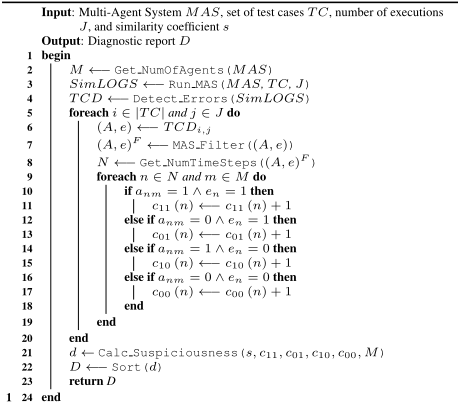
faulty agent Ag5 was the highest ranked by ESFL-MAS in the end of the process.
5 Experimental Setup
5.1 Test Suite
We use an instance of the Pickup and Delivery Problem (PDP) [Savelsbergh and Sol, 1995] to test our approach because (i) it is well-known and (ii) it is a real-world representative problem. MASs offer an interesting solution for PDP [Fischer et al., 1996].
The Second Edition of the Multi-Agent Programming Contest (MAPC) 1 [Dastani et al., 2007] provides an instance of PDP known as the GoldMiners scenario. GoldMiners implements fundamental concepts of MASs, such as autonomy, team-work coordination, high-level interaction, as well as partial and local perception of the environment. We chose the MAS programmed in AgentSpeak, an agent-oriented programming language, using Jason [Bordini et al., 2007], an interpreter for an extended version of AgentSpeak, given our previous experience using AgentSpeak [Rossetti et al., 2002]. Additionally, MAPC's implementations were previously tested and validated by the MAS community.
The Jason implementation aims to find a schedule that delivers as many items as possible at a lowest cost relying on a twofold strategy: first, a priori allocation of agents'
1 MAPC is an annual competition that, since 2005, aims at providing suitable test suites offering key problems for the community to test agent-oriented programming approaches.
| Agent | Ag1 | Ag2 | Ag3 | Ag4 | Ag5 |
|---|---|---|---|---|---|
| Coefficient Value | 0.40 | 0.33 | 0.20 | 0.17 | 0.75 |
| Ranking (D) | 2 | 3 | 4 | 5 | 1 |
| Qnt. Fault Description | NCNO NCO CNO CO |
|---|---|
| 1 Agent disrespects its search quadrant 1 Agent conceals nugget positions 1 Agent has a delayed response 1 Agent gets stuck in a specific goal 1 Agent gets the farthest gold nuggets. 3 Delete a belief in the agent. 3 Delete a plan in the agent. 3 Delete the condition part of a rule. 3 Replace the triggering event operator. 3 Delete the context of a plan. 3 Delete the body of a plan. 3 Delete a formula in the body plan. 3 Swap adjacent formulae in a plan. 3 Replace the operator of a goal. 3 Replace receivers in a message. 3 Replace the illocutionary force. 3 Delete a propositional in a message. | × √ × √ × × √ √ √ √ √ √ √ √ √ √ √ √ √ √ √ √ √ √ √ √ √ √ √ √ √ √ √ √ √ √ √ √ √ √ √ √ √ √ √ √ √ √ √ √ √ √ √ √ √ √ × × √ √ × × √ √ √ √ |
search quadrants and, second, a team-work coordination aiming to find and carry gold nuggets to the depot. Seeking completeness of our test suite and knowing MAS organizations [Horling and Lesser, 2004], we implement modified MASs varying both the coordination and spatial organisation dimensions resulting in the following types of MAS: (1) Non-Coordinated and Non-Organised (NCNO), where agents work individually (not cooperatively) and do not receive a search quadrant (loose spatial organization); (2) NonCoordinated and Organised (NCO), where agents work individually but each of them has an assigned search quadrant; (3) Coordinated and Non-Organised (CNO), where agents coordinate the gold-nuggets search, yet there is no allocated quadrant; and (4) Coordinated and Organised (CO), where agents coordinate the gold-nuggets search as well as have an assigned search quadrant.
We used both hand-seeded and seeded by mutation through rules (called mutation operators) to inject faults. Hand-seeded faults aim to emulate dysfunctional behaviours specifically for the aforementioned strategy [Passos et al., 2014] and, moreover, faults seeded by mutation rules automatically build a set of validated faulty versions as we used high-level mutation operators proposed by Huang et al. [2014]. Table 4 gives an overview of the faulty versions in the test suite.
5.2 Data Acquisition
A two-step process (depicted in Figure 1) generates the spectra required by the experiments.
Collecting Logs A MAS initially configured according to a given test case is executed to obtain the logs both from agents and from the overall system. For the experimental setup, we randomly generated 5 test cases and each of them corresponded to a set of initial positions for: agents, the depot, and gold nuggets. To collect information to generate spectra, the MAS with 25 agents was executed 75 times for each test case recording 1000 time steps.
Expected MAS Performance and Error Detection Both used test cases and the generation of performance spectra demands for measurements to verify MAS and agent correctness. Agent and the MAS are measured by the amount of carried gold nuggets in each time frame and the amount of gold nuggets in the depot, respectively. We run the correct version of MAS and compute the MAS performance baseline. While assessing the faulty versions, time steps with performance values above the baseline are marked as passed (en = 0) and below as failed (en = 1).
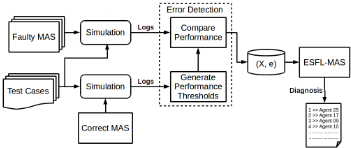
Differently from the original SFL, ESFL-MAS does not directly get spectra from the involvement of agents in a test case and thus an error detection phase is necessary to generate the performance spectra. Thus, we emulate an error-detection phase in our experiments to assess ESFL-MAS, even though proposing such mechanism is not within the scope of this work. Error detection for Miner agents is done similarly to the calculation of expected MAS performance. We compute the average amount of gold nuggets carried by each agent in a certain time frame and use this value as baseline to detect whether the agent is performing as expected (anm = 0) or not (anm = 1) for time n, therefore mapping collected logs to spectra.
5.3 EvaluationMetric
Diagnostic performance is expressed in terms of diagnostic quality (also referred to as accuracy) that evaluates how many agents need to be inspected before the faulty agent is found. If other agents have the same similarity coefficient as the faulty agent, we use the average ranking position for these agents. Diagnostic quality is defined as [Steimann et al., 2013]
where Sj and Sf denote the suspiciousness value for agent j and for the faulty agent respectively, and M is the total number of agents. Intuitively, the |{j|Sj > Sf}| term represents the number of agents ranked in front of the faulty agent whereas |{j|Sj ≥ Sf}| represents the number of agents with same or higher suspiciousness compared to the faulty one.
6 Experimental Results
The resulting groups for our benchmark are shown in Figure 2; moreover, Table 5 presents the average of diagnostic quality for each group of coefficients, as well as the standard deviation (σ). Note that the number of groups (and their elements) is not the same in every type of MAS. Only Group 01 has the same similarity coefficients and consistently yields the best accuracy (average of 96.26%) for our benchmark.
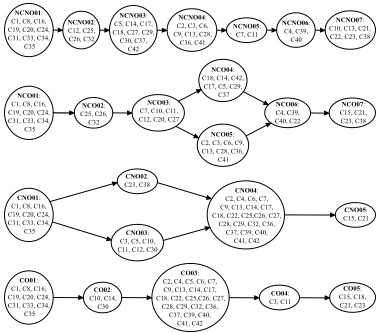
After carefully analysing the group compositions, two fundamental aspects can explain them. First, from the mathematical formulae of coefficients, there is a logical causal relation between accuracy and the dichotomy matrix: the more significance a coefficient assigns to anomalous behaviour for which a system's error has been detected (represented by c11), the better the diagnostic quality. Second, the test suite has reduced capacity of representing cascading effects of undesired behaviour. Thus, coefficients with greater emphasis on c10 have lower diagnostic quality.
Second, the test suite has reduced capacity of representing cascading effects of undesired behaviour; for instance, the faulty agent sending the wrong location of a gold nuggets for a correct agent inducing the latter in failure. Thus, coefficients that give greater emphasis on time steps where MASs are correct and an agent have performed unexpectedly have lower diagnostic quality.
On the Impact of Observation Quantity
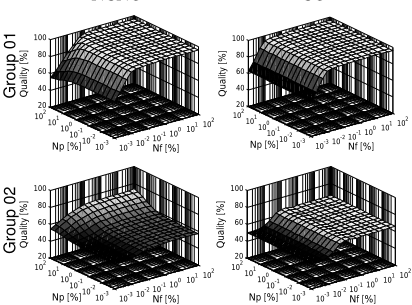
In the previous results, we have assumed that the designer/tester has time to run the MAS several times under different conditions to collect a considerable amount of measurements. In practice, the tester works under short-time constraints. To investigate how the amount of data influences ESFL-MAS performance, we evaluate Q while varying the number of passed (Np) and failed time steps (NF ) encompassed in the diagnosis process. We study this influence on the diagnostic accuracy Q throughout all the range of available data in the range of 0.001-100%.
| Q (σ) [%] | Group | ||||||
|---|---|---|---|---|---|---|---|
| 01 | 02 | 03 | 04 | 05 | 06 | 07 | |
| NCNO | 96.25 (11.27) | 73.96 (31.15) | 53.61 (22.98) | 47.90 (12.90) | 43.54 (19.61) | 36.85 (21.58) | 22.08 (27.95) |
| NCO | 95.16 (12.68) | 67.74 (27.45) | 53.27 (27.02) | 47.87 (17.81) | 46.19 (14.26) | 37.47 (21.39) | 23.32 (31.46) |
| CNO | 97.08 (10.35) | 55.83 (39.88) | 54.10 (31.77) | 50.00 (0.00) | 8.358 (19.67) | - | - |
| CO | 96.54 (10.74) | 66.23 (36.46) | 49.95 (1.628) | 44.92 (21.33) | 27.36 (38.17) | - | - |
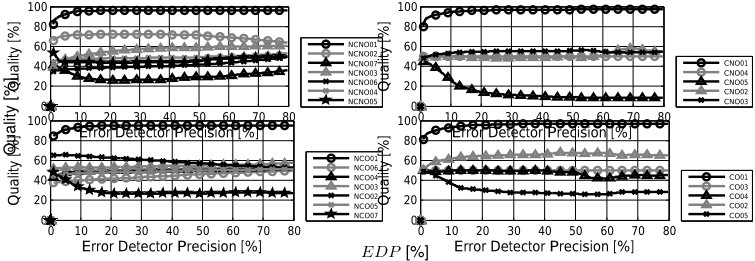
Figure 3 shows such evaluations of Group 01 and 02 for NCNO and CO versions. We can see that Np changes the diagnostic quality, however, as agents are more organised and coordinated, this effect becomes insignificant for all groups. This happens because, when agents work as teammates in an organised manner, the MAS performs as a "well-oiled machine" and no agent fails when the system is performing properly, otherwise the system itself would fail. Concerning the number of erroneous time steps Nf , we confirm from Figure 3 that adding failed time steps improves the diagnostic quality. The benefit of inducing more than 200 steps is marginal on average.
On the Impact of Error Detection Precision
This experiment discloses how precision in detecting error affects diagnostic quality for each similarity coefficient. For any realistic system and practical error-detection mechanism, there will very likely exist errors that go undetected. They can go undetected because of two reasons. First, the fault agent only jeopardises system's operation under specific conditions. For instance, let us assume that aMiner agent, erroneously, is not able to perceive gold nuggets; no error is detected unless the agent is near a gold nugget. Second, analogously to faults
NCNO
CO
in software, errors induced by agents might not propagate all the way to system failures and thus would go undetected.
Consequently, the number of rows in spectra, in which both faulty agent and system fail, will only be a fraction of the total rows in which the agent fails. More intuitively, this proportion represents the Error Detection Precision (EDP), that is, how precisely the error detection phase is able to correlate a system failure with the faulty agent. Using the prevision notation, we define
where f is the location of the faulty agent.
Each faulty version of our benchmark has an inherent value for EDP fluctuating from 3.31% to 97.77%. We vary EDP by (1) excluding time steps that activate the faulty agent, but for which no system error has been detected decreasing c10 (f), and increasing EDP; and (2) excluding time steps that activate the faulty agent and for each an system error has been detected decreasing c11 (f), and decreasing EDP .
Figure 4 shows for all cases how the diagnostic quality changes with respect to the error detection precision. We see that, on average for all cases, a detection precision more than 40% has marginal contribution to a better fault diagnosis. This does not mean that the community needs to give up improving error detection techniques; this means that, when coupled with a diagnosis phase, error detection needs a solid (not necessarily optimal) performance. Moreover, we confirm the Group 01 as the best set of similarity coefficients for MASs also regarding the EDP variation. Foremost, we show that ESFL-MAS can maintain high accuracy even for low error detection precision being the borderline EDP ≥ 10%.
7 Conclusions
We proposed a novel approach, called ESFL-MAS, to localise faults in MASs that is able to identify agents that may jeopardise the overall performance through run-time profiles of the system. We argued that SFL needs be extended to support agent-specific features (such as autonomy) and then we proposed such extensions.
The empirical evaluation produced prominent results, giving a good prospect for the application of ESFL-MAS. Results show that Accuracy, Coverage, Jaccard, Laplace, Least Contradiction, Ochiai, Rogers and Tanimoto, SimpleMatching, Sorensen-Dice, and Support yield the best diagnostic accuracy for the used benchmark. They yield roughly 96.26% diagnostic accuracy and are stable when varying either error detection precision and quantity of observations. However, from the experiments we also observed that ESFLMAS' accuracy might be jeopardised by cascading faults, produced by highly interacting agents.
Future work will address the improvement in our experimental setup to support cascading faults. Afterwards, we intend to compare ESFL-MAS to other diagnosis approaches including Kalech's [2012] and Micalizio's [2013]; as well as experiment with the spectrum-based reasoning technique [Abreu et al., 2009] which reasons in terms of multiple faults. Finally, we plan to integrate ESFL-MAS with an agent-oriented methodology [Passos et al., 2015b].
Acknowledgement
Authors would like to thank Anabela N. Fernandes, Leonardo A. Piedade, Nuno Cardoso, and Zafeiris Kokkinogenis for the useful discussions during the development of this work. This work is supported by Fundac¸ ˜ao para a Ciˆencia e a Tecnologia (FCT), grant SFRH/BD/66717/2009, and Coordenac¸ ˜ao de Aperfeic¸oamento de Pessoal de N´ıvel Superior (CAPES), grant 9382-13-5.
@inproceedings{ijcai2015p164,
  title     = {Spectrum-Based Fault Localisation for Multi-Agent Systems},
  author    = {Passos, Lúcio S. and Abreu, Rui and Rossetti, Rosaldo J. F.},
  booktitle = {Proceedings of the Twenty-Fourth International Joint Conference on
               Artificial Intelligence, {IJCAI-15}},
  publisher = {International Joint Conferences on Artificial Intelligence},
  editor    = {Qiang Yang and Michael Wooldridge},
  pages     = {1134--1139},
  year      = {2015},
  month     = {7},
  note      = {Main Track},
  url       = {https://ijcai.org/proceedings/2015/164},
}
TY - CPAPER TI - Spectrum-Based Fault Localisation for Multi-Agent Systems AU - Passos, Lúcio S. AU - Abreu, Rui AU - Rossetti, Rosaldo J. F. T2 - Proceedings of the Twenty-Fourth International Joint Conference on Artificial Intelligence, IJCAI-15 PB - International Joint Conferences on Artificial Intelligence PY - 2015 SP - 1134 EP - 1139 UR - https://ijcai.org/proceedings/2015/164 ER -Copied
Machine-readable versions of this paper, for tools and AI agents:





