
A Unified Model for Unsupervised Opinion Spamming Detection Incorporating Text Generality
Proceedings of the Twenty-Fourth International Joint Conference on Artificial Intelligence. Main Track. Pages 725-731.
© 2015 International Joint Conferences on Artificial Intelligence
Abstract
Many existing methods on review spam detection considering text content merely utilize simple text features such as content similarity. We explore a novel idea of exploiting text generality for improving spam detection. Besides, apart from the task of review spam detection, although there have also been some works on identifying the review spammers (users) and the manipulated offerings (items), no previous works have attempted to solve these three tasks in a unified model. We have proposed a unified probabilistic graphical model to detect the suspicious review spams, the review spammers and the manipulated offerings in an unsupervised manner. Experimental results on three review corpora including Amazon, Yelp and TripAdvisor have demonstrated the superiority of our proposed model compared with the state-of-the-art models.
- [Beutel et al., 2014] Alex Beutel, Kenton Murray, Christos Faloutsos, and Alexander J Smola. Cobafi: collaborative bayesian filtering. In WWW, pages 97-108. International World Wide Web Conferences Steering Committee, 2014.
- [Bishop, 2006] Christopher M. Bishop. Pattern Recognition and Machine Learning (Information Science and Statistics). Springer-Verlag New York, Inc., Secaucus, NJ, USA, 2006.
- [Blei et al., 2010] David M Blei, Thomas L Griffiths, and Michael I Jordan. The nested chinese restaurant process and bayesian nonparametric inference of topic hierarchies. Journal of the ACM (JACM), 57(2):7, 2010.
- [Chang and Lin, 2011] Chih-Chung Chang and Chih-Jen Lin. Libsvm: a library for support vector machines. ACM Transactions on Intelligent Systems and Technology (TIST), 2(3):27, 2011.
- [Diao et al., 2014] Qiming Diao, Minghui Qiu, Chao-Yuan Wu, Alexander J Smola, Jing Jiang, and Chong Wang. Jointly modeling aspects, ratings and sentiments for movie recommendation (jmars). In KDD, pages 193-202. ACM, 2014.
- [Duchi et al., 2008] J. Duchi, S. Shalev-Shwartz, Y. Singer, and T. Chandra. Efficient projections onto the l 1-ball for learning in high dimensions. In ICML, pages 272-279, 2008.
- [Fei et al., 2013] Geli Fei, Arjun Mukherjee, Bing Liu, Me- ichun Hsu, Malu Castellanos, and Riddhiman Ghosh. Ex- ploiting burstiness in reviews for review spammer detection. In ICWSM, 2013.
- [Feng et al., 2012] Song Feng, Longfei Xing, Anupam Gogar, and Yejin Choi. Distributional footprints of deceptive prod- uct reviews. In ICWSM, 2012.
- [Fleiss, 1971] Joseph L Fleiss. Measuring nominal scale agreement among many raters. Psychological bulletin, 76(5):378, 1971.
- [Hoffman et al., 2012] Matt Hoffman, David M Blei, and David M Mimno. Sparse stochastic inference for latent dirichlet allocation. In ICML, pages 1599-1606, 2012.
- [Jindal and Liu, 2008] Nitin Jindal and Bing Liu. Opinion spam and analysis. In WSDM, pages 219-230. ACM, 2008.
- [Li et al., 2011] Fangtao Li, Minlie Huang, Yi Yang, and Xi- aoyan Zhu. Learning to identify review spam. In IJCAI, volume 22, page 2488, 2011. IJCAI
- [Li et al., 2013a] Jiwei Li, Claire Cardie, and Sujian Li. Top- icspam: a topic-model based approach for spam detection. In ACL, pages 217-221, 2013.
- [Li et al., 2013b] Jiwei Li, Myle Ott, and Claire Cardie. Iden- tifying manipulated offerings on review portals. In EMNLP, pages 1933-1942, 2013.
- [Li et al., 2014] Jiwei Li, Myle Ott, Claire Cardie, and Ed- uard Hovy. Towards a general rule for identifying deceptive opinion spam. In ACL, 2014.
- [Lim et al., 2010] Ee-Peng Lim, Viet-An Nguyen, Nitin Jin- dal, Bing Liu, and Hady Wirawan Lauw. Detecting product review spammers using rating behaviors. In CIKM, pages 939-948. ACM, 2010.
- [Mukherjee et al., 2012] Arjun Mukherjee, Bing Liu, and Na- talie Glance. Spotting fake reviewer groups in consumer reviews. In WWW, pages 191-200. ACM, 2012.
- [Mukherjee et al., 2013] Arjun Mukherjee, Abhinav Kumar, Bing Liu, Junhui Wang, Meichun Hsu, Malu Castellanos, and Riddhiman Ghosh. Spotting opinion spammers using behavioral footprints. In KDD, pages 632-640. ACM, 2013.
- [Ott et al., 2011] Myle Ott, Yejin Choi, Claire Cardie, and Jeffrey T Hancock. Finding deceptive opinion spam by any stretch of the imagination. In ACL, pages 309-319. Association for Computational Linguistics, 2011.
- [Ott et al., 2012] Myle Ott, Claire Cardie, and Jeff Hancock. Estimating the prevalence of deception in online review communities. In WWW, pages 201-210. ACM, 2012.
- [Sun et al., 2013] Huan Sun, Alex Morales, and Xifeng Yan. Synthetic review spamming and defense. In KDD, pages 1088-1096. ACM, 2013.
- [Wang et al., 2011] Guan Wang, Sihong Xie, Bing Liu, and Philip S Yu. Review graph based online store review spam- mer detection. In ICDM, pages 1242-1247. IEEE, 2011.
- [Xie et al., 2012] Sihong Xie, Guan Wang, Shuyang Lin, and Philip S Yu. Review spam detection via temporal pattern discovery. In KDD, pages 823-831. ACM, 2012.
- [Xu et al., 2014] Yinqing Xu, Wai Lam, and Tianyi Lin. Col- laborative filtering incorporating review text and co-clusters of hidden user communities and item groups. In CIKM, pages 251-260. ACM, 2014.
References were extracted automatically from the PDF and may contain errors.
Full text extracted automatically from the PDF; figures, tables and equations may differ. The PDF is the version of record.
1 Introduction
In many modern E-commerce websites such as Amazon, Yelp and TripAdvisor, online review texts and ratings have increasingly played an important role to help make purchase decisions for potential customers. Products with large proportion of positive reviews tend to attract more customers and bring significant financial gains, while large amount of negative review comments can also defame such product and cause sales loss. Due to the reputation and financial incentive, imposters may be hired to deliberately write fake or deceptive reviews to promote or demote the reputation for their target products or services. Such imposters are called review or opinion spammers and their review texts are called review spams [Jindal and Liu, 2008]. Definitely, this malicious activity would mislead the potential customers and damage the fairness of the market.
In the past few years, several supervised methods for detecting review spams or review spammers have been proposed. Unlike other forms of spamming, it is difficult to collect a large amount of gold-standard labels for reviews by means of manual effort. Thus, most of these methods [Mukherjee et al., 2013; Li et al., 2013a; Sun et al., 2013] just rely on the ad-hoc or pseudo fake or non-fake labels for model training, such as the labels annotated by the Amazon anonymous online workers [Ott et al., 2011; Li et al., 2014]. On the other hand, some unsupervised methods have been proposed to detect the individual review spammer [Mukherjee et al., 2013; Lim et al., 2010; Wang et al., 2011] and review spammer groups [Mukherjee et al., 2012]. In addition, time series pattern [Xie et al., 2012], rating distribution [Feng et al., 2012], reviewer graph [Wang et al., 2011], and reviewing burstiness [Fei et al., 2013] have also been applied to identify the review spams in an unsupervised manner.
∗The work described in this paper is substantially supported by grants from the Research Grant Council of the Hong Kong Special Administrative Region, China(Project Codes: 413510 and 14203414) and the Direct Grant of the Faculty of Engineering, CUHK (Project Code: 4055034). This work is also affiliated with the CUHK MoEMicrosoft Key Laboratory of Human-centric Computing and Interface Technologies.
The features used in the previous works usually contain reviewer related features, product item related features and the review text content features. Though review texts can provide us rich features at both linguistic and semantic level, most of the previous works merely utilize simple text features such as content similarity, n-gram or the review length [Li et al., 2011]. In this paper, we explore a novel idea of exploiting text generality in addition to the existing features for improving spam detection.
Intuitively, it is more likely that spammed review content tends to be general, and overly general review description has higher chance to be review spam 1 . This phenomenon frequently occurs in the domains such as hotels and restaurants. Review spammers for such domains are hard to write the comments in details when lack of truthful experience. On the contrary, for the domains like daily products or mobile phones, review spammers can learn the detailed related information from the advertisements or the experience of corresponding substitutes, so that they can easily fabricate a detailed and nearly genuine review text. In this paper, we only concentrate on the former domains.
To illustrate the idea of text generality for review spams, we provide two example reviews below,
- The Chicago Hilton is a great hotel our stay there was fantastic. The hotel is placed in the heart of the city were you can find
1 http://www.moneytalksnews.com/3-tips-for-spotting-fakeproduct-reviews-%E2%80%93-from-someone-who-wrote-them/
it a easy walk to almost everything from the local colleges to the great restaurant that surround the city. The room itself was clean and the staff was fun and helpful. I cant really say anything bad about this place it was a great time and a great place to stay while we were there.
- We stay at Hilton for 4 nights last march. We got a large room with 2 double beds and 2 bathrooms, The TV was Ok, a 27' CRT Flat Screen. The coincierge was very friendly when we need. The room was very cleaned when we arrived, we ordered some pizzas from room service and the pizza was Ok also. The breakfast is charged, 20 dollars, kinda expensive. The internet access (WiFi) is charged, 13 dollars/day. Tip: When leaving the building, always use the Michigan Av exit. Its a great view.
These two reviews are extracted from the gold-standard review spam dataset in [Ott et al., 2011] where they hired Amazon workers to crowdsource fake reviews for the hotels in Tripadvisor. The review 1 is a fake review where the bolded general terms or phrases frequently appear, while the review 2 is a truthful review which describes each aspect in detail and even provides us the breakfast price as well as TV screen size. It is more likely that the reviewer of the review 2 has the genuine experience. Consequently, we propose a method that computes text generality and attempt to improve spam detection in addition to other useful features for the reviews in the domains such as hotels and restaurants.
Recently, [Li et al., 2013b] focused on identifying the product or service offerings where fake reviews appear with high probability. They named this task as identifying manipulated offerings. Although several methods have been proposed to individually detect the suspicious review spams, the review spammers, and the manipulated offerings, no previous works have attempted to solve these three tasks in a unified model. Such unified approach is important and useful for the review portal operators, such as TripAdvisor and Yelp, to investigate and monitor the activities of highly suspicious reviews, reviewers (users) and offerings (items) in order to maintain a fair market. Although [Lim et al., 2010] have reported that these three tasks are intimately related as solving one task can help solve another two, it is not appropriate to consider all suspicious review spammer's reviews as fake reviews. Some spammers are able to write fake reviews by his own truthful account or the truthful accounts of his friends, or some clever spammers may even hijack truthful accounts and begin providing malicious and misleading reviews [Beutel et al., 2014]. Besides, to detect the review spammers or the manipulated offerings by the proportion of his or its fake reviews is also not appropriate since the spamming degree (called "spamicity" in this paper) of a review is dyadic involving the mutual interactions between the reviewer (user) and the offering (item). The spamicity of a review should be simultaneously influenced by the spamicity of the reviewer (user) and the offering (item). For example, faced with different product items, the same spammer would inevitably write the fake reviews with different spamicity since they have different background knowledge for these items. Similarly, the same itemwould receive reviews from different reviewers with various spamicity. Consequently, it would be more effective to estimate the spamicity of the review, the reviewer (user) and the offering (item) in a unified model rather than individually estimate the spamicity of the reviewer or the offering by the spamicity of corresponding reviews.
In this paper, we have proposed a unified probabilistic graphical model to detect the suspicious review spams, the review spammers, and the manipulated offerings in an unsupervised manner. Our idea of tackling these three tasks simultaneously is new. We formulate this unified task as a ranking problem. Our model takes the collection of review texts in a particular domain as input. The goal is to rank the review texts, the reviewers (users) and the offerings (items) based on their spamicity, which is modeled as a latent variable with other observed features. Besides, compared with previous unsupervised opinion spam detection models, our model is able to effectively exploit the text generality based on the topic hierarchy generated by the hierarchical Latent Dirichlet Allocation (hLDA) model [Blei et al., 2010].
In order to evaluate our model, we have performed several experiments on the review corpora including Amazon, Yelp, and TripAdvisor. We borrow the indirect review classification method from [Mukherjee et al., 2013] for evaluating the review spam ranking results without using any labeled data. Meanwhile, three human judges have been hired to evaluate the ranking lists for the reviewers and the offerings. The experimental results demonstrate that our model significantly outperforms the state-of-the-art unsupervised baseline methods.
2 Our ProposedModel
We investigate the task of jointly detecting the suspicious review spams, the review spammers, and the manipulated offerings in an unsupervised manner. To facilitate a better presentation, we call the review spammer as "suspicious user" while manipulated offering as "suspicious item". Given a review corpus D = {d1, d2, ..., d|D|}, the goal is to simultaneously rank the review texts, users, and items based on the spamicity (degree of spamming in the range of [0, 1]) [Mukherjee et al., 2013].
2.1 Model Description
We propose a unified probabilistic graphical model, called "Unified Review Spamming Model" (URSM), for detecting the suspicious review spams, the review spammers, and the manipulated offerings in an unsupervised manner. In order to infer the latent spamicity, URSM not only considers the observed abnormal features of reviews, users, and items, but also incorporates the text generality detected from the review text.
Differing with most of the previous works, URSM decomposes the spamicity into K levels. Each review, user, and item is thus modeled as a K-dimensional spam level distribution vector where the sum of each element equals one. For a particular user u, its spam level distribution vector gu is assumed to be drawn from a Dirichlet distribution, and is responsible for generating the corresponding observed user abnormal features F ux and user-related review abnormal features F uy . As shown in [Mukherjee et al., 2013], these abnormal features are the useful indicator for spamming. For example, a user's reviews are all nearly duplicated, or he always gives extreme ratings. Sec. 2.2 will explain such features in detail. Specifically, for the review d, URSMwill sample a user spam level assignment πu d from the Multinomial distribution of gu which is the conjugate distribution with Dirichlet distribution. Given the parameters φux kf and φuy kf , each spam level k is characterized by a Bernoulli distribution for each binary user feature f, i.e. F ux f ∼ Bern(φux kf ), and a Beta distribution for each user-related review feature f in [0, 1], i.e. F uy f ∼ Beta(φuy kf ). Consequently, these Bernoulli and Beta distributions are employed to generate the observed user features F ux and F uy . On the other hand, we perform the similar process to generate the observed item features F vx and F vy .
For the review d, we believe its corresponding spam level distribution vector sd is influenced by three factors including the user spam level distribution vector gu, the item spam level distribution vector hv, and the text generality vector md, due to the fact that the review text is dyadic [Xu et al., 2014] involving mutual interaction between users and items. On top of that, text generality can provide us an additional clue for review spams. In URSM, such generality is derived from the hierarchical Latent Dirichlet Allocation (hLDA) model which is a classical Bayesian nonparametric topic model [Blei et al., 2010]. Provided a document collection, hLDA is able to extract a topic hierarchy tree with a fixed depth L where each node corresponds to a topic and each document will have a topic path cd from the root topic to the leaf topic. Their topic levels correspond to 0 (root) to L- 1 (leaf). Since the topic whose level close to the root (leaf) level indicates a relatively general (specific) topic, more words in the document assigned to a topic with higher level would indicate a "general" document. Thus, we can measure the text generality by the topic proportion θd for the review d. However, in hLDA, the topic proportion θd is generated by the stick breaking process based on the infinite topic space while our review spam level distribution vector sd is in finite space. In order to perform efficient inference, we instead use the topic assignment zd, i.e. the sample of topic proportion, for text generality measurement.
In URSM, we assume the depth of the topic tree L equals the number of spam level K. Given the counter ndl referring to the number of words assigned to the level l in the review d, we can calculate the kth element of text generality md by the reverted normalized counter ndl since the spam level 0 (K) indicates the least (most) suspicious level. For example, a large nd0 would indicate that most of the words in the review d are general terms leading to a large spamicity in the most suspicious level K.
where nd(·) represents the number of words in the review d. Consequently, sd is assumed to be drawn from the Normal distribution with the mean as weighted sum of gu, hv and md.
where ˜ sdk = [guk, hvk,mdk] and ω represents the weight.
Figure 1 illustrates the entire graphical model of URSM. We note that each user (item) feature is placed within the review plate since each user (item) feature is exhibited by all his/her (its) reviews, as similarly used in [Mukherjee et al., 2013]. The generative process for the observed features and observed words is described below.
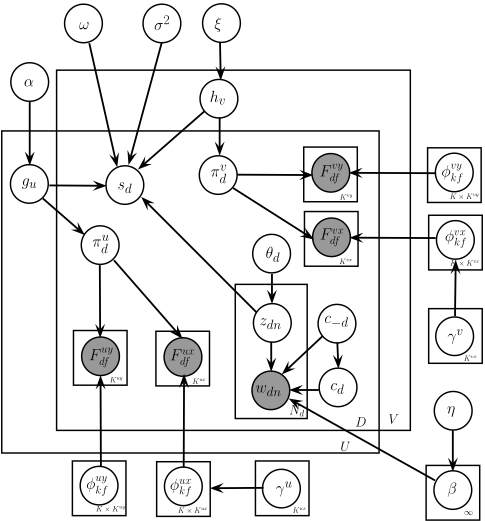
- For each user u ∈ U, choose gu ∝ Dir(α)
- For each item v ∈ V, choose hv ∝ Dir(ξ)
- For each user-related review abnormal feature f under the k spam level, choose φux kf ∝Beta(γ u k )
- For each item-related review abnormal feature f under the k spam level, choose φvx kf ∝Beta(γ v k )
- For topic collection β, choose a new topic βi ∝ Dir(η) if necessary
- For each review d written by the user u for the item v
The generative process for the words is similar to the original hLDA except an additional dependency on sd. Due to space limit, we will not describe the word generative process in detail. The dependency relationship can be easily seen in the inference part.
2.2 Observed User and ItemAbnormal Features
We present several observed abnormal features about reviews, users and items which are useful for spam detection. In [Mukherjee et al., 2013], they proposed both user abnormal features such as content similarity, and user-related review abnormal features such as duplicate/near duplicate reviews. Since such features have been explained in [Mukherjee et al., 2013], we just introduce the corresponding item abnormal features and item-related review abnormal features.
Item Abnormal Features: For the item v, such feature value F vy f is assumed in the range of [0, 1] modeled by the Beta distribution. The value close to 1 (0) indicates spamming (non-spamming).
The first three abnormal features for items, i.e. Content Similarity F vy f0 , Maximum Number of Reviews Within a Time Window F vy f1 , and Reviewing Burstiness F vy f2 , are similar with the user abnormal features presented in [Mukherjee et al., 2013]. The unique feature for the item v is the Ratio of Singleton Reviews F vy f3 . Singleton review is written by the reviewer who only has one piece of review. The study in [Xie et al., 2012] reported that the singleton reviews tend to be involved with spamming since professional review spammers would usually register many new accounts and post a single review comment. We thus employ the ratio of singleton reviews for a item to be one of the item abnormal features.
where # represents the counter.
Item-related Review Abnormal Features: Apart from the user-related review abnormal features F ux f in [Mukherjee et al., 2013], we also propose two binary item-related review abnormal features F vx f . Value of 1 (0) refers to the spamming (non-spamming).
1. Extreme Rating under the J-shaped Rating Distribution: According to the study in [Feng et al., 2012], manipulated items that hire spammers to write spam reviews would necessarily distort the natural rating score distribution of this particular item. Normally, the items involving spamming tend to have the bimodel (J-shaped) rating score distribution. The number of extreme rating (1 or 5 stars) is more than the number of 2 to 4 stars. Consequently, we believe that such feature value F vx f0 for a review is 1 if exhibiting extreme rating score as well as commenting for a item with J-shaped rating distribution, and 0 otherwise.
2. Reviewing in the Burstiness Time Interval: Reviews posting within the burstiness time window of its corresponding item would be considered as review spams with high probability. Thus, we first detect the burstiness time interval by sliding a time window of fixed width τ vw . If the number of reviews exceed the given threshold nr, we will assign such feature value F vx f1 of the reviews in this interval as 1, and 0 otherwise.
2.3 Posterior Inference
Given the model parameters Ω = {g, h, s, ω, φux, φvx, φuy , φvy } and the observed data Θ = {F ux, F vx, F uy , F vy }, the key step of applying the URSMmodel is to infer the posterior distribution of the latent variables Φ = {πu, πv , z, c, β}
conditioned on the Ω and Θ. We utilize the Gibbs-EM [Diao et al., 2014; Hoffman et al., 2012], a hybrid inference method alternating between collapsed Gibbs sampling and gradient descent in variational inference, to estimate latent variables Φ and model parameters Ω. Differing with the traditional EM method, Gibbs-EM estimates the expectation of variational distribution of z and c, i.e. q⋆ (z, c), by the average value of the samples from Gibbs sampler in the E-step.
Specifically, we introduce a family of factorized variational distribution for Φ.
where βi represents the ith topic.
The lower bound L of the log-likelihood for the review corpus can be approximated by the Jensen's inequality as follows. The goal of Gibbs-EMmethod is to maximize such lower bound by alternating between E-step and M-step.
To maximize the lower bound L is equivalent to finding the optimal free parameters so that the approximated variational distribution is close to the true posterior by the KL divergence. Following [Bishop, 2006], we thus directly present the updating formula for the free parameters ̂κud , ̂κvd and ̂λi below.
E-step:
where ̂κudk refers to the estimated probability for the πu d = k. Updating for the ̂κvdk can be similarly derived.
where ediw is a counter for the number of word w assigned to the topic i in the review d. For the zd and cd, we estimate their expectation by the Gibbs sampling. Normally, in each E-step, we would save the average value of the sampled zd and cd after B burn-in sweeps, which has been done similarly in [Hoffman et al., 2012].
where δ1 and δ2 represent the mean and variance of the GEM distribution in the hLDA model, respectively, and ˜ sdk = [guk, hvk, mdk].
where #[c-d = t] denotes the number of reviews assigned to the path t except the review d, #[D] is the number of reviews in the entire corpus, and γ is the hyper-parameter in the hLDA to control the size of the topic hierarchy tree.
M-step:
In M-step, we estimate the model parameters in Ω by maximizing the lower bound L in Eq. 5. For the user and item spam level distribution vector gu and hv, we update their values by the projected gradient descent [Duchi et al., 2008] since they should be constrained in a simplex. Since the items related parameters (h, φvx, φvy ) play the same role with user related parameters (g, φux, φuy ), we only present the user related updating formula.
where ωg is the corresponding weight element for the gu in ω. For the Bernoulli parameter φux kf of binary user related review features, we can compute its analytical updating formula by setting its gradient to zero.
We update the Beta shape parameters using the method of moment which is commonly used in previous works. Besides, we update the spam level distribution vector sd for the review d by the mean of its Normal Distribution, i.e. sd = ˜ sd. In addition, we also perform the projected gradient descent for updating the weight ω since it should stay in a simplex.
In summary, after the initialization, we can iteratively perform the E-step and M-step until convergence. All the related parameters setting are described in Sec. 3.2.
3 Experiment
3.1 Data Sets and Preprocessing
We demonstrate the effectiveness of our model by conducting experiments on three popular review data sets including the Amazon audioCD data 2 , the TripAdvisor hotel data 3 , and the Yelp restaurant data 4 . As discussed in Sec. 1, the review spammers in these three domains are more likely to write general review comments. In particular, each dataset is a collection of review comments from a set of users for the product items.
2 http://liu.cs.uic.edu/download/data/
3 http://www.cs.cmu.edu/ jiweil/html/hotel-review.html
4 http://www.yelp.com/dataset challenge
| Data Set | #Review | #User | #Item | Avg.words |
|---|---|---|---|---|
| Amazon-audioCD | 36,774 | 8,937 | 10,087 | 63.6 |
| TripAdvisor | 22,635 | 2,069 | 935 | 72.4 |
| Yelp | 13,007 | 248 | 255 | 79.1 |
For the preprocessing, we first remove non-English reviews and reviews with less than 20 words, and compute the values of each abnormal features in Sec. 2.2. Then we only keep the users with more than 5 reviews and items with more than 5 reviews since the users or items with fewer reviews exhibit less behavior characteristics. Besides, in order to ensure our evaluated data set has review spammers and manipulated offerings, we randomly sample a proportion of reviews with the average value of corresponding user or item abnormal feature greater than 0.5. For the review text, we remove the stop words, and the terms whose count frequency is less than 5. Table 1 depicts the statistics for each data set.
3.2 Experimental Setup
We specify the similar thresholds for the user abnormal features mentioned in [Mukherjee et al., 2013]. For the item abnormal features, we set τv = 70, and τ vw = 5, nr = 50.
For the initialization of our model URSM, we first rank the review collection in each data set based on the sum of corresponding abnormal feature values, and then divide the ranked reviews into K segments with the same size of #[D] K . The kth segment can be initially treated as the reviews with the kth spam level. We thus have the initial value of πu d and πv d , and then we can apply the M-step to initialize gu, hv, sd and all the Beta, Bernouli distribution parameters. Additionally, we set K = L = 3, Kux = 5, Kuy = 4, Kvx = 2, Kvy = 4 and use default values for the parameters related to the hLDA. The hyper-parameters are specified as follows, i.e. α = ξ = 0.5 K , σ2 = 1.0, and uniformed priors for all γ. When performing our Gibbs-EM algorithm, we set the maximum iteration number as 1000, and the burn-in sweeps as 10.
3.3 Evaluation for Review SpamDetection
We employ the supervised review classification method to evaluate the spamicity-based ranking of suspicious review spams. This evaluation method has been used in [Mukherjee et al., 2013]. The main idea is that supervised text classification using n-gram features have been proven quite effective for review spam detection [Ott et al., 2011]. Thus, if our classification of the reviews using n-gram features performs better, it implies that our detected spam and non-spam labels for the reviews are more accurate. Moreover, if URSM is effective, the most (least) suspicious review would be ranked at the top (bottom). We can treat the top k% reviews as spams and the bottom k% reviews as non-spam reviews, and then perform a supervised classification for such labeled review set using the textual n-gram features. Since the URSM involves the bag-of-words modeling in hLDA, i.e. unigram, we thus apply the bigram and trigram features for classification.
We compare our model URSM with the state-of-the-art unsupervised models. ASM-HE proposed by [Mukherjee et al., 2013] is able to rank the suspicious reviews based on its spamicity in an unsupervised manner. Such model exploits user's abnormal behavior features and user-related review abnormal features, but does not consider the item abnormal features and ignore the useful review text generality information. FSum-R: intuitively ranking each review by the sum of all the review abnormal feature values. URSM-IF: in order to demonstrate the effectiveness of considering text generality factor, we further compare URSM with URSM-IF, a variant of URSM by removing the hLDA text generality modeling part. In URSMIF, the spamicity of a particular review is merely influenced by the user spamicity and item spamicity.
Since [Ott et al., 2012] reported that there are normally 8% to 15% spam rate for online review sites, we only report the results of k=5%, 10% and 15%. We conduct the supervised classification by the popular LIBSVM library [Chang and Lin, 2011] with a linear kernel and report the 5-fold cross validation results in Table 2. Due to the space limit, we only show the metrics of F1-score and accuracy. From the result, we note that our model URSM outperforms all the baseline methods for all data sets because the review spams in such domains tend to be general and the items can also provide helpful spamming clues. Specifically, URSM-IF performs better than ASM-HE and FSum-R indicating that our consideration for the item abnormal features is useful. Besides, we note that URSM outperforms URSM-IF after considering the text generality. Consequently, it is really useful to exploit item abnormal features and text generality for review spam detection.
| k(%) | URSM | URSM-IF | ASM-HE | FSum-R | ||||
|---|---|---|---|---|---|---|---|---|
| F1 | A | F1 | A | F1 | A | F1 | A | |
| 5 | 76.7 | 78.0 | 73.2 | 72.6 | 68.3 | 68.3 | 60.8 | 62.2 |
| 10 | 75.5 | 76.6 | 70.3 | 70.2 | 61.4 | 62.5 | 55.7 | 57.4 |
| 15 | 70.4 | 71.7 | 64.6 | 64.1 | 59.0 | 60.9 | 56.8 | 55.9 |
| URSM | URSM-IF | ASM-HE | FSum-R | |||||
|---|---|---|---|---|---|---|---|---|
| k(%) | F1 | A | F1 | A | F1 | A | F1 | A |
| 5 | 78.1 | 78.8 | 74.2 | 74.0 | 72.4 | 72.5 | 64.9 | 65.9 |
| 10 | 72.2 | 73.2 | 70.3 | 69.2 | 64.5 | 65.5 | 60.2 | 60.3 |
| 15 | 69.4 | 70.3 | 66.4 | 67.1 | 63.5 | 63.9 | 52.6 | 53.4 |
| k(%) | URSM | URSM-IF | ASM-HE | FSum-R | ||||
|---|---|---|---|---|---|---|---|---|
| F1 | A | F1 | A | F1 | A | F1 | A | |
| 5 | 75.5 | 75.2 | 72.6 | 71.9 | 68.0 | 70.5 | 67.9 | 68.3 |
| 10 | 74.3 | 73.8 | 68.0 | 68.1 | 65.5 | 66.3 | 64.0 | 63.9 |
| 15 | 70.1 | 71.4 | 66.7 | 67.0 | 64.9 | 64.6 | 55.1 | 56.9 |
(c) Yelp
Table 2: 5-fold SVM Review classification result for each data set. F1: F1-score A: Accuracy
3.4 Human Evaluation for Review Spammer and Manipulated Offering Detection
For the evaluation of the ranked users and items based on the spamicity, we resort to the human judgement method which is commonly used in the spamming evaluation. We employ 3 college student helpers to label the suspicious users and items. They are firstly required to read the related article on the spamming detection strategies 5 , and then independently examine the user or item detailed profile and all his or its review texts to provide a label of spam or non-spam.
Due to the limited manpower, we just consider the largest Amazon-audioCD data set which has more users and items, and compare our model with the baseline models mentioned above. Note that although the original ASM-HE model can only rank the suspicious review and users, we can also use the proportion of review spams to measure the spamicity for a particular item, which is called ASM-HE-V. For the FSum approach, we can apply the sum of all the user or item abnormal feature values to rank the users or items. We name such methods as FSum-U and FSum-V respectively.
| URSM | URSM-IF | ASM-HE | FSum-U | |||||||||
|---|---|---|---|---|---|---|---|---|---|---|---|---|
| TP | MP | BP | TP | MP | BP | TP | MP | BP | TP | MP | BP | |
| J1 | 84 | 12 | 0 | 77 | 14 | 0 | 71 | 17 | 2 | 66 | 20 | 3 |
| J2 | 80 | 9 | 1 | 70 | 11 | 2 | 66 | 16 | 3 | 62 | 19 | 3 |
| J3 | 78 | 9 | 1 | 73 | 9 | 1 | 65 | 13 | 3 | 68 | 17 | 1 |
| Avg. | 80.7 | 10.0 | 0.7 | 73.3 | 11.3 | 1.0 | 67.3 | 15.3 | 2.7 | 65.3 | 18.7 | 2.3 |
| κF | 0.70 | 0.72 | 0.71 | 0.71 | ||||||||
| URSM | URSM-IF | ASM-HE-V | FSum-V | |||||||||
|---|---|---|---|---|---|---|---|---|---|---|---|---|
| TP | MP | BP | TP | MP | BP | TP | MP | BP | TP | MP | BP | |
| J1 | 43 | 3 | 1 | 40 | 7 | 2 | 31 | 10 | 3 | 34 | 12 | 2 |
| J2 | 40 | 5 | 0 | 38 | 5 | 1 | 35 | 11 | 5 | 35 | 9 | 2 |
| J3 | 39 | 4 | 0 | 35 | 7 | 1 | 30 | 12 | 3 | 35 | 10 | 4 |
| Avg. | 40.7 | 4.0 | 0.3 | 37.7 | 6.3 | 1.3 | 32.0 | 11.0 | 3.7 | 34.7 | 10.3 | 2.7 |
| κF | 0.73 | 0.72 | 0.76 | 0.74 | ||||||||
Table 3: Human evaluation result for the Amazon-audioCD data set. The larger value for TP indicates better performance while the smaller value for MP and BP indicates better performance.
Similar to the setting in [Mukherjee et al., 2013], for the evaluation of users, we provide each helper with three parts of users for each method, i.e. Top Part (TP) contains the top 100 ranked users. Middle Part (MP) contains the middle 100 ranked users and Bottom Part (BP) contains the bottom 100 ranked users. For the evaluation of items, since the number of reviews for an item is relatively larger, we decrease the size of part to 50. Note that a particular item is labeled as a manipulated offering when its review spam proportion succeeds 0.5. Table 3 shows the human evaluation results as the count of users or items labeled as spam. We additionally measure the agreement of judges by the Fleiss multi-rater kappa [Fleiss, 1971] for each method. As you can see, our model URSM can detect more spammers or manipulated offerings within the top part (TP) and leave less spammers within the middle part (MP) and the bottom part (BP). In other words, URSM has better ranking performance towards the users and the items based on the spamicity than other methods, and all judges have consensus in the spamming judgements based on the high κF value. Moreover, the URSM-IF method performs better than the ASM-HE-V and FSum-V further indicating the usefulness of considering item abnormal features. On the other hand, the URSMmethod with the additional consideration for the text generality is superior to URSM-IF, which further shows that it is effective to exploit the text generality as well as the item abnormal features for spamming detection.
5 http://consumerist.com/2010/04/14/how-you-spot-fake-onlinereviews/
4 Conclusion
In this paper, we have proposed a unified probabilistic graphical model URSM for detecting the suspicious review spams, the review spammers and the manipulated offerings in an unsupervised manner. Compared with previous works, we additionally consider the item abnormal features and text generality for spamming detection. Experimental results on three popular review data sets demonstrate the effectiveness of our proposed model.
@inproceedings{ijcai2015p108,
  title     = {A Unified Model for Unsupervised Opinion Spamming Detection Incorporating Text Generality},
  author    = {Xu, Yinqing and Shi, Bei and Tian, Wentao and Lam, Wai},
  booktitle = {Proceedings of the Twenty-Fourth International Joint Conference on
               Artificial Intelligence, {IJCAI-15}},
  publisher = {International Joint Conferences on Artificial Intelligence},
  editor    = {Qiang Yang and Michael Wooldridge},
  pages     = {725--731},
  year      = {2015},
  month     = {7},
  note      = {Main Track},
  url       = {https://ijcai.org/proceedings/2015/108},
}
TY - CPAPER TI - A Unified Model for Unsupervised Opinion Spamming Detection Incorporating Text Generality AU - Xu, Yinqing AU - Shi, Bei AU - Tian, Wentao AU - Lam, Wai T2 - Proceedings of the Twenty-Fourth International Joint Conference on Artificial Intelligence, IJCAI-15 PB - International Joint Conferences on Artificial Intelligence PY - 2015 SP - 725 EP - 731 UR - https://ijcai.org/proceedings/2015/108 ER -Copied
Machine-readable versions of this paper, for tools and AI agents:





