
Look versus Leap: Computing Value of Information with High-Dimensional Streaming Evidence
Proceedings of the Twenty-Third International Joint Conference on Artificial Intelligence. Pages 2561-2566.
© 2013 International Joint Conferences on Artificial Intelligence
Abstract
A key decision facing autonomous systems with access to streams of sensory data is whether to act based on current evidence or to wait for additional information that might enhance the utility of taking an action. Computing the value of information is particularly difficult with streaming high-dimensional sensory evidence. We describe a belief projection approach to reasoning about information value in these settings, using models for inferring future beliefs over states given streaming evidence. These belief projection models can be learned from data or constructed via direct assessment of parameters and they fit naturally in modular, hierarchical state inference architectures. We describe principles of using belief projection and present results drawn from an implementation of the methodology within a conversational system.
- [Armstrong-Crews and Veloso, 2008] N. Armstrong-Crews and M. Veloso. An approximate solution for oracular pomdps. In ICRA '08, pages 3346 -3352, 2008.
- [Ben-Bassat, 1978] M. Ben-Bassat. Myopic policies in se- quential classification. IEEE Trans. Comput., 27:170-178, 1978.
- [Bilgic and Getoor, 2011] M. Bilgic and L. Getoor. Value of information lattice: Exploiting probabilistic independence for effective feature subset acquisition. Journal of Artifi- cial Intelligence Research, 41:69-95, 2011.
- [Bohus and Horvitz, 2009] D. Bohus and E. Horvitz. Mod- els for multiparty engagement in open-world dialog. In Meeting of the Special Interest Group on Discourse and Dialogue, pages 225-234, 2009.
- [Boutilier et al., 1999] C. Boutilier, T. Dean, and S. Hanks. Decision-theoretic planning: Structural assumptions and computational leverage. Journal of Artificial Intelligence Research, 11:1-94, 1999.
- [Hajishirzi et al., 2009] H. Hajishirzi, A. Shirazi, J. Choi, and E. Amir. Greedy algorithms for sequential sensing decisions. In International Joint Conference on Artificial Intelligence, pages 1908-1915, 2009. IJCAI
- [Heckerman et al., 1992] D. Heckerman, E. Horvitz, and B. Nathwani. Toward normative expert systems: The pathfinder project. Technical report, Knowledge Systems Laboratory, Medical Computer Science, Stanford Univer- sity, 1992.
- [Heckerman et al., 1993] D. Heckerman, E. Horvitz, and B. Middleton. An approximate nonmyopic computation for value of information. IEEE Transactions on Pattern Analysis and Machine Intelligence, pages 292-298, 1993.
- [Horvitz et al., 2002] E. Horvitz, P. Koch, C. M. Kadie, and A. Jacobs. Coordinate: Probabilistic forecasting of pres- ence and availability. In Uncertainty and Artificial Intelli- gence, pages 224-233, 2002.
- [Horvitz et al., 2004] E. Horvitz, J. Apacible, and P. Koch. Busybody: Creating and fielding personalized models of the cost of interruption. In Conference on Computer Sup- ported Cooperative Work, pages 507-510, 2004.
- [Horvitz, 1987] E. Horvitz. Reasoning about beliefs and ac- tions under computational resource constraints. In 3rd Conference on Uncertainty in Artificial Intelligence, pages 429-444, 1987.
- [Horvitz, 2001] E. Horvitz. Principles and applications of continual computation. Artificial Intelligence, 126:159- 196, 2001.
- [Kaelbling et al., 1998] L. Kaelbling, M. Littman, and A Cassandra. Planning and acting in partially observable stochastic domains. Artificial Intelligence, 101:99-134, 1998.
- [Kamar et al., 2012] E. Kamar, S. Hacker, , and E. Horvitz. Combining human and machine intelligence in large-scale crowdsourcing. In AAMAS, pages 467-474, 2012.
- [Kendon, 1990] A. Kendon. Conducting Interaction: Pat- terns of behavior in focused encounters. Cambridge Uni- versity Press, 1990.
- [Krause and Guestrin, 2007] A. Krause and C. Guestrin. Near-optimal observation selection using submodular functions. National Conference on Artificial Intelligence, 22(2):1650-1654, 2007.
- [Liao and Ji, 2008] W. Liao and Q. Ji. Efficient non-myopic value-of-information computation for influence diagrams. International Journal of Approximate Reasoning, 49:436- 450, 2008.
- [Littman et al., 2002] Michael L Littman, Richard S Sutton, and Satinder Singh. Predictive representations of state. Ad- vances in neural information processing systems (NIPS), 14:1393-1400, 2002.
- [Oliver and Horvitz, 2003] N. Oliver and E. Horvitz. Selec- tive perception policies for guiding sensing and computa- tion in multimodal systems: A comparative analysis. In International Conference on Multimodal Interfaces, 2003.
- [Peškir and Širjaev, 2006] Goran Peškir and Al'bert Niko- laevič Širjaev. Optimal stopping and free-boundary prob- lems. Springer, 2006.
- [Selman et al., 1996] B. Selman, R. A. Brooks, T. Dean, E. Horvitz, T. M. Mitchell, and N. J. Nilsson. Challenge problems for artificial intelligence. In AAAI-96, pages 1340-1345, 1996.
- [Sidner et al., 2005] C. L. Sidner, C. Lee, C. D. Kidd, N. Lesh, , and C. Rich. Explorations in engagement for humans and robots. Artificial Intelligence, 166(1-2):140- 164, 2005.
References were extracted automatically from the PDF and may contain errors.
Full text extracted automatically from the PDF; figures, tables and equations may differ. The PDF is the version of record.
1 Introduction
Real-time adaptive systems, such as self-driving cars, monitoring systems, and conversational agents, reason continuously under uncertainty: they probabilistically estimate the state of the world based on data collected via multiple sensors and use these state estimates to guide action selection. Sensors and inferences can be characterized by different levels of accuracy and by stochastic delays, and collecting additional evidence can lead to improved state estimates at the cost of delayed action. For instance, face identification often becomes more accurate as a person approaches a camera. Significant tradeoffs can arise between the decision to act immediately based on the available evidence or to wait for additional evidence to accumulate for the future action. To resolve such tradeoffs, a systemmust reason about the expected benefits and costs of future courses of actions, including gathering additional information under uncertainty.
Exact computation of the value of information with streaming sensory data is challenging for several reasons. Realtime systems often harness high-dimensional streams of evidence, which introduce challenges in training accurate generative observation models. As an example, an embodied conversational agent can leverage pixels in RGB video streams, depth maps, and audio signals to track the location, intentions and goals of people in the surrounding environment. Building generative models that accurately predict future pixels, depth maps, and audio signals based on the previous series of such rich observations is a challenging task. In fact physically situated conversational systems often rely on hierarchies of conditional models that abstract the high-dimensional streaming sensory evidence into fewer, lower-dimensional percepts. For instance, a conversational agent may use vision models to track and identify people in its vicinity based on an analysis of pixels in a video stream. These trajectory and identity percepts can be used to infer peoples' goals and intentions, and ultimately to drive decisions about interaction. Even when relying on the abstraction of high-dimensional sensors, performing belief updates by iteratively combining predictions of generative observation models can lead to an accumulation of errors over long periods of time.
∗Stephanie Rosenthal contributed to this research during an internship at Microsoft Research.
We address the challenge of constructing informationgathering policies for systems that rely on high-dimensional streaming sensor data. As we will discuss in more detail, traditional approaches for computing the value of information do not perform well in these settings as they use generative models for predicting future observations that are hard to train and reason with. We propose an approach we refer to as belief projection, in which direct conditional models are used to predict future beliefs from a prior stream of observations. We show how these models can be used to resolve the tradeoffs between acting immediately, waiting for more evidence to accumulate, or, more generally, orchestrating which sensors should be activated at a given time. The proposed belief projection models can be learned automatically, via self-supervision, and fit naturally into hierarchical inferential architectures. We demonstrate a practical implementation of these ideas in a physically situated embodied conversational agent that uses natural language to interact with people. The proposed approach enables a mixed-initiative engagement policy in this system, and opens new opportunities for solving other real-world decision problems.
2 RelatedWork
Tradeoffs between acting and waiting can be resolved by computing the expected value of information (VOI). VOI has been also used in prior work for evaluating the value for performing additional computation [Horvitz, 1987] and for evaluating the value of precomputing answers to future problem instances with currently available resources [Horvitz, 2001].
In settings with large state spaces and high-dimensional streaming evidence, exact computation of VOI is challenging for several reasons. First, the computation requires reasoning about an exponentially growing tree of future evidence gathering actions and outcomes [Heckerman et al., 1993], which quickly renders the problem intractable. To address this issue, various approximations of VOI have been proposed. Most VOI approximations employ a greedy analysis, assuming that only a single piece of evidence will be observed [Ben-Bassat, 1978; Heckerman et al., 1992] before action is taken. If the problem has a submodular structure, greedy VOI approaches have been shown to have well-defined error bounds [Krause and Guestrin, 2007]. Non-myopic VOI analyses have been formulated [Heckerman et al., 1993; Bilgic and Getoor, 2011; Liao and Ji, 2008] for situations where sequential observations are independent. When future evidence can perfectly predict the state, approximate algorithms [ArmstrongCrews and Veloso, 2008] can be used. Algorithms have also been proposed for problems with decomposable structure [Boutilier et al., 1999], and for problems with a search space that grows linearly in the horizon [Hajishirzi et al., 2009]. Decisions about when to terminate evidence collection have also been studied in optimal stopping problems [Peˇskir and ˇSirjaev, 2006]. Tractable solutions developed for this class of problems are not applicable to our setting as the aggregation of evidence can have arbitrary influences on beliefs.
The challenge of acting under uncertainty with streaming evidence has been noted as a key AI research problem [Selman et al., 1996]. Previous work on computing VOI in such settings has focused on myopic analyses and domain-specific heuristics [Oliver and Horvitz, 2003]. We propose a new approach to reasoning about information value amidst streams of high-dimensional evidence. The proposed approach is myopic but includes actions for waiting different amounts of time for new streaming evidence.
Besides the exponentially growing search tree, a second important challenge in computing VOI with highdimensional evidence has to do with the use of generative observation models [Kaelbling et al., 1998]. Constructing such models is difficult for domains with high-dimensional observation spaces. In addition, it has been shown [Kamar et al., 2012] that predicting future beliefs by iteratively applying generative observation models leads to accumulation of errors in belief predictions. Predictive state representations have been proposed as an alternative to generative approaches [Littman et al., 2002]. However, these representations are also prone to error accumulation as a result of iterative updating. We introduce belief projection, where direct conditional models are used for tractable and accurate predictions of future beliefs.
3 Approach
To resolve the tradeoff between acting immediately and waiting to collect additional observations, systems need to consider the uncertainty of their current state and of future observations. The tradeoff can be formalized using a POMDP, or equivalently a belief MDP [Kaelbling et al., 1998]. st ∈ S represents the state of the world at time t. Ψt is a sequence of evidence vectors that are collected by the system from time 1 to time t, Ψt = {ψi}i=1:t. bt(st) represents the system's belief at time t about being in state st. p(bt|Ψt) is the probability of bt given evidence collected. The set of actions A is composed of a set of domain actions Ad and the action aw which represents waiting a single time step to collect additional information. The system transitions to a terminal state after taking a domain action. p(Ψt+1|Ψt) is the probability of future evidence after taking action aw. R(st, a) is the system's reward for taking action a at state st. The expected reward for belief state bt is computed r(bt, a) = ∑st bt(st) · R(st, a).
The VOI at any belief state bt is the difference between Vwait, the value for waiting, and Vact, the value of acting. Vwait and Vact are computed with the Bellman equation:
where V ∗ (bt) = max(Vact(bt), Vwait(bt)). A positive VOI indicates that it is beneficial to wait for more evidence.
The number of belief states that need to be explored for the exact computation of VOI grows exponentially with the depth of lookahead, rendering exact computation intractable, especially when evidence arrives incrementally in a streaming manner. To overcome this complexity, we introduce an approximation procedure that converts the sequential decision problem into a myopic problem, while still considering the utility of taking sequences of information gathering actions. We move beyond the recursive consideration of sequences and introduce longer duration wait actions, aw(k), which represent waiting for k time steps and then taking a single domain action and terminating. The reward for taking these actions can be approximated from existing reward functions, e.g, r(bt, aw(k)) = k · r(bt, aw), or can be elicited directly from domain experts. The value of taking aw(k) is calculated as follows, under the assumption that the system will take the best domain action at the end of waiting:
The value of waiting (Vwait(bt)) is approximated as the maximum of values associated with the different wait durations.
Although greedy, this computation is still intractable as it requires a model that predicts future sensory evidence, p(Ψt+k|Ψt). Building a generative model that predicts future observations is intractable because of the high-dimensionality and streaming nature of the sensory evidence ψ. Complex systems that harness perceptual machinery, such as cameras and microphones, use off-the-shelf non-decomposable components for making state inferences p(st|Ψt), where ψi is high-dimensional, e.g., pixels for face tracking or raw audio for speech recognition. Alternative formulations using factorizations of p(Ψt+k|Ψt) into p(Ψt+k|st+k) · p(st+k|Ψt) encounter similar tractability challenges.
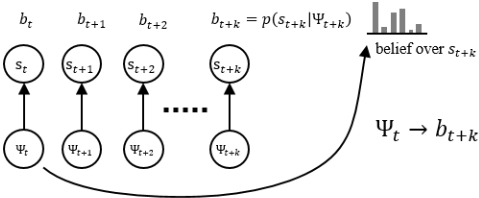
To address this computational challenge, we introduce belief projection. Belief projection models are direct conditional models of the form p(bt+k|Ψt) that predict the future belief at time t + k based on the evidence Ψt collected up to time t. These models do not require predictions of future sensory evidence streams, and can be used to estimate the value of wait actions:
The belief projection model p(bt+k|Ψt) can be trained in a supervised manner without requiring manual labeling (see Figure 1). The training data, consisting of pairs of the form Ψt → bt+k, can be collected automatically at runtime by recording Ψt, the sensory evidence collected up to time t, and the output of the state inference model at time t + k (see Figure 1). For each data point (Ψt, bt+k), the features Ψt describe the sensory evidence collected up to time t. The corresponding label, bt+k, consists of the output of the state inference models at some future time t+k; the training label is a belief over the state st+k. For instance, if the state is binary, i.e., st ∈ {0, 1}, the belief over st is defined over the unit 1 simplex, i.e., bt ∈ ∆1 , which is the [0, 1] real interval. In this case, the belief projection model constructs a probability distribution over this simplex, or over the [0, 1] interval.
A possible approach to constructing belief projection models is to employ a mixture of Beta distributions (see the application described in Section 4). The model parameters can be trained from data in a maximum likelihood manner. An alternative is to discretize the [0, 1] interval into several bins, treat the problem as multinomial classification, and to build a model via discriminative learning techniques such as maximum entropy or decision trees. The complexity of the learning problem increases as the size of the original state space increases. For instance, if instead of being binary, the state is a multinomial variable with d possible values, the belief over st is defined over the unit d - 1 simplex, i.e., bt ∈ ∆(d-1) . The state projection inference model could be constructed in this case as a mixture of Dirichlet distributions.
Finally, we note that the proposed approach requires that we sum over all possible beliefs bt+k. In practice, a tractable solution for computing this sum (or integral) is required. One approach that works well when the underlying state space is small is to discretize the belief space (the simplex) into a number of bins, and to sum over the corresponding probabilities.
Another alternative is to construct belief projection models with parametric forms that allows for analytic integration. We have explored the use of non-parametric techniques (decision trees and random forests) for learning belief projection models that can directly provide belief samples which can be used in the VOI computation.
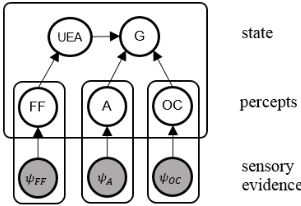
As we mentioned earlier, belief projection is well-suited for complex systems constructed via the coupling of multiple, modular inference components into hierarchical state inference architectures. In such systems, lower-level components, such as speech recognition and face tracking and identification, are usually trained and optimized separately, prior to integration in a larger application. These components abstract the high-dimensional streaming sensory evidence, such as raw audio and video data, into fewer lower-dimensional percepts, such as words spoken and the location and identity of a person. The outputs of these perceptual models are then used as inputs for higher-level domain-specific inferences models that reason about goals, activities, and other relevant state variables, which ultimately drive interaction decisions. An example is shown in Figure 3 and discussed in more detail in the next section. Belief projection is a natural fit for computing VOI for such modular architectures as models can be trained independently for each low-level perceptual inference model. The projected beliefs over the percepts can then be used to infer the corresponding beliefs of the highlevel state.
4 Application
We now review an implementation of the methodology described earlier to support a mixed-initiative engagement policy in a deployed system that has been serving as an automated secretary for nearly two years.
4.1 The Assistant
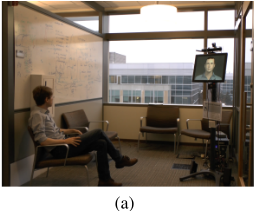
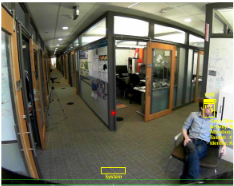
The Assistant is a multimodal interactive kiosk displaying an animated avatar head. The system is stationed outside the office of an employee at our organization (see Figure 2 part (a)) and has been serving as an automated secretary. The system has access to the owner's calendar, computer activity, and the wifi fingerprints of devices on the owner's network, and continuously makes probabilistic forecasts about the owner's availability and arrival for meetings via subsystems developed as separate research projects [Horvitz et al., 2002; 2004]. The Assistant can interact via spoken language with visitors who stop by the owner's office and handles a variety of administrative tasks, such as providing information about the activities, whereabouts, and future availability of its owner, scheduling meetings, and relaying messages. The system leverages an array of sensors and makes real-time inferences about people in its proximity, including their identities, activities and goals, in support of natural and effective interactions with visitors.
4.2 Engagement Problem
An important challenge for the Assistant is managing its engagement with people. Engagement is the process by which participants in a conversation coordinate their actions to initiate, maintain and terminate their interactions [Sidner et al.,
(b)
(d)
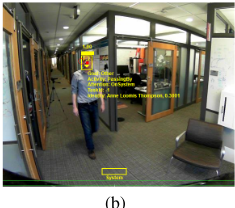
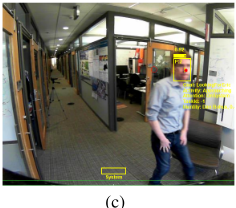
Figure 2: (a) The Assistant outside the owners office. (b) Visitor walks through the Assistant's field of vision. (c) Visitor heads towards the chair to wait for owner. (d) Visitor sits down in Assistant's field of view.
2005; Bohus and Horvitz, 2009]. Prior versions of the Assistant used a conservative, heuristic engagement policy: the system waited for users to initiate engagement by entering in an f-formation [Kendon, 1990] with it, i.e., by approaching and standing closely in front of it. This policy was designed to minimize false positive cases where the Assistant would accidentally initiate engagement with someone walking by or standing nearby but talking to someone in another office. At the same time, we had noticed that people who are waiting for the owner (to return to his office, or to become available) often bypass the system and sit in nearby chairs (see Figure 2 (a)) or talk to others while waiting. In these situations, the Assistant's engagement policy did not allow it to proactively initiate engagement, which led to missed opportunities to engage a waiting person in dialog. Such missed opportunities can be costly. For example, the system may know that the owner is running late for a scheduled meeting, and would like to relay this information if the person waiting is scheduled to meet with the owner. Without knowledge of the delay, the visitor may leave in frustration.
The engagement problem is a sequential decision-making problem with streaming evidence. The Assistant can partially observe the state of the world: it cannot perfectly observe a visitor's goals or intentions to engage with the system. However, the Assistant has access to streaming observations, which provide additional evidence about the true state of the world over time. The observations are complex, composed of information from multiple sensors including a camera and a microphone, and the domain of observations can be very large. The decision to reach out and engage someone near the system depends on inferences about the state of the world based on the streaming and high-dimensional observations.
At each time step, the Assistant makes a decision between acting to engage right away, and waiting to gather additional sensory evidence in support of better decisions. In addition, the Assistant can take actions to seek additional evidence in real time. Specifically, the system can take and send a snapshot of the visual scene to human volunteers and ask them to help identify the person in the scene. When deciding how to act, the Assistant needs to reason about multiple sources of uncertainty: uncertainty about the streaming observations it may collect, about when the responses to information gathering actions will arrive, and about whether and when the person may leave the scene (and thus curtail an opportunity to engage in conversation).
The methodology described earlier enables a mixedinitiative engagement policy which allows the Assistant to initiate engagement proactively with users (even at a distance) when it is confident about the state of the user, and to wait or trigger external queries for additional evidence when it is uncertain. This engagement policy hinges on inferences about the current state and future observations, and trades off the value of additional sensory evidence that is likely to be accumulated in the future with the costs of engaging people that are not looking for the owner, and the costs of missed opportunities to engage visitors before they leave.
4.3 Formalization
The engagement problem described above can be formalized in terms of a belief MDP. The state S relevant for making engagement decisions subsumes three variables: (1) the users Presence (P), which can take two possible values: present, denoting that the user is still present in the scene, or notpresent, denoting that the user has left the scene; (2) the User's Engagement Action (UEA), which can take two possible values: engaging, denoting that the user is entering in an f-formation with the Assistant, or not-engaging otherwise; and (3) the users Goal (G), which can take two possible values: looking-for-owner, denoting that the user is looking for the owner, or other if this is not the case. The Assistant can observe whether a user is present, but cannot fully observe the user's engagement action or goal. The Assistant keeps a belief state representing its belief about the non-observable variables of the state. The belief is inferred based on a hierarchical graphical model shown in Figure 3, which leverages three lower-level percepts: F-Formation (FF), which indicates whether or not a user is entering in an f-formation with the Assistant; Activity (A), which indicates whether or not the user is approaching the Assistant; and On-Calendar (OC), which indicates whether the user has a meeting with the owner that has started or is about to start. These lowerlevel percepts are in turn inferred based on direct conditional models that leverage even lower-level high-dimensional observations obtained from sensors such as sustained attention, the trajectory of the face, speed of movement, proximity, centrality of location, face identification information, as well as the owner's calendar information.
The engagement problem includes two domain actions: Engage, in which the Assistant engages the user immediately, and DontEngage, in which the Assistant decides to not engage the user. If the user is not present, the Assistant can only take the DontEngage action. The decision-making problem terminates after taking any of the domain actions. Evidence collection actions include: Wait(t) to collect additional sensory information, and AskAndWait(t) to ask an external source whether the user is the person on the owner's calendar and also collect sensory information while waiting for the response, where t ranges from 1 to 100 seconds.
| States S | System | Utility | |
|---|---|---|---|
| Engagement Action (UEA) | Goal (G) | Action (A) | |
| engaging | 〈any〉 | Engage | 1.00 |
| DontEngage | 0.05 | ||
| not- engaging | looking- for-owner | Engage | 0.75 |
| DontEngage | 0.25 | ||
| other | Engage | 0.10 | |
| DontEngage | 1.00 | ||
The reward function represents the utility for taking an action at a given state. The rewards for taking Engage and DontEngage actions at different states elicited from the Assistant's owner are shown in Table 1. The current policy in the Assistant considers a 0.05 cost for taking action AskAndWait(t).
In belief MDPs, the transition model represents the probability of transitioning to a belief state after taking an action. Traditional methods for predicting future belief states would use observation models for predicting future evidence. Deliberating amidst high-dimensional streaming evidence makes these methods infeasible. Instead, we combine predictions of multiple belief projection models, as outlined in Section 3, to predict future belief states. Three belief projection models predict the future values of FF, A and OC variables. The hierarchical model given in Figure 3 is used to turn beliefs over these perceptual variables to beliefs over binary UEA and G variables. The belief over each of these binary variables is a 1-dimensional simplex, i.e., the interval [0, 1]. In this case, we construct the three belief projection models heuristically, based on mixtures of Beta distributions; we present these models in Subsection 4.5, where we illustrate their implementation and function with a concrete example.
To determine the transition probabilities, the predictions of belief projection models are combined with predictions of a model for the likelihood that a user may leave the scene. This inference is based on the time since the actor was detected, via a mixture of two linear hazard rate distributions: the first component has a mean of ∼ 4 seconds and models people that simply pass through the corridor and the second component has a mean of ∼ 300 seconds and models people that sit in an alcove near the Assistant.
When the AskAndWait(t) action is taken, the transition model takes into account the likelihood that the response will arrive sometime in the future and the likelihood about the content of the message if it arrives. The first likelihood is modeled via a log-normal distribution with a mean of 40 seconds. The likelihood of the content of the message is modeled with the Assistant's current prediction of the OC variable. Once the message arrives, the Assistant updates its belief about the OC variable with the content of the message.
4.4 Selecting Actions
Based on the methodology outlined in Section 3, the Assistant computes the expected utilities for taking any of the domain actions, and for taking any of the information-gathering actions followed by the best domain action. The expected utilities for domain actions reflect the Assistant's belief about immediate rewards. The expected utilities for observation gathering actions combine the potential benefits of improved estimates of the state of the world with the potential costs of external queries or for missing the opportunity to engage if the user leaves the scene.
The Assistant recomputes the utilities at every time step and chooses the action with the highest expected utility. With this replanning approach, the Assistant may choose a particular action like Wait(10) at a certain time, while at the next time step the action selected might change based on the accumulated evidence, e.g., to something like Engage or Wait(50).
4.5 Sample Trace
We now illustrate the methods with a sample trace of the Assistant's operation. In the example, a visitor approaches the office where the Assistant is stationed (see Figure 2(b)), passes by the system (see Figure 2(c)) and sits down in a nearby chair (see Figure 2(a,d)).
Between times t1 and t2, as the visitor approaches, the width of the face (Figure 4A), as well as the probability of f-formation and approaching (Figure 4D) are increasing; the Assistant is uncertain about whether this visitor is oncalendar (Figure 4D). Based on the lower-level perceptual evidence, the state inference indicates that at time t2 the marginal probability that the visitor is looking-for-owner is 0.33 (Figure 4D). As the visitor is approaching, the expected utility for Engage has been steadily increasing and for DontEngage has been decreasing (Figure 4B).
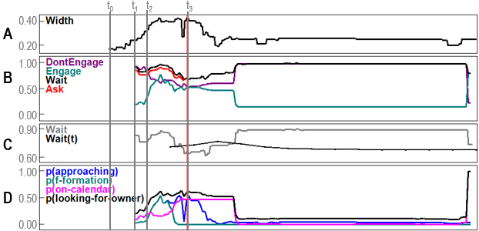
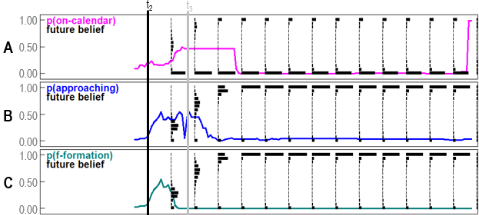
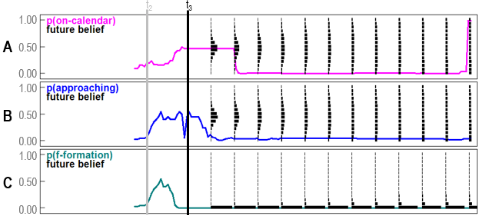
The Assistant also computes the utility of Wait(t) and AskAndWait(t). For each time t, these computations are based on projection models for the On-Calendar, Activity and FFormation percepts. Figures 5A, B, and C show the projected future beliefs (black histograms at every future time point), as computed at time t2. The actual beliefs (constructed at the future points) are also shown as a solid, colored line.
The projected beliefs for the On-Calendar percept, shown as black histograms in Figure 5A, are constructed based on a mixture of two Beta distributions. The mixture model is formulated such that, if the actor is getting closer the system (as in our example), the On-Calendar perceptual inference is more likely to output future beliefs with more certainty, concentrated towards 0 and 1. The projected beliefs for the Activity and F-Formation percepts are computed similarly and displayed in Figures 5B and C. These figures indicate that, if the Assistant waits, there will be reduced uncertainty over whether the person is on the calendar, whether they are approaching, and whether they are entering in an f-formation. The computation for the expected utility of Wait(t) performed at time t2 integrates over these predicted future beliefs, and also takes into account the probability that the actor will disappear. Figure 4C shows the resulting expected utility of Wait(t) for different values of t. The maximum expected utility is attained for a wait time of t=3 seconds, and corresponds to the value for the Wait action shown in gray in Figure 4C. Similarly, the computation for the expected utility of AskAndWait(t) integrates over the predicted future beliefs, as well as over the probability that the response might arrive by time t, and takes into account the likelihood of different responses.
As Figure 4B shows, while initially the expected utility on Engage increases, and even exceeds the expected utility of DontEngage shortly thereafter, the expected utility of Wait is even larger; the system infers that waiting is most beneficial since the person is getting closer and uncertainties about their identity, and, ultimately their goals, will likely be resolved and a better decision can be made in the near future.
Next, the visitor passes by the Assistant and sits in a nearby chair (see Figure 2(d)). In Figure 6A, B, and C, we show the projected beliefs for the On-Calendar, Activity and FFormation percepts, as computed at time t3. As the person is no longer moving closer, the projected beliefs indicate that there is not much to gain by waiting. At t3, the expected utility of AskAndWait exceeds the expected utility of Wait (see Figure 4B), as the perceptual belief projection model indicates that the identity will not be known better in the future and the visitor will not likely leave immediately. The Assistant launches an external query about the visitor's identity.
Figure 6: Projected percept beliefs computed for t3 for OnCalendar (A), Activity B, F-Formation (C).
From this point forward, the AskAndWait action is no longer evaluated, but the utility computation for the Wait(t) action also reflects the fact that the response to the information gathering action might arrive. When this happens a few seconds later, at time t4, the system finds that the visitor is indeed the person expected and the corresponding probability for on-calendar increases to 1.0 (see Figure 4D). The maximum expected utility action becomes Engage (see Figure 4B), and the system proactively engages the visitor that is at this point still waiting in the chair (see Figure 2D), by saying "Pardon me, are you looking for [Owner's Name]?"
5 Conclusions and FutureWork
We introduced belief projection for computing the value of information in systems that operate with high-dimensional streaming sensory evidence. The approach relies on developing direct conditional models to predict future beliefs based on current evidence. Belief projection can be used to resolve tradeoffs between acting immediately and waiting for more evidence to accumulate. The methods are well-suited for systems that use hierarchical architectures for making state inferences. We implemented belief projection in a deployed interactive agent and illustrated how the methodology enables mixed-initiative engagement policies. Using belief projection models constructed with heuristic parameters, the system is able to deliberate about the value of waiting for more information from sensors, soliciting help in real time from experts, or acting immediately.
We are currently exploring the learning of the projection models from case libraries of sensory data via non-parametric methods. Another direction for future work is investigating whether belief projection can be applied to broader decisionmaking problems with arbitrary sequences of actions.
@inproceedings{ijcai2013p377,
  title     = {Look versus Leap: Computing Value of Information with High-Dimensional Streaming Evidence},
  author    = {Rosenthal, Stephanie and Bohus, Dan and Kamar, Ece and Horvitz, Eric},
  booktitle = {Proceedings of the Twenty-Third International Joint Conference on
               Artificial Intelligence, {IJCAI-13}},
  publisher = {AAAI Press / International Joint Conferences on Artificial Intelligence},
  editor    = {Francesca Rossi},
  pages     = {2561--2566},
  year      = {2013},
  month     = {8},
  url       = {https://ijcai.org/proceedings/2013/377},
}
TY - CPAPER TI - Look versus Leap: Computing Value of Information with High-Dimensional Streaming Evidence AU - Rosenthal, Stephanie AU - Bohus, Dan AU - Kamar, Ece AU - Horvitz, Eric T2 - Proceedings of the Twenty-Third International Joint Conference on Artificial Intelligence, IJCAI-13 PB - AAAI Press / International Joint Conferences on Artificial Intelligence PY - 2013 SP - 2561 EP - 2566 UR - https://ijcai.org/proceedings/2013/377 ER -Copied
Machine-readable versions of this paper, for tools and AI agents:





