
Probabilistic Reasoning with Undefined Properties in Ontologically-Based Belief Networks
Proceedings of the Twenty-Third International Joint Conference on Artificial Intelligence. Pages 2532-2538.
© 2013 International Joint Conferences on Artificial Intelligence
Abstract
This paper concerns building probabilistic models with an underlying ontology that defines the classes and properties used in the model. In particular, it considers the problem of reasoning with properties that may not always be defined. Furthermore, we may even be uncertain about whether a property is defined for a given individual. One approach is to explicitly add a value undefined to the range of random variables, forming extended belief networks; however, adding an extra value to a random variable's range has a large computational overhead. In this paper, we propose an alternative, ontologically-based belief networks, where all properties are only used when they are defined, and we show how probabilistic reasoning can be carried out without explicitly using the value undefined during inference. We prove this is equivalent to reasoning with the corresponding extended belief network and empirically demonstrate that inference becomes more efficient.
- Aristotle, 350 BC] Aristotle. Categories. Translated by E. M. Edghill, 350 B.C. [Berg, 1982] Jan Berg. Aristotle's theory of definition. In ATTI del Convegno Internazionale di Storia della Logica, pages 19-30, San Gimignano, 1982.
- [Boutilier et al., 1996] Craig Boutilier, Nir Friedman, Moi- ses Goldszmidt, and Daphne Koller. Context-specific in- dependence in Bayesian networks. In Proceedings of the Twelfth Conference on Uncertainty in Artificial Intelli- gence (UAI-96), pages 115-123, 1996.
- [Darwiche, 2001] Adnan Darwiche. Recursive conditioning. Artificial Intelligence, 126(1-2):5-41, 2001.
- [Darwiche, 2009] Adnan Darwiche. Modeling and Reason- ing with Bayesian Networks. Cambridge University Press, 2009.
- [De Raedt et al., 2008] Luc De Raedt, Paolo Frasconi, Kris- tian Kersting, and Stephen H. Muggleton, editors. Proba- bilistic Inductive Logic Programming. Springer, 2008.
- [Dechter, 1996] R. Dechter. Bucket elimination: A unifying framework for probabilistic inference. In E. Horvitz and F. Jensen, editors, UAI-96, pages 211-219, Portland, OR, 1996.
- [Getoor and Taskar, 2007] Lise Getoor and Ben Taskar, edi- tors. Introduction to Statistical Relational Learning. MIT Press, Cambridge, MA, 2007.
- [Grau et al., 2008] Bernardo Cuenca Grau, Ian Horrocks, Boris Motik, Bijan Parsia, Peter Patel-Schneider, and Ul- rike Sattler. Owl 2: The next step for owl. Web Semant., 6(4):309-322, November 2008.
- [Koller and Friedman, 2009] Daphne Koller and Nir Fried- man. Probabilistic Graphical Models -Principles and Techniques. MIT Press, 2009.
- [Motik et al., 2012a] Boris Motik, Peter F. Patel-Schneider, and Bernardo Cuenca Grau. Owl 2 web ontology lan- guage: Direct semantics (second edition). W3C Recom- mendation, 11 December 2012, 2012.
- [Motik et al., 2012b] Boris Motik, Peter F. Patel-Schneider, and Bijan Parsia. Owl 2 web ontology language: Structural specification and functional-style syntax (second edition). W3C Recommendation, 11 December 2012, 11 December 2012.
- [Pearl, 1988] J. Pearl. Probabilistic Reasoning in Intelligent Systems: Networks of Plausible Inference. Morgan Kauf- mann, San Mateo, CA, 1988.
- [Poole and Zhang, 2003] David Poole and Nevin Lianwen Zhang. Exploiting contextual independence in probabilis- tic inference. Journal of Artificial Intelligence Research, 18:263-313, 2003. Code is available from http://www.cs. ubc.ca/~poole/code.html. Link
- [Poole et al., 2008] David Poole, Clinton Smyth, and Rita Sharma. Semantic science: Ontologies, data and proba- bilistic theories. In Uncertainty Reasoning for the Seman- tic Web I, LNAI/LNCS. Springer, 2008.
- [Poole et al., 2009] David Poole, Clinton Smyth, and Rita Sharma. Ontology design for scientific theories that make probabilistic predictions. IEEE Intelligent Systems, 24(1):27-36, Jan/Feb 2009.
- [Smith, 2003] Barry Smith. Ontology. In L. Floridi, editor, Blackwell Guide to the Philosophy of Computing and In- formation, pages 155-166. Oxford: Blackwell, 2003.
- [Zhang and Poole, 1994] N. L. Zhang and D. Poole. A sim- ple approach to Bayesian network computations. In Proc. 10th Canadian Conference on AI, pages 171-178, 1994.
- [Zhang and Poole, 1999] N. L. Zhang and D. Poole. On the role of context-specific independence in probabilistic rea- soning. In IJCAI-99, pages 1288-1293, Stockholm, Swe- den, August 1999.
References were extracted automatically from the PDF and may contain errors.
Full text extracted automatically from the PDF; figures, tables and equations may differ. The PDF is the version of record.
1 Introduction
In many fields, we want ontologies to define the vocabulary and probabilistic models to make predictions. For example, in geology, the need to define standardized vocabularies becomes clear when one looks at detailed geological maps, which do not match at political boundaries because jurisdictions use incompatible vocabularies. There has been much recent effort to define ontologies for geology and use them to describe data (e.g., http://onegeology.org/). Geologists need to make decisions under uncertainty, and so need probabilistic models that use ontologies. Similarly, in the biomedical domain, huge ontologies (e.g., http://obofoundry.org/) are being developed and need to be integrated into decision making under uncertainty.
In an ontology, the domain of a property specifies the individuals for which the property is defined. One of the problems in the integration of ontologies and reasoning under uncertainty arises when properties have non-trivial domains and thus are not always defined. Properties applied to individuals correspond to random variables in the probabilistic model, giving rise to random variables that are not always defined. For example, the property education may be applicable to people but not to dogs or rocks. However, we may not know if an individual is a person, and performance on some task may depend on his/her education level if the individual is a person, such as when some damage may have been caused by a crafty person (depending on his/her education level) or by a natural phenomenon. Similarly, hardness measure (in Mohs scale) may be applicable to rocks but not to people. When modelling and learning, we do not want to think about undefined values, and we will never observe an undefined value in a dataset that obeys the ontology; for instance, we do not want to consider the education level of rocks, and no data would contain such information.
∗The author contributed to this work while she was doing a summer internship at UBC.
We propose a simple framework, ontologically-based belief networks (OBBNs), which integrates belief networks [Pearl, 1988] with ontologies. OBBNs do not explicitly use an undefined value in the construction of random variables, but by leveraging the ontology, we can compute the posterior distribution of any random variable, including the possibility of it being undefined. We define three inference methods for computing the posterior distribution of a random variable. The first method explicitly includes an extra value "undefined" in the range of the random variables that are potentially undefined. The second does not include "undefined", but involves two separate inference steps: (i) determining the probability that the query is well-defined and (ii) querying a random variable as if the well-definedness of the query were observed evidence. The third only adds "undefined" to the range of the target variable at query time.
2 Ontologies
An ontology is a formal specification of the meanings of the symbols in an information system [Smith, 2003]. Ontologies provide researchers and practitioners with standardized vocabulary in which to describe the world. An ontology defines any terminology that needs to be shared among datasets.
Modern ontologies, such as those in the Web Ontology Language (OWL) [Grau et al., 2008; Motik et al., 2012b], are defined in terms of classes, properties, and individuals. The semantics of OWL is defined in terms of sets [Motik et al., 2012a] - a class characterizes the set of all possible individuals it may contain, and a property is a binary relation, which is the set of all ordered pairs for which the property holds.
Properties have domains and ranges. The domain of a property is the class of individuals for which the property is defined. Thus, a property is only defined for individuals in its domain; for other individuals, the property is not defined. The range of a property specifies the set of possible values for the property.
It has been advocated that ontologies be written in terms of Aristotelian definitions [Aristotle, 350 BC; Berg, 1982; Poole et al., 2009], where each explicitly specified class is defined in terms of a super-class, the genus, and restrictions on properties (e.g., that some property has a particular value), the differentia, that distinguish this class from other subclasses of the genus. This is not a restrictive assumption, as we can always define a property that is true of members of a class. It allows us to just model properties, with classes being defined in terms of property restrictions. So, we can model uncertainty in relationship to properties.
Thing is the single top-level class, which every other class is a subclass of, and that contains all possible individuals.
Example 1. The functional property education is defined for humans, and its range is {low,high}. This can be specified in OWL-2 functional syntax:
Declaration(ObjectProperty(:education)) FunctionalObjectProperty(:education) ObjectPropertyDomain(:education :Human) ObjectPropertyRange(:education ObjectUnionOf(:Low :High))A human is any individual in the class Animal for which the property isHuman is true:
Declaration(Class(:Human)) EquivalentClasses( :Human ObjectIntersectionOf( DataHasValue(:isHuman "true"^^xsd:boolean) :Animal)) Declaration(DataProperty(:isHuman)) FunctionalDataProperty(:isHuman) DataPropertyDomain(:isHuman owl:Animal) DataPropertyRange(:isHuman xsd:boolean)Here, we stated that isHuman is only defined for animals. This makes the example later more interesting. An animal is an individual for which the property isAnimal is true and can be defined in a similar way. The domain of isAnimal is Thing and its range is a Boolean value.
In Example 1, the genus and differentia of Animal are Thing and isAnimal = true, respectively, whereas those of the class Human are Animal and isHuman = true. The property education has Human as its domain and is thus undefined when applied to an individual for which isHuman is not true. Likewise, isHuman has domain Animal and so is only defined for individuals of the class Animal.
Definition 1. An ontology O contains a set of logical assertions about a set C of classes, a set Prop of properties, and a set I of individuals. Each property p ∈ Prop has a domain and a range. In addition, O does not contain cyclic definitions of property domains in the sense that any class that defines the domain of a property cannot be defined in terms of that property.
We use O.C and O.Prop to refer to the classes and properties, respectively, of ontology O.
An Aristotelian ontology is an ontology where every class C ∈ C is either Thing or is defined as C′ ∈ C conjoined with a set of property restrictions (such as p1 = v1 ∧ · · · ∧ pk = vk, where pi ∈ Prop, vi ∈ range(pi), and pi is defined for individuals in C′ for which p1 = v1 ∧· · ·∧ pi-1 = vi-1). We can always reduce a class C to a conjunction of property restrictions (with Thing omitted), which we refer to as the primitive form of class C. We denote by dom(p) the primitive form of the domain of p. The ontology induces a partial ordering of the properties: for every property p ∈ Prop, any property p′ appearing in dom(p) precedes p, written as p′ ≺ p. Aristotelian definitions give rise to a class hierarchy and reduce class definitions to property restrictions. In Example 1, dom(education) ≡ isAnimal = t rue ∧ isHuman = t rue.
The acyclic restriction avoids the possibility of defining two classes in terms of each other. It ensures that to determine whether a property is defined for an individual cannot involve applying the property to that individual.
A formula, i.e., logical sentence written in the language (e.g., OWL) used for an ontology, is entailed by the ontology if the formula is always true given the set of logical assertions in the ontology. As a simple example, if an ontology specifies that Student is a subclass of Human and Human is a subclass of Animal, then the ontology entails that Student is a subclass of Animal, i.e., any individual in the class Student is also in the class Animal. There exist ontology reasoners for OWL, (e.g., Pellet 1 and HermiT 2 ), that determine such entailments. We write O |= a if formula a is entailed by ontology O.
3 Integration of Ontologies with Probabilistic Models
Graphical models [Pearl, 1988] represent factorizations of joint probability distributions in terms of graphs that encode conditional (in)dependencies amongst random variables. A belief network is a directed graphical model where the factorization represents conditional probability distributions (CPDs) of the random variables. A relational probabilistic model [Getoor and Taskar, 2007; De Raedt et al., 2008], also referred to as a template-based model [Koller and Friedman, 2009], extends a graphical model with the relational (or firstorder) component and can be defined in terms of parametrized random variables. Given a population of individuals, such models can be grounded into standard graphical models. Our work concerns directed graphical models.
We will follow the integration of ontologies and probabilistic models of Poole et al. [2008; 2009], where random variables are constructed from properties and individuals. When modelling uncertainty, a functional property applied to an individual becomes a random variable, where the range of the random variable is the range of the property. A
1 http://clarkparsia.com/pellet
2 http://hermit-reasoner.com/
non-functional property applied to an individual becomes a Boolean random variable for each value in the range of the property. We can arrange these random variables into a DAG which specifies (conditional) dependencies.
The underlying property of a random variable is undefined for individuals not in its domain. We need a way to represent that a random variable is defined only in some contexts. As Poole et al. [2009] noticed, the idea of using a random variable only in a context in which it is defined is reminiscent of context-specific independence [Boutilier et al., 1996; Zhang and Poole, 1999]. Here, instead of context-specific independence, a random variable is simply not defined in some contexts.
While an ontologically-based probabilistic model is inherently relational (as the ontology is about properties of individuals), the issues considered do not depend on the relational structure. For the rest of the paper, we discuss the propositional version, which can be considered as either being about a single distinguished individual or about the grounding of a relational network, with the individuals implicit.
Definition 2. For each random variable X, the extended variant of X is a random variable X + with range(X +) = range(X) ∪ {⊥}, where X + = X when X is defined, and X + = ⊥ when X is undefined.
A straightforward approach to dealing with undefined properties is to do inference using extended random variables and standard inference methods. In this paper, we explore representing and reasoning in terms of the non-extended random variables. Exact inference methods such as variable elimination [Zhang and Poole, 1994; Dechter, 1996] or recursive conditioning [Darwiche, 2001; 2009] have complexity O(|variables' range|T ), where T is the network treewidth. Reducing the ranges of random variables can have a dramatic impact on inference speed.
The alternatives are best given in terms of a motivating example:
Example 2. Continuing Example 1, suppose the ontology contains the property causeDamage, whose domain is Thing and range is {true, false}, which specifies whether an individual is capable of causing some particular damage.
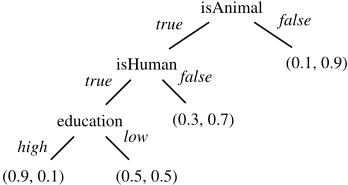
Suppose we have the following conditional probabilities for causeDamage. For non-animals, there is a small probability (e.g., 0.1) that causeDamage = true. For animals that are not human, the probability of causeDamage = true is higher (e.g., 0.3). For humans, the distribution of causeDamage depends on education. When education is high, the probability of causeDamage = true is 0.9, and when education is low, the probability of causeDamage = true is 0.5. A tree representation of the CPDs for causeDamage given its parents isAnimal, isHuman, and education is given in Figure 1.
Note that the conditional probabilities in Example 2 obey the constraint that a property is only used in a context where it is defined.
One way of encoding the possibility of a property being undefined is to build a model using the extended random variables. The ontology implies the probabilities:
To define the distribution over all random variables, we also need the probabilities: P(isAnimal+ = true), P(isHuman+ = true | isAnimal+ = true), and P(education+ = high | isHuman+ = true). A belief network using the extended random variables is shown in Figure 2, where causeDamage+ depends on all three other random variables. A tabular ver-
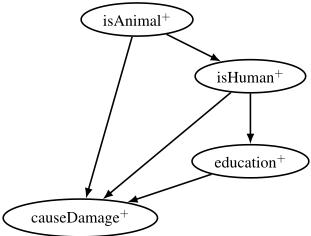
sion of the CPDs for causeDamage+ would define the probability distribution of causeDamage+ in 27 contexts (3 3 ). A tree-structured version of the CPDs of causeDamage+ is more complicated than that in Figure 1, because it needs to model the undefined cases that are implied by the ontology.
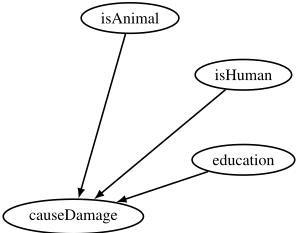
A simpler representation is to build a model with the nonextended random variables as in Figure 3. In this model, the constraints of the ontology are not represented. In particular, there is no arc from isHuman to educat ion - the probability of education does not depend on isHuman; only the definedness of education does, and that is represented by the ontology. Not only do the random variables have smaller ranges, but the network is smaller (with fewer arcs).
In this paper, we address two questions: (i) how to build a model and specify probabilities and (conditional) independencies that obey the constraints implied by the underlying ontology, and (ii) how to carry out probabilistic inference, by leveraging the ontology, so that undefined values do not need to be explicitly modelled in the random variables.
4 Ontologically-Based Belief Networks
In this section, we define ontologically-based belief networks (OBBNs), which represent probabilistic dependencies separately from the logical dependencies of an ontology.
4.1 Representation
Preliminary Definitions and Notation
In an OBBN, random variables are constructed from properties in the ontology 3 . For a random variable, the domain of its corresponding property signifies when the random variable is defined. The range of a random variable is the range of the corresponding property in the ontology.
Propositions are built from variable-value assignments with logical connectives. We need to be concerned with undefined values. Here, we assume pre-emptive operators, which are evaluated from left-to-right 4 :
Definition 3. A proposition is of one of the following forms:
- X = x where X is a random variable and x ∈ range(X), which is true if X has value x.
- a ∧b where a and b are propositions, which is false if a is false or if a is true and b is false, and is true if both a and b are true. It is undefined if a is undefined or if a is true and b is undefined.
- ¬a where a is a proposition, which is true if a is false, is false if a is true, and is undefined if a is undefined.
- a ∨b where a and b are propositions, which has the same value as ¬(¬a ∧¬b ).
3 Since every random variable corresponds to a property in the ontology, we use the same symbol to refer to both the variable and the property. Thus, the individuals are left implicit. The context will make clear to which of the two constructs the symbol is referring.
4 These should be familiar to programmers, as most programming languages have non-commutative logical operations, allowing x ̸= 0∧y = 1/x to be false when x = 0, as opposed to y = 1/x∧x ̸= 0, which is undefined (giving an error) when x = 0.
These operators strictly extend the standard definitions. It is straightforward to check that, while non-commutative, the defined logical conjunction and disjunction operators remain associative. In the rest of this paper, when dealing with nonextended random variables, the notations ∧, ¬, and ∨ are used to represent the non-commutative logic, instead of the commonly used operators in classical logic.
Definition 4. A proposition is well-defined in context Con, where Con is a proposition, with respect to an ontology if
- the proposition is of the form X = x, and the ontology entails that Con implies dom(X); or
- the proposition is of the forma∧b, a is well-defined in Con, and b is well-defined in Con∧a; or
- the proposition is of the form¬a, and a is well-defined in Con; or
- the proposition is of the forma∨b, a is well-defined in Con, and b is well-defined in Con∧¬a.
A well-defined proposition (in some context Con) is never evaluated to undefined. When a context is not specified, we assume the context True.
We use the notation vars(a), for some proposition a, to denote the set of random variables that appear in a. Furthermore, for any proposition a of variable assignments, we use a + to denote the corresponding proposition with variables Xi ∈ vars(a) replaced by their extended variants X + i but assigned the same value as Xi in a.
Structural and Probabilistic Constraints
An OBBN, like a belief network, is specified in terms of conditional probability distributions (CPDs) of random variables. We start with a total ordering of random variables X1, . . . ,Xn that is consistent with the partial order of the properties in the ontology. For each random variable Xi, a set of CPDs given the values of its parent variables, Pa(Xi) ⊆ {X1, . . . , Xi-1}, are specified such that P(Xi | X1, . . . ,Xi-1) = P(Xi | Pa(Xi)).
A parent context [Poole and Zhang, 2003] for a random variable X is a proposition c such that vars(c) ⊆ Pa(X) and c is well-defined in the context dom(X). For every random variable X, assume there is a covering set of parent contexts PX, such that the parent contexts in PX are mutually exclusive and their disjunction is implied by dom(X). For every ci ∈PX, there is a probability distribution pi over range(X), which represents P(X | ci).
This construction implies that for any pair of random variables X and Y ∈ vars(dom(X)), Y is not a descendent of X. A random variable Y , whose instantiation may possibly render X undefined, cannot thus be probabilistically influenced by the value of X. This follows from the constraint that the total ordering of the random variables used in the construction of the probabilistic model is consistent with the property ordering of the ontology.
Note that the random variables involved in the primitive form of the domain of a random variable X, vars(dom(X)), need not be parents of X in an OBBN, unless X is also probabilistically dependent on these random variables. The CPDs of X are simply irrelevant in the cases when its domain does not hold.
Definition 5. An ontologically-based belief network (OBBN) is described by a 5-tuple 〈Ont,X,≺,Pa,P〉, where
- Ont is an ontology;
- X ⊆Ont.Prop is a set of random variables;
- ≺ is a total ordering of the variables that is consistent with the property ordering of Ont;
- Pa : X → 2 X specifies, for each Xi ∈ X, the set of its parent variables Pa(Xi) ⊆ {X ∈ X : X ≺ Xi}; and
- P is a mapping from X, that maps X ∈ X into {〈ci, pi〉 : ci ∈PX}. Thus, P(X) specifies a conditional probability distribution for X given any proposition that is consistent with dom(X).
While the definition of an OBBN does not require that the CPDs of the random variables be specified in any particular form, a natural representation of the CPDs is a tree structure, like that for context-specific independence [Boutilier et al., 1996]. In the tree-structured representation of the CPDs for X, the internal nodes correspond to the parent variables, and the arcs from a node correspond to values for the random variable at that node. The domain of X conjoined with the path to a node must imply the domain of the random variable at that node in the ontology. PX corresponds to the set of paths down the tree, with the corresponding conditional probability distributions at the leaves.
Example 3. Figure 1 depicts a tree-structured representation of the CPDs for causeDamage. Note that the path isAnimal = false cannot split on any other parent variable because any more splitting results in undefined conjunctions of variable assignments, and similarly for the path isAnimal = true ∧ isHuman = false.
Example 4. The tree-structured CPDs for education consist of only one single distribution (e.g., (0.2,0.8)) over {low,high}, since education does not need a parent variable in an OBBN. We will only use education in the contexts where the individual under consideration is a human.
Given an OBBNM= 〈Ont,X,≺,Pa,P〉, the corresponding extended belief network (EBN) M+ has random variables X + for X ∈ X, and the parents of X + are the parents of X together with those random variables in the minimal subset Y of vars(dom(X)) such that for every random variable Y ∈ vars(dom(X)), either Y ∈ Y or M.Ont |= dom(X)Y → dom(X){Y}, where dom(X)Y denotes the part of dom(X) that involves the variables in Y and similarly for dom(X){Y}. In the worst case, Y = vars(dom(X)). For contexts ci where dom(X) is true, PM+(X + | c+i ) = PM(X | ci), (hence PM+(X + = ⊥ | c+i ) = 0). For contexts ci where dom(X) is false, PM+(X + =⊥ | c+i ) =1.
4.2 Semantics
The standard semantics for probability is in terms of possible worlds, which correspond to assignments to all of the random variables. A joint probability distribution is a distribution over the possible worlds, and probabilities of individual propositions can be defined in terms of this. When there is an underlying ontology, an assignment of a value to each random variable is often undefined. If we only consider the well-defined assignments, we can get a smaller possible world structure. The analogous notion to an assignment of a value to each random variable is a maximal well-defined conjunction of variable assignments:
Definition 6. A well-defined conjunction of variable assignments X1 = x1 ∧ · · · ∧ Xk = xk is maximal if for any variable X ′ /∈ {X1, . . . ,Xk} and any value x′ ∈ range(X ′ ), X1 = x1 ∧· · ·∧ Xk = xk ∧ X ′ = x′ is not well-defined.
To avoid considering equivalent conjunctions that only differ in the order of variable assignments, we assume that variables in a conjunction follow a total ordering consistent with the ordering of the ontology. For conjunction a, we use a<k to denote the preceding part of a that contains all variables Xi ∈ vars(a) with i < k.
Whereas an EBN encodes a joint probability distribution over all conjunctions of extended variable assignments that involve all the random variables, an OBBN represents a joint probability distribution only over maximal well-defined conjunctions of the non-extended random variables. For an OBBNMwith the total ordering X1, . . . ,Xn of random variables, the probability of a maximal well-defined conjunction, a ≡ Xp(1) = xp(1) ∧· · ·∧Xp(k) = xp(k), (where p is a mapping from {1, . . . ,k} to {1, . . . ,n} with p(i) < p(i+1)), is computed as:
where cp(i) is the parent context for Xp(i) such that a<p(i) |= cp(i). By not representing the undefined worlds, an OBBN can reduce the size of the set of possible worlds by an exponential factor.
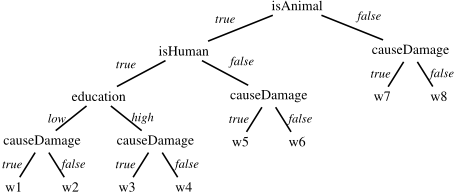
Example 5. For the EBN in Example 2, there are 4 random variables, each with 3 values (including ⊥), and so there are 3 4 = 81 possible worlds. The possible worlds for the OBBN for Example 3 are shown in Figure 4. Out of the 81 possible worlds for the EBN, only 8 have a non-zero probability. The others are impossible due to the ontology. There is an isomorphism between the non-zero worlds and the worlds for the EBN in Figure 4.
5 Inference
The problem of inference is to determine the posterior distribution P(Q+ | E) for a random variable Q, given some welldefined observed evidence E. We compare three approaches:
EBN-Q Compute P(Q+ | E +) using the EBN.
- 3Q Compute P(dom(Q) | E) and P(Q | E ∧dom(Q)) using the OBBN.
- MQ Replace Q in the OBBN with Q+, add explicit dependencies from vars(dom(Q)) to Q+, and then compute P(Q+ | E) using the modified OBBN.
We first describe 3Q. The inference starts with querying whether the ontology entails that Q is always, never, or sometimes well-defined given E. This relatively cheap computation can simplify or even make redundant the subsequent probabilistic queries. There are three possible outcomes for the ontological query:
- The ontology entails that E implies dom(Q) is false:
The answer to the query is then: P(Q+ =⊥) = 1. No probabilistic inference is needed.
- The ontology entails that E implies dom(Q) is true:
In this case, P(Q+ = ⊥) = 0, and for any other value q ̸=⊥, P(Q+ = q | E) is the same as P(Q= q | E) in the OBBN, (which does not contain undefined values).
- Otherwise, it remains uncertain whether an assignment Q = q, for any q ∈ range(Q), is well-defined given E. We proceed with two separate probabilistic inference tasks, which can be run in parallel: (i) determining the probability that Q = q is well-defined given E. Let g =P(dom(Q) | E); and (ii) calculating the distribution of Q when it is well-defined, i.e., P(Q | E ∧dom(Q)). We return P(Q+ =⊥ | E) = 1-g, and for q ̸=⊥, P(Q+ = q | E) = g P(Q = q | E ∧dom(Q)). Since dom(Q) is welldefined, (i) needs not deal with the potential issue of undefinedness. Similarly, (ii) incorporates dom(Q) into the evidence and becomes an instance of Case 2, where the query variable is always defined.
Leveraging the underlying ontology, the entire inference process of 3Q boils down to an ontological query, followed by up to two probabilistic queries. The ontological query is assumed to be a relatively cheaper computation compared to the probabilistic queries, yet in some cases, it lets us skip one or both of the probabilistic queries. This inference scheme is summarized in Procedure 3Q-INFERENCE.
Compared with 3Q, MQ allows for a single probabilistic query and so avoids repeated computation, at the expense of needing to dynamically modify the OBBN structure for each query.
6 Equivalence of Representations
In this section, we present the coherence of an OBBN and the validity of 3Q-INFERENCE by comparing it to inference using the corresponding EBN.
Procedure 3Q-INFERENCE
Input: OBBNM, query variable Q, and evidence E. Output: posterior distribution P(Q+ | E), where range(Q+) = range(Q) ∪ {⊥}. if Ont |=E →¬dom(Q) then return P(Q+ = ⊥ | E) = 1 else if Ont |=E →dom(Q) then D ← P(Q | E) return {P(Q | E) = D, P(Q+ = ⊥ | E) = 0} else g ←P(dom(Q) | E) D ← P(Q | E ∧ dom(Q)) return {P(Q | E) = g · D, P(Q+ = ⊥ | E) = 1-g} endTheorem 1. Every maximal well-defined conjunction S of variable assignments defined in an OBBN M can be extended to a possible world S +f ull in the corresponding EBN by adding an assignment of ⊥ to every random variable X /∈ vars(S), and PM(S) = PM+(S +f ull ). All other possible worlds in M+ have probability 0.
For a proof of this and other theorems, see the online appendix 5 . This shows that an OBBN represents a probability distribution over all maximal well-defined conjunctions of variable assignments.
This result is surprising because although some propositions may not be well-defined, as long as we follow the structure of an OBBN and never have a defined variable depend on an undefined variable, we never need to explicitly represent the value "undefined".
The coherence of an OBBN and the correspondence between the OBBN and the EBN directly lead to the consistency of probabilistic query results between the two models.
Theorem 2. Let M be an OBBN with a total ordering X1, . . . , Xn of random variables and M+ be the corresponding EBN. Let S be a well-defined conjunction of variable assignments. Then PM(S) = PM+(S +).
Theorem 3. Let Mbe an OBBN andM+ be the corresponding EBN. For any random variable Q and well-defined evidence E with PM(E) > 0, the posterior PM(Q+ | E) returned by 3Q-INFERENCE is the same as PM+(Q+ | E +).
7 Empirical Comparison
We construct an ontology that expands parametrically with the number of properties. For each property, there can be classes that are defined when the property is true, classes defined when the property is false, and classes that are defined when the property is defined but do not depend on its value. We construct one instance of each of these classes in a recursive tree structure, which we call a TAF structure (for "true, always, false"), in a breadth-first manner.
Figure 5 provides a pictorial illustration of the synthetic ontology. The range of each property is {true, false}. Property p0 is always defined, (e.g., the domain of p0 could be Thing in an OWL ontology). Property p1 is only defined when p0 = true; p2 is always defined regardless of the value p0 takes; and p3 is defined when p0 = false. p4 is defined only when p1 = true, (so dom(p4) ≡ p0 = true∧ p1 = true). Note that although p5 is defined no matter what value p1 takes, it still requires that p1 be defined, which means p0 = true. Other properties are constructed in the same fashion.
5 The appendix can be accessed at http://www.cs.ubc.ca/~poole/ papers/kuo-ijcai2013-appendix.pdf.
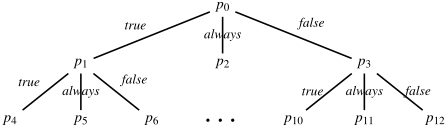
We build an OBBN using the ontology such that each random variable pi probabilistically depends on every predecessor variable whenever it is defined, except for those variables whose values are determined when pi is defined. As an example, for the ontology in Figure 5, p12 has probabilistic dependencies on p2, p7, p8, p9, and p11. We query the final random variable.
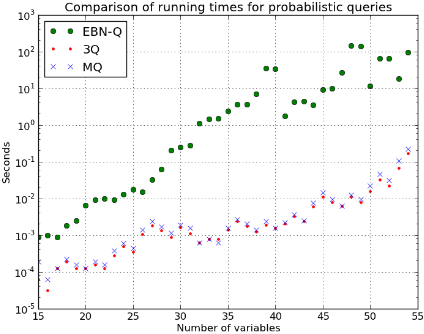
We use an open-source implementation of the CVE algorithm [Poole and Zhang, 2003], which uses a compact representation for the CPDs to exploit context-specific independence. Figure 6 presents a comparison of the running times for probabilistic queries using the OBBN and its corresponding EBN. These running times are the averages of those of 500 runs of the same queries for 15 ≤ n ≤ 30, 100 runs for 31 ≤ n ≤ 45, and 10 runs for 46 ≤ n, where n is the number of random variables 6 . The significant difference in the running times demonstrates that inference with OBBNs can be orders of magnitude more efficient 7 .
All of the measured running times are for a Java implementation running on a Windows 7 machine with an Intel dualcore i5-2520 processor and 16 GB of RAM, with up to 12 GB allocated to the Java Virtual Machine. Garbage collector was run using a separate parallel thread.
8 Conclusion
We have presented OBBNs, a simple framework that integrates belief networks with ontologies and avoids explicit modelling of undefined values in the random variables. We showed that, by exploiting the determinism that arises from the ontology, probabilistic reasoning involving variables whose corresponding properties may not be well-defined can still be effectively carried out. The proposed framework frees domain modellers from having to think about undefined values by separating the probabilistic dependencies from the logical dependencies implied by the ontology. Importantly, it also facilitates more efficient inference by leveraging the ontology to reduce the probabilistic network structures and the ranges of the random variables.
6 For the small models, we could not get meaningful measures of the running times with one single run of each query, due to the issue of recorded numerical precision. The inference procedures are deterministic, and the variation in our implementation's running times is not significant.
7 In our experiments, we ran the two probabilistic queries sequentially. However, they could easily be executed in parallel.
Acknowledgement
We thank Matthew Dirks and the anonymous reviewers for their comments. This work was supported in part by NSERC, Mitacs, and the Institute for Computing, Information and Cognitive Systems (ICICS) at UBC.
@inproceedings{ijcai2013p373,
  title     = {Probabilistic Reasoning with Undefined Properties in Ontologically-Based Belief Networks},
  author    = {Kuo, Chia-Li and Buchman, David and Katiyar, Arzoo and Poole, David},
  booktitle = {Proceedings of the Twenty-Third International Joint Conference on
               Artificial Intelligence, {IJCAI-13}},
  publisher = {AAAI Press / International Joint Conferences on Artificial Intelligence},
  editor    = {Francesca Rossi},
  pages     = {2532--2538},
  year      = {2013},
  month     = {8},
  url       = {https://ijcai.org/proceedings/2013/373},
}
TY - CPAPER TI - Probabilistic Reasoning with Undefined Properties in Ontologically-Based Belief Networks AU - Kuo, Chia-Li AU - Buchman, David AU - Katiyar, Arzoo AU - Poole, David T2 - Proceedings of the Twenty-Third International Joint Conference on Artificial Intelligence, IJCAI-13 PB - AAAI Press / International Joint Conferences on Artificial Intelligence PY - 2013 SP - 2532 EP - 2538 UR - https://ijcai.org/proceedings/2013/373 ER -Copied
Machine-readable versions of this paper, for tools and AI agents:





